steering wheel SATURN ASTRA 2008 Owner's Manual
[x] Cancel search | Manufacturer: SATURN, Model Year: 2008, Model line: ASTRA, Model: SATURN ASTRA 2008Pages: 304, PDF Size: 1.92 MB
Page 146 of 304

Care of the CD Player
Do not add labels to a CD, it could
get caught in the CD player. Use a
marking pen to write on the top of the
CD if a description is needed.
Do not use CD lens cleaners, they
could damage the CD player.
Notice:If a label is added to a
CD, or more than one CD is
inserted into the slot at a time,
or an attempt is made to play
scratched or damaged CDs, the
CD player could be damaged.
While using the CD player, use
only CDs in good condition
without any label, load one CD at a
time, and keep the CD player and
the loading slot free of foreign
materials, liquids, and debris.
Theft-Deterrent Feature
The audio system is equipped
with an electronic safety system to
prevent theft, and only works in the
vehicle.
Audio Steering Wheel
Controls
Some audio controls can be
adjusted at the steering wheel.
Several functions of the audio
system can be operated with the
audio remote control buttons and
the rotary control located on
both sides of the steering wheel.Depending on the vehicle’s features,
see the following audio controls:
Z(Rotary Control):Manually
seek a station by turning to move
the cursor either to the previous
or next screen entry. Press to
conrm the selection.
For the DIC (Driver Information
Center), press the rotary control to
call up the DIC menu. Press to
reset the current value. Press and
hold for two seconds to reset
all of the values.
Y:Press to go to the next preset
station if playing the radio.
Press to go to the beginning of a
currently playing CD or to the
next album on an MP3.
6-24 Infotainment
ProCarManuals.com
Page 154 of 304

Starting and
Operating Your
Vehicle
New Vehicle Break-In
Notice:Your vehicle does not
need an elaborate break-in. But it
will perform better in the long
run if you follow these guidelines:
Do not drive at any one
constant speed, fast or slow,
for the rst 500 miles (805 km).
Do not make full-throttle
starts. Avoid downshifting
to brake or slow the vehicle.
Avoid making hard stops for
the rst 200 miles (322 km) or
so. During this time the new
brake linings are not yet broken
in. Hard stops with new linings
can mean premature wear and
earlier replacement. Follow this
breaking-in guideline every
time you get new brake linings.Following break-in, engine
speed and load can be gradually
increased.
Ignition Positions
Use the key to turn the ignition
switch to four different positions.
Notice:Using a tool to force the
key to turn in the ignition could
cause damage to the switch or
break the key. Use the correct key,
make sure it is all the way in, and
turn it only with your hand. If the
key cannot be turned by hand, see
your dealer/retailer.To shift out of P (Park), the ignition
must be in the ON/RUN position
and the regular brake pedal must
be applied.
A (LOCK/OFF):This is the only
position from which you can remove
the key. This locks the steering
wheel, ignition and automatic
transmission.
On vehicles with an automatic
transmission, the shift lever must
be in P (Park) to turn the ignition
switch to the LOCK/OFF position.
The ignition switch can bind in the
LOCK/OFF position with your wheels
turned off center. If this happens,
move the steering wheel from
right to left while turning the key to
STEERING UNLOCK/IGNITION
OFF. If this doesn’t work, then the
vehicle needs service.
8-2 Driving and Operating
ProCarManuals.com
Page 155 of 304
B (STEERING UNLOCKED/
IGNITION OFF):This position
unlocks the steering wheel.
C (ON/RUN):The ignition switch
stays in this position when the
engine is running. This position can
be used to operate the electrical
accessories, as well as to display
some warning and indicator lights.
The battery could be drained if you
leave the key in the ON/RUN position
with the engine off. You may not be
able to start the vehicle if the battery
is allowed to drain for an extended
period of time.
D (START):This position starts
the engine. When the engine starts,
release the key. The ignition switch
will return to ON/RUN for normal
driving. A warning tone will sound
when the driver door is opened and
the key is in the ignition.Retained Accessory
Power (RAP)
The power windows and mirrors
may be used for up to ve minutes
after the key is turned to LOCK/OFF.
The power windows and mirrors will
not operate after any of the front
doors are opened.
The radio may be used for up to
sixty minutes after the key is turned
to LOCK/OFF.
Starting the Engine
Automatic Transmission
Move the shift lever to P (Park) or
N (Neutral). The engine will not start
in any other position. To restart
when you are already moving,
use N (Neutral) only.
Notice:Do not try to shift to
P (Park) if your vehicle is moving.
If you do, you could damage the
transmission. Shift to P (Park)
only when your vehicle is stopped.
Manual Transmission
The shift lever should be in Neutral
and the parking brake engaged.
Hold the clutch pedal to the
oor and start the engine. The
vehicle will not start if the clutch
pedal is not all the way down.
Starting Procedure
1. With your foot off the accelerator
pedal, turn the ignition key to
START. When the engine starts,
let go of the key. The idle speed
will go down as your engine gets
warm. Do not race the engine
immediately after starting it.
Operate the engine and
transmission gently to allow the
oil to warm up and lubricate all
moving parts.
Driving and Operating 8-3
ProCarManuals.com
Page 171 of 304
Remember: ABS does not change
the time you need to get your foot
up to the brake pedal or always
decrease stopping distance. If you
get too close to the vehicle in front of
you, you will not have time to apply
the brakes if that vehicle suddenly
slows or stops. Always leave enough
room up ahead to stop, even though
you have ABS.
Using ABS
Do not pump the brakes. Just hold
the brake pedal down rmly and
let antilock work for you. You might
hear the antilock pump or motor
operate, and feel the brake
pedal pulsate, but this is normal.
Braking in Emergencies
With ABS, you can steer and
brake at the same time. In many
emergencies, steering can help
you more than even the very best
braking.
StabiliTrak®System
Your vehicle may have StabiliTrak
which combines antilock brake,
traction and stability control systems
and helps the driver maintain
directional control of the vehicle
in most driving conditions.
When you rst start your vehicle and
begin to drive away, the system
performs several diagnostic checks
to ensure there are no problems.
You may hear or feel the system
working. This is normal and does not
mean there is a problem with your
vehicle. The system should initialize
before the vehicle reaches 20 mph
(32 km/h).
The system monitors vehicle
movements, and helps the driver
maintain control of the vehicle in
most driving situations. When the
vehicle’s stability is affected the
engine output is reduced, and the
brakes are applied to individual
wheels.When you turn the ignition on,
this light on the instrument panel
cluster will come on for a few
seconds, then go out when the
system is ready.
You may also feel or hear the
system working; this is normal.
StabiliTrak is automatically enabled
whenever you start your vehicle.
To assist the driver with vehicle
directional control, especially in
slippery road conditions, you should
always leave the system on. But, you
can turn it off if you ever need to.
Driving and Operating 8-19
ProCarManuals.com
Page 172 of 304
It is recommended to leave the
system on for normal driving
conditions, but it may be necessary
to turn the system off if your vehicle
is stuck in sand, mud, ice or snow,
and you want to “rock” your vehicle
to attempt to free it. It may also be
necessary to turn off the system
when driving in extreme off-road
conditions where high wheel spin
is required. SeeIf Your Vehicle is
Stuck in Sand, Mud, Ice, or Snow
on page 8-29.
StabiliTrak may also turn off
automatically if it determines that a
problem exists with the system.
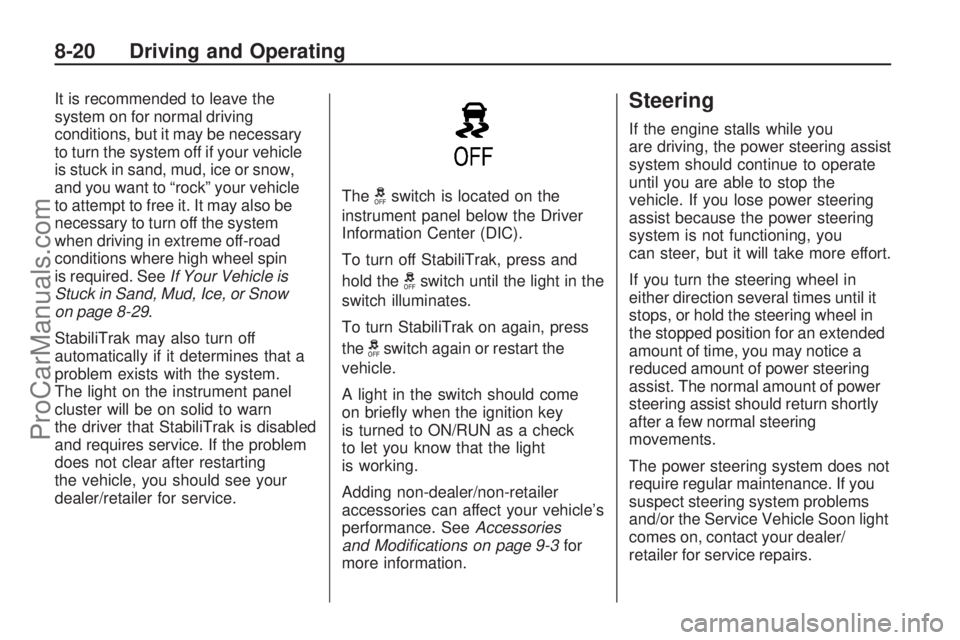
The light on the instrument panel
cluster will be on solid to warn
the driver that StabiliTrak is disabled
and requires service. If the problem
does not clear after restarting
the vehicle, you should see your
dealer/retailer for service.The
gswitch is located on the
instrument panel below the Driver
Information Center (DIC).
To turn off StabiliTrak, press and
hold the
gswitch until the light in the
switch illuminates.
To turn StabiliTrak on again, press
the
gswitch again or restart the
vehicle.
A light in the switch should come
on briey when the ignition key
is turned to ON/RUN as a check
to let you know that the light
is working.
Adding non-dealer/non-retailer
accessories can affect your vehicle’s
performance. SeeAccessories
and Modifications on page 9-3for
more information.
Steering
If the engine stalls while you
are driving, the power steering assist
system should continue to operate
until you are able to stop the
vehicle. If you lose power steering
assist because the power steering
system is not functioning, you
can steer, but it will take more effort.
If you turn the steering wheel in
either direction several times until it
stops, or hold the steering wheel in
the stopped position for an extended
amount of time, you may notice a
reduced amount of power steering
assist. The normal amount of power
steering assist should return shortly
after a few normal steering
movements.
The power steering system does not
require regular maintenance. If you
suspect steering system problems
and/or the Service Vehicle Soon light
comes on, contact your dealer/
retailer for service repairs.
8-20 Driving and Operating
ProCarManuals.com
Page 173 of 304

Steering Tips
It is important to take curves at a
reasonable speed.
A lot of the “driver lost control”
accidents mentioned on the news
happen on curves. Here is why:
Experienced driver or beginner,
each of us is subject to the same
laws of physics when driving on
curves. The traction of the tires
against the road surface makes it
possible for the vehicle to change its
path when you turn the front wheels.
If there is no traction, inertia will
keep the vehicle going in the same
direction. If you have ever tried to
steer a vehicle on wet ice, you will
understand this.
Traction in a curve depends on
the condition of the tires and
the road surface, the angle at which
the curve is banked, and your
speed. While in a curve, speed is
the one factor you can control.Suppose you are steering
through a sharp curve. Then
you suddenly accelerate. Both
control systems — steering
and acceleration — have to do
their work where the tires meet
the road. Adding the sudden
acceleration can demand too much
of those places. You can lose
control. SeeStabiliTrak
®System
on page 8-19.
What should you do if this ever
happens? Ease up on the brake
or accelerator pedal, steer the
vehicle the way you want it to go,
and slow down.
Speed limit signs near curves warn
that you should adjust your speed.
Of course, the posted speeds are
based on good weather and road
conditions. Under less favorable
conditions you will want to go slower.If you need to reduce speed when
approaching a curve, do it before
you enter the curve, while the front
wheels are straight ahead.
Try to adjust the speed so you can
drive through the curve. Maintain
a reasonable, steady speed. Wait
to accelerate until you are out of the
curve, and then accelerate gently
into the straightaway.
Adding non-dealer/non-retailer
accessories can affect your vehicle’s
performance. SeeAccessories
and Modifications on page 9-3.
Driving and Operating 8-21
ProCarManuals.com
Page 174 of 304

Steering in Emergencies
There are times when steering can
be more effective than braking. For
example, you come over a hill and
nd a truck stopped in your lane, or a
car suddenly pulls out from nowhere,
or a child darts out from between
parked cars and stops right in front of
you. You can avoid these problems
by braking — if you can stop in time.
But sometimes you cannot; there is
not room. That is the time for evasive
action — steering around the
problem.
Your vehicle can perform very well
in emergencies like these. First
apply the brakes. SeeBraking on
page 8-17. It is better to remove
as much speed as you can from a
possible collision. Then steer around
the problem, to the left or right
depending on the space available.An emergency like this requires
close attention and a quick decision.
If you are holding the steering wheel
at the recommended 9 and 3 o’clock
positions, you can turn it a full
180 degrees very quickly without
removing either hand. But you have
to act fast, steer quickly, and just as
quickly straighten the wheel once
you have avoided the object.
The fact that such emergency
situations are always possible is a
good reason to practice defensive
driving at all times and wear
safety belts properly.
Off-Road Recovery
Your vehicle’s right wheels can drop
off the edge of a road onto the
shoulder while driving.
If the level of the shoulder is only
slightly below the pavement,
recovery should be fairly easy.
Ease off the accelerator and then,
if there is nothing in the way,
steer so that your vehicle straddles
the edge of the pavement.
8-22 Driving and Operating
ProCarManuals.com
Page 175 of 304

Turn the steering wheel 3 to
5 inches (about one-eighth turn)
until the right front tire contacts the
pavement edge. Then turn the
steering wheel to go straight down
the roadway.
Passing
Passing another vehicle on a
two-lane road can be dangerous.
To reduce the risk of danger
while passing:
Look down the road, to the sides,
and to crossroads for situations
that might affect a successful
pass. If in doubt, wait.
Watch for traffic signs, pavement
markings, and lines that could
indicate a turn or an intersection.
Never cross a solid or
double-solid line on your
side of the lane.
Do not get too close to the vehicle
you want to pass. Doing so can
reduce your visibility.
Wait your turn to pass a slow
vehicle.
When you are being passed, ease
to the right.
Loss of Control
Let us review what driving experts
say about what happens when
the three control systems — brakes,
steering, and acceleration — do
not have enough friction where the
tires meet the road to do what
the driver has asked.
In any emergency, do not give up.
Keep trying to steer and constantly
seek an escape route or area of
less danger.
Skidding
In a skid, a driver can lose control of
the vehicle. Defensive drivers avoid
most skids by taking reasonable care
suited to existing conditions, and by
not overdriving those conditions.
But skids are always possible.
The three types of skids correspond
to your vehicle’s three control
systems. In the braking skid, the
wheels are not rolling. In the steering
or cornering skid, too much speed or
steering in a curve causes tires to
slip and lose cornering force. And
in the acceleration skid, too much
throttle causes the driving wheels
to spin.
A cornering skid is best handled
by easing your foot off of the
accelerator pedal.
Driving and Operating 8-23
ProCarManuals.com
Page 180 of 304

You can get wet ice when it is about
freezing, 32°F (0°C), and freezing
rain begins to fall. Try to avoid driving
on wet ice until salt and sand crews
can get there.
Whatever the condition — smooth
ice, packed, blowing, or loose
snow — drive with caution.
Accelerate gently. Try not to
break the fragile traction. If you
accelerate too fast, the drive wheels
will spin and polish the surface
under the tires even more.
The Antilock Brake System (ABS)
improves your vehicle’s stability
when you make a hard stop
on a slippery road. Even though you
have ABS, begin stopping soonerthan you would on dry pavement.
SeeAntilock Brake System
(ABS) on page 8-18.
Allow greater following distance
on any slippery road.
Watch for slippery spots. The
road might be ne until you hit
a spot that is covered with ice.
On an otherwise clear road, ice
patches can appear in shaded
areas where the sun cannot
reach, such as around clumps of
trees, behind buildings, or under
bridges. Sometimes the surface
of a curve or an overpass can
remain icy when the surrounding
roads are clear. If you see a patch
of ice ahead of you, brake before
you are on it. Try not to brake
while you are actually on the ice,
and avoid sudden steering
maneuvers.
If You Are Caught in a Blizzard
If you are stopped by heavy
snow, you could be in a serious
situation. You should probably
stay with your vehicle unless you
know for sure that you are near
help and you can hike through the
snow. Here are some things to do
to summon help and keep yourself
and your passengers safe:
Turn on the hazard warning
ashers.
Tie a red cloth to your vehicle to
alert police that you have been
stopped by the snow.
Put on extra clothing or wrap a
blanket around you. If you do not
have blankets or extra clothing,
make body insulators from
newspapers, burlap bags, rags,
oor mats — anything you can
wrap around yourself or tuck
under your clothing to keep warm.
You can run the engine to keep
warm, but be careful.
8-28 Driving and Operating
ProCarManuals.com
Page 182 of 304

Rocking Your Vehicle to
Get It Out
First, turn the steering wheel left and
right to clear the area around the
front wheels. Turn off any stability
system. SeeStabiliTrak
®System on
page 8-19. Then shift back and forth
between REVERSE (R) and a
forward gear, or with a manual
transmission, between FIRST (1) or
SECOND (2) and REVERSE (R),
spinning the wheels as little as
possible. To prevent transmission
wear, wait until the wheels stop
spinning before shifting gears.Release the accelerator pedal
while you shift, and press lightly
on the accelerator pedal when
the transmission is in gear. By slowly
spinning the wheels in the forward
and reverse directions, you will
cause a rocking motion that could
free your vehicle. If that does not get
your vehicle out after a few tries, it
might need to be towed out. If your
vehicle does need to be towed out,
seeTowing Your Vehicle on
page 9-72.
Loading the Vehicle
It is very important to know how
much weight your vehicle can
carry. This weight is called the
vehicle capacity weight and
includes the weight of all
occupants, cargo and all
nonfactory-installed options.
Two labels on your vehicle
show how much weight it may
properly carry, the Tire and
Loading Information label and
the Certication label.
8-30 Driving and Operating
ProCarManuals.com