automatic transmission SATURN AURA 2010 Owners Manual
[x] Cancel search | Manufacturer: SATURN, Model Year: 2010, Model line: AURA, Model: SATURN AURA 2010Pages: 428, PDF Size: 2.78 MB
Page 9 of 428
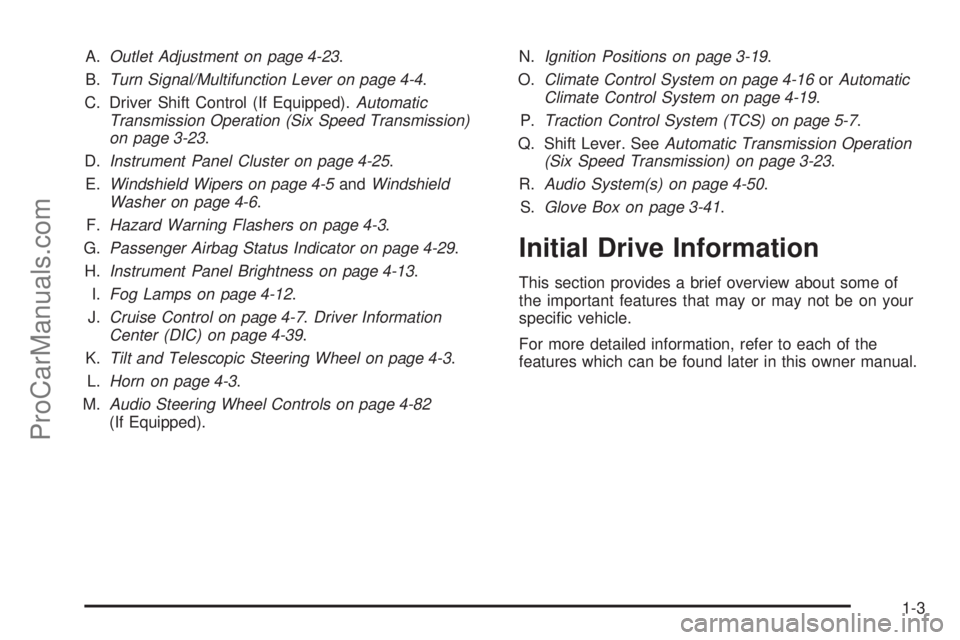
A.Outlet Adjustment on page 4-23.
B.Turn Signal/Multifunction Lever on page 4-4.
C. Driver Shift Control (If Equipped).Automatic
Transmission Operation (Six Speed Transmission)
on page 3-23.
D.Instrument Panel Cluster on page 4-25.
E.Windshield Wipers on page 4-5andWindshield
Washer on page 4-6.
F.Hazard Warning Flashers on page 4-3.
G.Passenger Airbag Status Indicator on page 4-29.
H.Instrument Panel Brightness on page 4-13.
I.Fog Lamps on page 4-12.
J.Cruise Control on page 4-7.Driver Information
Center (DIC) on page 4-39.
K.Tilt and Telescopic Steering Wheel on page 4-3.
L.Horn on page 4-3.
M.Audio Steering Wheel Controls on page 4-82
(If Equipped).N.Ignition Positions on page 3-19.
O.Climate Control System on page 4-16orAutomatic
Climate Control System on page 4-19.
P.Traction Control System (TCS) on page 5-7.
Q. Shift Lever. SeeAutomatic Transmission Operation
(Six Speed Transmission) on page 3-23.
R.Audio System(s) on page 4-50.
S.Glove Box on page 3-41.
Initial Drive Information
This section provides a brief overview about some of
the important features that may or may not be on your
specific vehicle.
For more detailed information, refer to each of the
features which can be found later in this owner manual.
1-3
ProCarManuals.com
Page 20 of 428
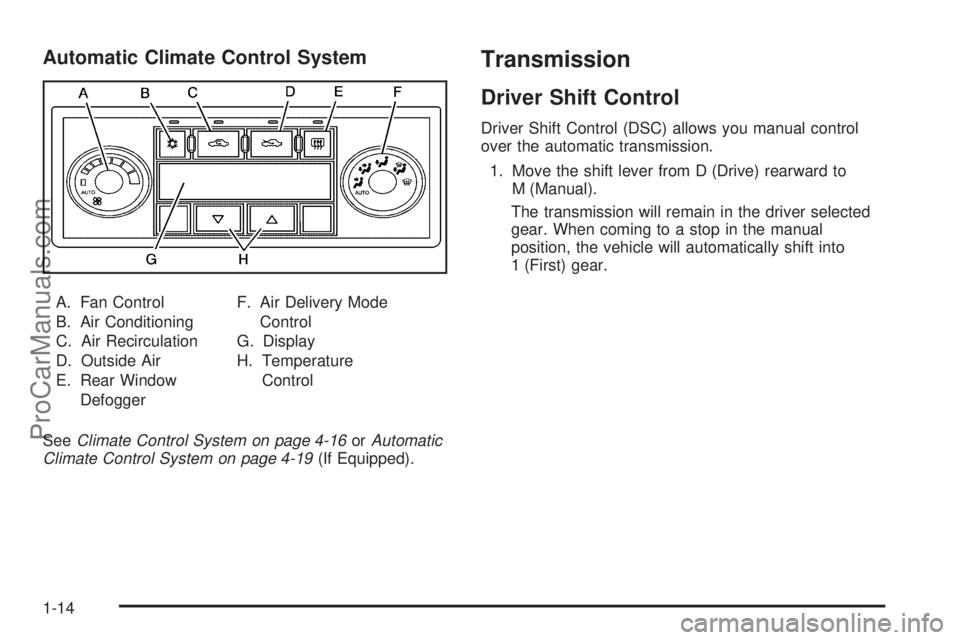
Automatic Climate Control System
A. Fan Control
B. Air Conditioning
C. Air Recirculation
D. Outside Air
E. Rear Window
DefoggerF. Air Delivery Mode
Control
G. Display
H. Temperature
Control
SeeClimate Control System on page 4-16orAutomatic
Climate Control System on page 4-19(If Equipped).
Transmission
Driver Shift Control
Driver Shift Control (DSC) allows you manual control
over the automatic transmission.
1. Move the shift lever from D (Drive) rearward to
M (Manual).
The transmission will remain in the driver selected
gear. When coming to a stop in the manual
position, the vehicle will automatically shift into
1 (First) gear.
1-14
ProCarManuals.com
Page 21 of 428
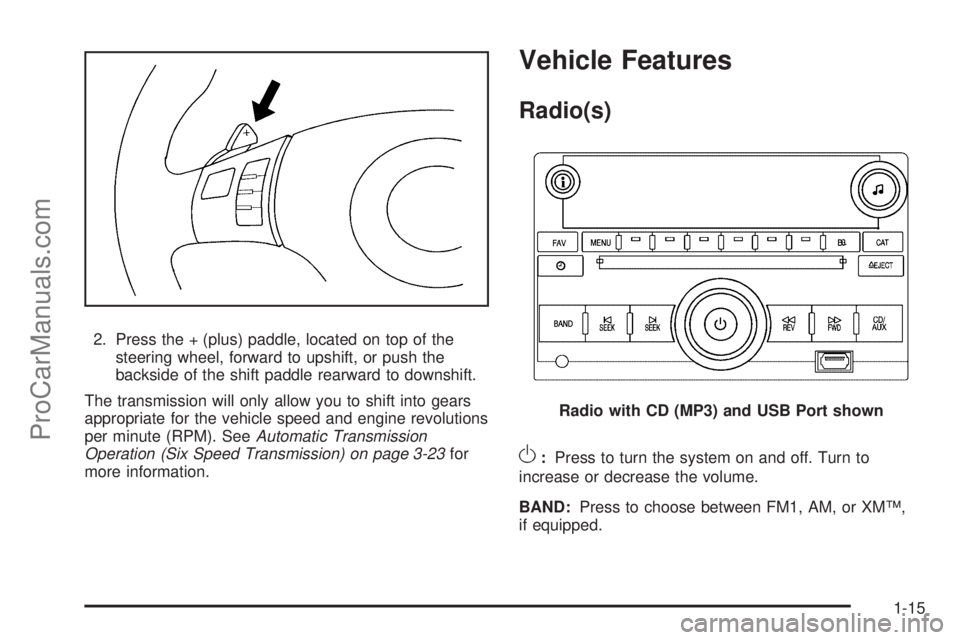
2. Press the + (plus) paddle, located on top of the
steering wheel, forward to upshift, or push the
backside of the shift paddle rearward to downshift.
The transmission will only allow you to shift into gears
appropriate for the vehicle speed and engine revolutions
per minute (RPM). SeeAutomatic Transmission
Operation (Six Speed Transmission) on page 3-23for
more information.
Vehicle Features
Radio(s)
O:Press to turn the system on and off. Turn to
increase or decrease the volume.
BAND:Press to choose between FM1, AM, or XM™,
if equipped.
Radio with CD (MP3) and USB Port shown
1-15
ProCarManuals.com
Page 109 of 428
Keys...............................................................3-2
Remote Keyless Entry (RKE) System................3-3
Remote Keyless Entry (RKE) System
Operation...................................................3-3
Remote Vehicle Start......................................3-5
Doors and Locks.............................................3-8
Door Locks....................................................3-8
Power Door Locks..........................................3-8
Door Ajar Reminder........................................3-8
Delayed Locking.............................................3-9
Programmable Automatic Door Locks................3-9
Rear Door Security Locks..............................3-10
Lockout Protection........................................3-10
Trunk..........................................................3-11
Windows........................................................3-13
Power Windows............................................3-14
Sun Visors...................................................3-15
Theft-Deterrent Systems..................................3-15
Content Theft-Deterrent.................................3-16
PASS-Key
®III+ Electronic Immobilizer.............3-17
PASS-Key®III+ Electronic Immobilizer
Operation.................................................3-17
Starting and Operating Your Vehicle................3-19
New Vehicle Break-In....................................3-19
Ignition Positions..........................................3-19
Retained Accessory Power (RAP)...................3-20Starting the Engine.......................................3-20
Engine Coolant Heater..................................3-22
Automatic Transmission Operation
(Six Speed Transmission)...........................3-23
Parking Brake..............................................3-26
Shifting Into Park..........................................3-27
Shifting Out of Park......................................3-28
Parking Over Things That Burn.......................3-29
Engine Exhaust............................................3-30
Running the Vehicle While Parked..................3-31
Mirrors...........................................................3-32
Manual Rearview Mirror.................................3-32
Automatic Dimming Rearview Mirror................3-32
Compass.....................................................3-33
Outside Power Mirrors...................................3-34
Outside Automatic Dimming Mirror..................3-34
Outside Heated Mirrors..................................3-34
Universal Home Remote System......................3-34
Universal Home Remote System Operation
(With Three Round LED)............................3-35
Storage Areas................................................3-41
Glove Box...................................................3-41
Cupholders..................................................3-41
Center Console Storage.................................3-41
Convenience Net..........................................3-42
Sunroof.........................................................3-42
Section 3 Features and Controls
3-1
ProCarManuals.com
Page 131 of 428
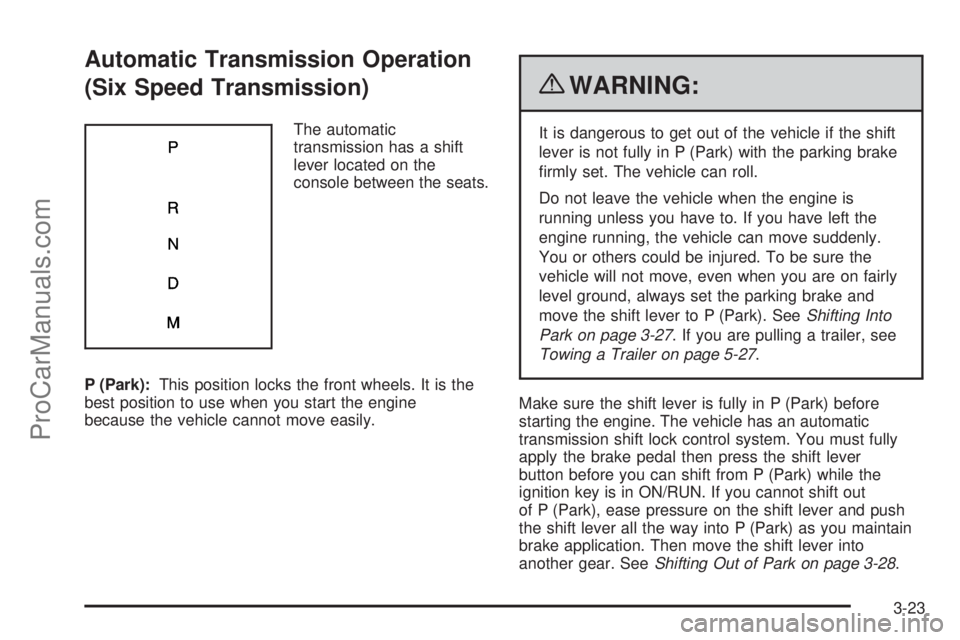
Automatic Transmission Operation
(Six Speed Transmission)
The automatic
transmission has a shift
lever located on the
console between the seats.
P (Park):This position locks the front wheels. It is the
best position to use when you start the engine
because the vehicle cannot move easily.
{WARNING:
It is dangerous to get out of the vehicle if the shift
lever is not fully in P (Park) with the parking brake
firmly set. The vehicle can roll.
Do not leave the vehicle when the engine is
running unless you have to. If you have left the
engine running, the vehicle can move suddenly.
You or others could be injured. To be sure the
vehicle will not move, even when you are on fairly
level ground, always set the parking brake and
move the shift lever to P (Park). SeeShifting Into
Park on page 3-27. If you are pulling a trailer, see
Towing a Trailer on page 5-27.
Make sure the shift lever is fully in P (Park) before
starting the engine. The vehicle has an automatic
transmission shift lock control system. You must fully
apply the brake pedal then press the shift lever
button before you can shift from P (Park) while the
ignition key is in ON/RUN. If you cannot shift out
of P (Park), ease pressure on the shift lever and push
the shift lever all the way into P (Park) as you maintain
brake application. Then move the shift lever into
another gear. SeeShifting Out of Park on page 3-28.
3-23
ProCarManuals.com
Page 132 of 428
R (Reverse):Use this gear to back up.
Notice:Shifting to R (Reverse) while the vehicle is
moving forward could damage the transmission.
The repairs would not be covered by the vehicle
warranty. Shift to R (Reverse) only after the vehicle
is stopped.
To rock the vehicle back and forth to get out of snow,
ice, or sand without damaging the transmission,
seeIf Your Vehicle is Stuck in Sand, Mud, Ice, or Snow
on page 5-18.
N (Neutral):In this position, the engine does not
connect with the wheels. To restart the engine when the
vehicle is already moving, use N (Neutral) only. Also,
use N (Neutral) when the vehicle is being towed.
{WARNING:
Shifting into a drive gear while the engine is
running at high speed is dangerous. Unless your
foot is firmly on the brake pedal, the vehicle could
move very rapidly. You could lose control and hit
people or objects. Do not shift into a drive gear
while the engine is running at high speed.Notice:Shifting out of P (Park) or N (Neutral) with
the engine running at high speed may damage
the transmission. The repairs would not be covered
by the vehicle warranty. Be sure the engine is
not running at high speed when shifting the vehicle.
D (Drive):This position is for normal driving. It
provides the best fuel economy. If you need more
power for passing, and you are:
•Going less than 35 mph (56 km/h), push the
accelerator pedal about halfway down.
•Going about 35 mph (56 km/h) or more, push the
accelerator all the way down.
M (Manual Mode):This position, allows you to change
gears similar to a manual transmission. If the vehicle
has this feature, see Driver Shift Control (DSC).
Driver Shift Control (DSC)
To use this feature, do the following:
1. Move the shift lever from D (Drive) rearward to
M (Manual).
While driving in manual mode, the transmission will
remain in the driver selected gear. When coming
to a stop in the manual position, the vehicle
will automatically shift into 1 (First) gear.
3-24
ProCarManuals.com
Page 133 of 428

2. Press the + (plus) paddle located on top of the
steering wheel controls forward to upshift, or
push the backside of the shift paddle rearward to
downshift.The Driver Information Center (DIC) in the instrument
cluster will change from the currently displayed message
to the letter “M”, For Manual position, and a number
indicating the requested gear range when moving
the shift lever forward or rearward.
While using the DSC feature the transmission will have
firmer shifting and sportier performance. You can
use this for sport driving or when climbing hills to stay in
gear longer or to downshift for more power or engine
braking.
The transmission will only allow you to shift into gears
appropriate for the vehicle speed and engine revolutions
per minute (RPM):
•The transmission will not automatically shift to the
next higher gear if the vehicle speed or engine
RPM is too low.
•The transmission will not allow shifting to the next
lower gear if the vehicle speed or engine RPM is
too high.
3-25
ProCarManuals.com
Page 139 of 428

Running the Vehicle While Parked
It is better not to park with the engine running. But if you
ever have to, here are some things to know.
{WARNING:
Idling a vehicle in an enclosed area with poor
ventilation is dangerous. Engine exhaust may
enter the vehicle. Engine exhaust contains Carbon
Monoxide (CO) which cannot be seen or smelled.
It can cause unconsciousness and even death.
Never run the engine in an enclosed area that has
no fresh air ventilation. For more information, see
Engine Exhaust on page 3-30.
{WARNING:
It can be dangerous to get out of the vehicle if the
automatic transmission shift lever is not fully in
P (Park) with the parking brake firmly set. The
vehicle can roll. Do not leave the vehicle when the
engine is running unless you have to. If you have
left the engine running, the vehicle can move
suddenly. You or others could be injured. To be
sure the vehicle will not move, even when you are
on fairly level ground, always set the parking
brake and move the shift lever to P (Park).
Follow the proper steps to be sure the vehicle will not
move. SeeShifting Into Park on page 3-27.
If parking on a hill and pulling a trailer, seeTowing a
Trailer on page 5-27.
3-31
ProCarManuals.com
Page 164 of 428

The DRL and automatic headlamp systems will only
be affected when the light sensor sees a change
in lighting lasting longer than this delay.
If vehicle is started in a dark garage, the automatic
headlamp system comes on immediately. Once
the vehicle leaves the garage, it takes about one minute
for the automatic headlamp system to change to DRL
if it is light outside. During that delay, the instrument
panel cluster may not be as bright as usual. Make sure
the instrument panel brightness control is in the full
bright position. SeeInstrument Panel Brightness
on page 4-13.
To idle the vehicle with the automatic headlamp system
off, turn the ignition on and set the exterior light
switch to the off/on position. For vehicles first sold in
Canada, the transmission must stay in P (Park) for this
function.
The regular headlamps should be used when needed.Fog Lamps
For vehicles with fog lamps, the button for this feature is
located on the instrument panel, to the left of the
steering wheel.
The ignition must be on for the fog lamps to work.
#:Press to turn the fog lamps on or off. An indicator
light comes on when the fog lamps are on.
The parking lamps automatically turn on and off when
the fog lamps are turned on and off.
The fog lamps turn off while the high-beam headlamps
are turned on.
Some localities have laws that require the headlamps to
be on along with the fog lamps.
4-12
ProCarManuals.com
Page 244 of 428
To turn the system off or
on, press and release this
button located on the
center console.
The DIC will display the appropriate message as
described previously when the button is pressed.
Traction Control Operation
Traction control limits wheel spin by reducing engine
power to the wheels (engine speed management)
and by applying brakes to each individual wheel
(brake-traction control) as necessary.
The traction control system is enabled automatically
when the vehicle is started, and it will activate and flash
the ESC/TCS light and display the LOW TRACTION
message if it senses either of the front wheels are
spinning or beginning to lose traction while driving. For
more information on the LOW TRACTION message,
seeDriver Information Center (DIC) on page 4-39.
Notice:If the wheel(s) of one axle are allowed to
spin excessively while the ESC/TCS, ABS and Brake
warning lights and the SERVICE ESC and/or
SERVICE TRACTION messages are displayed, thedifferential could be damaged. The repairs would
not be covered by the vehicle warranty. Reduce
engine power and do not spin the wheel(s)
excessively while these lights and this message
are displayed.
Notice:When traction control is turned off, it is
possible to lose traction. If you attempt to shift with
the front wheels spinning with a loss of traction,
it is possible to cause damage to the transmission.
Do not attempt to shift when the front wheels do
not have traction. Damage caused by misuse of the
vehicle is not covered. See your warranty book
for additional information.
The traction control system may activate on dry or
rough roads or under conditions such as heavy
acceleration while turning or abrupt upshifts/downshifts
of the transmission. When this happens, a reduction
in acceleration may be noticed, or a noise or vibration
may be heard. This is normal.
If the vehicle is in cruise control when the system
activates, the ESC/TCS light will flash and the cruise
control will automatically disengage. The cruise control
may be re-engaged when road conditions allow.
SeeCruise Control on page 4-7.
Adding non-dealer/non-retailer accessories can affect
the vehicle’s performance. SeeAccessories and
Modications on page 6-3for more information.
5-8
ProCarManuals.com