oil Seat Alhambra 2006 User Guide
[x] Cancel search | Manufacturer: SEAT, Model Year: 2006, Model line: Alhambra, Model: Seat Alhambra 2006Pages: 299, PDF Size: 6.33 MB
Page 142 of 299
Seats and stowage 140
Rear ashtrays
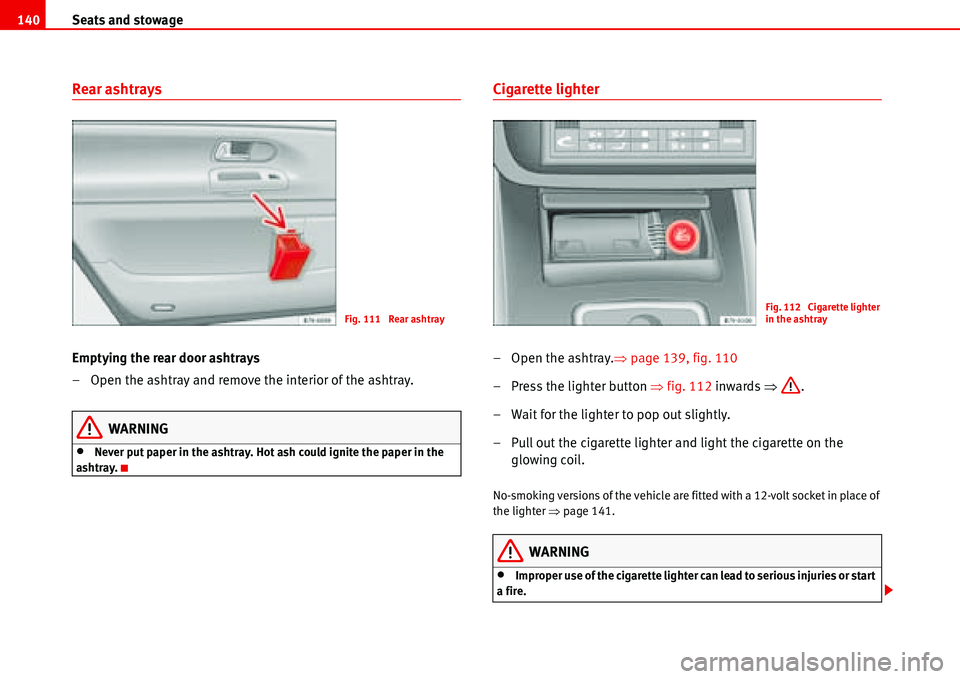
Emptying the rear door ashtrays
– Open the ashtray and remove the interior of the ashtray.
WARNING
•Never put paper in the ashtray. Hot ash could ignite the paper in the
ashtray.
Cigarette lighter
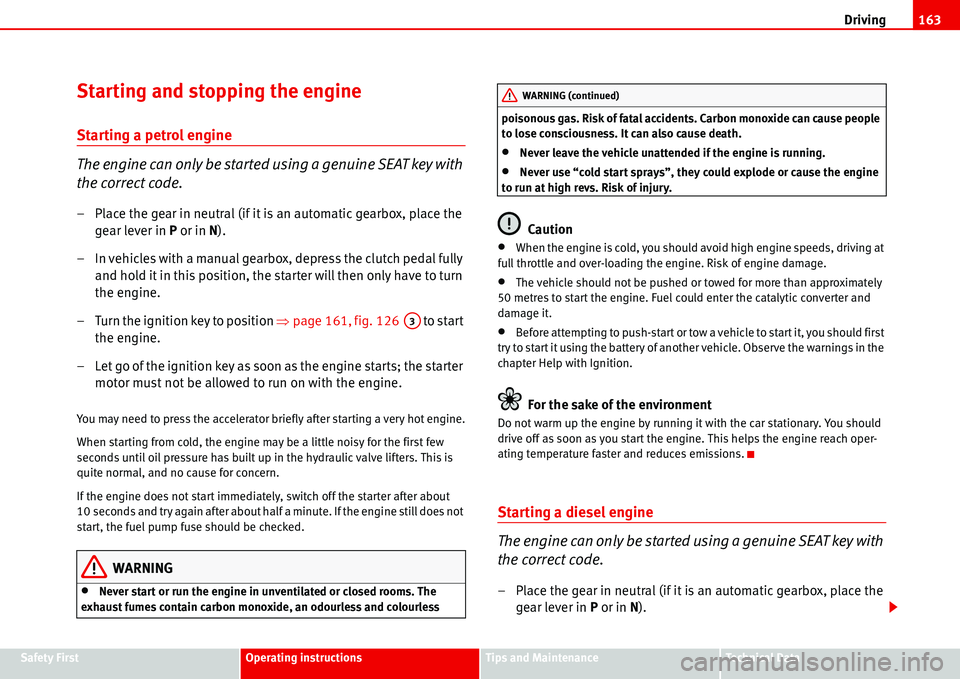
– Open the ashtray.Ÿpage 139, fig. 110
– Press the lighter button Ÿfig. 112 inwards Ÿ.
– Wait for the lighter to pop out slightly.
– Pull out the cigarette lighter and light the cigarette on the
glowing coil.
No-smoking versions of the vehicle are fitted with a 12-volt socket in place of
the lighter Ÿpage 141.
WARNING
•Improper use of the cigarette lighter can lead to serious injuries or start
a fire.
Fig. 111 Rear ashtrayFig. 112 Cigarette lighter
in the ashtray
Page 165 of 299
Driving163
Safety FirstOperating instructionsTips and MaintenanceTe c h n i c a l D a t a
Starting and stopping the engine
Starting a petrol engine
The engine can only be started using a genuine SEAT key with
the correct code.
– Place the gear in neutral (if it is an automatic gearbox, place the
gear lever in P or in N).
– In vehicles with a manual gearbox, depress the clutch pedal fully
and hold it in this position, the starter will then only have to turn
the engine.
– Turn the ignition key to position Ÿpage 161, fig. 126 to start
the engine.
– Let go of the ignition key as soon as the engine starts; the starter
motor must not be allowed to run on with the engine.
You may need to press the accelerator briefly after starting a very hot engine.
When starting from cold, the engine may be a little noisy for the first few
seconds until oil pressure has built up in the hydraulic valve lifters. This is
quite normal, and no cause for concern.
If the engine does not start immediately, switch off the starter after about
10 seconds and try again after about half a minute. If the engine still does not
start, the fuel pump fuse should be checked.
WARNING
•Never start or run the engine in unventilated or closed rooms. The
exhaust fumes contain carbon monoxide, an odourless and colourless poisonous gas. Risk of fatal accidents. Carbon monoxide can cause people
to lose consciousness. It can also cause death.
•Never leave the vehicle unattended if the engine is running.
•Never use “cold start sprays”, they could explode or cause the engine
to run at high revs. Risk of injury.
Caution
•When the engine is cold, you should avoid high engine speeds, driving at
full throttle and over-loading the engine. Risk of engine damage.
•The vehicle should not be pushed or towed for more than approximately
50 metres to start the engine. Fuel could enter the catalytic converter and
damage it.
•Before attempting to push-start or tow a vehicle to start it, you should first
try to start it using the battery of another vehicle. Observe the warnings in the
chapter Help with Ignition.
For the sake of the environment
Do not warm up the engine by running it with the car stationary. You should
drive off as soon as you start the engine. This helps the engine reach oper-
ating temperature faster and reduces emissions.
Starting a diesel engine
The engine can only be started using a genuine SEAT key with
the correct code.
– Place the gear in neutral (if it is an automatic gearbox, place the
gear lever in P or in N).
A3
WARNING (continued)
Page 166 of 299
Driving 164
– In vehicles with a manual gearbox, depress the clutch pedal fully
and hold it in this position, the starter will then only have to turn
the engine.
– Turn the ignition key to position Ÿpage 161, fig. 126 . The
warning lamp
D lights up to show that the glow plugs are
preheating the engine.
– When the warning lamp goes out, turn the key to position to
start the engine. Do not press the accelerator.
– Let go of the ignition key as soon as the engine starts, the starter
motor must not be allowed to run on with the engine.
When starting from cold, the engine may be a little noisy for the first few
seconds until oil pressure has built up in the hydraulic valve lifters. This is
quite normal, and no cause for concern.
If you have problems starting the engine, please refer to Help with Ignition.
Glow plug system
To avoid unnecessary loads on the battery, do not use any other major elec-
trical equipment while the glow plugs are preheating.
Start the engine as soon as the glow plug warning lamp goes out.
Starting a diesel engine after the fuel tank has been completely run dry
If the fuel tank has been completely run dry, it may take longer than normal
(up to one minute) to start a diesel engine after refuelling. This is because air
needs to be bled from the fuel system while starting.
WARNING
•Never start or run the engine in unventilated or closed rooms. The
exhaust fumes contain carbon monoxide, an odourless and colourless poisonous gas. Risk of fatal accidents. Carbon monoxide can cause people
to lose consciousness. It can also cause death.
•Never leave the vehicle unattended if the engine is running.
•Never use “cold start sprays”, they could explode or cause the engine
to run at high revs. Risk of injury.
Caution
•When the engine is cold, you should avoid high engine speeds, driving at
full throttle and over-loading the engine. Risk of engine damage.
•The vehicle should not be pushed or towed for more than approximately
50 metres to start the engine. Fuel could enter the catalytic converter and
damage it.
•Before attempting to push-start or tow a vehicle to start it, you should first
try to start it using the battery of another vehicle. Observe the warnings in the
chapter Help with Ignition.
For the sake of the environment
Do not warm up the engine by running it with the car stationary. You should
drive off as soon as you start the engine. This helps the engine reach oper-
ating temperature faster and reduces emissions.
Switching off the engine
– Stopping the engine.
– Turn the ignition key to position Ÿpage 161, fig. 126 .
A2
A3
WARNING (continued)
A1
Page 171 of 299
Driving169
Safety FirstOperating instructionsTips and MaintenanceTe c h n i c a l D a t a
Note
The two clutch system of the direct shift gearbox* has a system to protect
against excess strain, which may occur, for example, when the vehicle is held
on a hill with the clutch and the gearbox oil overheats. When the clutch is
overloaded, the vehicle begins to jerk and the position indicator of the
selector lever begins to flash. To avoid breakdowns, the clutch breaks the
power transmission between the engine and the gearbox, as a result of which
the vehicle loses impetus. If the clutch opens automatically due to over-
loading, depress the brake pedal and wait a few seconds before
continuing.
Selector lever positions
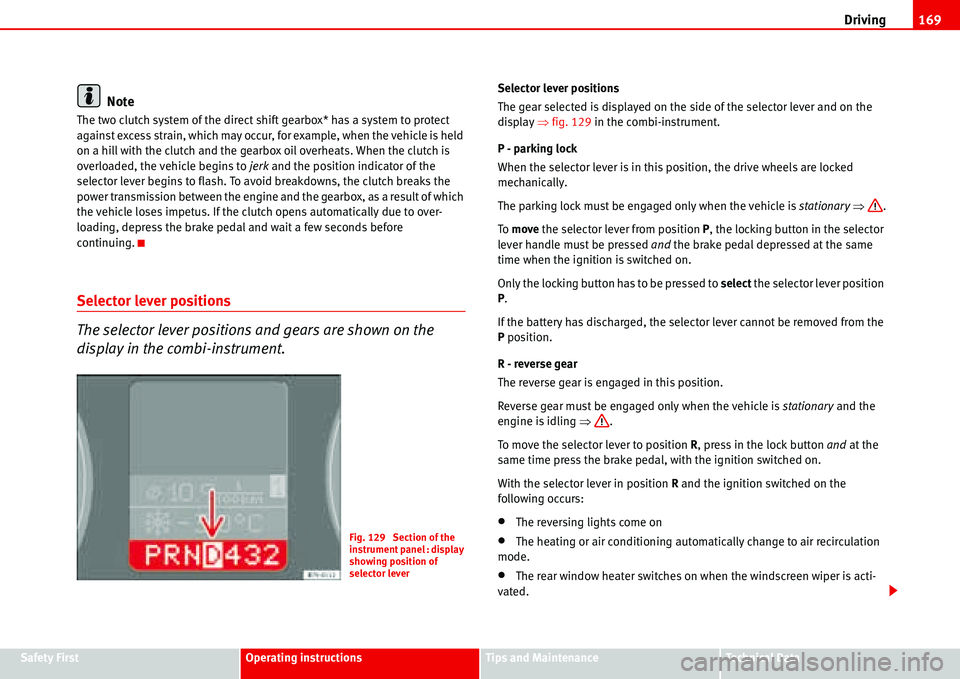
The selector lever positions and gears are shown on the
display in the combi-instrument.
Selector lever positions
The gear selected is displayed on the side of the selector lever and on the
display Ÿfig. 129 in the combi-instrument.
P - parking lock
When the selector lever is in this position, the drive wheels are locked
mechanically.
The parking lock must be engaged only when the vehicle is stationary Ÿ.
To move the selector lever from position P, the locking button in the selector
lever handle must be pressed and the brake pedal depressed at the same
time when the ignition is switched on.
Only the locking button has to be pressed to select the selector lever position
P.
If the battery has discharged, the selector lever cannot be removed from the
P position.
R - reverse gear
The reverse gear is engaged in this position.
Reverse gear must be engaged only when the vehicle is stationary and the
engine is idling Ÿ.
To move the selector lever to position R, press in the lock button and at the
same time press the brake pedal, with the ignition switched on.
With the selector lever in position R and the ignition switched on the
following occurs:
•The reversing lights come on
•The heating or air conditioning automatically change to air recirculation
mode.
•The rear window heater switches on when the windscreen wiper is acti-
vated.
Fig. 129 Section of the
instrument panel : display
showing position of
selector lever
Page 187 of 299
Driving and the environment185
Safety FirstOperating instructionsTips and MaintenanceTe c h n i c a l D a t a
Driving and the environment
Running-in
Running in a new engine
The engine needs to be run-in over the first 1,500 km.
Up to 1,000 kilometres
– Do not drive faster than three quarters of top speed.
– Do not use full throttle.
– Avoid high engine revolutions.
– Do not tow a trailer.
From 1000 to 1500 km
–Speeds can be gradually increased to the maximum road speed
or maximum permissible engine speed (rpm).
During its first few hours of running, the internal friction in the engine is
greater than later on when all the moving parts have bedded down.
For the sake of the environment
If the engine is run in gently, the life of the engine will be increased and its oil
consumption reduced.
Running in tyres and brake pads
New tyres should be run-in carefully for the first 500 km. New
brake pads should be run-in carefully for the first 200 km.
During the first 200 km, you can compensate for the reduced braking effect
by applying more pressure to the brake pedal. If you need to make an emer-
gency stop, the braking distance will be longer with new brake pads than with
brake pads which have been run-in.
WARNING
•New tyres do not give maximum grip to start with, and need running in.
This may cause an accident. Drive particularly carefully in the first 500 km.
•New brake pads must be “run in” and do not have the correct friction
properties during the first 200 km. However, you can compensate for the
slightly reduced braking effect by applying more pressure on the brake
pedal.
Braking effect and braking distance
The braking effect and braking distance are influenced by
driving situations and road conditions.
The efficiency of the brakes depends directly on the brake pad wear. The rate
of wear of the brake pads depends to a great extent on the conditions under
which the vehicle is operated and the way the vehicle is driven. If you often
drive in town traffic, drive short distances or have a sporty driving style, we
recommend that you have the thickness of your brake pads checked by SEAT
Service more frequently than recommended in the service schedule.
Page 188 of 299
Driving and the environment 186
If you drive with wet brakes, for example after driving through water, after
heavy rainfall or after washing the car, the braking effect will be reduced as
the brake discs will be wet, or possibly frozen (in winter): the brakes must be
“dried” through careful braking.
The brake fluid must be changed every two years at the latest. Heavy use of
the brakes may cause a vapour lock if the brake fluid is left in the system for
too long. This prevents the brakes developing their full braking effect.
WARNING
Longer braking distances and faults in the brake system increase the risk
of accidents.
•New brake pads must be run in and do not have the correct friction
during the first 200 km. The slightly reduced braking effect can be compen-
sated for by increasing pressure on the brake pedal. This also applies when
new brake pads are fitted.
•If brakes are wet or frozen, or if you are driving on roads which have
been gritted with salt, braking power may set in later than normal.
•When driving downhill, the brakes work hard and get hot very quickly.
Before driving down a long steep gradient, it is advisable to reduce speed
and change to a lower gear (or move the selector lever to a lower gear if
your vehicle has automatic transmission). In this way you will make use of
the engine braking effect and relieve the load on the brakes.
•Never let the brakes “rub” by only applying light pressure. Continuous
braking will cause the brakes to overheat and will increase the braking
distance. Apply and then release the brakes alternately.
•Never let the vehicle coast with the engine switched off. The braking
distance is increased considerably as the brake servo does not work.
•Very heavy use of the brakes may cause a vapour lock if the brake fluid
is left in the system for too long. This impairs the braking effect.
•Non-standard or damaged front spoilers could restrict the airflow to the
brakes and cause them to overheat. Observe the notes Ÿpage 202 before
buying accessories.
•If a brake circuit fails, the braking distance will be increased consider-
ably. Contact a qualified workshop immediately and avoid unnecessary
journeys.
Exhaust gasses purification system
Catalytic converter*
To conserve the useful life of the catalytic converter
– Always use unleaded petrol.
– Do not run the fuel tank dry.
– For engine oil changes, do not replenish with too much engine oil
Ÿpage 215, “Topping up engine oil E”.
– Never tow the vehicle to start it, use jump leads if necessary
Ÿpage 249.
If you notice misfiring, uneven running or loss of power when the vehicle is
moving, reduce speed immediately and have the vehicle inspected at the
nearest qualified workshop. These symptoms are indicated by the exhaust
gas warning lampŸpage 70. If this happens, unburnt fuel can enter the
exhaust system and escape into the environment. The catalytic converter can
also be damaged by overheating.
WARNING
The catalytic converter reaches very high temperatures! Fire hazard!
WARNING (continued)
Page 193 of 299
Driving and the environment191
Safety FirstOperating instructionsTips and MaintenanceTe c h n i c a l D a t a Overheating
At very high temperatures and during prolonged ascents, driving in a low gear
and high engine speed always monitor the temperature indicator for the
coolant.
Electronic Stabilisation Program
Do not switch off the ESP when towing a trailer. The ESP makes it easier to
stabilise if the trailer starts to snake.
Driving economically and with respect for the
environment
General notes
Fuel consumption depends largely on your personal driving
style.
Fuel economy, environmental impact and wear on the engine, brakes and
tyres depend largely on three factors:
•Personal driving style
•Conditions of use (weather, road surface)
•Technical requirements
By adopting an economical driving style and anticipating the traffic situation
ahead, you can easily reduce fuel consumption by 10-15%. This section
suggests methods of lessening the impact on the environment and reducing
your operating costs at the same time.
Think ahead when driving
A vehicle uses most fuel when accelerating. If you think ahead when driving,
you will need to brake less and thus accelerate less. Wherever possible, let
the vehicle roll slowly to a stop, for instance when you can see that the next
traffic lights are red.
Regular servicing
By taking your car to an Authorised Service Centre for regular servicing you
can establish a basis for good fuel economy before you start driving. A well-
serviced engine gives you the benefit of improved fuel efficiency as well as
maximum reliability and an enhanced resale value.
A badly serviced engine can consume up to 10% more fuel than necessary.
Check the oil level every time you fill the tank. Oil consumption depends to a
great extent on the engine load and engine speed. Depending on your
personal driving style, oil consumption can be up to 1 litre per 1,000 km.
Page 195 of 299
Cleaning and caring for your vehicle193
Safety FirstOperating instructionsTips and MaintenanceTe c h n i c a l D a t a
Cleaning and caring for your vehicle
General notes
Regular washing and care help maintain the value of your
vehicle.
Regular care
Regular and expert care helps to maintain the value of the vehicle. This may
also be one of the requirements for acknowledging warranty claims in the
event of corrosion or paint defects.
The best way to protect the car against environmental contaminants is to
wash and wax it frequently. The longer substances such as insects, bird drop-
pings, resinous tree sap, road dirt, industrial deposits, tar, soot or road salt
and other aggressive materials remain on the vehicle, the more damage they
do to the paintwork. High temperatures (for instance in strong sunlight)
further intensify the corrosive effect.
After the period when salt is put on the roads it is important to have the
underside of the vehicle washed thoroughly.
Car care products
Car care products are available from your Authorised Service Centre. Keep the
product instructions until you have used up the product.
WARNING
•Car care products can be toxic. For this, they must always be kept
closed in their original container. Keep out of children's reach. Failure to
comply could result in poisoning.
•Always read and observe the instructions and warnings on the package
before using car care products. Improper use could damage your health or your vehicle. The use of certain products may produce noxious vapours;
these should be used in well-ventilated areas.
•Never use fuel, turpentine, engine oil, nail varnish remover or other
volatile fluids. These are toxic and highly flammable. There is a fire / explo-
sion risk.
•Before you wash your vehicle, or carry out any maintenance, switch off
the engine, apply the handbrake firmly and remove the key from the igni-
tion.
Caution
Never attempt to remove dirt, mud or dust if the surface of the vehicle is dry.
Never use a dry cloth or sponge for cleaning purposes. This could damage the
paintwork or glass on your vehicle. Soak dirt, mud or dust with plenty of
water.
For the sake of the environment
•When purchasing car care products, try to select ones which are not
harmful to the environment.
•Left over car care products should not be disposed of with ordinary house-
hold waste. Observe the disposal information on the package.
WARNING (continued)
Page 197 of 299
Cleaning and caring for your vehicle195
Safety FirstOperating instructionsTips and MaintenanceTe c h n i c a l D a t a
For the sake of the environment
In the interests of environmental protection, the car should be washed only
in specially provided wash bays. This prevents toxic, oil-laden waste water
entering the sewerage system. In some districts, washing vehicles anywhere
else may be prohibited.
Note
Do not wash the vehicle in direct sunlight.
Washing the car with a high pressure cleaner
Be particularly careful when using a high pressure cleaner!
– Always observe the instructions for the high-pressure cleaner,
particularly those concerning the pressure and the spraying
distance.
– Increase the spraying distance for soft materials and painted
bumpers.
– Do not use a high pressure cleaner to remove ice or snow from
windows Ÿpage 196.
– Never use concentrated jet nozzles or so-called “dirt blasters”
Ÿ.
– If possible, avoid sudden braking directly after washing the
vehicle. “Dry ” the brakes by applying the brakes carefully
several times
WARNING
•Never wash tyres with a concentrated jet or cylindrical jet (“rotating
nozzle”). Even at large spraying distances and short cleaning times, visible
and invisible damage can occur to the tyres. This may cause an accident.
•Moisture, ice and salt on the brakes may affect braking efficiency. Risk
of accident.
Caution
•Do not use water hotter than 60°C. This could damage the car.
•To avoid damage to the vehicle, maintain a sufficient distance from sensi-
tive materials for example: flexible hoses, plastic, sound proofing, etc. This is
especially important for bumpers painted in the same colour as the vehicle.
The closer the nozzle is to the surface, the greater the wear on the material.
Waxing the car
Regular waxing protects the paintwork.
You need to apply wax to your car if water does not form small drops and run
off the paintwork when it is clean.
Good quality hard wax is available from your Authorised Service Centre.
A good coat of wax helps to protects the paintwork from environmental
contaminants Ÿpage 193. It is also effective in protecting against minor
scratches.
Even if a wax solution is used regularly in the car wash, it is advisable to
protect the paint with a coat of hard wax at least twice a year.
Page 198 of 299
Cleaning and caring for your vehicle 196
Polishing the paintwork
Polishing brings back gloss to the paintwork.
Polishing is only necessary if the paint has lost its shine, and the gloss cannot
be brought back by applying wax. Polish can be obtained from your Author-
ised Service Centre.
The car must be waxed after polishing if the polish used does not contain wax
compounds to seal the paint Ÿpage 195, “Waxing the car”.
Caution
To prevent damage to the paintwork:
•Do not use polishes and hard wax on painted parts with a matt finish or
on plastic parts.
•Do not polish your vehicle in a sandy or dusty environment.
Caring for plastic parts
Solvents will damage plastic parts.
If normal washing fails to clean plastic parts, clean them with special solvent-
free plastic cleaning and care products.
Caution
•The use of liquid air conditioners directly over the air vents of the vehicle
may damage the plastic parts if the liquid is accidentally spilled.
•Cleaning products which contain solvents will damage the material.
Cleaning windows and exterior mirrors
Cleaning the windows
– Moisten the windows with commercially available, alcohol based
glass cleaner.
– Dry the windows with a clean chamois leather or a lint-free cloth.
Removing snow
– Use a small brush to remove snow from the windows and mirrors.
Removing ice
– Use a de-icer spray.
Use a clean cloth or chamois leather to dry the windows. Chamois leathers
which have been used on painted surfaces are not suitable for use on
windows. They will be soiled with wax deposits which would smear the
windows.
If possible use a de-icing spray to remove ice. If you use an ice scraper, push
it in one direction only. Do not move it to and fro.
Use window cleaner or a silicone remover to clean off rubber, oil, grease and
silicone deposits.
Wax deposits have to be removed with a special cleaner which is available
from your Authorised Service Centre. Wax deposits on the windscreen could
cause the wiper blades to judder. A window cleanser specifically for removing
wax will stop the blades juddering if added to the windscreen washer fluid.
Grease removing cleansers will not remove wax deposits.
Caution
•Never use warm or hot water to remove snow and ice from windows and
mirrors. This could cause the glass to crack!