warning light Seat Alhambra 2011 Owners Manual
[x] Cancel search | Manufacturer: SEAT, Model Year: 2011, Model line: Alhambra, Model: Seat Alhambra 2011Pages: 385, PDF Size: 7.92 MB
Page 262 of 385
260
Accessories, parts replacement and modifications
Retro-fitting of two-way radios An exterior aerial is required for the use of two-way radios in the vehicle.
The retr
o-fittin
g of electrical or electronic appliances in the vehicle is sub-
ject to their approval for use in your vehicle. Under certain circumstances,
this could mean that your vehicle registration documents are no longer val-
id.
SEAT has approved your vehicle for use with two-way radios providing the
following conditions are observed:
● The exterior aerial must be mounted professionally.
● The maximum transmitting power is 10 watts.
An only e
xternal aerial is needed to give the equipment its optimal reach.
Check first with a qualified dealer if you wish to use a two-way radio with a
transmitting power of over 10 watts. The qualified workshops are familiar
with the technical options for installation. SEAT recommends visiting a Tech-
nical Service.
All legal requirements, together with the instructions for the use of two-way
radios must be observed. WARNING
If the two-way radio is not securely fastened in position, it could be sent
flyin g ar
ound the vehicle in the event of sharp braking, sudden manoeu-
vres or accident, causing injury.
● While driving, two-way radios must be securely fastened in position,
outside the r
adius of action of the airbags, or safely stowed away. WARNING
When using a two-way radio without a connection to an exterior aerial,
the max imum permitt
ed levels of electromagnetic radiation may be ex-
ceeded. This is also the case if the aerial has not been correctly installed.
● You should only use a two-way radio inside the vehicle if it has first
been correctly
connected to an exterior aerial.
Information stored by the control units Your vehicle is fitted at the factory with a series of electronic control units
re
s
ponsible for the engine and gearbox management. In addition, the con-
trol units supervise the performance of the exhaust gas system and the air-
bag systems.
Therefore, while the vehicle is being driven, these electronic control units
are continuously analysing the vehicle data. In the event of faults or devia-
tions from the theoretical values, only this data is stored. Normally, the
warning lamps on the instrument panel light up in the event of faults.
This data can only be read and analysed using special equipment.
The storing of the data allows specialised workshops to detect and repair
faults. Stored data may include:
● Data relating to the engine or the gearbox
● Speed
● Direction of travel
● Braking force
● Detection of seat belt
The vehic
le control units never record conversations held by passengers in
the vehicle.
Page 267 of 385
265
Checking and refilling levels WARNING (Continued)
– If you are using a metal fuel canister, the nozzle must always touch
the c ani
s
ter while it is being filled to avoid static electricity.
– Follow the legal requirements for the use, storage and transport of
spar
e fuel canisters.
– Insure that the fuel container complies with manufacturing stand-
ards, f
or example, ANSI or ASTM F852-86. CAUTION
● Always remove any fuel spilled on the vehicle paintwork immediately to
av oid d
amage to the wheel housing, the tyre and vehicle paintwork.
● Refuelling a petrol engine with diesel or a diesel engine with petrol can
cause seriou
s engine and fuel system damage; the resulting malfunctions
are not covered by the SEAT warranty. If you refuel with the wrong type of
fuel, never start the engine. This applies to even the smallest amount of the
wrong fuel. You should obtain professional assistance. With the engine run-
ning, the composition of the wrong fuel could significantly damage the fuel
system and the engine itself.
● In vehicles with a diesel engine, under no cir
cumstances should you re-
fuel or drive with petrol, kerosene, heating oil or any other type of different
fuel. Other types of fuels could cause serious damage to the engine and to
the fuel supply system and the resulting problems are not covered by the
SEAT warranty. For the sake of the environment
Fuels can contaminate the environment. Collect any spilt service fluids and
allo w a pr
ofessional to dispose of them. Note
There is no emergency mechanism for the manual release of the tank flap. If
nece s
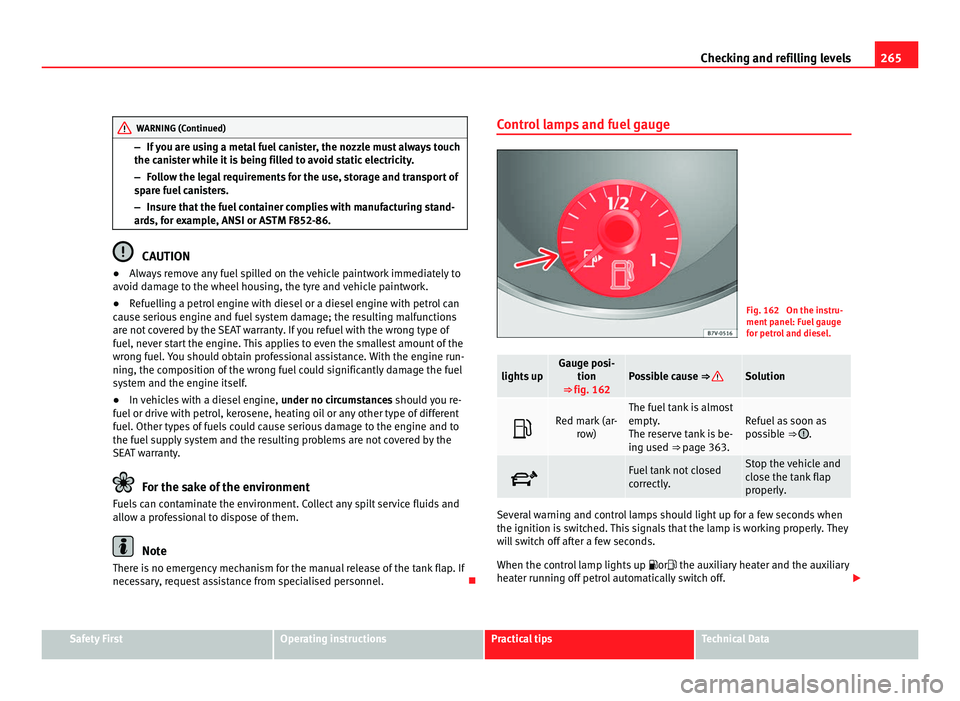
sary, request assistance from specialised personnel. Control lamps and fuel gauge
Fig. 162 On the instru-
ment p
anel: F
uel gauge
for petrol and diesel. lights up Gauge posi-
tion
⇒ fig. 162 Possible cause ⇒ Solution
Red mark (ar-
row) The fuel tank is almost
empty.
The r
e
serve tank is be-
ing used ⇒ page 363. Refuel as soon as
pos
s
ible ⇒ .
Fuel tank not closed
corr
ectly
. Stop the vehicle and
clo
se the t
ank flap
properly. Several warning and control lamps should light up for a few seconds when
the ignition is
sw
itched. This signals that the lamp is working properly. They
will switch off after a few seconds.
When the control lamp lights up or the auxiliary heater and the auxiliary
heater running off petrol automatically switch off. Safety First Operating instructions Practical tips Technical Data
Page 269 of 385
267
Checking and refilling levels
Closing the tank cap
● Screw on the tank cap clockwise until it you hear it click into position.
● Press the tank flap until you hear it click into place. The tank flap must
be flush w ith the body
contour. WARNING
Do not continue refilling once the fuel nozzle has switched itself off. The
fuel t
ank may be filled too much. As a result, fuel may spurt out and spill.
This could lead to a fire, explosion and severe injuries. CAUTION
● Always remove any fuel spilled on the vehicle paintwork immediately to
av oid d
amage to the wheel housing, the tyre and vehicle paintwork. For the sake of the environment
Spilt fuel can contaminate the environment.
Refilling precautions Information on bulb replacement
⇒ pag
e 326.
Checklist
Never work on the engine or in the engine compartment if you are not famil-
iar with the operations to be carried out, the applicable safety standards
and especially if you do not have the instruments, liquids and tools neces-
sary ⇒ page 275, Working in the engine compartment! Have the work car-
ried out by a Technical Service if you are uncertain. Check the following reg-
ularly, preferably when you refuel:
● Windscreen washer fluid level ⇒ pag
e 105
● Engine oil level ⇒ pag
e 279 ●
Engine coolant level ⇒ p
age 283
● Brake fluid level ⇒ pag
e 183
● Tyre pressure ⇒ pag
e 293
● Vehicle lighting required to guarantee road safety:
Indicator
s
Side lights, dipped headlights and full beam headlights
Rear lights
Brake lights
Rear fog light ⇒ page 97 WARNING
Not following the checklist prepared for your own safety could lead to ac-
cident s
and severe injuries.
● Always follow the check list and perform the necessary operations.
Fuel Introduction You will find a factory-fitted sticker containing information on the type of
fuel
f
or your vehicle on the inside of the fuel tank flap.
Additional information and warnings:
● ⇒ Bookl et Maintenance Programme
● R
efuelling ⇒ pag e 264
● En
gine and exhaust system management ⇒ page 228
–
–
–
–
–
Safety First Operating instructions Practical tips Technical Data
Page 271 of 385
269
Checking and refilling levels
● If, in exceptional circumstances, petrol with a lower octane rating to that
r ec
ommended is used, only use moderate engine speeds and a light throt-
tle. Avoid using full throttle and overloading the engine. Otherwise you may
damage the engine. Fill up with fuel of a suitable octane rating as soon as
possible.
● Do not refuel if the filler indicates that the fuel contains metal. LRP (lead
repl
acement petrol) fuels also contain high concentrations of metal addi-
tives. This could damage the engine!
● Just one full tank of leaded fuel would seriously impair the efficiency of
the catalytic
converter and could damage it.
Diesel Diesel fuel
Diesel
f
uel must correspond to European standard EN 590 (In Germany,
EN 590 or DIN 51628).
The use of diesel fuel with a high sulphur percentage requires shorter serv-
ice intervals ⇒ Booklet Maintenance Programme ⇒ . Your qualified work-
shop wi l
l be able to tell you which countries have diesel with a high sulphur
content.
Do not mix fuel additives (thinners, or similar additives) with diesel fuel.
Winter-grade diesel
When using “summer-grade diesel fuel”, difficulties may be experienced at
temperatures below 0°C (+32°F) because the fuel thickens due to wax sepa-
ration. For this reason, “winter-grade diesel fuel” is available in Germany,
for example, during the cold months. It can be used at temperatures as low
as -20°C (-4°F).
In countries with different climatic conditions, other types of diesel fuel are
available that are suitable to local temperatures. SEAT qualified workshops
and filling stations in the country concerned will inform you on the type of
diesel fuels available. A cold diesel engine makes more noise during winter temperatures than
summer temper
atures. Furthermore, the exhaust fumes may turn slightly
bluish while the engine is heating. The quantity of exhaust gases will de-
pend on the outside temperature.
Filter pre-heater
Vehicles with a diesel engine are fitted with a fuel filter pre-heater. This en-
sures that the fuel system remains operational to approx. -24°C (-11.2°F),
provided you use winter-grade diesel which is safe to -15°C (+5°F).
However, if the fuel has waxed to such an extent that the engine will not
start at temperatures of under -24°C (-11.2°F), simply place the vehicle in a
warm garage or workshop for a while to heat up.
Auxiliary heater
Vehicles with a diesel engine may be fitted with an auxiliary heater. The
heater runs off the fuel from the fuel tank. On doing so, smells and steam
may be noticed outside the vehicle for a short period. This is normal and it
is not an indication of a fault in the vehicle.
Whenever there is little fuel in the tank (reserve), the auxiliary heater auto-
matically switches off. WARNING
Never use start boosters. An aerosol start booster could explode or cause
a sud den ri
se in engine speed leading to engine damage and serious in-
jury. Safety First Operating instructions Practical tips Technical Data
Page 273 of 385
271
Checking and refilling levels
Selective Catalytic Reduction* (AdBlue)
Introduction The AdBlue fill level must be checked when the vehicle is being serviced
⇒ Bookl
et
Maintenance Programme.
Additional information and warnings:
● Luggage compartment ⇒ p
age 125
● Fuel ⇒ page 267
● Wheels
and tyres ⇒ pag
e 293
● Accessories, parts replacement, repairs and modifications ⇒ page 257WARNING
If the AdBlue fill level is too low, the vehicle may not restart after switch-
ing the ignition off .
The emergency start or jump start will not be possi-
ble either!
● Top up with AdBlue at the latest 1000 km or 600 miles before it runs
out.
● Do not a
llow the AdBlue to run too low. WARNING
AdBlue is an irritant, corrosive liquid that can cause injuries if it touches
the skin, ey e
s or respiratory organs.
● If AdBlue get in contact with eyes and skin, rinse for at least 15 mi-
nutes
with plenty of water and seek medical help.
● If the AdBlue is swallowed, wash the mouth with plenty of water for at
lea
st 15 minutes. Do not try to provoke vomiting unless recommended by
a Doctor. Seek medical advice immediately. CAUTION
AdBlue damages surfaces such as painted vehicle parts, plastic, items of
clothin g and c
arpets. Spilt AdBlue should be removed as quickly as possi-
ble using a damp cloth and plenty of cold water.
● If the AdBlue has crystallised, remove with warm water and a sponge.
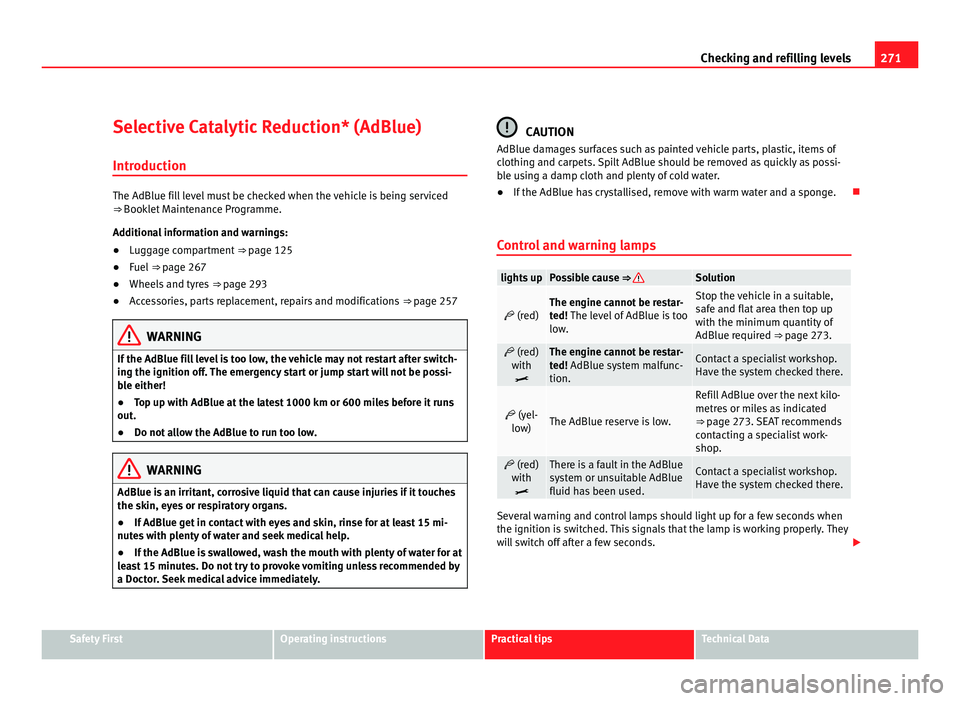
Control and warning lamps lights up Possible cause ⇒ Solution
(red) The engine cannot be restar-
ted!
The l
evel of AdBlue is too
low. Stop the vehicle in a suitable,
saf
e and fl
at area then top up
with the minimum quantity of
AdBlue required ⇒ page 273. (red)
with
The engine cannot be restar-
ted!
AdBlue sy
stem malfunc-
tion. Contact a specialist workshop.
Have the sy
s
tem checked there.
(yel-
lo w) The AdBlue reserve is low. Refill AdBlue over the next kilo-
metre
s
or miles as indicated
⇒ page 273. SEAT recommends
contacting a specialist work-
shop. (red)
with
There is a fault in the AdBlue
sys
t
em or unsuitable AdBlue
fluid has been used. Contact a specialist workshop.
Have the sy
s
tem checked there. Several warning and control lamps should light up for a few seconds when
the ignition is
sw
itched. This signals that the lamp is working properly. They
will switch off after a few seconds. Safety First Operating instructions Practical tips Technical Data
Page 274 of 385
272
Checking and refilling levels WARNING
If the warning lamps and messages are ignored, the vehicle may stall in
traffic, or m a
y cause accidents and severe injuries.
● Never ignore the warning lamps or text messages.
● Stop the vehicle safely as soon as possible. CAUTION
Failure to heed the warning lamps and text messages when they appear
ma y
result in faults in the vehicle.
Information on AdBlue In vehicles with Selective Catalytic Reduction, a special urea solution (AdBl-
ue) is
inj
ected into the exhaust gas system in front of the catalytic converter
to reduce nitrogen oxide emissions.
The consumption of AdBlue depends on individual driving style, the tem-
perature at which the system operates and the outside temperature where
the vehicle is driven. AdBlue is kept in an independent tank in the vehicle and should be refilled
at an offici
al supplier. The AdBlue tank holds about 17 litres.
A message will be displayed on the instrument panel around 2400 km be-
fore the next service to indicate that AdBlue must be refilled ⇒ page 273. If
you ignore this message and do not refill, you will be unable to start the en-
gine afterwards ⇒ page 271.
SEAT recommends contacting a specialist workshop. If you are unable to
visit a qualified specialist workshop, you should temporarily refill with a
minimum of 10.0 litres of AdBlue. Only refill using AdBlue expressly ap-
proved by SEAT.
When the indicators and light simultaneously, there is a fault. SEAT
recommends visiting the closest qualified workshop.
AdBlue ®
is a registered trademark in the US, Germany, the European Union
and other countries belonging to the German automobile industry ("Ver-
band der Automobilindustrie e. V.", VDA).
Page 281 of 385
279
Checking and refilling levels CAUTION
● To avoid damage to the bonnet and to the windscreen wiper arms, only
open the bonnet when the w
indscreen wipers are in place against the wind-
screen.
● Before driving, always lower the wiper arms.
Engine oil Introduction Additional information and warnings:
●
⇒ Book l
et Maintenance Programme
● W
orking in the engine compartment ⇒ page 275
● A
ccessories, parts replacement, repairs and modifications ⇒ page 257WARNING
Incorrectly handling engine oil can cause injury and serious burns.
● Always protect your eyes when handling engine oil.
● Oil is toxic and must be kept out of the reach of children.
● Engine oil must only be kept closed in its original container. The same
app lie
s to use oil until it has been disposed of.
● Never store engine oil in empty food containers or bottles as other
people m
ay accidentally drink it.
● Regular contact with engine oil can be bad for the skin. If you come
into cont
act with engine oil, wash your skin with soap and water.
● With the engine running, the engine oil gets extremely hot and can
cause sev
ere skin burns. Always wait until the engine has fully cooled. For the sake of the environment
Similar to the other service liquids, spilled engine oil can be bad for the en-
vir onment
. Collect any spilt fluids in suitable containers and dispose of in
accordance with legislation and with the utmost respect for the environ-
ment.
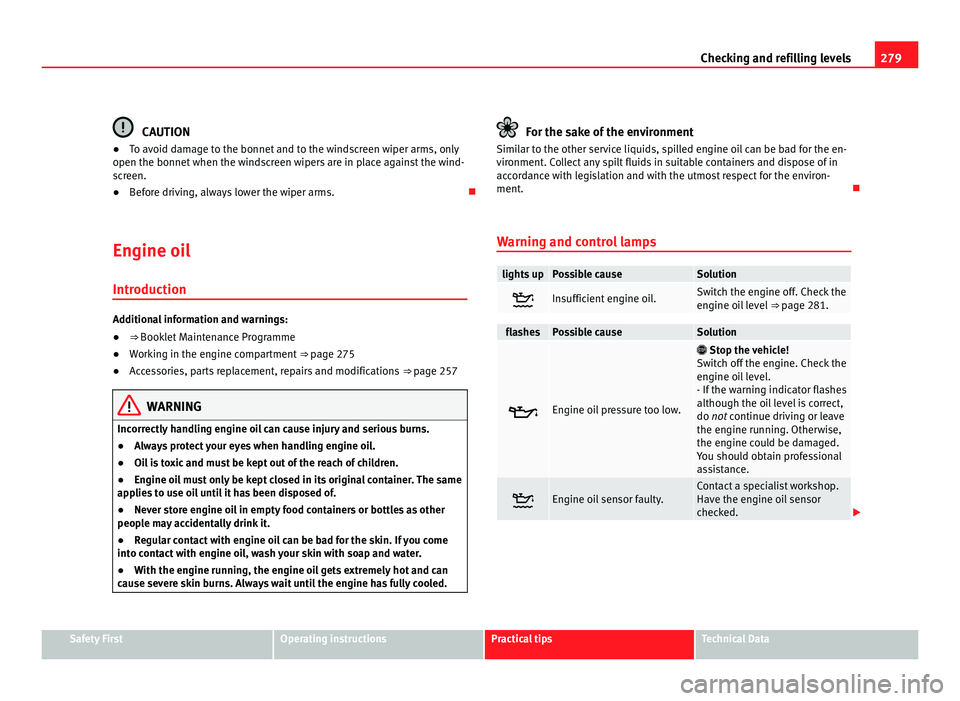
Warning and control lamps lights up Possible cause Solution
Insufficient engine oil. Switch the engine off. Check the
engine oi
l
level ⇒ page 281. flashes Possible cause Solution
Engine oil pressure too low.
Stop the vehicle!
Sw it
ch off the engine. Check the
engine oil level.
- If the warning indicator flashes
although the oil level is correct,
do not continue driving or leave
the engine running. Otherwise,
the engine could be damaged.
You should obtain professional
assistance. Engine oil sensor faulty. Contact a specialist workshop.
Have the en
gine oi
l sensor
checked. Safety First Operating instructions Practical tips Technical Data
Page 286 of 385
284
Checking and refilling levels For the sake of the environment
Coolants and additives can contaminate the environment. Collect any spilt
fluids in s
uitable containers and dispose of in accordance with legislation
and with the utmost respect for the environment.
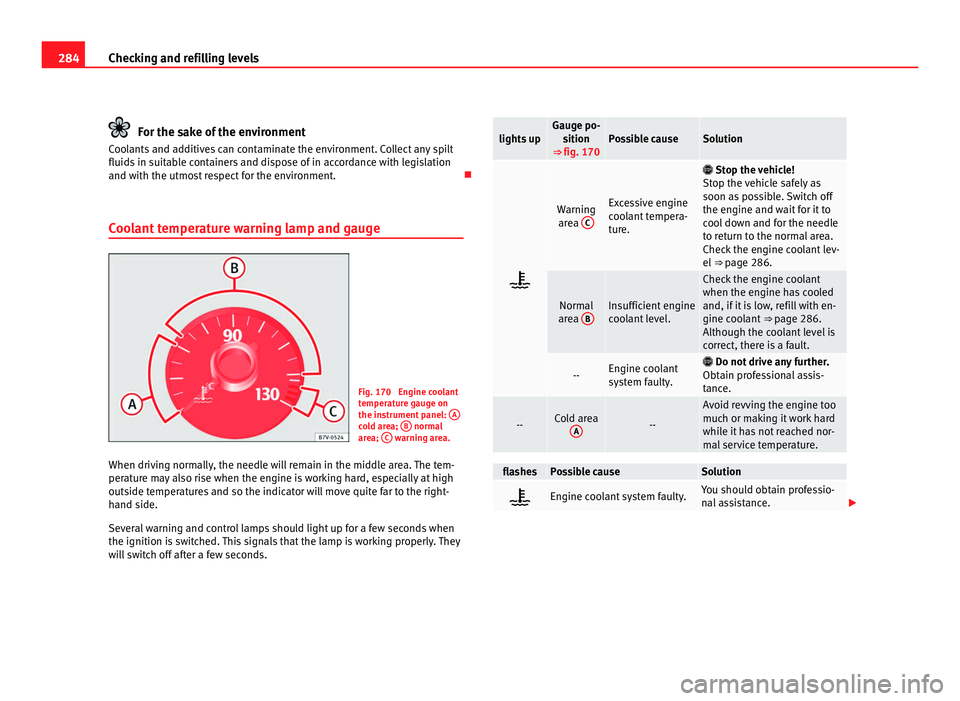
Coolant temperature warning lamp and gauge Fig. 170 Engine coolant
temper
at
ure gauge on
the instrument panel: A cold area;
B normal
are a; C warning area.
When driving normally, the needle will remain in the middle area. The tem-
perat ur
e may also rise when the engine is working hard, especially at high
outside temperatures and so the indicator will move quite far to the right-
hand side.
Several warning and control lamps should light up for a few seconds when
the ignition is switched. This signals that the lamp is working properly. They
will switch off after a few seconds. lights up Gauge po-
sition
⇒ fig. 170 Possible cause Solution
Warning
are a C Excessive engine
coo
l
ant tempera-
ture.
Stop the vehicle!
St op the
vehicle safely as
soon as possible. Switch off
the engine and wait for it to
cool down and for the needle
to return to the normal area.
Check the engine coolant lev-
el ⇒ page 286. Normal
are a B Insufficient engine
coo
l
ant level. Check the engine coolant
when the engine h
a
s cooled
and, if it is low, refill with en-
gine coolant ⇒ page 286.
Although the coolant level is
correct, there is a fault. -- Engine coolant
sys
t
em faulty.
Do not drive any further.
O bt
ain professional assis-
tance. -- Cold area
A -- Avoid revving the engine too
much or m
ak
ing it work hard
while it has not reached nor-
mal service temperature. flashes Possible cause Solution
Engine coolant system faulty. You should obtain professio-
nal
a
ssistance.
Page 288 of 385
286
Checking and refilling levels
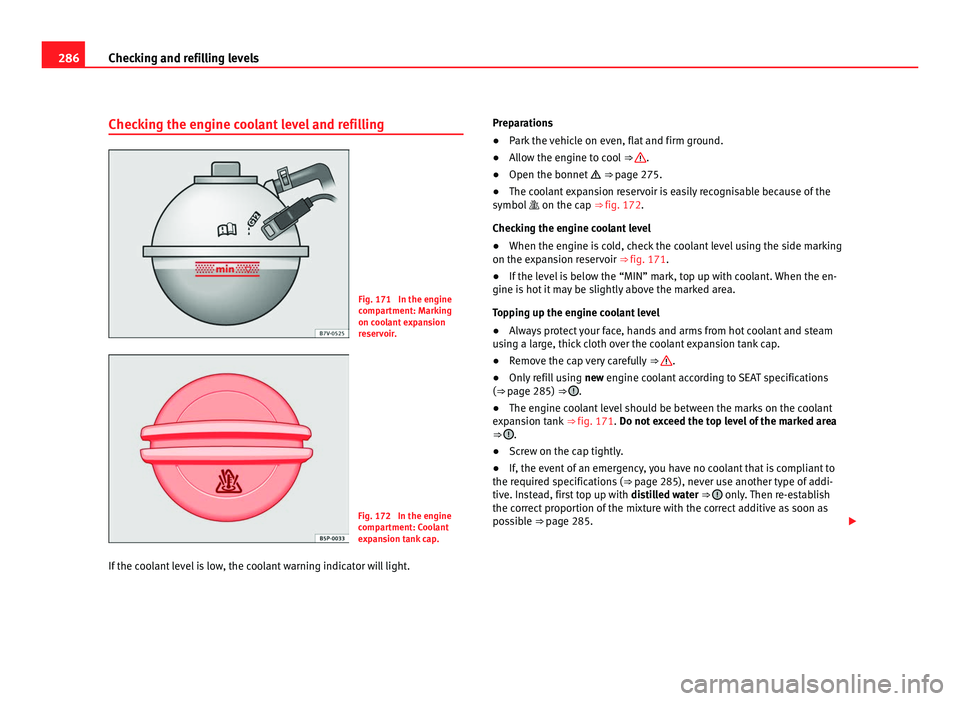
Checking the engine coolant level and refilling Fig. 171 In the engine
comp
ar
tment: Marking
on coolant expansion
reservoir. Fig. 172 In the engine
comp
ar
tment: Coolant
expansion tank cap.
If the coolant level is low, the coolant warning indicator will light. Preparations
●
Park the vehicle on even, flat and firm ground.
● Allow the engine to cool ⇒ .
● Open the bonnet ⇒ p
age 275.
● The coolant expansion reservoir is easily recognisable because of the
symbol
on the cap ⇒ fig. 172.
Checking the engine coolant level
● When the engine is cold, check the coolant level using the side marking
on the expan
sion reservoir ⇒ fig. 171.
● If the level is below the “MIN” mark, top up with coolant. When the en-
gine is hot
it may be slightly above the marked area.
Topping up the engine coolant level
● Always protect your face, hands and arms from hot coolant and steam
usin
g a large, thick cloth over the coolant expansion tank cap.
● Remove the cap very carefully ⇒ .
● Only refill using new engine coo
lant according to SEAT specifications
(⇒ page 285) ⇒ .
● The engine coolant level should be between the marks on the coolant
exp an
sion tank ⇒ fig. 171. Do not exceed the top level of the marked area
⇒ .
● Screw on the cap tightly.
● If, the event of an emergency, you have no coolant that is compliant to
the requir ed s
pecifications ( ⇒ page 285), never use another type of addi-
tive. Instead, first top up with distilled water ⇒ only. Then re-establish
the corr ect
proportion of the mixture with the correct additive as soon as
possible ⇒ page 285.
Page 290 of 385
288
Checking and refilling levels
Vehicle battery
Introduction The battery is a component of the vehicle's electrical system.
Never w
ork
on the electrical system without fully understanding the opera-
tions required, the applicable safety standards and without the correct tools
⇒ ! Have the work carried out by a Technical Service if you are uncertain.
SEA T r
ecommends visiting a Technical Service. Negligent work can cause
serious injury.
Location and number of batteries in the vehicle
The battery is located in the engine compartment.
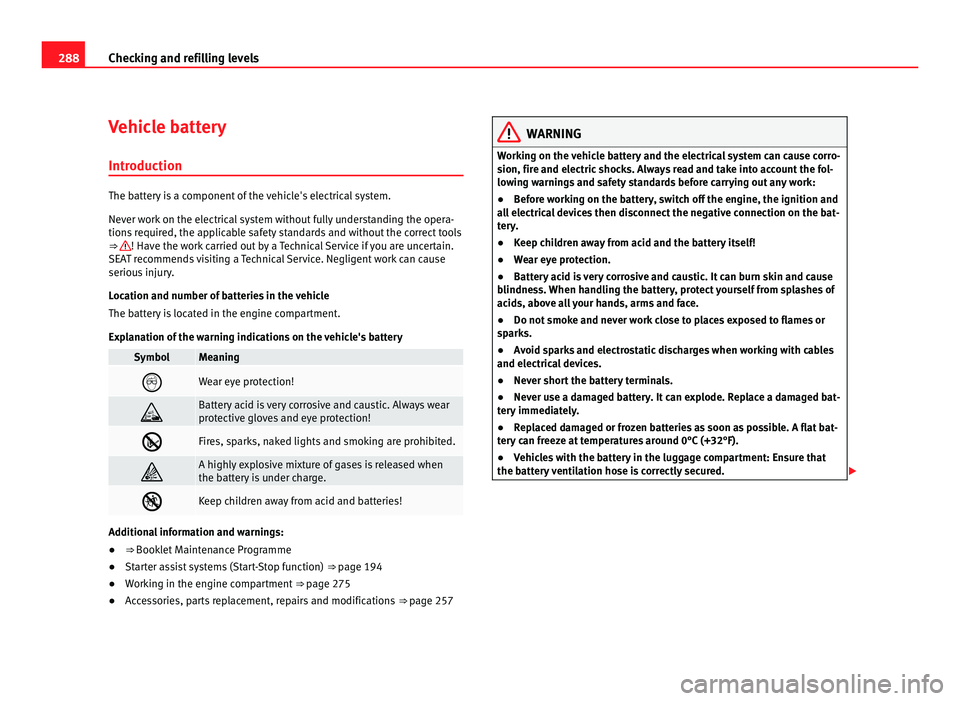
Explanation of the warning indications on the vehicle's battery Symbol Meaning
Wear eye protection!
Battery acid is very corrosive and caustic. Always wear
prot
ectiv
e gloves and eye protection! Fires, sparks, naked lights and smoking are prohibited.
A highly explosive mixture of gases is released when
the batt
er
y is under charge. Keep children away from acid and batteries!
Additional information and warnings:
●
⇒ Book l
et Maintenance Programme
● St
arter assist systems (Start-Stop function) ⇒ page 194
● W
orking in the engine compartment ⇒ page 275
● A
ccessories, parts replacement, repairs and modifications ⇒ page 257 WARNING
Working on the vehicle battery and the electrical system can cause corro-
sion, fir e and el
ectric shocks. Always read and take into account the fol-
lowing warnings and safety standards before carrying out any work:
● Before working on the battery, switch off the engine, the ignition and
all
electrical devices then disconnect the negative connection on the bat-
tery.
● Keep children away from acid and the battery itself!
● Wear eye protection.
● Battery acid is very corrosive and caustic. It can burn skin and cause
blindnes
s. When handling the battery, protect yourself from splashes of
acids, above all your hands, arms and face.
● Do not smoke and never work close to places exposed to flames or
spark
s.
● Avoid sparks and electrostatic discharges when working with cables
and electrica
l devices.
● Never short the battery terminals.
● Never use a damaged battery. It can explode. Replace a damaged bat-
tery
immediately.
● Replaced damaged or frozen batteries as soon as possible. A flat bat-
tery
can freeze at temperatures around 0°C (+32°F).
● Vehicles with the battery in the luggage compartment: Ensure that
the batter
y ventilation hose is correctly secured.