belt Seat Alhambra 2011 Owner's Guide
[x] Cancel search | Manufacturer: SEAT, Model Year: 2011, Model line: Alhambra, Model: Seat Alhambra 2011Pages: 385, PDF Size: 7.92 MB
Page 51 of 385
49
Child safety
Lifting the cushion
● Pull the unlock lever ⇒ fig. 29 A on the cushion in the direction of the
arro w 1 .
● Fold both sides B up in the direction of the arrow
2 .
● Push the cushion C back in the direction of the arrow
3 until it engag-
es.
Fittin g the s
ide head restraint
● Fold the backrest of the rear seat forwards ⇒ page 117.
● R
emove the head restraint.
● Make sure the belt guide handle on the window side is on the side head
res
traint ⇒ page 49.
● Insert the guide rods ⇒ fig. 30 1 of the head restraint into the guides
on the side he a
d restraint 2 .
● Insert the head restraint and the side head restraint into the guides on
the corr e
sponding backrest B .
● Push the head restraint down as far as it will go.
● Fold the backrest of the rear seat back.
● Pull the rear seat and the backrest to check whether they are engaged
properly . Se
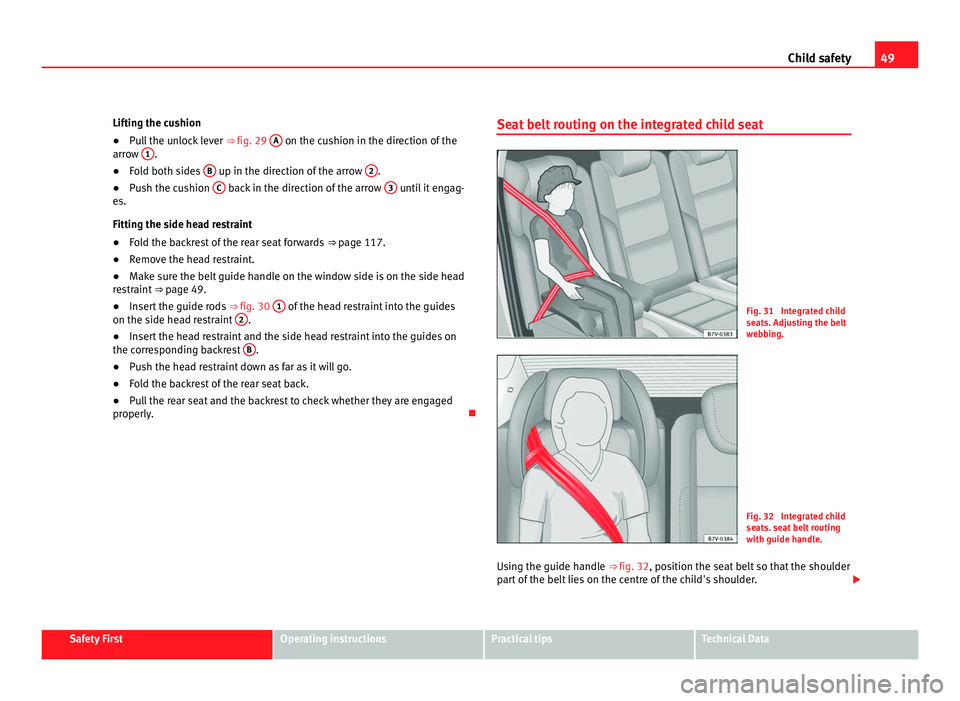
at belt routing on the integrated child seat Fig. 31 Integrated child
seat
s. Adju
sting the belt
webbing. Fig. 32 Integrated child
seat
s. se
at belt routing
with guide handle.
Using the guide handle ⇒ fig. 32, position the se
at belt so that the shoulder
part of the belt lies on the centre of the child's shoulder. Safety First Operating instructions Practical tips Technical Data
Page 52 of 385
50
Child safety
Seat belt guide handle
● Secure the seat belt guide handle to the side head restraint on the win-
dow s ide.
The guide handle is secured by a button.
● Open the upper button on the seat belt guide handle and pass the belt
webb
ing below the side head restraint and through the guide handle.
● Close the button again.
Adjustin
g the belt routing
● Guide the automatic three-point seat belt below the side head restraint.
● Pull the latch plate and slowly place the belt webbing across the child's
ches
t and lap.
● Insert the latch plate into the buckle for the appropriate seat and push it
down unti
l it is securely locked with an audible click.
● Pull the belt to ensure that the latch plate is securely engaged in the
buck
le. WARNING
The seat belt only offers maximum protection from severe or fatal injuries
when it i s
correctly positioned.
● Children must assume the proper sitting position and be properly bel-
ted in whil
e travelling.
● The shoulder belt must be positioned against the middle of the
shoulder
.
● The seat belt must lie flat and fit comfortably.
● Allow the belt to retract until it fits tightly over the child's seat.
● The lap part of the seat belt must lie across the pelvis, never across
the stom
ach.
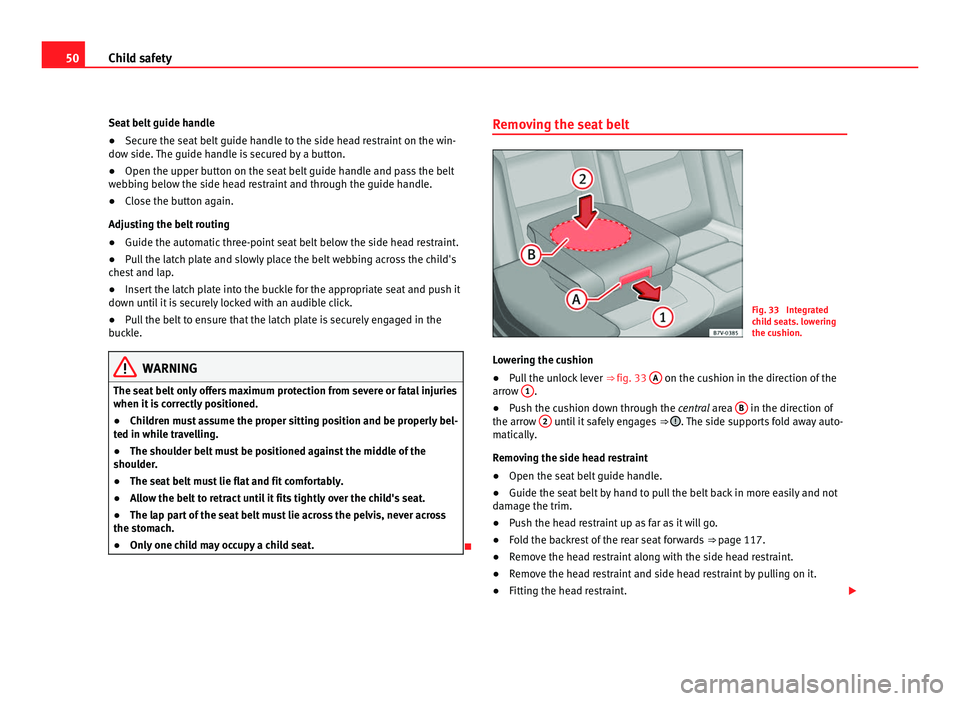
● Only one child may occupy a child seat. Removing the seat belt
Fig. 33 Integrated
chi
l
d seats. lowering
the cushion.
Lowering the cushion
● Pull the unlock lever ⇒ fig. 33 A on the cushion in the direction of the
arro w 1 .
● Push the cushion down through the cen tr
al area B in the direction of
the arro w 2 until it safely engages
⇒ . The side supports fold away auto-
matic al
ly.
Removing the side head restraint
● Open the seat belt guide handle.
● Guide the seat belt by hand to pull the belt back in more easily and not
damag
e the trim.
● Push the head restraint up as far as it will go.
● Fold the backrest of the rear seat forwards ⇒ page 117.
● R
emove the head restraint along with the side head restraint.
● Remove the head restraint and side head restraint by pulling on it.
● Fitting the head restraint.
Page 57 of 385
55
Cockpit
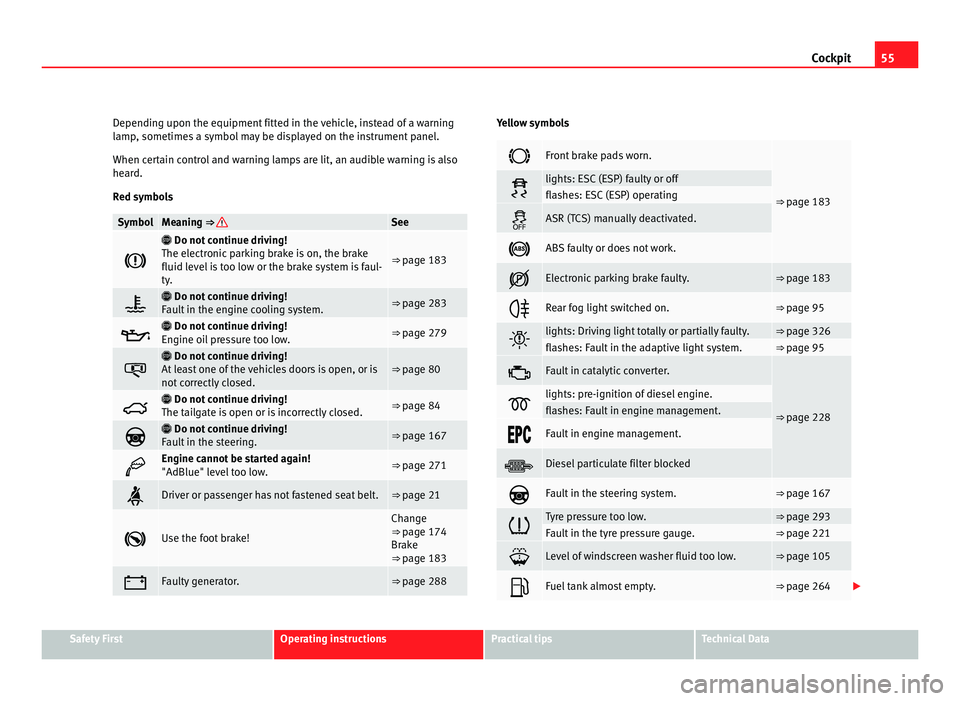
Depending upon the equipment fitted in the vehicle, instead of a warning
lamp , sometime
s a symbol may be displayed on the instrument panel.
When certain control and warning lamps are lit, an audible warning is also
heard.
Red symbols Symbol Meaning ⇒ See
Do not continue driving!
The el ectr
onic parking brake is on, the brake
fluid level is too low or the brake system is faul-
ty. ⇒ page 183
Do not continue driving!
F au
lt in the engine cooling system. ⇒ page 283
Do not continue driving!
En gine oi
l pressure too low. ⇒ page 279
Do not continue driving!
At l
east one of the vehicles doors is open, or is
not correctly closed. ⇒ page 80
Do not continue driving!
The t ai
lgate is open or is incorrectly closed. ⇒ page 84
Do not continue driving!
F au
lt in the steering. ⇒ page 167
Engine cannot be started again!
"AdBlue" lev
el
too low. ⇒ page 271
Driver or passenger has not fastened seat belt. ⇒ page 21
Use the foot brake! Change
⇒ pag
e 174
Br
ake
⇒ page 183 Faulty generator. ⇒ page 288 Yellow symbols
Front brake pads worn.
⇒ page 183 lights: ESC (ESP) faulty or off
flashes: ESC (ESP) operating
ASR (TCS) manually deactivated.
ABS faulty or does not work.
Electronic parking brake faulty. ⇒ page 183
Rear fog light switched on. ⇒ page 95
lights: Driving light totally or partially faulty. ⇒ page 326
flashes: Fault in the adaptive light system. ⇒ page 95
Fault in catalytic converter.
⇒ page 228 lights: pre-ignition of diesel engine.
flashes: Fault in engine management.
Fault in engine management.
Diesel particulate filter blocked
Fault in the steering system. ⇒ page 167
Tyre pressure too low. ⇒ page 293
Fault in the tyre pressure gauge. ⇒ page 221
Level of windscreen washer fluid too low. ⇒ page 105
Fuel tank almost empty. ⇒ page 264
Safety First Operating instructions Practical tips Technical Data
Page 58 of 385
56
Cockpit flashes: Engine oil sensor faulty.
⇒ page 279
lights: Insufficient engine oil.
Fault in airbag system and seat belt tensioners. ⇒ page 31
Passenger front airbag is off (
PASSENGER AIR-
BAG ). ⇒ page 31
Top up "AdBlue", or there is a fault in the "AdBl-
ue" system.
⇒ page 271
Fuel tank not closed correctly. ⇒ page 264
Lane Assist is connected, but not active. ⇒ page 216
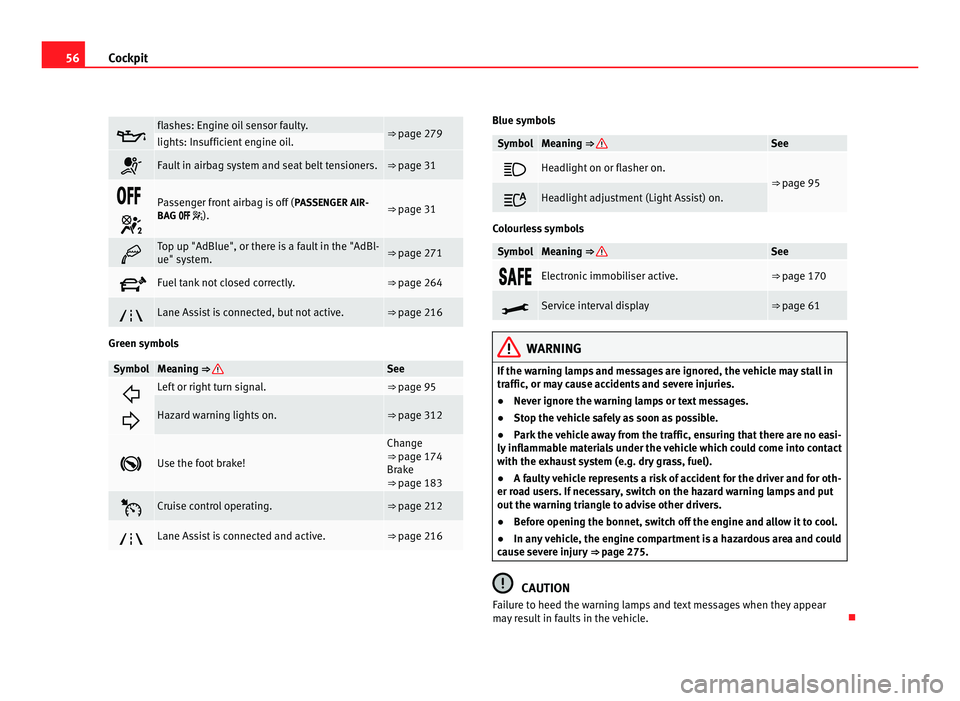
Green symbols
Symbol Meaning ⇒ See
Left or right turn signal. ⇒ page 95
Hazard warning lights on. ⇒ page 312
Use the foot brake! Change
⇒ page 174
Br ak
e
⇒ page 183 Cruise control operating. ⇒ page 212
Lane Assist is connected and active. ⇒ page 216 Blue symbols
Symbol Meaning
⇒ See
Headlight on or flasher on.
⇒
page 95 Headlight adjustment (Light Assist) on.
Colourless symbols
Symbol Meaning ⇒ See
Electronic immobiliser active. ⇒ page 170
Service interval display ⇒ page 61
WARNING
If the warning lamps and messages are ignored, the vehicle may stall in
traffic, or may cause accidents and severe injuries.
● Never ignore the warning lamps or text messages.
● Stop the vehicle safely as soon as possible.
● Park the vehicle away from the traffic, ensuring that there are no easi-
ly inflammable materials under the vehicle which could come into contact
with the exhaust system (e.g. dry grass, fuel).
● A faulty vehicle represents a risk of accident for the driver and for oth-
er road users. If necessary, switch on the hazard warning lamps and put
out the warning triangle to advise other drivers.
● Before opening the bonnet, switch off the engine and allow it to cool.
● In any vehicle, the engine compartment is a hazardous area and could
cause severe injury ⇒ page 275. CAUTION
Failure to heed the warning lamps and text messages when they appear
may result in faults in the vehicle.
Page 119 of 385
117
Seats and storage compartments
Seat functions Introduction Additional information and warnings
●
Adjust the seat position ⇒ page 10
● Se
at belts ⇒ page 21
● Airb
ag system ⇒ page 31
● Chi
ld seats (accessories) ⇒ page 39
● Int
egrated child seats ⇒ page 46
● Ext
erior mirrors ⇒ page 110
● L
uggage compartment ⇒ page 125 WARNING
Inappropriate use of the seat functions can cause severe injuries.
● Assume the proper sitting position before your trip and remain in it
throughout .
This also applies to the other occupants.
● Only adjust the seat position memory when the vehicle is stationary.
● Only switch the lumbar massage function on and off when the vehicle
is s
tationary.
● Keep hands, fingers, feet and other limbs away from the seat operat-
ing and adju
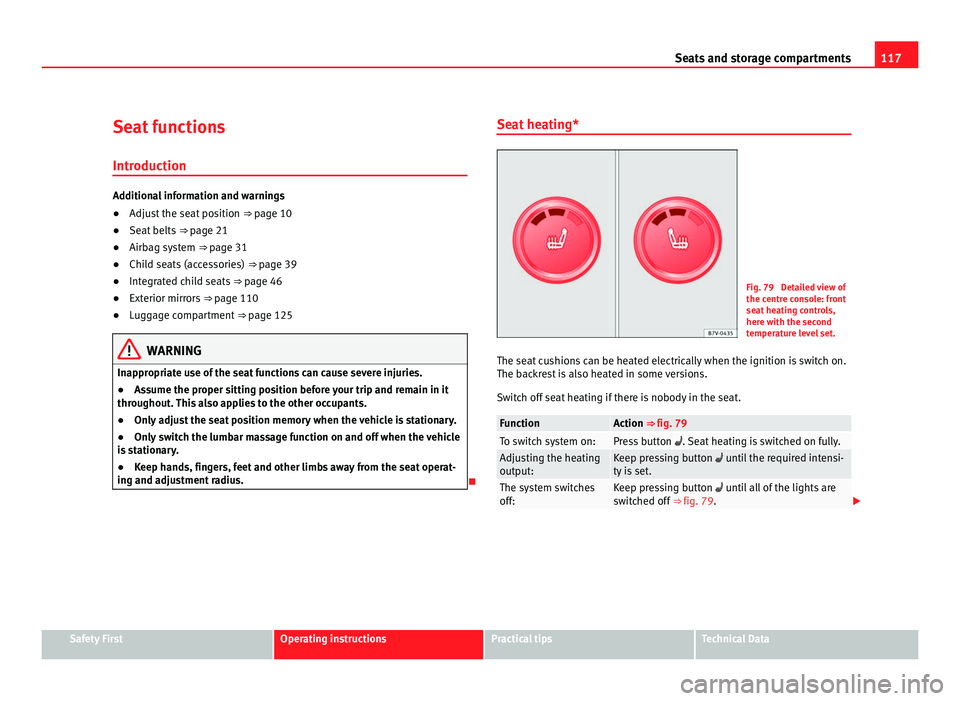
stment radius. Seat heating* Fig. 79 Detailed view of
the centr
e c
onsole: front
seat heating controls,
here with the second
temperature level set.
The seat cushions can be heated electrically when the ignition is switch on.
The back
rest is also heated in some versions.
Switch off seat heating if there is nobody in the seat. Function Action ⇒ fig. 79
To switch system on: Press button
. Seat
heating is switched on fully. Adjusting the heating
output: Keep pressing button unti
l
the required intensi-
ty is set. The system switches
off: Keep pressing button unti
l
all of the lights are
switched off ⇒ fig. 79. Safety First Operating instructions Practical tips Technical Data
Page 122 of 385
120
Seats and storage compartments
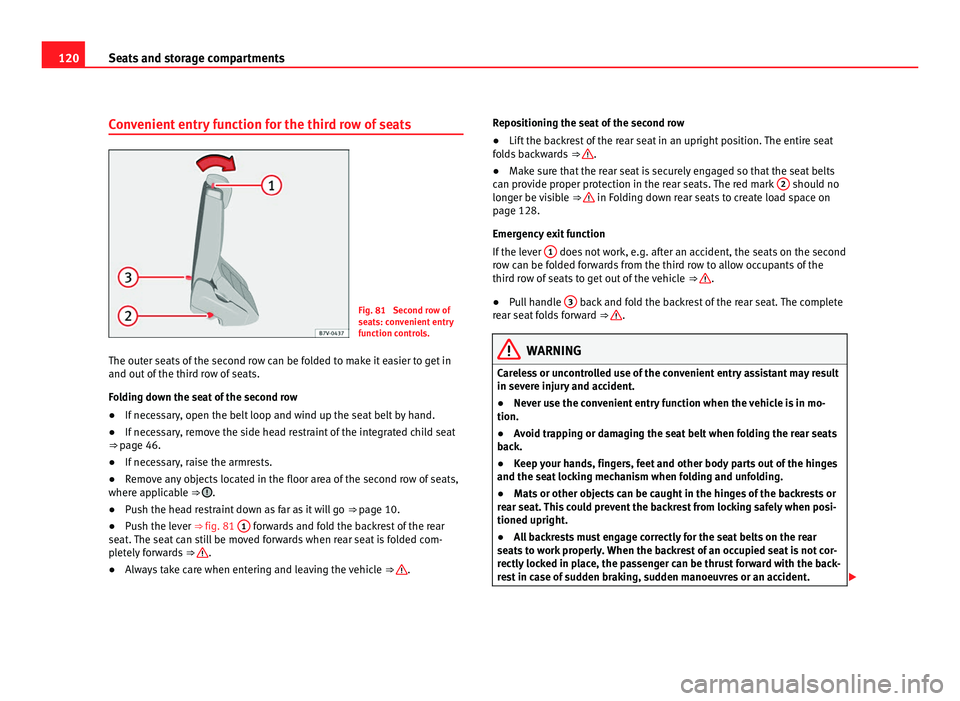
Convenient entry function for the third row of seats Fig. 81 Second row of
seat
s: c
onvenient entry
function controls.
The outer seats of the second row can be folded to make it easier to get in
and out of the thir
d row of seats.
Folding down the seat of the second row
● If necessary, open the belt loop and wind up the seat belt by hand.
● If necessary, remove the side head restraint of the integrated child seat
⇒ page 46.
● If
necessary, raise the armrests.
● Remove any objects located in the floor area of the second row of seats,
where app
licable ⇒ .
● Push the head restraint down as far as it will go ⇒ page 10.
● P
ush the lever ⇒ fig. 81 1 forwards and fold the backrest of the rear
seat .
The seat can still be moved forwards when rear seat is folded com-
pletely forwards ⇒ .
● Always take care when entering and leaving the vehicle ⇒ .Repositioning the seat of the second row
●
Lift the backrest of the rear seat in an upright position. The entire seat
fo l
ds backwards ⇒ .
● Make sure that the rear seat is securely engaged so that the seat belts
can pr o
vide proper protection in the rear seats. The red mark 2 should no
long er be
visible ⇒ in Folding down rear seats to create load space on
pag e 128.
Emer
gency exit function
If the lever 1 does not work, e.g. after an accident, the seats on the second
ro w c
an be folded forwards from the third row to allow occupants of the
third row of seats to get out of the vehicle ⇒ .
● Pull handle 3 back and fold the backrest of the rear seat. The complete
re ar se
at folds forward ⇒ .
WARNING
Careless or uncontrolled use of the convenient entry assistant may result
in sever e injur
y and accident.
● Never use the convenient entry function when the vehicle is in mo-
tion.
● Avoid trapping or damaging the seat belt when folding the rear seats
back.
● K
eep your hands, fingers, feet and other body parts out of the hinges
and the seat loc
king mechanism when folding and unfolding.
● Mats or other objects can be caught in the hinges of the backrests or
rear se
at. This could prevent the backrest from locking safely when posi-
tioned upright.
● All backrests must engage correctly for the seat belts on the rear
seats
to work properly. When the backrest of an occupied seat is not cor-
rectly locked in place, the passenger can be thrust forward with the back-
rest in case of sudden braking, sudden manoeuvres or an accident.
Page 130 of 385
128
Seats and storage compartments
Folding the seats in the second row of seats for loading
●If necessary, open the belt loop and wind up the seat belt by hand.
● If it is necessary, remove the head rests on the integrated child seats
then rein s
talled the integrated child seats ⇒ page 46.
● If necessary, raise the armrests.
● Remove objects from the footrest area in front of and behind the rear
seat ⇒ .
● Move the rear seat all the way back.
● Push the head restraint down as far as it will go ⇒ page 10.
● In the mid
dle seat, close the drinks carrier in the rear of the centre con-
sole, if
necessary.
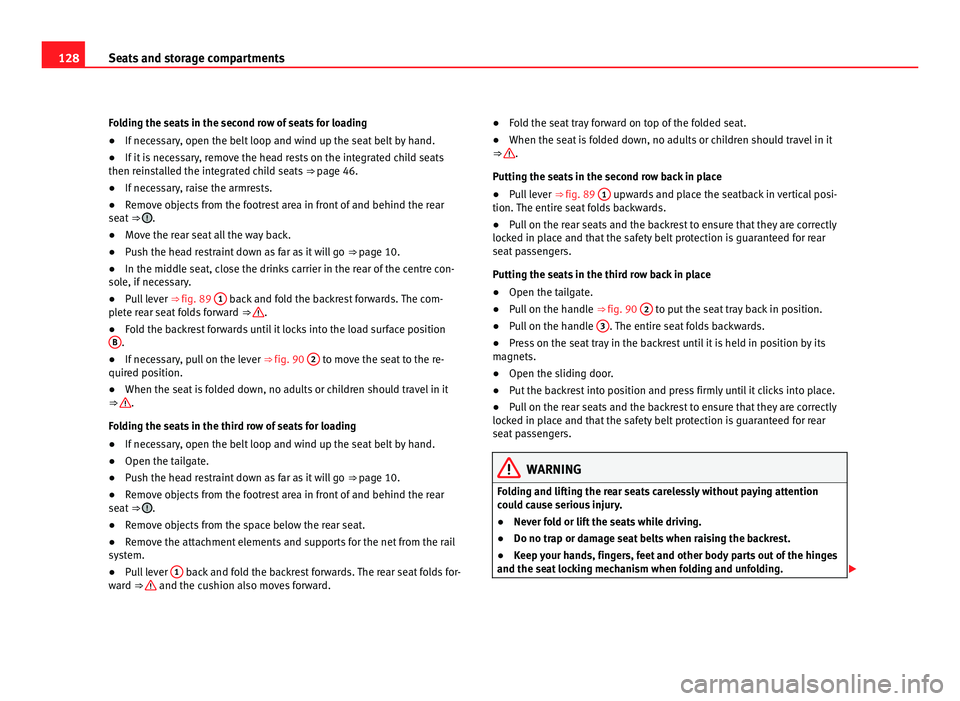
● Pull lever ⇒ fig. 89 1 back and fold the backrest forwards. The com-
pl et
e rear seat folds forward ⇒ .
● Fold the backrest forwards until it locks into the load surface position
B .
● If necessary, pull on the lever ⇒ fig. 90 2 to move the seat to the re-
quired po s
ition.
● When the seat is folded down, no adults or children should travel in it
⇒ .
Fo l
ding the seats in the third row of seats for loading
● If necessary, open the belt loop and wind up the seat belt by hand.
● Open the tailgate.
● Push the head restraint down as far as it will go ⇒ page 10.
● R
emove objects from the footrest area in front of and behind the rear
seat ⇒ .
● Remove objects from the space below the rear seat.
● Remove the attachment elements and supports for the net from the rail
sys t
em.
● Pull lever 1 back and fold the backrest forwards. The rear seat folds for-
war d
⇒ and the cushion also moves forward. ●
Fold the seat tray forward on top of the folded seat.
● When the se at
is folded down, no adults or children should travel in it
⇒ .
Puttin g the se
ats in the second row back in place
● Pull lever ⇒ fig. 89 1 upwards and place the seatback in vertical posi-
tion. The entir e se
at folds backwards.
● Pull on the rear seats and the backrest to ensure that they are correctly
locked in p
lace and that the safety belt protection is guaranteed for rear
seat passengers.
Putting the seats in the third row back in place
● Open the tailgate.
● Pull on the handle ⇒ fig. 90 2 to put the seat tray back in position.
● Pull on the handle 3 . The entire seat folds backwards.
● Press on the seat tray in the backrest until it is held in position by its
magnets.
● Open the s lidin
g door.
● Put the backrest into position and press firmly until it clicks into place.
● Pull on the rear seats and the backrest to ensure that they are correctly
locked in p
lace and that the safety belt protection is guaranteed for rear
seat passengers. WARNING
Folding and lifting the rear seats carelessly without paying attention
cou l
d cause serious injury.
● Never fold or lift the seats while driving.
● Do no trap or damage seat belts when raising the backrest.
● Keep your hands, fingers, feet and other body parts out of the hinges
and the seat loc
king mechanism when folding and unfolding.
Page 131 of 385
129
Seats and storage compartments WARNING (Continued)
● Mats or other objects can be caught in the hinges of the backrests or
r e
ar seat. This could prevent the seat or backrest from locking securely in
the vertical position.
● All backrests must engage correctly for the seat belts on the rear
seats
to work properly. When the backrest of an occupied seat is not cor-
rectly locked in place, the passenger can be thrust forward with the back-
rest in case of sudden braking, sudden manoeuvres or an accident.
● No seat must be occupied if the backrest or seat is folded or not cor-
rectly en
gaged. CAUTION
● Before folding the backrest of the rear seat, adjust the front seats so
th at
the head restraint or backrest do not hit them when it is folded.
● Objects placed in the footrest area in front of and behind the rear seats
can be dam
aged when seats are folded down or put back into position. Re-
move any objects in the way before folding seats down or repositioning
them. ●
Objects placed in the moulding on the back of the third row of seats can
be dam
aged when folding down the seats or putting them back into posi-
tion. Remove any objects in the way before folding seats down or reposi-
tioning them.
● The attachment elements and supports for the net partition placed on
the rail
system can be damaged when folding down seats from the third row
or putting them back into position and these can also damage the seats
themselves. Before folding down or repositioning the seats, remove the at-
tachment elements and supports for the net from the rail system. Safety First Operating instructions Practical tips Technical Data
Page 147 of 385
145
Seats and storage compartments
Pull the lever to open ⇒ fig. 107.
Pr ess the cover upwards to close.
Vehicle wallet compartment
The glove compartment is designed to store the vehicle wallet.
The vehicle wallet should always be kept in the glove compartment. To store
the wallet, insert it sideways into the glove compartment.
Cooling the glove compartment
There is an air vent ⇒ fig. 108 A on the rear panel so that cooled air from
the clim at
e control system (this must be connected) is fed into the glove
compartment. Turn the air vent to open and close it. WARNING
The risk of serious injuries in the event of an accident during a sudden
brak in
g manoeuvre or turn is increased if the glove compartment is left
open.
● Keep the glove compartment closed while the vehicle is in motion. CAUTION
For structural reasons, some model versions will have gaps behind the
glov e c
ompartment into which small objects may fall. This could lead to
strange noises and damage to the vehicle. You should therefore not keep
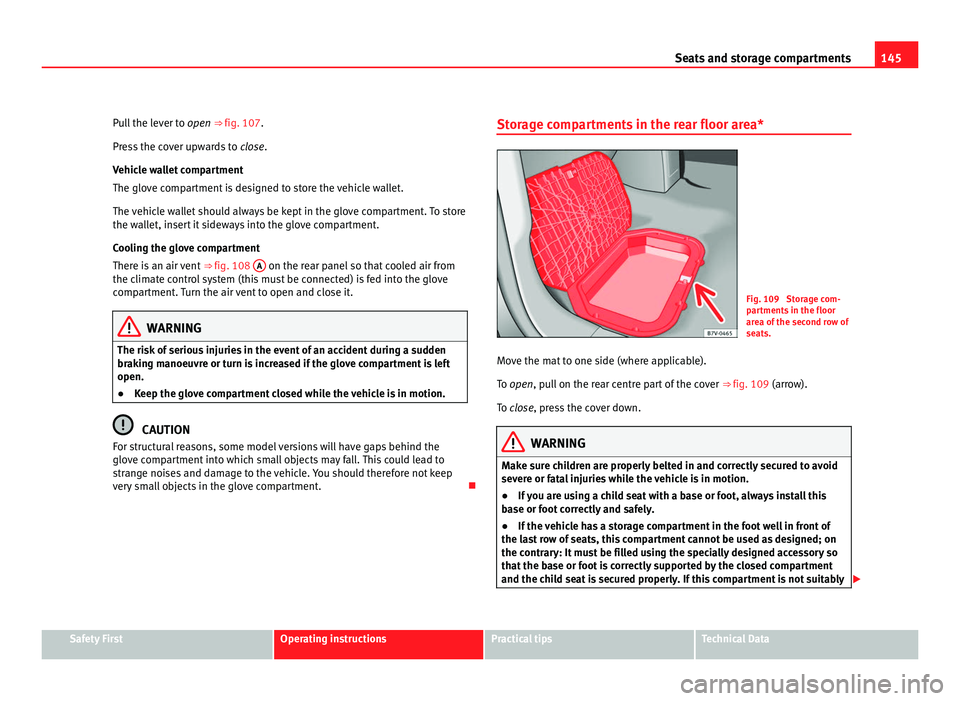
very small objects in the glove compartment. Storage compartments in the rear floor area*
Fig. 109 Storage com-
par
tment
s in the floor
area of the second row of
seats.
Move the mat to one side (where applicable).
To open
, pull on the rear centre part of the cover ⇒ fig. 109 (arrow).
To close, press the cover down. WARNING
Make sure children are properly belted in and correctly secured to avoid
sever e or f
atal injuries while the vehicle is in motion.
● If you are using a child seat with a base or foot, always install this
base or f
oot correctly and safely.
● If the vehicle has a storage compartment in the foot well in front of
the las
t row of seats, this compartment cannot be used as designed; on
the contrary: It must be filled using the specially designed accessory so
that the base or foot is correctly supported by the closed compartment
and the child seat is secured properly. If this compartment is not suitably Safety First Operating instructions Practical tips Technical Data
Page 172 of 385
170
Driving
Stopping and starting the engine
Introduction Immobiliser display
When an inv
alid k
ey is used or in the event of a system fault, or Immo-
biliser on is displayed on the instrument panel. The engine cannot be star- ted.
Pushing or towing
For technical reasons, the vehicle must not be push- or tow-started. Jump
starting is preferable.
Additional information and warnings:
● Vehicle key set ⇒ pag
e 71
● Changing gear ⇒ pag
e 174
● Braking, stopping and parking ⇒ page 183
● St
eering ⇒ pag
e 167
● Start assist systems ⇒ pag
e 194
● Refuelling ⇒ pag
e 264
● Fuel ⇒ page 267
● Emer
gency locking and unlocking ⇒ page 314
● Jump s
tarting ⇒ pag
e 337
● Tow-starting and towing away ⇒ pag
e 340 WARNING
Turning off the engine while driving will make stopping the vehicle diffi-
cu lt; thi
s could even result in the loss of control causing an accident with
serious consequences.
● The assisted braking and steering systems, the airbag system, safety
belts and c
ertain safety equipment are only active while the engine is
running.
● The engine should only be switched off when the vehicle is at a
stand
still. WARNING
While the engine is running or starting it could help reduce the risk of se-
rious injur
y.
● Never start or leave the engine running in poorly ventilated or closed
spac
es. Exhaust gas contains carbon monoxide, a toxic, colourless and
odourless gas. Carbon monoxide can cause people to lose conscious-
ness. It can also cause death.
● Never leave the vehicle unattended if the engine is running. The vehi-
cle c
ould move off suddenly or something unexpected could happen re-
sulting in damage and serious injury.
● Never use start boosters. Cold start sprays could explode or increase
the engine speed u
nexpectedly.