engine Seat Alhambra 2015 Owner's Manual
[x] Cancel search | Manufacturer: SEAT, Model Year: 2015, Model line: Alhambra, Model: Seat Alhambra 2015Pages: 305, PDF Size: 5.46 MB
Page 267 of 305
Fuses and bulbs
●
Several components may run on a single
fuse. Vehicle fuses
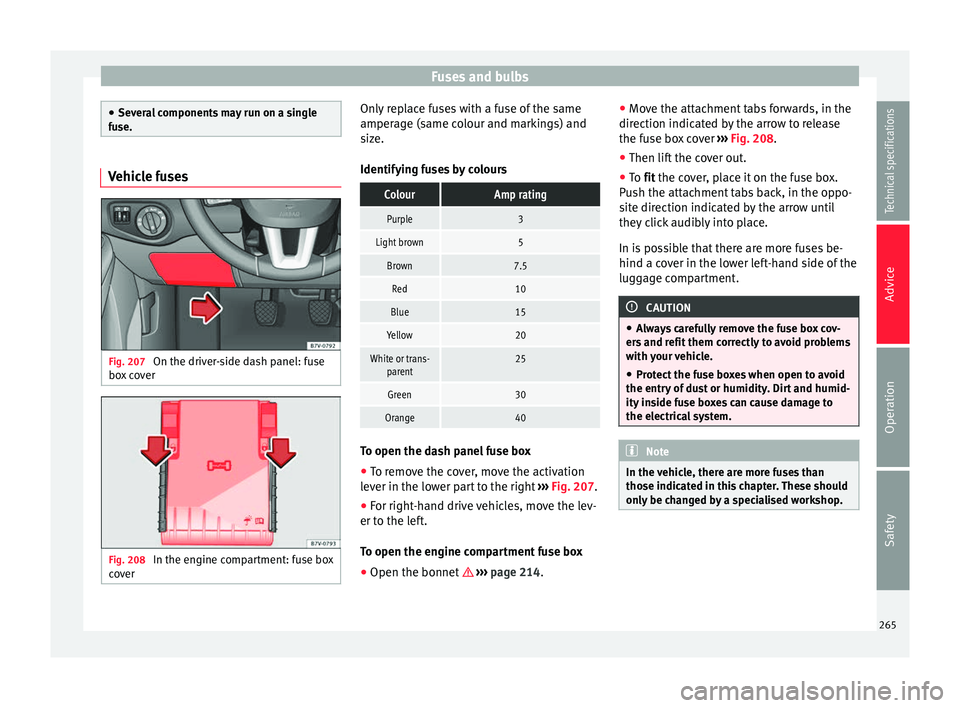
Fig. 207
On the driver-side dash panel: fuse
box cover Fig. 208
In the engine compartment: fuse box
cover Only replace fuses with a fuse of the same
amperage (same colour and markings) and
size.
Identifying fuses by coloursColourAmp rating
Purple3
Light brown5
Brown7.5
Red10
Blue15
Yellow20
White or trans-
parent25
Green30
Orange40 To open the dash panel fuse box
●
To remove the cover, move the activation
lever in the lower part to the right ››› Fig. 207.
● For right-hand drive vehicles, move the lev-
er to the left.
To open the engine compartment fuse box
● Open the bonnet ››› page 214. ●
Move the attachment tabs forwards, in the
direction indicated by the arrow to release
the fuse box cover ››› Fig. 208 .
● Then lif t
the cover out.
● To
fit the cover, place it on the fuse box.
Push the attachment tabs back, in the oppo-
site direction indicated by the arrow until
they click audibly into place.
In is possible that there are more fuses be-
hind a cover in the lower left-hand side of the
luggage compartment. CAUTION
● Always carefully remove the fuse box cov-
ers and refit them correctly to avoid problems
with your vehicle.
● Protect the fuse boxes when open to avoid
the entry of dust or humidity. Dirt and humid-
ity inside fuse boxes can cause damage to
the electrical system. Note
In the vehicle, there are more fuses than
those indicated in this chapter. These should
only be changed by a specialised workshop. 265
Technical specifications
Advice
Operation
Safety
Page 269 of 305
Fuses and bulbs
WARNING
Failure to replace bulbs correctly may cause
serious accidents.
● Before carrying out any work in the engine
compartment please read and observe the
warnings ››› page 214. In any vehicle, the en-
gine c omp
artment is a hazardous area and
could cause severe injury.
● Discharge lamps work with high-voltage
and can cause serious or fatal injury if han-
dled incorrectly.
● H7 and discharge lamps are highly pressur-
ised and could explode when being changed.
● Only replace the bulbs concerned when
they have cooled.
● Never replace bulbs alone if you are not fa-
miliar with the operations necessary. If you
are not sure about procedures then visit a
specialised workshop to carry out the neces-
sary work.
● Never touch the bulb glass directly. Finger-
prints will be evaporated by the heat of the
operating bulb thus “fogging” up the reflec-
tor.
● The headlamp frameworks in the engine
compartment and the tail lamps contain sharp elements. Always protect your hands
when changing bulbs.
CAUTION
● After changing a bulb, if the rubber covers
are not replaced correctly on the headlamp
framework, the electrical installation may be
damaged, especially if water is allowed to en-
ter.
● Remove the ignition key before working on
the electric system. Otherwise, a short circuit
could occur.
● Switch off the lights and the parking light
before changing a bulb.
● Take good care to avoid damaging any com-
ponents. Control lamp
It
lights upPossible causeSolution
A vehicle exterior
lighting bulb is not
working.Replace the faulty
bulb. Several warning and control lamps light up
for a few seconds when the ignition is switch-
ed on, signalling that the function is being
verified. They will switch off after a few sec-
onds.
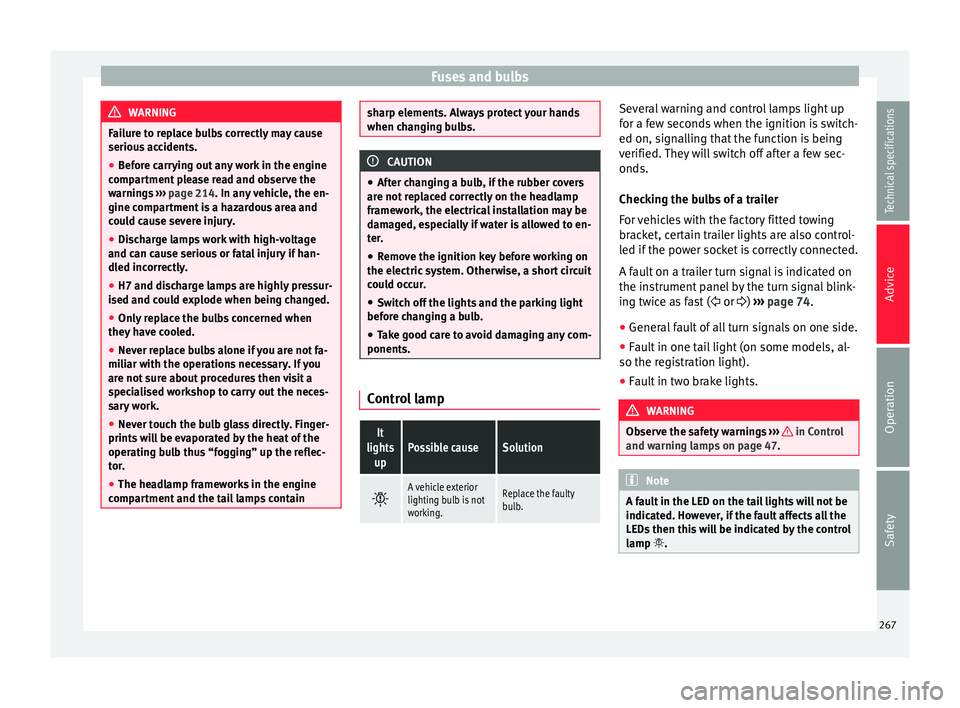
Checking the bulbs of a trailer
For vehicles with the factory fitted towing
bracket, certain trailer lights are also control-
led if the power socket is correctly connected.
A fault on a trailer turn signal is indicated on
the instrument panel by the turn signal blink-
ing twice as fast (
or ) ››› page 74.
● General fault of all turn signals on one side.
● Fault in one tail light (on some models, al-
so the registration light).
● Fault in two brake lights. WARNING
Observe the safety warnings ››› in Control
and warning lamps on page 47. Note
A fault in the LED on the tail lights will not be
indicated. However, if the fault affects all the
LEDs then this will be indicated by the control
lamp . 267
Technical specifications
Advice
Operation
Safety
Page 270 of 305
Advice
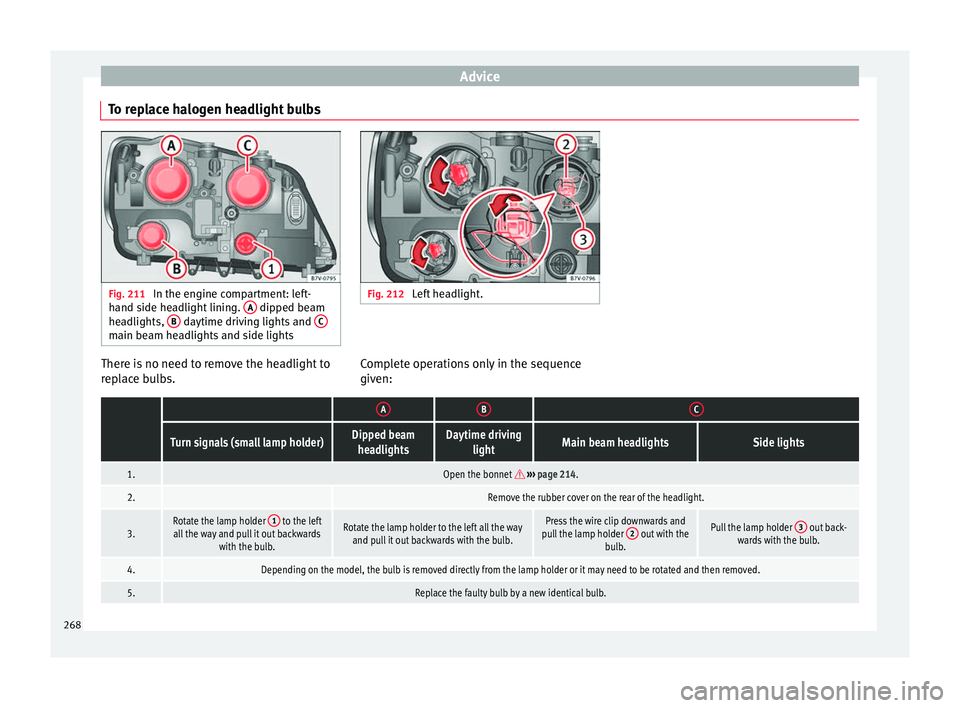
To replace halogen headlight bulbs Fig. 211
In the engine compartment: left-
hand side headlight lining. A dipped beam
headlights, B daytime driving lights and
Cmain beam headlights and side lights Fig. 212
Left headlight. There is no need to remove the headlight to
replace bulbs.
Complete operations only in the sequence
given:
ABC
Turn signals (small lamp holder)Dipped beam
headlightsDaytime driving lightMain beam headlightsSide lights
1.Open the bonnet ››› page 214.
2. Remove the rubber cover on the rear of the headlight.
3.Rotate the lamp holder 1 to the left
all the way and pull it out backwards with the bulb.Rotate the lamp holder to the left all the wayand pull it out backwards with the bulb.Press the wire clip downwards and
pull the lamp holder 2 out with the
bulb.Pull the lamp holder 3 out back-
wards with the bulb.
4.Depending on the model, the bulb is removed directly from the lamp holder or it may need to be rotated and then removed.
5.Replace the faulty bulb by a new identical bulb. 268
Page 271 of 305
Fuses and bulbs
ABC
Turn signals (small lamp holder)Dipped beam
headlightsDaytime driving lightMain beam headlightsSide lights
6.Place the bulb holder in the headlight and rotate to the right all the way.Place the lamp holder in the head-
light and pull the wire clip upwards until it clicks into place.Place the lamp holder in the head-light and insert completely.
7. Insert the rubber cover. Note
The images show the left hand headlight
from behind. The structure of the right hand
side headlight is symmetric. To replace the xenon headlights bulb
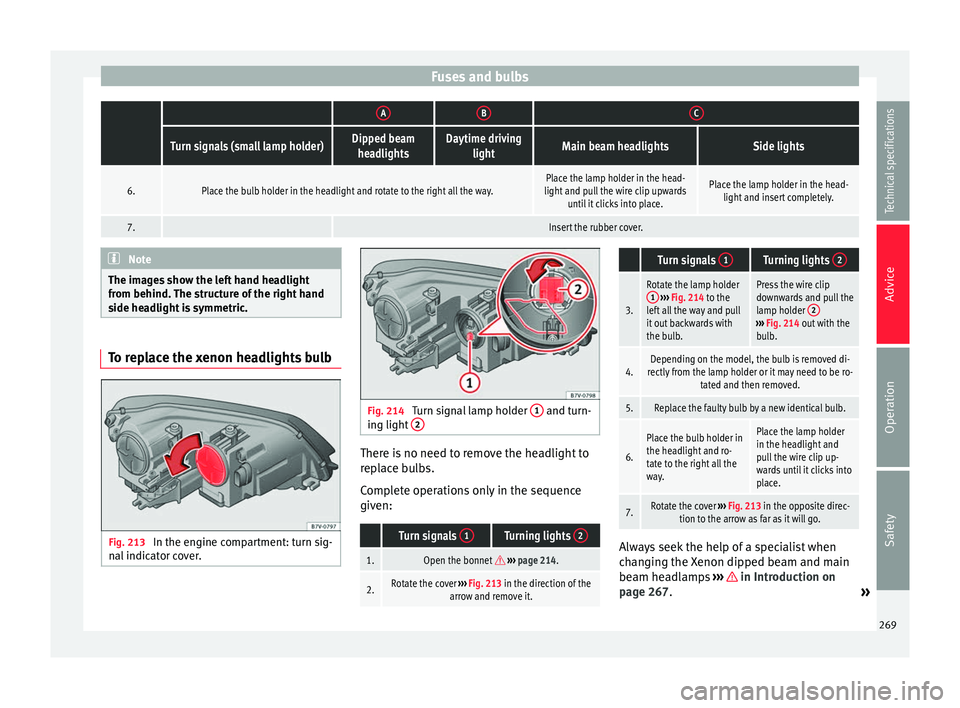
Fig. 213
In the engine compartment: turn sig-
nal indicator cover. Fig. 214
Turn signal lamp holder 1 and turn-
ing light 2 There is no need to remove the headlight to
replace bulbs.
Complete operations only in the sequence
given:
Turn signals
1Turning lights 2
1.Open the bonnet
››› page 214.
2.Rotate the cover ››› Fig. 213 in the direction of the
arrow and remove it.
Turn signals 1Turning lights 2
3.
Rotate the lamp holder
1 ››› Fig. 214 to the
left all the way and pull
it out backwards with
the bulb.Press the wire clip
downwards and pull the
lamp holder 2
›››
Fig. 214 out with the
bulb.
4.Depending on the model, the bulb is removed di-
rectly from the lamp holder or it may need to be ro- tated and then removed.
5.Replace the faulty bulb by a new identical bulb.
6.
Place the bulb holder in
the headlight and ro-
tate to the right all the
way.Place the lamp holder
in the headlight and
pull the wire clip up-
wards until it clicks into
place.
7.Rotate the cover ››› Fig. 213 in the opposite direc-
tion to the arrow as far as it will go. Always seek the help of a specialist when
changing the Xenon dipped beam and main
beam headlamps
››› in Introduction on
page 267. »
269
Technical specifications
Advice
Operation
Safety
Page 276 of 305
Technical specifications
Technical specifications
Technical specifications
Important information Important The information in the vehicle documentation
always takes precedence over the informa-
tion in this Instruction Manual.
All technical specifications provided in this
documentation are valid for the standard
model in Spain. The vehicle data card inclu-
ded in the Maintenance Programme or the
vehicle registration documents shows which
engine is installed in the vehicle.
The figures may be different depending
whether additional equipment is fitted, for
different models, for special vehicles and for
other countries.
Abbreviations used in the Technical
Specifications sectionAbbrevi-
ationMeaning
kWKilowatt, engine power measurement.
PSPferdestärke (horsepower), formerly used
to denote engine power.
rpmRevolutions per minute - engine speed.
NmNewton metres, unit of engine torque.
litres per100 kmFuel consumption in litres per 100 km (70
miles).
g/kmCarbon dioxide emissions in grams per km
(mile) travelled.
CO 2Carbon dioxide
CNCetane number, indication of the diesel
combustion power.
RONResearch octane number, indication of the
knock resistance of petrol. Vehicle code
Fig. 223
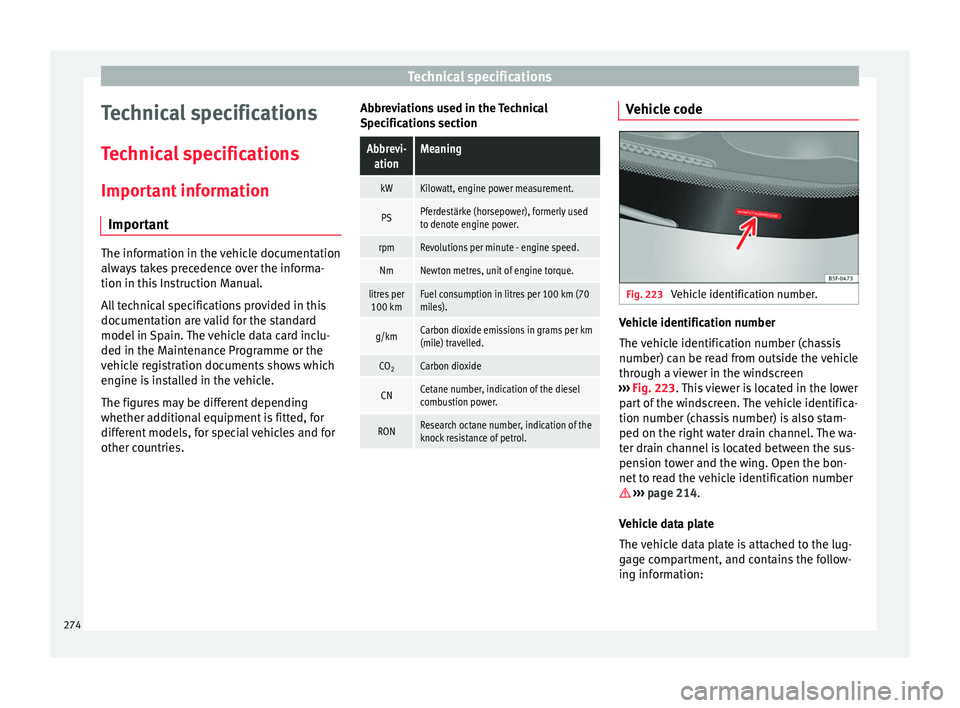
Vehicle identification number. Vehicle identification number
The vehicle identification number (chassis
number) can be read from outside the vehicle
through a viewer in the windscreen
››› Fig. 223 . This viewer is located in the lower
p ar
t of the windscreen. The vehicle identifica-
tion number (chassis number) is also stam-
ped on the right water drain channel. The wa-
ter drain channel is located between the sus-
pension tower and the wing. Open the bon-
net to read the vehicle identification number
››› page 214.
Vehic
le data plate
The vehicle data plate is attached to the lug-
gage compartment, and contains the follow-
ing information:
274
Page 277 of 305
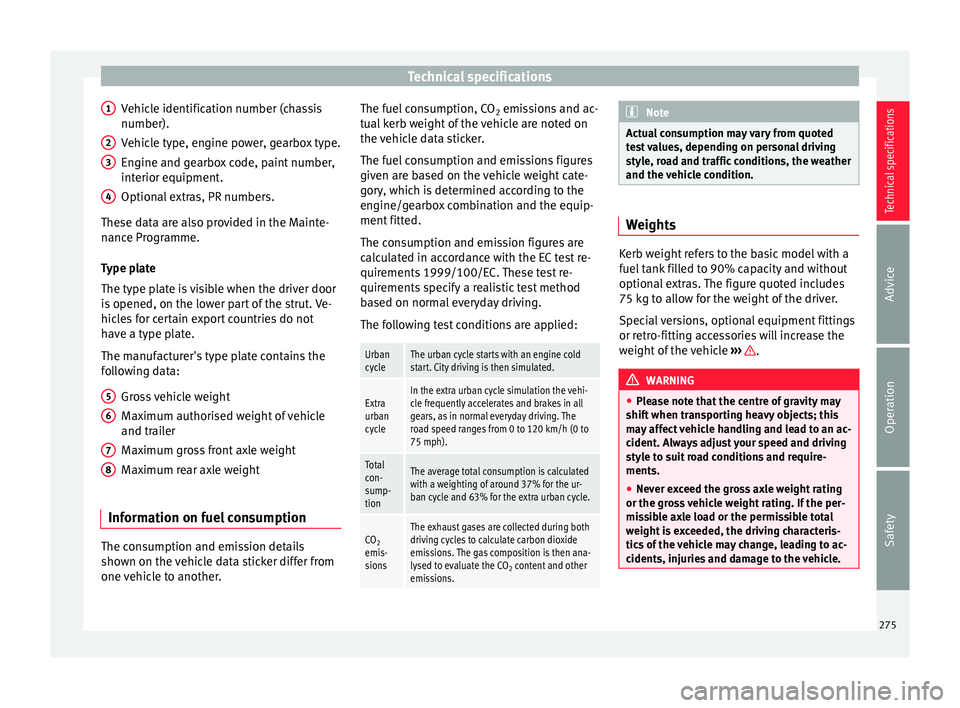
Technical specifications
Vehicle identification number (chassis
number).
Vehicle type, engine power, gearbox type.
Engine and gearbox code, paint number,
interior equipment.
Optional extras, PR numbers.
These data are also provided in the Mainte-
nance Programme.
Type plate
The type plate is visible when the driver door
is opened, on the lower part of the strut. Ve-
hicles for certain export countries do not
have a type plate.
The manufacturer's type plate contains the
following data: Gross vehicle weight
Maximum authorised weight of vehicle
and trailer
Maximum gross front axle weight
Maximum rear axle weight
Information on fuel consumption The consumption and emission details
shown on the vehicle data sticker differ from
one vehicle to another.1 2
3
4
5
6
7
8 The fuel consumption, CO
2 emissions and ac-
tual kerb weight of the vehicle are noted on
the vehicle data sticker.
The fuel consumption and emissions figures
given are based on the vehicle weight cate-
gory, which is determined according to the
engine/gearbox combination and the equip-
ment fitted.
The consumption and emission figures are
calculated in accordance with the EC test re-
quirements 1999/100/EC. These test re-
quirements specify a realistic test method
based on normal everyday driving.
The following test conditions are applied:Urban
cycleThe urban cycle starts with an engine cold
start. City driving is then simulated.
Extra
urban
cycleIn the extra urban cycle simulation the vehi-
cle frequently accelerates and brakes in all
gears, as in normal everyday driving. The
road speed ranges from 0 to 120 km/h (0 to
75 mph).
Total
con-
sump-
tionThe average total consumption is calculated
with a weighting of around 37% for the ur-
ban cycle and 63% for the extra urban cycle.
CO 2
emis-
sionsThe exhaust gases are collected during both
driving cycles to calculate carbon dioxide
emissions. The gas composition is then ana-
lysed to evaluate the CO 2 content and other
emissions. Note
Actual consumption may vary from quoted
test values, depending on personal driving
style, road and traffic conditions, the weather
and the vehicle condition. Weights
Kerb weight refers to the basic model with a
fuel tank filled to 90% capacity and without
optional extras. The figure quoted includes
75 kg to allow for the weight of the driver.
Special versions, optional equipment fittings
or retro-fitting accessories will increase the
weight of the vehicle
››› .
WARNING
● Please note that the centre of gravity may
shift when transporting heavy objects; this
may affect vehicle handling and lead to an ac-
cident. Always adjust your speed and driving
style to suit road conditions and require-
ments.
● Never exceed the gross axle weight rating
or the gross vehicle weight rating. If the per-
missible axle load or the permissible total
weight is exceeded, the driving characteris-
tics of the vehicle may change, leading to ac-
cidents, injuries and damage to the vehicle. 275
Technical specifications
Advice
Operation
Safety
Page 279 of 305
Technical specifications
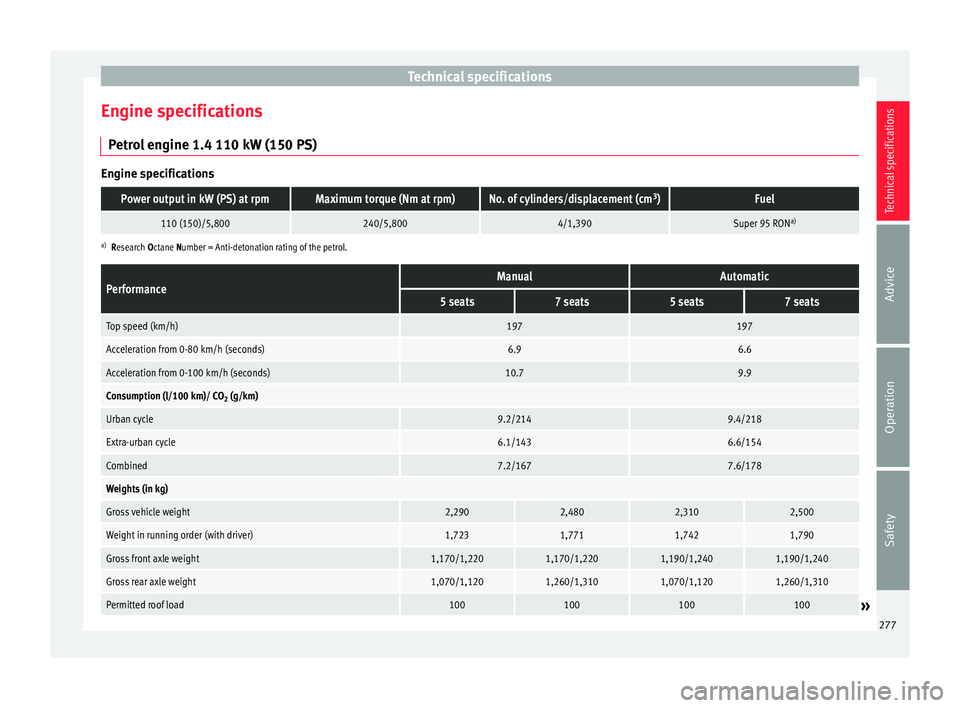
Engine specifications Petrol engine 1.4 110 kW (150 PS) Engine specificationsPower output in kW (PS) at rpmMaximum torque (Nm at rpm)No. of cylinders/displacement (cm
3
)Fuel
110 (150)/5,800240/5,8004/1,390Super 95 RON a)
a)
Research Octane Number = Anti-detonation rating of the petrol.
PerformanceManualAutomatic
5 seats7 seats5 seats7 seats
Top speed (km/h)197197
Acceleration from 0-80 km/h (seconds)6.96.6
Acceleration from 0-100 km/h (seconds)10.79.9
Consumption (l/100 km)/ CO 2 (g/km)
Urban cycle9.2/2149.4/218
Extra-urban cycle6.1/1436.6/154
Combined7.2/1677.6/178
Weights (in kg)
Gross vehicle weight2,2902,4802,3102,500
Weight in running order (with driver)1,7231,7711,7421,790
Gross front axle weight1,170/1,2201,170/1,2201,190/1,2401,190/1,240
Gross rear axle weight1,070/1,1201,260/1,3101,070/1,1201,260/1,310
Permitted roof load100100100100» 277
Technical specifications
Advice
Operation
Safety
Page 280 of 305
Technical specificationsPerformanceManualAutomatic
5 seats7 seats5 seats7 seats
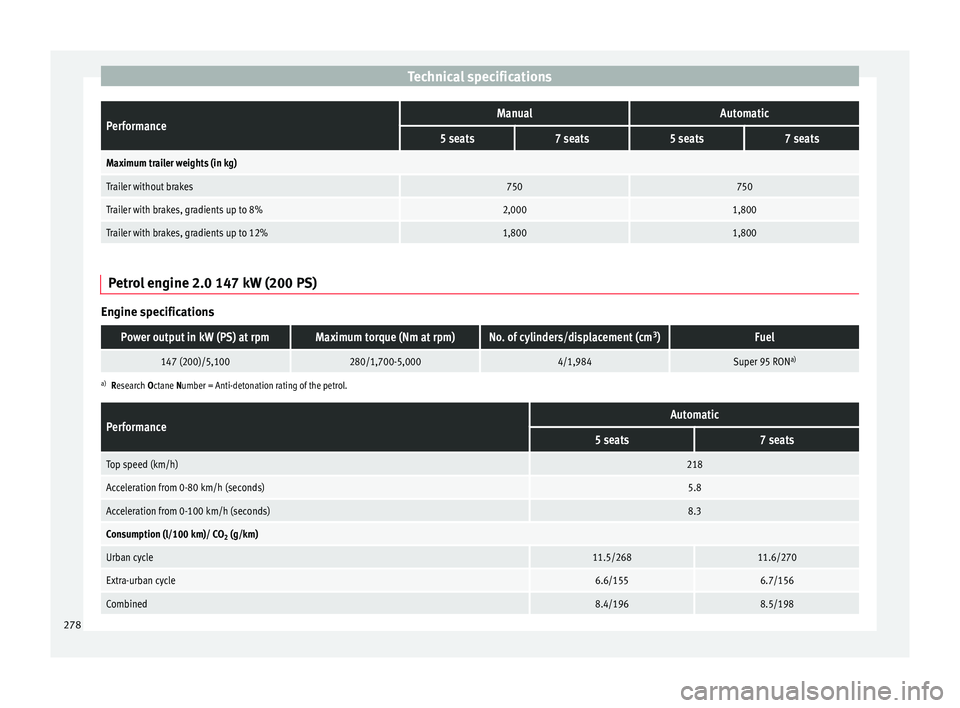
Maximum trailer weights (in kg)
Trailer without brakes750750
Trailer with brakes, gradients up to 8%2,0001,800
Trailer with brakes, gradients up to 12%1,8001,800
Petrol engine 2.0 147 kW (200 PS)
Engine specifications
Power output in kW (PS) at rpmMaximum torque (Nm at rpm)No. of cylinders/displacement (cm
3
)Fuel
147 (200)/5,100280/1,700-5,0004/1,984Super 95 RON a)
a)
Research Octane Number = Anti-detonation rating of the petrol.
PerformanceAutomatic
5 seats7 seats
Top speed (km/h)218
Acceleration from 0-80 km/h (seconds)5.8
Acceleration from 0-100 km/h (seconds)8.3
Consumption (l/100 km)/ CO 2 (g/km)
Urban cycle11.5/26811.6/270
Extra-urban cycle6.6/1556.7/156
Combined8.4/1968.5/198 278
Page 281 of 305
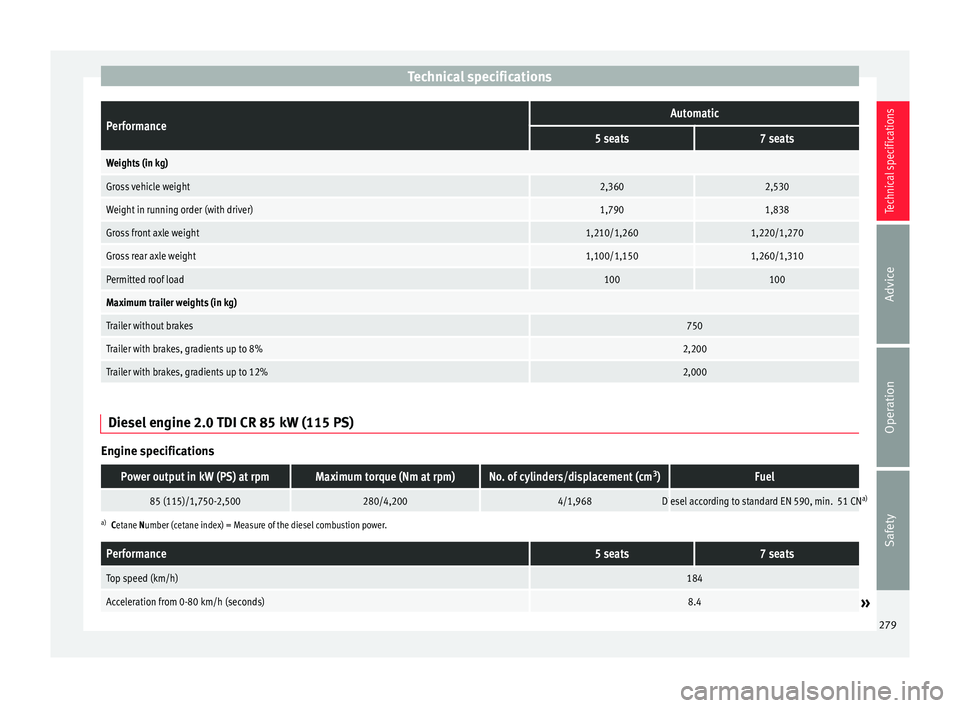
Technical specificationsPerformanceAutomatic
5 seats7 seats
Weights (in kg)
Gross vehicle weight2,3602,530
Weight in running order (with driver)1,7901,838
Gross front axle weight1,210/1,2601,220/1,270
Gross rear axle weight1,100/1,1501,260/1,310
Permitted roof load100100
Maximum trailer weights (in kg)
Trailer without brakes750
Trailer with brakes, gradients up to 8%2,200
Trailer with brakes, gradients up to 12%2,000
Diesel engine 2.0 TDI CR 85 kW (115 PS)
Engine specifications
Power output in kW (PS) at rpmMaximum torque (Nm at rpm)No. of cylinders/displacement (cm
3
)Fuel
85 (115)/1,750-2,500280/4,2004/1,968Diesel according to standard EN 590, min. 51 CN a)
a)
Cetane Number (cetane index) = Measure of the diesel combustion power.
Performance5 seats7 seats
Top speed (km/h)184
Acceleration from 0-80 km/h (seconds)8.4» 279
Technical specifications
Advice
Operation
Safety
Page 282 of 305
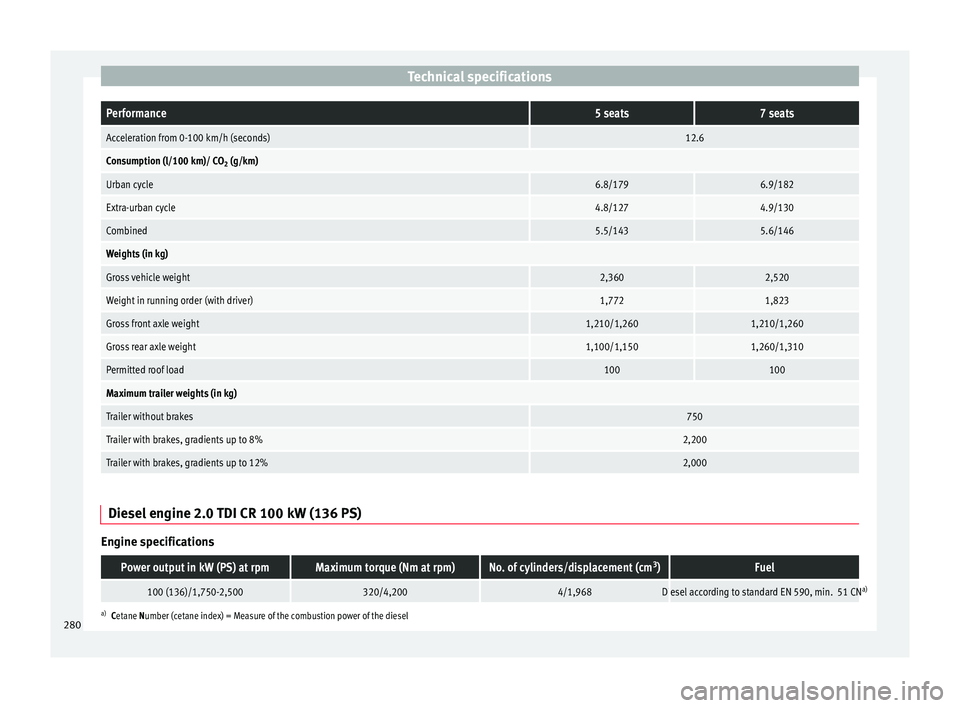
Technical specificationsPerformance5 seats7 seats
Acceleration from 0-100 km/h (seconds)12.6
Consumption (l/100 km)/ CO
2 (g/km)
Urban cycle6.8/1796.9/182
Extra-urban cycle4.8/1274.9/130
Combined5.5/1435.6/146
Weights (in kg)
Gross vehicle weight2,3602,520
Weight in running order (with driver)1,7721,823
Gross front axle weight1,210/1,2601,210/1,260
Gross rear axle weight1,100/1,1501,260/1,310
Permitted roof load100100
Maximum trailer weights (in kg)
Trailer without brakes750
Trailer with brakes, gradients up to 8%2,200
Trailer with brakes, gradients up to 12%2,000 Diesel engine 2.0 TDI CR 100 kW (136 PS)
Engine specifications
Power output in kW (PS) at rpmMaximum torque (Nm at rpm)No. of cylinders/displacement (cm
3
)Fuel
100 (136)/1,750-2,500320/4,2004/1,968Diesel according to standard EN 590, min. 51 CN a)
a)
Cetane Number (cetane index) = Measure of the combustion power of the diesel280