lights Seat Alhambra 2015 Repair Manual
[x] Cancel search | Manufacturer: SEAT, Model Year: 2015, Model line: Alhambra, Model: Seat Alhambra 2015Pages: 305, PDF Size: 5.46 MB
Page 230 of 305
Advice
●
Avoid sparks and electrostatic discharges
when working with cables and electrical devi-
ces.
● Never short the battery terminals.
● Never use a damaged battery. It can ex-
plode. Replace a damaged battery immedi-
ately.
● Replaced damaged or frozen batteries as
soon as possible. A flat battery can also
freeze at temperatures close to 0 °C (+32 °F).
● For vehicles with the battery in the luggage
compartment: Check that the battery gas
ventilation hose is securely attached. CAUTION
● Never disconnect the battery if the ignition
is switched on or if the engine is running.
This could damage the electrical system or
electronic components.
● Do not expose the battery to direct sunlight
over a long period of time, as the intense ul-
traviolet radiation can damage the battery
housing.
● If the car is left standing for long periods,
protect the battery from extreme cold temper-
ature so that it does not “freeze up” and be-
come damaged. Warning lampIt
lights upPossible causeSolution
Faulty generator.
Contact a specialised
workshop. Have the
electrical system
checked.
Disconnect any unneces-
sary electrical devices.
The generator does not
charge the battery while
the vehicle is in motion.
Several warning and control lamps light up
for a few seconds when the ignition is switch-
ed on, signalling that the function is being
verified. They will switch off after a few sec-
onds.
WARNING
If the warning lamps and messages are ignor-
ed, the vehicle may stall in traffic, or may
cause accidents and severe injuries.
● Never ignore the warning lamps or text
messages.
● Stop the vehicle safely as soon as possible. CAUTION
Failure to heed the control lamps and text
messages when they appear may result in
faults in the vehicle. Checking the electrolyte level of the
vehicle battery
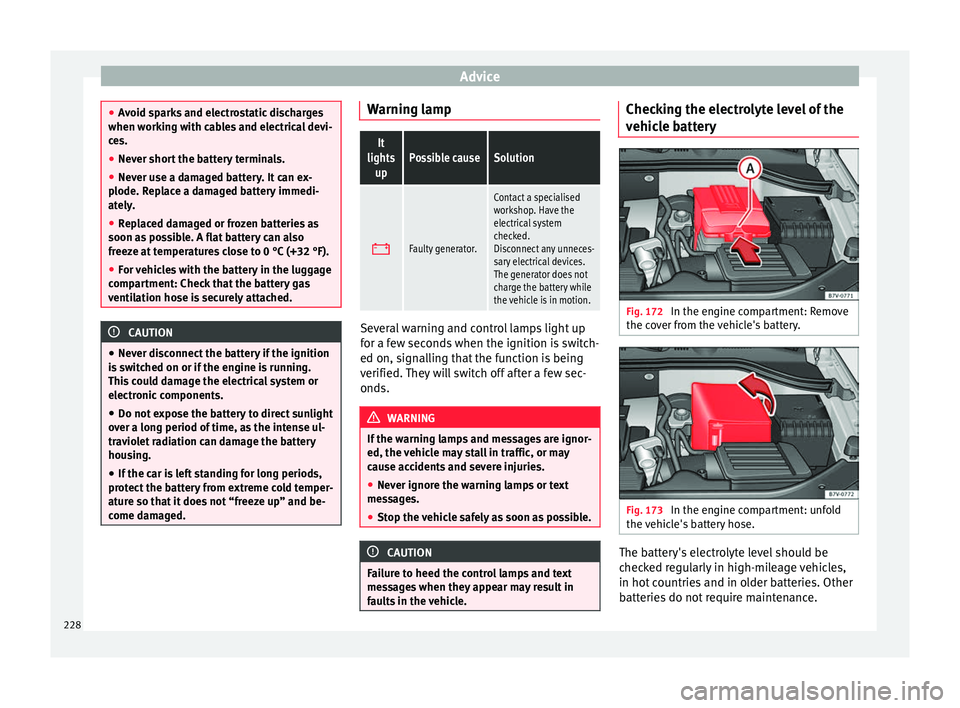
Fig. 172
In the engine compartment: Remove
the cover from the vehicle's battery. Fig. 173
In the engine compartment: unfold
the vehicle's battery hose. The battery's electrolyte level should be
checked regularly in high-mileage vehicles,
in hot countries and in older batteries. Other
batteries do not require maintenance.
228
Page 232 of 305
Advice
● The vehicle must be unlocked before dis-
connecting the battery, otherwise the alarm
will be triggered.
● First disconnect the negative cable and
then the positive ››› .
Connecting the vehicle's battery
● Before reconnecting the battery, switch off
the engine and all electrical devices.
● First reconnect the positive cable and then
the negative ››› .
Different control lamps may light up after
connecting the battery and switching the ig-
nition on. They will be turned off after a short
trip at a speed of between 15-20 km/h
(10-12 mph). If the warning indicators remain
lit, please visit a specialised workshop to
have the vehicle checked.
If the battery has been disconnected for a
long time, it is possible that the next service
date is not displayed or calculated correctly
››› page 40 . Respect the maximum service in-
t er
vals permitted ››› Booklet Maintenance
Programme.
Vehic
les with Keyless Access (››› page 59): if,
after connecting the battery, the ignition can-
not be switched on, lock and unlock the vehi-
cle from outside. Then try to switch on the ig-
nition again. If the ignition does not work,
seek professional assistance. Automatic device disconnection
The intelligent vehicle electrical system auto-
matically implements a range of measures to
prevent the battery from discharging when
high demands are made on it:
● the idling speed is increased so that the al-
ternator provides more electricity.
● where necessary, the power of the most
powerful devices is reduced or even com-
pletely disconnected.
● On starting the engine, the power supply
from the 12-volt power sockets and the ciga-
rette lighter may be interrupted for a short
time.
The on-board management program cannot
always prevent the battery from running flat.
For example, if the ignition is left on for a
long period with the engine off or if the side
lights or parking lights are left on while the
vehicle is stationary.
Why does the battery run flat?
● When stationary for a long time without
starting the engine, particularly if the ignition
is switched on.
● Use of electrical devices with the engine
switched off.
● If the auxiliary heater is running
››› page 128
. WARNING
Incorrectly securing the battery or using the
wrong battery can cause short-circuits, fire
and serious injuries.
● Always use only maintenance free batteries
that do not run flat alone and whose proper-
ties, specifications and size correspond to
the standard battery. The specifications are
indicated on the battery case. WARNING
A highly explosive mixture of gases is re-
leased when the battery is under charge.
● The batteries should be charged in a well-
ventilated room only.
● Never charge a frozen or recently thawed
battery. A flat battery can also freeze at tem-
peratures close to 0 °C (+32 °F).
● Always replace a battery which has frozen.
● Battery cables not correctly connected may
cause a short circuit. Reconnect first the posi-
tive cable and then the negative cable. CAUTION
● Never disconnect the battery if the ignition
is switched on or if the engine is running.
This could damage the electrical system or
electronic components.
● Never plug accessories that supply current,
such as solar panels or a battery charger, to
the 12-volt power sockets or the cigarette 230
Page 245 of 305
Emergencies
First-aid kit
There is a first aid kit ››› page 112 in the rear
left-hand side storage compartment of the
luggage compartment.
The first aid kit must comply with legal re-
quirements. Check the expiry date of the con-
tents of the first aid kit.
Fire extinguisher
There is a Fire extinguisher underneath the
fr ont
passenger seat.
The fire extinguisher must conform to legal
requirements, be ready for use and be
checked regularly. Check the certification
seal on the extinguisher. WARNING
Loose objects in the vehicle interior can be vi-
olently thrown in case of a sudden manoeu-
vre or braking and especially in accidents
causing serious injury.
● Secure fire extinguishers, first aid kit, re-
flective vests and warning triangle securely
to their respective supports. Protecting yourself and securing the
vehicle
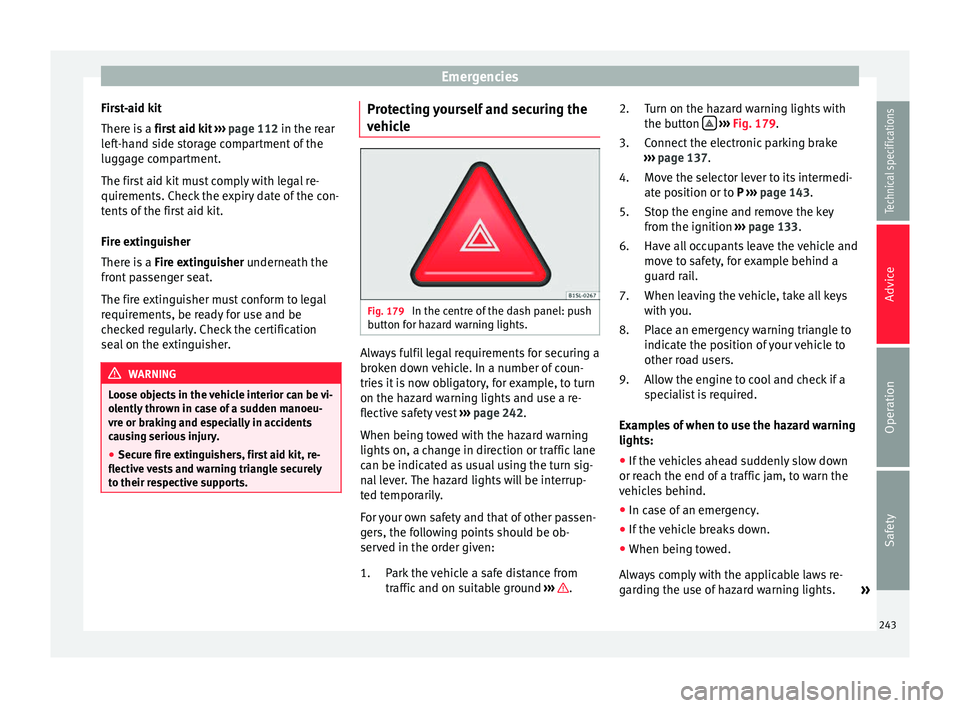
Fig. 179
In the centre of the dash panel: push
button for hazard warning lights. Always fulfil legal requirements for securing a
broken down vehicle. In a number of coun-
tries it is now obligatory, for example, to turn
on the hazard warning lights and use a re-
flective safety vest
››› page 242.
When being towed with the hazard warning
lights on, a change in direction or traffic lane
can be indicated as usual using the turn sig-
nal lever. The hazard lights will be interrup-
ted temporarily.
For your own safety and that of other passen-
gers, the following points should be ob-
served in the order given:
Park the vehicle a safe distance from
traffic and on suitable ground ››› .
1. Turn on the hazard warning lights with
the button
››› Fig. 179.
Connect the electronic parking brake
››› page 137 .
Mo v
e the selector lever to its intermedi-
ate position or to
P ››› page 143.
Stop the engine and remove the key
from the ignition ››› page 133.
Have all occupants leave the vehicle and
move to safety, for example behind a
guard rail.
When leaving the vehicle, take all keys
with you.
Place an emergency warning triangle to
indicate the position of your vehicle to
other road users.
Allow the engine to cool and check if a
specialist is required.
Examples of when to use the hazard warning
lights:
● If the vehicles ahead suddenly slow down
or reach the end of a traffic jam, to warn the
vehicles behind.
● In case of an emergency.
● If the vehicle breaks down.
● When being towed.
Always comply with the applicable laws re-
garding the use of hazard warning lights. »
2.
3.
4.
5.
6.
7.
8.
9.
243Technical specifications
Advice
Operation
Safety
Page 246 of 305
Advice
If the hazard warning lights are not working,
you must use an alternative method of draw-
ing attention to your vehicle. This method
must comply with traffic legislation. WARNING
A faulty vehicle in traffic represents a risk of
accident for the driver and for other road
users.
● Stop the vehicle safely as soon as possible.
Park the vehicle a safe distance from sur-
rounding traffic to lock all the doors in case of
an emergency. Turn on the hazard warning
lights to warn other road users.
● Never leave children or disabled people
alone in the vehicle if the doors are to be
locked. In case of an emergency, passengers
will be trapped inside the vehicle. Individuals
locked in the vehicle can be exposed to very
high or very low temperatures. WARNING
The components of the exhaust system reach
very high temperatures. This could cause a
fire and considerable damage.
● Always park your vehicle so that no part of
the exhaust system can come in contact with
flammable materials (such as dried grass or
fuel). Note
● The vehicle battery will discharge and run
down if the hazard warning lights remain on for too long (even with the ignition turned
off).
● For some vehicles, the brake lights will
blink when braking suddenly at speeds of ap-
proximately 80 km/h (50 mph) to alert vehi-
cles to the rear. If braking continues, the haz-
ard warning lights system will automatically be turned on at a speed of less than approxi-
mately 10 km/h (6 mph). The brake lights re-
main lit. Upon accelerating, the hazard warn-
ing lights will be automatically turned off. Vehicle tool kit*
Introduction When securing the vehicle in case of a break-
down, please note the legal requirements for
each country.
WARNING
Loose objects in the vehicle interior can be vi-
olently fired through the compartment in
case of a sudden manoeuvre or braking and
especially in accidents causing serious in-
jury.
● Make sure that the vehicle tools are stored
safely in the luggage compartment. WARNING
Unsuitable or damaged vehicle tools can
cause injury or accidents.
● Never work with inappropriate or damaged
tools. Location
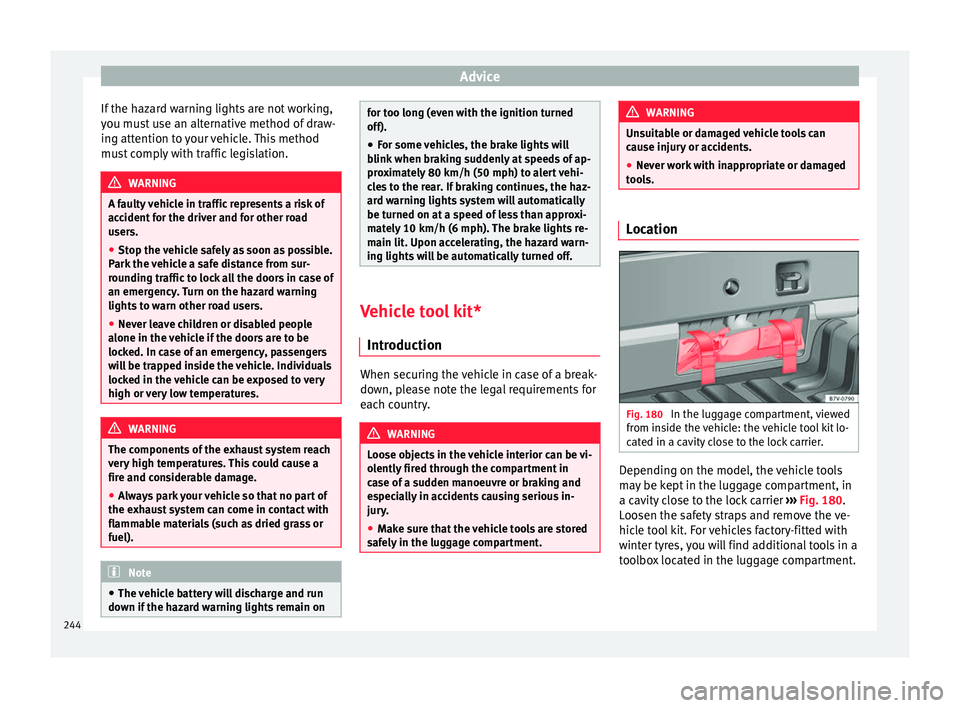
Fig. 180
In the luggage compartment, viewed
from inside the vehicle: the vehicle tool kit lo-
cated in a cavity close to the lock carrier. Depending on the model, the vehicle tools
may be kept in the luggage compartment, in
a cavity close to the lock carrier
››› Fig. 180 .
L oo
sen the safety straps and remove the ve-
hicle tool kit. For vehicles factory-fitted with
winter tyres, you will find additional tools in a
toolbox located in the luggage compartment.
244
Page 248 of 305
Advice
WARNING
If the folding chocks are assembled or used
incorrectly, an accident may occur and seri-
ous injury caused.
● Never use damaged chocks.
● Never use chocks to immobilize the vehicle
on a slope. Changing a wheel*
Introduction The tyres mounted on the vehicle are anti-
puncture. The wheels should only be
changed when switching from summer to
winter tyres or vice-versa. See
›››
page 237
The vehicle only comes with the necessary
tools for changing wheels if factory supplied
with winter tyres. If this is not the case, you
need to go to a specialised workshop to get
the wheels changed.
You should only change the wheels yourself if
the vehicle is parked in a safe place, you are
familiar with the procedure and safety stand-
ards and you have all the necessary tools!
Otherwise, you should seek professional as-
sistance. WARNING
Changing a wheel can be dangerous, espe-
cially on the hard shoulder. Please observe
the following rules to minimise the risk of in-
jury:
● Stop the vehicle safely as soon as possible.
Park at a safe distance from surrounding traf-
fic to change a wheel.
● When changing a wheel, keep all passen-
gers, and particularly children, a safe dis-
tance away from the work area.
● Turn on the hazard warning lights to warn
other road users.
● Ensure the ground on which you park is flat
and solid. If necessary, support the jack on a
wide solid base.
● If you are changing a wheel yourself, you
should be familiar with the required proce-
dure. Otherwise, you should seek professio-
nal assistance.
● Only use suitable tools that are not dam-
aged when changing a wheel.
● Always stop the engine, turn on the elec-
tronic parking brake and place the gear selec-
tor lever in position P, for an automatic gear-
box, or engage a gear for a manual gearbox to
reduce the risk of the vehicle moving acciden-
tally.
● Have the tightening torque of the wheel
bolts checked as soon as possible with a reli-
able torque wrench. WARNING
If the wheel trims are not appropriate or not
fitted correctly, they could cause major acci-
dents or damage.
● Incorrectly mounted wheel trims may come
off while driving and endanger other road
users.
● Damaged trims must never be mounted on
the wheels.
● Always ensure that the brake ventilation
and cooling is not cut off or blocked. This is
also valid if hubcaps are fitted later. If there
is not enough air, you may require signifi-
cantly longer braking distances. CAUTION
Remove and remount wheel trims taking care
to avoid damage to the vehicle. 246
Page 253 of 305
Emergencies
and the necessary safety measures, and if
you have the right kit! Otherwise, you should
seek professional assistance.
The tyre sealant should not be used in the
following cases:
● If the wheel is damaged.
● The outside temperature is lower than -20
℃ (-4 °F).
● If the tear or puncture on the tyre is over 4
mm wide.
● If you have driven with very low pressure or
a flat tyre.
● If the expiry date on the bottle of tyre seal-
ant has passed. WARNING
Using the tyre mobility system can be dan-
gerous, especially when filling the tyre at the
roadside. Please observe the following rules
to minimise the risk of injury:
● Stop the vehicle safely as soon as possible.
Park it at a safe distance from surrounding
traffic to fill the tyre.
● Ensure the ground is flat and firm.
● All occupants, and especially children,
should always be at a safe distance outside
the work area.
● Turn on the hazard warning lights to warn
other road users. ●
Use the tyre mobility system only if you are
familiar with the necessary procedures. Oth-
erwise, you should seek professional assis-
tance.
● Only use the tyre mobility system in the
event of an emergency to get to the nearest
workshop.
● Replace the repaired tyre with the tire mo-
bility set as soon as possible.
● The sealant is hazardous for your health
and if it touches your skin, it must be imme-
diately washed off.
● Keep children away from the tyre mobility
system.
● Never use a jack even if it is approved for
the vehicle.
● To reduce the risk of the vehicle possibly
moving on its own, always turn off the en-
gine, set the electronic parking brake and put
the selector lever in position P or put into
gear if the gearbox is a manual. WARNING
A tyre repaired with sealant does not have
the normal drive properties.
● Never drive faster than 80 km/h (50 mph).
● Avoid hard acceleration, heavy braking and
fast cornering.
● Check the tyre after travelling 10 minutes
at no more than 80 km/h (50 mph). For the sake of the environment
Once used or expired, dispose of the sealant
according to legal provisions. Note
● Sealant bottles can be purchased from
SEAT dealers.
● Observe the usage instructions provided by
the snow chain manufacturer. Contents of the tyre mobility system*
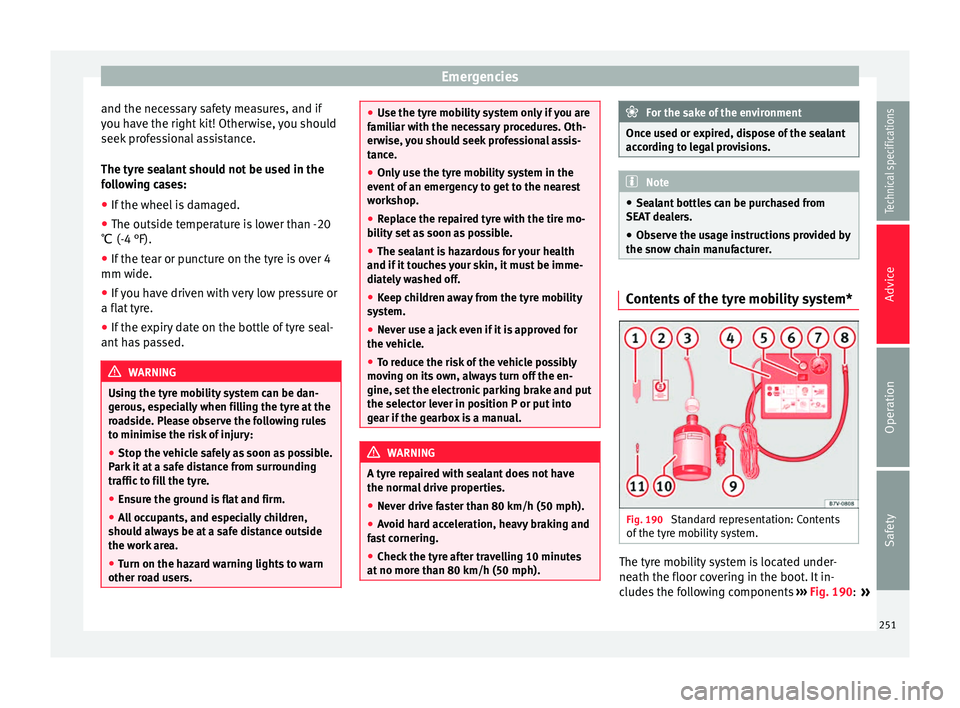
Fig. 190
Standard representation: Contents
of the tyre mobility system. The tyre mobility system is located under-
neath the floor covering in the boot. It in-
cludes the following components
››› Fig. 190 :
»
251Technical specifications
Advice
Operation
Safety
Page 257 of 305
Emergencies
Starting
7. Start the engine of the vehicle with the boosting battery and let it run at idling
speed.
8. Start the engine of the vehicle with the flat battery and wait 2 or 3 minutes until the
engine is “running”.
Removing the jump leads
9. Before you remove the jump leads, switch off the dipped beam headlights (if they
are switched on).
10. Turn on the heater blower and heated rear
w indo
w in the vehicle with the flat battery.
This helps minimise voltage peaks which
are generated when the leads are discon-
nected.
11.When the engine is running, disconnect the leads in reverse order to the details
given above.
Connect the battery clamps so they have
good metal-to-metal contact with the battery
terminals.
If the engine fails to start, switch off the start-
er after about 10 seconds and try again after
about 1 minute. WARNING
● Please note the safety warnings referring to
working in the engine compartment
››› page 214.
● The b att
ery providing assistance must have
the same voltage as the flat battery (12V) and
approximately the same capacity (see imprint
on battery). Failure to comply could result in
an explosion.
● Never use jump leads when one of the bat-
teries is frozen. Danger of explosion! Even af-
ter the battery has thawed, battery acid could
leak and cause chemical burns. If a battery
freezes, it should be replaced.
● Keep sparks, flames and lighted cigarettes
away from batteries, danger of explosion.
Failure to comply could result in an explo-
sion.
● Observe the instructions provided by the
manufacturer of the jump leads.
● Do not connect the negative cable from the
other vehicle directly to the negative terminal
of the flat battery. The gas emitted from the
battery could be ignited by sparks. Danger of
explosion.
● Do not attach the negative cable from the
other vehicle to parts of the fuel system or to
the brake line.
● The non-insulated parts of the battery
clamps must not be allowed to touch. The
jump lead attached to the positive battery
terminal must not touch metal parts of the ve-
hicle, this can cause a short circuit. ●
Position the leads in such a way that they
cannot come into contact with any moving
parts in the engine compartment.
● Do not lean on the batteries. This could re-
sult in chemical burns. Note
The vehicles must not touch each other, oth-
erwise electricity could flow as soon as the
positive terminals are connected. Towing and tow starting
Introduction When towing, always respect legal require-
ments.
For technical reasons, it is not possible to
tow a vehicle if the battery is flat.
If the vehicle comes with the Keyless Access
system, towing is only allowed with the igni-
tion on!
The vehicle battery drains if the vehicle is
towed with the engine switched off and the
ignition connected. Depending on the battery
charge status, the drop in voltage may be so
large, even after just a few minutes, that no
electrical device in the vehicle may work e.g.
the hazard warning lights. In vehicles with
»
255
Technical specifications
Advice
Operation
Safety
Page 258 of 305
Advice
the Keyless Access system, the steering
wheel could lock ››› .
WARNING
A vehicle with a flat battery should never be
towed.
● Never remove the key from the ignition
lock. Otherwise, the steering wheel lock
could suddenly lock. The vehicle would not
be controlled and a serious accident could
ensue. WARNING
When towing the vehicle, the handling and
braking efficiency change considerably.
Please observe the following instructions to
minimise the risk of serious accidents and in-
jury:
● As the driver of the vehicle being towed:
– The brake must be depressed must hard-
er as the brake servo does not operate.
Always remain aware to avoid collision
with the towing vehicle.
– More strength is required at the steering
wheel as the power steering does not op-
erate when the engine is switched off.
● As the driver of the towing vehicle:
– Accelerate gently and carefully.
– Avoid sudden braking and manoeuvres.
– Brake well in advance than usual and
brake gently. CAUTION
● Carefully fit and remove the towline anchor-
age and its cover to avoid damage to the ve-
hicle (e.g. paintwork).
● When towing, fuel could enter the catalytic
converter and cause damage! Instructions for tow starting
In general, the vehicle should not be started
by towing. Jump-starting is much more pref-
erable
› › ›
page 253.
For technical reasons, the following vehicles
can
not be tow started:
● Vehicles with an automatic gearbox.
● Vehicles with the Keyless Access locking
and ignition system, since the electronic
steering lock may not unlock.
● Vehicles with an electronic parking brake,
given that it is possible that the brake will
not be disengaged.
● If the vehicle battery is flat, it is possible
that the engine control units do not operate
correctly.
However, if your vehicle must absolutely be
tow-started (manual gearbox):
● Put it into second or third gear.
● Keep the clutch pressed down. ●
Switch on the ignition and the hazard warn-
ing lights.
● Release the clutch when both vehicles are
moving.
● As soon as the engine starts, press the
clutch and move the gear lever into neutral.
This helps to prevent a collision with the tow-
ing vehicle. CAUTION
When tow-starting, fuel could enter the cata-
lytic converter and damage it. Towing instructions
Tow rope or tow bar
When towing, the tow bar is the safest and
vehicle friendly way. You should only use a
tow rope if you do not have a tow bar.
A tow rope should be slightly elastic to avoid
damage to both vehicles. It is advisable to
use a tow rope made of synthetic fibre or sim-
ilarly elastic material.
Only secure the tow rope or tow bar to the
towline anchorage or specially designed fit-
ting.
Vehicles with a
factory fitted towing device ,
can only
be used for towing with a tow bar,
s
pecially designed to fit on a tow hitch ball
››› page 179.
256
Page 260 of 305
Advice
● After towing, remove the towline anchorage
by turning it clockwise and put the cover
b ac
k in place. CAUTION
The towline anchorage must always be com-
pletely and firmly tightened. Otherwise, it
could be released while towing and tow-start-
ing. Fitting the rear towline anchorage
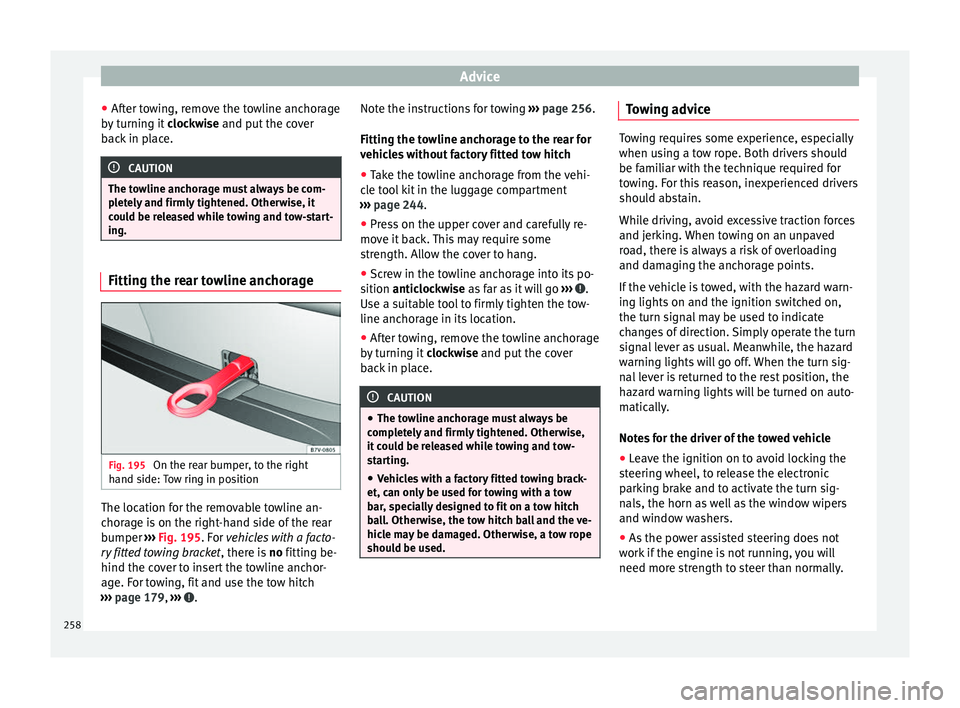
Fig. 195
On the rear bumper, to the right
hand side: Tow ring in position The location for the removable towline an-
chorage is on the right-hand side of the rear
bumper
››› Fig. 195 . For
vehicles with a facto-
ry
fitted towing bracket , there is no fitting be-
hind the cover to insert the towline anchor-
age. For towing, fit and use the tow hitch
››› page 179, ››› . Note the instructions for towing
››› page 256.
Fitting the towline anchorage to the rear for
vehicles without factory fitted tow hitch ● Take the towline anchorage from the vehi-
cle tool kit in the luggage compartment
››› page 244 .
● Pr e
ss on the upper cover and carefully re-
move it back. This may require some
strength. Allow the cover to hang.
● Screw in the towline anchorage into its po-
sition anticlockwise as far as it will go ›
›› .
Use a suitable tool to firmly tighten the tow-
line anchorage in its location.
● After towing, remove the towline anchorage
by turning it clockwise and put the cover
b ac
k in place. CAUTION
● The towline anchorage must always be
completely and firmly tightened. Otherwise,
it could be released while towing and tow-
starting.
● Vehicles with a factory fitted towing brack-
et, can only be used for towing with a tow
bar, specially designed to fit on a tow hitch
ball. Otherwise, the tow hitch ball and the ve-
hicle may be damaged. Otherwise, a tow rope
should be used. Towing advice
Towing requires some experience, especially
when using a tow rope. Both drivers should
be familiar with the technique required for
towing. For this reason, inexperienced drivers
should abstain.
While driving, avoid excessive traction forces
and jerking. When towing on an unpaved
road, there is always a risk of overloading
and damaging the anchorage points.
If the vehicle is towed, with the hazard warn-
ing lights on and the ignition switched on,
the turn signal may be used to indicate
changes of direction. Simply operate the turn
signal lever as usual. Meanwhile, the hazard
warning lights will go off. When the turn sig-
nal lever is returned to the rest position, the
hazard warning lights will be turned on auto-
matically.
Notes for the driver of the towed vehicle
●
Leave the ignition on to avoid locking the
steering wheel, to release the electronic
parking brake and to activate the turn sig-
nals, the horn as well as the window wipers
and window washers.
● As the power assisted steering does not
work if the engine is not running, you will
need more strength to steer than normally.
258
Page 266 of 305
Advice
CAUTION
● Damaged or dirty windscreen wipers could
scratch the glass.
● If products containing solvents, rough
sponges or sharp objects are used to clean
the blades, the graphite layer will be dam-
aged.
● Never use fuel, nail varnish remover, paint
thinner or similar products to clean the win-
dows. Fuses and bulbs
Fuses Introduction Due to the constant updating of vehicles,
fuse assignments based on equipment and
the use of the same fuse for various electrical
components, it is not possible to provide an
up-to-date summary of the fuse positions for
the electrical components at the time of
printing this manual. For detailed information
about the fuse positions, please consult a
technical service.
In general, a fuse can be assigned to various
electrical components. Likewise, an electrical
component can be protected by several
fuses.
Only replace fuses when the cause of the
problem has been solved. If a newly inserted
fuse blows after a short time, you must have
the electrical system checked by a special-
ised workshop as soon as possible.
WARNING
The high voltages in the electrical system can
give serious electrical shocks, causing burns
and even death!
● Never touch the electrical wiring of the igni-
tion system. ●
Take care not to cause short circuits in the
electrical system. WARNING
Using unsuitable fuses, repairing fuses or
bridging a current circuit without fuses can
cause a fire and serious injury.
● Never use a fuse with a higher value. Only
replace fuses with a fuse of the same amper-
age (same colour and markings) and size.
● Never repair a fuse.
● Never replace a fuse by a metal strip, staple
or similar. CAUTION
● To prevent damage to the vehicle's electric
system, before replacing a fuse always turn
off the ignition, the lights and all electrical
elements and remove the key from the igni-
tion.
● If you replace a fuse with higher-rating
fuse, you could cause damage to another part
of the electrical system.
● Protect the fuse boxes when open to pre-
vent the entry of dust or humidity as they can
damage the electrical system. Note
● One component may have more than one
fuse. 264