lock Seat Ibiza SC 2009 Owner's Guide
[x] Cancel search | Manufacturer: SEAT, Model Year: 2009, Model line: Ibiza SC, Model: Seat Ibiza SC 2009Pages: 257, PDF Size: 6.61 MB
Page 85 of 257
Unlocking and locking83
Safety First
Controls and equipment
Practical tips
Technical Data
•Always take the key with you when leaving the vehicle, even if you only
intend to be gone for a short time. Please ensure that children are never left
alone inside the vehicle.•The electric windows will work until the ignition has been switched off
and one of the front doors has been opened.•Closing the windows without observing and ensuring it is clear could
cause serious injury to you and third parties. Make sure that no one is in
the path of a window.•Never allow people to remain in the vehicle when you close the vehicle
from the outside. The windows cannot be opened even in an emergency.•The roll-back function does not prevent fingers or other parts of the
body getting pinched against the window frame and cause injury.
Convenience opening and closing* Using the door lock
– Hold the key in the door lock of the driver door in either the locking or the unlocking position until all windows are either
opened or closed.
– Release the key to interrupt this function.
Using the remote control
– Keep the locking/unlocking button pressed for the electrical window risers to open/close; if you stop pressing the button, the
window raising/lowering function is stopped.
– If the automatic raising is stopped and immediately after, the opening button is kept pressed, the window risers will lower. – Once the windows are completely closed, the indicators will
flash.
Panoramic tilting roof*Opening and closing th e sliding/tilting roof
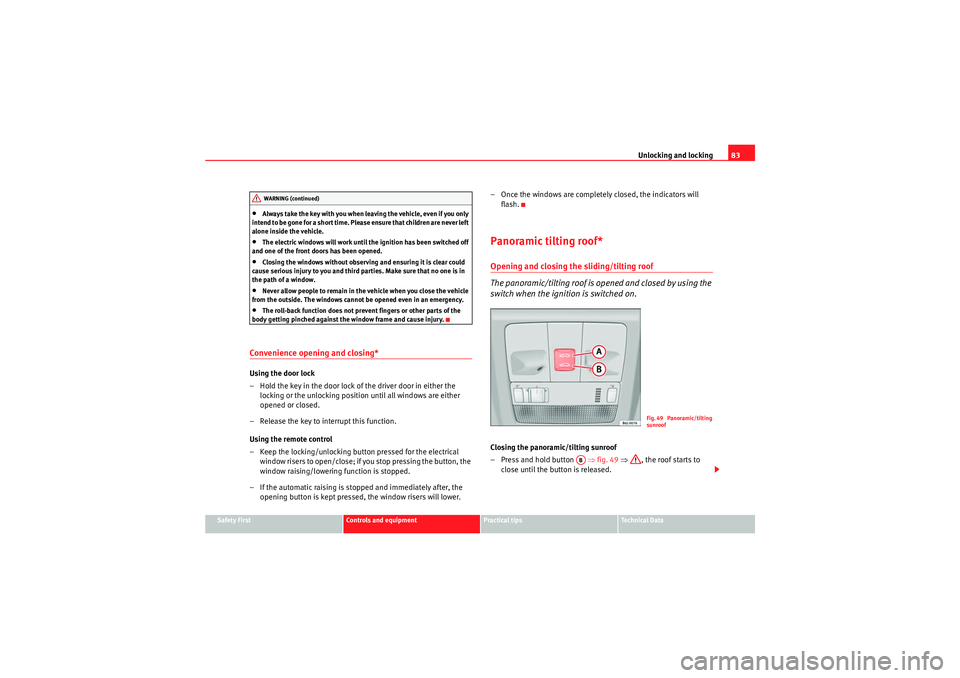
The panoramic/tilting roof is opened and closed by using the
switch when the ignition is switched on.Closing the panoramic/tilting sunroof
– Press and hold button ⇒fig. 49 ⇒ , the roof starts to
close until the button is released.
WARNING (continued)
Fig. 49 Panoramic/tilting
sunroof
AB
IbizaSC_EN.book Seite 83 Mittwoch, 16. September 2009 12:11 12
Page 86 of 257
Unlocking and locking
84
Opening the panoramic/tilting sunroof
– Press and hold down button . The roof starts opening until the button is released.
Automatic closing of the panoramic/tilting sunroof
– Press button once only; the roof starts closing automatically until it is completely closed.
Automatic opening of the panoramic/ tilting sunroof
– Press button once only. The roof starts opening automatically until it is completely open.
Restoring one-touch opening and closing
– Close the roof manually until it is completely closed. Release the button
– Press the closing button again, keeping it pressed down, until a complete opening and closing cycle has taken place.Always close the panoramic/ tilting roof fully if you park the vehicle or leave
it unattended ⇒ .
The tilting roof can be operated for up to about ten minutes after the ignition
has been switched off, provided the driver door and the front passenger door
are not opened.
Sunroof blind
The sunroof blind is opened and closed manually (independently of the
sliding/ tilting roof).
WARNING
•Incorrect use of the tilting roof can result in injury.
•Never close the tilting sunroof without observing and ensuring it is
clear to do, otherwise it may cause serious injury to you and others. Make
sure that no one is in the path of the tilting roof.•Always take the vehicle key with you when you leave the vehicle.•Never leave children or disabled persons in the vehicle, particularly if
they have access to the keys. Unsupervised use of a key could mean that
the engine is started or that electrical equipment is used (e.g. electric
tilting sunroof) with a risk of accident. The doors can be locked using the
remote control key. This could make assistance difficult in an emergency.•The tilting sunroof continues to function until one of the front doors is
opened and the key removed from the ignition.•Ensure that no object and/or limb is between the glass and the roof
when the one-touch opening/closing function is reset.
Convenience closing*Using the door lock
– Hold the key in the door lock of the driver's door in the locking position until the tilting sunroof is closed.
– Release the key to interrupt this function.
Using the remote control
– Push the lock button on the remote control for about 3 seconds. The tilting roof closes.
– Press the unlock button to interrupt the function.
AA
ABAA
WARNING (continued)
IbizaSC_EN.book Seite 84 Mittwoch, 16. September 2009 12:11 12
Page 87 of 257
Unlocking and locking85
Safety First
Controls and equipment
Practical tips
Technical Data
Roll-back function of the panoramic/ tilting roof*The panoramic/ tilting roof has a roll-back function which prevents larger
objects getting trapped when the roof is closed. The roll-back function does
not prevent fingers getting pinched against the roof opening. The tilting
sunroof stops and opens again immediately if it is obstructed when closing.Operation in case of breakdown
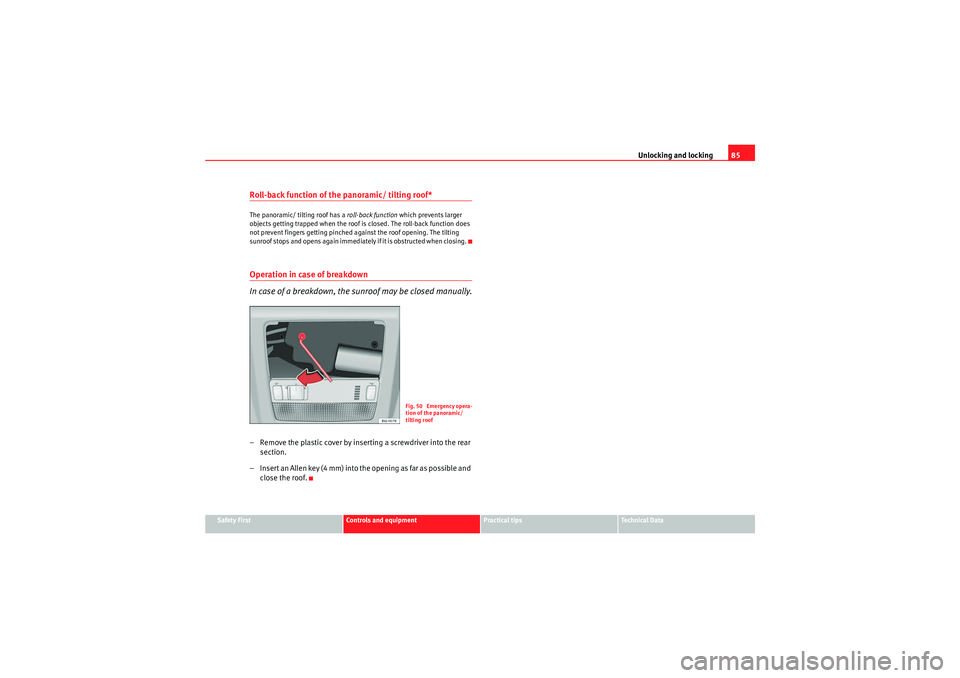
In case of a breakdown, the sunroof may be closed manually.– Remove the plastic cover by inserting a screwdriver into the rear section.
– Insert an Allen key (4 mm) into th e opening as far as possible and
close the roof.
Fig. 50 Emergency opera-
tion of the panoramic/
tilting roof
IbizaSC_EN.book Seite 85 Mittwoch, 16. September 2009 12:11 12
Page 89 of 257
Lights and visibility87
Safety First
Controls and equipment
Practical tips
Technical Data
•If the lights are left on after the key has been taken out of the ignition lock,
a buzzer will sound while the driver door remains open. This is a reminder to
switch the lights off.•The rear fog light is so bright that it can dazzle drivers behind you. You
should use the rear fog light only when visibility is very poor.•The use of the lighting described here is subject to the relevant statutory
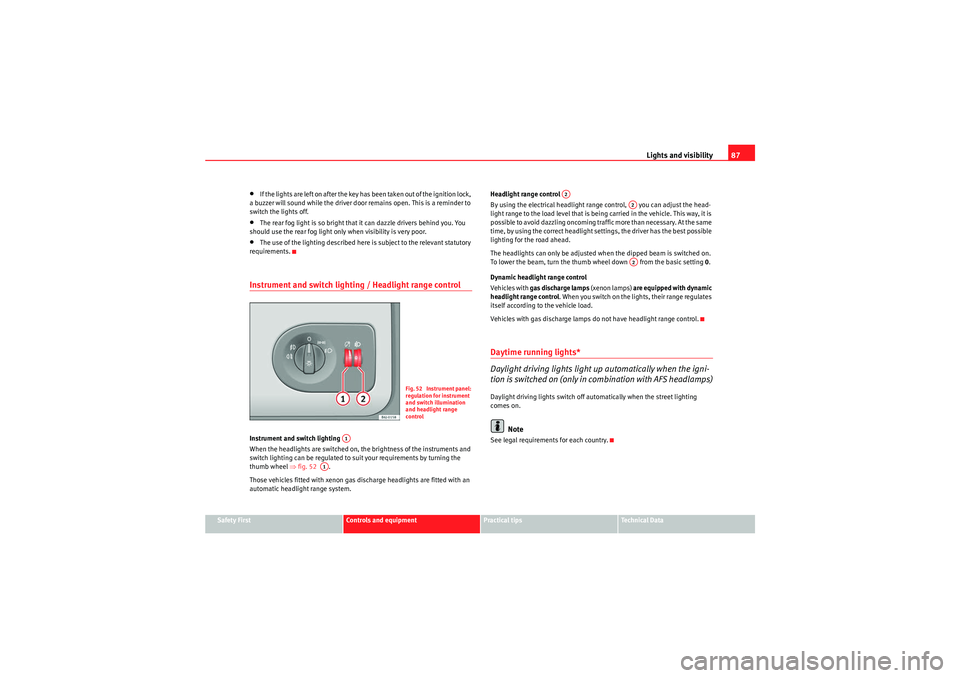
requirements.Instrument and switch lighting / Headlight range controlInstrument and switch lighting
When the headlights are switched on, the brightness of the instruments and
switch lighting can be regulated to suit your requirements by turning the
thumb wheel ⇒fig. 52 .
Those vehicles fitted with xenon gas discharge headlights are fitted with an
automatic headlight range system. Headlight range control
By using the electrical headlight range control, you can adjust the head-
light range to the load level that is being carried in the vehicle. This way, it is
possible to avoid dazzling oncoming traffic more than necessary. At the same
time, by using the correct headlight settings, the driver has the best possible
lighting for the road ahead.
The headlights can only be adjusted when the dipped beam is switched on.
To lower the beam, turn the thumb wheel down from the basic setting
0.
Dynamic headlight range control
Vehicles with gas discharge lamps (xenon lamps) are equipped with dynamic
headlight range control . When you switch on the lights, their range regulates
itself according to the vehicle load.
Vehicles with gas discharge lamps do not have headlight range control.
Daytime running lights*
Daylight driving lights light up automatically when the igni-
tion is switched on (only in combination with AFS headlamps)Daylight driving lights switch off automatically when the street lighting
comes on.
Note
See legal requirements for each country.
Fig. 52 Instrument panel:
regulation for instrument
and switch illumination
and headlight range
control
A1
A1
A2
A2A2
IbizaSC_EN.book Seite 87 Mittwoch, 16. September 2009 12:11 12
Page 93 of 257
Lights and visibility91
Safety First
Controls and equipment
Practical tips
Technical Data
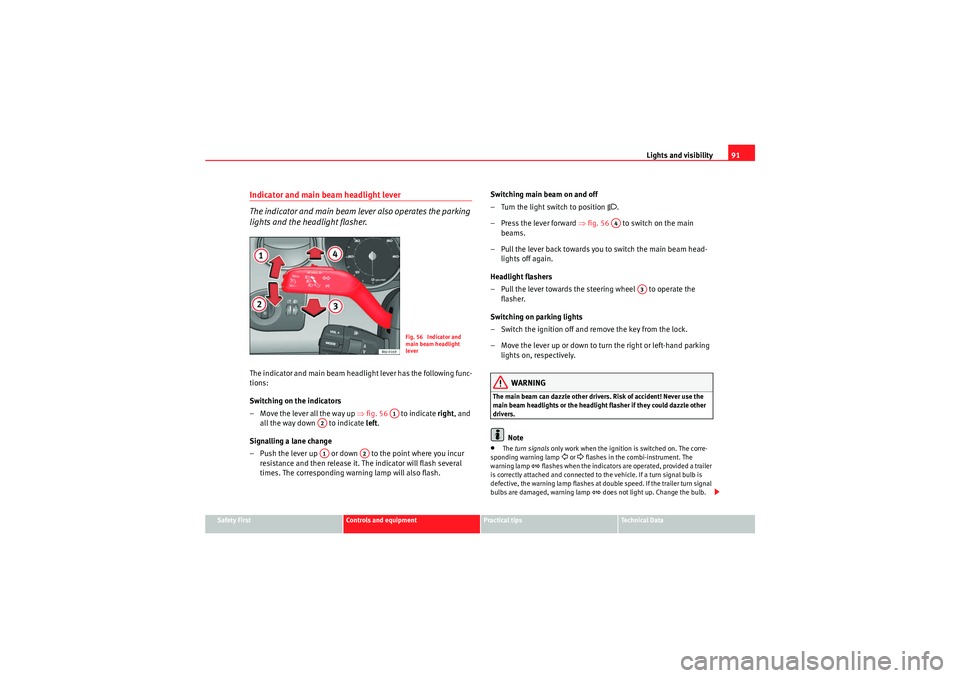
Indicator and main beam headlight lever
The indicator and main beam lever also operates the parking
lights and the headlight flasher.The indicator and main beam headlight lever has the following func-
tions:
Switching on the indicators
– Move the lever all the way up ⇒fig. 56 to indicate right, and
all the way down to indicate left.
Signalling a lane change
– Push the lever up or down to the point where you incur resistance and then release it. The indicator will flash several
times. The corresponding warning lamp will also flash. Switching main beam on and off
– Turn the light switch to position
.
– Press the lever forward ⇒fig. 56 to switch on the main
beams.
– Pull the lever back towards you to switch the main beam head- lights off again.
Headlight flashers
– Pull the lever towards the steering wheel to operate the flasher.
Switching on parking lights
– Switch the ignition off and remove the key from the lock.
– Move the lever up or down to turn the right or left-hand parking lights on, respectively.
WARNING
The main beam can dazzle other drivers. Risk of accident! Never use the
main beam headlights or the headligh t flasher if they could dazzle other
drivers.
Note
• The turn signals only work when the ignition is switched on. The corre-
sponding warning lamp
or flashes in the combi-instrument. The
warning lamp
flashes when the indicators are operated, provided a trailer
is correctly attached and connected to the vehicle. If a turn signal bulb is
defective, the warning lamp flashes at double speed. If the trailer turn signal
bulbs are damaged, warning lamp
does not light up. Change the bulb.
Fig. 56 Indicator and
main beam headlight
lever
A1
A2A1
A2
A4
A3
IbizaSC_EN.book Seite 91 Mittwoch, 16. September 2009 12:11 12
Page 94 of 257
Lights and visibility
92•The main beam headlights can only be switched on if the dipped beam
headlights are already on. The warning lamp
then comes on in the combi-
instrument.
•The headlight flasher comes on for as long as you pull the lever – even if
no other lights are switched on. The warning lamp
then comes on in the
combi-instrument.
•When the parking lights are switched on, the headlight and the rear light
on the corresponding side of the vehicle light up. The parking lights will only
work if the key is removed from the ignition. If the lights are switched on, a
buzzer gives an audible warning while the driver door is open.•If the turn signal lever is left on after the key has been taken out of the
ignition lock, an acoustic signal sounds when the driver door is opened. This
is a reminder to switch off the turn signal, unless of course you wish to leave
the parking light on.
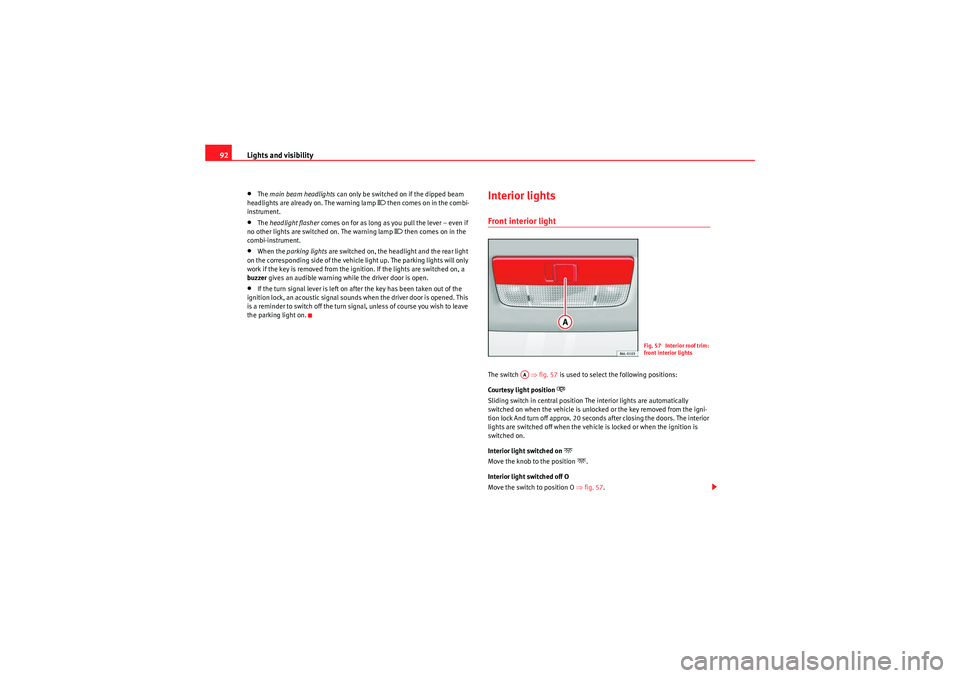
Interior lightsFront interior light The switch ⇒fig. 57 is used to select the following positions:
Courtesy light position
Sliding switch in central position The interior lights are automatically
switched on when the vehicle is unlocked or the key removed from the igni-
tion lock And turn off approx. 20 seconds after closing the doors. The interior
lights are switched off when the vehicle is locked or when the ignition is
switched on.
Interior light switched on
Move the knob to the position
.
Interior light switched off O
Move the switch to position O ⇒fig. 57 .
Fig. 57 Interior roof trim:
front interior lights
AA
IbizaSC_EN.book Seite 92 Mittwoch, 16. September 2009 12:11 12
Page 107 of 257
Seats and stowage105
Safety First
Controls and equipment
Practical tips
Technical Data
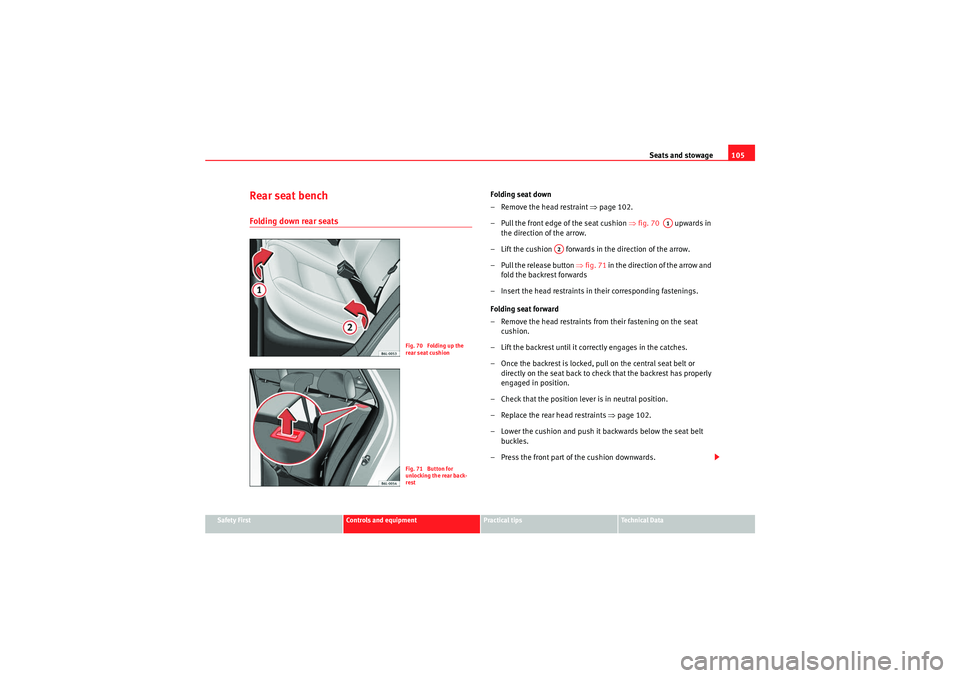
Rear seat benchFolding down rear seats
Folding seat down
– Remove the head restraint ⇒page 102.
– Pull the front edge of the seat cushion ⇒fig. 70 upwards in
the direction of the arrow.
– Lift the cushion forwards in the direction of the arrow.
– Pull the release button ⇒fig. 71 in the direction of the arrow and
fold the backrest forwards
– Insert the head restraints in their corresponding fastenings.
Folding seat forward
– Remove the head restraints from their fastening on the seat cushion.
– Lift the backrest until it co rrectly engages in the catches.
– Once the backrest is locked, pull on the central seat belt or directly on the seat back to check that the backrest has properly
engaged in position.
– Check that the position lever is in neutral position.
– Replace the rear head restraints ⇒page 102.
– Lower the cushion and push it backwards below the seat belt
buckles.
– Press the front part of the cushion downwards.
Fig. 70 Folding up the
rear seat cushionFig. 71 Button for
unlocking the rear back-
rest
A1
A2
IbizaSC_EN.book Seite 105 Mittwoch, 16. September 2009 12:11 12
Page 118 of 257
Heating, Ventilation and Air conditioning
116•In air recirculation mode, no cold air from the outside enters the vehicle
interior. The windows can quickly fog over if the heating is switched off.
Therefore, never leave the air recirculation mode switched on for a long
time (risk of accident).Note
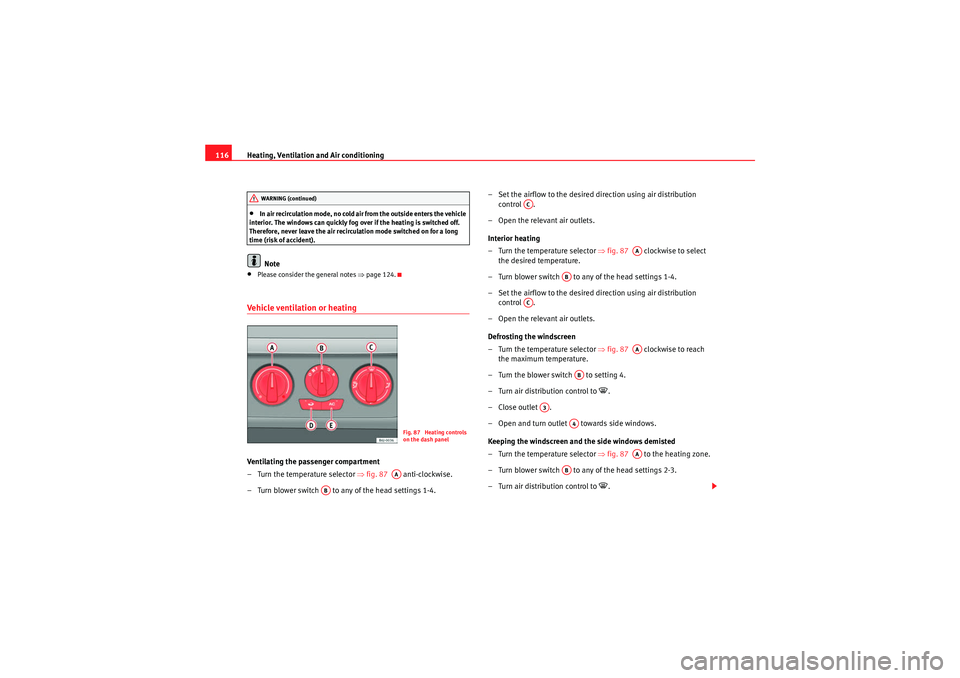
•Please consider the general notes ⇒page 124.Vehicle ventilation or heatingVentilating the passenger compartment
– Turn the temperature selector ⇒fig. 87 anti-clockwise.
– Turn blower switch to any of the head settings 1-4. – Set the airflow to the desired direction using air distribution
control .
– Open the relevant air outlets.
Interior heating
– Turn the temperature selector ⇒fig. 87 clockwise to select
the desired temperature.
– Turn blower switch to any of the head settings 1-4.
– Set the airflow to the desired direction using air distribution control .
– Open the relevant air outlets.
Defrosting the windscreen
– Turn the temperature selector ⇒fig. 87 clockwise to reach
the maximum temperature.
– Turn the blower switch to setting 4.
– Turn air distribution control to
.
–Close outlet .
– Open and turn outlet towards side windows.
Keeping the windscreen and the side windows demisted
– Turn the temperature selector ⇒fig. 87 to the heating zone.
– Turn blower switch to any of the head settings 2-3.
– Turn air distribution control to .
WARNING (continued)
Fig. 87 Heating controls
on the dash panel
AA
AB
AC
AA
AB
AC
AA
AB
A3
A4
AA
AB
IbizaSC_EN.book Seite 116 Mittwoch, 16. September 2009 12:11 12
Page 128 of 257
Driving
126DrivingAddressAdjusting the steering wheel position
The height and reach of the steering wheel can be freely
adjusted to suit the driver.– Adjust the driver seat to the correct position.
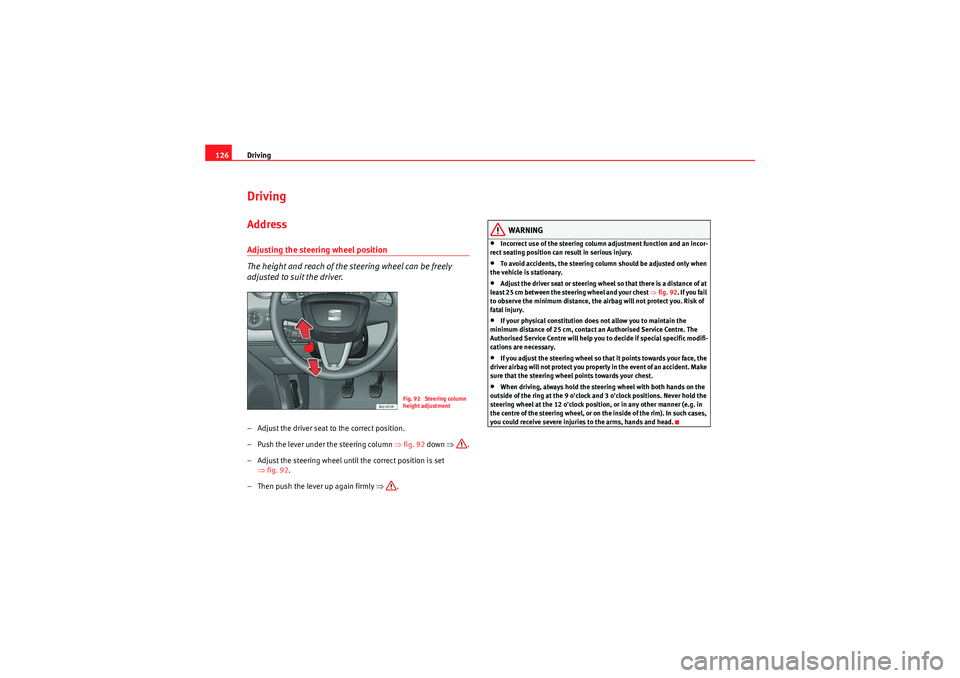
– Push the lever under the steering column ⇒fig. 92 down ⇒.
– Adjust the steering wheel until the correct position is set ⇒fig. 92 .
– Then push the lever up again firmly ⇒.
WARNING
•Incorrect use of the steering column adjustment function and an incor-
rect seating position can result in serious injury.•To avoid accidents, the steering column should be adjusted only when
the vehicle is stationary.•Adjust the driver seat or steering wheel so that there is a distance of at
least 25 cm between the steering wheel and your chest ⇒fig. 92 . If you fail
to observe the minimum distance, the airbag will not protect you. Risk of
fatal injury.•If your physical constitution does not allow you to maintain the
minimum distance of 25 cm, contact an Authorised Service Centre. The
Authorised Service Centre will help you to decide if special specific modifi-
cations are necessary.•If you adjust the steering wheel so that it points towards your face, the
driver airbag will not protect you properly in the event of an accident. Make
sure that the steering wheel points towards your chest.•When driving, always hold the steering wheel with both hands on the
outside of the ring at the 9 o'clock and 3 o'clock positions. Never hold the
steering wheel at the 12 o'clock position, or in any other manner (e.g. in
the centre of the steering wheel, or on the inside of the rim). In such cases,
you could receive severe injuries to the arms, hands and head.
Fig. 92 Steering column
height adjustment
IbizaSC_EN.book Seite 126 Mittwoch, 16. September 2009 12:11 12
Page 129 of 257
Driving127
Safety First
Controls and equipment
Practical tips
Technical Data
SafetyElectronic stabilisation programme (ESP)*
ESP helps make driving safer in certain situations.The Electronic Stabilisation Program (ESP) contains the electronic differential
lock (EDL) and the traction control system (TCS). The ESP function works
together with the ABS. Both warning lamps will light up if the ESP or ABS
systems are faulty.
The ESP is started automatically when the engine is started.
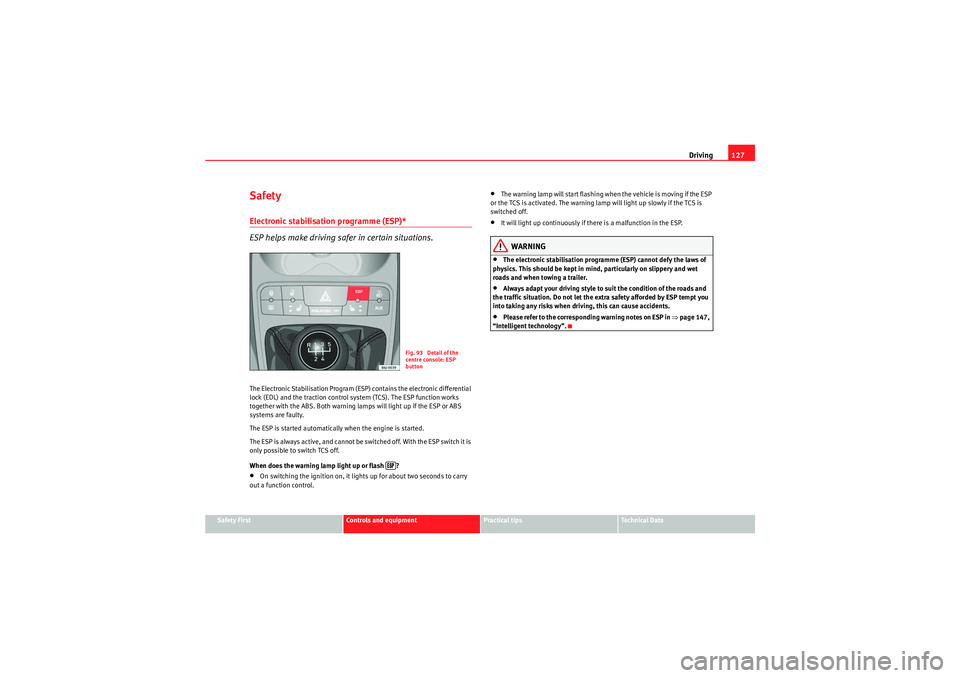
The ESP is always active, and cannot be switched off. With the ESP switch it is
only possible to switch TCS off.
When does the warning lamp light up or flash ?•On switching the ignition on, it lights up for about two seconds to carry
out a function control.
•The warning lamp will start flashing when the vehicle is moving if the ESP
or the TCS is activated. The warning lamp will light up slowly if the TCS is
switched off.•It will light up continuously if there is a malfunction in the ESP.WARNING
•The electronic stabilisation programme (ESP) cannot defy the laws of
physics. This should be kept in mind, particularly on slippery and wet
roads and when towing a trailer.•Always adapt your driving style to suit the condition of the roads and
the traffic situation. Do not let the extra safety afforded by ESP tempt you
into taking any risks when driving, this can cause accidents.•Please refer to the corresponding warning notes on ESP in ⇒page 147,
“Intelligent technology”.
Fig. 93 Detail of the
centre console: ESP
button
IbizaSC_EN.book Seite 127 Mittwoch, 16. September 2009 12:11 12