ignition Seat Toledo 2012 Repair Manual
[x] Cancel search | Manufacturer: SEAT, Model Year: 2012, Model line: Toledo, Model: Seat Toledo 2012Pages: 249, PDF Size: 3.6 MB
Page 186 of 249

185
Checking and refilling levels
Note
● The battery acid level is also regularly checked during servicing at au-
thorised SEAT dealers.
● The acid level on “AGM” vehicle batteries cannot be checked for techni-
cal reasons.
● Vehicles equipped with the “START-STOP” system include a battery con-
trol unit to control the battery level for repeat engine starting.
Winter service
At low temperatures the battery provides only a fraction of the starting pow-
er it has at normal temperatures.
A flat battery can also freeze at temperatures slightly below to 0 °C (32 °F).
We therefore recommend you have the battery checked and, if necessary,
charged at an official SEAT technical service before the start of winter.
Charging the battery
A fully-charged battery is essential for reliable starting.
– Switch off the ignition and all electrical equipment.
– For “fast-charging” only: disconnect both battery connection ca-
bles (first the “negative” terminal and then the “positive”).
– Connect the charger cables to the battery terminals (red = “pos-
itive”, black = “negative”).
– Plug in the battery charger and switch on. –
After charging the battery: Switch off the battery charger and
disconnect the cable.
– Remove the charger cables.
– If necessary, reconnect both battery cables to the battery (first
the “positive” cable, then the “negative” cable).
When charging with a low current (e.g. with a small battery charger), the
battery does not have to be disconnected. The instructions of the battery
charger manufacturer must be followed.
Use a current equivalent to or lower than 0.1 of the battery capacity to fully
charge the battery.
Before “fast-charging” the battery however, both battery cables must be
disconnected.
“Fast-charging” a battery is dangerous and requires a battery charger and
special knowledge. Fast charges should be performed by an official techni-
cal service.
The battery caps should not be opened while the battery is being charged.
CAUTION
In vehicles fitted with the “START-STOP” system, the charger cable cannot
be directly connected to the negative terminal of the vehicle battery but
must be attached to the engine earthing point ⇒ page 207.
Disconnecting and connecting the battery
The following functions will either be inoperative or will not work properly
after disconnecting and reconnecting the battery:
Safety FirstOperating instructionsPractical TipsTechnical specifications
Page 187 of 249

186Checking and refilling levels
FunctionInstallationSetting the clock⇒ page 58The multifunction display data is deleted⇒ page 59
Note
We recommend having the vehicle checked by an authorised SEAT dealer to
guarantee the correct working order of all electrical systems.
Changing the battery
A replacement battery must have the same capacity, voltage, current rating
and size as the original. The appropriate types of battery can be acquired
from authorised SEAT dealers.
We recommend having the battery changed by an authorised SEAT dealer,
where the new battery will be correctly installed and the original disposed
of in line with regulations.
Automatic disconnection of electrical equipment
When heavily-charging a battery, the programme selected by the electrical
system control unit prevents the battery from automatically discharging.
This may result in the following:
● Increase in idling speed so that the alternator can supply more current
to the electrical system.
● The performance of certain electrical components could be limited or
some may switch off temporarily, e.g. the heated seats, the heated rear win-
dow, the 12V power socket.
Note
Despite any measures taken by the control unit, the battery could drain. e.g.
with the engine is switched off, the key is turned in the ignition for a long
period or the side lights or parking lights are switched on. The switching off
of certain electrical components does not impair driving comfort and the
driver will often not even realise.
Page 193 of 249

192Wheels and tyres
Removing
–Insert the plastic clip into the cap until the inner retaining
notches on the clips touch the collar of the cap and then re-
move ⇒ Fig. 127.
Fitting
– Insert the caps as far as they will go over the wheel bolts.
The wheel bolt caps are stored in a box on the spare wheel or in the spare
wheel well.
Tyre pressure
Fig. 128 Tyre pressure
setting switch
The tyre pressure monitoring system uses ABS sensors to compare the revo-
lutions and the circumference of each wheel. Should the circumference of
any wheel change, the warning lamp in the general instrument panel
⇒ page 72 will light up and an audible warning will be heard.
Tyre circumference may change if:
● Tyre pressure is too low
● Tyre structure is damaged ●
Vehicle load not evenly distributed
● Wheels on one axle are subjected to greater load, (e.g. driving with trail-
er, uphill, downhill)
● Snow chains are fitted
● The temporary spare wheel is fitted
● One wheel on the axle has been changed
Basic system settings
Should the tyre pressure change or if one or more wheels are changed or
the position of the wheel on the vehicle is changed, e.g. changing round the
front and rear wheels, or where a warning lamp lights up when driving, the
system must be adjusted as follows:
● Inflate all tyres to the prescribed pressures ⇒ page 188.
● Switch the ignition on.
● Hold the
⇒ Fig. 128 button down for at least 2 seconds. The warn-
ing lamp will light up when the button is pressed. The system memory is
also deleted and a new calibration system will begin, which is indicated by
an audible warning before the warning lamp switches off .
● If the warning lamp remains lit and does not switch off, not even once
the basic setting process is complete, this indicates a fault in the system.
Contact an Official Service.
The warning lamp lights up
If the pressure on at least one tyre is significantly lower than the pressure
set by the driver, the warning lamp ⇒
will light up.
The warning lamp flashes
If the warning lamp flashes, there is a fault in the system. Contact a special-
ised service to have it fixed.
Page 200 of 249

199
Self-help
WARNING (Continued)
● Always raise the vehicle with the doors closed.
● Never place parts of your body, e.g. arms and legs, underneath the
vehicle when supported only by the jack.
● Secure the base of the jack with suitable supports so that it cannot
slip. The jack could slide if the ground below it is soft and slippery and
the vehicle could slip off it. Therefore, place the jack on a firm surface or
use a large, stable base. On a slippery surface, e.g. tiles, use a non-slip
base such as a rubber mat.
● Never start the engine when the vehicle is raised. Risk of injury.
● The jack should only be used in the correct jacking points.
CAUTION
● The prescribed tightening torque for wheel bolts on steel and alloy
wheels is 120 Nm.
● If the anti-theft wheel bolt is overly tightened, this could damage the
bolt and the adapter
Note
● The set of anti-theft wheel bolts or the adapter are available from au-
thorised SEAT dealers.
● Please observe the relevant local legal regulations when changing the
wheel.
Preparation work
Some preparation is required before changing a wheel:
– If you have a flat tyre, stop the vehicle as far away as possible
from moving traffic. The surface must be horizontal.–
All vehicle occupants should leave the vehicle . Vehicle occu-
pants should waiting in a safe place, e.g. behind the roadside
crash barrier) while the wheel is being changed.
– Switch off the ignition and engage neutral or move the selector
lever on the automatic gearbox to position P.
– Apply the handbrake firmly.
– If towing a trailer, unhitch it.
– Take the vehicle tool kit ⇒ page 198 and the spare wheel
⇒ page 198 out of the luggage compartment.
Changing a wheel
If possible, change the wheel on a level surface.
– Pull off the hub cap ⇒ page 191 or the wheel bolt covers
⇒ page 191.
– First loosen the anti-theft wheel bolts and then the other wheel
bolts ⇒ page 200.
– Raise the vehicle until the wheel to be changed is no longer
touching the ground ⇒ page 201.
– Remove the wheel bolts and place them on a clean surface
(cloth, paper, etc.).
– Take off the wheel.
– Lift the spare wheel into position and tighten the wheel bolts
lightly.
Safety FirstOperating instructionsPractical TipsTechnical specifications
Page 205 of 249
204Self-help
Before using the tyre repair kit
The following jobs must be performed before using the tyre repair
kit:
–If you have a flat tyre, stop the vehicle well away from moving
traffic. Stop on flat, solid ground.
– All vehicle occupants should leave the vehicle. Vehicle occu-
pants should waiting in a safe place, e.g. behind the roadside
crash barrier) while the wheel is being changed.
– Switch off the ignition and engage neutral or move the selector
lever on the automatic gearbox to position P.
– Apply the handbrake firmly.
– Check whether the tyre can be repaired using the tyre repair kit
⇒ page 202.
– If towing a trailer, unhitch it.
– Take the tyre repair kit out of the luggage compartment.
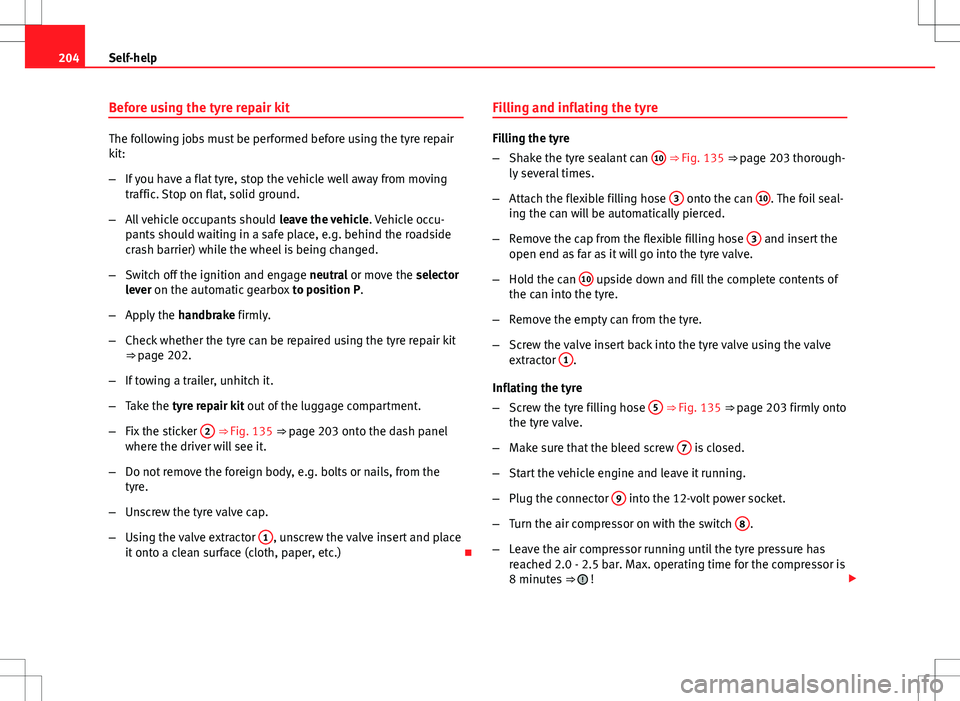
– Fix the sticker 2
⇒ Fig. 135 ⇒
page 203 onto the dash panel
where the driver will see it.
– Do not remove the foreign body, e.g. bolts or nails, from the
tyre.
– Unscrew the tyre valve cap.
– Using the valve extractor 1
, unscrew the valve insert and place
it onto a clean surface (cloth, paper, etc.) Filling and inflating the tyre
Filling the tyre
–
Shake the tyre sealant can 10
⇒ Fig. 135 ⇒ page 203 thorough-
ly several times.
– Attach the flexible filling hose 3
onto the can 10. The foil seal-
ing the can will be automatically pierced.
– Remove the cap from the flexible filling hose 3
and insert the
open end as far as it will go into the tyre valve.
– Hold the can 10
upside down and fill the complete contents of
the can into the tyre.
– Remove the empty can from the tyre.
– Screw the valve insert back into the tyre valve using the valve
extractor 1
.
Inflating the tyre
– Screw the tyre filling hose 5
⇒ Fig. 135 ⇒ page 203 firmly onto
the tyre valve.
– Make sure that the bleed screw 7
is closed.
– Start the vehicle engine and leave it running.
– Plug the connector 9
into the 12-volt power socket.
– Turn the air compressor on with the switch 8
.
– Leave the air compressor running until the tyre pressure has
reached 2.0 - 2.5 bar. Max. operating time for the compressor is
8 minutes ⇒
!
Page 209 of 249
208Self-help
road. If the vehicle is towed with the rear wheels lifted off the road
the automatic gearbox will be damaged!
It is easier and safer to tow a vehicle with a towbar. A towrope
should only be used if you do not have a towbar.
Follow the instructions below when towing a vehicle:
Notes for the driver of the towing vehicle
– Engage the clutch very gently when starting to move or on vehi-
cles with automatic gearbox press the accelerator carefully.
– On vehicles with manual gearbox, the towrope must be taut be-
fore driving off.
The maximum towing speed is 50 km/h (31 mph).
Notes for the driver of the towed vehicle
– The ignition should be switched on so that the steering wheel
lock is not engaged and the turn signals, horn and windscreen
wipers and washers can be used.
– Put the gear lever in neutral or move the selector lever to posi-
tion N (automatic gearbox).
The brake servo and power steering only work when the engine is
running. Considerably more effort is required on the brake pedal
and steering wheel when the engine is switched off.
Ensure the towrope remains taut at all times when towing.
CAUTION
● Do not tow-start the engine. Risk of engine damage! In vehicles with a
catalytic converter, unburnt fuel could reach the catalytic converter and
catch fire in it. This could damage and destroy the catalytic converter. Use
the battery from another vehicle for help in starting the engine ⇒ page 206,
Starting the engine.
● If, due to a fault, there is no oil in the gearbox, the car may only be tow-
ed with the driven wheels lifted clear of the road and transported on a spe-
cial vehicle transporter or trailer.
● If normal towing is not possible or if the vehicle is to be towed for further
than 50 km (31 miles), the vehicle must be transported on a special vehicle
transporter or trailer.
● The towrope should be slightly elastic to reduce the loading on both ve-
hicles during towing. It is advisable to use a towrope made of synthetic fibre
or similar material only.
● Do not pull too hard with the towing vehicle and always take care to
avoid jerking the towrope. When towing on a loose surface there is always a
risk of overloading and damaging the anchorage points.
● Attach the towrope or towbar only to the towline anchorages or to the
removable towing bracket ⇒ page 161, or ⇒ page 209.
Note
● We recommend you use the towrope or towbar available in the SEAT
Original Accessories programme from authorised SEAT dealers.
● Towing a vehicle requires some experience. Both drivers should be fa-
miliar with the technique required for towing. Inexperienced drivers should
not attempt to tow away another vehicle or to have their vehicle towed.
● Note the legal regulations concerning towing, particularly those regard-
ing the signalling of the towed and towing vehicle.
● The towrope must not be twisted, as under certain circumstances this
could unscrew the front towline anchorage.
Page 211 of 249

210Fuses and bulbs
Fuses and bulbs
Fuses
Introduction
All the electrical circuits are protected by fuses.
● Switch off the ignition and the electrical component concerned before
changing a fuse.
● Identify the fuse corresponding to the failed electrical component
⇒ page 211, Fuses in the dash panel, or ⇒ page 214, Changing fuses in
the engine compartment.
● Take the plastic clip from inside the fuse cover, fit it onto the blown fuse
and pull the fuse out.
● Replace the blown fuse (which will have a melted metal strip) with a new
fuse of the same amp rating.
Fuse colour code
ColourMaximum amp rating
light brown5dark brown7,5red10blue15yellow20white25green30
WARNING
Read and follow the warnings ⇒ page 173, Engine compartment before
starting work in the engine compartment.
CAUTION
● Never “repair” a fuse or replace it by fitting a fuse with a higher amp rat-
ing. Risk of fire! This could also cause damage to other parts of the electri-
cal system.
● If a newly replaced fuse blow again when the electrical component con-
cerned is switched on, the electrical system must be checked by an Official
Service as soon as possible.
Note
● It is advisable to always keep spare fuses in the vehicle. The spare fuse
box is available in the range of original SEAT parts.
● One single electrical component could have more than one fuse.
● Several electrical components may be protected by the same fuse.
Page 212 of 249

211
Fuses and bulbs
Fuses in the dash panel
Fig. 140 Bottom of the
dash panel. Fuse cover
Fig. 141 Diagram of the
fuse box to the left/right
of the steering wheel
The fuses are located behind a cover below the steering wheel.
● Carefully tilt the cover in the direction indicated by the arrow and remove
it ⇒ Fig. 140.
● After changing the fuse, replace the cover on the dash panel in the di-
rection opposite that is indicated by the arrow so that the cover tabs fit into
the slots on the dash panel. Subsequently, press down on the cover to
close. List of fuses in the dash panel
NumberElectrical equipment1S - ignition2START-STOP
3Instrument panel, headlight range control, telephone, oil level
sensor
4ABS/ESC control unit5Petrol engine: cruise control6Reverse light (manual gearbox)7Switch, engine control unit, automatic gearbox8Brake switch, clutch switch, cooling fan
9Heating control panel, air conditioning control unit, parking
aid, electric window riser, radiator fan, windscreen wiper jets
10DC-DC converter11Exterior mirror control12Towing bracket control unit13Automatic gearbox control unit, automatic gear selector14Headlight range control15Vacant16Power steering, speed sensor, engine control unit17Radio (START-STOP ) daytime driving light18Heated mirrors19Ignition inlet20Engine control unit, fuel pump control unit, fuel pump
21Reverse light (automatic gearbox), fog lights with CORNER func-
tion
22Heating control panel, control unit of the climate control, tele-
phone, general instrument panel, steering wheel angle sensor,
multifunction steering wheel, automatic gearbox key lock
23Interior lighting, glove compartment and luggage compartment
lighting, side lights
Safety FirstOperating instructionsPractical TipsTechnical specifications
Page 213 of 249
212Fuses and bulbs
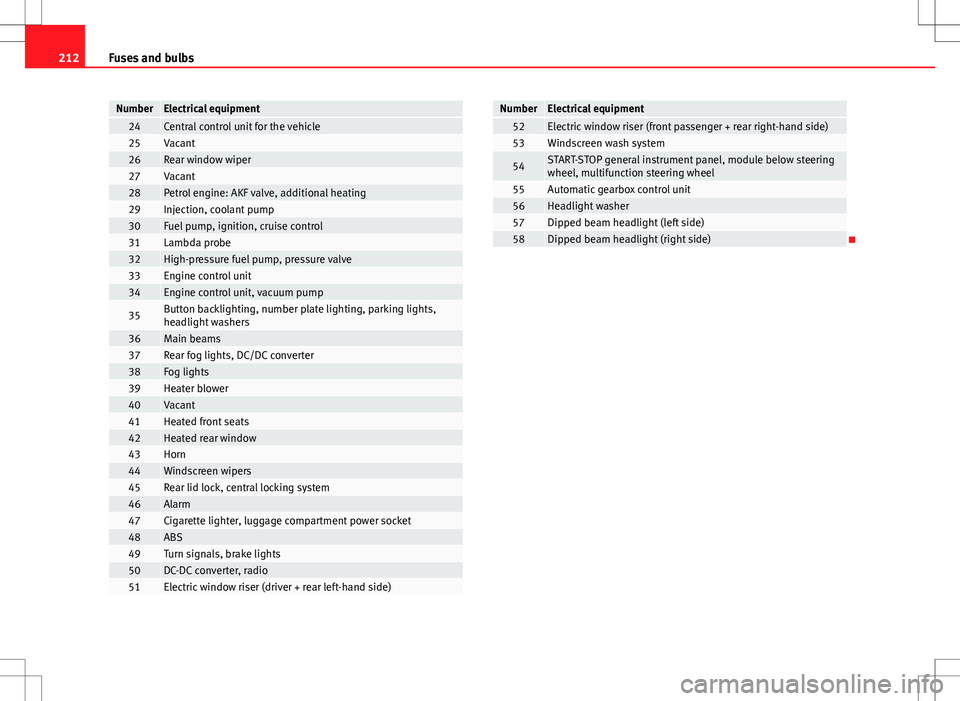
NumberElectrical equipment24Central control unit for the vehicle25Vacant26Rear window wiper27Vacant28Petrol engine: AKF valve, additional heating29Injection, coolant pump30Fuel pump, ignition, cruise control31Lambda probe32High-pressure fuel pump, pressure valve33Engine control unit34Engine control unit, vacuum pump
35Button backlighting, number plate lighting, parking lights,
headlight washers
36Main beams37Rear fog lights, DC/DC converter38Fog lights39Heater blower40Vacant41Heated front seats42Heated rear window43Horn44Windscreen wipers45Rear lid lock, central locking system46Alarm47Cigarette lighter, luggage compartment power socket48ABS49Turn signals, brake lights50DC-DC converter, radio51Electric window riser (driver + rear left-hand side)
NumberElectrical equipment52Electric window riser (front passenger + rear right-hand side)53Windscreen wash system
54START-STOP general instrument panel, module below steering
wheel, multifunction steering wheel
55Automatic gearbox control unit56Headlight washer57Dipped beam headlight (left side)58Dipped beam headlight (right side)
Page 215 of 249

214Fuses and bulbs
Changing fuses in the engine compartment
Fig. 144 Battery: fuse cover (version 1)
Fig. 145 Battery: fuse cover (version 2)
●Press the flexible tabs on the fuse box cover in the direction indicated by
the arrows 1
⇒ Fig. 144.
● Remove the cover by sliding it in the direction indicated by arrow 2.
● Use a flat-headed screwdriver to unlock the holes 3.
● Open the cover in the direction indicated by the arrow 4.Changing bulbs
Introduction
Changing bulbs requires a certain degree of practical skill. If in doubt, we
recommend you have defective bulbs changed by a specialised service or,
in case of an emergency, seek professional assistance.
● Switch off the ignition and all of the lights before changing a bulb.
● Do not touch the glass part of the bulb with your bare hands. The finger-
prints left on the glass will vaporise as a result of the heat generated by the
bulb, causing a reduction in bulb life and condensation on the mirror sur-
face, thus reducing efficiency.
● A bulb must only be replaced by one of the same type. The type is indi-
cated on the bulb, either on the glass part or on the base.
● There is a storage area for the bulb box in the spare wheel well or below
the carpet in the luggage compartment.
The light source used for each function is listed below:
Double headlights
H7 Long Life
H7
W5W Long Life PY21W NA P21W Super Long Life
Dipped beam:
Main beam:
Side lights:
Turn signals:
Daytime driving lights: