bonnet Seat Toledo 2014 User Guide
[x] Cancel search | Manufacturer: SEAT, Model Year: 2014, Model line: Toledo, Model: Seat Toledo 2014Pages: 200, PDF Size: 4.37 MB
Page 136 of 200

Advice
away from the glass. Otherwise the paint-
work may be damaged.
– Pull the release catch in the direction of the
arrow 2
››› Fig. 108 and the bonnet will be
r el
eased.
– Hold and lift the bonnet.
– Remove the support strut 3
››› Fig. 109
from its fastening in the direction of the ar- row and secure the raised bonnet so that
the end of the strut hooks onto the opening
in the bonnet
4 .
Closing the bonnet – Lift the bonnet slightly and unhook the
support strut keeping the bonnet open and
insert it into its fastening 3 .
–
Let the bonnet drop from a height of
around 20 cm into the catch Do not press
down afterwards!
– Check that the bonnet is correctly closed.
Checking fluid levels Fig. 110
Diagram for the location of the various elements. From time to time, the levels of the different
fluids in the vehicle must be checked. Never
fill with incorrect fluids, otherwise serious
damage to the engine may be caused.
Coolant expansion tank . . . . . . . . . . .138
Window washer water tank . . . . . . . .139
Engine oil filler cap . . . . . . . . . . . . . . .137
1 2
3 Engine oil level dipstick
. . . . . . . . . . .136
Brake fluid reservoir . . . . . . . . . . . . . .139
Battery . . . . . . . . . . . . . . . . . . . . . . . . . . . 140
The checking and replenishment of the serv-
ice fluids are carried out on the components
mentioned above. These operations are de-
scribed in the ››› page 132 .
4 5
6 Overview
You will find further explanations, instruc-
tions and restrictions on the technical speci-
fications as of
››› page 174 . Note
The layout of the engine compartment is very
similar to all petrol and diesel engines. 134
Page 138 of 200

Advice
● Avoid mixing this oil with other engine oils.
● Only in exceptional circumstances, if the
engine oil level is too low ››› page 136 and
you cannot obtain the oil specified for your
vehicle, you can use a small quantity of oil
(once) conforming to the VW 506 00,
VW 506 01, VW 505 00, VW 505 01 or
ACEA B3/ACEA B4 specification. (up to 0.5 l).
Oil propertiesEngine typeSpecification
Petrol without flexible
service intervalVW 502 00/VW 504 00
Petrol with flexible serv-
ice interval (LongLife)VW 504 00
Diesel. Engines without
Particulate filter (DPF)VW 505 01/VW 506 01/VW
507 00
Diesel. Particulate Filter
Engines (DPF).
With or without flexible
service interval (with
and without LongLife) a)VW 507 00
a)
Only use recommended oils, otherwise you may damage the
engine.
Engine oil additives
No type of additive should be mixed with the
engine oil. The deterioration caused by these
additives is not covered by the warranty. Note
Before a long trip, we recommend finding an
engine oil that conforms to the correspond-
ing VW specifications and recommend keep-
ing it in the vehicle. This way, the correct en-
gine oil will always be available for a top-up if
needed. Checking the engine oil level
Fig. 111
Engine oil dipsticks. The dipstick shows the engine oil level.
››› Fig. 111 .
Chec k
ing oil level
– Park the vehicle on a level surface and en-
sure the engine is at operating tempera-
ture.
– Switch the ignition off.
– Open the bonnet. –
Wait a few minutes for the engine oil to
flow back to the sump and remove the dip-
stick.
– Wipe the dipstick with a clean cloth and in-
sert it again as far as it will go.
– Then pull the dipstick out again and check
the oil level.
Oil level in area A –
Do not
t
op up oil.
Oi
l level in area B –
Oil can be topped up. After topping up the
oi l
level could be in area A .
Oil level in area C –
Oil must be topped up. After topping up,
the oil level should be in area B .
It is normal for the engine to consume a cer-
tain amount of oil. Depending on how you
drive and the conditions in which the vehicle
is used, oil consumption can be up to 0.5 li-
tres per 1,000 km. Oil consumption can also
be higher for the first 5,000 km (3000 miles).
You should therefore check the oil level at
regular intervals, ideally every time you fill
the tank or before setting off on a long trip.
When the engine is working hard, for in-
stance during sustained motorway cruising in
summer, when towing a trailer or caravan or
136
Page 140 of 200

Advice
Checking coolant level Fig. 112
Engine compartment: coolant fluid
tank. The coolant expansion tank is located in the
engine compartment of the vehicle.
– Switch the ignition off.
– Open the bonnet ››› page 132.
– Read off the coolant level on coolant ex-
pansion tank ››› Fig. 112 . When the engine
i s
cold, the coolant should be between
marks B (min.) and
A (max.). When the
engine is hot, it may be slightly above mark A (max.).
If the coolant fluid level in the reservoir is too
low, this will be indicated by the red warn-
ing lamp illuminating on the general dash
panel ›››
page 35, Coolant level and tempera-
ture . However, we recommend checking
the coolant level directly in the tank. Coolant fluid loss
Any loss of coolant normally indicates a
leak.
It is not sufficient merely to top up the cool-
ant. The cooling system should be inspected
by an Official Service without delay. CAUTION
In the event of a fault that causes the engine
to overheat, contact an authorised SEAT deal-
er immediately, as this could damage the en-
gine. Topping up coolant
–
Switch the ignition off.
– Wait for the engine to cool down.
– Cover the cap on the coolant expansion
tank ›››
Fig. 112 with a cloth and
carefully
u
nscrew the cap.
– Refill the level of coolant.
– Screw the cap on again until it clicks into
place.
Do not use a different type of additive if the
prescribed anti-freeze additive is not availa-
ble, in the event of an emergency. In this
case, use only water and bring the coolant
concentration back up to the correct level as
soon as possible at an Official Service.
Always top up with unused coolant. Never fill the coolant tank above mark
A (max.)
››› Fig. 112 Excess coolant is forced
out of
the cooling system through the over-
pressure valve in the filler cap of the expan-
sion tank when the engine heats up. WARNING
● The anti-freeze additive and, therefore, the
entire coolant, are a health hazard. Avoid
touching the coolant. Coolant fumes are also
a health hazard. For this reason, always store
the coolant additive in a safe place out of the
reach of children. Risk of poisoning!
● If splashed into eyes, rinse immediately
with clean water and seek immediate medical
attention.
● Seek immediate medical attention if the
coolant is accidentally ingested. CAUTION
If the coolant cannot be topped up under the
given conditions, do not drive on. We rec-
ommend c
ontacting an authorised SEAT deal-
er, as this can damage the engine. 138
Page 141 of 200

Checking and refilling levels
Brake fluid Checking brake fluid level Fig. 113
Engine compartment: brake fluid
reservoir. The brake fluid reservoir is located in the en-
gine compartment of the vehicle.
– Switch the ignition off.
– Open the bonnet ››› page 132.
– Check the brake fluid level in the reservoir
››› Fig. 113 . It should be between the “MIN”
and “MAX” m ark
s.
The fluid level drops slightly after a period of
time due to automatic compensation for
brake pad wear. This is quite normal.
However, if the level goes down noticeably in
a short time, or drops below the “MIN” mark,
there may be a leak in the brake system. If
the brake fluid level in the reservoir is too low, this will be indicated by the warning
lamp illuminating on the instrument panel
››› page 33, Brake system . WARNING
If the fluid level has dropped below the MIN
mark, do not continue driving. Risk of acci-
dent! Go t
o a technical service. Changing the brake fluid
Brake fluid absorbs moisture. Therefore, it
gradually absorbs moisture from the atmos-
phere. If the water content in the brake fluid
is too high, the brake system could corrode.
The water content also reduces the boiling
point of the brake fluid.
The brake fluid must comply with one of the
following standards or specifications:
● VW 50114
● FMVSS 116 DOT4 WARNING
Heavy use of the brakes may cause a vapour
lock if the brake fluid is left in the brake sys-
tem for too long. This would seriously affect
the efficiency of the brakes and the safety of
the vehicle. CAUTION
Brake fluid damages the vehicle paintwork. Windscreen washer
Fig. 114
Engine compartment: windscreen
washer reservoir. The container for the windscreen washer con-
tains the cleaning fluid for the windscreen or
rear window and the headlight washer sys-
tem. The container is located in the engine
compartment.
»
139Technical specifications
Advice
Operation
Safety
Page 164 of 200

Advice
Manual release of the selector lever Fig. 135
Manual release of the selector lever. If there is a fault in the power system to the
electronic selector lever lock system (flat bat-
tery, blown fuse) or the system itself is faulty,
the selector lever cannot be moved from po-
sition
P
in the normal manner, which pre-
v
ents the vehicle from being moved. The se-
lector lever must be unlocked using the man-
ual release.
– Apply the handbrake.
– Pull gently on both sides at the front of the
selector lever cover.
– Also loosen the cover at the rear.
– Press the yellow plastic part with your fin-
ger in the direction indicated by the arrow
››› Fig. 135.
– Pre
ss the interlock button on the selector
lever knob at the same time and move the
selector lever to position N (if the selector l
ever is moved back to position
P, it will
lock again).
Changing the wiper blades Changing the windscreen wiper
blades Fig. 136
Windscreen wiper blades. Set the windscreen wiper arms to the service
position before changing the blades.
Service position for changing wiper blades
– Close the bonnet.
– Switch the ignition on and off.
– Press the lever to position 4
››› Fig. 56
››› page 69, the windscreen wiper arms are
set to the service position. Taking off the wiper blade
–
Lift the windscreen wiper arm away from
the glass moving the blade slightly in the
direction of the arm – arrow A
››› Fig. 136 .
– Ho l
d the top of the windscreen wiper arm
with one hand.
– Unlock the catch 1 with the other hand
and remove the blade in the direction of ar-
row B .
Fitting the wiper blade – Slide the blade fully until it clicks into posi-
tion.
– Check that the wiper is correctly secured.
– Fold the windscreen wiper arm back down
onto the glass.
– Switch the ignition on and press the lever
to position 4
››› Fig. 56 ››› page 69, the
windscreen wiper arms are set to the basic
position.
162
Page 169 of 200
Fuses and bulbs
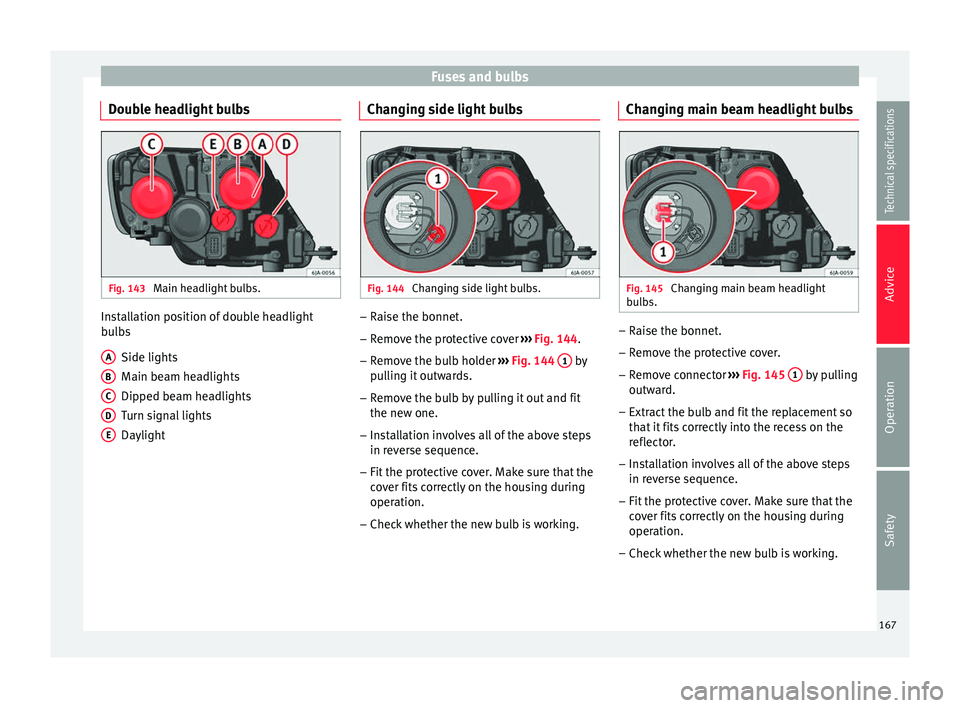
Double headlight bulbs Fig. 143
Main headlight bulbs. Installation position of double headlight
bulbs
Side lights
Main beam headlights
Dipped beam headlights
Turn signal lights
Daylight
A B
C
D
E Changing side light bulbs
Fig. 144
Changing side light bulbs. –
Raise the bonnet.
– Remove the protective cover ››› Fig. 144 .
– Remo
ve the bulb holder ››› Fig. 144 1 by
pulling it outwards.
– Remove the bulb by pulling it out and fit
the new one.
– Installation involves all of the above steps
in reverse sequence.
– Fit the protective cover. Make sure that the
cover fits correctly on the housing during
operation.
– Check whether the new bulb is working. Changing main beam headlight bulbs
Fig. 145
Changing main beam headlight
bulbs. –
Raise the bonnet.
– Remove the protective cover.
– Remove connector ››› Fig. 145 1 by pulling
outward.
– Extract the bulb and fit the replacement so
that it fits correctly into the recess on the
reflector.
– Installation involves all of the above steps
in reverse sequence.
– Fit the protective cover. Make sure that the
cover fits correctly on the housing during
operation.
– Check whether the new bulb is working.
167
Technical specifications
Advice
Operation
Safety
Page 170 of 200
Advice
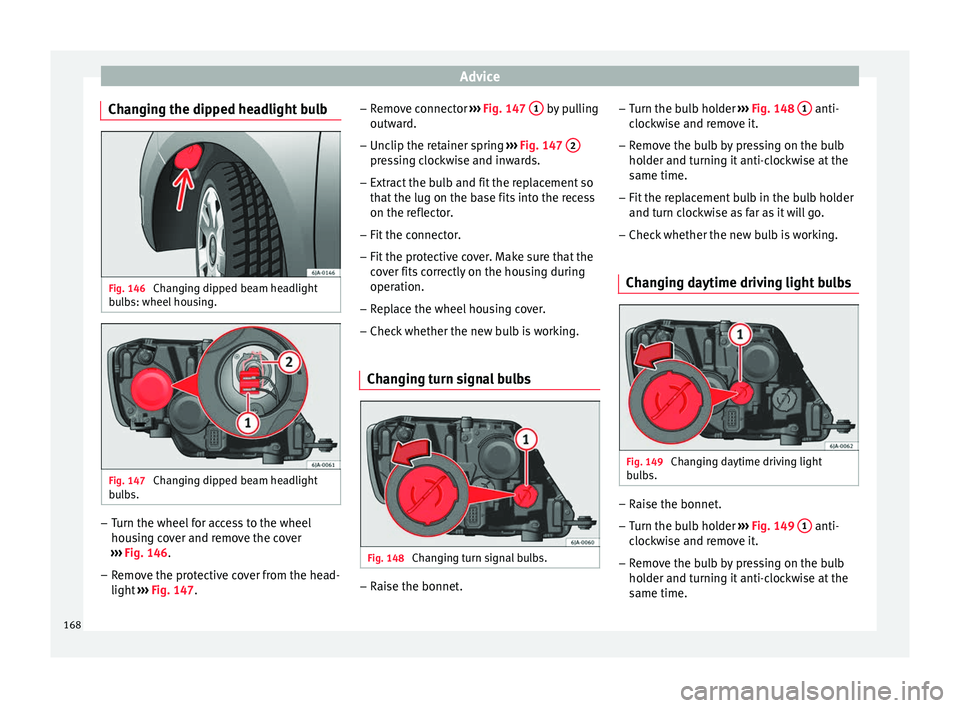
Changing the dipped headlight bulb Fig. 146
Changing dipped beam headlight
bulbs: wheel housing. Fig. 147
Changing dipped beam headlight
bulbs. –
Turn the wheel for access to the wheel
housing cover and remove the cover
››› Fig. 146 .
– Remo
ve the protective cover from the head-
light ››› Fig. 147. –
Remo
ve connector
››› Fig. 147 1 by pulling
outward.
– Unclip the retainer spring ››› Fig. 147 2 pressing clockwise and inwards.
– Extract the bulb and fit the replacement so
that the lug on the base fits into the recess
on the reflector.
– Fit the connector.
– Fit the protective cover. Make sure that the
cover fits correctly on the housing during
operation.
– Replace the wheel housing cover.
– Check whether the new bulb is working.
Changing turn signal bulbs Fig. 148
Changing turn signal bulbs. –
Raise the bonnet. –
Turn the bulb holder ››› Fig. 148 1 anti-
clockwise and remove it.
– Remove the bulb by pressing on the bulb
holder and turning it anti-clockwise at the
same time.
– Fit the replacement bulb in the bulb holder
and turn clockwise as far as it will go.
– Check whether the new bulb is working.
Changing daytime driving light bulbs Fig. 149
Changing daytime driving light
bulbs. –
Raise the bonnet.
– Turn the bulb holder ››› Fig. 149 1 anti-
clockwise and remove it.
– Remove the bulb by pressing on the bulb
holder and turning it anti-clockwise at the
same time.
168
Page 189 of 200

Index
Index
A
ABS . . . . . . . . . . . . . . . . . . . . . . . . . . . . . . . . . . . . 109 control lamp . . . . . . . . . . . . . . . . . . . . . . . . . . . . 36
Accessories . . . . . . . . . . . . . . . . . . . . . . . . . . . . . . 122
Adjusting the seat belt height . . . . . . . . . . . . . . . . 15
Adjustment seats . . . . . . . . . . . . . . . . . . . . . . . . . . . . . . . . . . 72
steering wheel . . . . . . . . . . . . . . . . . . . . . . . . . . . 7
Aerial . . . . . . . . . . . . . . . . . . . . . . . . . . . . . . . . . . . 124 see radio reception . . . . . . . . . . . . . . . . . . . . . . 126
Airbag . . . . . . . . . . . . . . . . . . . . . . . . . . . . . . . . . . . 16
Airbag covers . . . . . . . . . . . . . . . . . . . . . . . . . . . . . 19
Airbags description . . . . . . . . . . . . . . . . . . . . . . . . . . . . . 17
Airbag system . . . . . . . . . . . . . . . . . . . . . . . . . . . . . 16 activation . . . . . . . . . . . . . . . . . . . . . . . . . . . . . . 18
control lamp . . . . . . . . . . . . . . . . . . . . . . . . . . . . 18
front airbags . . . . . . . . . . . . . . . . . . . . . . . . . . . . 19
functioning . . . . . . . . . . . . . . . . . . . . . . . . . . . . . 18
Head-protection airbags . . . . . . . . . . . . . . . . . . 21
side airbags . . . . . . . . . . . . . . . . . . . . . . . . . . . . 20
air conditioning air conditioning . . . . . . . . . . . . . . . . . . . . . . . . . 88
Air conditioning air conditioning . . . . . . . . . . . . . . . . . . . . . . 90, 92
Climatronic . . . . . . . . . . . . . . . . . . . . . . . . . . . . . 93
Air recirculation manual air conditioning . . . . . . . . . . . . . . . . . . . 92
Alarm . . . . . . . . . . . . . . . . . . . . . . . . . . . . . . . . . . . . 57
Anti-lock system . . . . . . . . . . . . . . . . . . . . . . . . . . 109
Anti-theft alarm system . . . . . . . . . . . . . . . . . . . . . 57
Armrest . . . . . . . . . . . . . . . . . . . . . . . . . . . . . . . . . . 74 rear . . . . . . . . . . . . . . . . . . . . . . . . . . . . . . . . . . . 74
Ashtrays . . . . . . . . . . . . . . . . . . . . . . . . . . . . . . . . . 78 Aspects to take into account before starting the
vehicle . . . . . . . . . . . . . . . . . . . . . . . . . . . . . . . . . . 5
ASR . . . . . . . . . . . . . . . . . . . . . . . . . . . . . . . . . . . . 109 Assistance systems . . . . . . . . . . . . . . . . . . . . . . 35
control lamp . . . . . . . . . . . . . . . . . . . . . . . . . . . . 35
Assistance system ABS . . . . . . . . . . . . . . . . . . . . . . . . . . . . . . . . . . 109
ASR . . . . . . . . . . . . . . . . . . . . . . . . . . . . . . . . . . 109
Start-Stop . . . . . . . . . . . . . . . . . . . . . . . . . . . . . 112
Assistance systems ABS . . . . . . . . . . . . . . . . . . . . . . . . . . . . . . . . . . . 36
cruise control . . . . . . . . . . . . . . . . . . . . . . . . . . 111
EDL . . . . . . . . . . . . . . . . . . . . . . . . . . . . . . . . . . 110
ESC . . . . . . . . . . . . . . . . . . . . . . . . . . . . . . 35, 108
parking aid . . . . . . . . . . . . . . . . . . . . . . . . . . . . 110
Audible signal . . . . . . . . . . . . . . . . . . . . . . . . . . . . 11
Auto-check system . . . . . . . . . . . . . . . . . . . . . . . . . 44
Automatic disconnection of electrical equip- ment . . . . . . . . . . . . . . . . . . . . . . . . . . . . . . . . . 143
Automatic gearbox . . . . . . . . . . . . . . . . . . . . . . . . 100 back-up programme . . . . . . . . . . . . . . . . . . . . . 104
Driving programmes . . . . . . . . . . . . . . . . . . . . . 103
instructions for use . . . . . . . . . . . . . . . . . . . . . 100
kick-down . . . . . . . . . . . . . . . . . . . . . . . . . . . . . 101
manual release of the selector lever . . . . . . . . 162
parking . . . . . . . . . . . . . . . . . . . . . . . . . . . . . . . 101
Selector lever lock . . . . . . . . . . . . . . . . . . . . . . 103
selector lever positions . . . . . . . . . . . . . . . . . . 101
starting . . . . . . . . . . . . . . . . . . . . . . . . . . . . . . . 101
stopping . . . . . . . . . . . . . . . . . . . . . . . . . . . . . . 101
Tiptronic . . . . . . . . . . . . . . . . . . . . . . . . . . . . . . 102
Automatic headlight control . . . . . . . . . . . . . . . . . 63
AUX-IN . . . . . . . . . . . . . . . . . . . . . . . . . . . . . . . . . . . 51
B Back-up automatic gearbox . . . . . . . . . . . . . . . . . . . . . . 104 Battery
automatic disconnection of electrical equip-ment . . . . . . . . . . . . . . . . . . . . . . . . . . . . . . . 143
changing . . . . . . . . . . . . . . . . . . . . . . . . . . . . . . 143
charging . . . . . . . . . . . . . . . . . . . . . . . . . . . . . . 142
checking acid level . . . . . . . . . . . . . . . . . . . . . . 142
replacing the battery . . . . . . . . . . . . . . . . . . . . . 53
safety instructions . . . . . . . . . . . . . . . . . . . . . . 140
winter service . . . . . . . . . . . . . . . . . . . . . . . . . . 142
Before starting the vehicle . . . . . . . . . . . . . . . . . . . 5
Belt tightening . . . . . . . . . . . . . . . . . . . . . . . . . . . . 15
Bonnet closing . . . . . . . . . . . . . . . . . . . . . . . . . . . . . . . . 133
opening . . . . . . . . . . . . . . . . . . . . . . . . . . . . . . . 133
Boot hook . . . . . . . . . . . . . . . . . . . . . . . . . . . . . . . . . . 84
retaining elements . . . . . . . . . . . . . . . . . . . . . . . 83
retaining nets . . . . . . . . . . . . . . . . . . . . . . . . . . . 84
see boot hatch . . . . . . . . . . . . . . . . . . . . . . . . . . 59
Boot hatch . . . . . . . . . . . . . . . . . . . . . . . . . . . . . . . 59 automatic lock . . . . . . . . . . . . . . . . . . . . . . . . . . 58
Boot lid . . . . . . . . . . . . . . . . . . . . . . . . . . . . . . . . . . 59 automatic lock . . . . . . . . . . . . . . . . . . . . . . . . . . 58
Brake assist . . . . . . . . . . . . . . . . . . . . . . . . . . . . . 108
Brake fluid checking . . . . . . . . . . . . . . . . . . . . . . . . . . . . . . 139
Brakes brake fluid . . . . . . . . . . . . . . . . . . . . . . . . . . . . . 139
handbrake . . . . . . . . . . . . . . . . . . . . . . . . . . . . . . 99
running in . . . . . . . . . . . . . . . . . . . . . . . . . . . . . 104
warning lamps . . . . . . . . . . . . . . . . . . . . . . . . . . 33
Brake servo . . . . . . . . . . . . . . . . . . . . . . . . . . . . . . . 99
Button on driver's door electric window opening and closing . . . . . . . . 60
187