engine Seat Toledo 2014 Workshop Manual
[x] Cancel search | Manufacturer: SEAT, Model Year: 2014, Model line: Toledo, Model: Seat Toledo 2014Pages: 200, PDF Size: 4.37 MB
Page 141 of 200

Checking and refilling levels
Brake fluid Checking brake fluid level Fig. 113
Engine compartment: brake fluid
reservoir. The brake fluid reservoir is located in the en-
gine compartment of the vehicle.
– Switch the ignition off.
– Open the bonnet ››› page 132.
– Check the brake fluid level in the reservoir
››› Fig. 113 . It should be between the “MIN”
and “MAX” m ark
s.
The fluid level drops slightly after a period of
time due to automatic compensation for
brake pad wear. This is quite normal.
However, if the level goes down noticeably in
a short time, or drops below the “MIN” mark,
there may be a leak in the brake system. If
the brake fluid level in the reservoir is too low, this will be indicated by the warning
lamp illuminating on the instrument panel
››› page 33, Brake system . WARNING
If the fluid level has dropped below the MIN
mark, do not continue driving. Risk of acci-
dent! Go t
o a technical service. Changing the brake fluid
Brake fluid absorbs moisture. Therefore, it
gradually absorbs moisture from the atmos-
phere. If the water content in the brake fluid
is too high, the brake system could corrode.
The water content also reduces the boiling
point of the brake fluid.
The brake fluid must comply with one of the
following standards or specifications:
● VW 50114
● FMVSS 116 DOT4 WARNING
Heavy use of the brakes may cause a vapour
lock if the brake fluid is left in the brake sys-
tem for too long. This would seriously affect
the efficiency of the brakes and the safety of
the vehicle. CAUTION
Brake fluid damages the vehicle paintwork. Windscreen washer
Fig. 114
Engine compartment: windscreen
washer reservoir. The container for the windscreen washer con-
tains the cleaning fluid for the windscreen or
rear window and the headlight washer sys-
tem. The container is located in the engine
compartment.
»
139Technical specifications
Advice
Operation
Safety
Page 143 of 200

Checking and refilling levels
●
Neutralize any acid splashes on the skin or
clothing with soap solution as quickly as pos-
sible and rinse off with plenty of water. If acid
is swallowed by mistake, consult a doctor im-
mediately.
● Keep children away from the battery.
● Hydrogen is released and a highly explo-
sive mixture of gases is generated when the
battery is under charge. Sparks when discon-
necting or releasing cable terminals with the
ignition switched on could also cause an ex-
plosion.
● A short circuit is produced if the battery ter-
minals are bridged, e.g. using metal objects,
cables, etc. Possible consequences of a short
circuit: melting of lead plates, battery explo-
sion and fire, splashing acid.
● The following is forbidden while working on
the battery: fire and open flames, smoking
and activities that could produce sparks.
Avoid causing sparks when handling cables
or electrical apparatus. Risk of injury in the
event of large sparks.
● Before working on the electrical system,
you must switch off the engine, the ignition
and all electrical components and disconnect
the cable from the negative terminal (-) of the
battery. To change a bulb, simply switch off
the corresponding light.
● Never charge a frozen or thawed out bat-
tery. Risk of explosion and acid burns! Re-
place a frozen battery.
● Never use the jump leads on batteries in
which the electrolyte level is too low. Risk of
explosion and acid burns! ●
Never use a damaged battery. Risk of ex-
plosion! Replace a damaged battery immedi-
ately. CAUTION
● Never disconnect the battery when the igni-
tion is switched on, as the electrical system
(electronic components) of the vehicle could
be damaged. When disconnecting the battery
from the vehicle electrical system, disconnect
its negative terminal (-) first. Only then may
the positive terminal (+) be disconnected.
● When connecting the battery, first connect
the positive terminal (+) and then the nega-
tive terminal (-). The battery cables must nev-
er be connected to the wrong battery termi-
nals. Risk of burning the electrical installa-
tion!
● Make sure the battery acid does not come
into contact with the bodywork. Risk of paint-
work damage.
● Do not expose the battery to direct sunlight
to protect it from ultraviolet radiation.
● If the vehicle is not used for 3 or 4 weeks,
the battery could run flat. This is because
some components use electricity even in
standby mode (e.g. control units). Prevent the
battery from running flat by disconnecting its
negative terminal or leave it charging at a low
current.
● If you frequently use the vehicle for short
trips, the battery may not fully charge and
could run flat. For the sake of the environment
A flat battery is particularly harmful waste for
the environment. It must therefore be dis-
posed of according to current local law. Note
Replace a battery once it is older than 5
years. Open the battery cover.
Fig. 115
Battery: Opening the cover. The battery is located beneath a plastic cover
in the engine compartment.
–
Open the battery cover in the direction indi-
cated by the arrow ›››
Fig. 115 .
– The po s
itive terminal (+) of the battery is
connected in reverse order.
141
Technical specifications
Advice
Operation
Safety
Page 144 of 200

Advice
Checking battery acid level Fig. 116
Battery: Electrolyte level indicator. We recommend you have the acid level regu-
larly checked at an official technical service,
particularly in the following cases.
● At high outside temperatures.
● On long daily trips.
● Whenever the vehicle is loaded
››› page 142, Charging the battery .
In v
ehicles equipped with a battery with col-
our indicator, the so-called magic eye
››› Fig. 116
changes colour to indicate the
acid level.
Air bubbles can influence the colour of the in-
dicator. Therefore, carefully knock the indica-
tor before checking the acid level.
● Black – the acid level is correct.
● Colourless or light yellow – acid level too
low, battery must be changed. Note
● The battery acid level is also regularly
checked during servicing at authorised SEAT
dealers.
● The electrolyte level on “AGM” batteries
cannot be checked for technical reasons.
● Vehicles equipped with the “Start-Stop”
system include a battery control unit to con-
trol the battery level for repeated engine
starting. Winter service
At low temperatures the battery provides only
a fraction of the starting power it has at nor-
mal temperatures.
A flat battery can also freeze at temperatures
slightly below to 0 °C (32 °F).
We therefore recommend you have the bat-
tery checked and, if necessary, charged at an
official SEAT technical service before the start
of winter.
Charging the battery A fully-charged battery is essential for relia-
ble starting.
– Switch off the ignition and all electrical
equipment. –
For “fast-charging” only: disconnect both
battery connection cables (first the “nega-
tive” terminal and then the “positive”).
– Connect the charger cables to the battery
terminals (red = “positive”, black = “nega-
tive”).
– Plug in the battery charger and switch on.
– After charging the battery: Switch off the
battery charger and disconnect the cable.
– Remove the charger cables.
– If necessary, reconnect both battery cables
to the battery (first the “positive” cable,
then the “negative” cable).
When charging with a low current (e.g. with a
small battery charger ), the battery does not
normally have to be disconnected. The in-
structions of the battery charger manufactur-
er must be followed.
Use a current equivalent to or lower than
10% of the battery capacity to fully charge
the battery.
Before “ fast-charging
” the battery however,
both b
attery cables must be disconnected.
“Fast-charging” a battery is dangerous and
requires a battery charger and special knowl-
edge. Fast charges should be performed by
an official technical service.
The battery caps should not be opened while
the battery is being charged.
142
Page 145 of 200

Checking and refilling levels
CAUTION
In vehicles fitted with the “Start-Stop” sys-
tem, the charger cable cannot be directly con-
nected to the negative terminal of the vehicle
battery but must be attached to the engine
ground point ››› page 158. Disconnecting and connecting the
battery
The following functions will either be inoper-
ative or will not work properly after discon-
necting and reconnecting the battery:FunctionInstallation
Setting the clock›››
page 32
The multifunction display data
is deleted››› page 39 Note
We recommend having the vehicle checked by
an authorised SEAT dealer to guarantee the
correct working order of all electrical sys-
tems. Changing the battery
A replacement battery must have the same
capacity, voltage, current rating and size as
the original. The appropriate types of battery can be acquired from authorised SEAT deal-
ers.
We recommend having the battery changed
by an authorised SEAT dealer, where the new
battery will be correctly installed and the
original disposed of in line with regulations.
Automatic disconnection of electrical
equipment When heavily-charging a battery, the pro-
gramme selected by the electrical system
control unit prevents the battery from auto-
matically discharging. This may result in the
following:
● Increase in idling speed so that the alterna-
tor can supply more current to the electrical
system.
● The performance of certain electrical com-
ponents could be limited or some may switch
off temporarily, e.g. the heated seats, the
heated rear window, the 12 V power socket. Note
Despite any measures taken by the control
unit, the battery could drain. e.g. with the en-
gine is switched off, the key is turned in the
ignition for a long period or the side lights or
parking lights are switched on. The switching
off of certain electrical components does not
impair driving comfort and often the driver
will not even notice. 143
Technical specifications
Advice
Operation
Safety
Page 152 of 200
Advice
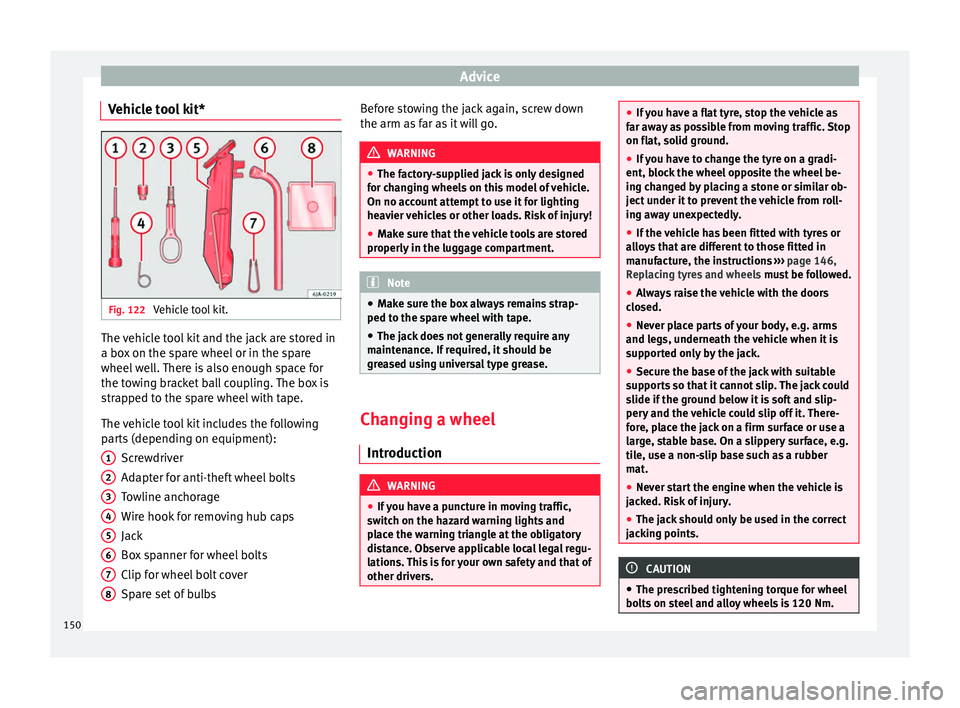
Vehicle tool kit* Fig. 122
Vehicle tool kit. The vehicle tool kit and the jack are stored in
a box on the spare wheel or in the spare
wheel well. There is also enough space for
the towing bracket ball coupling. The box is
strapped to the spare wheel with tape.
The vehicle tool kit includes the following
parts (depending on equipment):
Screwdriver
Adapter for anti-theft wheel bolts
Towline anchorage
Wire hook for removing hub caps
Jack
Box spanner for wheel bolts
Clip for wheel bolt cover
Spare set of bulbs
1 2
3
4
5
6
7
8 Before stowing the jack again, screw down
the arm as far as it will go.
WARNING
● The factory-supplied jack is only designed
for changing wheels on this model of vehicle.
On no account attempt to use it for lighting
heavier vehicles or other loads. Risk of injury!
● Make sure that the vehicle tools are stored
properly in the luggage compartment. Note
● Make sure the box always remains strap-
ped to the spare wheel with tape.
● The jack does not generally require any
maintenance. If required, it should be
greased using universal type grease. Changing a wheel
Introduction WARNING
● If you have a puncture in moving traffic,
switch on the hazard warning lights and
place the warning triangle at the obligatory
distance. Observe applicable local legal regu-
lations. This is for your own safety and that of
other drivers. ●
If you have a flat tyre, stop the vehicle as
far away as possible from moving traffic. Stop
on flat, solid ground.
● If you have to change the tyre on a gradi-
ent, block the wheel opposite the wheel be-
ing changed by placing a stone or similar ob-
ject under it to prevent the vehicle from roll-
ing away unexpectedly.
● If the vehicle has been fitted with tyres or
alloys that are different to those fitted in
manufacture, the instructions ››› page 146,
Replacing tyres and wheels must be followed.
● Always raise the vehicle with the doors
closed.
● Never place parts of your body, e.g. arms
and legs, underneath the vehicle when it is
supported only by the jack.
● Secure the base of the jack with suitable
supports so that it cannot slip. The jack could
slide if the ground below it is soft and slip-
pery and the vehicle could slip off it. There-
fore, place the jack on a firm surface or use a
large, stable base. On a slippery surface, e.g.
tile, use a non-slip base such as a rubber
mat.
● Never start the engine when the vehicle is
jacked. Risk of injury.
● The jack should only be used in the correct
jacking points. CAUTION
● The prescribed tightening torque for wheel
bolts on steel and alloy wheels is 120 Nm. 150
Page 158 of 200
Advice
– Fix the sticker 2
››› Fig. 128
›
›› page 155
onto the dash panel where the driver will
see it.
– Do not remove the foreign body, e.g. bolts
or nails, from the tyre.
– Unscrew the tyre valve cap.
– Using the valve extractor 1 , unscrew the
valve insert and place it on a clean surface
(cloth, paper, etc.)
Filling and inflating the tyre Filling the tyre
– Shake the tyre sealant can 10
››› Fig. 128
››› page 155 thoroughly several times.
– Att ac
h the flexible filling hose 3 onto the
can 10 . The foil sealing the can will be au-
tomatically pierced.
– Remove the cap from the flexible filling
hose 3 and insert the open end as far as it
will go into the tyre valve.
– Hold the can 10 upside down and fill the
complete contents of the can into the tyre.
– Remove the empty can from the tyre.
– Screw the valve insert back into the tyre
valve using the valve extractor 1 .Inflating the tyre
–
Screw the tyre filling hose 5
››› Fig. 128
››› page 155 firmly onto the tyre valve.
– Make sure that the bleed screw 7 is
closed.
– Start the vehicle engine and leave it run-
ning.
– Plug connector 9 into the 12-volt power
socket.
– Turn on the air compressor with switch 8 .
– Leave the air compressor running until the
tyre pressure has reached 2.0 -2.5 bar
(29-36 psi/200-250 kPa). The max. operat-
ing time for the compressor is 8 minutes
››› !
– Switch the compressor off.
– When an air pressure of 2.0-2.5 bar
(29-36 psi/200-250 kPa) cannot be
reached, unscrew the flexible tube 5 from
the tyre valve.
– Drive the vehicle approx. 10 metres for-
wards or backwards, so that the sealant
can “spread evenly” in the tyre.
– Screw the flexible hose from the air com-
pressor 5 back onto the tyre valve and re-
peat the inflation process.
– If the pressure is still lower than specified,
the tyre is too badly damaged. The tyre can- not be repaired using the tyre sealant kit
››› .
– Switch the compressor off.
– Unscrew the flexible hose 5 from the tyre
valve.
When a tyre pressure of 2.0-2.5 bar
(29-36 psi/200-250 kPa) is reached, you can
continue driving at a max. speed of 80 km/h
(50 mph).
Check the tyre pressure after 10 minutes of
driving ››› page 157 . WARNING
● The flexible tyre filling hose and the air
compressor may heat up during the filling
process. Risk of injury!
● Do not place the hot flexible tyre filling
hose or hot air compressor on top of flamma-
ble materials. Risk of fire!
● If the tyre cannot be inflated to a minimum
pressure of 2.0 bar (29 psi/200 kPa), then
the tyre is too badly damaged. The sealing
product is unable to seal the tyre . Do not
continue driving and obtain professional as-
sistance. CAUTION
Do not use the air compressor for longer than
8 minutes at a time. Risk of overheating! Be-
fore using the air compressor again, leave it
to cool down for several minutes. 156
Page 159 of 200

Emergencies
Check after 10 minutes of driving Check the tyre pressure after 10 minutes of
driving!
If the tyre pressure is less than 1.3 bar
(18.8 psi/130 kPa):
– Do not drive on! The tyr e cannot be suffi-
ciently filled using the tyre repair kit.
– See professional assistance.
If the tyre pressure is greater than 1.3 bar
(18.8 psi/130 kPa): – Correct the tyre pressure again to the cor-
rect value (see inside of the fuel tank flap).
– Carefully drive to the nearest specialised
workshop at a maximum speed of 80 km/h
(50 mph).
Jump-starting Introduction If the engine fails to start because of a dis-
charged battery, the battery can be connec-
ted to the battery of another vehicle to start
the engine. Suitable jump leads are required.
Both batteries need to have nominal voltage
of 12 V. The
capacity (Ah) of the back-up bat- t
er
y should not be notably less than the
drained battery.
Jump leads
The jump leads must be heavy enough to car-
ry the starter current and must be fitted with
insulated battery clamps. Refer to the instruc-
tions given by the manufacturer.
Positive cable – usually red
Neg
ative cable
– usually black WARNING
● A flat battery can also freeze at tempera-
tures slightly below to 0 °C (32 °F). Do not at-
tempt to start the vehicle with a frozen bat-
tery. Risk of explosion!
● Please note the safety warnings referring to
working in the engine compartment
››› page 132.
● The non-in s
ulated parts of the battery
clamps must not be allowed to touch. Addi-
tionally, the jump lead attached to the posi-
tive battery terminal must not touch metal
parts of the vehicle. Risk of short circuit!
● Do not connect the negative lead to the
negative terminal of the discharged battery.
In the event of sparks when starting the en-
gine, the explosive gas given off by the bat-
tery could catch fire.
● Position the jump leads in such a way that
they cannot come into contact with any mov-
ing parts in the engine compartment. ●
Do not bend over the battery. Risk of acid
burns!
● The screw plugs on the battery cells must
be screwed in firmly.
● Keep sources of fire (flames, lit cigarettes,
etc.) away from the battery. - Risk of explo-
sion!
● Never use the jump leads on batteries in
which the electrolyte level is too low. Risk of
explosion and acid burns. Note
● The vehicles must not touch each other, as
electricity could flow as soon as the positive
terminals are connected.
● The discharged battery must be properly
connected to the vehicle electrical system.
● The jump leads should be checked in a spe-
cialist vehicle battery shop. 157
Technical specifications
Advice
Operation
Safety
Page 160 of 200

Advice
How to jump start: description Fig. 129
Diagram of connections for vehicles
without Start Stop system Fig. 130
Diagram of connections for vehicles
with Start Stop system Jump lead terminal connections
1. Switch off the ignition of both vehicles
››› . 2. Connect one end of the
red jump lead to
the po s
itive + terminal of the vehicle
with the flat battery A
››› Fig. 129 .
3. C
onnect the other end of the red
jump
lead to the positive terminal + in the ve-
hicle providing assistance B .
4. For vehicles without Start-Stop system:
connect one end of the black jump lead to
the negative terminal – of the vehicle
providing the current B
››› Fig. 129 .
– For
vehicles with Start-Stop system: con-
nect one end of the black jump lead X to a
suitable ground terminal, to a solid piece of
metal in the engine block, or to the engine
block itself ››› Fig. 130 .
5. C
onnect the other end of the black jump
lead X to a solid metal component bolted
to the engine block or to the engine block
itself of the vehicle with the flat battery.
Do not connect it to a point near the bat-
tery A .
6. Position the leads in such a way that they cannot come into contact with any moving
parts in the engine compartment.
Starting
7. Start the engine of the vehicle with the boosting battery and let it run at idling
speed. 8. Start the engine of the vehicle with the flat
battery and wait 2 or 3 minutes until the
engine is “running”.
Removing the jump leads
9. Before you remove the jump leads, switch off the dipped beam headlights (if they
are switched on).
10.Turn on the heater blower and heated rear window in the vehicle with the flat battery.
This helps minimise voltage peaks which
are generated when the leads are discon-
nected.
11. When the engine is running, disconnect
the l e
ads in reverse order to the details
given above.
Connect the battery clamps so they have
good metal-to-metal contact with the battery
terminals.
If the engine fails to start, switch off the start-
er after about 10 seconds and try again after
about 1 minute. WARNING
● Please note the safety warnings referring to
working in the engine compartment
››› page 132.
● The b att
ery providing assistance must have
the same voltage as the flat battery (12V) and
approximately the same capacity (see imprint 158
Page 161 of 200

Emergencies
on battery). Failure to comply could result in
an explosion.
●
Never use jump leads when one of the bat-
teries is frozen. Danger of explosion! Even af-
ter the battery has thawed, battery acid could
leak and cause chemical burns. If a battery
freezes, it should be replaced.
● Keep sparks, flames and lighted cigarettes
away from batteries, danger of explosion.
Failure to comply could result in an explo-
sion.
● Observe the instructions provided by the
manufacturer of the jump leads.
● Do not connect the negative cable from the
other vehicle directly to the negative terminal
of the flat battery. The gas emitted from the
battery could be ignited by sparks. Danger of
explosion.
● Do not attach the negative cable from the
other vehicle to parts of the fuel system or to
the brake line.
● The non-insulated parts of the battery
clamps must not be allowed to touch. The
jump lead attached to the positive battery
terminal must not touch metal parts of the ve-
hicle, this can cause a short circuit.
● Position the leads in such a way that they
cannot come into contact with any moving
parts in the engine compartment.
● Do not lean on the batteries. This could re-
sult in chemical burns. Note
The vehicles must not touch each other, oth-
erwise electricity could flow as soon as the
positive terminals are connected. Towing the vehicle
Introduction Vehicles with manual gearbox can be towed
using a towbar or towrope. They can also be
towed with either the front or rear wheels lif-
ted off the road.
Vehicles with automatic gearbox can be tow-
ed using a towbar or towrope. They can also
be towed with the front wheels lifted off the
road. If the vehicle is towed with the rear
wheels lifted off the road the automatic gear-
box will be damaged!
It is safer to tow a vehicle with a
towbar. A
towrope should only be used if you do not
h av
e a towbar.
Follow the instructions below when towing a
vehicle:
Notes for the driver of the towing vehicle
– Engage the clutch very gently when starting
to move or on vehicles with automatic gear-
box press the accelerator carefully. –
On vehicles with a manual gearbox, the
towrope must be taut before driving off.
Maximum towing speed is 50 km/h (31
mph).
Note
s for the driver of the towed vehicle
– The ignition should be switched on so that
the steering wheel lock is not engaged and
the turn signals, horn and windscreen wip-
ers and washers can be used.
– Put the gear lever in neutral or move the se-
lector lever to position N (automatic gear-
bo
x).
The brake servo and power steering only
work when the engine is running. Considera-
bly more effort is required on the brake pedal
and steering wheel when the engine is
switched off.
Ensure the towrope remains taut at all times
when towing. CAUTION
● Do not tow-start the engine. Risk of engine
damage! In vehicles with a catalytic convert-
er, fuel that has not been burned could reach
the catalytic converter and catch fire in it.
This could damage and destroy the catalytic
converter. You may use the battery from an-
other vehicle to help you start your engine
››› page 158.
» 159
Technical specifications
Advice
Operation
Safety
Page 165 of 200

Fuses and bulbs
Changing the rear window wiper
blade* Fig. 137
Rear window wiper blade. Taking off the wiper blade
–
Lift the rear window wiper arm away from
the glass moving the blade slightly in the
direction of the arm – arrow A
››› Fig. 137 .
– Ho l
d the top of the rear window wiper arm
with one hand.
– Unlock the catch 1 with the other hand
and remove the blade in the direction of ar-
row B .
Fitting the wiper blade – Slide the blade fully until it clicks into posi-
tion.
– Check that the wiper is correctly secured.
– Fold the rear window wiper arm back down
onto the glass. Fuses and bulbs
Fuses Introduction Due to the constant updating of vehicles,
fuse assignments based on equipment and
the use of the same fuse for various electrical
components, it is not possible to provide an
up-to-date summary of the fuse positions for
the electrical components at the time this
manual was printed. For detailed information
about the fuse positions, please consult a
technical service.
In general, a fuse can be assigned to various
electrical components. Likewise, an electrical
component can be protected by several
fuses.
Only replace fuses when the cause of the
problem has been solved. If a newly inserted
fuse blows after a short time, you must have
the electrical system checked by a special-
ised workshop as soon as possible.
Additional information and warnings:
● Working in the engine compartment
››› page 132 . WARNING
The high voltages in the electrical system can
give serious electrical shocks, causing burns
and even death!
● Never touch the electrical wiring of the igni-
tion system.
● Take care not to cause short circuits in the
electrical system. WARNING
Using unsuitable fuses, repairing fuses or
bridging a current circuit without fuses can
cause a fire and serious injury.
● Never use a fuse with a higher value. Only
replace fuses with a fuse of the same amper-
age (same colour and markings) and size.
● Never repair a fuse.
● Never replace a fuse by a metal strip, staple
or similar. CAUTION
● To prevent damage to the vehicle's electric
system, before replacing a fuse always turn
off the ignition, the lights and all electrical
elements and remove the key from the igni-
tion.
● If you replace a fuse with higher-rating
fuse, you could cause damage to another part
of the electrical system.
● Protect the fuse boxes when open to pre-
vent the entry of dust or humidity as they can
damage the electrical system. » 163
Technical specifications
Advice
Operation
Safety