ignition Seat Toledo 2014 Workshop Manual
[x] Cancel search | Manufacturer: SEAT, Model Year: 2014, Model line: Toledo, Model: Seat Toledo 2014Pages: 200, PDF Size: 4.37 MB
Page 131 of 200
Checking and refilling levels
Checking and refilling levels
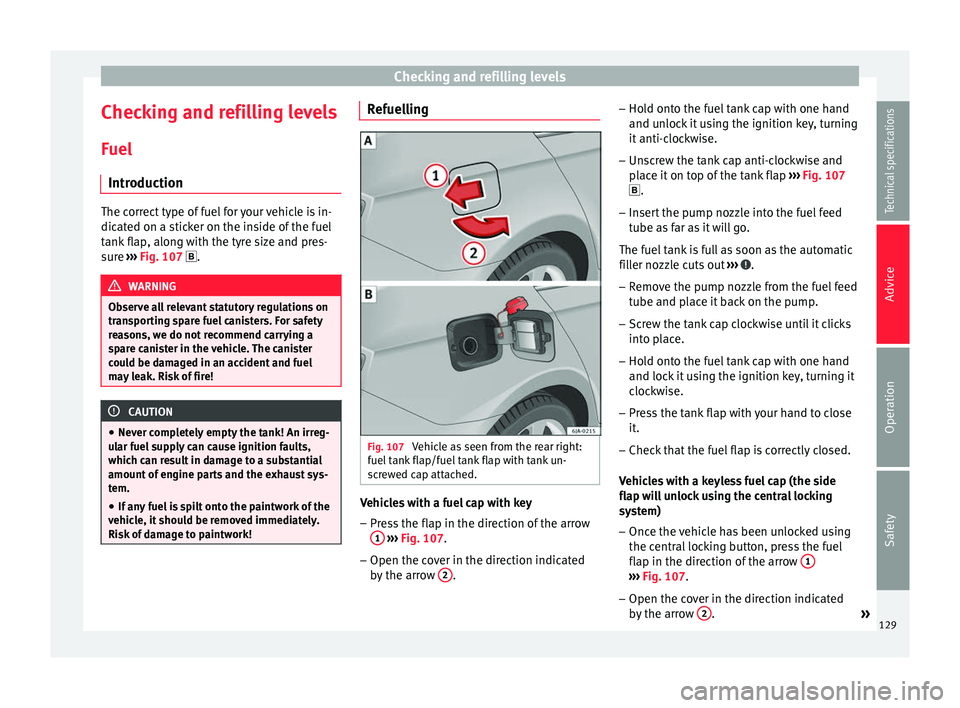
Fuel Introduction The correct type of fuel for your vehicle is in-
dicated on a sticker on the inside of the fuel
tank flap, along with the tyre size and pres-
sure
››› Fig. 107 . WARNING
Observe all relevant statutory regulations on
transporting spare fuel canisters. For safety
reasons, we do not recommend carrying a
spare canister in the vehicle. The canister
could be damaged in an accident and fuel
may leak. Risk of fire! CAUTION
● Never completely empty the tank! An irreg-
ular fuel supply can cause ignition faults,
which can result in damage to a substantial
amount of engine parts and the exhaust sys-
tem.
● If any fuel is spilt onto the paintwork of the
vehicle, it should be removed immediately.
Risk of damage to paintwork! Refuelling
Fig. 107
Vehicle as seen from the rear right:
fuel tank flap/fuel tank flap with tank un-
screwed cap attached. Vehicles with a fuel cap with key
–
Press the flap in the direction of the arrow
1
››› Fig. 107 .
– Open the c o
ver in the direction indicated
by the arrow 2 .–
Hold onto the fuel tank cap with one hand
and unlock it using the ignition key, turning
it anti-clockwise.
– Unscrew the tank cap anti-clockwise and
place it on top of the tank flap ››› Fig. 107
.
– Inser
t the pump nozzle into the fuel feed
tube as far as it will go.
The fuel tank is full as soon as the automatic
filler nozzle cuts out ››› .
– Remove the pump nozzle from the fuel feed
tube and place it back on the pump.
– Screw the tank cap clockwise until it clicks
into place.
– Hold onto the fuel tank cap with one hand
and lock it using the ignition key, turning it
clockwise.
– Press the tank flap with your hand to close
it.
– Check that the fuel flap is correctly closed.
Vehicles with a keyless fuel cap (the side
flap will unlock using the central locking
system)
– Once the vehicle has been unlocked using
the central locking button, press the fuel
flap in the direction of the arrow 1 ›››
Fig. 107 .
– Open the c o
ver in the direction indicated
by the arrow 2 .
»
129
Technical specifications
Advice
Operation
Safety
Page 133 of 200

Checking and refilling levels
petrol with the correct RON as soon as possi-
ble.
Petrol with a RON below 91 cannot be used,
ev en a
s an emergency measure. Risk of seri-
ously damaging the engine!
Petrol additives
The quality of the fuel influences the behav-
iour, power and service life of the engine.
This is why the petrol you use should carry
suitable additives already included by the
petrol industry, free of metals. These addi-
tives will help to prevent corrosion, keep the
fuel system clean and prevent deposits from
building up in the engine.
If good-quality petrol with metal-free addi-
tives is not available or engine problems
arise, the necessary additives must be added
when refuelling ››› .
Not all petrol additives have been shown to
be effective. The use of unsuitable petrol ad-
ditives may cause significant damage to the
engine and the catalytic converter. Metal ad-
ditives should never be used. Metal additives
may also be contained in petrol additives for
improving anti-detonation ratings or octane
ratings ››› .
SEAT recommends “genuine Volkswagen
Group Fuel Additives for petrol engines”.
These additives can be bought at SEAT deal-
ers, where information on how to use them
can also be obtained. CAUTION
● Do not refuel if the filler indicates that the
fuel contains metal. LRP (lead replacement
petrol) fuels contain high concentrations of
metal additives. Using them may damage the
engine!
● All SEAT vehicles with petrol engines can
only run on unleaded petrol. Refuelling just
once with leaded petrol disables the exhaust
system!
● Use of petrol with a lower RON to that pre-
scribed could damage the engine compo-
nents.
● Fuels marked as containing metal on the
garage fuel pump cannot be used. Risk of
damage to most engine parts or the exhaust
system!
● The use of unsuitable additives in petrol
can cause damage to most engine parts or
the exhaust system. Diesel fuel
Your vehicle can only run on
diesel fuel that
complies with the Standard EN 590 (in Ger-
m an
y, also DIN 51628, in Austria also
ÖNORM C 1590 , in Russia also GOST R
52368-2005/EN 590:2004).
Wint
er driving – winter-grade diesel
In winter use diesel fuel that complies with
the Standard EN 590
(in Germany, also DIN 51628, in Austria also ÖNORM C 1590
, in
Russia also
GOST R 52368-2005/EN
590:2004). “Winter-grade diesel” still per-
forms well at -20 °C (-4 °F).
In countries with other weather conditions,
diesel is often available that behaves differ-
ently with regards to the temperature. The
authorised SEAT dealers and petrol stations
in each country will inform you on the normal
diesel fuel of the country in question.
Preheating the fuel filter
The vehicle is fitted with a glow plug system
for the fuel filter. Therefore, the reliability of
the diesel is ensured at ambient tempera-
tures of down to approximately -25 °C
(-13 °F).
Fuel additives
Fuel additives, known as “thinners” (petrol or
similar substances) should not be mixed with
the diesel fuel. CAUTION
● Even one tankful of diesel fuel that does
not comply with the standard could damage
engine parts, the fuel system and the ex-
haust system!
● If fuel different to the prescribed diesel fuel
(e.g. petrol) is used by mistake, never start
the engine or switch on the ignition! Risk of » 131
Technical specifications
Advice
Operation
Safety
Page 134 of 200

Advice
serious damage to the engine! Contact an au-
thorised SEAT dealer to clean the engine fuel
system.
● Water allowed to collect in the fuel filter
can cause engine faults.
● Your vehicle is not prepared for use of bio-
fuel (RME) and, therefore, this fuel must not
be used for refuelling or driving. The use of
biofuel (RME) could cause serious damage to
the engine or the fuel system. Engine compartment
Introduction Always be aware of the danger of injury and
scalding as well as the risk of accident or fire
when working in the engine compartment,
e.g. when checking and refilling fluids.
Therefore, always observe the warnings and
follow all general safety precautions. The en-
gine compartment is a dangerous area
.WARNING
● Never open the bonnet if you see steam,
smoke or coolant escaping from the engine
compartment. Risk of scalding! Wait until no
steam or coolant can be seen before opening
the bonnet.
● Switch off the engine and remove the key
from the ignition. ●
Engage neutral in vehicles with manual
gearbox and move the selector lever to posi-
tion P in vehicles with automatic gearbox.
● Apply the handbrake firmly.
● Wait for the engine to cool down.
● For safety reasons, the bonnet must always
be closed when the vehicle is moving. There-
fore, after closing the bonnet always check
that it is properly secured.
● Should you notice that the bonnet is not
safely secured when the vehicle is moving,
stop the vehicle immediately and close the
bonnet properly. Risk of accident!
● Keep children away from the engine com-
partment.
● Do not touch hot engine parts. Risk of
burns!
● Never spill fluids on hot engine compart-
ments. These fluids can cause a fire (e.g. anti-
freeze in coolant)!
● Take care not to cause short circuits in the
electrical system, especially when working
on the battery.
● Never touch the radiator fan when the en-
gine is hot. The fan may start running sud-
denly!
● Never cover the engine with additional in-
sulating materials such as a blanket. Risk of
fire!
● Do not unscrew the cap on the coolant ex-
pansion tank when the engine is hot. The
cooling system is under pressure! ●
Protect face, hands and arms from any hot
steam or hot coolant released by covering the
cap with a large, thick rag when opening the
expansion tank.
● Do not leave any objects, such as cloths or
tools, in the engine compartment.
● When working underneath the vehicle, se-
cure it so that it cannot roll away and support
it safely on suitable supports. The hydraulic
jack is not sufficient for this purpose. Risk of
injuries!
● If any tests have to be performed with the
engine running, there is an extra safety risk
from rotating parts, such as the drive belt, al-
ternator and radiator fan, etc., and from the
high-voltage ignition system. You should also
note the following:
– Never touch the electrical wiring of the
ignition system.
– Keep away from moving engine parts
when wearing jewellery, loose clothing or
long hair. Risk of fatal injuries! All jewel- lery must be removed, hair tied back and
close-fitting clothing worn.
● Observe the following additional warnings
if work on the fuel system or the electrical
system is necessary.
–Always disconnect the battery from the
on-board network.
– Do not smoke.
– Never work near naked flames.
– Always keep an approved fire extinguish-
er immediately available. 132
Page 137 of 200

Checking and refilling levels
Radiator fan The radiator is driven by an electric motor
and controlled according to the temperature
of the coolant.
After the engine has been stopped and the
ignition switched off, the radiator fan may
continue running for around 10 minutes.
Engine oil
General notes The engine comes with a special, multi-grade
oil that can be used all year round.
Because the use of high-quality oil is essen-
tial for the correct operation of the engine
and its long useful life, when topping up or
changing oil, use only those oils that comply
with VW standards.
The specifications (VW standards) set out in
the following page should appear on the con-
tainer of the service oil; when the container
displays the specific standards for petrol and
diesel engines together, it means that the oil
can be used for both types of engines.
We recommend that the oil change indicated
in the Maintenance Programme, be per-
formed by a technical service or specialised
workshop. The correct oil specifications for your engine
are listed in the
››› page 136, Oil properties .
Service intervals
Service intervals can be flexible (LongLife
service) or fixed (dependent on time/dis-
tance travelled).
If the PR code that appears on the back of the
Maintenance Programme booklet is QG1, this
means that your vehicle has the LongLife
service programmed. If it has the codes QG0
or QG2, the service interval is dependent on
time/distance travelled.
Flexible service intervals (LongLife service
intervals*)
Special oils and processes have been devel-
oped which, depending on the characteris-
tics and individual driving profiles, enable
the extension of the oil change service (Long-
Life service intervals).
Because this oil is essential for extending the
service intervals, it must only be used ob-
serving the following indications:
● Avoid mixing it with oil for fixed service in-
tervals.
● Only in exceptional circumstances, if the
engine oil level is too low ›››
page 136 and
LongLife oil is not available, it is permitted to
top up (once) with oil for fixed service inter-vals
››› page 136 (up to a maximum of 0.5 li-
tr e
s).
Fixed service intervals*
If your vehicle does not have the “LongLife
service interval” or it has been disabled (by
request), you may use oils for fixed service
intervals
, which also appear in ››› page 136,
Oil properties . In this case, your vehicle must
be serviced after a fixed interval of 1
year/15,000 km (10,000 miles)(whatever
comes first) ››› Booklet Maintenance Pro-
gramme.
● In ex
ceptional circumstances, if the engine
oil level is too low ››› page 136 and you can-
not o
btain the oil specified for your vehicle,
you can add a small quantity of oil conform-
ing to the specification ACEA A2 or ACEA A3
(petrol engines) or ACEA B3 or ACEA B4 (die-
sel engines) (up to 0.5 l).
Vehicles with diesel particulate filter*
The Maintenance Programme states whether
your vehicle is fitted with a diesel particulate
filter.
Only VW 507 00 engine oil, with reduced ash
formation, may be used in diesel engines
equipped with particulate filter. Using other
types of oil will cause a higher soot concen-
tration and reduce the life of the DPF. There-
fore: »
135
Technical specifications
Advice
Operation
Safety
Page 138 of 200

Advice
● Avoid mixing this oil with other engine oils.
● Only in exceptional circumstances, if the
engine oil level is too low ››› page 136 and
you cannot obtain the oil specified for your
vehicle, you can use a small quantity of oil
(once) conforming to the VW 506 00,
VW 506 01, VW 505 00, VW 505 01 or
ACEA B3/ACEA B4 specification. (up to 0.5 l).
Oil propertiesEngine typeSpecification
Petrol without flexible
service intervalVW 502 00/VW 504 00
Petrol with flexible serv-
ice interval (LongLife)VW 504 00
Diesel. Engines without
Particulate filter (DPF)VW 505 01/VW 506 01/VW
507 00
Diesel. Particulate Filter
Engines (DPF).
With or without flexible
service interval (with
and without LongLife) a)VW 507 00
a)
Only use recommended oils, otherwise you may damage the
engine.
Engine oil additives
No type of additive should be mixed with the
engine oil. The deterioration caused by these
additives is not covered by the warranty. Note
Before a long trip, we recommend finding an
engine oil that conforms to the correspond-
ing VW specifications and recommend keep-
ing it in the vehicle. This way, the correct en-
gine oil will always be available for a top-up if
needed. Checking the engine oil level
Fig. 111
Engine oil dipsticks. The dipstick shows the engine oil level.
››› Fig. 111 .
Chec k
ing oil level
– Park the vehicle on a level surface and en-
sure the engine is at operating tempera-
ture.
– Switch the ignition off.
– Open the bonnet. –
Wait a few minutes for the engine oil to
flow back to the sump and remove the dip-
stick.
– Wipe the dipstick with a clean cloth and in-
sert it again as far as it will go.
– Then pull the dipstick out again and check
the oil level.
Oil level in area A –
Do not
t
op up oil.
Oi
l level in area B –
Oil can be topped up. After topping up the
oi l
level could be in area A .
Oil level in area C –
Oil must be topped up. After topping up,
the oil level should be in area B .
It is normal for the engine to consume a cer-
tain amount of oil. Depending on how you
drive and the conditions in which the vehicle
is used, oil consumption can be up to 0.5 li-
tres per 1,000 km. Oil consumption can also
be higher for the first 5,000 km (3000 miles).
You should therefore check the oil level at
regular intervals, ideally every time you fill
the tank or before setting off on a long trip.
When the engine is working hard, for in-
stance during sustained motorway cruising in
summer, when towing a trailer or caravan or
136
Page 140 of 200

Advice
Checking coolant level Fig. 112
Engine compartment: coolant fluid
tank. The coolant expansion tank is located in the
engine compartment of the vehicle.
– Switch the ignition off.
– Open the bonnet ››› page 132.
– Read off the coolant level on coolant ex-
pansion tank ››› Fig. 112 . When the engine
i s
cold, the coolant should be between
marks B (min.) and
A (max.). When the
engine is hot, it may be slightly above mark A (max.).
If the coolant fluid level in the reservoir is too
low, this will be indicated by the red warn-
ing lamp illuminating on the general dash
panel ›››
page 35, Coolant level and tempera-
ture . However, we recommend checking
the coolant level directly in the tank. Coolant fluid loss
Any loss of coolant normally indicates a
leak.
It is not sufficient merely to top up the cool-
ant. The cooling system should be inspected
by an Official Service without delay. CAUTION
In the event of a fault that causes the engine
to overheat, contact an authorised SEAT deal-
er immediately, as this could damage the en-
gine. Topping up coolant
–
Switch the ignition off.
– Wait for the engine to cool down.
– Cover the cap on the coolant expansion
tank ›››
Fig. 112 with a cloth and
carefully
u
nscrew the cap.
– Refill the level of coolant.
– Screw the cap on again until it clicks into
place.
Do not use a different type of additive if the
prescribed anti-freeze additive is not availa-
ble, in the event of an emergency. In this
case, use only water and bring the coolant
concentration back up to the correct level as
soon as possible at an Official Service.
Always top up with unused coolant. Never fill the coolant tank above mark
A (max.)
››› Fig. 112 Excess coolant is forced
out of
the cooling system through the over-
pressure valve in the filler cap of the expan-
sion tank when the engine heats up. WARNING
● The anti-freeze additive and, therefore, the
entire coolant, are a health hazard. Avoid
touching the coolant. Coolant fumes are also
a health hazard. For this reason, always store
the coolant additive in a safe place out of the
reach of children. Risk of poisoning!
● If splashed into eyes, rinse immediately
with clean water and seek immediate medical
attention.
● Seek immediate medical attention if the
coolant is accidentally ingested. CAUTION
If the coolant cannot be topped up under the
given conditions, do not drive on. We rec-
ommend c
ontacting an authorised SEAT deal-
er, as this can damage the engine. 138
Page 141 of 200

Checking and refilling levels
Brake fluid Checking brake fluid level Fig. 113
Engine compartment: brake fluid
reservoir. The brake fluid reservoir is located in the en-
gine compartment of the vehicle.
– Switch the ignition off.
– Open the bonnet ››› page 132.
– Check the brake fluid level in the reservoir
››› Fig. 113 . It should be between the “MIN”
and “MAX” m ark
s.
The fluid level drops slightly after a period of
time due to automatic compensation for
brake pad wear. This is quite normal.
However, if the level goes down noticeably in
a short time, or drops below the “MIN” mark,
there may be a leak in the brake system. If
the brake fluid level in the reservoir is too low, this will be indicated by the warning
lamp illuminating on the instrument panel
››› page 33, Brake system . WARNING
If the fluid level has dropped below the MIN
mark, do not continue driving. Risk of acci-
dent! Go t
o a technical service. Changing the brake fluid
Brake fluid absorbs moisture. Therefore, it
gradually absorbs moisture from the atmos-
phere. If the water content in the brake fluid
is too high, the brake system could corrode.
The water content also reduces the boiling
point of the brake fluid.
The brake fluid must comply with one of the
following standards or specifications:
● VW 50114
● FMVSS 116 DOT4 WARNING
Heavy use of the brakes may cause a vapour
lock if the brake fluid is left in the brake sys-
tem for too long. This would seriously affect
the efficiency of the brakes and the safety of
the vehicle. CAUTION
Brake fluid damages the vehicle paintwork. Windscreen washer
Fig. 114
Engine compartment: windscreen
washer reservoir. The container for the windscreen washer con-
tains the cleaning fluid for the windscreen or
rear window and the headlight washer sys-
tem. The container is located in the engine
compartment.
»
139Technical specifications
Advice
Operation
Safety
Page 143 of 200

Checking and refilling levels
●
Neutralize any acid splashes on the skin or
clothing with soap solution as quickly as pos-
sible and rinse off with plenty of water. If acid
is swallowed by mistake, consult a doctor im-
mediately.
● Keep children away from the battery.
● Hydrogen is released and a highly explo-
sive mixture of gases is generated when the
battery is under charge. Sparks when discon-
necting or releasing cable terminals with the
ignition switched on could also cause an ex-
plosion.
● A short circuit is produced if the battery ter-
minals are bridged, e.g. using metal objects,
cables, etc. Possible consequences of a short
circuit: melting of lead plates, battery explo-
sion and fire, splashing acid.
● The following is forbidden while working on
the battery: fire and open flames, smoking
and activities that could produce sparks.
Avoid causing sparks when handling cables
or electrical apparatus. Risk of injury in the
event of large sparks.
● Before working on the electrical system,
you must switch off the engine, the ignition
and all electrical components and disconnect
the cable from the negative terminal (-) of the
battery. To change a bulb, simply switch off
the corresponding light.
● Never charge a frozen or thawed out bat-
tery. Risk of explosion and acid burns! Re-
place a frozen battery.
● Never use the jump leads on batteries in
which the electrolyte level is too low. Risk of
explosion and acid burns! ●
Never use a damaged battery. Risk of ex-
plosion! Replace a damaged battery immedi-
ately. CAUTION
● Never disconnect the battery when the igni-
tion is switched on, as the electrical system
(electronic components) of the vehicle could
be damaged. When disconnecting the battery
from the vehicle electrical system, disconnect
its negative terminal (-) first. Only then may
the positive terminal (+) be disconnected.
● When connecting the battery, first connect
the positive terminal (+) and then the nega-
tive terminal (-). The battery cables must nev-
er be connected to the wrong battery termi-
nals. Risk of burning the electrical installa-
tion!
● Make sure the battery acid does not come
into contact with the bodywork. Risk of paint-
work damage.
● Do not expose the battery to direct sunlight
to protect it from ultraviolet radiation.
● If the vehicle is not used for 3 or 4 weeks,
the battery could run flat. This is because
some components use electricity even in
standby mode (e.g. control units). Prevent the
battery from running flat by disconnecting its
negative terminal or leave it charging at a low
current.
● If you frequently use the vehicle for short
trips, the battery may not fully charge and
could run flat. For the sake of the environment
A flat battery is particularly harmful waste for
the environment. It must therefore be dis-
posed of according to current local law. Note
Replace a battery once it is older than 5
years. Open the battery cover.
Fig. 115
Battery: Opening the cover. The battery is located beneath a plastic cover
in the engine compartment.
–
Open the battery cover in the direction indi-
cated by the arrow ›››
Fig. 115 .
– The po s
itive terminal (+) of the battery is
connected in reverse order.
141
Technical specifications
Advice
Operation
Safety
Page 144 of 200

Advice
Checking battery acid level Fig. 116
Battery: Electrolyte level indicator. We recommend you have the acid level regu-
larly checked at an official technical service,
particularly in the following cases.
● At high outside temperatures.
● On long daily trips.
● Whenever the vehicle is loaded
››› page 142, Charging the battery .
In v
ehicles equipped with a battery with col-
our indicator, the so-called magic eye
››› Fig. 116
changes colour to indicate the
acid level.
Air bubbles can influence the colour of the in-
dicator. Therefore, carefully knock the indica-
tor before checking the acid level.
● Black – the acid level is correct.
● Colourless or light yellow – acid level too
low, battery must be changed. Note
● The battery acid level is also regularly
checked during servicing at authorised SEAT
dealers.
● The electrolyte level on “AGM” batteries
cannot be checked for technical reasons.
● Vehicles equipped with the “Start-Stop”
system include a battery control unit to con-
trol the battery level for repeated engine
starting. Winter service
At low temperatures the battery provides only
a fraction of the starting power it has at nor-
mal temperatures.
A flat battery can also freeze at temperatures
slightly below to 0 °C (32 °F).
We therefore recommend you have the bat-
tery checked and, if necessary, charged at an
official SEAT technical service before the start
of winter.
Charging the battery A fully-charged battery is essential for relia-
ble starting.
– Switch off the ignition and all electrical
equipment. –
For “fast-charging” only: disconnect both
battery connection cables (first the “nega-
tive” terminal and then the “positive”).
– Connect the charger cables to the battery
terminals (red = “positive”, black = “nega-
tive”).
– Plug in the battery charger and switch on.
– After charging the battery: Switch off the
battery charger and disconnect the cable.
– Remove the charger cables.
– If necessary, reconnect both battery cables
to the battery (first the “positive” cable,
then the “negative” cable).
When charging with a low current (e.g. with a
small battery charger ), the battery does not
normally have to be disconnected. The in-
structions of the battery charger manufactur-
er must be followed.
Use a current equivalent to or lower than
10% of the battery capacity to fully charge
the battery.
Before “ fast-charging
” the battery however,
both b
attery cables must be disconnected.
“Fast-charging” a battery is dangerous and
requires a battery charger and special knowl-
edge. Fast charges should be performed by
an official technical service.
The battery caps should not be opened while
the battery is being charged.
142
Page 145 of 200

Checking and refilling levels
CAUTION
In vehicles fitted with the “Start-Stop” sys-
tem, the charger cable cannot be directly con-
nected to the negative terminal of the vehicle
battery but must be attached to the engine
ground point ››› page 158. Disconnecting and connecting the
battery
The following functions will either be inoper-
ative or will not work properly after discon-
necting and reconnecting the battery:FunctionInstallation
Setting the clock›››
page 32
The multifunction display data
is deleted››› page 39 Note
We recommend having the vehicle checked by
an authorised SEAT dealer to guarantee the
correct working order of all electrical sys-
tems. Changing the battery
A replacement battery must have the same
capacity, voltage, current rating and size as
the original. The appropriate types of battery can be acquired from authorised SEAT deal-
ers.
We recommend having the battery changed
by an authorised SEAT dealer, where the new
battery will be correctly installed and the
original disposed of in line with regulations.
Automatic disconnection of electrical
equipment When heavily-charging a battery, the pro-
gramme selected by the electrical system
control unit prevents the battery from auto-
matically discharging. This may result in the
following:
● Increase in idling speed so that the alterna-
tor can supply more current to the electrical
system.
● The performance of certain electrical com-
ponents could be limited or some may switch
off temporarily, e.g. the heated seats, the
heated rear window, the 12 V power socket. Note
Despite any measures taken by the control
unit, the battery could drain. e.g. with the en-
gine is switched off, the key is turned in the
ignition for a long period or the side lights or
parking lights are switched on. The switching
off of certain electrical components does not
impair driving comfort and often the driver
will not even notice. 143
Technical specifications
Advice
Operation
Safety