engine SKODA FABIA 2014 3.G / NJ Manual PDF
[x] Cancel search | Manufacturer: SKODA, Model Year: 2014, Model line: FABIA, Model: SKODA FABIA 2014 3.G / NJPages: 216, PDF Size: 30.7 MB
Page 179 of 216

›Continue driving carefully to the nearest specialist garage at a maximum
speed of 80 km/h (50 mph).WARNING■ A tyre filled with sealant has the same driving characteristics as a stand-
ard tyre.■
Do not drive faster than 80 km/h (50 mph).
■
Avoid accelerating at full throttle, sharp braking and fast cornering.
Jump-starting
Introduction
This chapter contains information on the following subjects:
Jump-starting using the battery from another vehicle
176
The battery of another vehicle can be used to jump-start your vehicle if the en-
gine will not start because the battery is flat.
WARNING■ Pay attention to the warning instructions relating to working in the en-
gine compartment » page 150.■
A discharged vehicle battery can freeze at temperatures just below 0 °C.
If the battery is frozen, do not jump start with the battery of another vehi-
cle – risk of explosion.
■
Keep any sources of ignition (naked flame, smouldering cigarettes, etc.)
away from the battery – risk of explosion!
■
Never jump-start vehicle batteries with an electrolyte level that is too low
– risk of explosion and caustic burns.
■
The vent screws of the battery cells must be tightened firmly.
Note
We recommend you buy jump-start cables from a car battery specialist.Jump-starting using the battery from another vehicleFig. 166
Jump-starting: A – flat battery, B
– battery providing current
Fig. 167
Engine earth: START-STOP sys-
tem
Read and observe on page 176 first.
The starting process using the battery of another vehicle requires the use of
jumper cables.
The jump-start cables must be attached in the following sequence.
›
Attach clamp
1
to the positive terminal of the discharged battery
A
» Fig. 166 .
›
Attach clamp
2
to the positive terminal of the battery supplying power
B
.
›
Attach clamp
3
to the negative terminal of the battery supplying power
B
.
›
Attach the clamp
4
to a solid metal component firmly connected to the en-
gine block or to the engine block itself.
The jump-start cable must only be connected to the engine earthing point on
vehicles with the START-STOP system » Fig. 167.
Starting engine
›
Start the engine on the vehicle providing the power and allow it to idle.
›
Start the engine of the vehicle with the discharged battery.
176Do-it-yourself
Page 180 of 216

›If the engine does not start, halt the attempt to start the engine after 10 sec-
onds and wait for 30 seconds before repeating the process.›
Detach the jumper cables in the exact reverse order that they were attached.
Both batteries must have a rated voltage of 12 V. The capacity (Ah) of the bat-
tery supplying the power must not be significantly less than the capacity of
the discharged battery in your vehicle.
Jump-start cables
Only use jump-start cables which have an adequately large cross-section and
insulated terminal clamps. Obey the instructions of the jump start cable manu-
facturer.
Positive cable - colour coding in the majority of cases is red.
Negative cable - colour coding in the majority of cases is black.
WARNING■
Do not clamp the jump-start cable to the negative terminal of the dis-
charged battery. There is the risk of detonating gas seeping out the battery
being ignited by the strong spark which results from the engine being star-
ted.■
The non-insulated parts of the terminal clamps must never touch each
other – risk of short circuit.
■
The jump-start cable connected to the positive terminal of the battery
must not come into contact with electrically conducting parts of the vehicle
– risk of short circuit.
■
Route the jump-start cables so that they cannot be caught by any rotat-
ing parts in the engine compartment.
■
There must not be any contact between the two vehicles otherwise cur-
rent may flow as soon as the negative terminals are connected.
Towing the vehicle
Introduction
Fig. 168
Braided tow ropes/spiral tow rope
This chapter contains information on the following subjects:
Front towing eye
178
Rear towing eye
179
Vehicles with a tow hitch
179
A braided tow rope must be used for towing » Fig. 168 -
.
The following guidelines must be observed when towing.
Vehicles with manual transmission may be towed with a tow bar or a tow rope
or with the front or rear wheels raised.
Vehicles with automatic transmission may be towed with a tow bar or a tow
rope or with the front wheels raised. If the vehicle is raised at rear, the auto-
matic gearbox is damaged!
Driver of the tow vehicle
›
Engage the clutch gently when starting off or depress the accelerator partic-
ularly gently if the vehicle is fitted with an automatic gearbox.
›
Only then, approach correctly when the rope is taut.
The maximum towing speed is 50 km/h.
Driver of the towed vehicle
›
Switch on the ignition so that the steering wheel is not locked and so that
the turn signal lights, windscreen wipers and windscreen washer system can
be used.
177Emergency equipment, and self-help
Page 181 of 216

›Take the vehicle out of gear or move the selector lever into position
N if the
vehicle is fitted with an automatic gearbox.
Please note that the brake servo unit and power steering only operate if the
engine is running. If the engine is not running, significantly more physical force
is required to depress the brake pedal and steer the vehicle.
If using a tow rope, ensure that it is always kept taught.
Both drivers should be familiar with the potential issues of towing a vehicle.
Unskilled drivers should not attempt to tow another vehicle or to be towed.
The vehicle must be transported on a special breakdown vehicle or trailer if it
is not possible to tow the vehicle in the way described or if the towing dis-
tance is greater than 50 km.WARNING■ When towing, respect the national legal provisions, especially those
which relate to the identification of the towing vehicle and the vehicle be-
ing towed.■
Exercise increased caution when towing.
■
Spiral tow ropes must not be used for towing » Fig. 168 -
, the towing
eye may unscrew out of the vehicle - risk of accident.
■
The tow rope should not be twisted - risk of accident.
CAUTION
■ Do not tow-start the engine – risk of damaging the engine and the catalytic
converter. The battery from another vehicle can be used as a jump-start aid
» page 176 , Jump-starting .■
If the gearbox no longer contains any oil because of a defect, your vehicle
must only be towed with the drive wheels raised clear of the ground or on a
special breakdown vehicle or trailer.
■
To protect both vehicles when tow-starting or towing, the tow rope should
be elastic. Thus one should only use plastic fibre rope or a rope made out of a
similarly elastic material.
■
There is always a risk of excessive stresses and damage resulting at the
points to which you attach the tow rope or tow bar when you attempt to tow a
vehicle which is not standing on a paved road.
■
Attach the tow rope or the tow bar to the towing eyes » page 178 or
» page 179 to the detachable ball head of the towing equipment » page 129 .
NoteWe recommend using a tow rope from ŠKODA Original Accessories available
from a ŠKODA Partner.
Front towing eye
Fig. 169
Removing the cap / installing the towing eye
Read and observe
and on page 178 first.
Removing/installing the cap
›
Press on the fuel filler flap in the direction of the arrow
1
» Fig. 169 .
›
Remove the cap in the direction of the arrow
2
.
›
After unscrewing the cap of the towing eye, insert the cap in the region of
the arrow
1
and then press the opposite side of the cap.
The cap must engage firmly.
Removing/installing the towing eye
›
Manually screw the towing eye as far as it will go in the direction of the ar-
row
3
» Fig. 169 » .
For tightening purposes, we recommend, for example, using the wheel
wrench, towing eye from another vehicle or a similar object that can be pushed through the eye.
›
Unscrew the towing eye against the direction of the arrow
3
.
WARNINGThe towing eye must always be screwed in fully and firmly tightened, oth-
erwise the towing eye can tear when towing in or tow-starting.178Do-it-yourself
Page 185 of 216
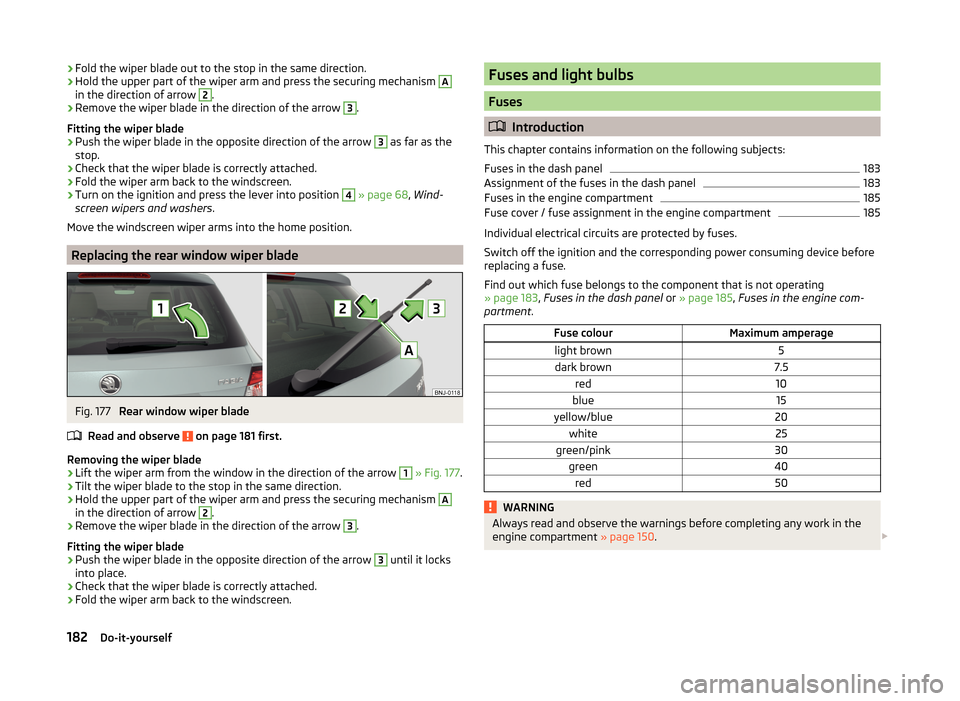
›Fold the wiper blade out to the stop in the same direction.›Hold the upper part of the wiper arm and press the securing mechanism A
in the direction of arrow
2
.
›
Remove the wiper blade in the direction of the arrow
3
.
Fitting the wiper blade
›
Push the wiper blade in the opposite direction of the arrow
3
as far as the
stop.
›
Check that the wiper blade is correctly attached.
›
Fold the wiper arm back to the windscreen.
›
Turn on the ignition and press the lever into position
4
» page 68 , Wind-
screen wipers and washers .
Move the windscreen wiper arms into the home position.
Replacing the rear window wiper blade
Fig. 177
Rear window wiper blade
Read and observe
on page 181 first.
Removing the wiper blade
›
Lift the wiper arm from the window in the direction of the arrow
1
» Fig. 177 .
›
Tilt the wiper blade to the stop in the same direction.
›
Hold the upper part of the wiper arm and press the securing mechanism
A
in the direction of arrow
2
.
›
Remove the wiper blade in the direction of the arrow
3
.
Fitting the wiper blade
›
Push the wiper blade in the opposite direction of the arrow
3
until it locks
into place.
›
Check that the wiper blade is correctly attached.
›
Fold the wiper arm back to the windscreen.
Fuses and light bulbs
Fuses
Introduction
This chapter contains information on the following subjects:
Fuses in the dash panel
183
Assignment of the fuses in the dash panel
183
Fuses in the engine compartment
185
Fuse cover / fuse assignment in the engine compartment
185
Individual electrical circuits are protected by fuses.
Switch off the ignition and the corresponding power consuming device before
replacing a fuse.
Find out which fuse belongs to the component that is not operating
» page 183 , Fuses in the dash panel or » page 185 , Fuses in the engine com-
partment .
Fuse colourMaximum amperagelight brown5dark brown7.5red10blue15yellow/blue20white25green/pink30green40red50WARNINGAlways read and observe the warnings before completing any work in the
engine compartment » page 150. 182Do-it-yourself
Page 186 of 216
CAUTION■“Never repair” fuses or replace them with a fuse of a higher amperage – risk
of fire. This may also cause damage at another part of the electrical system.■
A blown fuse is recognisable by the molten metal strip. Replace the faulty
fuse with a new one of the same amperage.
■
If a new fuse burns through again, consult a specialist immediately.
Note
■
We recommend that you always carry replacement fuses in the vehicle. A box
of replacement fuses can be purchased from ŠKODA Original Accessories.■
One fuse may cover several consumers.
■
A single consumer may use several fuses.
Fuses in the dash panel
Fig. 178
Remove the cover
Read and observe and on page 182 first.
The fuses are located on the bottom of the dash panel behind a cover.
Replacing fuses
›
Remove the cover of the fuse box » Fig. 178 in the direction of the arrow.
›
Remove the plastic clip from the holder in the fuse box cover in the dash
panel.
›
Place the clamp on the respective fuse and pull this fuse out.
›
Insert a new fuse.
›
Replace the clamp in the original place.
›
Insert the top edge of the cover into the dash panel first.
›
Push the lower edge of the cover in the region
A
.
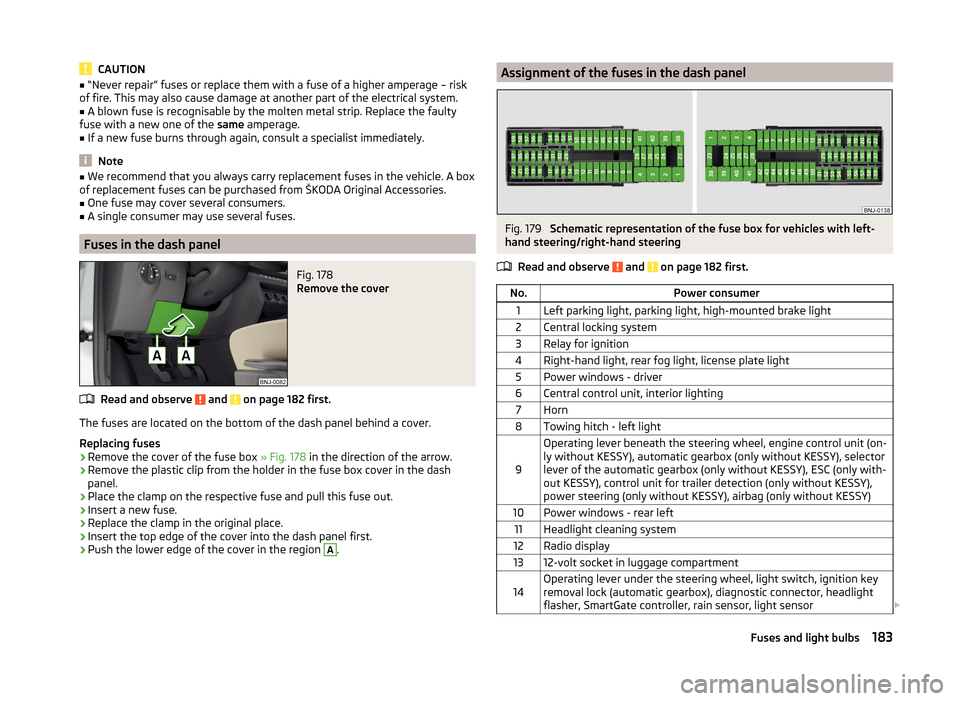
Assignment of the fuses in the dash panelFig. 179
Schematic representation of the fuse box for vehicles with left-
hand steering/right-hand steering
Read and observe
and on page 182 first.
No.Power consumer1Left parking light, parking light, high-mounted brake light2Central locking system3Relay for ignition4Right-hand light, rear fog light, license plate light5Power windows - driver6Central control unit, interior lighting7Horn8Towing hitch - left light
9
Operating lever beneath the steering wheel, engine control unit (on-
ly without KESSY), automatic gearbox (only without KESSY), selector
lever of the automatic gearbox (only without KESSY), ESC (only with-
out KESSY), control unit for trailer detection (only without KESSY),
power steering (only without KESSY), airbag (only without KESSY)10Power windows - rear left11Headlight cleaning system12Radio display1312-volt socket in luggage compartment14Operating lever under the steering wheel, light switch, ignition key
removal lock (automatic gearbox), diagnostic connector, headlight
flasher, SmartGate controller, rain sensor, light sensor 183Fuses and light bulbs
Page 188 of 216
Fuses in the engine compartmentFig. 180
Remove the cover
Read and observe
and on page 182 first.
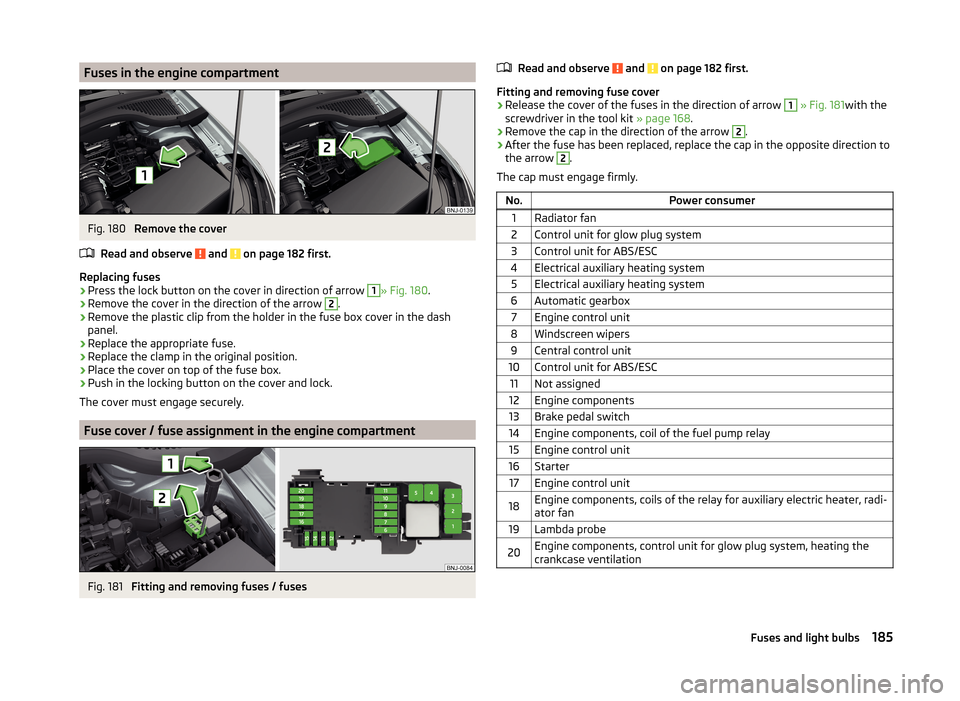
Replacing fuses
›
Press the lock button on the cover in direction of arrow
1
» Fig. 180 .
›
Remove the cover in the direction of the arrow
2
.
›
Remove the plastic clip from the holder in the fuse box cover in the dash
panel.
›
Replace the appropriate fuse.
›
Replace the clamp in the original position.
›
Place the cover on top of the fuse box.
›
Push in the locking button on the cover and lock.
The cover must engage securely.
Fuse cover / fuse assignment in the engine compartment
Fig. 181
Fitting and removing fuses / fuses
Read and observe and on page 182 first.
Fitting and removing fuse cover
›
Release the cover of the fuses in the direction of arrow
1
» Fig. 181 with the
screwdriver in the tool kit » page 168.
›
Remove the cap in the direction of the arrow
2
.
›
After the fuse has been replaced, replace the cap in the opposite direction to
the arrow
2
.
The cap must engage firmly.
No.Power consumer1Radiator fan2Control unit for glow plug system3Control unit for ABS/ESC4Electrical auxiliary heating system5Electrical auxiliary heating system6Automatic gearbox7Engine control unit8Windscreen wipers9Central control unit10Control unit for ABS/ESC11Not assigned12Engine components13Brake pedal switch14Engine components, coil of the fuel pump relay15Engine control unit16Starter17Engine control unit18Engine components, coils of the relay for auxiliary electric heater, radi-
ator fan19Lambda probe20Engine components, control unit for glow plug system, heating the
crankcase ventilation185Fuses and light bulbs
Page 189 of 216
Replacing bulbs
Introduction
This chapter contains information on the following subjects:
Bulb arrangement in the headlights
186
Removing and installing the cover in the front wheel arch
187
Fitting and removing the wash water container nozzle
187
Replacing the low beam and high beam bulb (halogen headlights)
188
Change bulb for turn signal switch (halogen headlight)
188
Replacing the parking light bulb (halogen headlights)
188
Changing bulb for daytime running lights switch (halogen headlight)
189
Replacing the high beam bulb (halogen projector headlights)
189
Replacing the high beam bulb (halogen projector headlights)
190
Replacing the turn signal switch bulb (halogen projector headlights)
190
Replacing the bulb for the fog light
191
Changing the licence plate light bulb
191
Rear Light
192
Replacing bulbs in rear light
192
Some manual skills are required to change a bulb. For this reason, if uncertain,
we recommend that bulbs are replaced by a specialist garage or other expert
help is sought.
› Switch off the ignition and all of the lights before replacing a bulb.
› Faulty bulbs must only be replaced with the same type of bulbs. The designa-
tion is located on the light socket or the glass bulb.
› A stowage compartment for replacement bulbs is located in a plastic box in
the spare wheel or underneath the floor covering in the boot.
WARNING■ Always read and observe the warnings before completing any work in the
engine compartment » page 150.■
Accidents can be caused if the road in front of the vehicle is not suffi-
ciently illuminated and the vehicle cannot or can only be seen with difficul-
ty by other road users.
■
Bulbs H8, H7 and H4 are pressurised and may burst when changed - there
is a risk of injury! We therefore recommended wearing gloves and safety
glasses when changing a bulb.
■
Switch off the respective vehicle light when changing the bulb.
CAUTIONDo not take hold of the glass bulb with naked fingers (even the smallest
amount of dirt reduces the working life of the light bulb). Use a clean cloth,
napkin, or similar.
Note
■ This Owner's Manual only describes the replacement of bulbs where it is pos-
sible to replace the bulbs on your own without any complications arising. Other
light bulbs should be changed by your specialist garage.■
We recommend that you always carry a box of replacement bulbs in the vehi-
cle. Replacement bulbs can be purchased from ŠKODAOriginal Accessories.
■
We recommend having the headlight settings checked by a specialist garage
after replacing a bulb in the main beam, low beam or fog lights.
■
Visit a specialist garage if an LED is faulty.
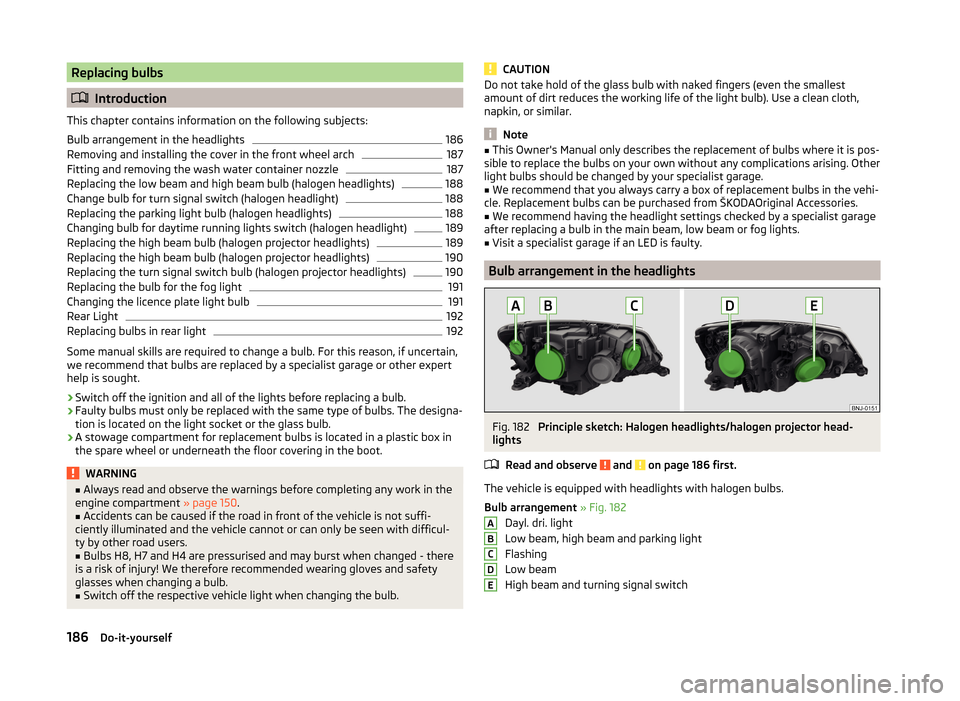
Bulb arrangement in the headlights
Fig. 182
Principle sketch: Halogen headlights/halogen projector head-
lights
Read and observe
and on page 186 first.
The vehicle is equipped with headlights with halogen bulbs.
Bulb arrangement » Fig. 182
Dayl. dri. light
Low beam, high beam and parking light
Flashing
Low beam
High beam and turning signal switch
ABCDE186Do-it-yourself
Page 190 of 216
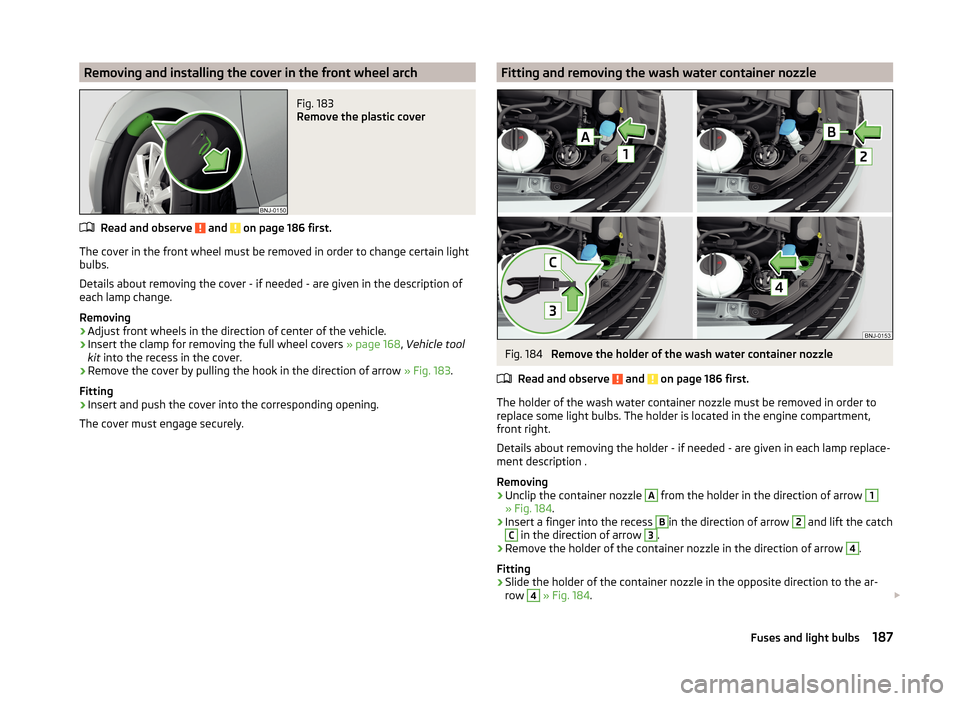
Removing and installing the cover in the front wheel archFig. 183
Remove the plastic cover
Read and observe and on page 186 first.
The cover in the front wheel must be removed in order to change certain light
bulbs.
Details about removing the cover - if needed - are given in the description of
each lamp change.
Removing
›
Adjust front wheels in the direction of center of the vehicle.
›
Insert the clamp for removing the full wheel covers » page 168, Vehicle tool
kit into the recess in the cover.
›
Remove the cover by pulling the hook in the direction of arrow » Fig. 183.
Fitting
›
Insert and push the cover into the corresponding opening.
The cover must engage securely.
Fitting and removing the wash water container nozzleFig. 184
Remove the holder of the wash water container nozzle
Read and observe
and on page 186 first.
The holder of the wash water container nozzle must be removed in order to
replace some light bulbs. The holder is located in the engine compartment,
front right.
Details about removing the holder - if needed - are given in each lamp replace-
ment description .
Removing
›
Unclip the container nozzle
A
from the holder in the direction of arrow
1
» Fig. 184 .
›
Insert a finger into the recess
B
in the direction of arrow
2
and lift the catch
C
in the direction of arrow
3
.
›
Remove the holder of the container nozzle in the direction of arrow
4
.
Fitting
›
Slide the holder of the container nozzle in the opposite direction to the ar-
row
4
» Fig. 184 .
187Fuses and light bulbs
Page 197 of 216

Technical data
Technical data
Vehicle data
Introduction
This chapter contains information on the following subjects:
Vehicle characteristics
194
Operating weight and payload
195
measurement of fuel consumption and CO 2 emissions according to ECE
Regulations and EU Directives
195
Dimensions
196
Departure angle
197
Vehicle-specific details per engine type
198
The details given in the vehicle's technical documentation always take prece-
dence over the details in the Owner's Manual.
The listed performance values were determined without performance-reduc- ing equipment, e.g. air conditioning system.
Vehicle characteristics
Fig. 197
Vehicle data sticker/type plate
Vehicle data sticker
The vehicle data sticker » Fig. 197 -
is located on the base of the luggage
compartment and is also stuck inside the service schedule.
The vehicle data sticker contains the following data.
Vehicle identification number (VIN)
Vehicle type
Gearbox code / paint number / interior equipment / engine output / engine
code
Partial vehicle description
Type plate
The type plate » Fig. 197 -
is located at the bottom of the B-pillar on the
right-hand driver's side.
The type plate contains the following data. Vehicle identification number (VIN)
Maximum permissible gross weight
Maximum permissible towed weight (towing vehicle and trailer)
Maximum permissible front axle load
Maximum permissible rear axle load
Vehicle identification number (VIN)
The vehicle identification number - VIN (vehicle body number) is stamped on
the right hand suspension strut dome in the engine compartment. This num-
ber is also located on a sign on the lower left hand edge below the windscreen
(together with a VIN bar code), together with a nameplate.
The VIN can also be displayed in the Infotainment system » Operating instruc-
tions for Infotainment , chapter Setting vehicle systems (CAR button) .
Engine number
The engine number (three-digit code letter and serial number) is stamped onto
the engine block.
Supplementary Information (applies to Russia)
The full type approval number of the means of transport is indicated in the
registration documents.WARNINGDo not exceed the specified maximum permissible weights – risk of an acci-
dent and damage.123456789194Technical data
Page 199 of 216

DimensionsFig. 198
Principle sketch: Vehicle dimensions
Vehicle dimensions by operating weight without driver (in mm)
» Fig. 198SpecificationFabiaFabia CombiA
Height
Basic dimension14671467Vehicles with off-road package14821482Vehicles with SPORT package14521452BFront trackBasic dimension14631463Vehicles with the 1.2 l/81 kW TSI and 1.4 l/77 kW TDI engine14571457CWidth17321732DRear trackBasic dimension14571457Vehicles with the 1.2 l/81 kW TSI and 1.4 l/77 kW TDI engine14511451EWidth including exterior mirrors19581958F
Clearance
Basic dimension133135Vehicles with off-road package141143Vehicles with SPORT package118120GWheelbase24702470HLength39924257196Technical data