airbag SKODA OCTAVIA TOUR 2009 1.G / (1U) User Guide
[x] Cancel search | Manufacturer: SKODA, Model Year: 2009, Model line: OCTAVIA TOUR, Model: SKODA OCTAVIA TOUR 2009 1.G / (1U)Pages: 226, PDF Size: 13.11 MB
Page 63 of 226
Seats and Storage
62•
In view of the fact that the seats can also be adjusted when the ignition is
switched off (even when ignition key withdrawn), you should never leave
children unattended in the car.
•
The backrests must not be angled too far back when driving otherwise
this will affect proper operation of th e seat belts and of the airbag system -
risk of injury!Note
If the movement of the seat is inadverten tly interrupted during an adjustment, once
again press the switch in the appropriate direction and continue with the adjust-
ment of the seat to the end.Storing settingStoring seat and exterior mirror settings for driving forward
– Switch on the ignition.
– Adjust the seat ⇒page 61.
– Adjust both exterior mirrors ⇒page 58. – Press one of the memory buttons and hold the button pressed for
about 3 seconds until an audible sign al confirms that the setting has
been stored. The setting of this button was stored.
Storing exterior mirror setting for reversing*
– Switch on the ignition.
– Turn the exterior mirror control to position
⇒ page 58.
– Engage reverse gear.
– Move the right exterior mirror into the desired position ⇒page 58.
– Press one of the memory buttons and hold the button pressed for about 3 seconds until an audible sign al confirms that the setting has
been stored. The setting of the selected button was stored.
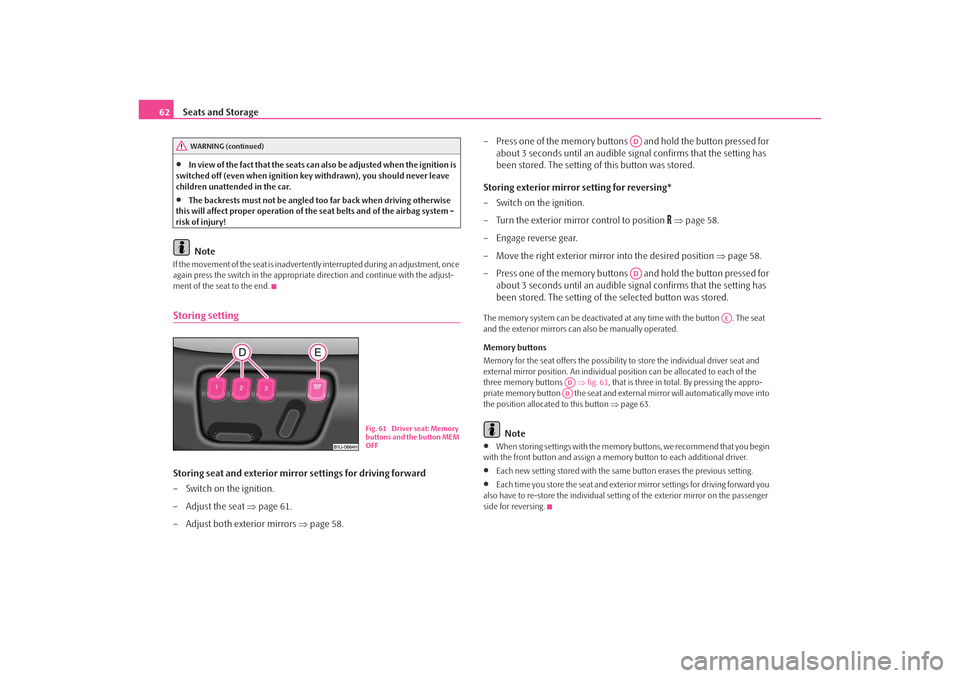
The memory system can be deactivated at any time with the button . The seat
and the exterior mirrors can also be manually operated.
Memory buttons
Memory for the seat offers the possibility to store the individual driver seat and
external mirror position. An individual po sition can be allocated to each of the
three memory buttons ⇒fig. 61 , that is three in total. By pressing the appro-
priate memory button the seat and extern al mirror will automatically move into
the position allocated to this button ⇒page 63.
Note
•
When storing settings with the memory buttons, we recommend that you begin
with the front button and assign a memory button to each additional driver.
•
Each new setting stored with the same button erases the previous setting.
•
Each time you store the seat and exterior mirror settings for driving forward you
also have to re-store the individual settin g of the exterior mirror on the passenger
side for reversing.
WARNING (continued)
Fig. 61 Driver seat: Memory
buttons and the button MEM
OFF
ADAD
AE
ADAD
s2ig.book Page 62 Monday, November 10, 2008 11:20 AM
Page 69 of 226
Seats and Storage
68luggage compartmentLoading the luggage compartmentPlease observe the following in the inte rest of having good handling char-
acteristics of your vehicle:
– Distribute the items of luggage as evenly as possible.
– Place heavy objects as far forward as possible.
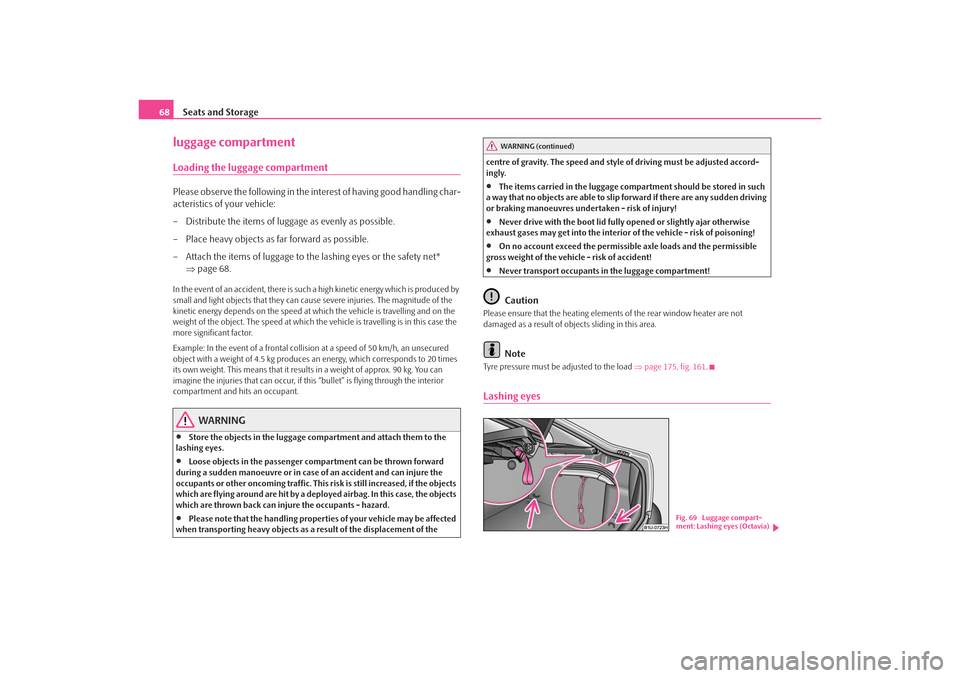
– Attach the items of luggage to the lashing eyes or the safety net* ⇒page 68.In the event of an accident, there is such a high kinetic energy which is produced by
small and light objects that they can caus e severe injuries. The magnitude of the
kinetic energy depends on the speed at wh ich the vehicle is travelling and on the
weight of the object. The speed at which the vehicle is travelling is in this case the
more significant factor.
Example: In the event of a frontal collision at a speed of 50 km/h, an unsecured
object with a weight of 4.5 kg produces an energy, which corresponds to 20 times
its own weight. This means that it results in a weight of approx. 90 kg. You can
imagine the injuries that can occur, if th is “bullet” is flying through the interior
compartment and hits an occupant.
WARNING
•
Store the objects in the luggage comp artment and attach them to the
lashing eyes.
•
Loose objects in the passenger compartment can be thrown forward
during a sudden manoeuvre or in case of an accident and can injure the
occupants or other oncoming traffic. This risk is still increased, if the objects
which are flying around are hit by a depl oyed airbag. In this case, the objects
which are thrown back can injure the occupants - hazard.
•
Please note that the handling properti es of your vehicle may be affected
when transporting heavy objects as a result of the displacement of the centre of gravity. The speed and style
of driving must be adjusted accord-
ingly.
•
The items carried in the luggage compar tment should be stored in such
a way that no objects are able to slip forward if there are any sudden driving
or braking manoeuvres undertaken - risk of injury!
•
Never drive with the boot lid fully opened or slightly ajar otherwise
exhaust gases may get into the interior of the vehicle - risk of poisoning!
•
On no account exceed the permissible axle loads and the permissible
gross weight of the vehicle - risk of accident!
•
Never transport occupants in the luggage compartment!Caution
Please ensure that the heating elements of the rear window heater are not
damaged as a result of objects sliding in this area.
Note
Tyre pressure must be adjusted to the load ⇒page 175, fig. 161 .Lashing eyes
WARNING (continued)
Fig. 69 Luggage compart-
ment: Lashing eyes (Octavia)
s2ig.book Page 68 Monday, November 10, 2008 11:20 AM
Page 81 of 226
Seats and Storage
80may distract you from concentrating on the traffic situation - risk of acci-
dent!•
Use the storage compartments in the door panels only for small items
which do not project out of the compartment in order to avoid any interfer-
ence with the proper operation of the side airbags.
•
Ensure that when driving no objects from the centre console of from
other storage possibilities may get into the footwell of the driver. You would
then no longer be able to apply the br akes, operate the clutch or accelerator
- risk of accident!
Storage compartment on the front passenger sideOpening and closing the storage compartment on the front
passenger side
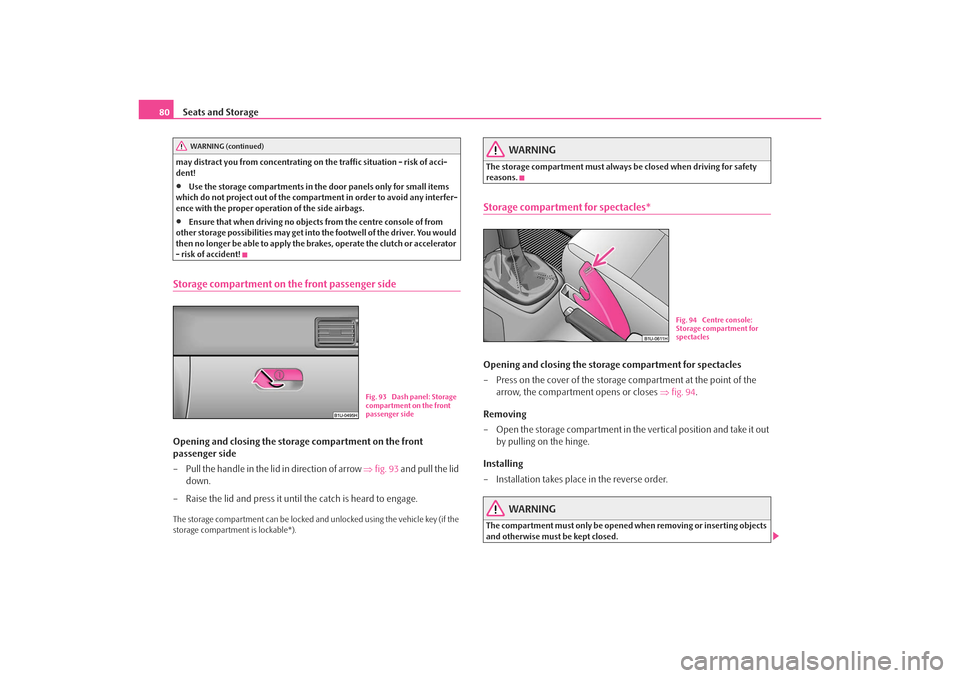
– Pull the handle in the li d in direction of arrow ⇒fig. 93 and pull the lid
down.
– Raise the lid and press it until the catch is heard to engage.The storage compartment can be locked and unlocked using the vehicle key (if the
storage compartment is lockable*).
WARNING
The storage compartment mu st always be closed when driving for safety
reasons.Storage compartment for spectacles*Opening and closing the storage compartment for spectacles
– Press on the cover of the storage compartment at the point of the arrow, the compartment opens or closes ⇒fig. 94 .
Removing
– Open the storage compartment in the vertical position and take it out by pulling on the hinge.
Installing
– Installation takes plac e in the reverse order.
WARNING
The compartment must only be opened when removing or inserting objects
and otherwise must be kept closed.
WARNING (continued)
Fig. 93 Dash panel: Storage
compartment on the front
passenger side
Fig. 94 Centre console:
Storage compartment for
spectacles
s2ig.book Page 80 Monday, November 10, 2008 11:20 AM
Page 95 of 226
Starting-off and Driving
94Starting-off and DrivingSetting steering wheel positionYou can set the height and the forward/back position of the steering
wheel to the desired position.
– Adjust the driver seat ⇒page 60.
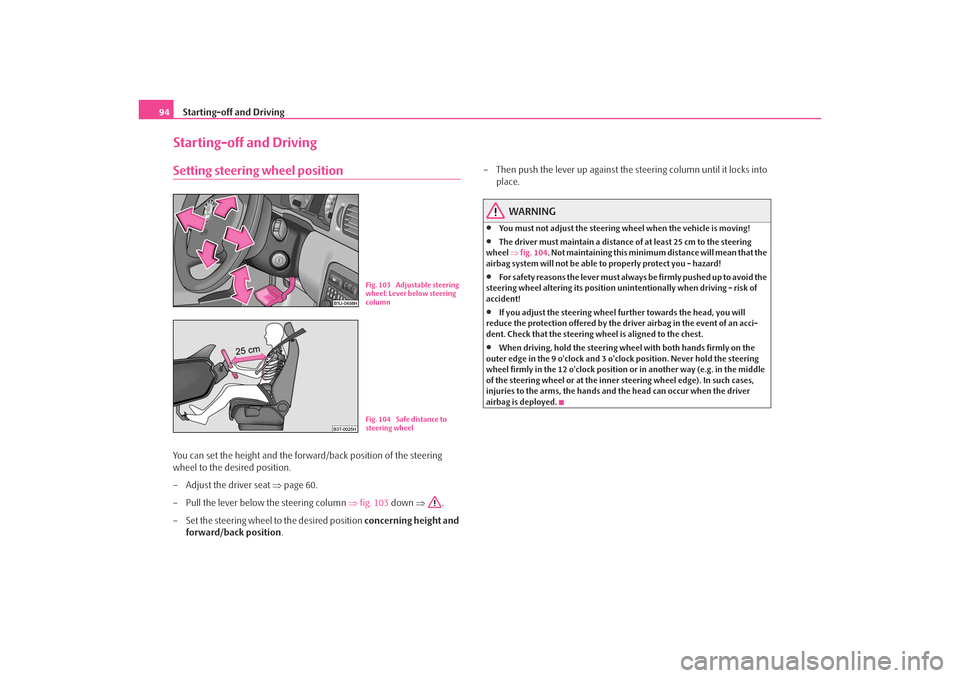
– Pull the lever below the steering column ⇒fig. 103 down ⇒.
– Set the steering wheel to the desired position concerning height and
forward/back position . – Then push the lever up against the
steering column until it locks into
place.
WARNING
•
You must not adjust the steering wh eel when the vehicle is moving!
•
The driver must maintain a distance of at least 25 cm to the steering
wheel ⇒fig. 104 . Not maintaining this minimum distance will mean that the
airbag system will not be able to properly protect you - hazard!
•
For s afe ty re a so ns t he le ve r m ust al wa y s b e fi rm ly pus he d up to a voi d the
steering wheel alteri ng its position unintentionally when driving - risk of
accident!
•
If you adjust the steer ing wheel further towards the head, you will
reduce the protection offered by the driver airbag in the event of an acci-
dent. Check that the steering wh eel is aligned to the chest.
•
When driving, hold the steering wheel with both hands firmly on the
outer edge in the 9 o'clock and 3 o'clock position. Never hold the steering
wheel firmly in the 12 o'clock position or in another way (e.g. in the middle
of the steering wheel or at the inner steering wheel edge). In such cases,
injuries to the arms, the hands and the head can occur when the driver
airbag is deployed.
Fig. 103 Adjustable steering
wheel: Lever below steering
columnFig. 104 Safe distance to
steering wheel
s2ig.book Page 94 Monday, November 10, 2008 11:20 AM
Page 105 of 226
Communication
104
– Plug the adapter cable into the mobile phone socket. The socket is located on the mobile phone mount below.
– Switch on the ignition.
– Wait approximately 20 seconds, switch off the ignition and pull the ignition key out of the ignition lock.
– Insert the mobile phone into the adapter (as specified in manufac- turer's instructions) and switch on the ignition.
Removing the mobile phone with the adapter
– Press the button and remove the mobile telephone.An initialisation mu st be carried out:•
after the first connection of the adapter,
•
after reconnecting the battery,
•
after pulling out the adapter cable from the power socket for the mobile phone.
This enables you to make full use of the ad vantages of a normal carphone (“hands-
free system” using a microphone integrated in the vehicle, optimal transmission of
signals using an external aerial etc.). The battery of the mobile phone is also
constantly charged.
Please contact your specialist garage if there are any points which are not clear.
Please also refer to the additional instructions ⇒page 104.
Mobile phones and two-way radio systemsThe installation of a mobile phone and two-way radio system in a vehicle should
only be carried out by a specialist garage.
Škoda Auto a.s. permits the operation of mobile phones and two-way radio
systems with a professionally installed ex ternal aerial and a maximum transmission
power of up to 10 watts. It is essential that you inform a specialist
garage about the possibilites to assemble
and operate mobile phones and two-way ra dio sets which have a power output of
more than 10 W. The Škoda Service Partners can provide you with details about the
technical possibilities for retrofitting of mobile telephones and radio transmitters.
Operation of mobile phones or two-way radio systems may interfere with func-
tioning of the electronic systems of your vehicle. The reasons for this may be:
•
no external aerial
•
external aerial incorrectly installed
•
transmission power greater than 10 watts.
You should therefore not operate a mobile phone or two-way radio system
inside the vehicle without the use of an external aerial, or with an external aerial
which has been incorrectly installed.
You should also be aware of the fact that only an external aerial makes it possible
to achieve the optimal range of such equipment.
WARNING
•
If a mobile phone or two-way radio sy stem is operated inside the vehicle
without using an external aerial, or wi th an external aerial which has been
incorrectly installed, the result can be excessive electromagnetic fields
which may cause harm to your health.
•
Please concentrate fully at all times on your driving!
•
You must not install two-way radio systems, mobile phones or mounts
on the covers of the airbags or within the immediate deployment range of
airbags. This might result in injuries to the occupants in th e event of an acci-
dent.Note
Please also refer to the operating instru ctions of the mobile phones and two-way
radio systems.
AA
AC
s2ig.book Page 104 Monday, November 10, 2008 11:20 AM
Page 106 of 226
Passive Safety105
Using the system
Safety
Driving Tips
General Maintenance
Breakdown assistance
Technical Data
SafetyPassive SafetyBasic informationDriving the safe way
Passive safety measures reduce the risk of injury in accident situa-
tions.In this section you will find important inform ation, tips and notes on the subject of
passive safety in your vehicle. We ha ve combined everything here which you
should be familiar with, for example, regarding seat belts, airbags, child seats and
safety of children. It is therefore importan t, in particular, to comply with the notes
and warnings in this section for your own interest and in the interest of those trav-
elling with you.
WARNING
•
This chapter contains important information on how to use the vehicle
for the driver and his occupants. You will find further information on safety,
which concerns you and those travelling with you, in the following chapters
of this Owner's Manual.
•
The complete on-board literature should always be in the vehicle. This
applies in particular, if you rent out or sell the vehicle.
Safety equipment
The safety equipment is part of the occupant protection and it can
reduce the risk of injuries in accident situations.“Do not put at risk” your safety and the safety of those travelling with you . In the
event of an accident, the safety equipmen t can reduce the risk of injuries. The
following list contains part of th e safety equipment in your vehicle:
•
three-point seat belts for all the seats,*,
•
belt force limiter for front seats*,
•
belt tensioner for front seats*,
•
seat belt height adjuster for front seats,
•
front airbags*,
•
side airbags*,
•
anchoring points for child seat using the “ISOFIX” system,
•
head restraint adjustable for height,
•
adjustable steering column.
The specified safety equipment works toge ther, in order to optimally protect you
and those travelling with you in accident situations. The safety equipment does not
protect you or the people travelling with you, if you or your occupants adopt an
incorrect seated position or the equipmen t is not correctly adjusted or used.
Fo r t h i s re a s o n y o u w i l l b e p ro v i d e d w i th i n fo rm a ti o n o n w hy t h i s e q u i p m e nt i s v e r y
important, how it protects you and the o ccupants, what should be observed when
using the equipment and how you and the pe ople travelling with you can make full
use of the existing safety equipment. This Owner's Manual contains important
warning notes, which you and those travelli ng with you should pay attention to in
order to reduce a risk of injury.
Safety concerns everybody!
Before setting off
The driver is always fully responsible for his occupants and for the
operating safety of the vehicle.For your own safety and the safety of the people travelling with you, please pay
attention to the following points before setting off:
s2ig.book Page 105 Monday, November 10, 2008 11:20 AM
Page 108 of 226

Passive Safety107
Using the system
Safety
Driving Tips
General Maintenance
Breakdown assistance
Technical Data
•
Adjust the backrest so that you are able to reach the highest point of the
steering wheel with your arms at a slight angle.
•
Adjust the head restraint so that the top edge of the head restraint is at the same
level as the upper part of your head ⇒page 106, fig. 114 .
•
Fasten the seat belt correctly ⇒page 112, “How are seat belts correctly
fastened?”.
Manual driver seat adjustment ⇒page 60, “Adjusting the front seats”.
Electrical driver seat adjustment ⇒page 61, “Adjusting front seats electrically*”.
WARNING
•
The front seats and the head restraints must always be adjusted to match
the body size of the seat occupant as well as the seat belts must always be
correctly fastened in order to provide an optimal protection for you and
your occupants.
•
The driver must maintain a distance of at least 25 cm to the steering
wheel ⇒page 106, fig. 113 . Not maintaining this minimum distance will
mean that the airbag system will not be able to properly protect you -
hazard!
•
When driving, hold the steering whee l with both hands firmly on the
outer edge in the 9 o'clock and 3 o'clock position. Never hold the steering
wheel firmly in the 12 o'clock position or in another way (e.g. in the middle
of the steering wheel or at the inner steering wheel edge). In such cases,
injuries to the arms, the hands and the head can occur when the driver
airbag is deployed.
•
The backrests must not be angled too far back when driving otherwise
this will affect proper operation of the seat belts and of the airbag system -
risk of injury!
•
Ensure that there are no objects in the footwell as any objects may get
behind the pedals during a driving or braking manoeuvre. You would then
no longer be able to operate the clutch, to brake or accelerate.
Correct seated position for the front passenger
The front passenger must maintain a distance of at least 25°cm from
the dash panel so that the combination of the airbag and the seat
belt offers the greatest possible safety when an airbag is deployed.For the safety of the front passenger and to reduce the risk of injury in the event of
an accident, we recommend the following setting:•
Adjust the front passenger seat as far as possible to the rear.
•
Adjust the head restraint so that the top edge of the head restraint is at the same
level as the upper part of your head ⇒page 106, fig. 114.
•
Fasten the seat belt correctly ⇒page 112, “How are seat belts correctly
fastened?”.
In exceptional cases the front passenger airbag can be deactivated ⇒page 122,
“Deactivating an airbag”.
Manual front passenger adjustment ⇒page 60, “Adjusting the front seats”.
Electrical front passenger seat adjustment ⇒page 61, “Adjusting front seats elec-
trically*”.
WARNING
•
The front seats and the head restraints must always be adjusted to match
the body size of the seat occupant as well as the seat belts must always be
correctly fastened in order to provide an optimal protection for you and
your occupants.
•
The front passenger must maintain a distance of at least 25 cm to the
dash panel. Not maintaining this mi nimum distance will mean that the
airbag system will not be able to properly protect you - hazard!
•
Always keep your feet in the footwell when the car is being driven - never
place your feet on the instrument panel, out of the window or on the
surfaces of the seats. You will be exposed to increased risk of injury if it
becomes necessary to apply the brake or in the event of an accident. If an
airbag is deployed, you may suffer fata l injuries when adopting an incorrect
seated position!
s2ig.book Page 107 Monday, November 10, 2008 11:20 AM
Page 109 of 226
Passive Safety
108•
The backrests must not be angled too far back when driving otherwise
this will affect proper operation of th e seat belts and of the airbag system -
risk of injury!
Correct seated position for the occupants on the rear seats
Occupants on the rear seats must sit upright, keep the feet in the
footwell and must have their se at belts correctly fastened.To reduce the risk of injury in the event of a sudden braking manoeuvre or an acci-
dent, the occupants on the rear seats must observe the following:•
Adjust the head restraints so that the top edge of the head restraints are at the
same level as the upper part of your head ⇒page 106, fig. 114 .
•
Fasten the seat belt correctly ⇒ page 112, “How are seat belts correctly
fastened?”.
•
If you are transporting ⇒page 125, “Transporting children safely” children in
the vehicle, please use a suitable child restraint system.
WARNING
•
The head restraints must always be adjusted to match the body size, in
order to offer an optimal protection for you and your occupants.
•
Always keep your feet in the footwell when the car is being driven - never
put your feet out of the window or on the surfaces of the seats. You will be
exposed to increased risk of injury if it becomes necessary to apply the brake
or in the event of an accident. If an airbag is deployed, you may suffer fatal
injuries when adopting an incorrect seated position!
•
If the occupants on the rear seats are no t sitting upright, the risk of injury
is increased due to incorrect routing of the seat belt.
Examples of an incorrect seated position
An incorrect seated position can lead to severe injuries or death for
the occupants.Seat belts offer their optimum protection on ly if the webbing of the seat belts is
properly routed. Incorrect seated positio ns considerably reduce the protective
functions of the seat belts and therefore incr ease the risk of injury due to an incor-
rect routing of the seat belt. The driver is fully responsible for himself and the occu-
pants, in particular for the children. Do not permit an occupant to adopt an incor-
rect seated position when the car is moving.
The following list contains the examples of seated positions which are dangerous
for the occupants. This list is not comple te, however we would like you to get inter-
ested in this subject.
Therefore, while the car is moving never:•
stand up in the vehicle,
•
stand up on the seats,
•
kneel onto the seats,
•
tilt the backrest fully to the back,
•
lean against the dash panel,
•
lie on the rear seats,
•
only sit on the front area of the seat,
•
sit to the side,
•
lean out of the window,
•
put the feet out of the window,
•
put the feet on the dash panel,
•
put the feet on the seat upholstery,
•
occupy the footwell,
•
have the seat belt not fastened,
•
occupy the luggage compartment.
WARNING (continued)
s2ig.book Page 108 Monday, November 10, 2008 11:20 AM
Page 110 of 226
Passive Safety109
Using the system
Safety
Driving Tips
General Maintenance
Breakdown assistance
Technical Data
WARNING
•
If the occupant adopts an incorrect seated position, he is exposed to life-
threatening injuries, in case he is hit by a deployed airbag.
•
Before setting off, please adopt the correct seated position and do not
change this seated position while the car is moving. Also advise your occu-
pants to adopt the correct seated position and not to change this seated
position while the car is moving.
s2ig.book Page 109 Monday, November 10, 2008 11:20 AM
Page 111 of 226
Seat belts
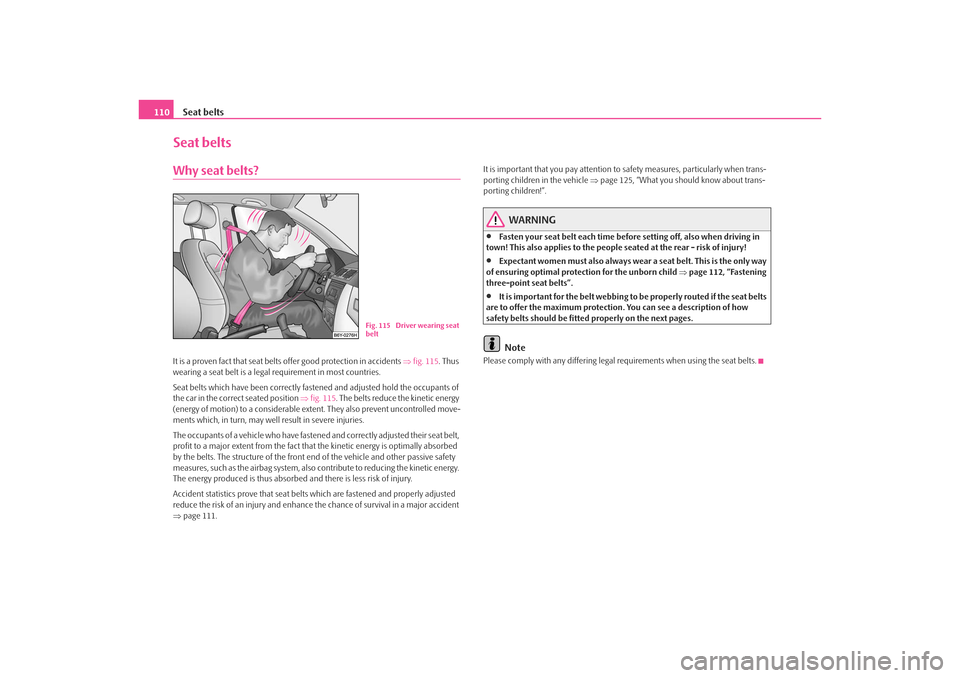
110Seat beltsWhy seat belts?It is a proven fact that seat belt s offer good protection in accidents ⇒fig. 115 . Thus
wearing a seat belt is a legal requirement in most countries.
Seat belts which have been correctly fastened and adjusted hold the occupants of
the car in the correc t seated position ⇒fig. 115 . The belts reduce the kinetic energy
(energy of motion) to a considerable extent. They also prevent uncontrolled move-
ments which, in turn, may well result in severe injuries.
The occupants of a vehicle who have fastened and correctly adjusted their seat belt,
profit to a major extent from the fact that the kinetic energy is optimally absorbed
by the belts. The structure of the front end of the vehicle and other passive safety
measures, such as the airbag system, also contribute to reducing the kinetic energy.
The energy produced is thus absorbed and there is less risk of injury.
Accident statistics prove that seat belts which are fastened and properly adjusted
reduce the risk of an injury and enhance the chance of survival in a major accident
⇒ page 111. It is important that you pay attention to
safety measures, particularly when trans-
porting children in the vehicle ⇒page 125, “What you should know about trans-
porting children!”.
WARNING
•
Fasten your seat belt each time before setting off, also when driving in
town! This also applies to the people seated at the rear - risk of injury!
•
Expectant women must also always wear a seat belt. This is the only way
of ensuring optimal protection for the unborn child ⇒ page 112, “Fastening
three-point seat belts”.
•
It is important for the belt webbing to be properly routed if the seat belts
are to offer the maximum protection. You can see a description of how
safety belts should be fitted properly on the next pages.Note
Please comply with any differing legal requirements when using the seat belts.
Fig. 115 Driver wearing seat
belt
s2ig.book Page 110 Monday, November 10, 2008 11:20 AM