tires SMART FORTWO 2016 Owners Manual
[x] Cancel search | Manufacturer: SMART, Model Year: 2016, Model line: FORTWO, Model: SMART FORTWO 2016Pages: 214, PDF Size: 4.93 MB
Page 4 of 214
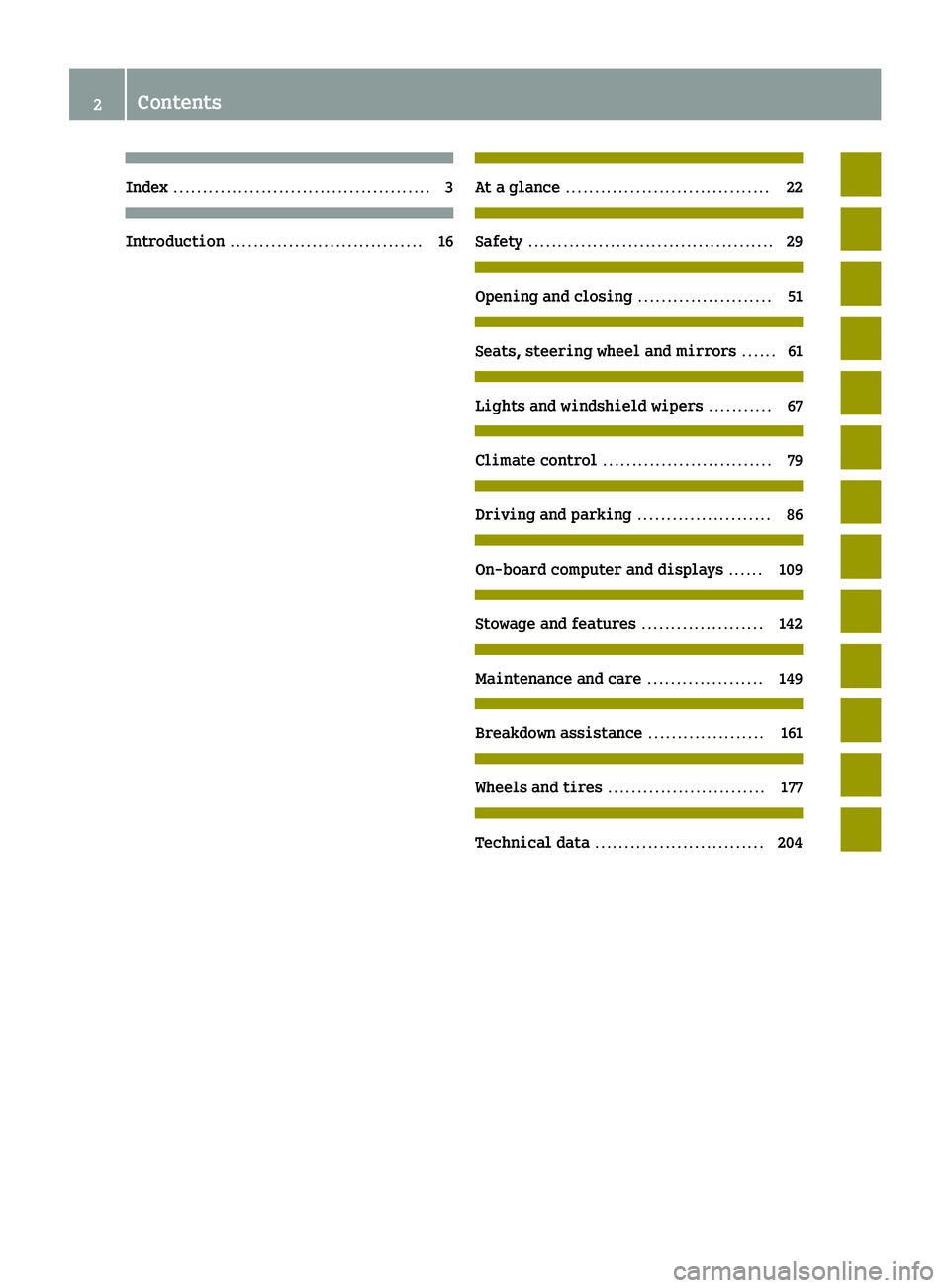
Index............................................ 3
Introduction................................. 16
At a glance................................... 22
Safety.......................................... 29
Opening and closing.......................51
Seats, steering wheel and mirrors ......61
Lights and windshield wipers ...........67
Climate control ............................. 79
Driving and parking.......................86
On-board computer and displays ......109
Stowage and features .....................142
Maintenance and care ....................149
Breakdown assistance ....................161
Wheels and tires........................... 177
Technical data............................. 204
2Contents
Page 8 of 214
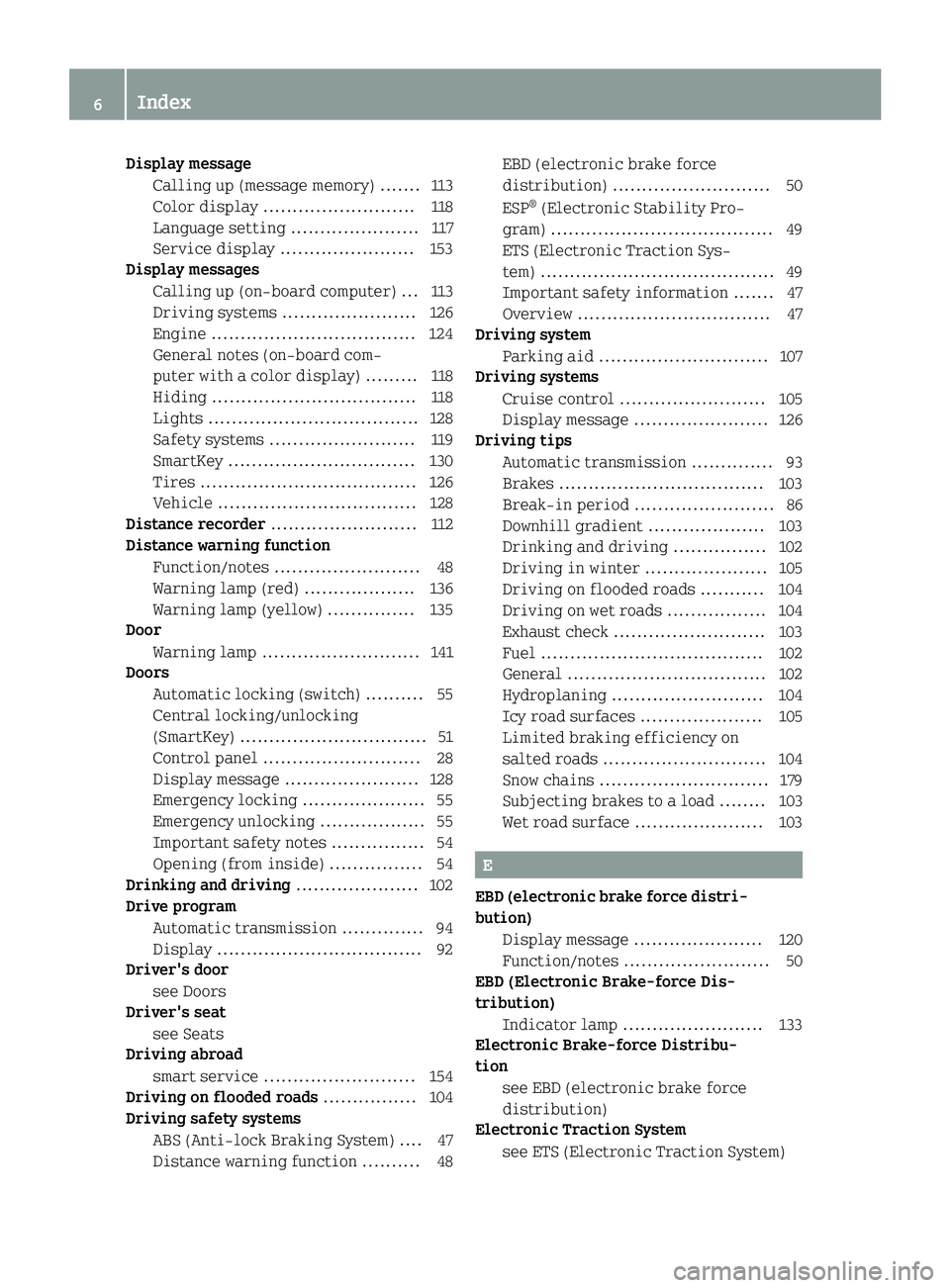
Display messageCalling up (message memory) .......1 13
Color display .......................... 118
Language setting ......................1 17
Service display ....................... 153
Display messages
Calling up (on-board computer) ... 113
Driving systems ....................... 126
Engine ................................... 124
General notes (on-board com-
puter with a color display) .........118
Hiding ................................... 118
Lights .................................... 128
Safety systems .........................1 19
SmartKey ................................ 130
Tires .....................................1 26
Vehicle ................................. .128
Distance recorder .........................112
Distance warning function
Function/notes .........................4 8
Warning lamp (red) ................... 136
Warning lamp (yellow) ............... 135
Door
Warning lamp ........................... 141
Doors
Automatic locking (switch) .......... 55
Central locking/unlocking
(SmartKey) ................................ 51
Control panel ........................... 28
Display message ....................... 128
Emergency locking ..................... 55
Emergency unlocking .................. 55
Important safety notes ................ 54
Opening (from inside) ................ 54
Drinking and driving ..................... 102
Drive program
Automatic transmission .............. 94
Display ................................... 92
Driver's door
see Doors
Driver's seat
see Seats
Driving abroad
smart service .......................... 154
Driving on flooded roads ................ 104
Driving safety systems
ABS (Anti-lock Braking System) .... 47
Distance warning function .......... 48 EBD (electronic brake force
distribution) ........................... 50
ESP
®(Electronic Stability Pro-
gram) ...................................... 49
ETS (Electronic Traction Sys-
tem) ........................................ 49
Important safety information ....... 47
Overview ................................. 47
Driving system
Parking aid ............................. 107
Driving systems
Cruise control ......................... 105
Display message ....................... 126
Driving tips
Automatic transmission .............. 93
Brakes ................................... 103
Break-in period ........................ 86
Downhill gradient .................... 103
Drinking and driving ................ 102
Driving in winter ..................... 105
Driving on flooded roads ........... 104
Driving on wet roads ................. 104
Exhaust check .......................... 103
Fuel ...................................... 102
General .................................. 102
Hydroplaning .......................... 104
Icy road surfaces ..................... 105
Limited braking efficiency on
salted roads ............................ 104
Snow chains ............................. 179
Subjecting brakes to a load ........ 103
Wet road surface ...................... 103
E
EBD (electronic brake force distri-
bution)Display message ...................... 120
Function/notes ......................... 50
EBD (Electronic Brake-force Dis-
tribution)
Indicator lamp ........................ 133
Electronic Brake-force Distribu-
tion
see EBD (electronic brake force
distribution)
Electronic Traction System
see ETS (Electronic Traction System)
6Index
Page 11 of 214
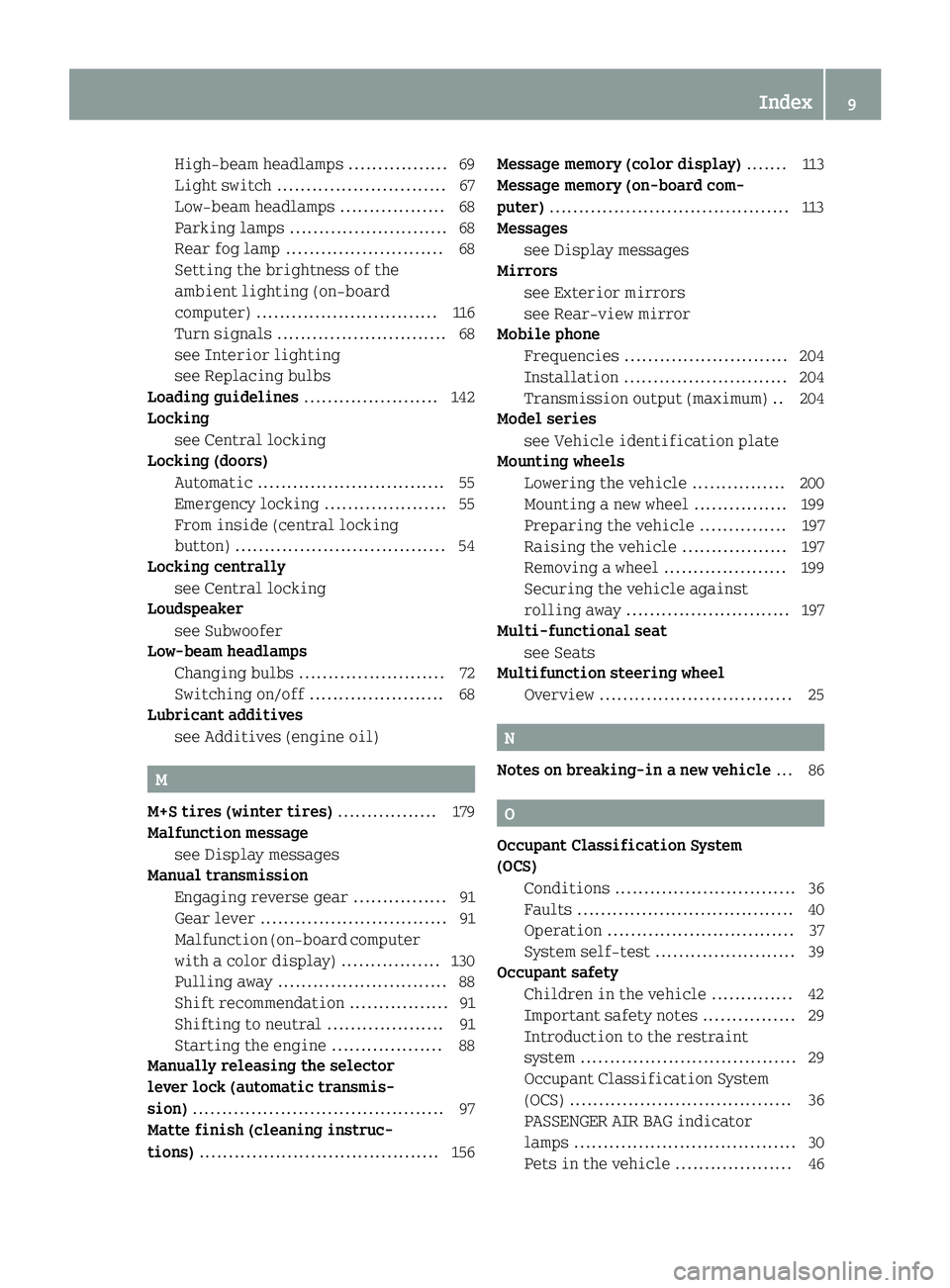
High-beam headlamps ................. 69
Light switch ............................. 67
Low-beam headlamps .................. 68
Parking lamps ........................... 68
Rear fog lamp ........................... 68
Setting the brightness of the
ambient lighting (on-board
computer) ............................... 116
Turn signals ............................. 68
see Interior lighting
see Replacing bulbs
Loading guidelines ....................... 142
Locking
see Central locking
Locking (doors)
Automatic ................................ 55
Emergency locking ..................... 55
From inside (central locking
button) .................................... 54
Locking centrally
see Central locking
Loudspeaker
see Subwoofer
Low-beam headlamps
Changing bulbs ......................... 72
Switching on/off ....................... 68
Lubricant additives
see Additives (engine oil)
M
M+S tires (winter tires) ................. 179
Malfunction message
see Display messages
Manual transmission
Engaging reverse gear ................ 91
Gear lever ................................ 91
Malfunction (on-board computer
with a color display) ................. 130
Pulling away ............................. 88
Shift recommendation ................. 91
Shifting to neutral .................... 91
Starting the engine ................... 88
Manually releasing the selector
lever lock (automatic transmis-
sion) ........................................... 97
Matte finish (cleaning instruc-
tions) ......................................... 156 Message memory (color display)
....... 113
Message memory (on-board com-
puter) ......................................... 113
Messages
see Display messages
Mirrors
see Exterior mirrors
see Rear-view mirror
Mobile phone
Frequencies ............................ 204
Installation ............................ 204
Transmission output (maximum) .. 204
Model series
see Vehicle identification plate
Mounting wheels
Lowering the vehicle ................ 200
Mounting a new wheel ................ 199
Preparing the vehicle ............... 197
Raising the vehicle .................. 197
Removing a wheel ..................... 199
Securing the vehicle against
rolling away ............................ 197
Multi-functional seat
see Seats
Multifunction steering wheel
Overview ................................. 25
N
Notes on breaking-in a new vehicle ... 86
O
Occupant Classification System
(OCS)
Conditions ............................... 36
Faults ..................................... 40
Operation ................................ 37
System self-test ........................ 39
Occupant safety
Children in the vehicle .............. 42
Important safety notes ................ 29
Introduction to the restraint
system ..................................... 29
Occupant Classification System
(OCS) ...................................... 36
PASSENGER AIR BAG indicator
lamps ...................................... 30
Pets in the vehicle .................... 46
Index9
Page 14 of 214
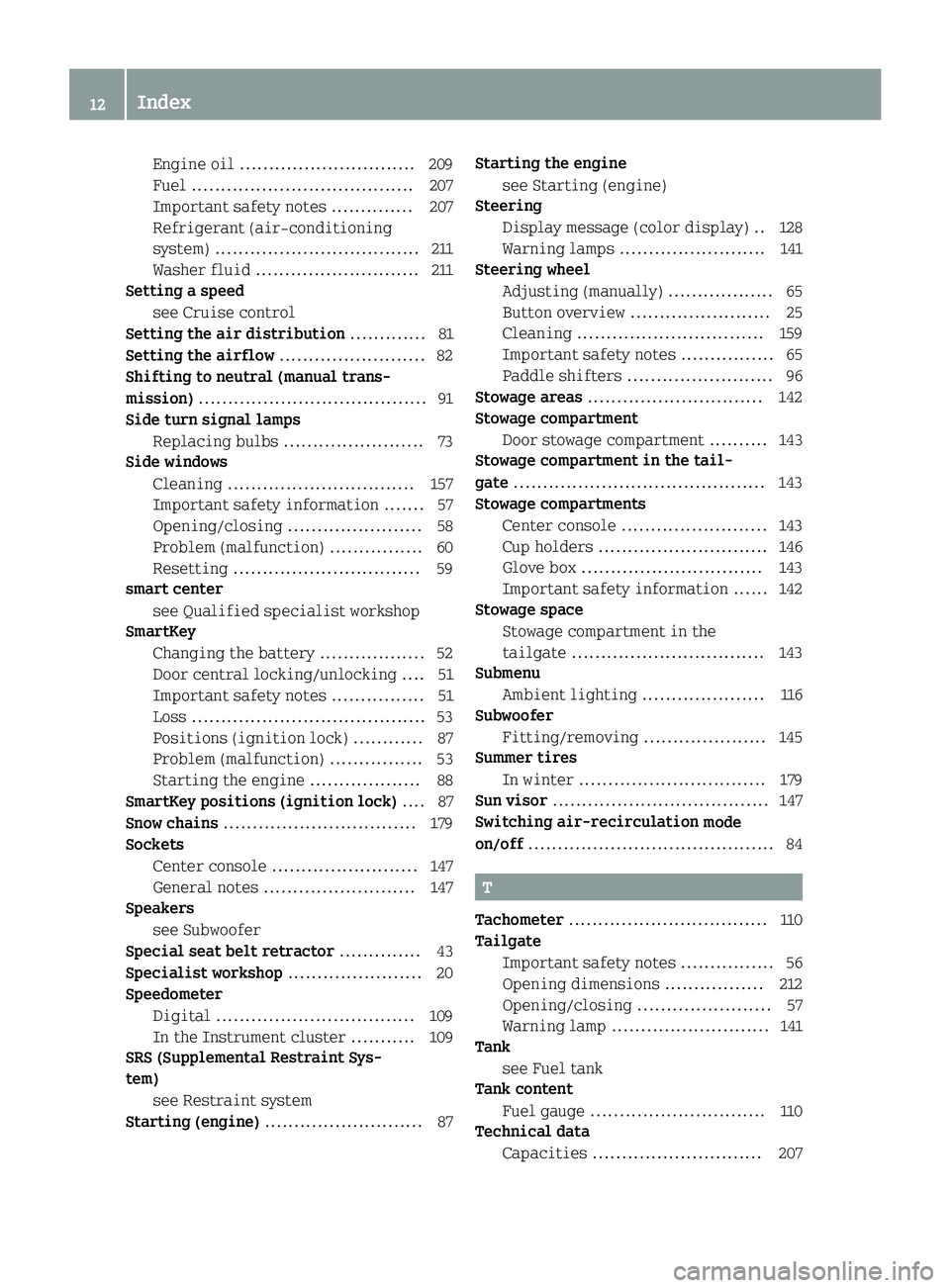
Engine oil .............................. 209
Fuel ...................................... 207
Important safety notes .............. 207
Refrigerant (air-conditioning
system) ................................... 211
Washer fluid ............................ 211
Setting a speed
see Cruise control
Setting the air distribution ............. 81
Setting the airflow ......................... 82
Shifting to neutral (manual trans-
mission) ....................................... 91
Side turn signal lamps
Replacing bulbs ........................ 73
Side windows
Cleaning ................................ 157
Important safety information ....... 57
Opening/closing ....................... 58
Problem (malfunction) ................ 60
Resetting ................................ 59
smart center
see Qualified specialist workshop
SmartKey
Changing the battery .................. 52
Door central locking/unlocking .... 51
Important safety notes ................ 51
Loss ........................................ 53
Positions (ignition lock) ............ 87
Problem (malfunction) ................ 53
Starting the engine ................... 88
SmartKey positions (ignition lock) .... 87
Snow chains ................................. 179
Sockets
Center console ......................... 147
General notes .......................... 147
Speakers
see Subwoofer
Special seat belt retractor .............. 43
Specialist workshop ....................... 20
Speedometer
Digital .................................. 109
In the Instrument cluster ........... 109
SRS (Supplemental Restraint Sys-
tem)
see Restraint system
Starting (engine) ........................... 87 Starting the engine
see Starting (engine)
Steering
Display message (color display) .. 128
Warning lamps ......................... 141
Steering wheel
Adjusting (manually) .................. 65
Button overview ........................ 25
Cleaning ................................ 159
Important safety notes ................ 65
Paddle shifters ......................... 96
Stowage areas .............................. 142
Stowage compartment
Door stowage compartment .......... 143
Stowage compartment in the tail-
gate ........................................... 143
Stowage compartments
Center console ......................... 143
Cup holders ............................. 146
Glove box ............................... 143
Important safety information ...... 142
Stowage space
Stowage compartment in the
tailgate ................................. 143
Submenu
Ambient lighting ..................... 116
Subwoofer
Fitting/removing ..................... 145
Summer tires
In winter ................................ 179
Sun visor ..................................... 147
Switching air-recirculation mode
on/off .......................................... 84
T
Tachometer .................................. 110
Tailgate
Important safety notes ................ 56
Opening dimensions ................. 212
Opening/closing ....................... 57
Warning lamp ........................... 141
Tank
see Fuel tank
Tank content
Fuel gauge .............................. 110
Technical data
Capacities ............................. 207
12Index
Page 15 of 214
Information ............................ 204
Tires/wheels ........................... 200
Vehicle data ........................... 212
Temperature
Coolant .................................. 113
Outside temperature ................. 109
Setting (climate control) ............ 81
Setting the display units ...........1 16
Thorax/pelvisbag ........................... 35
Time
Setting ................................... 114
Setting (dashboard clock) ........... 110
Setting the time format (on-
board computer with a color
display) ................................. 114
Tire pressure
Checking manually .................... 183
Display message ....................... 126
Important safety notes ............... 183
Maximum ................................ 182
Not reached (TIREFIT) ................1 63
Notes .....................................1 81
Reached (TIREFIT) .................... 163
Recommended .......................... 180
Tire pressure monitor
Function/notes ........................ 183
General notes .......................... 183
Important safety notes ............... 183
Restarting (on-board computer
with color display) ...................1 85
Warning lamp .......................... 139
Warning message ......................1 84
TIREFIT kit ..................................1 61
Tires
Aspect ratio (definition) ...........1 95
Average weight of the vehicle
occupants (definition) .............. 194
Bar (definition) ....................... 194
Changing a wheel ..................... 196
Characteristics ....................... 194
Checking ................................ 178
Curb weight (definition) ........... 195
Definition of terms .................. 194
Direction of rotation ................ 197
Display message ....................... 126
Distribution of the vehicle
occupants (definition) .............. 196 DOT (Department of Transporta-
tion) (definition) ..................... 194
DOT, Tire
Identification Num-
ber (TIN) ................................ 193
GAWR (Gross Axle Weight Rating)
(definition) ............................ 195
General notes .......................... 200
GVW (Gross Vehicle Weight)
(definition) ............................ 195
GVWR (Gross Vehicle Weight Rat- ing) (definition) ...................... 195
Important safety notes ............... 177
Increased vehicle weight due to
optional equipment (defini-
tion) ...................................... 194
Kilopascal (kPa) (definition) ...... 195
Labeling (overview) .................. 191
Load bearing index (definition) .. 196
Load index .............................. 193
Load index (definition) .............1 95
M+S tires (winter tires) ............. 179
Maximum load on a tire (defini- tion) ...................................... 195
Maximum loaded vehicle weight
(definition) ............................ 195
Maximum permissible tire
pressure (definition) ................ 195
Maximum tire load .................... 193
Maximum tire load (definition) ... 195
Optional equipment weight
(definition) ............................ 196
PSI (pounds per square inch)
(definition) ............................ 195
Replacing ............................... 196
Service life ............................ 178
Sidewall (definition) ................ 196
Snow chains ............................. 179
Speed rating (definition) .......... 195
Storing .................................. 197
Structure and characteristics
(definition) ............................ 194
Summer tires in winter .............. 179
Temperature ............................ 190
TIN (Tire Identification Num-
ber) (definition) ...................... 196
Tire bead (definition) .............. 196
Tire pressure (definition) ......... 195
Tire pressures (recommended) .... 194
Index13
Page 17 of 214
Vehicle dimensions....................... 212
Vehicle emergency locking .............. 55
Vehicle identification number
see VIN
Vehicle identification plate .......... 205
Vehicle key
see SmartKey
Vehicle tool kit ............................ 161
Ventilation
see Climate control
VIN ............................................ 205
W
Warning and indicator lamps
ABS ....................................... 134
Airbag ................................... 132
Battery ................................... 137
Brakes ................................... 132
Check Engine ........................... 136
Coolant .................................. 138
Distance warning function (red) .. 136
Distance warning function (yel-
low) ....................................... 135
Door ...................................... 141
EBD ....................................... 133
Electronics .............................1 41
ESP
®...................................... 134
Oil pressure ............................ 138
Overview ................................. 24
Parking brake .......................... 132
PASSENGER AIR BAG .................... 30
Restraint system ......................1 32
Seat belt ................................. 131
Steering ................................. 141
Tire pressure monitor ............... 139
Warranty ....................................... 17
Wheel and tire combination
see Tires
Wheel bolt tightening torque .......... 200
Wheels
Changing a wheel ..................... 196
Checking ................................ 178
Cleaning ................................ 157
General notes .......................... 200
Important safety notes ............... 177
Interchanging/changing ............ 196
Mounting a new wheel ................ 199 Mounting a wheel ...................... 197
Removing a wheel ..................... 199
Snow chains ............................. 179
Storing .................................. 197
Tightening torque .................... 200
Wheel size/tire size ................. 200
Window curtain air bag
Operation ................................ 36
Windows
see Side windows
Windscreen
see Windshield
Windshield
Defrosting ............................... 82
Windshield washer fluid
see Windshield washer system
Windshield washer system
Adding washer fluid .................. 153
Important safety notes ............... 211
Windshield wipers
Intermittent wiping ................... 75
Problem (malfunction) ................ 78
Rear window wiper ..................... 75
Replacing the wiper blades ......... 75
Switching on/off ....................... 74
Winter driving
Slippery road surfaces .............. 105
Snow chains ............................. 179
Winter operation
General notes .......................... 179
Winter tires
M+S tires ................................ 179
Wiper blades
Cleaning ................................ 157
Important safety notes ................ 75
Replacing (rear window) ............. 76
Replacing (windshield) ............... 76
Workshop
see Qualified specialist workshop
Index15
Page 18 of 214
Protection of the environment
General notes
HEnvironmental note
Daimler's declared policy is one of com-
prehensive environmental protection.
The objectives are for the natural resour-
ces that form the basis of our existence on
this planet to be used sparingly and in a
manner that takes the requirements of both
nature and humanity into account.
You too can help to protect the environment
by operating your vehicle in an environ-
mentally responsible manner.
Fuel consumption and the rate of engine,
transmission, brake and tire wear are
affected by these factors:
Roperating conditions of your vehicle
Ryour personal driving style
You can influence both factors. You should
bear the following in mind:
Operating conditions:
Ravoid short trips as these increase fuel
consumption.
Ralways make sure that the tire pressures
are correct.
Rdo not carry any unnecessary weight.
Ra regularly serviced vehicle will con-
tribute to environmental protection. You
should therefore adhere to the service
intervals.
RAlways have service work carried out at a
qualified specialist workshop.
Personal driving style:
Rdo not depress the accelerator pedal
when starting the engine.
Rdo not warm up the engine when the vehi-
cle is stationary.
Rdrive carefully and maintain a safe dis- tance from the vehicle in front.
Ravoid frequent, sudden acceleration and
braking.
Rchange gear in good time and use each
gear only up to 00C3of its maximum engine
speed.
Rswitch off the engine in stationary traf-
fic.
Rkeep an eye on the vehicle's fuel con-
sumption.
Environmental concerns and recom-
mendations
Wherever the operating instructions require you to dispose of materials, first try to
regenerate or re-use them. Observe the rel-
evant environmental rules and regulations
when disposing of materials. In this way you
will help to protect the environment.
Genuine smart parts
HEnvironmental note
Daimler AG also supplies reconditioned
major assemblies and parts which are of the
same quality as new parts. They are covered
by the same Limited Warranty entitlements
as new parts.
!Air bags and Emergency Tensioning Devi-
ces, as well as control units and sensors for
these restraint systems, may be installed
in the following areas of your vehicle:
Rdoors
Rdoor pillars
Rdoor sills
Rseats
Rcockpit
Rinstrument cluster
Rcenter console
Do not install accessories such as audio
systems in these areas. Do not carry out
repairs or welding. You could impair the
operating efficiency of the restraint sys-
tems.
Have aftermarket accessories installed at
a qualified specialist workshop.
You could jeopardize the operating safety of
your vehicle if you use parts, tires and wheels
16>> Introduction.
Page 19 of 214
as well as accessories relevant to safety
which have not been approved by smart. This
could lead to malfunctions in safety-relevant
systems, e.g. the brake system. Use only gen-
uine smart parts or parts of equal quality.
Only use tires, wheels and accessories that
have been specifically approved for your
vehicle.
Genuine smart parts are subject to strict
quality control. Each part has been specially
developed, manufactured or selected for
smart vehicles and fine-tuned for them.
Therefore, only genuine smart parts should be
used.
More than 300,000 different genuine smart
parts are available for smart models.
All smart centers maintain a supply of genu-
ine smart parts for necessary service and
repair work. In addition, strategically loca-
ted parts delivery centers provide quick and
reliable parts service.
Always specify the vehicle identification
number (VIN) (
Ypage 205) when ordering gen-
uine smart parts.
Operator's Manual
Vehicle equipment
This Operator's Manual describes all models
and all standard and optional equipment of
your vehicle available at the time of going to
print. Country-specific differences are pos-
sible. Bear in mind that your vehicle may not
feature all functions described here. This
also applies to safety-relevant systems and
functions. The equipment in your vehicle may
therefore differ from that shown in the
descriptions and illustrations.
The original purchase agreement lists all
systems installed in your vehicle.
Should you have any questions concerning
equipment and operation, please consult a
smart center.
The Operator's Manual and Maintenance Book- let are important documents and should be
kept in the vehicle.
Service and vehicle operation
Warranty
The smart USA Warranty booklet (USA only) or
the Warranty booklet (Canada only) contains
detailed information about the warranties
covering your smart, including:
Rsmart USA Limited Warranty (USA only
RNew Vehicle Limited Warranty (Canada
only)
REmission System Warranty
REmission Performance Warranty
Rwarranty against perforation through cor-
rosion
RCalifornia, Connecticut, Maine, Massachu-
setts, New York, Pennsylvania, Rhode Island
and Vermont Emission Control System War-
ranty
Rsmartmove Assistance (Canada only)
RState warranty enforcement laws (Lemon
Laws)
Maintenance
The Service and Warranty Booklet describes
all the necessary maintenance work which
should be done at regular intervals.
Always bring the Service and Warranty Infor-
mation Booklet with you when bringing the
vehicle to an authorized smart center. The
service advisor will record every service for
you in the Service and Warranty Booklet.
Roadside Assistance
The smartmove Assistance (Canada) and smart
1 service (USA) Program provides factory
trained technical help in the event of a
breakdown. Calls to the toll-free Roadside
Assistance number
1-800-762-7887 (in USA)
1-877-627-8004 (in Canada)
will be answered by smart Customer Assis-
tance Representatives 24 hours a day, 365 days
a year. In accordance with standard program
guidelines, Roadside Assistance provides
vehicle service up to a reasonable distance
from the next paved road. We will make every
effort to assist in a breakdown situation;
however, the accessibility of your vehicle
>> Introduction.17
Z
Page 21 of 214
electronic equipment carried out at a
qualified specialist workshop.
If you make any changes to the vehicle elec-
tronics, the general operating permit is ren-
dered invalid.
!There is a risk of damage to the vehicle if:
Rthe vehicle becomes stuck, e.g. on a high
curb or an unpaved road
Ryou drive too fast over an obstacle, e.g. a
curb or a hole in the road
Ra heavy object strikes the undercarriage
or parts of the chassis
In situations like this, the body, the under-
carriage, chassis parts, wheels or tires
could be damaged without the damage being
visible. Components damaged in this way
can unexpectedly fail or, in the case of an
accident, no longer withstand the strain
they are designed to.
If the underbody paneling is damaged,
combustible materials such as leaves,
grass or twigs can gather between the
underbody and the underbody paneling. If
these materials come in contact with hot
parts of the exhaust system, they can catch
fire.
In such situations, have the vehicle
checked and repaired immediately at a
qualified specialist workshop. If on con-
tinuing your journey you notice that driv-
ing safety is impaired, pull over and stop
the vehicle immediately, paying attention
to road and traffic conditions. In such
cases, consult a qualified specialist work-
shop.
Declarations of conformity
Vehicle components which receive
and/or transmit radio waves
USA: "The wireless devices of this vehicle
comply with Part 15 of the FCC Rules. Opera-
tion is subject to the following two condi-
tions: 1) These devices may not cause harmful interference, and 2) These devices must
accept any interference received, including
interference that may cause undesired oper-
ation. Changes or modifications not
expressly approved by the party responsible for compliance could void the user’s author-
ity to operate the equipment."
Canada:
"The wireless devices of this vehicle
comply with Industry Canada license-exempt
RSS standard(s). Operation is subject to the
following two conditions: (1) These devices
may not cause interference, and (2) These
devices must accept any interference,
including interference that may cause unde-
sired operation of the device."
Diagnostics connection
The diagnostics connection is only intended
for the connection of diagnostic equipment
at a qualified specialist workshop.
GWARNING
If you connect equipment to the diagnostics
connection in the vehicle, it may affect the
operation of the vehicle systems. As a
result, the operating safety of the vehicle
could be affected. There is a risk of an
accident.
Do not connect any equipment to a diagnos-
tics connection in the vehicle.
GWARNING
Objects in the driver's footwell can
restrict the pedal travel or obstruct a
depressed pedal. The operating and road
safety of the vehicle is jeopardized. There
is a risk of an accident.
Make sure that all objects in the vehicle are
stowed correctly, and that they cannot enter
the driver's footwell. Install the floormats securely and as specified in order to
ensure sufficient clearance for the pedals.
Do not use loose floormats and do not place
floormats on top of one another.
!If the engine is switched off and equip-
ment on the diagnostics connection is used,
the starter battery may discharge.
Connecting equipment to the diagnostics
connection can lead to emissions monitoring
information being reset, for example. This
may lead to the vehicle failing to meet the
>> Introduction.19
Z
Page 49 of 214
Switching off the alarm
XTo switch off the alarm:press the0036
button on the key.
The alarm is switched off.
or
XSwitch on the ignition.
The alarm is switched off.
The alarm is not switched off, even if you
close the open door that triggered it, for
example.
Driving safety systems
Overview of driving safety systems
In this section, you will find information
about the following driving safety systems:
RABS (Anti-lock BrakingSystem)
(Ypage 47)
RDistance warning function (Ypage 48)
Resp®(Electronic StabilityProgram)
(Ypage 49)
REBD (Electronic Brake forceDistribution)
(Ypage 50)
Important safety notes
If you fail to adapt your driving style or
become distracted, the driving safety sys-
tems can neither reduce the risk of accident
nor override the laws of physics. Driving
safety systems are merely aids designed to
assist driving. You are responsible for the
distance to the vehicle in front, for vehicle
speed and for braking in good time. Always
adapt your driving style to suit the prevail-
ing road, weather and traffic conditions and
maintain a safe distance from the vehicle in
front. Drive carefully.
The driving safety systems described only
work as effectively as possible when there is
adequate contact between the tires and the
road surface. Please pay special attention to
the notes on tires, recommended minimum
tire tread depths, etc. (
Ypage 177).
In wintry driving conditions, always use win-
ter tires (M+S tires) and if necessary, snow
chains. Only in this way will the driving
safety systems described in this section work
as effectively as possible. For safety reasons, smart recommends that you
only use snow chains that have been specially
approved for your vehicle by smart, or fine-
link snow chains that are of a corresponding
standard of quality. For more information,
please contact a qualified specialist work-
shop.
ABS (Anti-lock Braking System)
General information
ABS regulates brake pressure in such a way
that the wheels do not lock when you brake.
This allows you to continue steering the vehi-
cle when braking.
The 0025 (Canada only) or 00DF(USA only) abs
warning lamp in the instrument cluster lights up when the ignition is switched on. It goes
out when the engine is running.
Important safety notes
iObserve the "Important safety notes" sec-
tion for driving safety systems (Ypage 47).
When ABS is malfunctioning, other systems,
including driving safety systems, will also
become inoperative. Observe the information
on the ABS warning lamp (
Ypage 132) and
display messages which may be shown in the
instrument cluster (
Ypage 121).
GWARNING
If ABS is faulty, the wheels could lock when
braking. The steerability and braking
characteristics may be severely impaired.
Additionally, further driving safety sys-
tems are deactivated. There is an increased
danger of skidding and accidents.
Drive on carefully. Have ABS checked imme-
diately at a qualified specialist workshop.
abs works from a speed of about 4 mph (6 km/h),
regardless of road-surface conditions. ABS
works on slippery surfaces, even if you only
brake gently.
Driving safety systems47
>> Safety.
Z