led SMART FORTWO COUPE 2011 Service Manual
[x] Cancel search | Manufacturer: SMART, Model Year: 2011, Model line: FORTWO COUPE, Model: SMART FORTWO COUPE 2011Pages: 228, PDF Size: 11.48 MB
Page 150 of 228
parking. The heat generated serves to dry
the brakes.GWarning!
Make sure not to endanger any other road
users when carrying out these braking
maneuvers.
Limited braking effect on salted roads
Remember that the effect of the brakes can
be limited on salted road surfaces. A layer
of salt can form on brake discs and brake
pads, considerably reducing the friction
between the brake disc and the brake pad.
The effect is most noticeable after long
trips without braking, e.g. on the highway,
and after the vehicle has been parked for
several hours.
GWarning!
The accumulation of salt on brake discs and
brake pads reduces braking effectiveness
and increases the distance necessary to
come to a complete standstill. This could
potentially cause an accident and/or
personal injury.
To avoid this risk, you should
R brake carefully every now and then on
salted roads in order to remove any layer
of salt on the brake disc and brake pad,
but do so without endangering any other
road users
R keep a good safe distance from the
vehicle in front and drive carefully
R press the brake carefully at the end of the
trip and again when beginning the next
trip in order to remove any salt residues
from the brake disc
New brake pads
Only install brake pads recommended by
smart.
GWarning!
If other than recommended brake pads are
installed, or other than recommended brake
fluid is used, the braking properties of the
vehicle can be degraded to an extent that
safe braking is substantially impaired.
This could result in an accident.GWarning!
New brake pads will not achieve their
optimal braking effect until after several
hundred miles (kilometers). This means
that you must compensate for the reduced
braking effect by pressing harder on the
brake pedal and adapt your driving style
accordingly. The same applies after brake
pads or brake discs have been changed.
Drive sensibly - save fuel
Fuel consumption, to a great extent,
depends on driving habits and operating
conditions.
To save fuel you should:
R Shift gears in a timely manner.
R Avoid frequent acceleration and
deceleration.
R Keep tires at the recommended inflation
pressures.
R Remove carriers* when not in use.
R Remove unnecessary loads.
R Allow engine to warm up under low load
use.
R Have all maintenance work performed at
the intervals specified in the
Maintenance Booklet and as required by
the Maintenance System. Contact an
authorized smart center.
Fuel consumption is also increased by
driving in cold weather, in stop-and-go
traffic, on short trips, and in hilly areas.
Catalytic converter
Your smart is equipped with monolithic-
type catalytic converter, an important
element in conjunction with the oxygen
148Driving instructions>> Operation.* optionalBA 451 USA, CA Edition A 2011; 1; 4, en-UShereepeVersion: 3.0.3.62010-05-11T15:12:26+02:00 - Seite 148
Page 154 of 228
the air intake, causing severe internal
engine damage.
Any such damage is not covered by the smart
Limited Warranty.
Passenger compartment
GWarning!
Always fasten items being carried as
securely as possible.
In an accident, during hard braking or
sudden maneuvers, loose items thrown
around inside the vehicle may injure
vehicle occupants.
The cargo compartment is the preferred
place to carry objects.
Control and operation of radio
transmitters
Radio and telephone
GWarning!
Please do not forget that your primary
responsibility is to drive the vehicle
safely. Only operate the radio or
telephone 16
if road, weather and traffic
conditions permit.
Bear in mind that at a speed of just 30 mph
(approximately 50 km/h), your vehicle is
covering a distance of 44 feet
(approximately 14 m) every second.
Telephones and two-way radios
GWarning!
Never operate radio transmitters equipped
with a built-in or attached antenna (i.e.
without being connected to an external
antenna) from inside the vehicle while the
engine is running. Doing so could lead to a
malfunction of the vehicle’s electronic
system, possibly resulting in an accident
and/or serious personal injury.
Radio transmitters, such as a mobile phone
or a citizens band unit should only be used
inside the vehicle if they are connected to
an antenna that is installed on the outside
of the vehicle.
Refer to the radio transmitter operation
instructions regarding use of an external
antenna.
Emission control
Certain engine systems serve to keep the
toxic components of the exhaust gases
within permissible legal limits.
These systems, of course, will function
properly only when maintained strictly
according to factory specifications.
Any adjustments to the engine should
therefore be carried out only by qualified
smart center authorized technicians.
Engine adjustments should not be altered
in any way. Moreover, the specified service
jobs must be carried out regularly
according to smart servicing
requirements. For details refer to the
Maintenance Booklet.
GWarning!
Inhalation of exhaust gas is hazardous to
your health. All exhaust gas contains
carbon monoxide (CO), and inhaling it can
cause unconsciousness and lead to death.
Do not run the engine in confined areas
(such as a garage) which are not properly
ventilated. If you think that exhaust gas
fumes are entering the vehicle while
driving, have the cause determined and
corrected immediately. If you must drive
under these conditions, drive only with at
least one window fully open at all times.
16 Observe all legal requirements.152Driving instructions>> Operation.
BA 451 USA, CA Edition A 2011; 1; 4, en-UShereepeVersion: 3.0.3.62010-05-11T15:12:26+02:00 - Seite 152
Page 155 of 228
Coolant temperature
During severe operating conditions and
stop-and-go city traffic, the coolant
temperature may rise.
! Excessive coolant temperature causes
the red coolant temperature warning
lamp 00AE in the instrument cluster
comes on.
The engine should not be operated with
the red coolant temperature warning
lamp illuminated. Doing so may cause
serious engine damage which is not
covered by the smart Limited Warranty.
For more information on coolant
temperature warning lamp ( Y page 172).GWarning!
Driving when your engine is overheated can
cause some fluids which may have leaked
into the engine compartment to catch fire.
You could be seriously burned.
Steam from an overheated engine can cause
serious burns which can occur just by
opening the engine hood. Stay away from the
engine if you see or hear steam coming from
it.
Stop the vehicle in a safe location away
from other traffic. Turn off the engine, get
out of the vehicle and do not stand near the
vehicle until the engine has cooled down.
Driving abroad
Abroad, there is an extensive smart service
network at your disposal. If you plan to
drive into areas which are not listed in the
index of your smart center directory, you
should request pertinent information from
an authorized smart center.
Symmetrical low beams
i If you drive in countries where
vehicles drive on the other side of the
road than the country in which the
vehicle is registered, you must have the
headlamps modified for symmetrical low
beams. Relevant information can be
obtained at any authorized smart center.
Vehicle care
Care tips
Regular and proper care will help to
maintain the value of your vehicle. The
best way to protect your vehicle from
harmful environmental influences is to
wash it and use protective treatments
regularly.
smart recommends that you care for the
paintwork at least twice a year (e.g. in the
spring and autumn).
GWarning!
Many cleaning products can be hazardous.
Some are poisonous, others are flammable.
Always follow the instructions on the
particular container. Always open your
vehicle’s doors or windows when cleaning
the inside.
Never use fluids or solvents that are not
designed for cleaning your vehicle.
Always lock away cleaning products and
keep them out of reach of children.
! Follow the care tips. Wash your vehicle
preferably by hand.
While in operation or even while parked,
your vehicle is subjected to varying
external influences, which left unchecked
can attack the paint as well as the vehicle
underbody and lead to permanent damage.
Such damage is caused not only by extreme
and varying climatic conditions, but also
by:
R Air pollution
R Road salt
R Tar
R Gravel and stone chipping
Vehicle care153>> Operation.BA 451 USA, CA Edition A 2011; 1; 4, en-UShereepeVersion: 3.0.3.62010-05-11T15:12:26+02:00 - Seite 153Z
Page 156 of 228
To avoid paint damage, you should
immediately remove:
R Insects
R Bird droppings
R Tree sap, etc.
R Grease and oil
R Brake fluid
R Coolant
R Fuel
R Tar spots
! Failure to remove such dirt
immediately can cause damage to the
paint or the soft top fabric*.
Environmental influences are not
covered by the smart Limited Warranty.
Frequent washing reduces and/or
eliminates the aggressiveness and potency
of the above adverse influences.
More frequent washings are necessary to
deal with unfavorable conditions:
R near the ocean
R in industrial areas (smoke, exhaust
emissions)
R during winter operation
You should check your vehicle from time to
time for stone chipping or other damage.
Any damage should be repaired as soon as
possible to prevent corrosion.
In doing so, do not neglect the underbody
of the vehicle. A prerequisite for a
thorough check is a washing of the
underbody followed by a thorough
inspection. Damaged areas need to be re-
undercoated.
Your vehicle has been treated at the factory
with a wax-base rustproofing in the body
cavities which will last for the lifetime of
the vehicle. Post-production treatment is
neither necessary nor recommended by
smart because of the possibility of
incompatibility between materials used in
the production process and others applied
later.We have selected vehicle-care products
and compiled recommendations which are
specially matched to our vehicles and
which always reflect the latest technology.
You can obtain smart approved vehicle-
care products at an authorized smart
center.
Scratches, corrosive deposits, corrosion
or damage due to negligent or incorrect
care cannot always be removed or repaired
with the vehicle-care products
recommended here. In such cases it is best
to seek aid at an authorized smart center.
The following topics deal with the cleaning
and care of your vehicle and give important
“how-to” information as well as references
to smart approved vehicle-care products.
Vehicle care
Contact an authorized smart center for
recommended and approved care products.
i Advice on caring for the soft top
system, see ( Y page 157).
GWarning!
After washing the vehicle, the brakes may
still be wet and thus their functionality
impaired. Therefore, when you start off,
brake lightly several times without
endangering traffic.
154Vehicle care>> Operation.* optionalBA 451 USA, CA Edition A 2011; 1; 4, en-UShereepeVersion: 3.0.3.62010-05-11T15:12:26+02:00 - Seite 154
Page 157 of 228
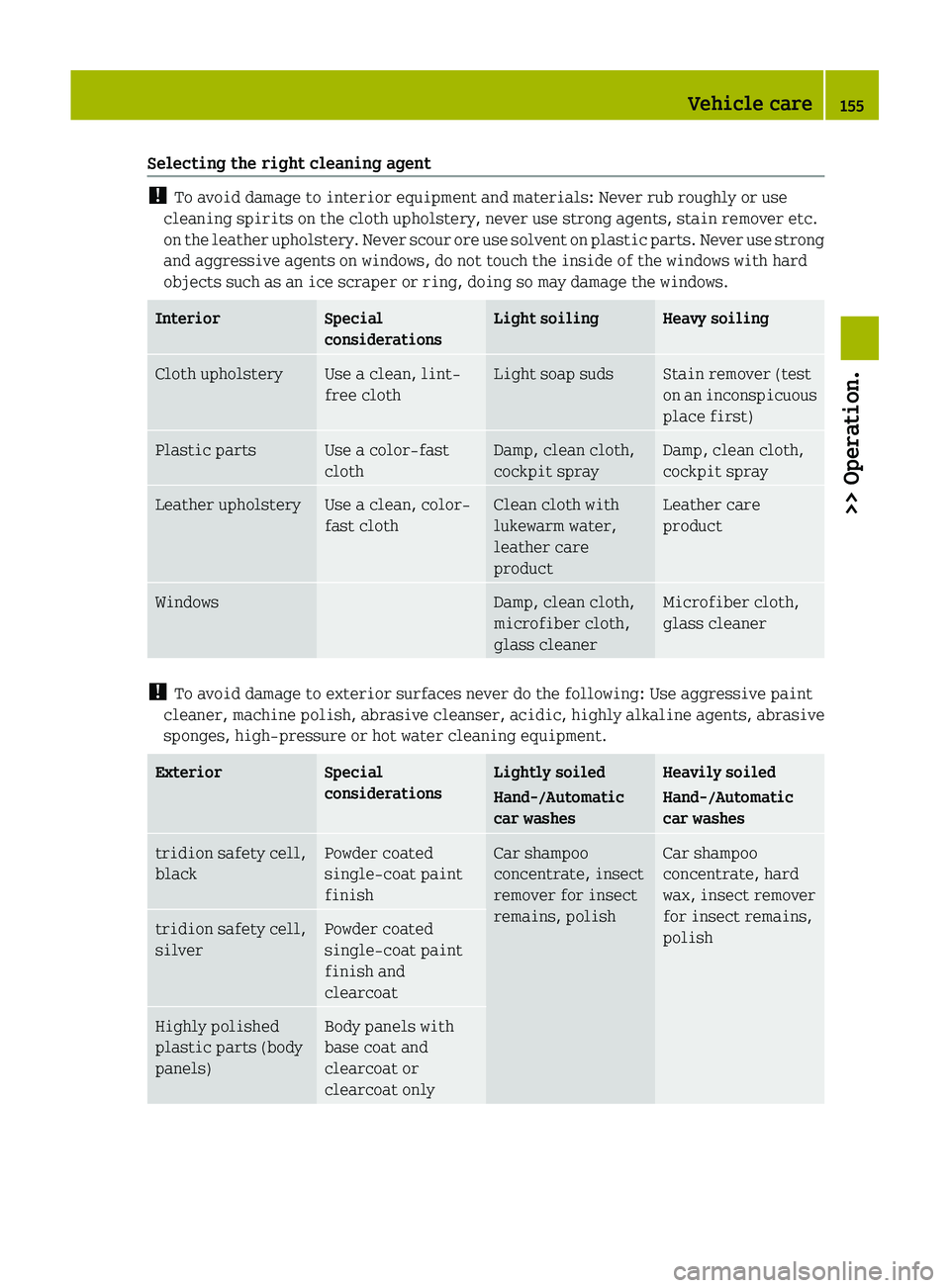
Selecting the right cleaning agent
! To avoid damage to interior equipment and materials: Never rub roughly or use
cleaning spirits on the cloth upholstery, never use strong agents, stain remover etc.
on the leather upholstery. Never scour ore use solvent on plastic parts. Never use strong
and aggressive agents on windows, do not touch the inside of the windows with hard
objects such as an ice scraper or ring, doing so may damage the windows.
InteriorSpecial
considerationsLight soilingHeavy soilingCloth upholsteryUse a clean, lint-
free clothLight soap sudsStain remover (test
on an inconspicuous
place first)Plastic partsUse a color-fast
clothDamp, clean cloth,
cockpit sprayDamp, clean cloth,
cockpit sprayLeather upholsteryUse a clean, color-
fast clothClean cloth with
lukewarm water,
leather care
productLeather care
productWindowsDamp, clean cloth,
microfiber cloth,
glass cleanerMicrofiber cloth,
glass cleaner
! To avoid damage to exterior surfaces never do the following: Use aggressive paint
cleaner, machine polish, abrasive cleanser, acidic, highly alkaline agents, abrasive
sponges, high-pressure or hot water cleaning equipment.
ExteriorSpecial
considerationsLightly soiled
Hand-/Automatic
car washesHeavily soiled
Hand-/Automatic
car washestridion safety cell,
blackPowder coated
single-coat paint
finishCar shampoo
concentrate, insect
remover for insect
remains, polishCar shampoo
concentrate, hard
wax, insect remover
for insect remains,
polishtridion safety cell,
silverPowder coated
single-coat paint
finish and
clearcoatHighly polished
plastic parts (body
panels)Body panels with
base coat and
clearcoat or
clearcoat onlyVehicle care155>> Operation.BA 451 USA, CA Edition A 2011; 1; 4, en-UShereepeVersion: 3.0.3.62010-05-11T15:12:26+02:00 - Seite 155Z
Page 158 of 228
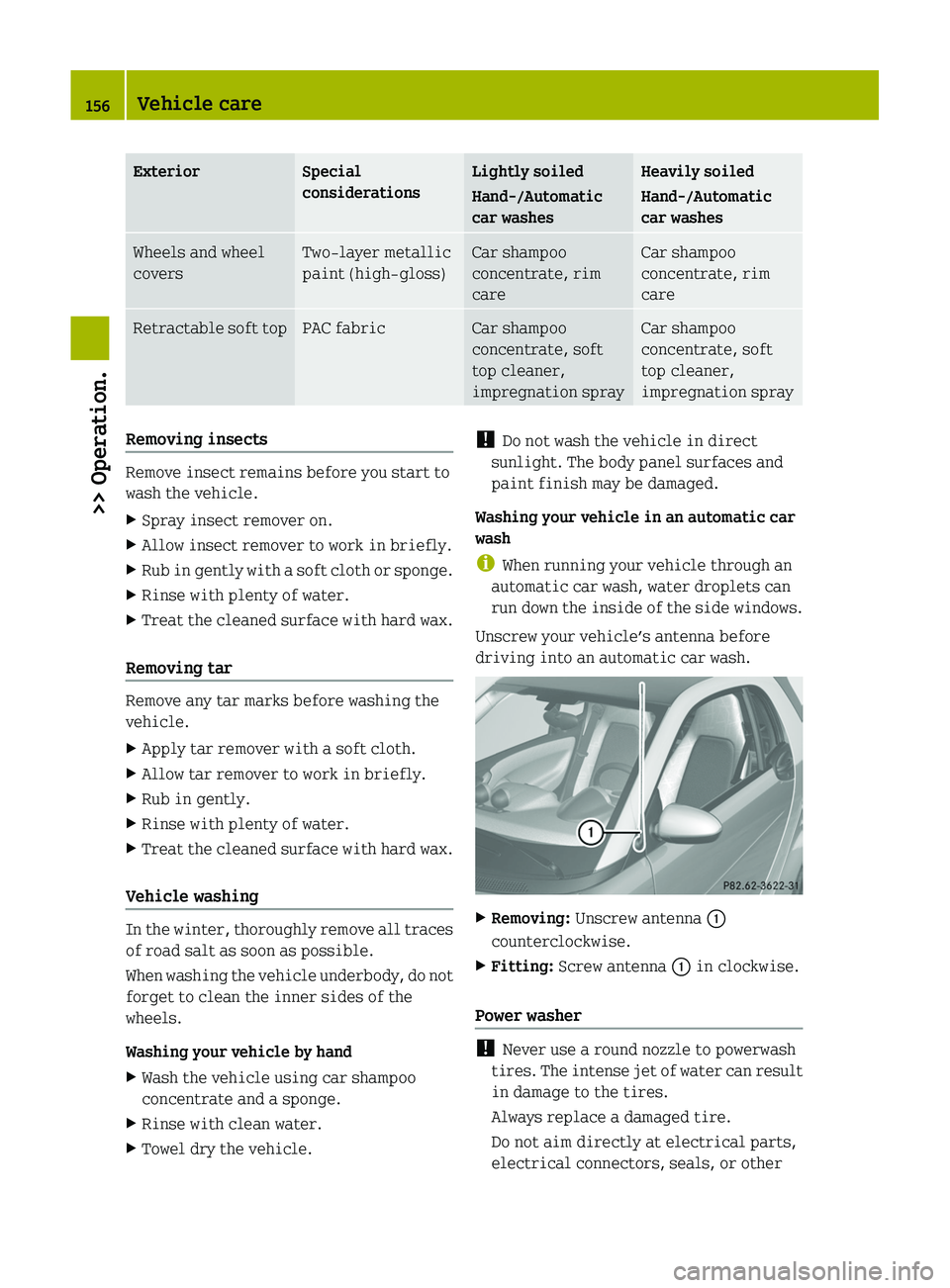
ExteriorSpecial
considerations
Lightly soiled
Hand-/Automatic
car washes
Heavily soiled
Hand-/Automatic
car washes
Wheels and wheel
covers
Two-layer metallic
paint (high-gloss)
Car shampoo
concentrate, rim
care
Car shampoo
concentrate, rim
care
Retractable soft topPAC fabricCar shampoo
concentrate, soft
top cleaner,
impregnation spray
Car shampoo
concentrate, soft
top cleaner,
impregnation spray
Removing insects
Remove insect remains before you start to
wash the vehicle.
XSpray insect remover on.XAllow insect remover to work in briefly.XRub in gently with a soft cloth or sponge.XRinse with plenty of water.XTreat the cleaned surface with hard wax.
Removing tar
Remove any tar marks before washing the
vehicle.
XApply tar remover with a soft cloth.XAllow tar remover to work in briefly.XRub in gently.XRinse with plenty of water.XTreat the cleaned surface with hard wax.
Vehicle washing
In the winter, thoroughly remove all traces
of road salt as soon as possible.
When washing the vehicle underbody, do not
forget to clean the inner sides of the
wheels.
Washing your vehicle by hand
XWash the vehicle using car shampoo
concentrate and a sponge.
XRinse with clean water.XTowel dry the vehicle.! Do not wash the vehicle in direct
sunlight. The body panel surfaces and
paint finish may be damaged.
Washing your vehicle in an automatic car
wash
iWhen running your vehicle through an
automatic car wash, water droplets can
run down the inside of the side windows.
Unscrew your vehicle’s antenna before
driving into an automatic car wash.
XRemoving: Unscrew antenna \000F
counterclockwise.
XFitting: Screw antenna \000F in clockwise.
Power washer
! Never use a round nozzle to powerwash
tires. The intense jet of water can result
in damage to the tires.
Always replace a damaged tire.
Do not aim directly at electrical parts,
electrical connectors, seals, or other
156Vehicle care>> Operation.
BA 451 USA, CA Edition A 2011; 1; 4, en-UShereepeVersion: 3.0.3.62010-05-11T15:12:26+02:00 - Seite 156
Page 163 of 228
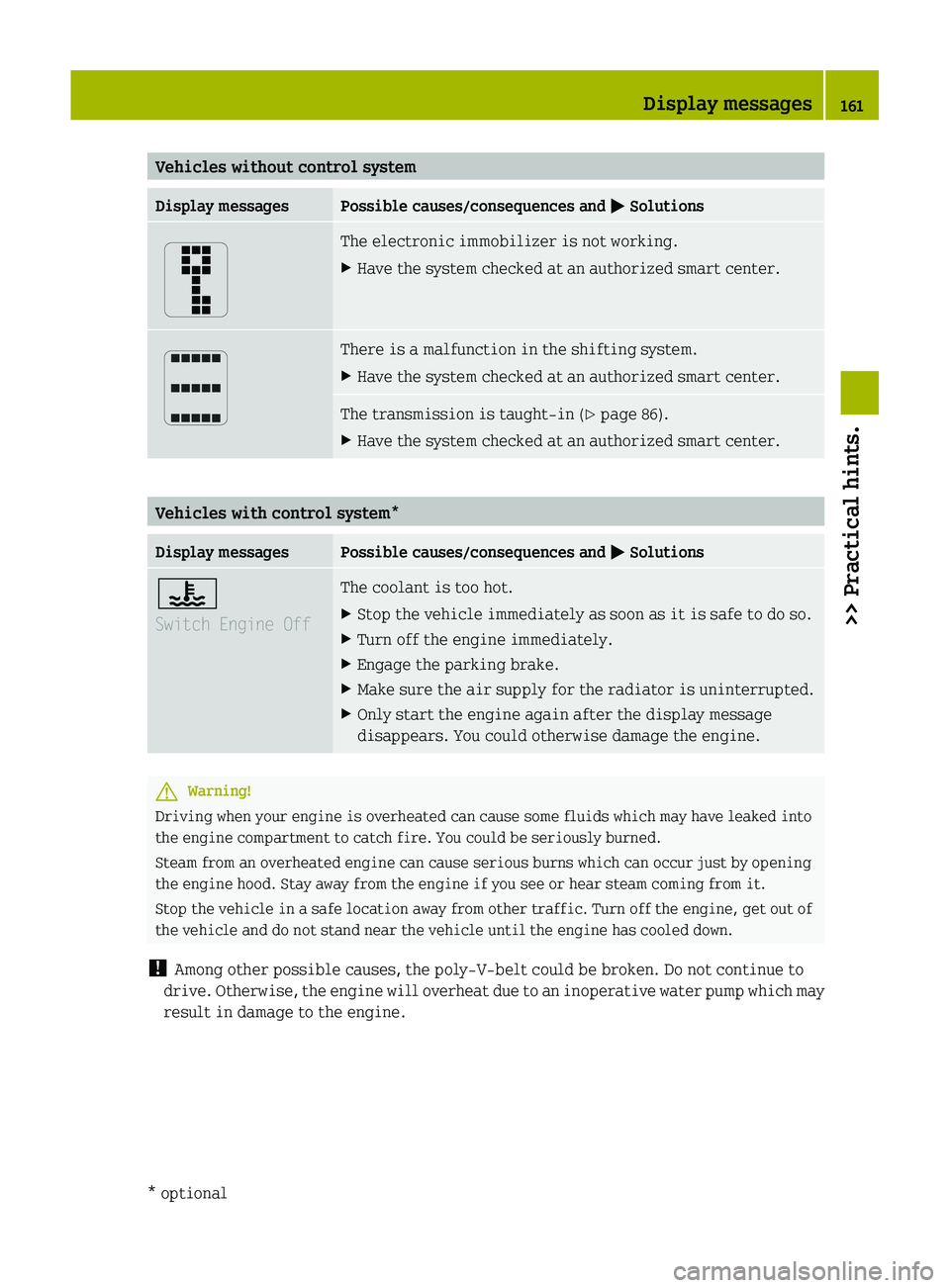
Vehicles without control systemDisplay messagesPossible causes/consequences and 0050 SolutionsThe electronic immobilizer is not working. XHave the system checked at an authorized smart center.There is a malfunction in the shifting system. XHave the system checked at an authorized smart center.The transmission is taught-in ( Y page 86).XHave the system checked at an authorized smart center.
Vehicles with control system*
Display messagesPossible causes/consequences and 0050 Solutions00AE
Switch Engine OffThe coolant is too hot.XStop the vehicle immediately as soon as it is safe to do so.XTurn off the engine immediately.XEngage the parking brake.XMake sure the air supply for the radiator is uninterrupted.XOnly start the engine again after the display message
disappears. You could otherwise damage the engine.GWarning!
Driving when your engine is overheated can cause some fluids which may have leaked into
the engine compartment to catch fire. You could be seriously burned.
Steam from an overheated engine can cause serious burns which can occur just by opening
the engine hood. Stay away from the engine if you see or hear steam coming from it.
Stop the vehicle in a safe location away from other traffic. Turn off the engine, get out of
the vehicle and do not stand near the vehicle until the engine has cooled down.
! Among other possible causes, the poly-V-belt could be broken. Do not continue to
drive. Otherwise, the engine will overheat due to an inoperative water pump which may
result in damage to the engine.
Display messages161>> Practical hints.* optionalBA 451 USA, CA Edition A 2011; 1; 4, en-UShereepeVersion: 3.0.3.62010-05-11T15:12:26+02:00 - Seite 161Z
Page 168 of 228

ProblemPossible causes/consequences and 0050 Solutions0027 (USA only)
004D (Canada only)
The brake warning
lamp illuminates
while the engine is
running. You are driving with the parking brake engaged.XRelease the parking brake.The brake circuit fails or the brake fluid level in the brake
fluid reservoir is too low.XStop the vehicle immediately in a safe location.XDo not continue to drive.XTurn off the engine.XDo not add brake fluid as this will not solve the problem.XEngage the parking brake when leaving the vehicle.XContact Roadside Assistance or an authorized smart center.0027 (USA only)
004D (Canada only)
The brake warning
lamp illuminates
together with the ABS
indicator lamp while
the engine is running.The ABS system has failed.XStop the vehicle immediately in a safe location.XDo not continue to drive.XTurn off the engine.XEngage the parking brake when leaving the vehicle.XContact Roadside Assistance or an authorized smart center.GWarning!
Driving with the brake warning lamp illuminated can result in an accident. Have your brake
system checked immediately if the brake warning lamp stays on.
Do not add brake fluid before checking the brake system.
! If you find that the brake fluid in the brake fluid reservoir has fallen to the minimum
mark or below, have the brake system checked for brake pad thickness and leaks
immediately. Contact an authorized smart center immediately. Do not add brake fluid
as this will not solve the problem.
166What to do if ...>> Practical hints.
BA 451 USA, CA Edition A 2011; 1; 4, en-UShereepeVersion: 3.0.3.62010-05-11T15:12:26+02:00 - Seite 166
Page 173 of 228
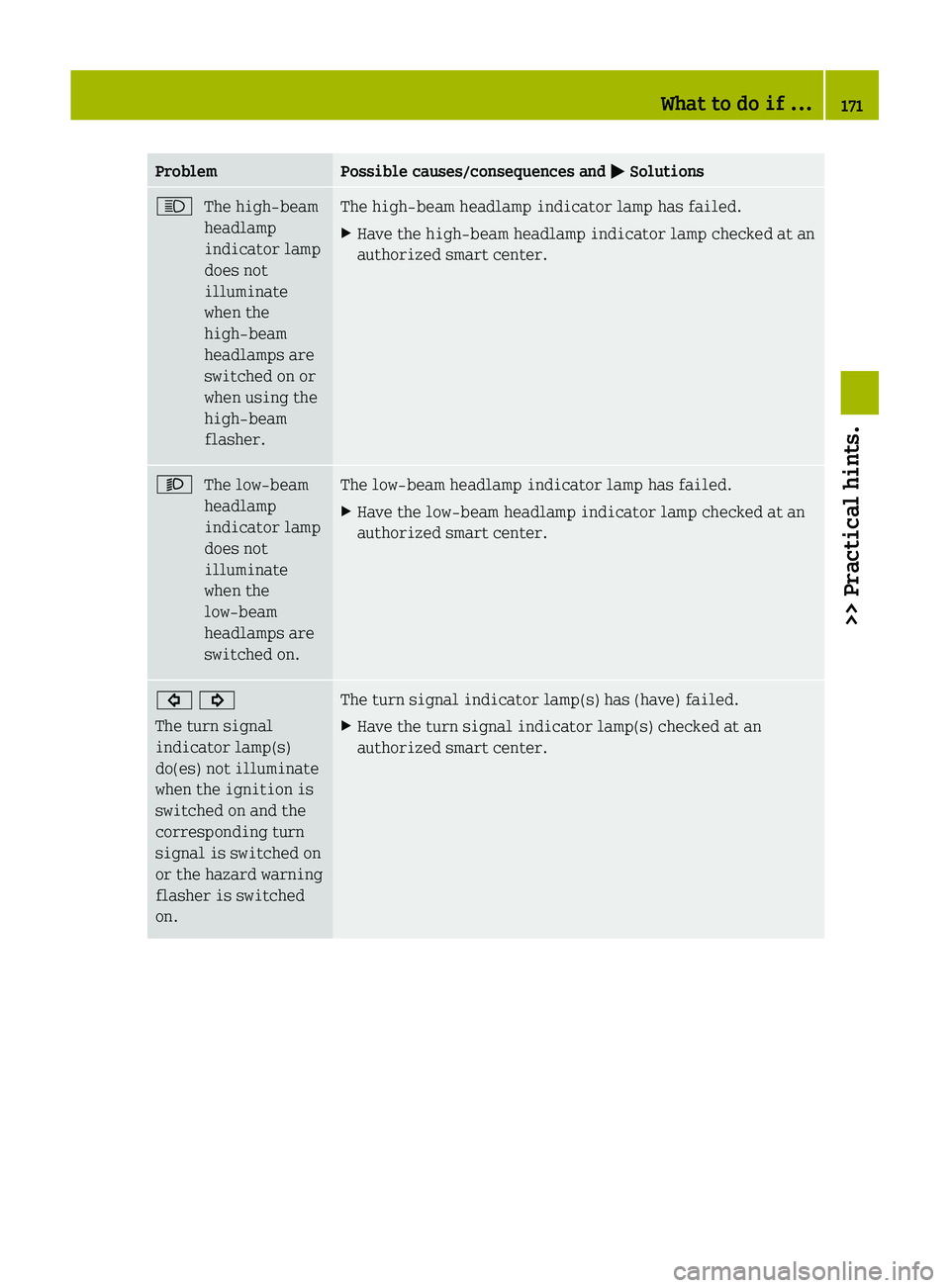
ProblemPossible causes/consequences and 0050 Solutions0063The high‑beam
headlamp
indicator lamp
does not
illuminate
when the
high‑beam
headlamps are
switched on or
when using the
high‑beam
flasher.The high‑beam headlamp indicator lamp has failed.XHave the high‑beam headlamp indicator lamp checked at an
authorized smart center.0065The low‑beam
headlamp
indicator lamp
does not
illuminate
when the
low‑beam
headlamps are
switched on.The low‑beam headlamp indicator lamp has failed.XHave the low‑beam headlamp indicator lamp checked at an
authorized smart center.0026 0024
The turn signal
indicator lamp(s)
do(es) not illuminate
when the ignition is
switched on and the
corresponding turn
signal is switched on
or the hazard warning
flasher is switched
on.The turn signal indicator lamp(s) has (have) failed. XHave the turn signal indicator lamp(s) checked at an
authorized smart center.What to do if ...171>> Practical hints.BA 451 USA, CA Edition A 2011; 1; 4, en-UShereepeVersion: 3.0.3.62010-05-11T15:12:26+02:00 - Seite 171Z
Page 174 of 228
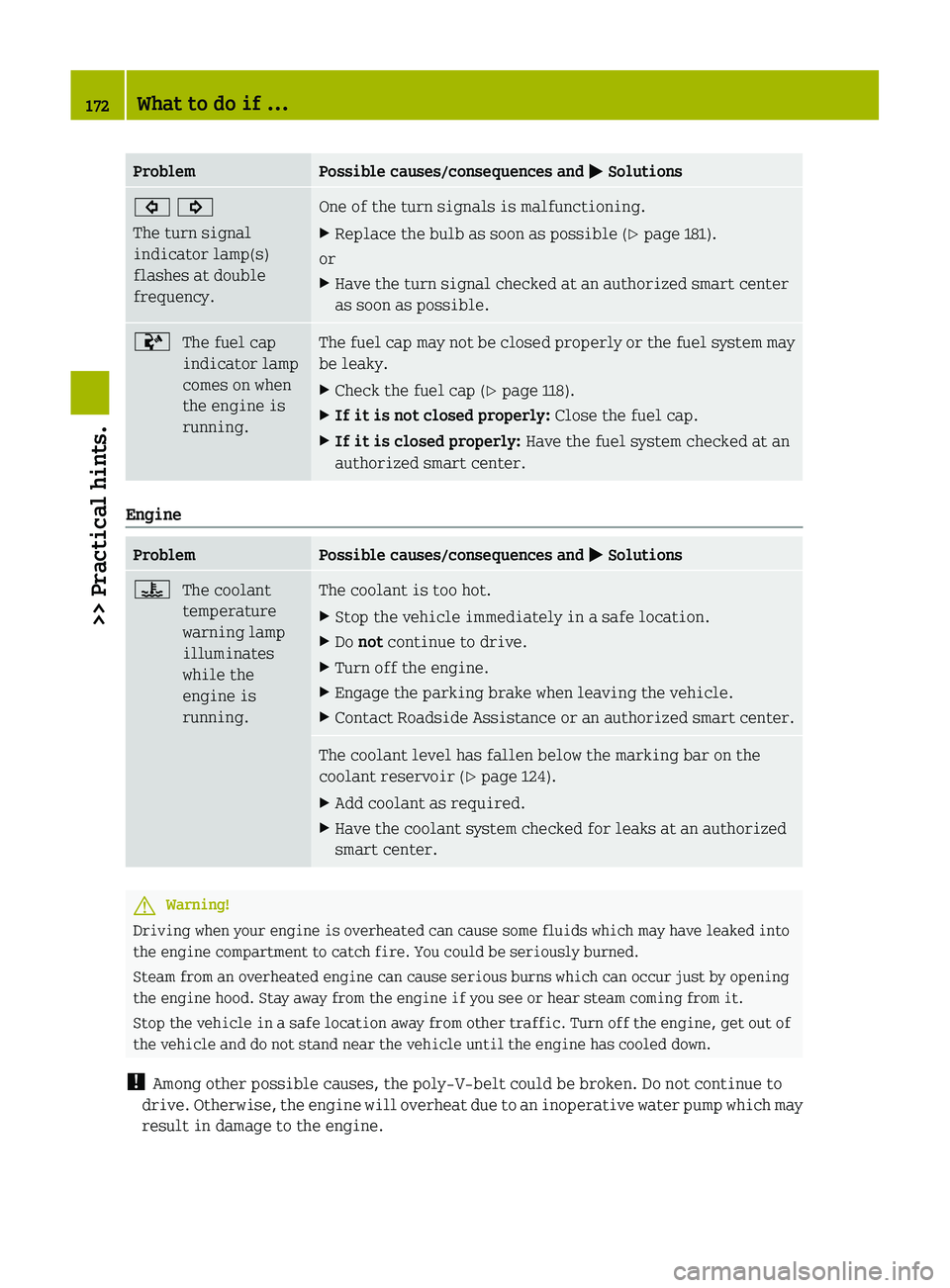
ProblemPossible causes/consequences and 0050 Solutions0026 0024
The turn signal
indicator lamp(s)
flashes at double
frequency.One of the turn signals is malfunctioning.XReplace the bulb as soon as possible ( Y page 181).
or
XHave the turn signal checked at an authorized smart center
as soon as possible.00ACThe fuel cap
indicator lamp
comes on when
the engine is
running.The fuel cap may not be closed properly or the fuel system may
be leaky. XCheck the fuel cap ( Y page 118).XIf it is not closed properly: Close the fuel cap.XIf it is closed properly: Have the fuel system checked at an
authorized smart center.
Engine
ProblemPossible causes/consequences and 0050 Solutions00AEThe coolant
temperature
warning lamp
illuminates
while the
engine is
running.The coolant is too hot. XStop the vehicle immediately in a safe location.XDo not continue to drive.XTurn off the engine.XEngage the parking brake when leaving the vehicle.XContact Roadside Assistance or an authorized smart center.The coolant level has fallen below the marking bar on the
coolant reservoir ( Y page 124).XAdd coolant as required.XHave the coolant system checked for leaks at an authorized
smart center.GWarning!
Driving when your engine is overheated can cause some fluids which may have leaked into
the engine compartment to catch fire. You could be seriously burned.
Steam from an overheated engine can cause serious burns which can occur just by opening
the engine hood. Stay away from the engine if you see or hear steam coming from it.
Stop the vehicle in a safe location away from other traffic. Turn off the engine, get out of
the vehicle and do not stand near the vehicle until the engine has cooled down.
! Among other possible causes, the poly-V-belt could be broken. Do not continue to
drive. Otherwise, the engine will overheat due to an inoperative water pump which may
result in damage to the engine.
172What to do if ...>> Practical hints.
BA 451 USA, CA Edition A 2011; 1; 4, en-UShereepeVersion: 3.0.3.62010-05-11T15:12:26+02:00 - Seite 172