led SMART FORTWO COUPE 2011 User Guide
[x] Cancel search | Manufacturer: SMART, Model Year: 2011, Model line: FORTWO COUPE, Model: SMART FORTWO COUPE 2011Pages: 228, PDF Size: 11.48 MB
Page 45 of 228
Unsecured or improperly positioned cargo
increases a child’s risk of injury in the
event of
R strong braking maneuvers
R sudden changes of direction
R an accident
Infant and child restraint system
We recommend all infants and children be
properly restrained at all times while the
vehicle is in operation.
The passenger lap-shoulder belt has a
special seat belt retractor for secure
fastening of child restraints.
To fasten a child restraint, follow all
mounting instructions provided by the
child restraint manufacturer. Then pull the
shoulder seat belt out completely and let it
retract. During seat belt retraction, a
ratcheting sound can be heard to indicate
that the special seat belt retractor is
activated. The seat belt is now locked. Push
down on child restraint to take up any
slack.
To deactivate, release seat belt buckle and
let seat belt retract completely. To
deactivate the special seat belt retractor
for the passenger seat, the passenger seat
must be in the most backward position. The
seat belt can again be used in the usual
manner.
GWarning!
Never release the seat belt buckle while the
vehicle is in motion, since the special seat
belt retractor will be deactivated.
The use of infant or child restraints is
required by law in all 50 states, the
District of Columbia, the U.S. territories,
and all Canadian provinces and
territories.
Infants and small children should be seated
in an appropriate infant or child restraint
system properly secured in accordance
with the manufacturer’s instructions for
the child restraint, that complies with U.S.
Federal Motor Vehicle Safety Standards 213
and 225 and Canadian Motor Vehicle Safety
Standards 213, 213.1 and 213.2.
A statement by the child restraint
manufacturer of compliance with these
standards can be found on the instruction
label on the restraint and in the
instruction manual provided with the
restraint.
When using any infant restraint, toddler
restraint, or booster seat be sure to
carefully read and follow all
manufacturer’s instructions for
installation and use.
Please read and observe warning labels
affixed to the inside of the vehicle and to
infant or child restraints.GWarning!
Children 12 years old and under must be
seated and properly secured in an
appropriately sized infant restraint,
toddler restraint, or booster seat
recommended for the size and weight of the
child.
The infant or child restraint must be
properly secured with the vehicle’s seat
belt fully in accordance with the child seat
manufacturer’s instructions.
Occupants, especially children, should
never place their bodies or lean their
heads in the area of the door where the
head-thorax air bags (cabriolet), window
curtain air bags (coupé) and thorax-pelvis
air bags (coupé) inflates. This could result
in serious injuries or death should the
head-thorax air bags (cabriolet), window
curtain air bags (coupé) and thorax-pelvis
air bags (coupé) be triggered. Always sit as
upright as possible, properly use the seat
belt and use an appropriately sized infant
restraint, toddler restraint, or booster
seat recommended for the size and weight
of the child.
Children can be killed or seriously injured
by an inflating air bag. Note the following
Occupant safety43>> Safety.BA 451 USA, CA Edition A 2011; 1; 4, en-UShereepeVersion: 3.0.3.62010-05-11T15:12:26+02:00 - Seite 43Z
Page 46 of 228
important information when circumstances
require you to place a child in the
passenger seat:
R Your vehicle is equipped with air bag
technology designed to turn off the
passenger front air bag in your vehicle
when the Occupant Classification System
senses the weight of a typical
12‑month‑old child or less along with the
weight of an appropriate child restraint
on the passenger seat.
R A child in a rear-facing child restraint
on the passenger seat may be seriously
injured or even killed if the passenger
front air bag inflates in a collision.
R If you install a rear-facing child
restraint on the passenger seat, make
sure the 007F 007B indicator lamp
is illuminated, indicating that the
passenger front air bag is deactivated.
Should the 007F 007B indicator
lamp not illuminate or go out while the
restraint is installed, please check
installation. Periodically check the
007F 007B indicator lamp while
driving to make sure the
007F 007B indicator lamp is
illuminated. If the 007F 007B
indicator lamp goes out or remains out,
do not transport a child on the passenger
seat until the system has been repaired.
A child in a rear-facing child restraint
on the passenger seat may be seriously
injured or even killed if the passenger
front air bag inflates.
R If you place a child in a forward-facing
child restraint on the passenger seat,
move the seat as far back as possible, use
a proper child restraint recommended
for the age, size and weight of the child,
and secure child restraint with the
vehicle’s seat belt according to the child
seat manufacturer’s instructions. For
children larger than the typical
12‑month‑old child, the passenger front
air bag may or may not be activated.GWarning!
Infants and small children should never
share a seat belt with another occupant.
During an accident, they could be crushed
between the occupant and seat belt.
A child’s risk of serious or fatal injuries
is significantly increased if the child
restraints are not properly secured in the
vehicle and/or the child is not properly
secured in the child restraint.
Children too big for a toddler restraint
must ride in a seat using regular seat belt.
Position shoulder belt across chest and
shoulder, not face or neck. A booster seat
may be necessary to achieve proper seat
belt positioning for children over 41 lbs
until they reach a height where a lap-
shoulder belt fits properly without a
booster.
When the child restraint is not in use,
remove it from the vehicle or secure it with
the seat belt to prevent the child restraint
from becoming a projectile in the event of
an accident.
Do not leave children unattended in the
vehicle, even if the children are secured in
a child restraint system. Unsupervised
children in a child restraint system may
use vehicle equipment and may cause an
accident and/or serious personal injury.
If you are using a rear-facing child
restraint system on the passenger seat, you
must verify that the passenger front air bag
is deactivated. When the passenger front
air bag is deactivated, the
007F 007B indicator lamp is
illuminated ( Y page 41).
Top tether
Top tether permits an additional
connection between a child restraint
system and the passenger seat. Proper
usage of the top tether, in accordance with
instructions provided by the child
restraint manufacturer, can further reduce
the risk of injuries.
44Occupant safety>> Safety.
BA 451 USA, CA Edition A 2011; 1; 4, en-UShereepeVersion: 3.0.3.62010-05-11T15:12:26+02:00 - Seite 44
Page 55 of 228
the direction from which the remote
control is activated.
To prevent theft, however, it is advisable
to only unlock the vehicle when you are
in close proximity to it.
Locking and unlocking from the
outside
XSelective unlocking: Press button 0034 on
the key once.
All turn signal lamps flash once.
The anti-theft warning system* is
disarmed.
The driver’s door and the fuel filler flap
are unlocked.XGlobal unlocking: Press button 0034 on the
key twice.
All turn signal lamps flash once again.
The passenger door and the tailgate are
unlocked in addition to the driver’s door
and the fuel filler flap.XGlobal locking: Press button 0038 on the
key.
With the doors, the tailgate(s), and the
fuel filler flap closed the turn signal
lamps flash three times.
The anti-theft warning system* is armed.
The indicator lamp on the central
locking switch flashes ( Y page 54).
The interior and exterior 8
lamps come on
and then go out again after 12 seconds.
i In vehicles with anti-theft warning
system*, an acoustic signal will sound
when locking or unlocking the vehicle.
When unlocking, the acoustic signal
sounds once. When locking, the acoustic
signal sounds three times.
The acoustic signal is activated at the
factory. If you wish to deactivate the
feature, contact an authorized smart
center.
Automatic locking
Auto-relock function
The vehicle will lock again automatically
within approximately 60 seconds of
unlocking with the key if neither the
driver’s nor passenger door is opened.
! To prevent an inadvertent lockout,
never leave your key lying in the vehicle.
Drive lock function
The vehicle locks automatically when the
ignition is switched on and the wheels are
turning at vehicle speeds of approximately
8 mph (14 km/h) or more. The drive lock
function is enabled at the factory.
XSwitching on: Switch off the ignition.XPress the central locking switch
( Y page 54) and button 0038 on the key
simultaneously.
An acoustic signal sounds.
The drive lock function is switched on.XSwitching off: Switch off the ignition.XPress the central unlocking switch
( Y page 54) and button 0034 on the key
simultaneously.
An acoustic signal sounds.
The drive lock function is switched off.
Locking and unlocking from the inside
GWarning!
When leaving the vehicle, always remove the
key from the starter switch, take it with
you, and lock the vehicle. Do not leave
children unattended in the vehicle, or with
access to an unlocked vehicle. A child’s
unsupervised access to a vehicle could
result in an accident and/or serious
personal injury.
You can lock and unlock the vehicle from
inside using the central locking or
8 Vehicles with rain-light sensor* only.Opening and closing53>> Controls.* optionalBA 451 USA, CA Edition A 2011; 1; 4, en-UShereepeVersion: 3.0.3.62010-05-11T15:12:26+02:00 - Seite 53Z
Page 60 of 228

005DFor removing key004AIgnition (power supply for all
electrical consumers) and driving
position
All lamps (except low‑beam
headlamp indicator lamp,
high‑beam headlamp indicator
lamp, and turn signal indicator
lamps unless activated) in the
instrument cluster come on. If a
lamp in the instrument cluster fails
to come on when the ignition is
switched on, have it checked and
replaced if necessary. If a lamp in
the instrument cluster remains on
after starting the engine or comes
on while driving, refer to “Warning
and indicator lamps in the
instrument cluster” ( Y page 164).004BStarting ( Y page 78)
i
When you switch on the ignition, the
indicator and warning lamps (except
low‑beam headlamp indicator lamp,
high‑beam headlamp indicator lamp, and
turn signal indicator lamps unless
activated) in the instrument cluster
come on. The indicator and warning
lamps (except low‑beam headlamp
indicator lamp, high‑beam headlamp
indicator lamp, and turn signal
indicator lamps if activated) will go out
when the engine is running. This
indicates that the respective systems
are operational.
Seats
Safety notes
GWarning!
All seat adjustments, as well as fastening
of seat belts, must be done before the
vehicle is operated.
GWarning!
When adjusting the seat, make sure no one
becomes trapped.
Do not adjust the driver’s seat while
driving. Adjusting the seat while driving
could cause the driver to lose control of the
vehicle.
Never ride in a moving vehicle with the seat
backrest in an excessively reclined
position as this can be dangerous. You
could slide under the seat belt in a
collision. If you slide under the seat belt,
it could apply force at the abdomen or neck,
potentially causing serious or fatal
injuries. The seat backrest and seat belts
provide the best restraint when the wearer
is in a position that is as upright as
possible and seat belts are properly
positioned on the body.
Your seat must be adjusted so that you can
correctly fasten your seat belt.
Observe the following points:
R Adjust the seat backrest until your arms
are slightly angled when holding the
steering wheel.
R Adjust the seat to a comfortable seating
position that still allows you to reach the
accelerator/brake pedal safely. The
position should be as far back as
possible with the driver still able to
operate the controls properly.
R Never place hands under the seat or near
any moving parts while a seat is being
adjusted.
Failure to do so could result in an accident
and/or serious personal injury.
Observe the notes on the air bag system.
GWarning!
Children 12 years old and under must be
seated and properly secured in an
appropriately sized infant restraint,
toddler restraint, or booster seat
recommended for the size and weight of the
58Seats>> Controls.
BA 451 USA, CA Edition A 2011; 1; 4, en-UShereepeVersion: 3.0.3.62010-05-11T15:12:26+02:00 - Seite 58
Page 61 of 228
child. For additional information, see
“Children in the vehicle”.
A child’s risk of serious or fatal injuries
is significantly increased if the child
restraints are not properly secured in the
vehicle and/or the child is not properly
secured in the child restraint.
GWarning!
Contact an authorized smart center if the
seats have become damaged.
The seat is an integral part of the vehicle’s
safety system in the same way as seat belts
and air bags. Damage to the seats may
reduce their ability to protect the
occupants in an accident.
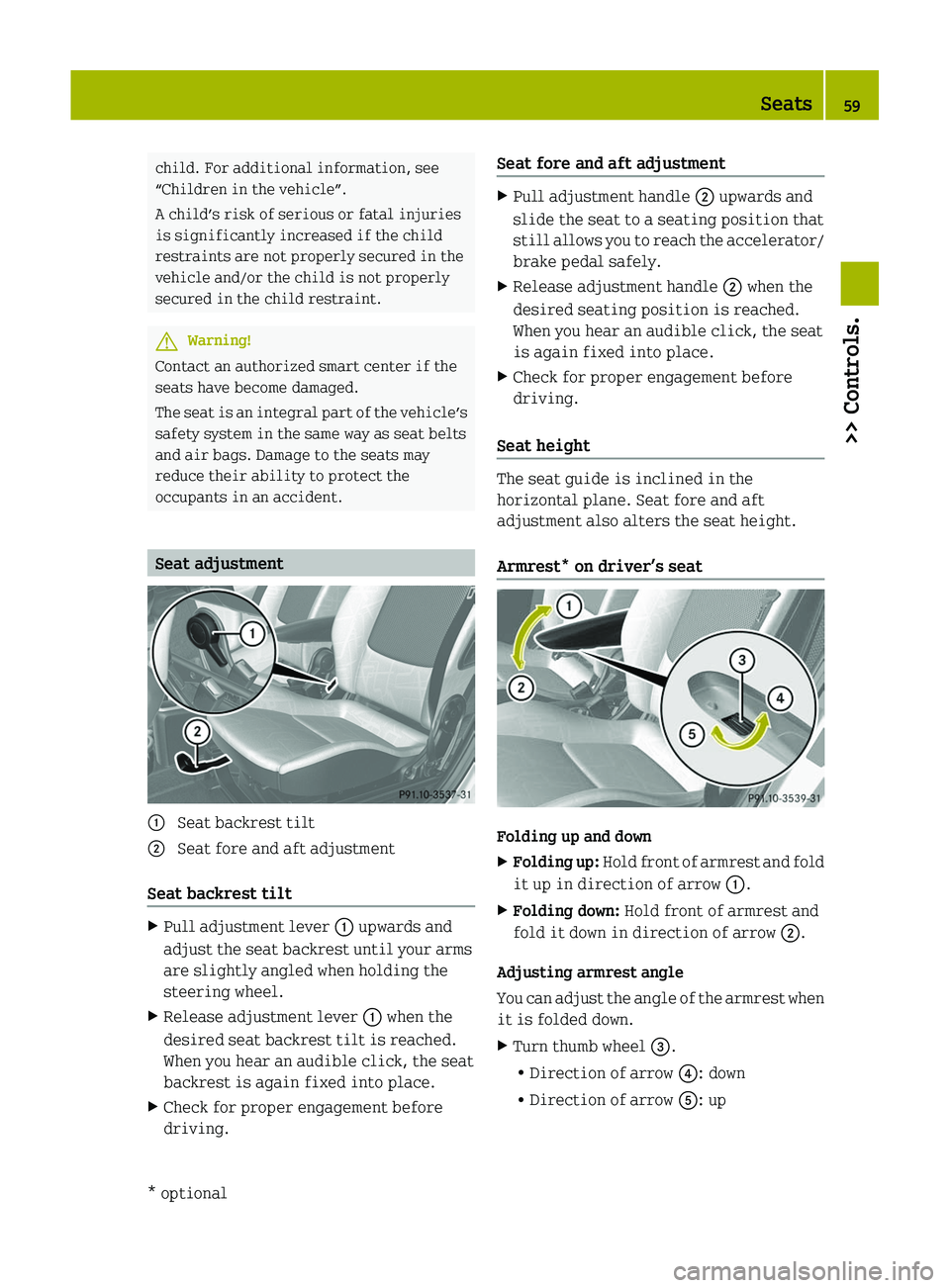
Seat adjustment
\000F Seat backrest tilt\000G Seat fore and aft adjustment
Seat backrest tilt
XPull adjustment lever \000F upwards and
adjust the seat backrest until your arms
are slightly angled when holding the
steering wheel.
XRelease adjustment lever \000F when the
desired seat backrest tilt is reached.
When you hear an audible click, the seat
backrest is again fixed into place.
XCheck for proper engagement before
driving.
Seat fore and aft adjustmentXPull adjustment handle \000G upwards and
slide the seat to a seating position that
still allows you to reach the accelerator/
brake pedal safely.
XRelease adjustment handle \000G when the
desired seating position is reached.
When you hear an audible click, the seat
is again fixed into place.
XCheck for proper engagement before
driving.
Seat height
The seat guide is inclined in the
horizontal plane. Seat fore and aft
adjustment also alters the seat height.
Armrest* on driver’s seat
Folding up and down
XFolding up: Hold front of armrest and fold
it up in direction of arrow \000F.
XFolding down: Hold front of armrest and
fold it down in direction of arrow \000G.
Adjusting armrest angle
You can adjust the angle of the armrest when
it is folded down.
XTurn thumb wheel \000
Page 64 of 228
Exterior rear view mirror heating
This feature is only available on the model
passion and BRABUS and in conjunction
with power exterior rear view mirrors.
After switching on the rear window
defroster, the exterior rear view mirrors
will be heated automatically. This
prevents icing up the exterior rear view
mirrors and also creates a clear view when
the exterior rear view mirrors have fogged
up.
If the rear window defroster is
automatically deactivated after
approximately 10 minutes of operation, the
exterior rear view mirror heating also
deactivates.
XMake sure the key is in starter switch
position 1.XSwitching on: Switch on the rear window
defroster ( Y page 107).
The exterior rear view mirror heating is
switched on.XSwitching off: Switch off the rear window
defroster ( Y page 107).
The exterior rear view mirror heating is
switched off.
i The exterior rear view mirror heating
also switches off if the key is turned to
starter switch position 0.
Interior rear view mirror
XAdjusting the mirror: Manually move the
interior rear view mirror up, down, left,
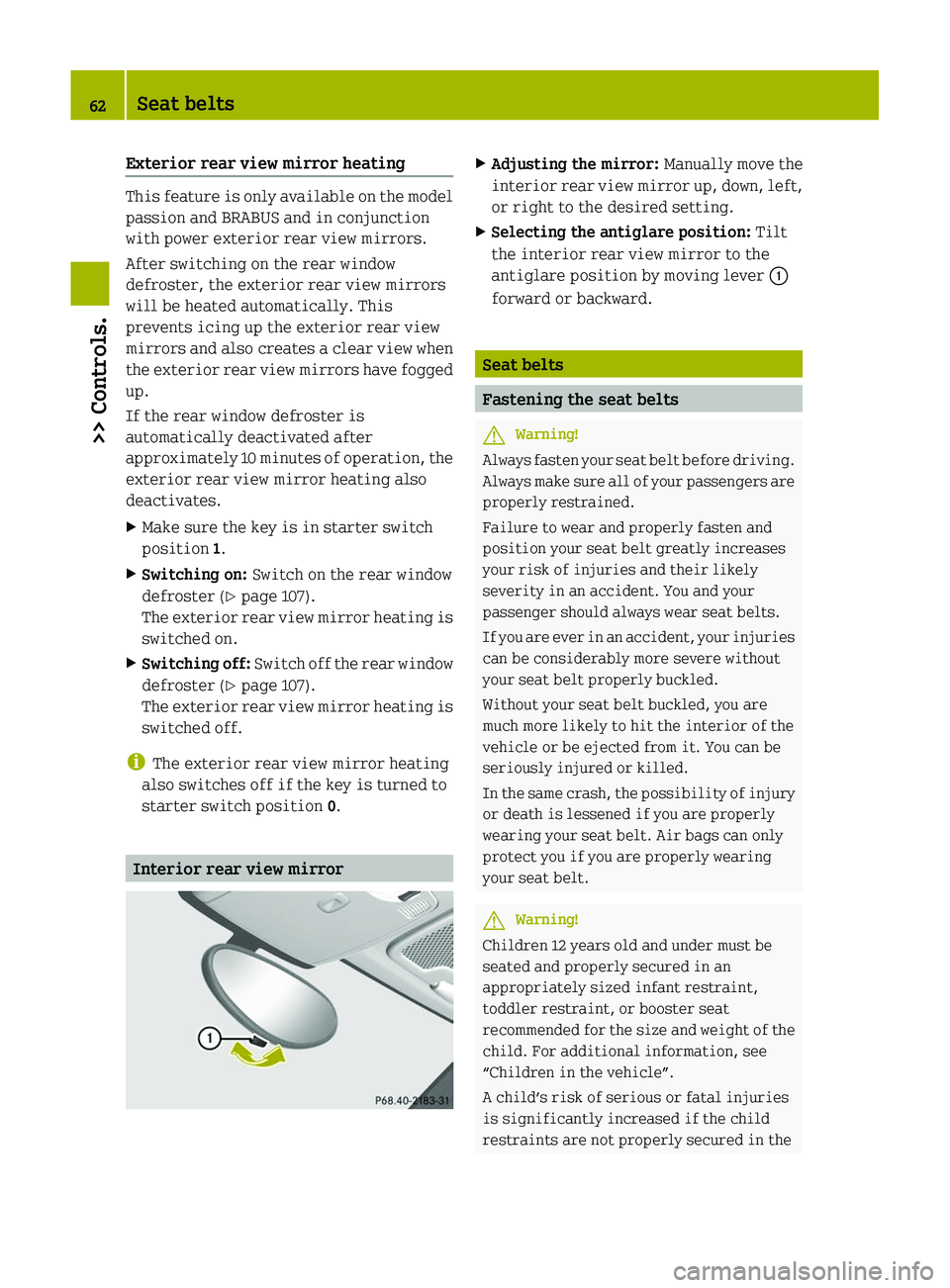
or right to the desired setting.XSelecting the antiglare position: Tilt
the interior rear view mirror to the
antiglare position by moving lever 0046
forward or backward.
Seat belts
Fastening the seat belts
GWarning!
Always fasten your seat belt before driving.
Always make sure all of your passengers are
properly restrained.
Failure to wear and properly fasten and
position your seat belt greatly increases
your risk of injuries and their likely
severity in an accident. You and your
passenger should always wear seat belts.
If you are ever in an accident, your injuries
can be considerably more severe without
your seat belt properly buckled.
Without your seat belt buckled, you are
much more likely to hit the interior of the
vehicle or be ejected from it. You can be
seriously injured or killed.
In the same crash, the possibility of injury
or death is lessened if you are properly
wearing your seat belt. Air bags can only
protect you if you are properly wearing
your seat belt.
GWarning!
Children 12 years old and under must be
seated and properly secured in an
appropriately sized infant restraint,
toddler restraint, or booster seat
recommended for the size and weight of the
child. For additional information, see
“Children in the vehicle”.
A child’s risk of serious or fatal injuries
is significantly increased if the child
restraints are not properly secured in the
62Seat belts>> Controls.
BA 451 USA, CA Edition A 2011; 1; 4, en-UShereepeVersion: 3.0.3.62010-05-11T15:12:26+02:00 - Seite 62
Page 73 of 228
If you have set intermittent wiping, dirt
on the surface of the sensor or optical
effects may cause the windshield wipers
to wipe in an undesired fashion. This
could then damage the windshield wiper
blades or scratch the windshield. You
should therefore switch off the
windshield wipers when weather
conditions are dry.
XMake sure the key is in starter switch
position 1.
XActivating intermittent wiping: Turn the
wiper switch to position \000J.
After the initial wipe, pauses between
wipes are automatically controlled
depending on the vehicle speed and by the
rain-light sensor*.
XDeactivating intermittent wiping: Turn
the wiper switch to position \000].
Wiping with windshield washer fluid
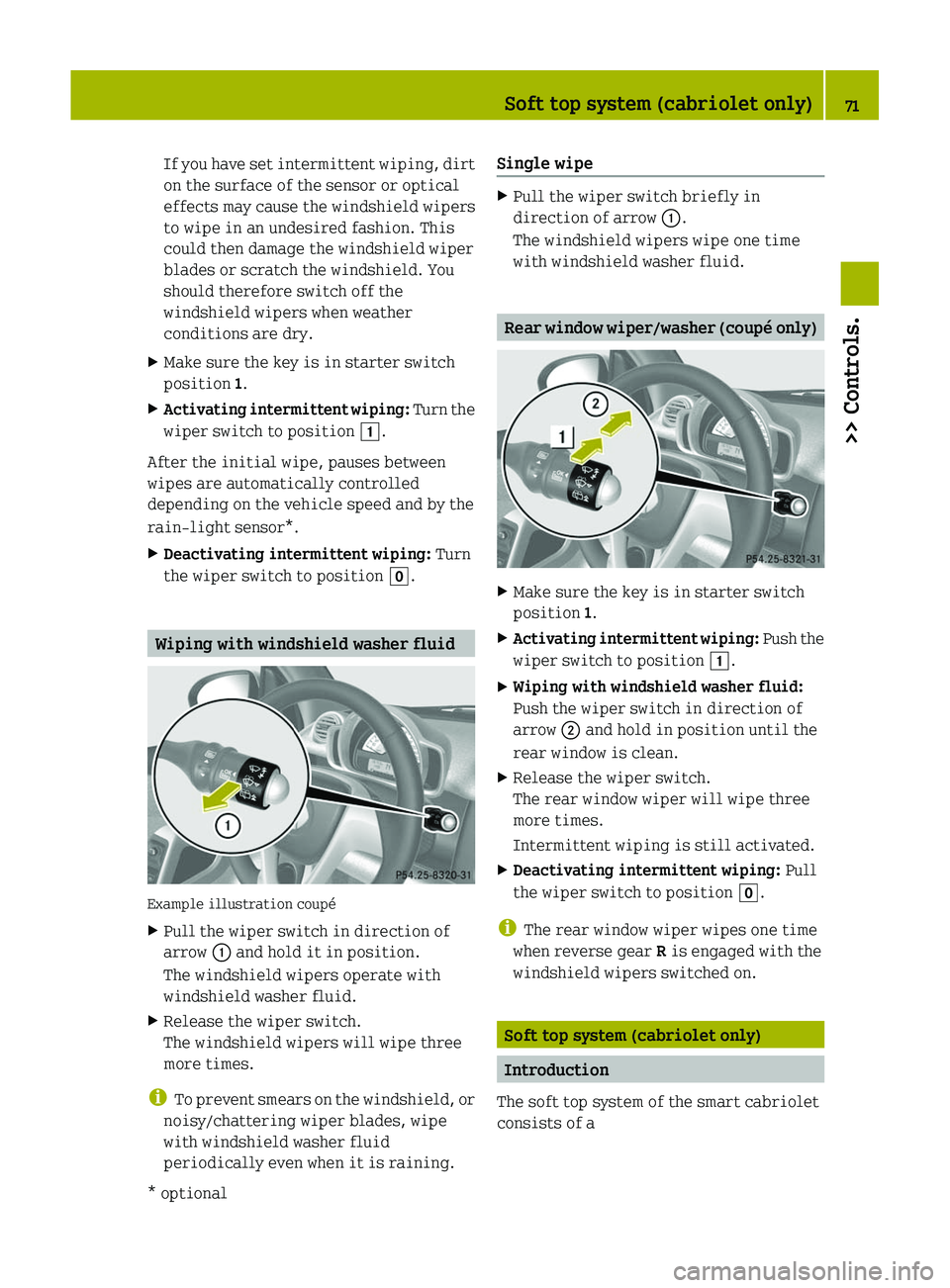
Example illustration coupé
XPull the wiper switch in direction of
arrow \000F and hold it in position.
The windshield wipers operate with
windshield washer fluid.
XRelease the wiper switch.
The windshield wipers will wipe three
more times.
iTo prevent smears on the windshield, or
noisy/chattering wiper blades, wipe
with windshield washer fluid
periodically even when it is raining.
Single wipeXPull the wiper switch briefly in
direction of arrow \000F.
The windshield wipers wipe one time
with windshield washer fluid.
Rear window wiper/washer (coupé only)
XMake sure the key is in starter switch
position 1.
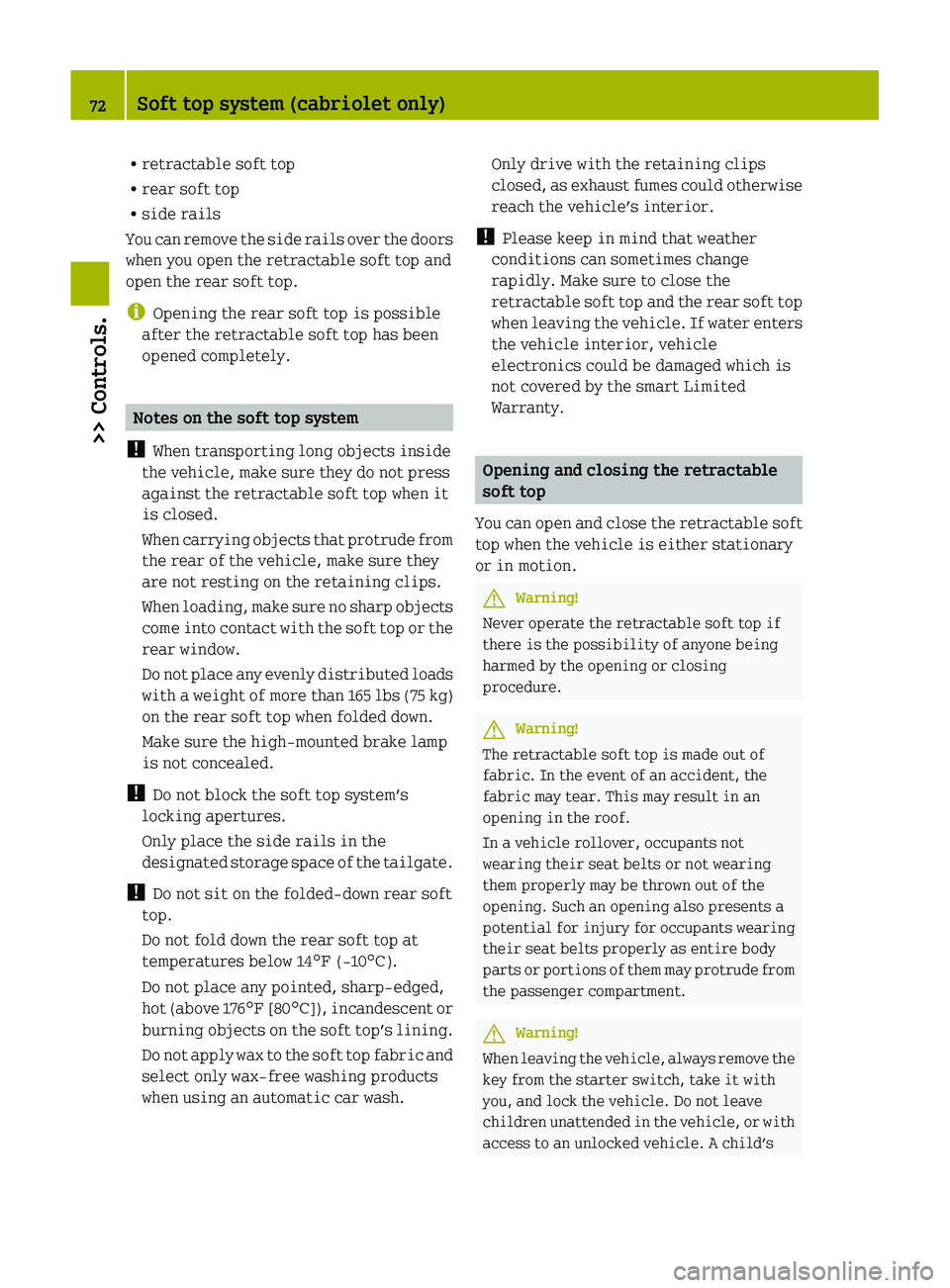
XActivating intermittent wiping: Push the
wiper switch to position \000J.
XWiping with windshield washer fluid:
Push the wiper switch in direction of
arrow \000G and hold in position until the
rear window is clean.
XRelease the wiper switch.
The rear window wiper will wipe three
more times.
Intermittent wiping is still activated.
XDeactivating intermittent wiping: Pull
the wiper switch to position \000].
iThe rear window wiper wipes one time
when reverse gear R is engaged with the
windshield wipers switched on.
Soft top system (cabriolet only)
Introduction
The soft top system of the smart cabriolet
consists of a
Soft top system (cabriolet only)71>> Controls.* optionalBA 451 USA, CA Edition A 2011; 1; 4, en-UShereepeVersion: 3.0.3.62010-05-11T15:12:26+02:00 - Seite 71Z
Page 74 of 228
Rretractable soft top
R rear soft top
R side rails
You can remove the side rails over the doors
when you open the retractable soft top and
open the rear soft top.
i Opening the rear soft top is possible
after the retractable soft top has been
opened completely.
Notes on the soft top system
! When transporting long objects inside
the vehicle, make sure they do not press
against the retractable soft top when it
is closed.
When carrying objects that protrude from
the rear of the vehicle, make sure they
are not resting on the retaining clips.
When loading, make sure no sharp objects
come into contact with the soft top or the
rear window.
Do not place any evenly distributed loads
with a weight of more than 165 lbs (75 kg)
on the rear soft top when folded down.
Make sure the high-mounted brake lamp
is not concealed.
! Do not block the soft top system’s
locking apertures.
Only place the side rails in the
designated storage space of the tailgate.
! Do not sit on the folded-down rear soft
top.
Do not fold down the rear soft top at
temperatures below 14 ¦ (-10 ¥).
Do not place any pointed, sharp-edged,
hot (above 176 ¦ [80 ¥]), incandescent or
burning objects on the soft top’s lining.
Do not apply wax to the soft top fabric and
select only wax-free washing products
when using an automatic car wash.
Only drive with the retaining clips
closed, as exhaust fumes could otherwise
reach the vehicle’s interior.
! Please keep in mind that weather
conditions can sometimes change
rapidly. Make sure to close the
retractable soft top and the rear soft top
when leaving the vehicle. If water enters
the vehicle interior, vehicle
electronics could be damaged which is
not covered by the smart Limited
Warranty.
Opening and closing the retractable
soft top
You can open and close the retractable soft
top when the vehicle is either stationary
or in motion.
GWarning!
Never operate the retractable soft top if
there is the possibility of anyone being
harmed by the opening or closing
procedure.
GWarning!
The retractable soft top is made out of
fabric. In the event of an accident, the
fabric may tear. This may result in an
opening in the roof.
In a vehicle rollover, occupants not
wearing their seat belts or not wearing
them properly may be thrown out of the
opening. Such an opening also presents a
potential for injury for occupants wearing
their seat belts properly as entire body
parts or portions of them may protrude from
the passenger compartment.
GWarning!
When leaving the vehicle, always remove the
key from the starter switch, take it with
you, and lock the vehicle. Do not leave
children unattended in the vehicle, or with
access to an unlocked vehicle. A child’s
72Soft top system (cabriolet only)>> Controls.
BA 451 USA, CA Edition A 2011; 1; 4, en-UShereepeVersion: 3.0.3.62010-05-11T15:12:26+02:00 - Seite 72
Page 79 of 228
! Make sure the side rails are installed
correctly. Otherwise the side rails may
not function properly or may be damaged.
XClose the storage compartment cover.XPress on the “PRESS” marking in the
middle of the storage compartment cover
until it engages audibly.
XClose the tailgate. Let the tailgate lock
into place.
XClose the driver’s and passenger door.XOpen the side windows if desired.
! Make sure the storage compartment
cover is closed before closing the
tailgate. Otherwise the tailgate could
jam.
Side windows
Opening and closing the side windows
Opening and closing the side windows
manually
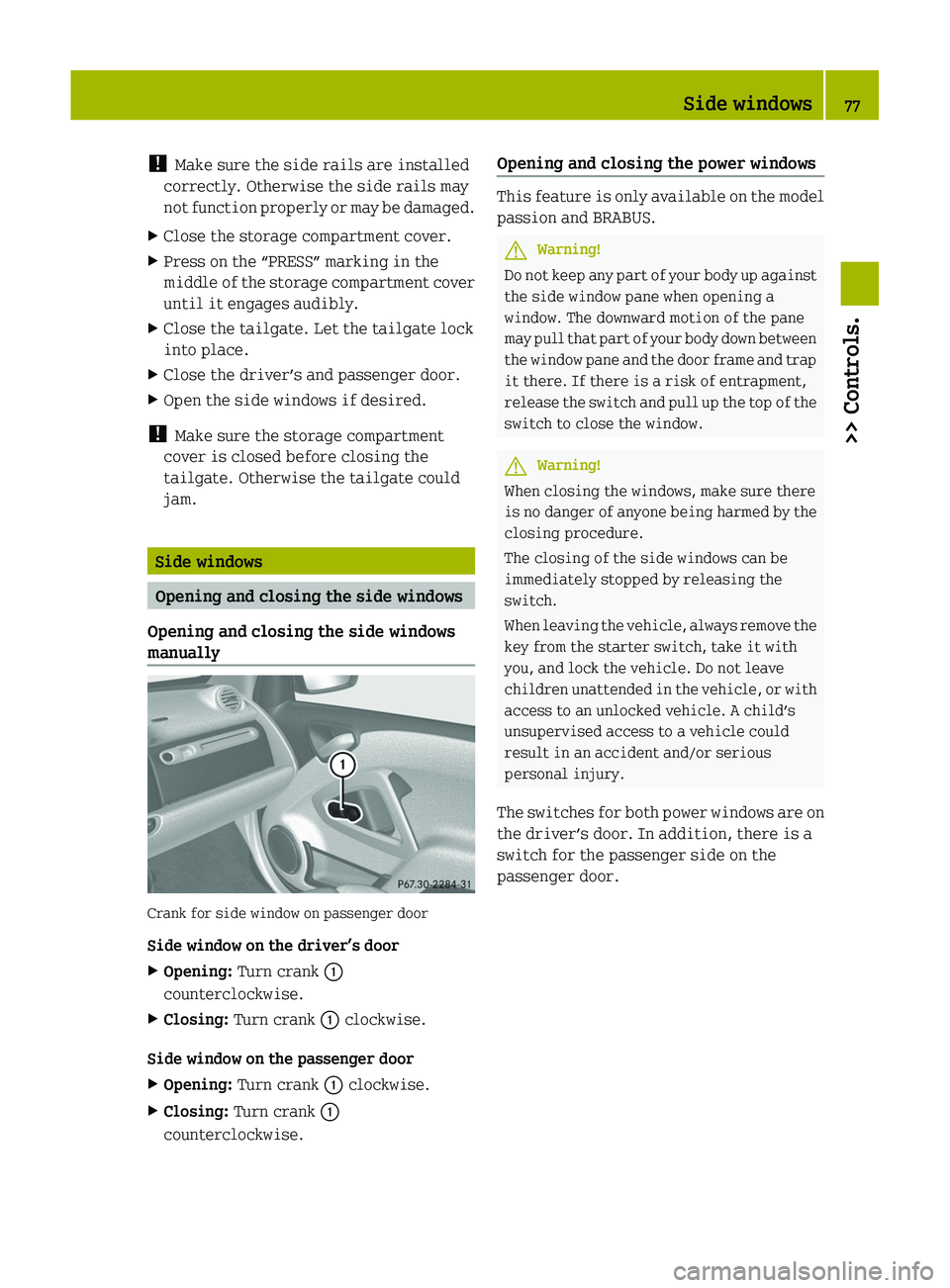
Crank for side window on passenger door
Side window on the driver’s door
XOpening: Turn crank \000F
counterclockwise.
XClosing: Turn crank \000F clockwise.
Side window on the passenger door
XOpening: Turn crank \000F clockwise.XClosing: Turn crank \000F
counterclockwise.
Opening and closing the power windows
This feature is only available on the model
passion and BRABUS.
GWarning!
Do not keep any part of your body up against
the side window pane when opening a
window. The downward motion of the pane
may pull that part of your body down between
the window pane and the door frame and trap
it there. If there is a risk of entrapment,
release the switch and pull up the top of the
switch to close the window.
GWarning!
When closing the windows, make sure there
is no danger of anyone being harmed by the
closing procedure.
The closing of the side windows can be
immediately stopped by releasing the
switch.
When leaving the vehicle, always remove the
key from the starter switch, take it with
you, and lock the vehicle. Do not leave
children unattended in the vehicle, or with
access to an unlocked vehicle. A child’s
unsupervised access to a vehicle could
result in an accident and/or serious
personal injury.
The switches for both power windows are on
the driver’s door. In addition, there is a
switch for the passenger side on the
passenger door.
Side windows77>> Controls.BA 451 USA, CA Edition A 2011; 1; 4, en-UShereepeVersion: 3.0.3.62010-05-11T15:12:26+02:00 - Seite 77Z
Page 83 of 228
you, and lock the vehicle. Do not leave
children unattended in the vehicle, or with
access to an unlocked vehicle. Children
could release the parking brake and/or
move the gear selector lever from park
position P, either of which could result in
an accident and/or serious personal
injury.
Brake pedal
The brake pedal has two brake circuits
independent of each other. A brake servo is
used during braking (when the engine is
running) to increase pedal force.
GWarning!
Make sure absolutely no objects are
obstructing the pedals’ range of motion.
Keep the driver’s footwell clear of all
obstacles. If there are any floormats* or
carpets in the footwell, make sure the
pedals still have sufficient clearance.
During sudden acceleration or braking
maneuvers, the objects could get caught
between or beneath the pedals and restrict
your ability to brake or accelerate. This
could lead to accidents and/or injury.
GWarning!
Considerably more effort will be required
to apply the brakes if
Rthe brake servo has failed
Ra brake circuit has failed
Rthe engine is switched off, e.g. for
towing the vehicle
The braking distance is likewise greater.
Make sure the engine is running whenever
the vehicle is rolling. Have the brake
system repaired at an authorized smart
center, if there is a fault in the brake
system.
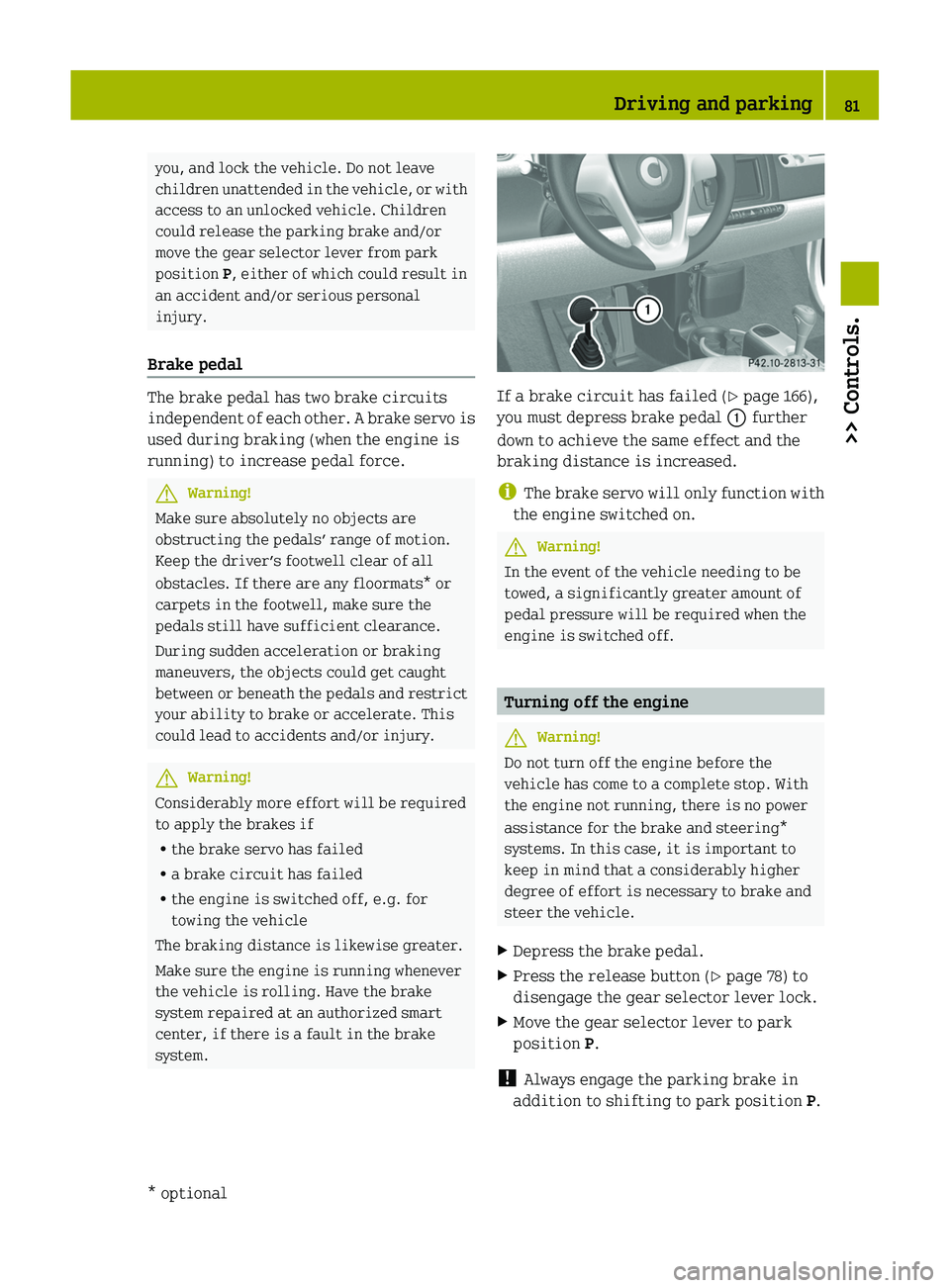
If a brake circuit has failed (Y page 166),
you must depress brake pedal \000F further
down to achieve the same effect and the
braking distance is increased.
iThe brake servo will only function with
the engine switched on.
GWarning!
In the event of the vehicle needing to be
towed, a significantly greater amount of
pedal pressure will be required when the
engine is switched off.
Turning off the engine
GWarning!
Do not turn off the engine before the
vehicle has come to a complete stop. With
the engine not running, there is no power
assistance for the brake and steering*
systems. In this case, it is important to
keep in mind that a considerably higher
degree of effort is necessary to brake and
steer the vehicle.
XDepress the brake pedal.XPress the release button (Y page 78) to
disengage the gear selector lever lock.
XMove the gear selector lever to park
position P.
! Always engage the parking brake in
addition to shifting to park position P.
Driving and parking81>> Controls.* optionalBA 451 USA, CA Edition A 2011; 1; 4, en-UShereepeVersion: 3.0.3.62010-05-11T15:12:26+02:00 - Seite 81Z