lamp SSANGYONG KORANDO 2013 Service Manual
[x] Cancel search | Manufacturer: SSANGYONG, Model Year: 2013, Model line: KORANDO, Model: SSANGYONG KORANDO 2013Pages: 1336, PDF Size: 92.18 MB
Page 1143 of 1336
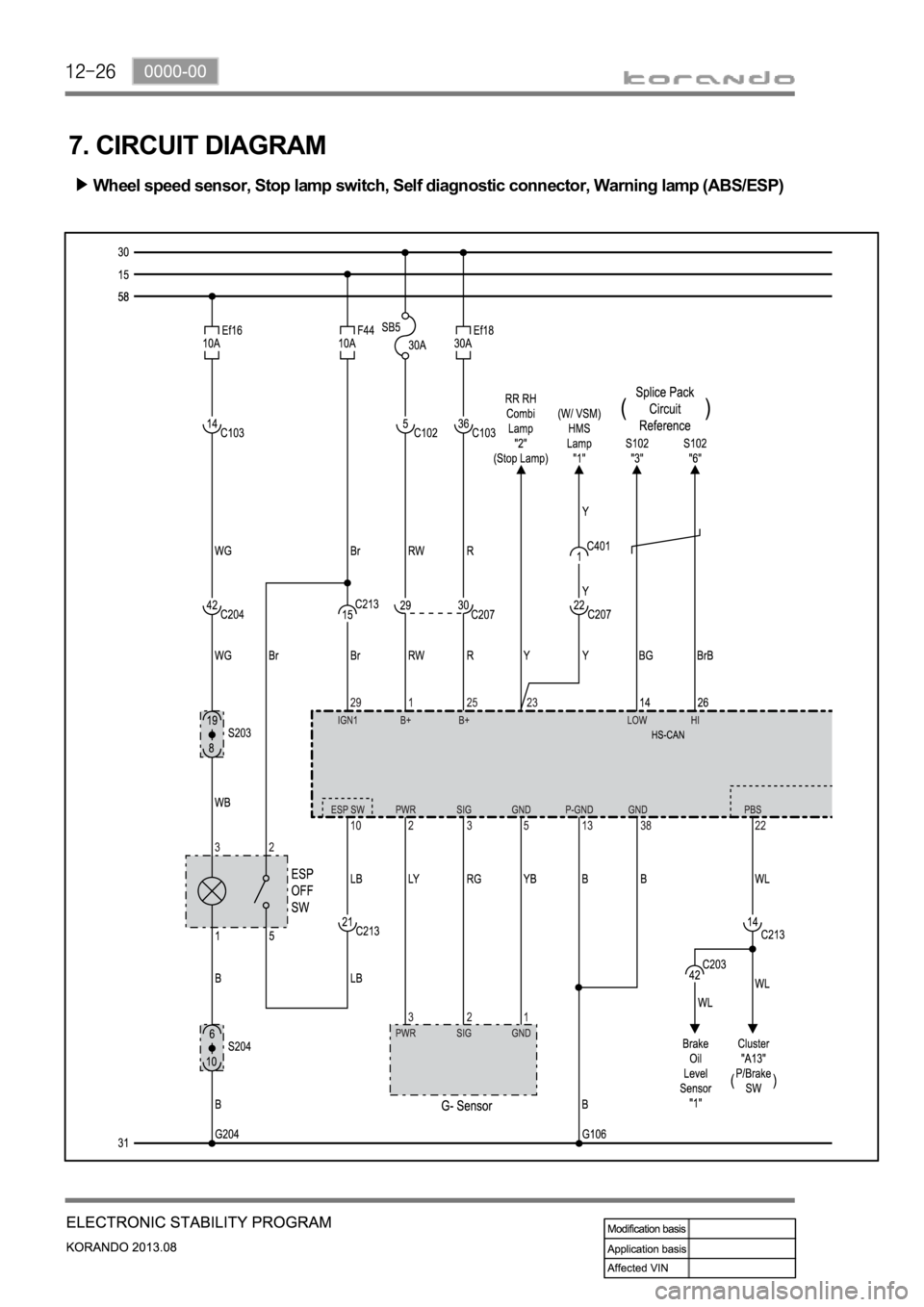
7. CIRCUIT DIAGRAM
Wheel speed sensor, Stop lamp switch, Self diagnostic connector, Warning lamp (ABS/ESP)
Page 1172 of 1336

4190-00
3. CAUTIONS
The tire pressure values displayed on the instrument cluster are sent from the wheel modules after
the vehicle is driven for a period of time. Therefore, they are not displayed at initial start (more than
20 minutes have elapsed after ignition off). It can be displayed after 10 minutes of driving at speed of
20 km/h or higher. -
The TPMS uses a radio frequency and a high frequency band between the wheel module and the
TPMS ECU for communication.
Therefore, if the vehicle is equipped with the electronic equipment such as mobile camera monitor
or the vehicle is passing through the area with a strong electromagnetic field, the system may not
operate normally.
For the vehicle equipped with the TPMS, the TPMS warning lamp on the instrument cluster comes
on and pressure values on the EL display is displayed as bars (--) after driving for a certain period of
time if a newly installed tire is not equipped with the wheel module. -
-
At initial startDisplay pressure value after
detecting
position automatically
Standard type
Supervision type
Page 1175 of 1336

Instrument cluster display related to TPMS (with standard)
DOT LCD display TPMS warning lamp Global warning lamp
2. LAYOUT 1. OVERVIEW
The TPMS is used to reduce the accident rate, enhance driving stability and avoid an unnecessary fuel
consumption and tire wear by monitoring the tire pressure and temperature to inform the driver of tire
pressure information and its status through the instrument cluster. The wheel module fitted in the tire
transmits the internal data for the tire to the TPMS ECU periodically through the wireless transmission.
The TPMS ECU can detect the positions of the wheel modules fitted to each wheel automatically and
sends the signal on tire condition through the CAN line to the instrument cluster so that the driver can
identify the wheel module in question.
Instrument cluster display related to TPMS (with supervision)
DOT LCD display TPMS warning lamp Global warning lamp
Page 1179 of 1336
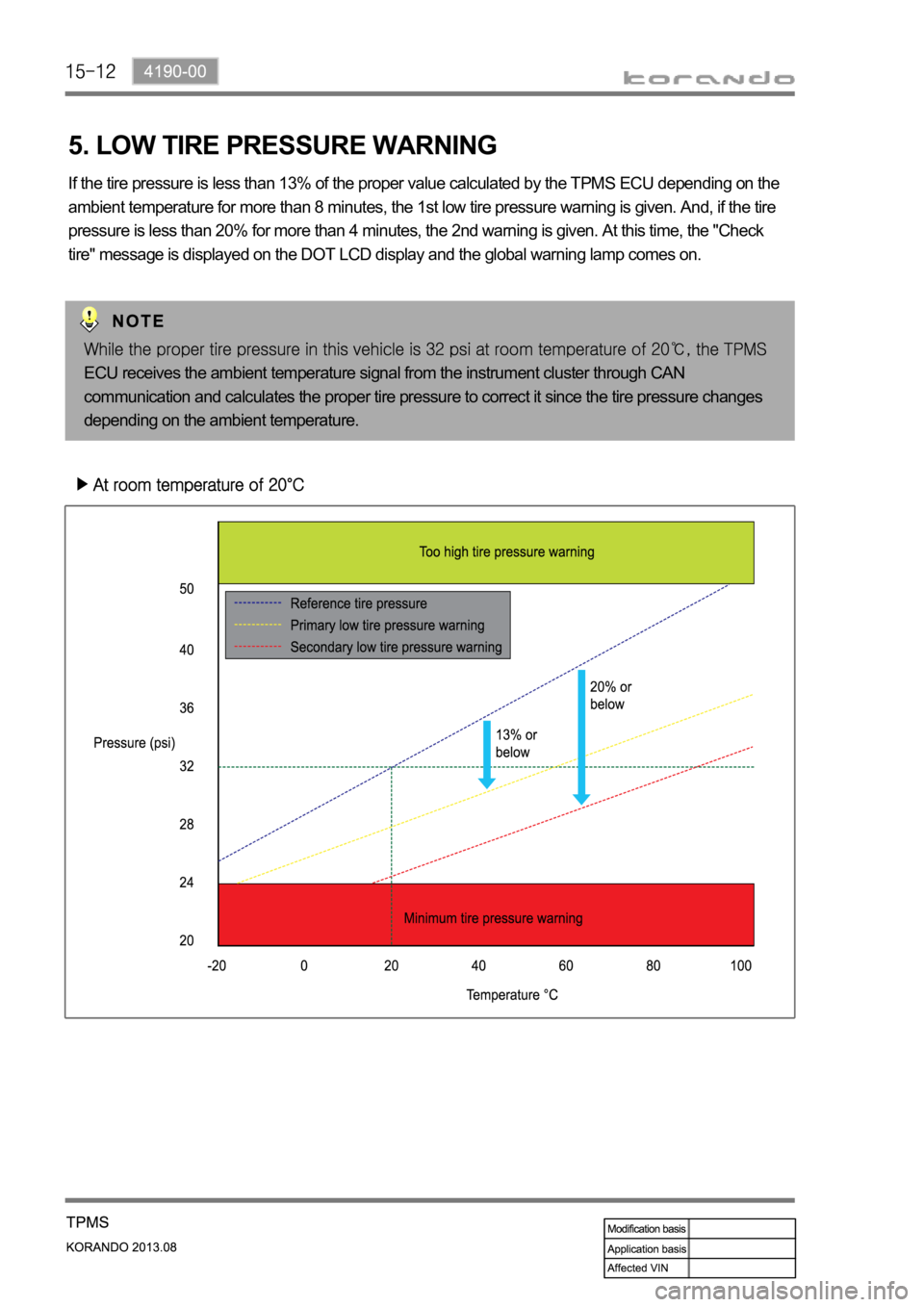
5. LOW TIRE PRESSURE WARNING
If the tire pressure is less than 13% of the proper value calculated by the TPMS ECU depending on the
ambient temperature for more than 8 minutes, the 1st low tire pressure warning is given. And, if the tire
pressure is less than 20% for more than 4 minutes, the 2nd warning is given. At this time, the "Check
tire" message is displayed on the DOT LCD display and the global warning lamp comes on.
ECU receives the ambient temperature signal from the instrument cluster through CAN
communication and calculates the proper tire pressure to correct it since the tire pressure changes
depending on the ambient temperature.
Page 1181 of 1336
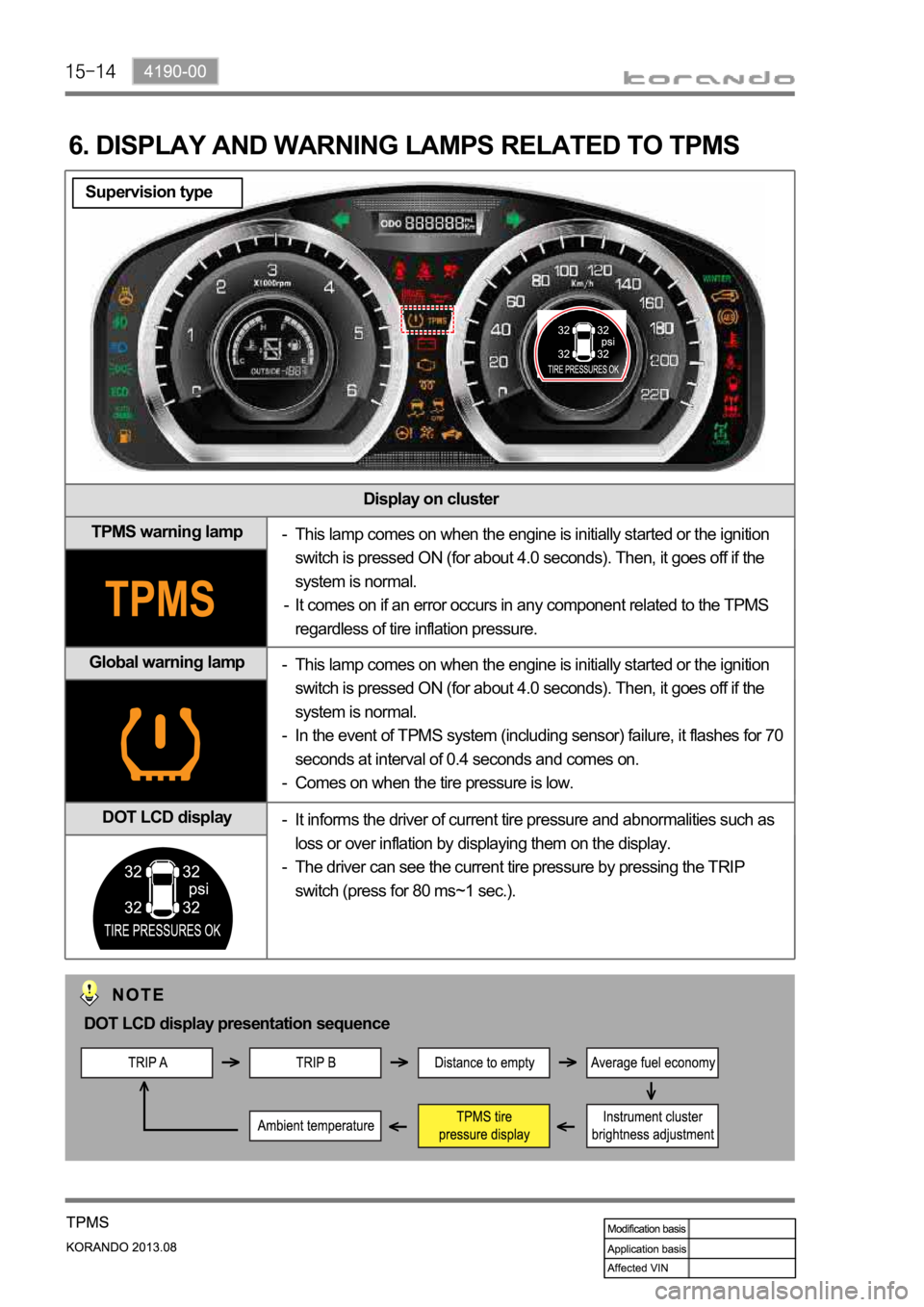
Display on cluster
TPMS warning lamp
Global warning lamp
DOT LCD display
6. DISPLAY AND WARNING LAMPS RELATED TO TPMS
This lamp comes on when the engine is initially started or the ignition
switch is pressed ON (for about 4.0 seconds). Then, it goes off if the
system is normal.
It comes on if an error occurs in any component related to the TPMS
regardless of tire inflation pressure. -
-
This lamp comes on when the engine is initially started or the ignition
switch is pressed ON (for about 4.0 seconds). Then, it goes off if the
system is normal.
In the event of TPMS system (including sensor) failure, it flashes for 70
seconds at interval of 0.4 seconds and comes on.
Comes on when the tire pressure is low. -
-
-
It informs the driver of current tire pressure and abnormalities such as
loss or over inflation by displaying them on the display.
The driver can see the current tire pressure by pressing the TRIP
switch (press for 80 ms~1 sec.). -
-
DOT LCD display presentation sequence
Supervision type
Page 1182 of 1336

4190-00
Display on cluster
TPMS warning lamp
Global warning lamp
DOT display
This lamp comes on when the engine is initially started or the ignition
switch is pressed ON (for about 4.0 seconds). Then, it goes off if the
system is normal.
It comes on if an error occurs in any component related to the TPMS
regardless of tire inflation pressure. -
-
This lamp comes on when the engine is initially started or the ignition
switch is pressed ON (for about 4.0 seconds). Then, it goes off if the
system is normal.
In the event of TPMS system (including sensor) failure, it flashes for 70
seconds at interval of 0.4 seconds and comes on.
Comes on when the tire pressure is low. -
-
-
The tire pressure for front wheels is displayed on the LCD display. The
tire pressure for rear wheels is displayed when pressing the Trip switch. -
Standard type
DOT display presentation sequence
Page 1183 of 1336

1) DOT LCD Display Related to TPMS
Status DOT LCD display Condition & illumination method
Correct tire pressureThe specified tire pressure is based on a
cold tire with the vehicle unloaded (no
Excessive tire pressureCorresponding status lamp blinks with
reverse shading at interval of 0.4 seconds if
tire pressure is 50 psi or higher
Low tire pressureWhen tire pressure is less than 13~20% of
specified value for a period of time,
corresponding status lamp blinks with
reverse shading for 70 seconds at interval o
f
0.4 seconds
Lower than minimum tire
pressureCorresponding status lamp comes on if tire
pressure is 24 psi or less
Sudden tire pressure lossCorresponding status lamp blinks with
shading reverse at interval of 0.4 seconds if
tire pressure changes more than 3 psi per 1
minute at speed of 0 km/h or above.
Imbalance between left and
right tire pressureCorresponding status lamps blink
alternately at interval of 1.0 second if tire
pressure differs by more than 4 psi in the left
and right tires while driving for more than 10
minutes
Impossible to determine tire
pressurePressure of the tire displayed as "--" when
not possible to determine tire pressure
correctly
* At initial start, the tire pressure can be
displayed after 10 minutes of driving at
speed of 20 km/h or higher
Supervision type
Page 1191 of 1336

6810-00
Heater & A/C control assembly
Heater and A/C control assembly design and switch arrangement changed
- Digital display (LCD display) with FATC used
- Push button type switch used (self-return type)
2. MAJOR CHANGES
Change of air conditioner pipe
With MTC
With FATC
With MTC
With FATC
Changes in heater and control assembly
Liquid and suction pipe
Liquid and suction pipe route changed due to change of headlamp mounting bracket
Page 1194 of 1336

2. LAYOUT
1) Exterior Layout
Liquid and suction pipe
The high/low-pressure A/C refrigerant flows
through this pipe. It is fitted with the refrigerant
pressure sensor.
Electric fan
It cools down the A/C condenser to speed up the
compression for the refrigerant in the condenser.
Refrigerant pressure sensor
It is mounted to the latter part of the right
headlamp. It converts the A/C refrigerant pressure
to voltage value and sends it to the engine ECU.
A/C compressor
It is installed to the left side of the engine
assembly, compresses the low-temperature and
low-pressure coolant and converts it to the high-
temperature and high-pressure coolant. Then, it
sends the coolant to the A/C condenser.
Page 1220 of 1336

(6) A/C control
The air conditioner is operated at the defroster mode and MAX air conditioner mode and when the A/C
switch is turned to "ON" position. It is controlled by the A/C compressor of the engine ECU according to
the signal from the heater and A/C control assembly. The driver can see that the A/C has been activated
when an indicator lamps at the A/C switch and MAX A/C switch comes on. If the intake sensor detects
the freezing of the evaporator core, it stops the air conditioner by turning off the compressor.
MAX A/C control
This is designed for increasing driver comfort. When the switch is pressed, the air conditioner is
operated and vent and recirculation modes are selected automatically. The discharge temperature and
fan speed are regulated depending on the driver's choice.
A/C switch
MAX A/C control switch