head SUBARU CROSSTREK 2018 User Guide
[x] Cancel search | Manufacturer: SUBARU, Model Year: 2018, Model line: CROSSTREK, Model: SUBARU CROSSTREK 2018Pages: 474, PDF Size: 20.76 MB
Page 37 of 474
(38,1)
北米Model "A1320BE-C" EDITED: 2017/ 10/ 10
fold down in the event of sudden
braking, or objects may move out
from the cargo area, which could
cause serious injury or death.&Head restraints
WARNING
The front seat head restraints are
designed to be installed into the
front seats only. The rear seat head
restraints are designed to be in-
stalled into the rear seats only. Do
not attempt to install the front seat
head restraints into the rear seats, or
the rear seat head restraints into the
front seats.NOTEIt is possible to adjust the angle of the
front seat head restraints only. When
installing the front seat head restraints,
make sure that the angle of the head
restraints can be adjusted.!Front seats
Both the driver’s seat and the front
passenger’s seat are equipped with head
restraints. Both head restraints are adjus-
table in the following ways.
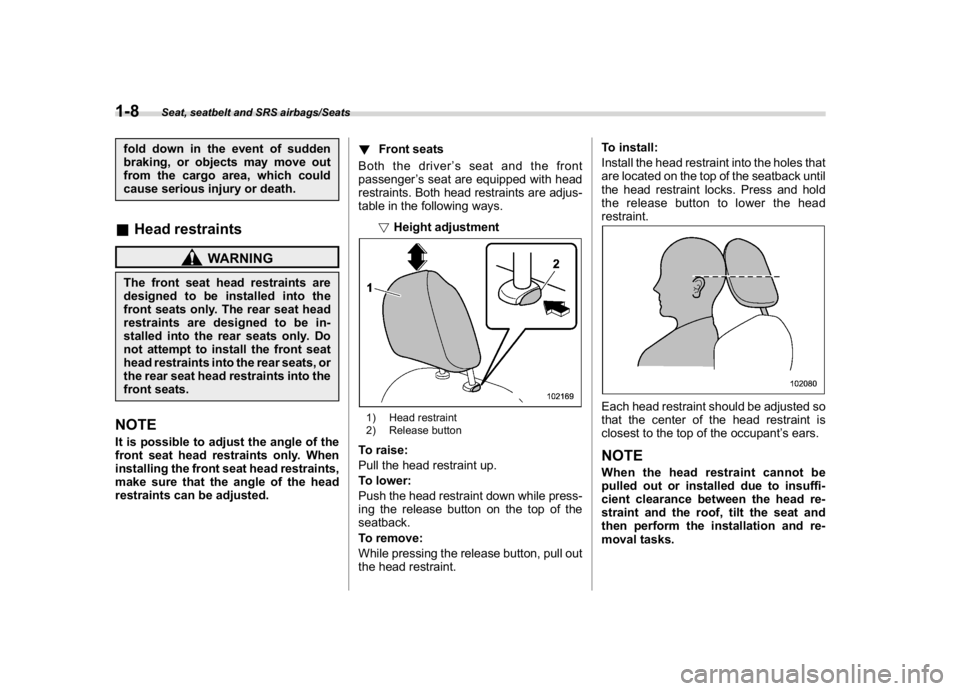
!Height adjustment
1) Head restraint
2) Release buttonTo raise:
Pull the head restraint up.
To lower:
Push the head restraint down while press-
ing the release button on the top of the
seatback.
To remove:
While pressing the release button, pull out
the head restraint.To install:
Install the head restraint into the holes that
are located on the top of the seatback until
the head restraint locks. Press and hold
the release button to lower the head
restraint.
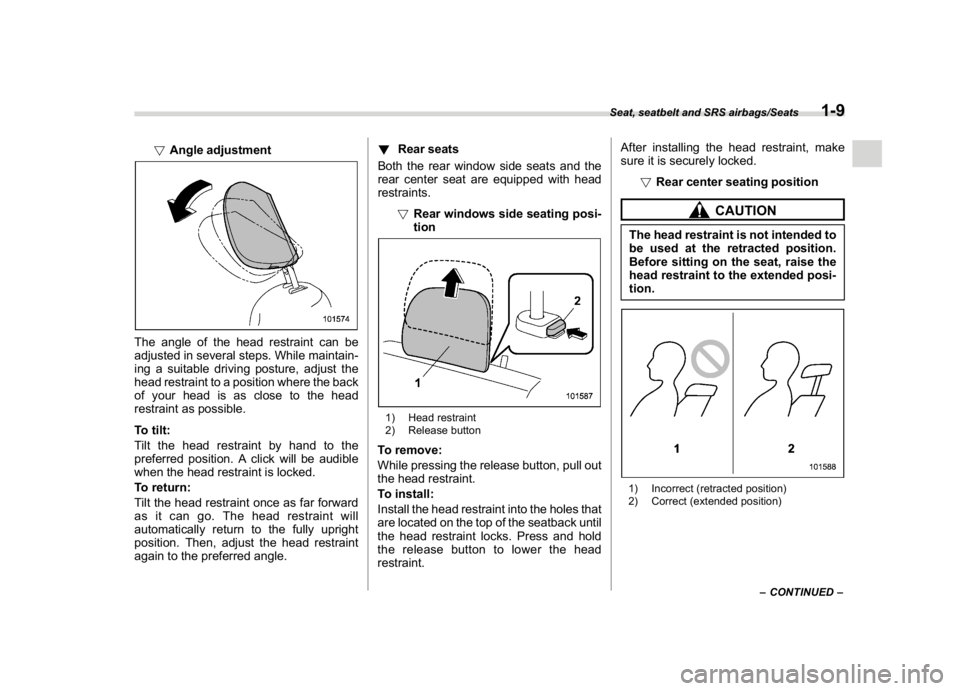
Each head restraint should be adjusted so
that the center of the head restraint is
closest to the top of the occupant’s ears.NOTEWhen the head restraint cannot be
pulled out or installed due to insuffi-
cient clearance between the head re-
straint and the roof, tilt the seat and
then perform the installation and re-
moval tasks.
Seat, seatbelt and SRS airbags/Seats
1-8
Page 38 of 474
(39,1)
北米Model "A1320BE-C" EDITED: 2017/ 10/ 10
!Angle adjustment
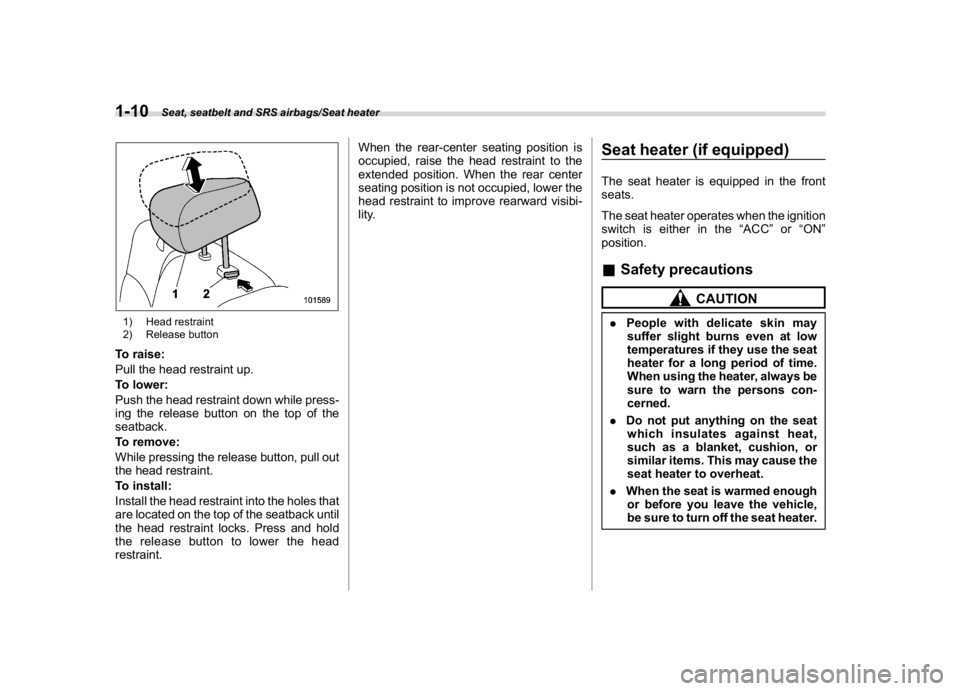
The angle of the head restraint can be
adjusted in several steps. While maintain-
ing a suitable driving posture, adjust the
head restraint to a position where the back
of your head is as close to the head
restraint as possible.
To tilt:
Tilt the head restraint by hand to the
preferred position. A click will be audible
when the head restraint is locked.
To return:
Tilt the head restraint once as far forward
as it can go. The head restraint will
automatically return to the fully upright
position. Then, adjust the head restraint
again to the preferred angle.!Rear seats
Both the rear window side seats and the
rear center seat are equipped with head
restraints.
!Rear windows side seating posi-
tion
1) Head restraint
2) Release buttonTo remove:
While pressing the release button, pull out
the head restraint.
To install:
Install the head restraint into the holes that
are located on the top of the seatback until
the head restraint locks. Press and hold
the release button to lower the head
restraint.After installing the head restraint, make
sure it is securely locked.
!Rear center seating position
CAUTION
The head restraint is not intended to
be used at the retracted position.
Before sitting on the seat, raise the
head restraint to the extended posi-
tion.1) Incorrect (retracted position)
2) Correct (extended position)
–CONTINUED–
Seat, seatbelt and SRS airbags/Seats
1-9
1
Page 39 of 474
(40,1)
北米Model "A1320BE-C" EDITED: 2017/ 10/ 10
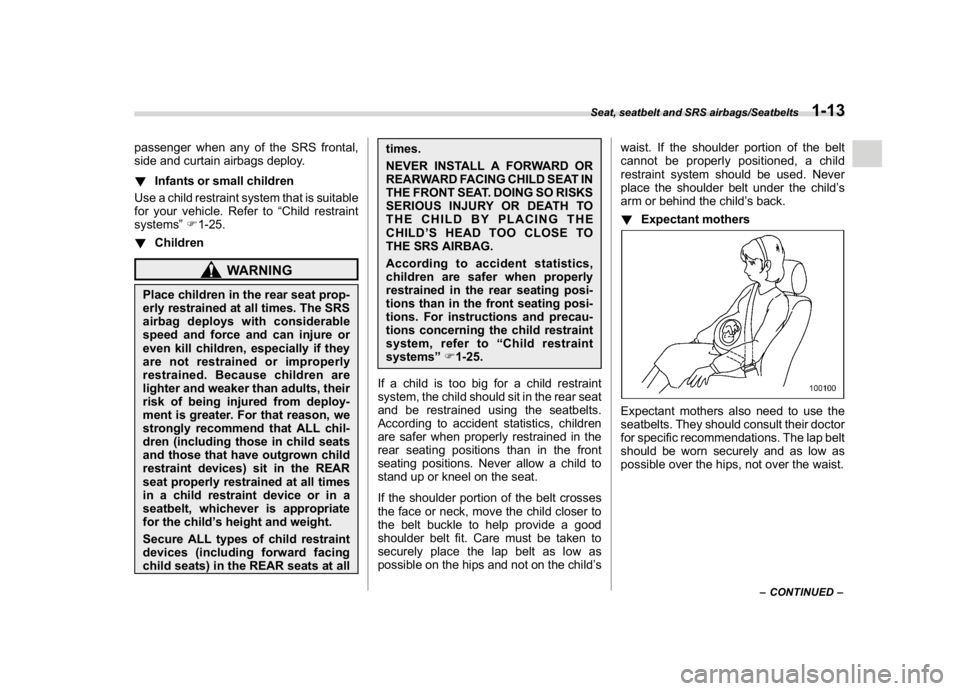
1) Head restraint
2) Release buttonTo raise:
Pull the head restraint up.
To lower:
Push the head restraint down while press-
ing the release button on the top of the
seatback.
To remove:
While pressing the release button, pull out
the head restraint.
To install:
Install the head restraint into the holes that
are located on the top of the seatback until
the head restraint locks. Press and hold
the release button to lower the head
restraint.When the rear-center seating position is
occupied, raise the head restraint to the
extended position. When the rear center
seating position is not occupied, lower the
head restraint to improve rearward visibi-
lity.
Seat heater (if equipped)The seat heater is equipped in the front
seats.
The seat heater operates when the ignition
switch is either in the“ACC”or“ON”
position.&Safety precautions
CAUTION
.People with delicate skin may
suffer slight burns even at low
temperatures if they use the seat
heater for a long period of time.
When using the heater, always be
sure to warn the persons con-
cerned.
.Do not put anything on the seat
which insulates against heat,
such as a blanket, cushion, or
similar items. This may cause the
seat heater to overheat.
.When the seat is warmed enough
or before you leave the vehicle,
be sure to turn off the seat heater.
Seat, seatbelt and SRS airbags/Seat heater
1-10
Page 42 of 474
(43,1)
北米Model "A1320BE-C" EDITED: 2017/ 10/ 10
passenger when any of the SRS frontal,
side and curtain airbags deploy.
!Infants or small children
Use a child restraint system that is suitable
for your vehicle. Refer to“Child restraint
systems”F1-25.
!Children
WARNING
Place children in the rear seat prop-
erly restrained at all times. The SRS
airbag deploys with considerable
speed and force and can injure or
even kill children, especially if they
are not restrained or improperly
restrained. Because children are
lighter and weaker than adults, their
risk of being injured from deploy-
ment is greater. For that reason, we
strongly recommend that ALL chil-
dren (including those in child seats
and those that have outgrown child
restraint devices) sit in the REAR
seat properly restrained at all times
in a child restraint device or in a
seatbelt, whichever is appropriate
for the child’s height and weight.
Secure ALL types of child restraint
devices (including forward facing
child seats) in the REAR seats at alltimes.
NEVER INSTALL A FORWARD OR
REARWARD FACING CHILD SEAT IN
THE FRONT SEAT. DOING SO RISKS
SERIOUS INJURY OR DEATH TO
THE CHILD BY PLACING THE
CHILD’SHEADTOOCLOSETO
THE SRS AIRBAG.
According to accident statistics,
children are safer when properly
restrained in the rear seating posi-
tions than in the front seating posi-
tions. For instructions and precau-
tions concerning the child restraint
system, refer to“Child restraint
systems”F1-25.
If a child is too big for a child restraint
system, the child should sit in the rear seat
and be restrained using the seatbelts.
According to accident statistics, children
are safer when properly restrained in the
rear seating positions than in the front
seating positions. Never allow a child to
stand up or kneel on the seat.
If the shoulder portion of the belt crosses
the face or neck, move the child closer to
the belt buckle to help provide a good
shoulder belt fit. Care must be taken to
securely place the lap belt as low as
possible on the hips and not on the child’swaist. If the shoulder portion of the belt
cannot be properly positioned, a child
restraint system should be used. Never
place the shoulder belt under the child’s
arm or behind the child’s back.
!Expectant mothers
Expectant mothers also need to use the
seatbelts. They should consult their doctor
for specific recommendations. The lap belt
should be worn securely and as low as
possible over the hips, not over the waist.
–CONTINUED–
Seat, seatbelt and SRS airbags/Seatbelts
1-13
1
Page 46 of 474
(47,1)
北米Model "A1320BE-C" EDITED: 2017/ 10/ 10
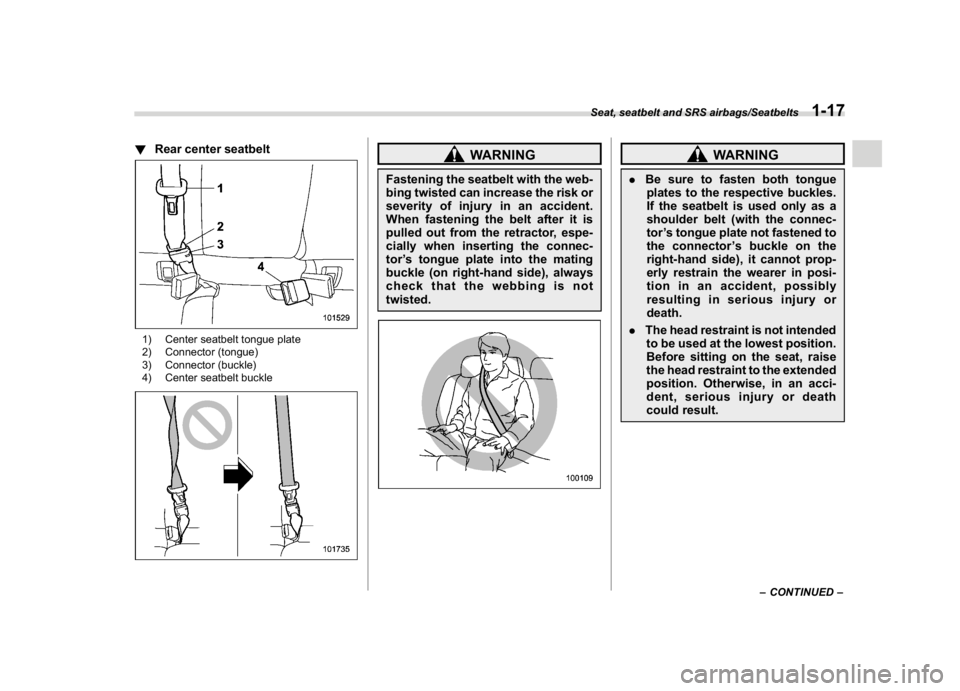
!Rear center seatbelt1) Center seatbelt tongue plate
2) Connector (tongue)
3) Connector (buckle)
4) Center seatbelt buckle
WARNING
Fastening the seatbelt with the web-
bing twisted can increase the risk or
severity of injury in an accident.
When fastening the belt after it is
pulled out from the retractor, espe-
cially when inserting the connec-
tor’s tongue plate into the mating
buckle (on right-hand side), always
check that the webbing is not
twisted.
WARNING
.Be sure to fasten both tongue
plates to the respective buckles.
If the seatbelt is used only as a
shoulder belt (with the connec-
tor’s tongue plate not fastened to
the connector’s buckle on the
right-hand side), it cannot prop-
erly restrain the wearer in posi-
tion in an accident, possibly
resulting in serious injury or
death.
.The head restraint is not intended
to be used at the lowest position.
Before sitting on the seat, raise
the head restraint to the extended
position. Otherwise, in an acci-
dent, serious injury or death
could result.
–CONTINUED–
Seat, seatbelt and SRS airbags/Seatbelts
1-17
1
Page 47 of 474
(48,1)
北米Model "A1320BE-C" EDITED: 2017/ 10/ 10
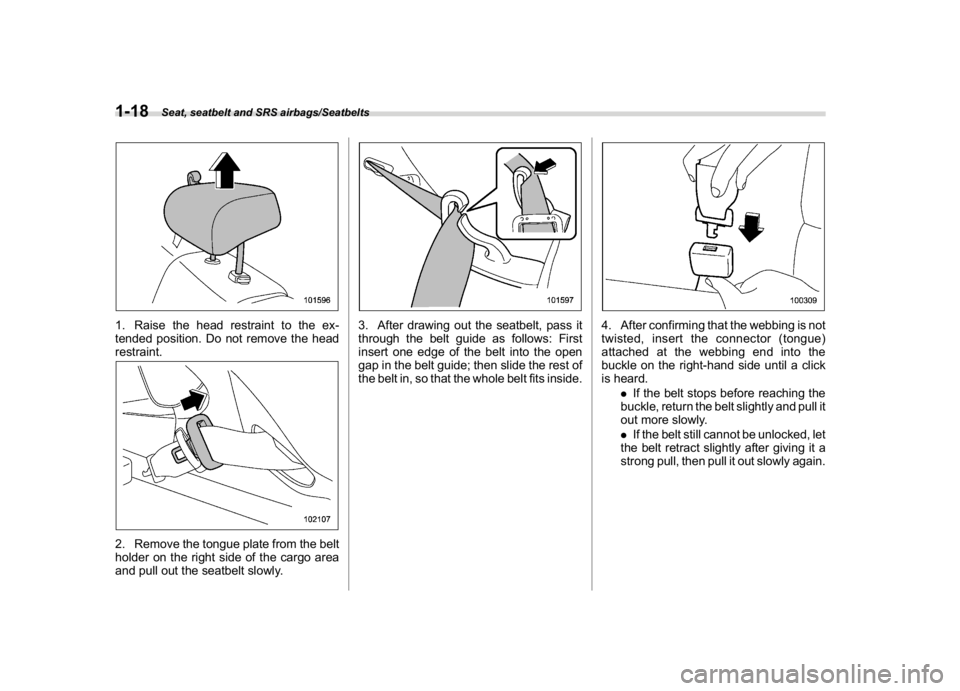
1. Raise the head restraint to the ex-
tended position. Do not remove the head
restraint.2. Remove the tongue plate from the belt
holder on the right side of the cargo area
and pull out the seatbelt slowly.
3. After drawing out the seatbelt, pass it
through the belt guide as follows: First
insert one edge of the belt into the open
gap in the belt guide; then slide the rest of
the belt in, so that the whole belt fits inside.
4. After confirming that the webbing is not
twisted, insert the connector (tongue)
attached at the webbing end into the
buckle on the right-hand side until a click
is heard.
.If the belt stops before reaching the
buckle, return the belt slightly and pull it
out more slowly.
.If the belt still cannot be unlocked, let
the belt retract slightly after giving it a
strong pull, then pull it out slowly again.
Seat, seatbelt and SRS airbags/Seatbelts
1-18
Page 56 of 474
(57,1)
北米Model "A1320BE-C" EDITED: 2017/ 10/ 10
.Automatic Locking Retractor/Emer-
gency Locking Retractor (ALR/ELR) seat-
belts
.Lower anchorages (bars)
.Upper anchorages (tether anchorages)
Some types of child restraints might not be
able to be secured firmly due to projection
of the seat cushion.
In this seating position, you should use
only a child restraint system that has a
bottom base that fits snugly against the
contours of the seat cushion and can be
securely retained using the seatbelt.
C: Rear seat, center seating position
The ALR/ELR seatbelt and an upper
anchorage (tether anchorage) are pro-
vided in this position.
Some types of child restraints might not be
able to be secured firmly due to projection
of the seat cushion.
In this seating position, you should use
only a child restraint system that has a
bottom base that fits snugly against the
contours of the seat cushion and can be
securely retained using the seatbelt.
When you install a child restraint system in
the rear seat’s center seating position,
raise the center head restraint.
Lower anchorages (bars) for window-side
seating positions may be used for a seat inthecenterseatingpositionifachild
restraint system manufacturer’s instruc-
tions permit and specify using anchors as
far apart as those in this vehicle.
If a child restraint system is not correctly
fixed in place (for example, if a child
restraint system can be moved more than
1 inch (2.5 cm) from side to side), you
should install the child restraint system in a
rear seat, window-side seating position.
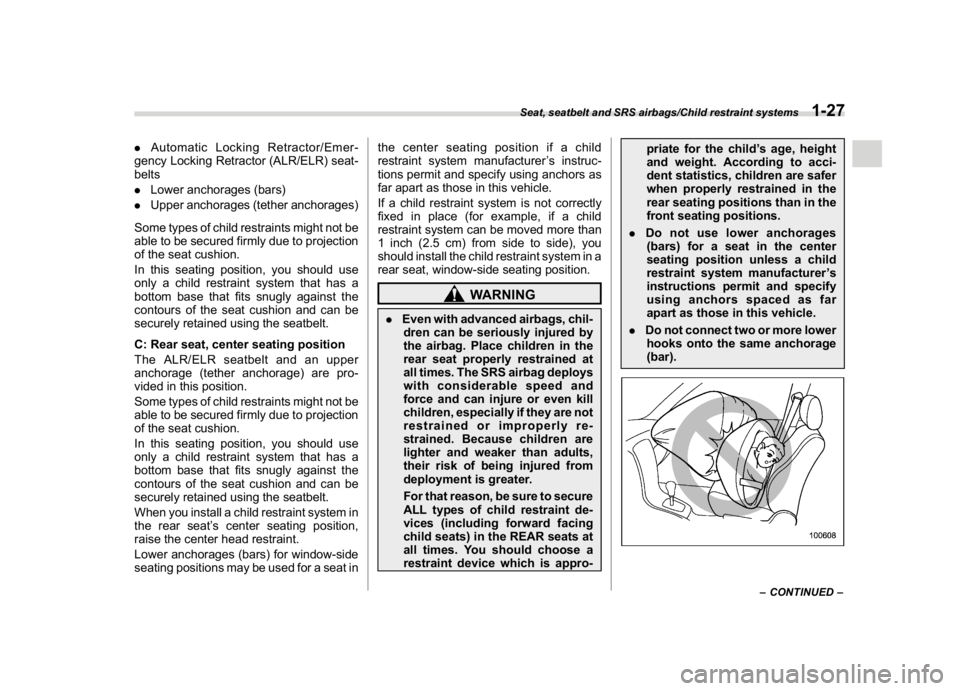
WARNING
.Even with advanced airbags, chil-
dren can be seriously injured by
the airbag. Place children in the
rear seat properly restrained at
all times. The SRS airbag deploys
with considerable speed and
force and can injure or even kill
children, especially if they are not
restrained or improperly re-
strained. Because children are
lighter and weaker than adults,
their risk of being injured from
deployment is greater.
For that reason, be sure to secure
ALL types of child restraint de-
vices (including forward facing
child seats) in the REAR seats at
all times. You should choose a
restraint device which is appro-priate for the child’s age, height
and weight. According to acci-
dent statistics, children are safer
when properly restrained in the
rear seating positions than in the
front seating positions.
.Do not use lower anchorages
(bars) for a seat in the center
seating position unless a child
restraint system manufacturer’s
instructions permit and specify
using anchors spaced as far
apart as those in this vehicle.
.Do not connect two or more lower
hooks onto the same anchorage
(bar).
–CONTINUED–
Seat, seatbelt and SRS airbags/Child restraint systems
1-27
1
Page 57 of 474
(58,1)
北米Model "A1320BE-C" EDITED: 2017/ 10/ 10
WARNING
SINCE YOUR VEHICLE IS
EQUIPPED WITH A PASSENGER’S
SRS AIRBAG, NEVER INSTALL A
FORWARD OR REARWARD FACING
CHILD SAFETY SEAT IN THE FRONT
PASSENGER’S SEAT. DOING SO
RISKS SERIOUS INJURY OR DEATH
TO THE CHILD BY PLACING THE
CHILD’S HEAD TOO CLOSE TO THE
SRS AIRBAG.&Choosing a child restraint
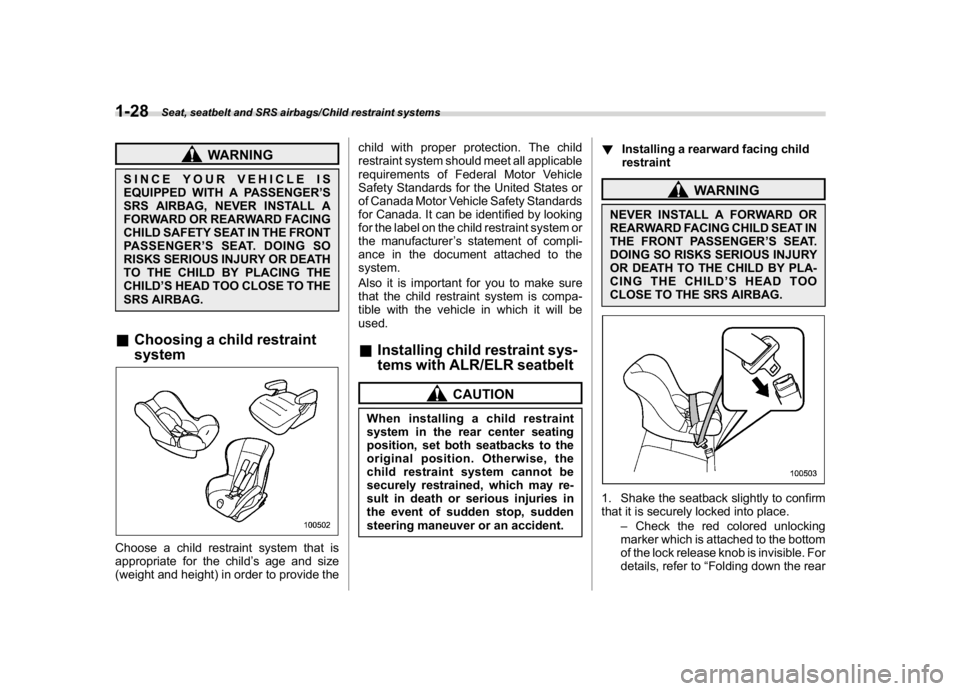
systemChoose a child restraint system that is
appropriate for the child’s age and size
(weight and height) in order to provide thechild with proper protection. The child
restraint system should meet all applicable
requirements of Federal Motor Vehicle
Safety Standards for the United States or
of Canada Motor Vehicle Safety Standards
for Canada. It can be identified by looking
for the label on the child restraint system or
the manufacturer’s statement of compli-
ance in the document attached to the
system.
Also it is important for you to make sure
that the child restraint system is compa-
tible with the vehicle in which it will be
used.
&Installing child restraint sys-
tems with ALR/ELR seatbelt
CAUTION
When installing a child restraint
system in the rear center seating
position, set both seatbacks to the
original position. Otherwise, the
child restraint system cannot be
securely restrained, which may re-
sult in death or serious injuries in
the event of sudden stop, sudden
steering maneuver or an accident.!Installing a rearward facing child
restraint
WARNING
NEVER INSTALL A FORWARD OR
REARWARD FACING CHILD SEAT IN
THE FRONT PASSENGER’S SEAT.
DOING SO RISKS SERIOUS INJURY
OR DEATH TO THE CHILD BY PLA-
CING THE CHILD’SHEADTOO
CLOSE TO THE SRS AIRBAG.1. Shake the seatback slightly to confirm
that it is securely locked into place.
–Check the red colored unlocking
marker which is attached to the bottom
of the lock release knob is invisible. For
details, refer to“Folding down the rear
Seat, seatbelt and SRS airbags/Child restraint systems
1-28
Page 59 of 474
(60,1)
北米Model "A1320BE-C" EDITED: 2017/ 10/ 10
!Installing forward facing child re-
straint
WARNING
Before installing a child restraint
system, be sure to confirm that the
seatback is securely locked into
place. Otherwise, in an accident,
serious injury or death could result.
1. Shake the seatback slightly to confirm
that it is securely locked into place.
–Check the red colored unlocking
marker which is attached to the bottom
of the lock release knob is invisible. For
details, refer to“Folding down the rear
seatback”F1-6.
2. Prepare the rear seat head restraint
where a child restraint system is intended
to be installed in the following way.
–When a child restraint system is
installed on thewindow-side seating
position, remove the rear seat head
restraint. For details, refer to“Rear
seats”F1-9.
Store the head restraint in the cargo
area. Avoid placing the head restraint
in the passenger compartment to pre-
vent it from being thrown around in the
passenger compartment in a sudden
stop or a sharp turn.–When a child restraint system is
installed on therear center seating
position, raise the rear seat head
restraint to the extended position. Do
not remove the head restraint. For
details, refer to“Rear seats”F1-9.
3. Place the child restraint system in the
rear seating position.
WARNING
When you intend to install a child
restraint system on the rear center
seating position, if the child restraint
system does not fit snugly against
the contours of the rear center seat
cushion, install the child restraint
system on the window-side seating
position to be safe. For details, refer
to“Where to place a child restraint
system”F1-26.
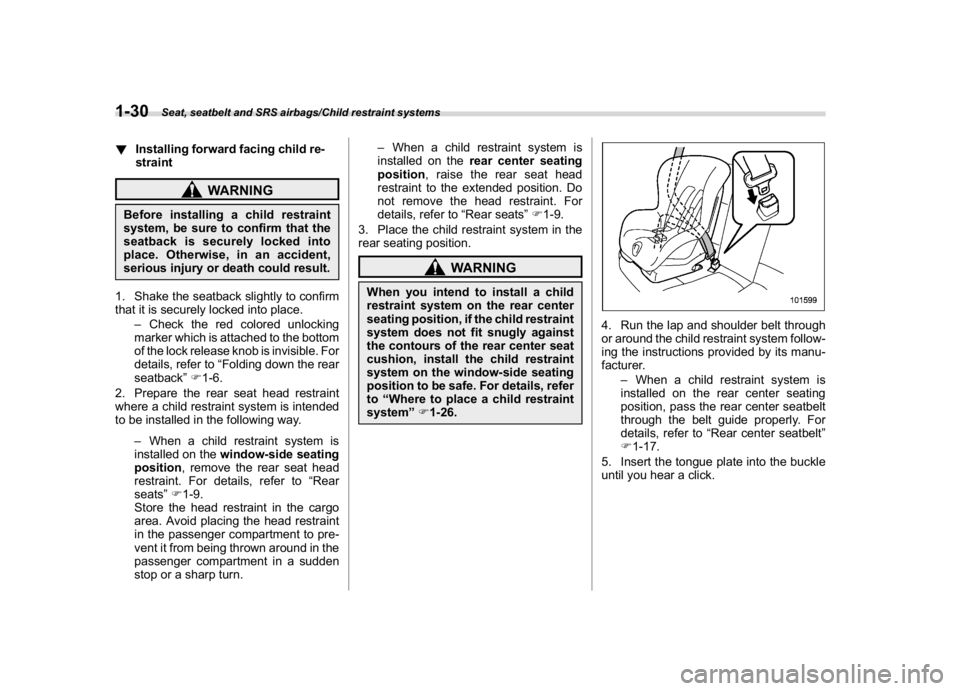
4. Run the lap and shoulder belt through
or around the child restraint system follow-
ing the instructions provided by its manu-
facturer.
–When a child restraint system is
installed on the rear center seating
position, pass the rear center seatbelt
through the belt guide properly. For
details, refer to“Rear center seatbelt”
F1-17.
5. Insert the tongue plate into the buckle
until you hear a click.
Seat, seatbelt and SRS airbags/Child restraint systems
1-30
Page 61 of 474
(62,1)
北米Model "A1320BE-C" EDITED: 2017/ 10/ 10
press the release button on the seatbelt
buckle and allow the belt to retract
completely. The belt will return to the
ELR mode.
If you have installed a child restraint
system for therear center seating posi-
tion, when you remove the child restraint
system, the seatbelt may not be restored
to the ELR mode even if the seatbelt is
retracted. In this case, lower the head
restraint to the retracted position to allow
the seatbelt to retract moreover. The
seatbelt will return to the ELR mode.
Remember that the head restraint is not
intended to be used at the lowest position
(retracted position). Therefore, when the
rear center seat is occupied (including
when a child restraint system is installed)
next time, be sure to raise the head
restraint to the extended position.NOTEWhen the child restraint system is no
longer in use, remove it and restore the
ELR function of the retractor. That
function is restored by allowing the
seatbelt to retract fully.
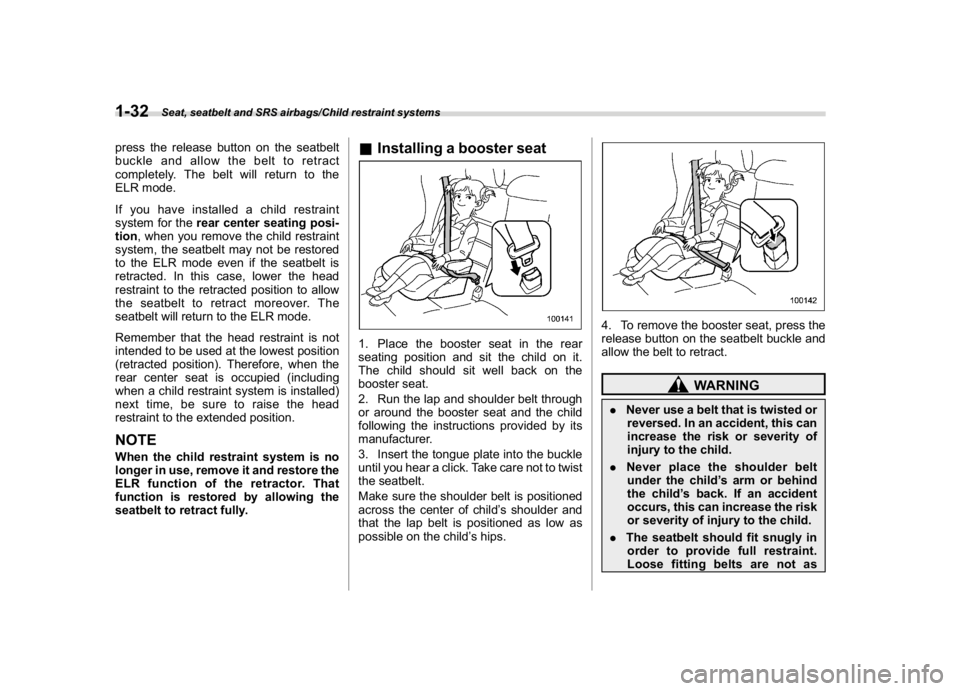
&Installing a booster seat1. Place the booster seat in the rear
seating position and sit the child on it.
The child should sit well back on the
booster seat.
2. Run the lap and shoulder belt through
or around the booster seat and the child
following the instructions provided by its
manufacturer.
3. Insert the tongue plate into the buckle
until you hear a click. Take care not to twist
the seatbelt.
Make sure the shoulder belt is positioned
across the center of child’s shoulder and
that the lap belt is positioned as low as
possible on the child’s hips.
4. To remove the booster seat, press the
release button on the seatbelt buckle and
allow the belt to retract.
WARNING
.Never use a belt that is twisted or
reversed. In an accident, this can
increase the risk or severity of
injury to the child.
.Never place the shoulder belt
under the child’s arm or behind
the child’s back. If an accident
occurs, this can increase the risk
or severity of injury to the child.
.The seatbelt should fit snugly in
order to provide full restraint.
Loose fitting belts are not as
Seat, seatbelt and SRS airbags/Child restraint systems
1-32