head SUBARU CROSSTREK 2018 Owner's Manual
[x] Cancel search | Manufacturer: SUBARU, Model Year: 2018, Model line: CROSSTREK, Model: SUBARU CROSSTREK 2018Pages: 474, PDF Size: 20.76 MB
Page 64 of 474
(65,1)
北米Model "A1320BE-C" EDITED: 2017/ 10/ 10
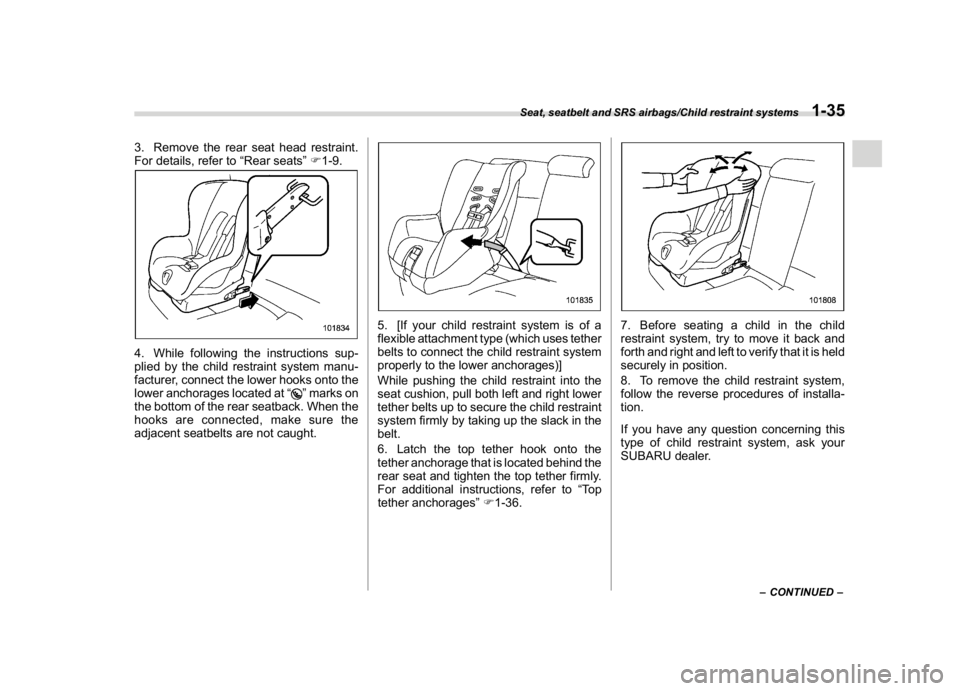
3. Remove the rear seat head restraint.
For details, refer to“Rear seats”F1-9.4. While following the instructions sup-
plied by the child restraint system manu-
facturer, connect the lower hooks onto the
lower anchorages located at“
”marks on
the bottom of the rear seatback. When the
hooks are connected, make sure the
adjacent seatbelts are not caught.
5. [If your child restraint system is of a
flexible attachment type (which uses tether
belts to connect the child restraint system
properly to the lower anchorages)]
While pushing the child restraint into the
seat cushion, pull both left and right lower
tether belts up to secure the child restraint
system firmly by taking up the slack in the
belt.
6. Latch the top tether hook onto the
tether anchorage that is located behind the
rear seat and tighten the top tether firmly.
For additional instructions, refer to“To p
tether anchorages”F1-36.
7. Before seating a child in the child
restraint system, try to move it back and
forth and right and left to verify that it is held
securely in position.
8. To remove the child restraint system,
follow the reverse procedures of installa-
tion.
If you have any question concerning this
type of child restraint system, ask your
SUBARU dealer.
–CONTINUED–
Seat, seatbelt and SRS airbags/Child restraint systems
1-35
1
Page 65 of 474
(66,1)
北米Model "A1320BE-C" EDITED: 2017/ 10/ 10
&Top tether anchoragesYour vehicle is equipped with three top
tether anchorages so that a child restraint
system having a top tether can be installed
in the rear seat. When installing a child
restraint system using top tether, proceed
as follows, while observing the instructions
by the child restraint system manufacturer.
Since a top tether can provide additional
stability by offering another connection
between a child restraint system and the
vehicle, we recommend that you use a top
tether whenever one is required or avail-
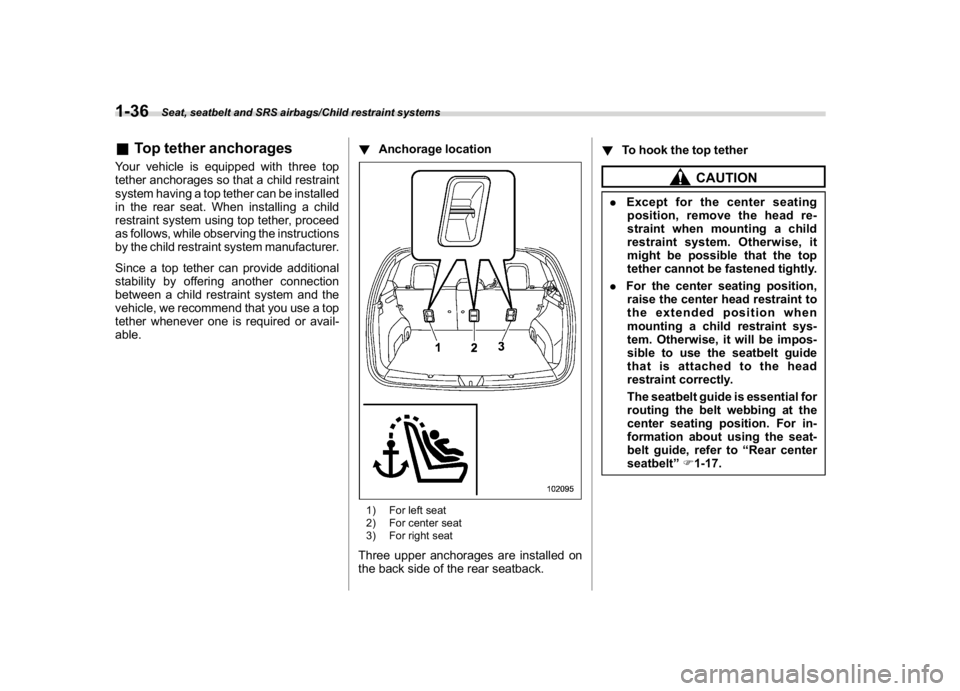
able.!Anchorage location
1) For left seat
2) For center seat
3) For right seatThree upper anchorages are installed on
the back side of the rear seatback.!To hook the top tether
CAUTION
.Except for the center seating
position, remove the head re-
straint when mounting a child
restraint system. Otherwise, it
might be possible that the top
tether cannot be fastened tightly.
.For the center seating position,
raise the center head restraint to
the extended position when
mounting a child restraint sys-
tem. Otherwise, it will be impos-
sible to use the seatbelt guide
that is attached to the head
restraint correctly.
The seatbelt guide is essential for
routing the belt webbing at the
center seating position. For in-
formation about using the seat-
belt guide, refer to“Rear center
seatbelt”F1-17.
Seat, seatbelt and SRS airbags/Child restraint systems
1-36
Page 66 of 474
(67,1)
北米Model "A1320BE-C" EDITED: 2017/ 10/ 10
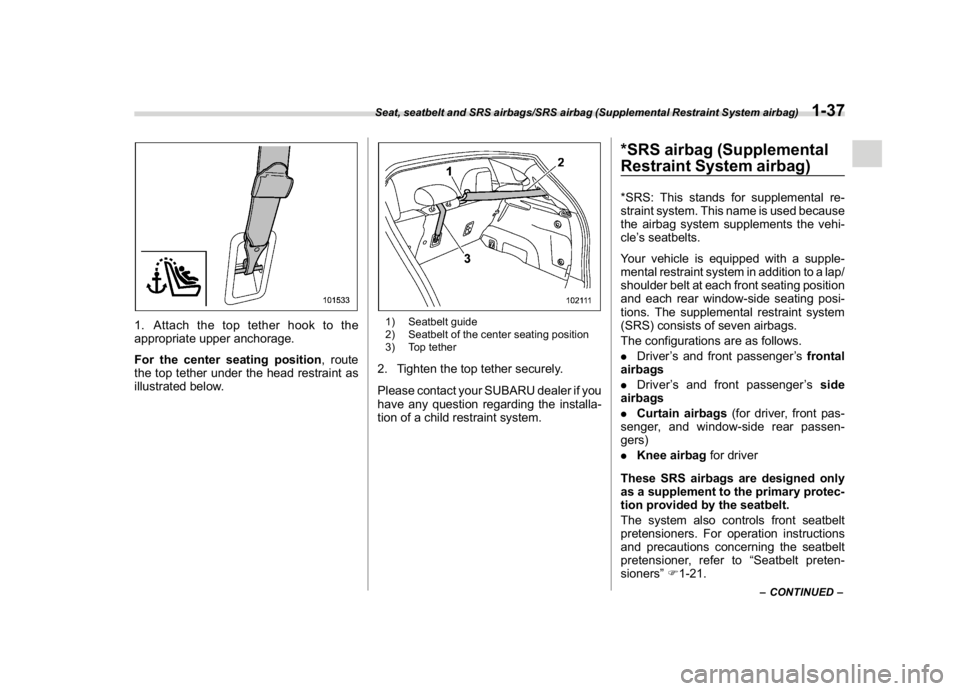
1. Attach the top tether hook to the
appropriate upper anchorage.
For the center seating position, route
the top tether under the head restraint as
illustrated below.
1) Seatbelt guide
2) Seatbelt of the center seating position
3) Top tether2. Tighten the top tether securely.
Please contact your SUBARU dealer if you
have any question regarding the installa-
tion of a child restraint system.
*SRS airbag (Supplemental
Restraint System airbag)*SRS: This stands for supplemental re-
straint system. This name is used because
the airbag system supplements the vehi-
cle’s seatbelts.
Your vehicle is equipped with a supple-
mental restraint system in addition to a lap/
shoulder belt at each front seating position
and each rear window-side seating posi-
tions. The supplemental restraint system
(SRS) consists of seven airbags.
The configurations are as follows.
.Driver’s and front passenger’sfrontal
airbags
.Driver’s and front passenger’sside
airbags
.Curtain airbags(for driver, front pas-
senger, and window-side rear passen-
gers)
.Knee airbagfor driver
These SRS airbags are designed only
as a supplement to the primary protec-
tion provided by the seatbelt.
The system also controls front seatbelt
pretensioners. For operation instructions
and precautions concerning the seatbelt
pretensioner, refer to“Seatbelt preten-
sioners”F1-21.
–CONTINUED–
Seat, seatbelt and SRS airbags/SRS airbag (Supplemental Restraint System airbag)
1-37
1
Page 67 of 474
(68,1)
北米Model "A1320BE-C" EDITED: 2017/ 10/ 10
&General precautions regard-
ing SRS airbag system
WARNING
.To obtain maximum protection in
the event of an accident, the
driver and all passengers must
always wear seatbelts when in
the vehicle. The SRS airbag is
designed only to be a supplement
to the primary protection pro-
vided by the seatbelt. It does not
eliminate the need to fasten seat-
belts. In combination with the
seatbelts, it offers the best com-
bined protection in case of a
serious accident.
Not wearing a seatbelt increases
the chance of severe injury or
death in a crash even when the
vehicle has the SRS airbag.
For instructions and precautions
concerning the seatbelt system,
refer to“Seatbelts”F1-12.
.The SRS side airbag and SRS
curtain airbag are designed only
to be a supplement to the primary
protection provided by the seat-
belt. They do not eliminate the
need to fasten seatbelts. It is also
important to wear your seatbelt tohelp avoid injuries that can result
when an occupant is not seated
in a proper upright position.
WARNING
.The SRS airbags deploy with
considerable speed and force.
Occupants who are out of proper
position when the SRS airbag
deploys could suffer very serious
injuries. Because the SRS airbag
needs enough space for deploy-
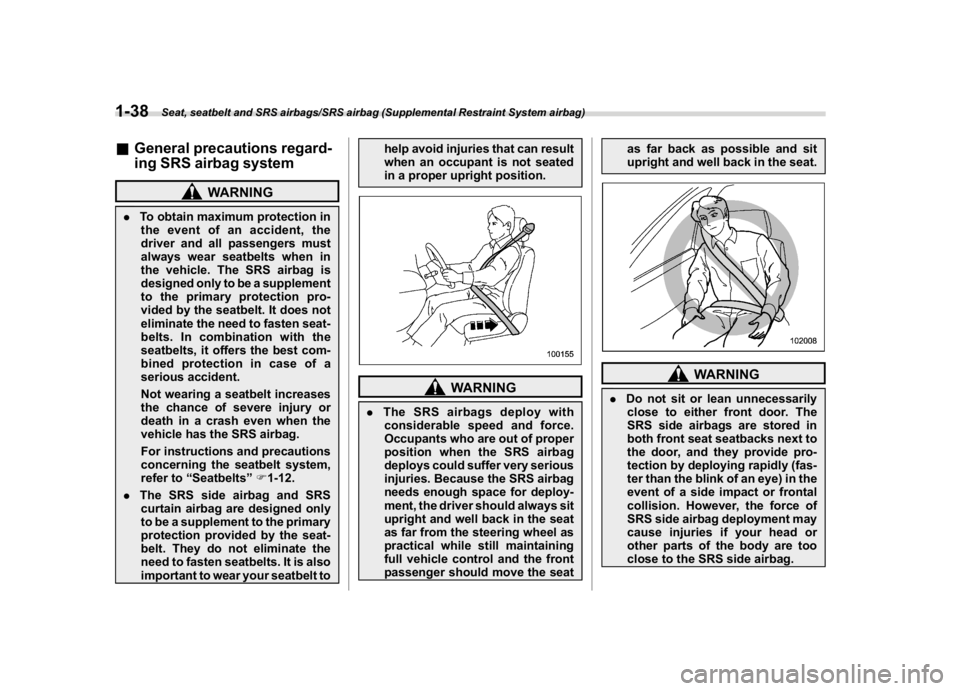
ment, the driver should always sit
upright and well back in the seat
as far from the steering wheel as
practical while still maintaining
full vehicle control and the front
passenger should move the seatas far back as possible and sit
upright and well back in the seat.
WARNING
.Do not sit or lean unnecessarily
close to either front door. The
SRS side airbags are stored in
both front seat seatbacks next to
the door, and they provide pro-
tection by deploying rapidly (fas-
ter than the blink of an eye) in the
event of a side impact or frontal
collision. However, the force of
SRS side airbag deployment may
cause injuries if your head or
other parts of the body are too
close to the SRS side airbag.
Seat, seatbelt and SRS airbags/SRS airbag (Supplemental Restraint System airbag)
1-38
Page 68 of 474
(69,1)
北米Model "A1320BE-C" EDITED: 2017/ 10/ 10
.Since your vehicle is equipped
with SRS curtain airbags, do not
sit or lean unnecessarily close to
the front or rear door on either
side. Also, do not put your head,
arms or hands out of the window.
The SRS curtain airbags on both
sides of the cabin are stored in
the roof side (between the front
pillar and a point behind the rear
quarter glass), and they provide
protection by deploying rapidly
(faster than the blink of an eye) in
the event of a side impact, roll-
over or an offset frontal collision.
However, the force of its deploy-
ment may cause injuries if your
head is too close to it.
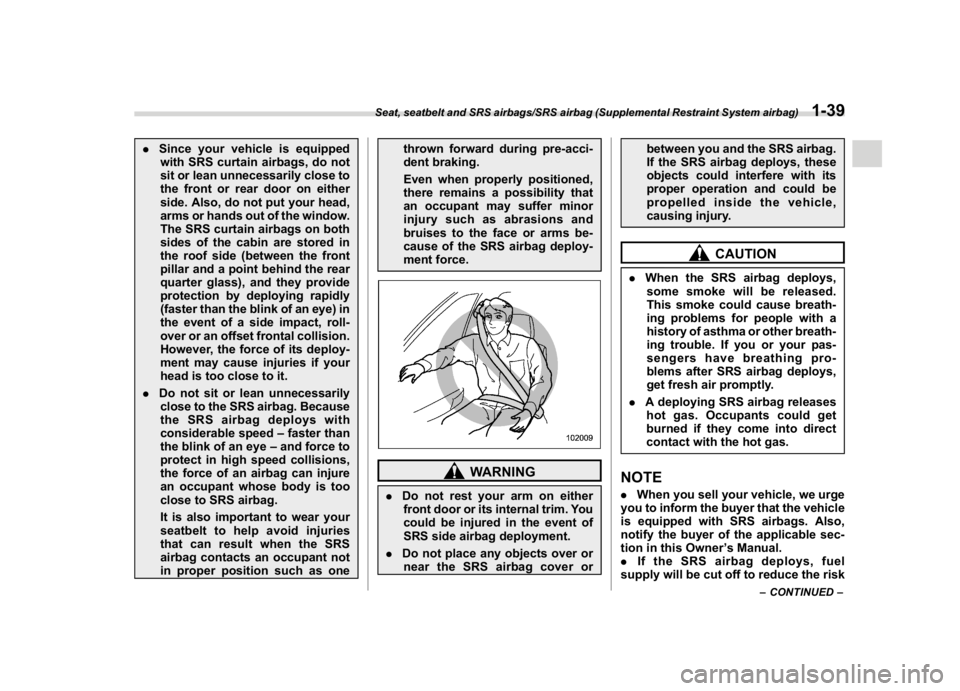
.Do not sit or lean unnecessarily
close to the SRS airbag. Because
the SRS airbag deploys with
considerable speed–faster than
the blink of an eye–and force to
protect in high speed collisions,
the force of an airbag can injure
an occupant whose body is too
close to SRS airbag.
It is also important to wear your
seatbelt to help avoid injuries
that can result when the SRS
airbag contacts an occupant not
in proper position such as onethrown forward during pre-acci-
dent braking.
Even when properly positioned,
there remains a possibility that
an occupant may suffer minor
injury such as abrasions and
bruises to the face or arms be-
cause of the SRS airbag deploy-
ment force.
WARNING
.Do not rest your arm on either
front door or its internal trim. You
could be injured in the event of
SRS side airbag deployment.
.Do not place any objects over or
near the SRS airbag cover orbetween you and the SRS airbag.
If the SRS airbag deploys, these
objects could interfere with its
proper operation and could be
propelled inside the vehicle,
causing injury.
CAUTION
.When the SRS airbag deploys,
some smoke will be released.
This smoke could cause breath-
ing problems for people with a
history of asthma or other breath-
ing trouble. If you or your pas-
sengers have breathing pro-
blems after SRS airbag deploys,
get fresh air promptly.
.A deploying SRS airbag releases
hot gas. Occupants could get
burned if they come into direct
contact with the hot gas.NOTE.When you sell your vehicle, we urge
you to inform the buyer that the vehicle
is equipped with SRS airbags. Also,
notify the buyer of the applicable sec-
tion in this Owner’s Manual.
.If the SRS airbag deploys, fuel
supply will be cut off to reduce the risk
–CONTINUED–
Seat, seatbelt and SRS airbags/SRS airbag (Supplemental Restraint System airbag)
1-39
1
Page 72 of 474
(73,1)
北米Model "A1320BE-C" EDITED: 2017/ 10/ 10
WARNING
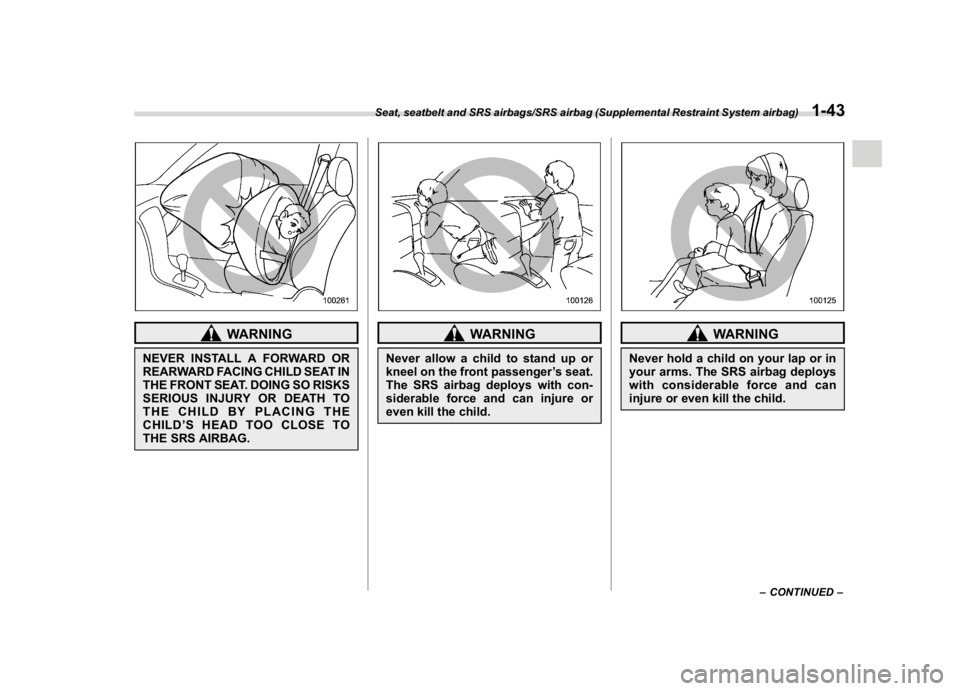
NEVER INSTALL A FORWARD OR
REARWARD FACING CHILD SEAT IN
THE FRONT SEAT. DOING SO RISKS
SERIOUS INJURY OR DEATH TO
THE CHILD BY PLACING THE
CHILD’S HEAD TOO CLOSE TO
THE SRS AIRBAG.
WARNING
Never allow a child to stand up or
kneel on the front passenger’s seat.
The SRS airbag deploys with con-
siderable force and can injure or
even kill the child.
WARNING
Never hold a child on your lap or in
your arms. The SRS airbag deploys
with considerable force and can
injure or even kill the child.
–CONTINUED–
Seat, seatbelt and SRS airbags/SRS airbag (Supplemental Restraint System airbag)
1-43
1
Page 73 of 474
(74,1)
北米Model "A1320BE-C" EDITED: 2017/ 10/ 10
WARNING
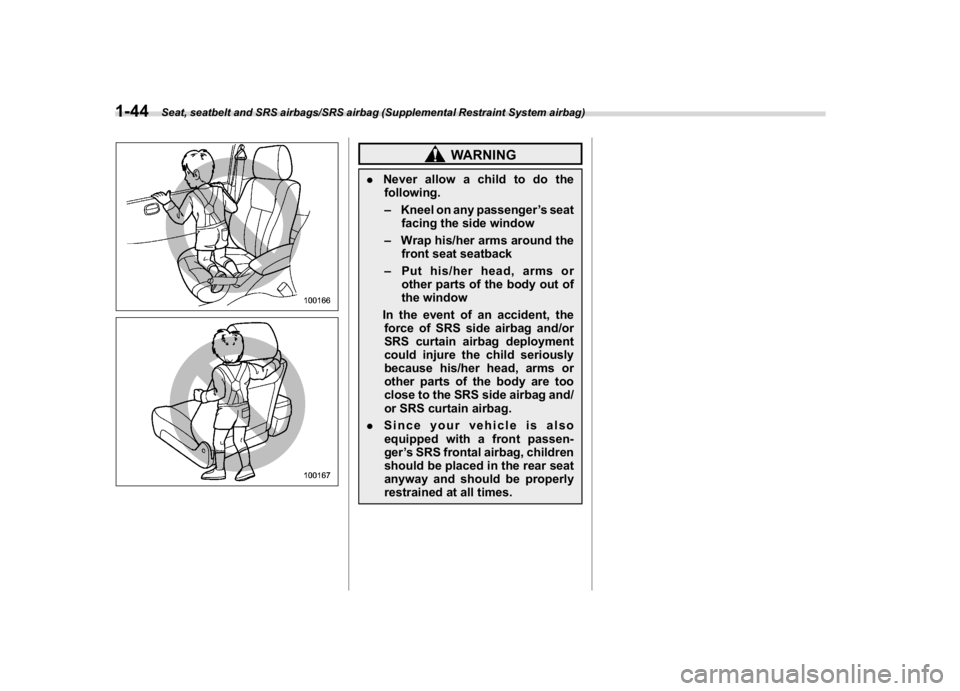
.Never allow a child to do the
following.
–Kneel on any passenger’s seat
facing the side window
–Wrap his/her arms around the
front seat seatback
–Put his/her head, arms or
other parts of the body out of
the window
In the event of an accident, the
force of SRS side airbag and/or
SRS curtain airbag deployment
could injure the child seriously
because his/her head, arms or
other parts of the body are too
close to the SRS side airbag and/
or SRS curtain airbag.
.Since your vehicle is also
equipped with a front passen-
ger’s SRS frontal airbag, children
should be placed in the rear seat
anyway and should be properly
restrained at all times.
Seat, seatbelt and SRS airbags/SRS airbag (Supplemental Restraint System airbag)
1-44
Page 76 of 474
(77,1)
北米Model "A1320BE-C" EDITED: 2017/ 10/ 10
&SUBARU advanced frontal
airbag systemYour vehicle is equipped with a SUBARU
advanced frontal airbag system that com-
plies with the new advanced frontal airbag
requirements in the amended Federal
Motor Vehicle Safety Standard (FMVSS)
No. 208.
The SUBARU advanced frontal airbag
system automatically determines the de-
ployment force of the driver’s SRS frontal
airbag at the time of deployment as well as
whether or not to activate the front
passenger’s SRS frontal airbag and, if
activated, the deployment force of the SRS
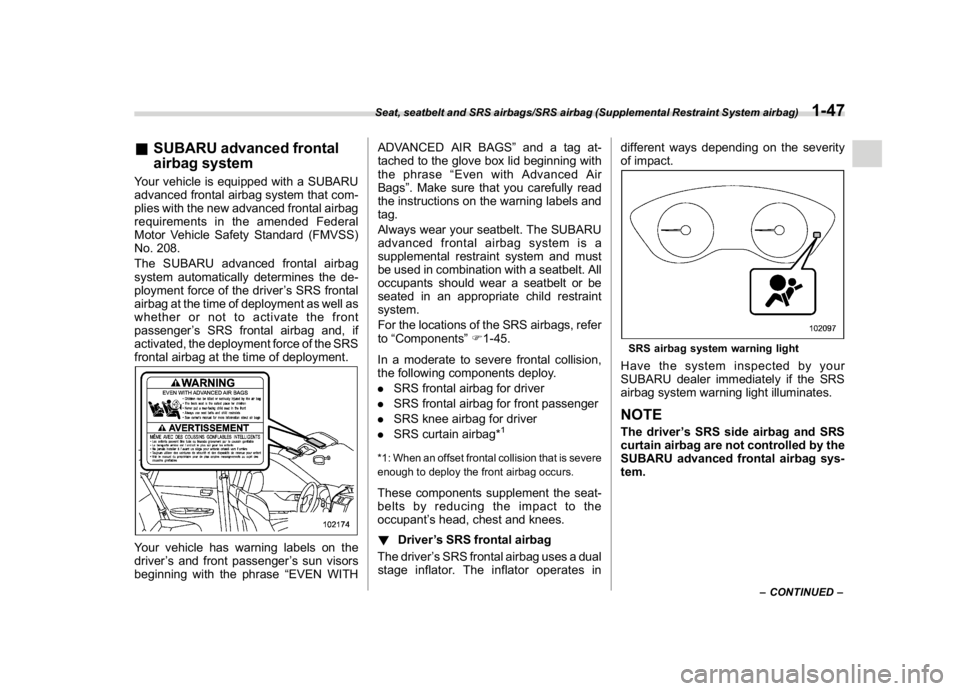
frontal airbag at the time of deployment.Your vehicle has warning labels on the
driver’s and front passenger’s sun visors
beginning with the phrase“EVEN WITHADVANCED AIR BAGS”and a tag at-
tached to the glove box lid beginning with
the phrase“Even with Advanced Air
Bags”. Make sure that you carefully read
the instructions on the warning labels and
tag.
Always wear your seatbelt. The SUBARU
advanced frontal airbag system is a
supplemental restraint system and must
be used in combination with a seatbelt. All
occupants should wear a seatbelt or be
seated in an appropriate child restraint
system.
For the locations of the SRS airbags, refer
to“Components”F1-45.
In a moderate to severe frontal collision,
the following components deploy.
.SRS frontal airbag for driver
.SRS frontal airbag for front passenger
.SRS knee airbag for driver
.SRS curtain airbag*
1
*1: When an offset frontal collision that is severe
enough to deploy the front airbag occurs.These components supplement the seat-
belts by reducing the impact to the
occupant’s head, chest and knees.
!Driver’s SRS frontal airbag
The driver’s SRS frontal airbag uses a dual
stage inflator. The inflator operates indifferent ways depending on the severity
of impact.
SRS airbag system warning lightHave the system inspected by your
SUBARU dealer immediately if the SRS
airbag system warning light illuminates.NOTEThe driver’s SRS side airbag and SRS
curtain airbag are not controlled by the
SUBARU advanced frontal airbag sys-
tem.
–CONTINUED–
Seat, seatbelt and SRS airbags/SRS airbag (Supplemental Restraint System airbag)
1-47
1
Page 77 of 474
(78,1)
北米Model "A1320BE-C" EDITED: 2017/ 10/ 10
!Front passenger’s SRS frontal air-
bag
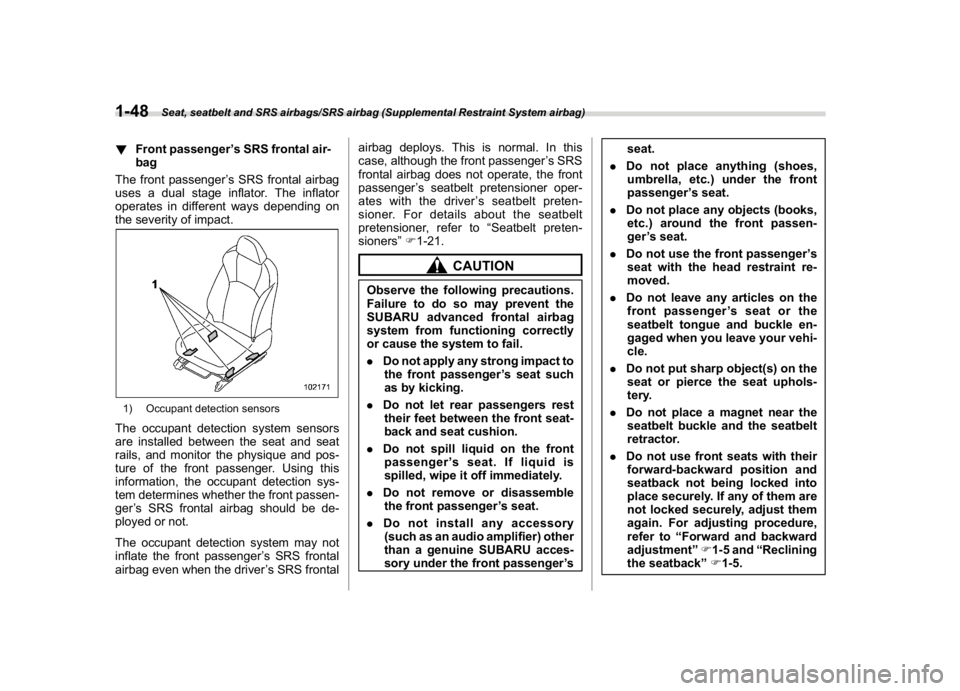
The front passenger’s SRS frontal airbag
uses a dual stage inflator. The inflator
operates in different ways depending on
the severity of impact.1) Occupant detection sensorsThe occupant detection system sensors
are installed between the seat and seat
rails, and monitor the physique and pos-
ture of the front passenger. Using this
information, the occupant detection sys-
tem determines whether the front passen-
ger’s SRS frontal airbag should be de-
ployed or not.
The occupant detection system may not
inflate the front passenger’s SRS frontal
airbag even when the driver’s SRS frontalairbag deploys. This is normal. In this
case, although the front passenger’s SRS
frontal airbag does not operate, the front
passenger’s seatbelt pretensioner oper-
ates with the driver’s seatbelt preten-
sioner. For details about the seatbelt
pretensioner, refer to“Seatbelt preten-
sioners”F1-21.
CAUTION
Observe the following precautions.
Failure to do so may prevent the
SUBARU advanced frontal airbag
system from functioning correctly
or cause the system to fail.
.Do not apply any strong impact to
the front passenger’s seat such
as by kicking.
.Do not let rear passengers rest
their feet between the front seat-
back and seat cushion.
.Do not spill liquid on the front
passenger’s seat. If liquid is
spilled, wipe it off immediately.
.Do not remove or disassemble
the front passenger’s seat.
.Do not install any accessory
(such as an audio amplifier) other
than a genuine SUBARU acces-
sory under the front passenger’sseat.
.Do not place anything (shoes,
umbrella, etc.) under the front
passenger’s seat.
.Do not place any objects (books,
etc.) around the front passen-
ger’s seat.
.Do not use the front passenger’s
seat with the head restraint re-
moved.
.Do not leave any articles on the
front passenger’s seat or the
seatbelt tongue and buckle en-
gaged when you leave your vehi-
cle.
.Do not put sharp object(s) on the
seat or pierce the seat uphols-
tery.
.Do not place a magnet near the
seatbelt buckle and the seatbelt
retractor.
.Do not use front seats with their
forward-backward position and
seatback not being locked into
place securely. If any of them are
not locked securely, adjust them
again. For adjusting procedure,
refer to“Forward and backward
adjustment”F1-5 and“Reclining
the seatback”F1-5.
Seat, seatbelt and SRS airbags/SRS airbag (Supplemental Restraint System airbag)
1-48
Page 84 of 474

(85,1)
北米Model "A1320BE-C" EDITED: 2017/ 10/ 10
The driver’s and front passenger’s SRS
frontal airbags use dual stage inflators.
The two inflators of each airbag are
triggered either sequentially or simulta-
neously, depending on the severity of
impact, in the case of the driver’s SRS
frontal airbag and depending on the
severity of impact and the characteristic
of item(s) or person on the seat in the case
of the front passenger’s SRS frontal air-
bag.
!After deployment
After deployment, the SRS airbag imme-
diately starts to deflate so that the driver’s
vision is not obstructed and the driver’s
ability to maintain control of the vehicle is
not impaired. The time required from
detecting impact to the deflation of the
SRS airbag after deployment is shorter
than the blink of an eye.
Both when only the driver’s SRS frontal
airbag deploys and the driver’s and front
passenger’s SRS frontal airbags deploy,
the driver’s and front passenger’s seatbelt
pretensioners operate at the same time.
When the SRS airbag deploys, a sudden,
fairly loud inflation noise will be heard and
some smoke will be released. These
occurrences are a normal result of the
deployment. This smoke does not indicate
a fire in the vehicle.
CAUTION
Do not touch the SRS airbag system
components around the steering
wheel and dashboard with bare
hands right after deployment. Doing
so can cause burns because the
components can be very hot as a
result of deployment.
!Example of the type of accident
The driver’s SRS frontal airbag and front
passenger’s SRS frontal airbag are de-
signed as follows.
.to deploy in the event of an accident
involving a moderate to severe frontal
collision
.to function on a one-time-only basis
The driver’s SRS frontal airbag and front
passenger’s SRS frontal airbag are not
designed as follows.
.to deploy in most lesser frontal im-
pacts
*1
.to deploy in most side or rear impacts or
in most rollover accidents
*2
*1: Because the necessary protection can be
achieved by the seatbelt alone.
*2: Because deployment of only the driver’s
SRS frontal airbag or both the driver’s and frontpassenger’s SRS frontal airbags would not
protect the occupant in those situations.
SRS airbag deployment depends on the
level of force experienced in the passen-
ger compartment during a collision. That
level differs from one type of collision to
another, and it may have no bearing on the
visible damage done to the vehicle itself.
!Example of accident in which the
driver’s/driver’s and front pas-
senger’s SRS frontal airbag(s)
will most likely deployA head-on collision against a thick con-
crete wall at a vehicle speed of 12 to 19
mph (20 to 30 km/h) or higher activates
only the driver’s SRS frontal airbag or both
driver’s and front passenger’s SRS frontal
airbags. The airbag(s) will also be acti-
–CONTINUED–
Seat, seatbelt and SRS airbags/SRS airbag (Supplemental Restraint System airbag)
1-55
1