combination meter SUBARU FORESTER 2004 Service Service Manual
[x] Cancel search | Manufacturer: SUBARU, Model Year: 2004, Model line: FORESTER, Model: SUBARU FORESTER 2004Pages: 2870, PDF Size: 38.67 MB
Page 652 of 2870
IM-10
IMMOBILIZER (DIAGNOSTIC)
Diagnostics Chart for Immobilizer Warning Light
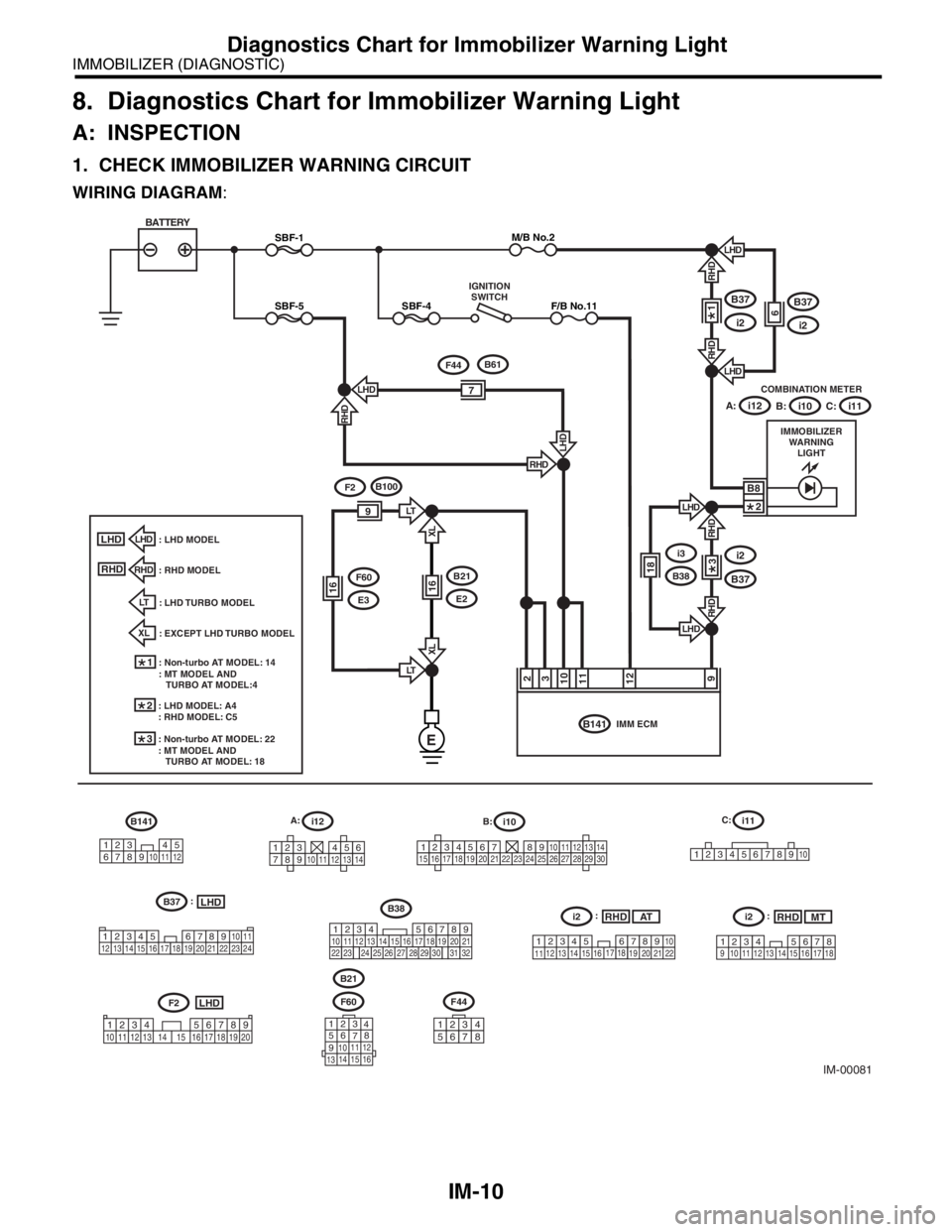
8. Diagnostics Chart for Immobilizer Warning Light
A: INSPECTION
1. CHECK IMMOBILIZER WARNING CIRCUIT
WIRING DIAGRAM:
IM-00081
F60
B21
RHD
SBF-1
SBF-5SBF-4
BATTERY
IMMOBILIZER
WARNING
LIGHT COMBINATION METER
B141IMM ECM
B37
i2
i2
B37
i12
B37
i2
LHD
RHDLHD
6
RHD
M/B No.2
F/B No.11
IGNITION
SWITCH
91211102
B8
3: RHD MODEL
1: Non-turbo AT MODEL: 14
: MT MODEL AND
TURBO AT MODEL:4
i12B141
34 12
89
10 11125
67
219
32
B38
1234 5610 11 12 13 14 15716
23 3019 20
22 26 27 28 29817
24 3118
25
123456789101112131415161718192021222324252627282930
LHDB37
34 12 89
10 11
12 13 14 15 16 17 18 19 20 21 22 23 24567
i10
1
23456789
10
B:
E
A:i10 B:
i11C:
: LHD TURBO MODELLT
: EXCEPT LHD TURBO MODEL
XL
34 12 8910
1112 13 14 15 161718
19 20 21 22567
i2RHD
F2LHD
LHD
LHD
7
F44B61
RHD
RHD
LHD
: LHD MODEL
1
2
i11 C:
LHD
LHD
18
i3
B38
RHD
RHD
3
XL
LT
XL
LT9
1616
F2B100
B21
E2
F60
E3
LHD
RHD
2: LHD MODEL: A4
: RHD MODEL: C5
3: Non-turbo AT MODEL: 22
: MT MODEL AND
TURBO AT MODEL: 18
A:
:
AT:
23 1789 1011121314 15
16 1718456
i2RHDMT:
1234 5678910 11 12 13 14 15 16 17 18 19 20123
4
56
78
9
1011 12
1314 15 16
1234568791011121314
F44
12345678
Page 653 of 2870

IM-11
IMMOBILIZER (DIAGNOSTIC)
Diagnostics Chart for Immobilizer Warning Light
Step Check Yes No
1 CHECK IMMOBILIZER WARNING LIGHT.
1) Turn the ignition switch to OFF.
2) Disconnect the harness connector from
IMM ECM.
3) Connect a resistor (750 Ω) between IMM
ECM harness connector terminal No. 9 and
chassis ground.Does the immobilizer warning
light illuminate?Go to step 2.Go to step 5.
2 CHECK IMM ECM GROUND CIRCUIT.
Measure the resistance between IMM ECM
harness connector terminal and chassis
ground.
Connector & terminal
(B141) No. 2, No. 3 — Chassis ground:Is the resistance less than 10
Ω?Go to step 3.Repair the open
circuit of IMMECM
ground circuit.
3 CHECK IMM ECM IGNITION CIRCUIT.
1) Turn the ignition switch to ON. (engine
OFF.)
2) Measure the voltage between IMM ECM
harness connector terminal and chassis
ground.
Connector & terminal
(B141) No. 12 (+) — Chassis ground(
−):Is the voltage more than 10 V? Go to step 4.Check the harness
for open or short
between IMM
ECM and ignition
switch.
4 CHECK IMM ECM POWER SUPPLY CIR-
CUIT.
1) Turn the ignition switch to OFF.
2) Measure the voltage between IMM ECM
harness connector terminal and chassis
ground.
Connector & terminal
(B141) No. 10, No. 11 (+) — Chassis
ground(
−):Is the voltage more than 10 V? Replace the IMM
ECM
Control Module.>
and then replace
all ignition keys
(including the tran-
sponder). Then
perform teaching
operation. Refer to
teaching opera-
tion manual (Pub.
No. S0820GZ).Check the harness
for open or short
between IMM
ECM and fuse.
5 CHECK COMBINATION METER CIRCUIT.
1) Remove the combination meter.
2) Measure the voltage between combination
meter harness connector terminal and chassis
ground.
Connector & terminal
(i10) No. 8 (+) — Chassis ground (
−):Is the voltage more than 10 V? Go to step 6.Check the harness
for open or short
between combina-
tion meter and
fuse.
6 CHECK COMBINATION METER CIRCUIT.
Measure the resistance between IMM ECM
harness connector terminal and combination
meter harness connector terminal.
Connector & terminal
LHD model
(B141) No. 9 — (i12) No. 4:
RHD model
(B141) No. 9 — (i11) No. 5:Is the resistance less than 10
Ω?Faulty LED.
Replace the com-
bination meter
printed circuit.
Combination
Meter Assembly.>Repair the har-
ness or connector.
Page 767 of 2870
PM-30
PERIODIC MAINTENANCE SERVICE
Brake Line
18.Brake Line
A: INSPECTION
1. BRAKE LINE
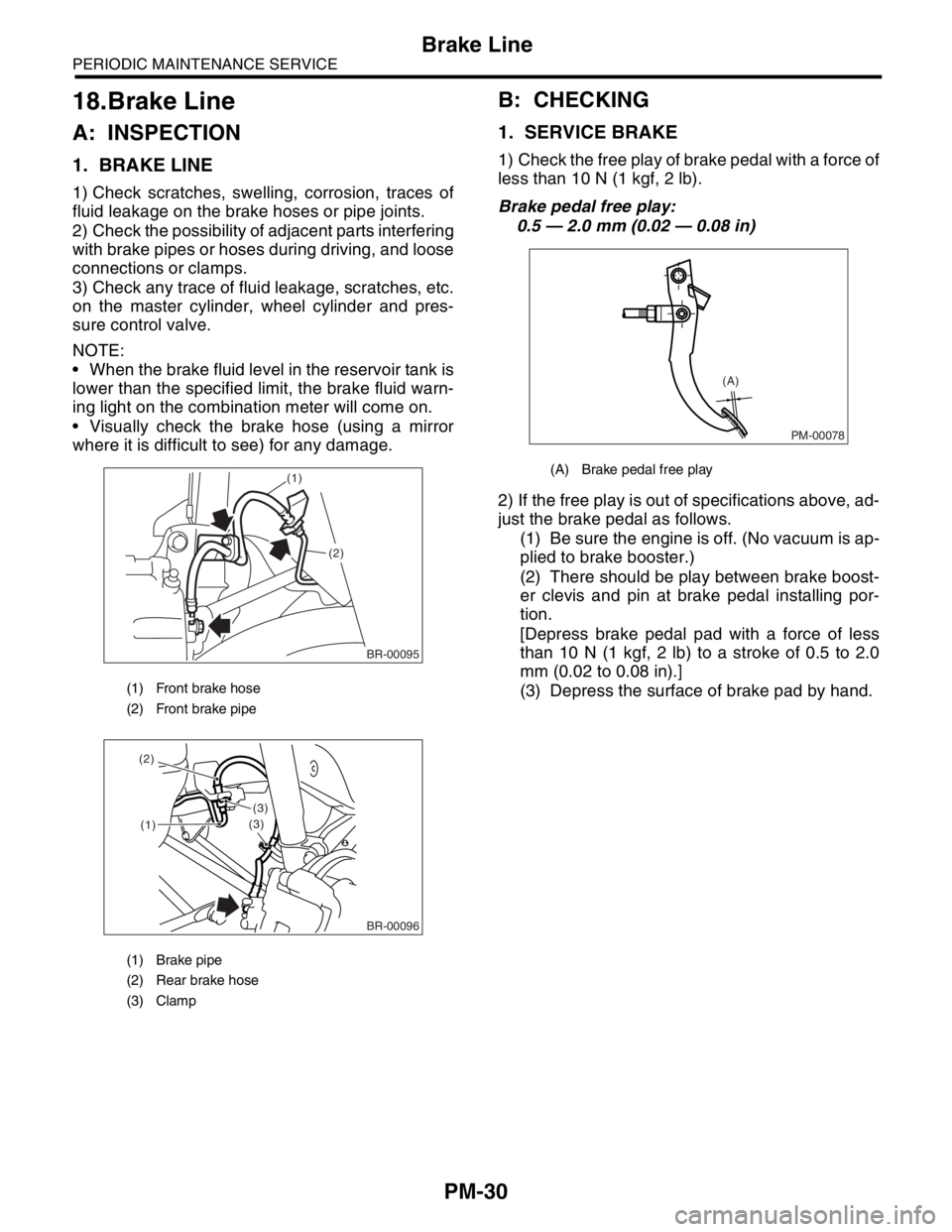
1) Check scratches, swelling, corrosion, traces of
fluid leakage on the brake hoses or pipe joints.
2) Check the possibility of adjacent parts interfering
with brake pipes or hoses during driving, and loose
connections or clamps.
3) Check any trace of fluid leakage, scratches, etc.
on the master cylinder, wheel cylinder and pres-
sure control valve.
NOTE:
When the brake fluid level in the reservoir tank is
lower than the specified limit, the brake fluid warn-
ing light on the combination meter will come on.
Visually check the brake hose (using a mirror
where it is difficult to see) for any damage.
B: CHECKING
1. SERVICE BRAKE
1) Check the free play of brake pedal with a force of
less than 10 N (1 kgf, 2 lb).
Brake pedal free play:
0.5 — 2.0 mm (0.02 — 0.08 in)
2) If the free play is out of specifications above, ad-
just the brake pedal as follows.
(1) Be sure the engine is off. (No vacuum is ap-
plied to brake booster.)
(2) There should be play between brake boost-
er clevis and pin at brake pedal installing por-
tion.
[Depress brake pedal pad with a force of less
than 10 N (1 kgf, 2 lb) to a stroke of 0.5 to 2.0
mm (0.02 to 0.08 in).]
(3) Depress the surface of brake pad by hand.
(1) Front brake hose
(2) Front brake pipe
(1) Brake pipe
(2) Rear brake hose
(3) Clamp
BR-00095
(1)
(2)
(1)
(3)
(3) (2)
BR-00096
(A) Brake pedal free play
PM-00078
(A)
Page 955 of 2870
ME(H4SO)-84
MECHANICAL
Cylinder Block
E: INSPECTION
1. CYLINDER BLOCK
1) Visually check for cracks and damage. Especial-
ly, inspect the important parts by means of red lead
check.
2) Check the oil passages for clogging.
3) Inspect the crankcase surface that mates with
cylinder head for warping by using a straight edge,
and correct by grinding if necessary.
Warping limit:
0.05 mm (0.0020 in)
Grinding limit:
0.1 mm (0.004 in)
Standard height of cylinder block:
201.0 mm (7.91 in)
2. CYLINDER AND PISTON
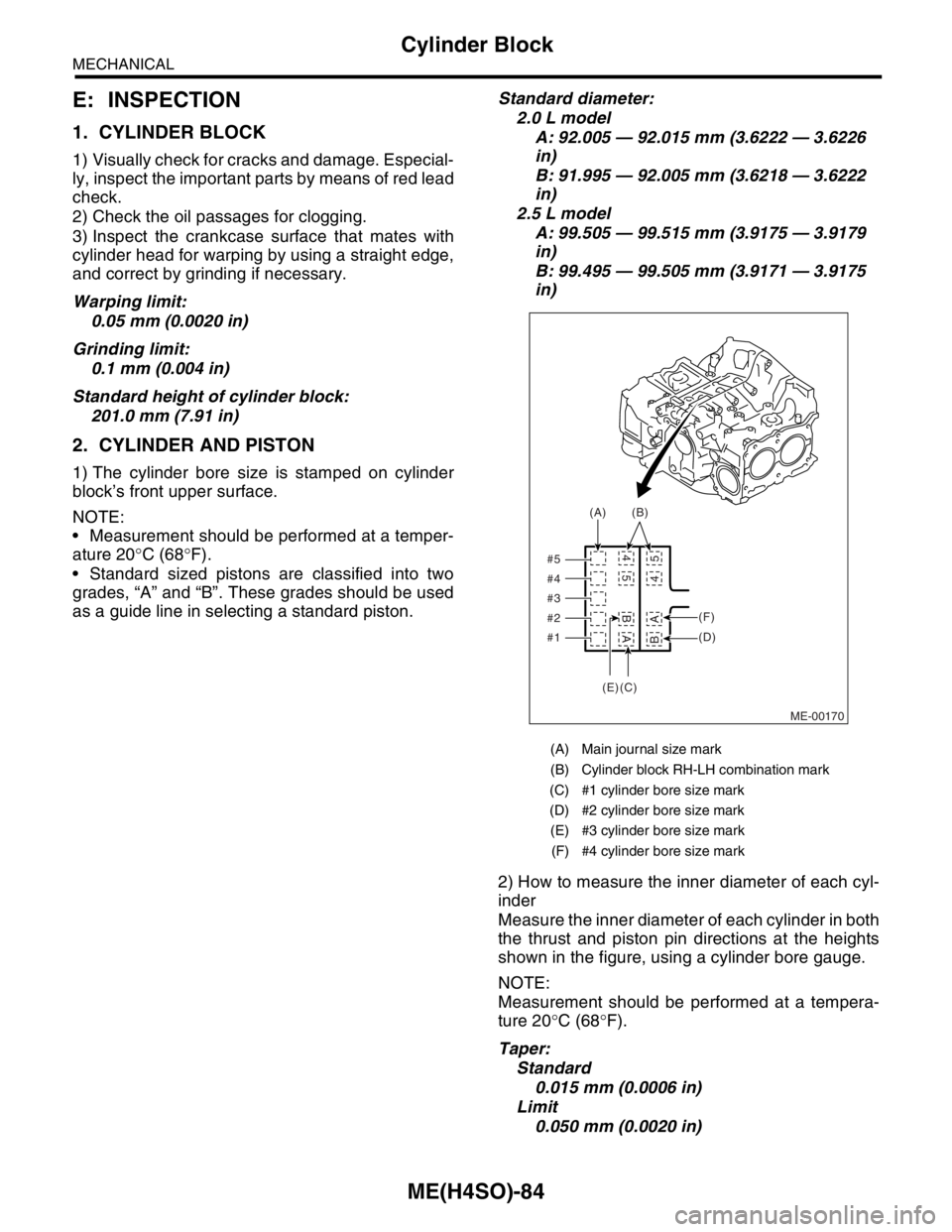
1) The cylinder bore size is stamped on cylinder
block’s front upper surface.
NOTE:
Measurement should be performed at a temper-
ature 20°C (68°F).
Standard sized pistons are classified into two
grades, “A” and “B”. These grades should be used
as a guide line in selecting a standard piston.Standard diameter:
2.0 L model
A: 92.005 — 92.015 mm (3.6222 — 3.6226
in)
B: 91.995 — 92.005 mm (3.6218 — 3.6222
in)
2.5 L model
A: 99.505 — 99.515 mm (3.9175 — 3.9179
in)
B: 99.495 — 99.505 mm (3.9171 — 3.9175
in)
2) How to measure the inner diameter of each cyl-
inder
Measure the inner diameter of each cylinder in both
the thrust and piston pin directions at the heights
shown in the figure, using a cylinder bore gauge.
NOTE:
Measurement should be performed at a tempera-
ture 20°C (68°F).
Taper:
Standard
0.015 mm (0.0006 in)
Limit
0.050 mm (0.0020 in)
(A) Main journal size mark
(B) Cylinder block RH-LH combination mark
(C) #1 cylinder bore size mark
(D) #2 cylinder bore size mark
(E) #3 cylinder bore size mark
(F) #4 cylinder bore size mark
ME-00170 #5
#4
#3
#2
#1(A)(B)
(F)
(D)
A BA B
5 45 4
(C) (E)
Page 1036 of 2870
LU(H4SO)-8
LUBRICATION
Oil Pressure System
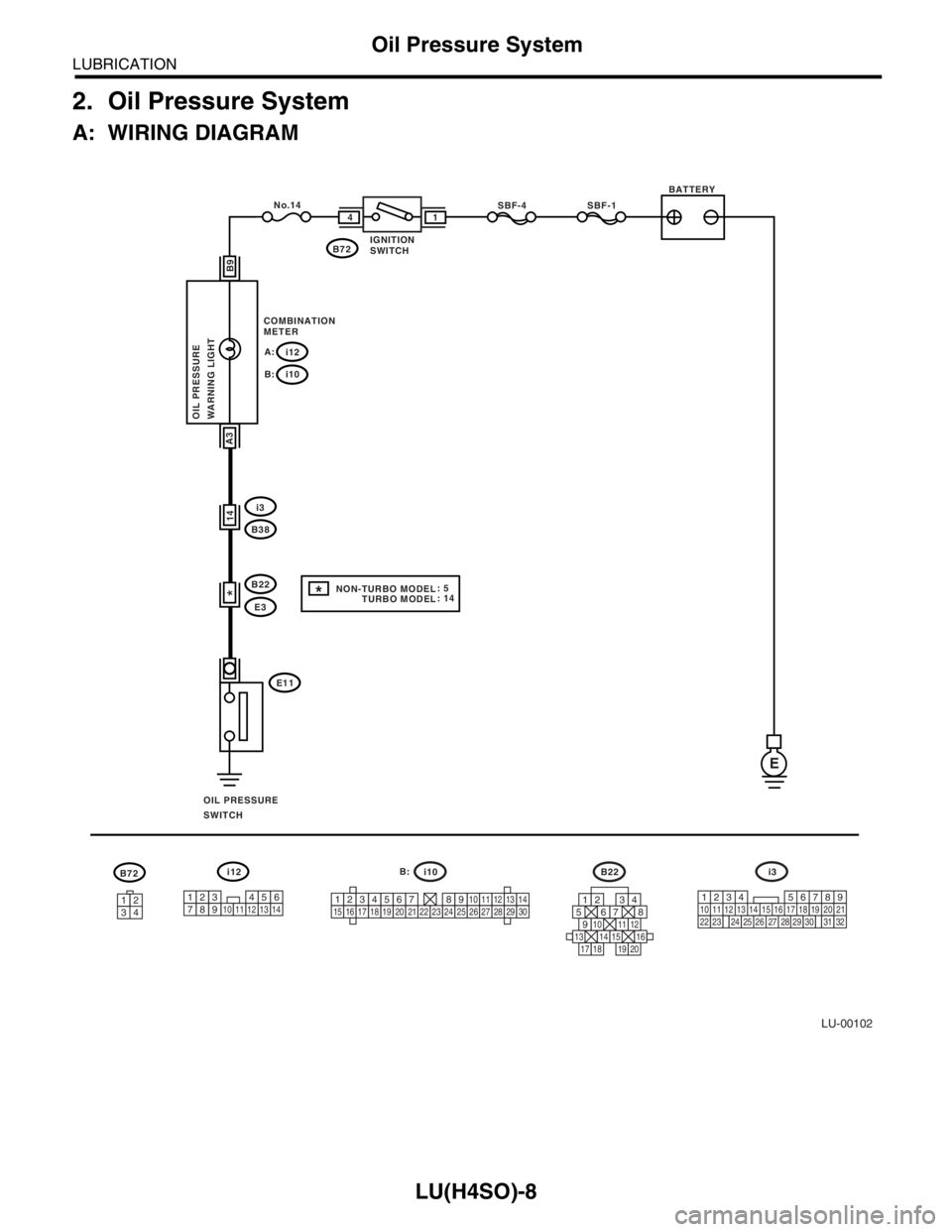
2. Oil Pressure System
A: WIRING DIAGRAM
LU-00102
E
i12
i10
i3
B38
B9
A3
B22
E3
14
E11
A:
B:
B:
i10
123456789101112131415161718192021222324252627282930219
32
1234 5610 11 12 13 14 15716
23 3019 20
22 26 27 28 29817
24 3118
25
i3B22
125678
131415169101112
34
17181920
**: 5
: 14
No.14SBF-4SBF-1
B72
14
B72i12
12345678910111213143412
TURBO MODEL NON-TURBO MODELBATTERY
IGNITION
SWITCH
COMBINATION
METER
OIL PRESSURE
WARNING LIGHT
OIL PRESSURE
SWITCH
Page 1037 of 2870

LU(H4SO)-9
LUBRICATION
Oil Pressure System
B: INSPECTION
Step Check Yes No
1 CHECK COMBINATION METER.
1) Turn the ignition switch to ON. (engine
OFF)
2) Check other warning lights.Does the warning lights illumi-
nate?Go to step 2.Repair or replace
the combination
meter.
Combination
Meter System.>
2 CHECK HARNESS CONNECTOR BETWEEN
COMBINATION METER AND OIL PRES-
SURE SWITCH.
1) Turn the ignition switch to OFF.
2) Disconnect the connector from oil pressure
switch.
3) Turn the ignition switch to ON.
4) Measure the voltage of harness between
the combination meter connector and chassis
ground.
Connector & terminal
(E11) No. 1 (+) — Chassis ground (
−):Is the voltage more than 10 V? Replace the oil
pressure switch.Go to step 3.
3 CHECK COMBINATION METER.
1) Turn the ignition switch to OFF.
2) Remove the combination meter.
3) Measure the resistance of combination
meter.
Te r m i n a l
No. B9 — No. A3:Is the resistance less than 10
Ω?Replace the har-
ness connector
between combina-
tion meter and oil
pressure switch.Repair or replace
the combination
meter and the oil
pressure switch
warning light bulb.
Page 1052 of 2870

LU(H4SO)-24
LUBRICATION
Engine Lubrication System Trouble in General
9. Engine Lubrication System Trouble in General
A: INSPECTION
Before performing diagnostics, make sure that the engine oil level is correct and no oil leakage exists.
Trouble Possible cause Corrective action
1. Warning light remains
on.1) Oil pressure switch
failureCracked diaphragm or oil leakage within switch Replace.
Broken spring or seized contacts Replace.
2) Low oil pressureClogged oil filter Replace.
Malfunction of oil by-pass valve of oil filter Clean or replace.
Malfunction of oil relief valve of oil pump Clean or replace.
Clogged oil passage Clean.
Excessive tip clearance and side clearance of oil
pump rotor and gearReplace.
Clogged oil strainer or broken pipe Clean or replace.
3) No oil pressureInsufficient engine oil Replenish.
Broken pipe of oil strainer Replace.
Stuck oil pump rotor Replace.
2. Warning light does
not go on.1) Malfunction of combination meter Replace.
2) Poor contact of switch contact points Replace.
3) Disconnection of wiring Repair.
3. Warning light flickers
momentarily.1) Poor contact at terminals Repair.
2) Defective wiring harness Repair.
3) Low oil pressureCheck for the same
possible causes as
listed in 1. — 2).
Page 1105 of 2870
EN(H4SO)-7
ENGINE (DIAGNOSTIC)
General Description
The antenna feeder must be placed as far
apart as possible from the ECM and MFI har-
ness.
Carefully adjust the antenna for correct
matching.
When mounting a large power type radio, pay
special attention to the three items above men-
tioned.
Incorrect installation of the radio may affect
the operation of the ECM.
13) Before disconnecting the fuel hose, disconnect
the fuel pump connector and crank the engine for
more than five seconds to release pressure in the
fuel system. If engine starts during this operation,
run it until it stops.
14) Problems in the electronic-controlled automatic
transmission may be caused by failure of the en-
gine, the electronic control system, the transmis-
sion proper, or by a combination of these. These
three causes must be distinguished clearly when
performing diagnostics.
15) Diagnostics should be conducted by rotating
with simple, easy operations and proceeding to
complicated, difficult operations. The most impor-
tant thing in diagnostics is to understand the cus-
tomer’s complaint, and distinguish between the
three causes.
16) In AT models, do not continue the stall for more
than five seconds. (from closed throttle, fully open
throttle to stall engine speed.)
17) On the model with ABS, when performing driv-
ing test in jacked-up or lifted-up position, some-
times the warning light may be lit, but this is not a
malfunction of the system. The reason for this is the
speed difference between the front and rear
wheels. After diagnosis of engine control system,
perform the ABS memory clearance procedure of
self-diagnosis function.
B: INSPECTION
Before performing diagnostics, check the following
items which might affect engine problems:
1. BATTERY
1) Measure battery voltage and specific gravity of
electrolyte.
Standard voltage: 12 V
Specific gravity: Above 1.260
2) Check the condition of the main and other fuses,
and harnesses and connectors. Also check for
proper grounding.
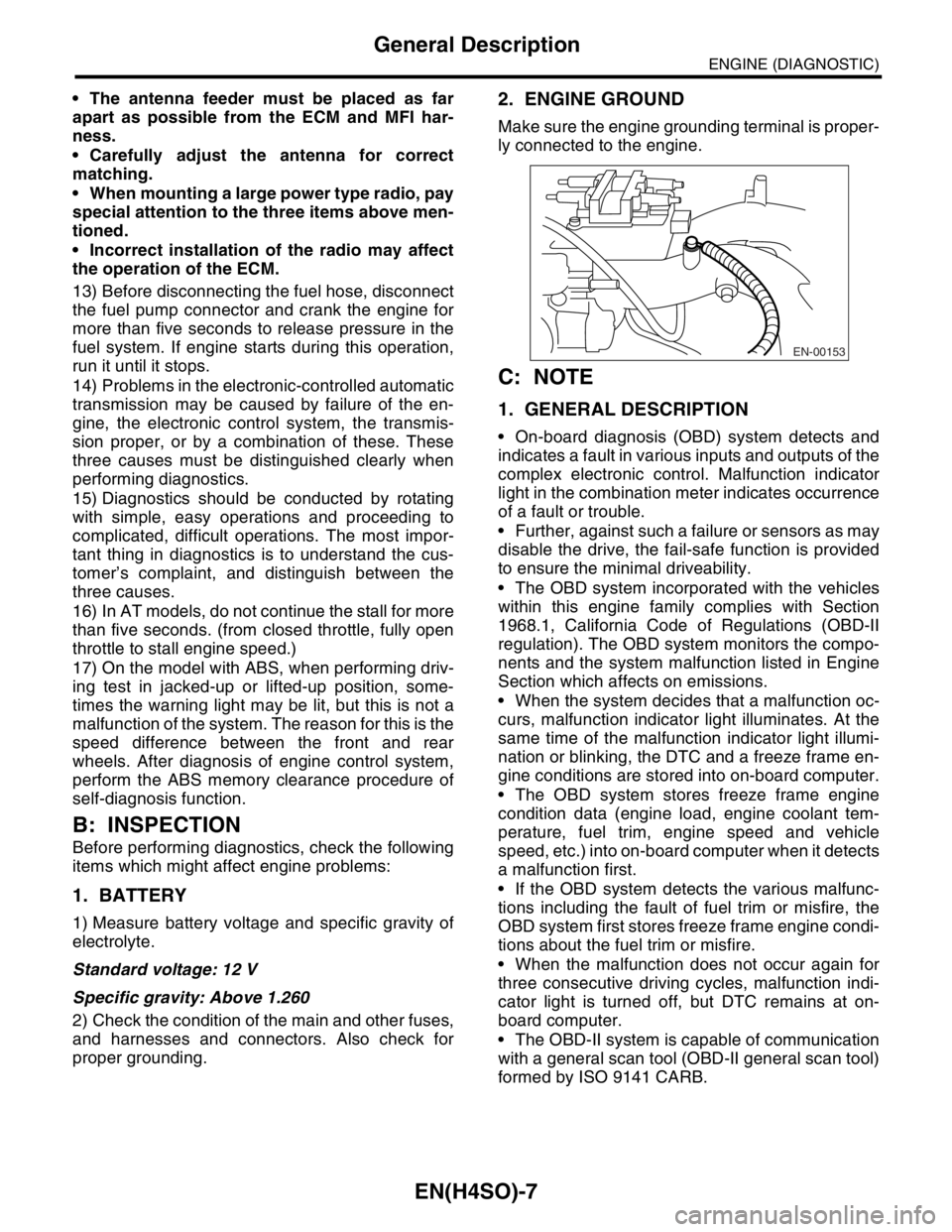
2. ENGINE GROUND
Make sure the engine grounding terminal is proper-
ly connected to the engine.
C: NOTE
1. GENERAL DESCRIPTION
On-board diagnosis (OBD) system detects and
indicates a fault in various inputs and outputs of the
complex electronic control. Malfunction indicator
light in the combination meter indicates occurrence
of a fault or trouble.
Further, against such a failure or sensors as may
disable the drive, the fail-safe function is provided
to ensure the minimal driveability.
The OBD system incorporated with the vehicles
within this engine family complies with Section
1968.1, California Code of Regulations (OBD-II
regulation). The OBD system monitors the compo-
nents and the system malfunction listed in Engine
Section which affects on emissions.
When the system decides that a malfunction oc-
curs, malfunction indicator light illuminates. At the
same time of the malfunction indicator light illumi-
nation or blinking, the DTC and a freeze frame en-
gine conditions are stored into on-board computer.
The OBD system stores freeze frame engine
condition data (engine load, engine coolant tem-
perature, fuel trim, engine speed and vehicle
speed, etc.) into on-board computer when it detects
a malfunction first.
If the OBD system detects the various malfunc-
tions including the fault of fuel trim or misfire, the
OBD system first stores freeze frame engine condi-
tions about the fuel trim or misfire.
When the malfunction does not occur again for
three consecutive driving cycles, malfunction indi-
cator light is turned off, but DTC remains at on-
board computer.
The OBD-II system is capable of communication
with a general scan tool (OBD-II general scan tool)
formed by ISO 9141 CARB.
EN-00153
Page 1145 of 2870
EN(H4SO)-47
ENGINE (DIAGNOSTIC)
Malfunction Indicator Light
16.Malfunction Indicator Light
A: PROCEDURE
B: ACTIVATION OF MALFUNCTION
INDICATOR LIGHT
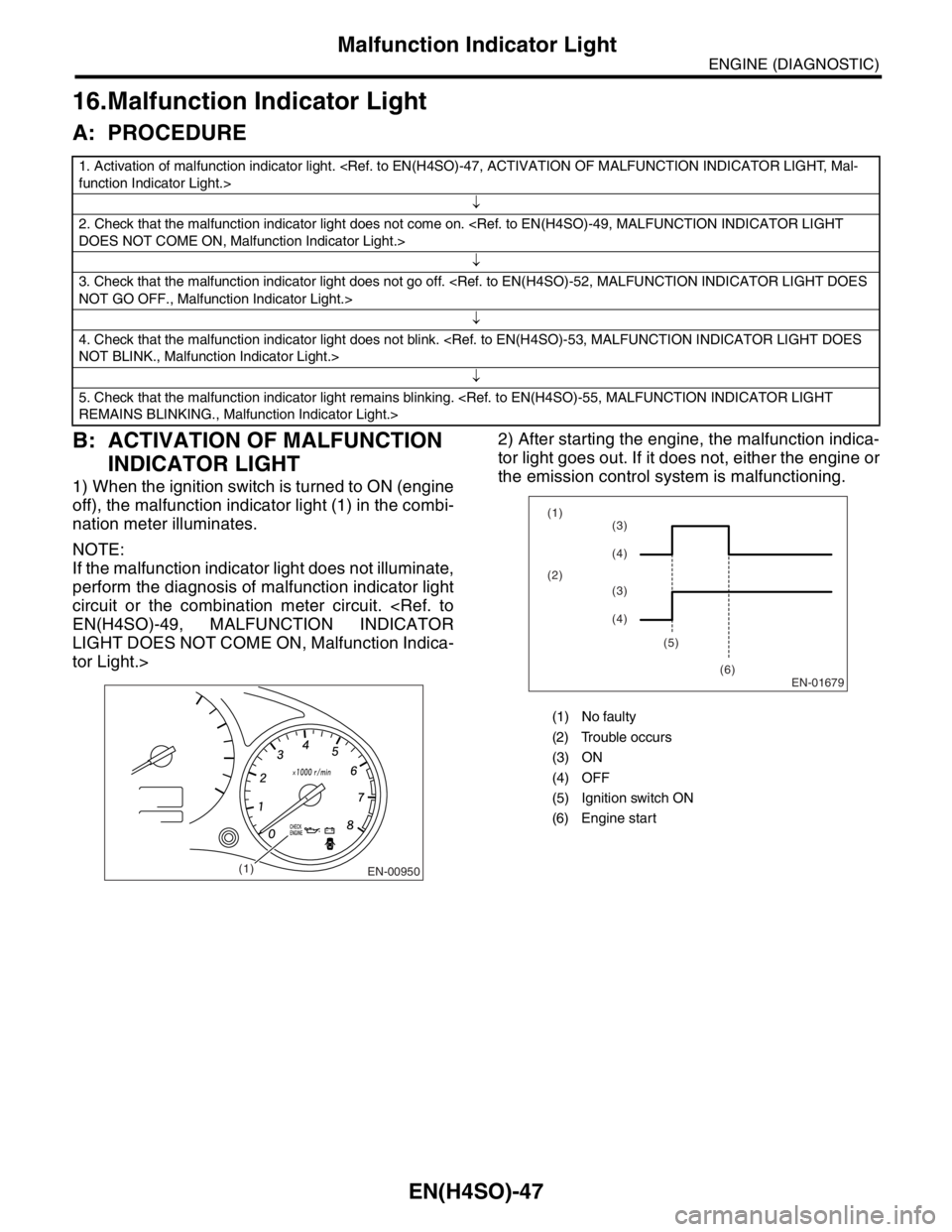
1) When the ignition switch is turned to ON (engine
off), the malfunction indicator light (1) in the combi-
nation meter illuminates.
NOTE:
If the malfunction indicator light does not illuminate,
perform the diagnosis of malfunction indicator light
circuit or the combination meter circuit.
LIGHT DOES NOT COME ON, Malfunction Indica-
tor Light.>2) After starting the engine, the malfunction indica-
tor light goes out. If it does not, either the engine or
the emission control system is malfunctioning.
1. Activation of malfunction indicator light.
↓
2. Check that the malfunction indicator light does not come on.
↓
3. Check that the malfunction indicator light does not go off.
↓
4. Check that the malfunction indicator light does not blink.
↓
5. Check that the malfunction indicator light remains blinking.
EN-00950(1)
(1) No faulty
(2) Trouble occurs
(3) ON
(4) OFF
(5) Ignition switch ON
(6) Engine start
EN-01679
(1)
(2)
(5)
(6)(3)
(4)
(3)
(4)
Page 1147 of 2870
EN(H4SO)-49
ENGINE (DIAGNOSTIC)
Malfunction Indicator Light
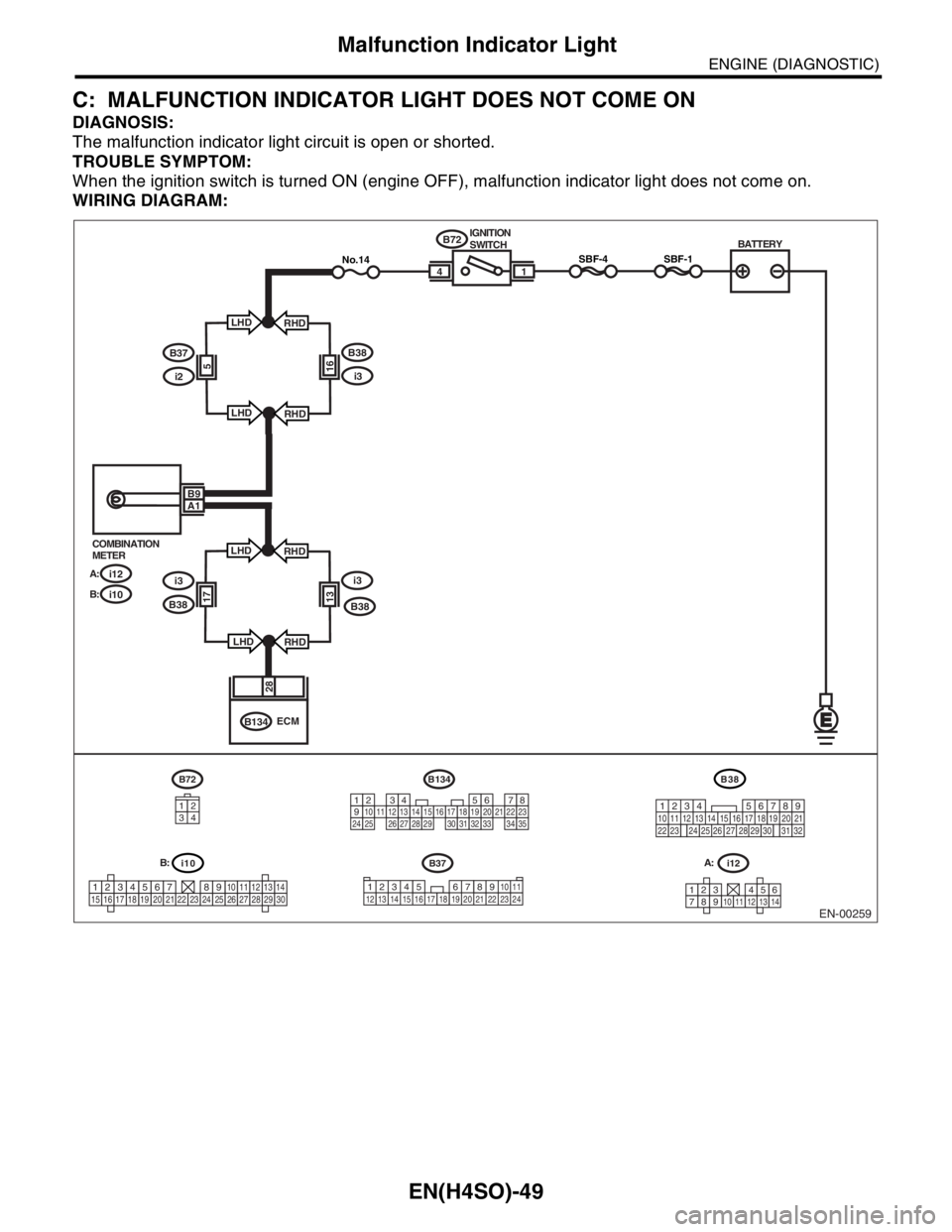
C: MALFUNCTION INDICATOR LIGHT DOES NOT COME ON
DIAGNOSIS:
The malfunction indicator light circuit is open or shorted.
TROUBLE SYMPTOM:
When the ignition switch is turned ON (engine OFF), malfunction indicator light does not come on.
WIRING DIAGRAM:
EN-00259
i10
123456789101112131415161718192021222324252627282930
BATTERY
1
B72
B134IGNITION
SWITCH
i12 COMBINATION
METER
A:
i10 B:
SBF-44
28
ECM
B9A1
i12
1234568791011121314
B134
1234567891011121314151617181920212223242526272829303132333435
B72
34
12
SBF-1No.14
B37
34 12 8910 11
12 13 14 15 16 17 18 19 20 21 22 23 24567
B38
219
32
1234 5610 11 12 13 14 15716
23 3019 20
22 26 27 28 29817
24 3118
25
B37
i2
B38
i3165
LHD
LHDRHD
RHD
i3i3
B381317
LHD
LHDRHD
RHD B38
A: B: