fuse SUBARU LEGACY 1999 Service Repair Manual
[x] Cancel search | Manufacturer: SUBARU, Model Year: 1999, Model line: LEGACY, Model: SUBARU LEGACY 1999Pages: 1456, PDF Size: 59.93 MB
Page 73 of 1456
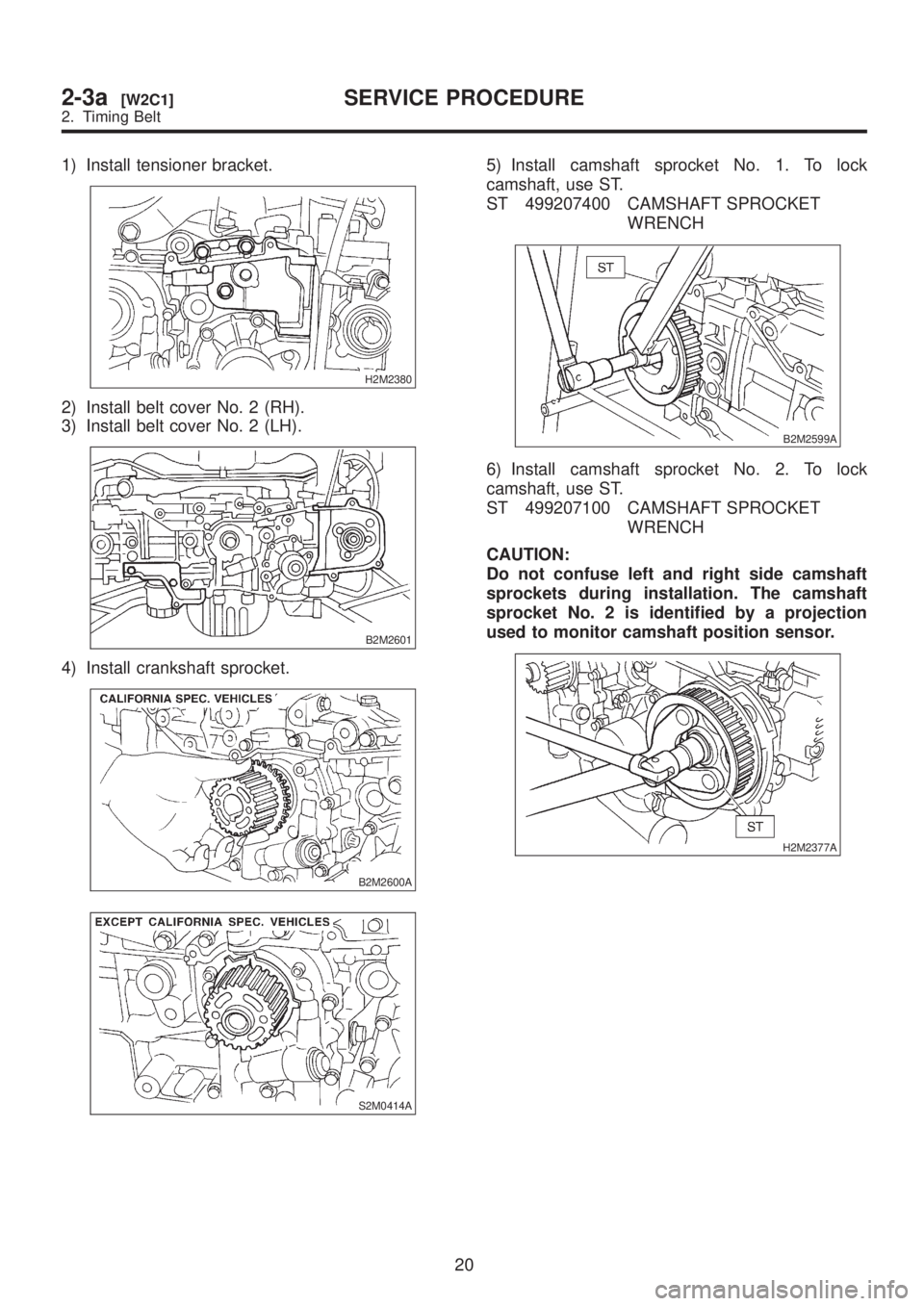
1) Install tensioner bracket.
H2M2380
2) Install belt cover No. 2 (RH).
3) Install belt cover No. 2 (LH).
B2M2601
4) Install crankshaft sprocket.
B2M2600A
S2M0414A
5) Install camshaft sprocket No. 1. To lock
camshaft, use ST.
ST 499207400 CAMSHAFT SPROCKET
WRENCH
B2M2599A
6) Install camshaft sprocket No. 2. To lock
camshaft, use ST.
ST 499207100 CAMSHAFT SPROCKET
WRENCH
CAUTION:
Do not confuse left and right side camshaft
sprockets during installation. The camshaft
sprocket No. 2 is identified by a projection
used to monitor camshaft position sensor.
H2M2377A
20
2-3a[W2C1]SERVICE PROCEDURE
2. Timing Belt
Page 109 of 1456
3) Draw out piston pin from #1 and #2 pistons
using ST.
ST 499097700 PISTON PIN REMOVER
CAUTION:
Be careful not to confuse original combination
of piston, piston pin and cylinder.
G2M0166
4) Similarly remove piston pins from #3 and #4
pistons.
5) Remove bolts which connect cylinder block on
the side of #2 and #4 cylinders.
6) Back off bolts which connect cylinder block on
the side of #1 and #3 cylinders two or three turns.
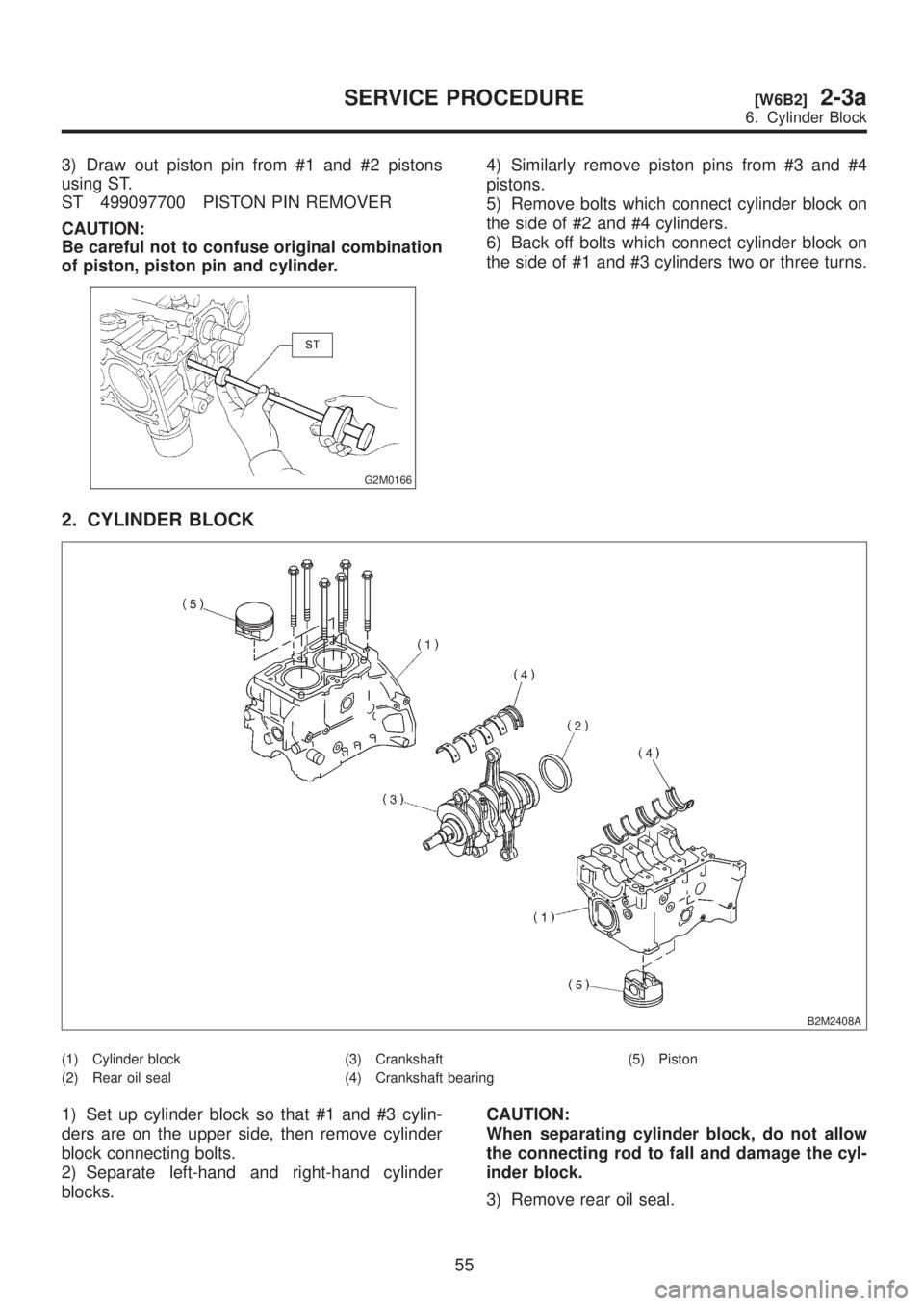
2. CYLINDER BLOCK
B2M2408A
(1) Cylinder block
(2) Rear oil seal(3) Crankshaft
(4) Crankshaft bearing(5) Piston
1) Set up cylinder block so that #1 and #3 cylin-
ders are on the upper side, then remove cylinder
block connecting bolts.
2) Separate left-hand and right-hand cylinder
blocks.CAUTION:
When separating cylinder block, do not allow
the connecting rod to fall and damage the cyl-
inder block.
3) Remove rear oil seal.
55
[W6B2]2-3aSERVICE PROCEDURE
6. Cylinder Block
Page 110 of 1456
4) Remove crankshaft together with connecting
rod.
5) Remove crankshaft bearings from cylinder
block using hammer handle.
CAUTION:
Do not confuse combination of crankshaft
bearings. Press bearing at the end opposite to
locking lip.6) Draw out each piston from cylinder block using
wooden bar or hammer handle.
CAUTION:
Do not confuse combination of piston and cyl-
inder.
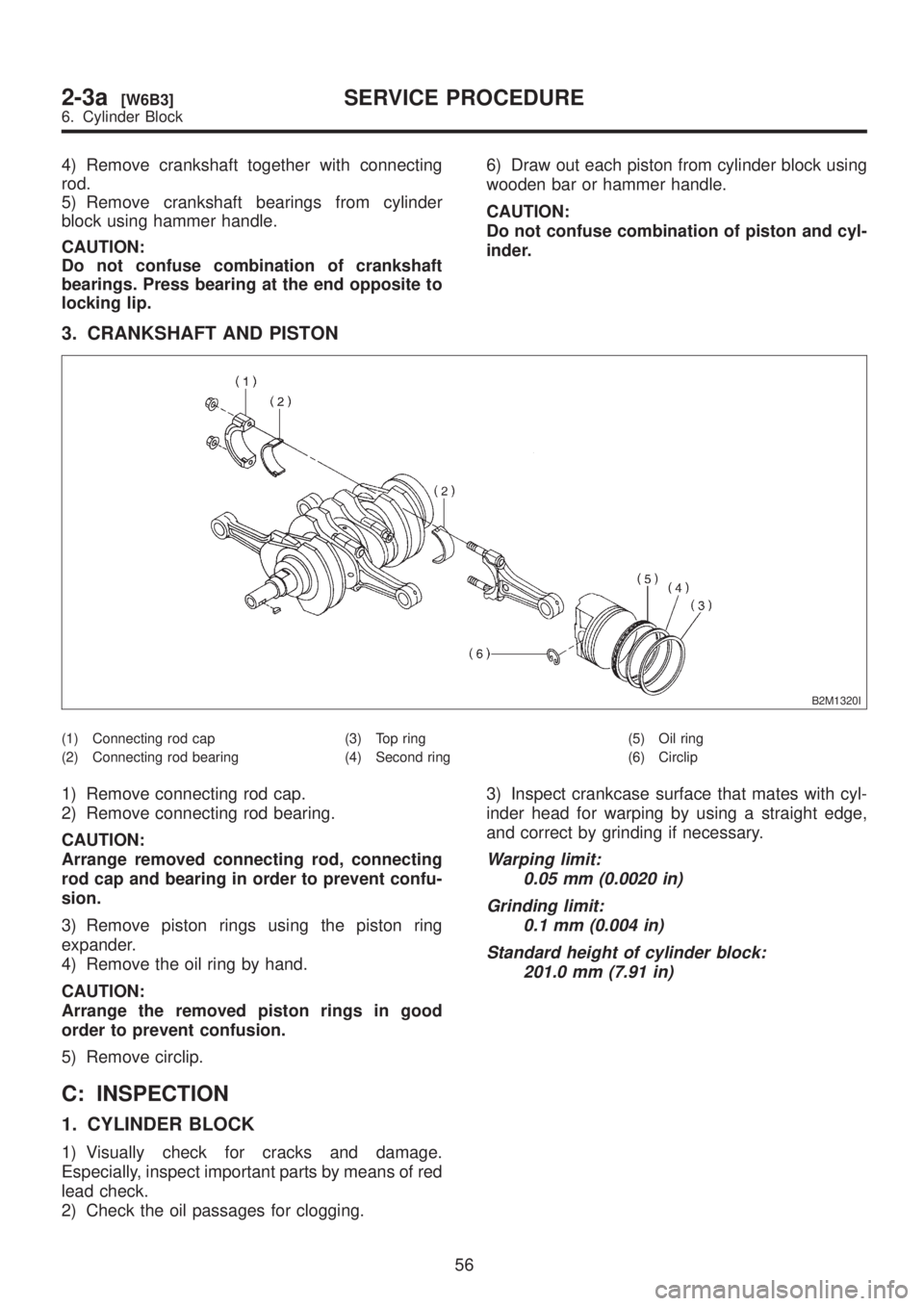
3. CRANKSHAFT AND PISTON
B2M1320I
(1) Connecting rod cap
(2) Connecting rod bearing(3) Top ring
(4) Second ring(5) Oil ring
(6) Circlip
1) Remove connecting rod cap.
2) Remove connecting rod bearing.
CAUTION:
Arrange removed connecting rod, connecting
rod cap and bearing in order to prevent confu-
sion.
3) Remove piston rings using the piston ring
expander.
4) Remove the oil ring by hand.
CAUTION:
Arrange the removed piston rings in good
order to prevent confusion.
5) Remove circlip.
C: INSPECTION
1. CYLINDER BLOCK
1) Visually check for cracks and damage.
Especially, inspect important parts by means of red
lead check.
2) Check the oil passages for clogging.3) Inspect crankcase surface that mates with cyl-
inder head for warping by using a straight edge,
and correct by grinding if necessary.
Warping limit:
0.05 mm (0.0020 in)
Grinding limit:
0.1 mm (0.004 in)
Standard height of cylinder block:
201.0 mm (7.91 in)
56
2-3a[W6B3]SERVICE PROCEDURE
6. Cylinder Block
Page 184 of 1456
B: DISASSEMBLY
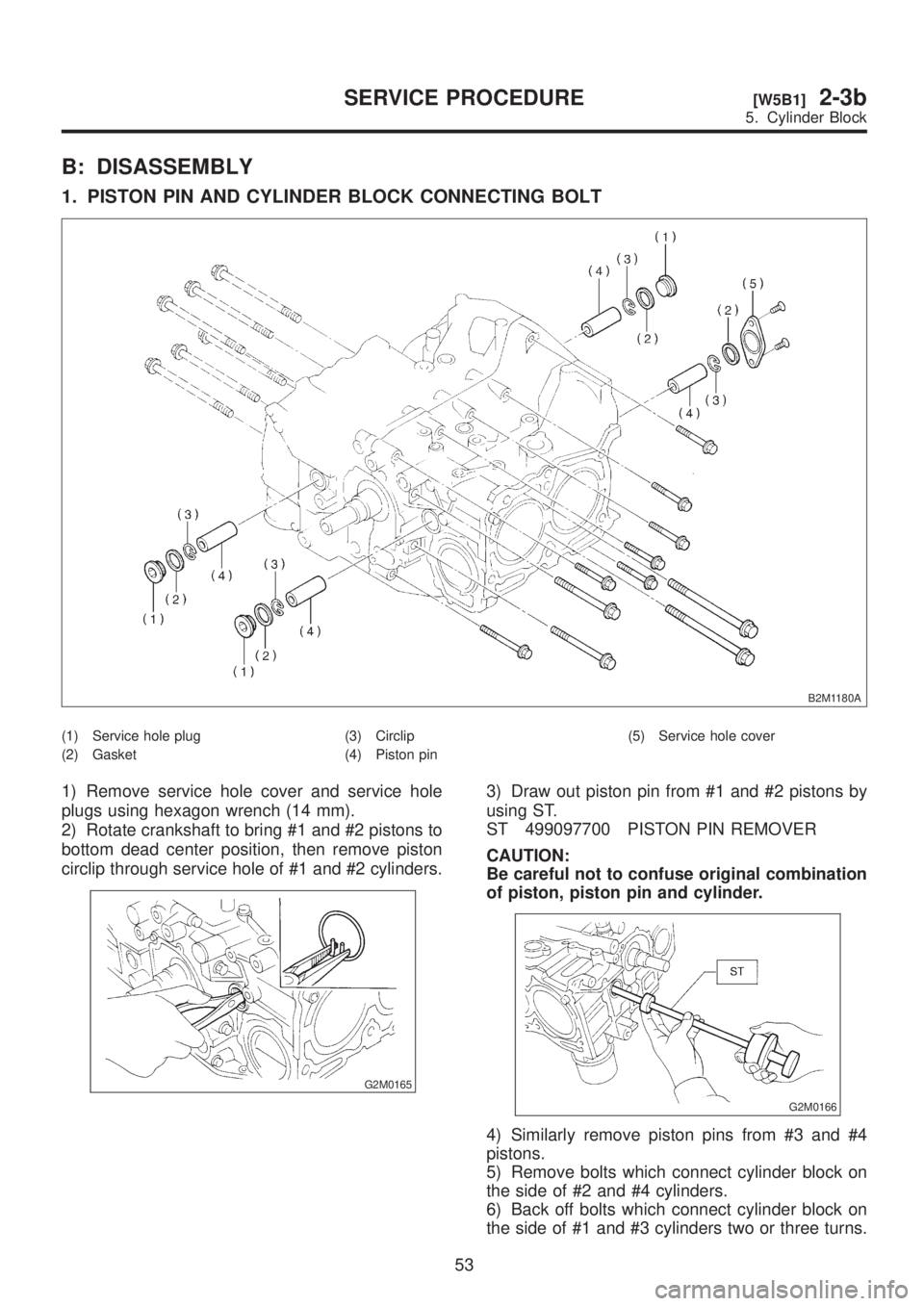
1. PISTON PIN AND CYLINDER BLOCK CONNECTING BOLT
B2M1180A
(1) Service hole plug
(2) Gasket(3) Circlip
(4) Piston pin(5) Service hole cover
1) Remove service hole cover and service hole
plugs using hexagon wrench (14 mm).
2) Rotate crankshaft to bring #1 and #2 pistons to
bottom dead center position, then remove piston
circlip through service hole of #1 and #2 cylinders.
G2M0165
3) Draw out piston pin from #1 and #2 pistons by
using ST.
ST 499097700 PISTON PIN REMOVER
CAUTION:
Be careful not to confuse original combination
of piston, piston pin and cylinder.
G2M0166
4) Similarly remove piston pins from #3 and #4
pistons.
5) Remove bolts which connect cylinder block on
the side of #2 and #4 cylinders.
6) Back off bolts which connect cylinder block on
the side of #1 and #3 cylinders two or three turns.
53
[W5B1]2-3bSERVICE PROCEDURE
5. Cylinder Block
Page 185 of 1456
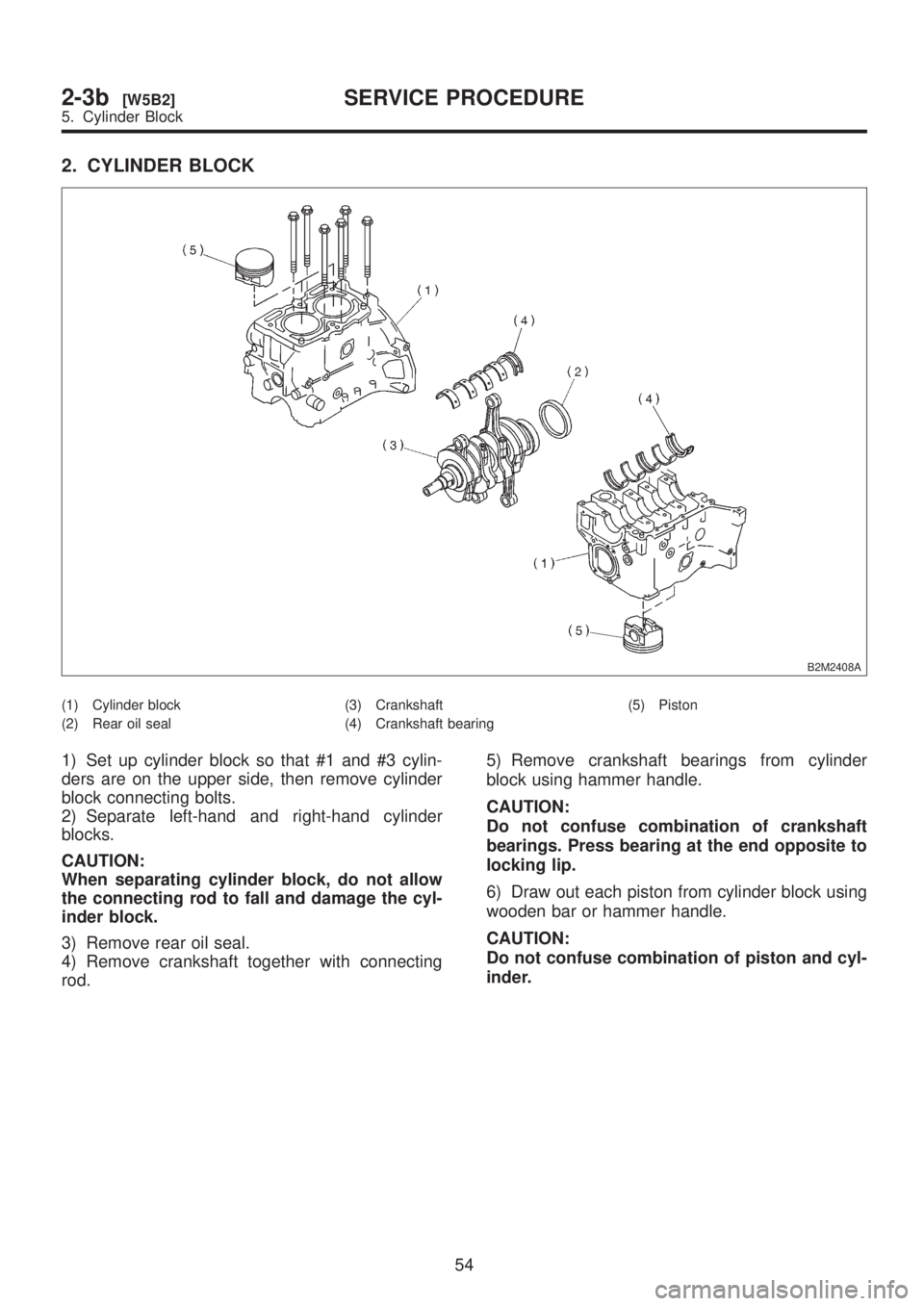
2. CYLINDER BLOCK
B2M2408A
(1) Cylinder block
(2) Rear oil seal(3) Crankshaft
(4) Crankshaft bearing(5) Piston
1) Set up cylinder block so that #1 and #3 cylin-
ders are on the upper side, then remove cylinder
block connecting bolts.
2) Separate left-hand and right-hand cylinder
blocks.
CAUTION:
When separating cylinder block, do not allow
the connecting rod to fall and damage the cyl-
inder block.
3) Remove rear oil seal.
4) Remove crankshaft together with connecting
rod.5) Remove crankshaft bearings from cylinder
block using hammer handle.
CAUTION:
Do not confuse combination of crankshaft
bearings. Press bearing at the end opposite to
locking lip.
6) Draw out each piston from cylinder block using
wooden bar or hammer handle.
CAUTION:
Do not confuse combination of piston and cyl-
inder.
54
2-3b[W5B2]SERVICE PROCEDURE
5. Cylinder Block
Page 352 of 1456
9) Take out ECM.
B2M0679A
10) Installation is in the reverse order of removal.
16. Main Relay
A: REMOVAL AND INSTALLATION
1) Disconnect battery ground cable.
G6M0095
2) Remove lower cover and then disconnect con-
nectors.
B5M0024A
3) Lower transmission control module.
4) Remove the front pillar lower trim.
5) Remove fuse box mounting nuts.
6) Lower fuse box.
7) Remove fuse box mounting bracket.
8) Remove screw which retains bracket of main
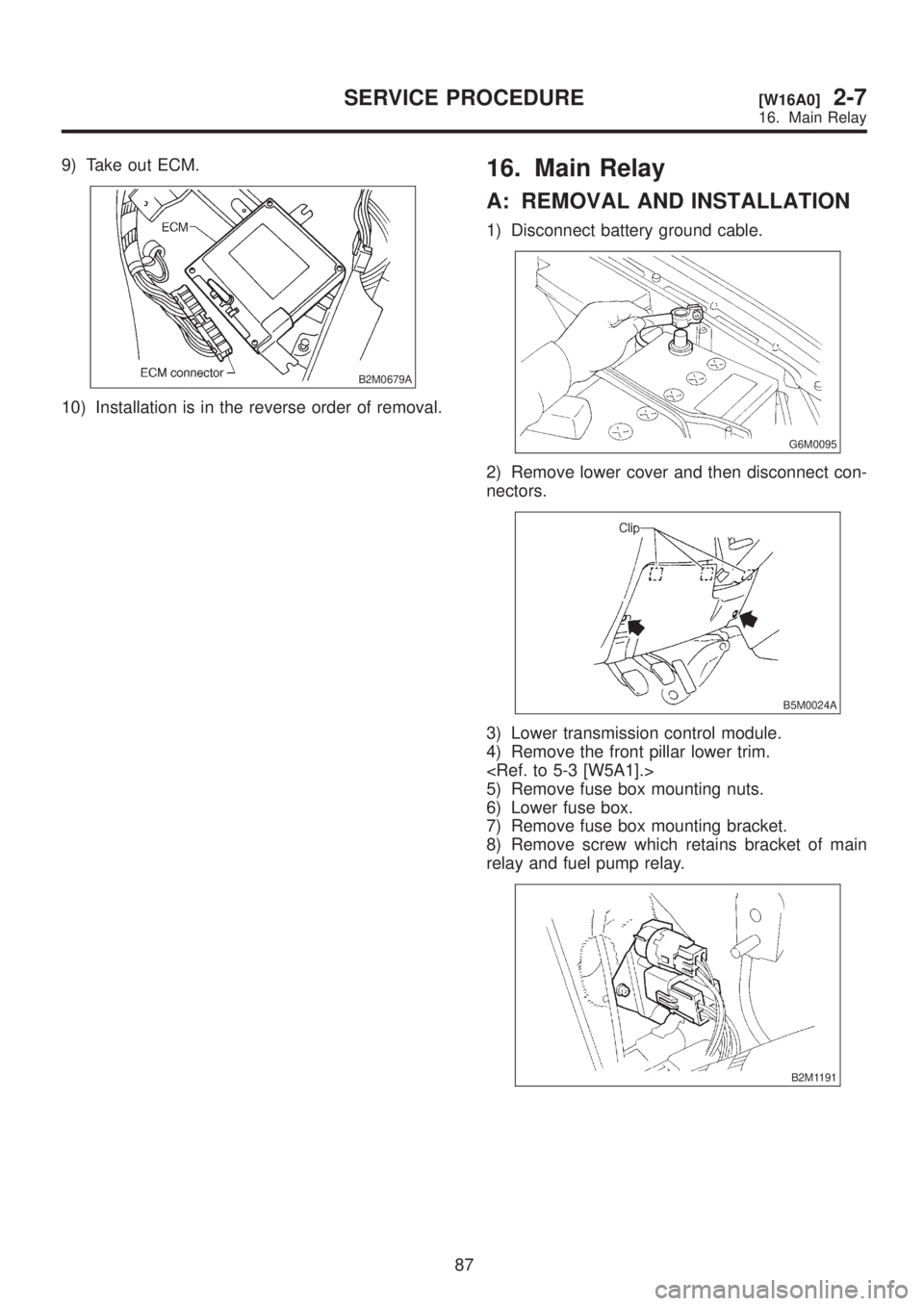
relay and fuel pump relay.
B2M1191
87
[W16A0]2-7SERVICE PROCEDURE
16. Main Relay
Page 353 of 1456
9) Take out ECM.
B2M0679A
10) Installation is in the reverse order of removal.
16. Main Relay
A: REMOVAL AND INSTALLATION
1) Disconnect battery ground cable.
G6M0095
2) Remove lower cover and then disconnect con-
nectors.
B5M0024A
3) Lower transmission control module.
4) Remove the front pillar lower trim.
5) Remove fuse box mounting nuts.
6) Lower fuse box.
7) Remove fuse box mounting bracket.
8) Remove screw which retains bracket of main
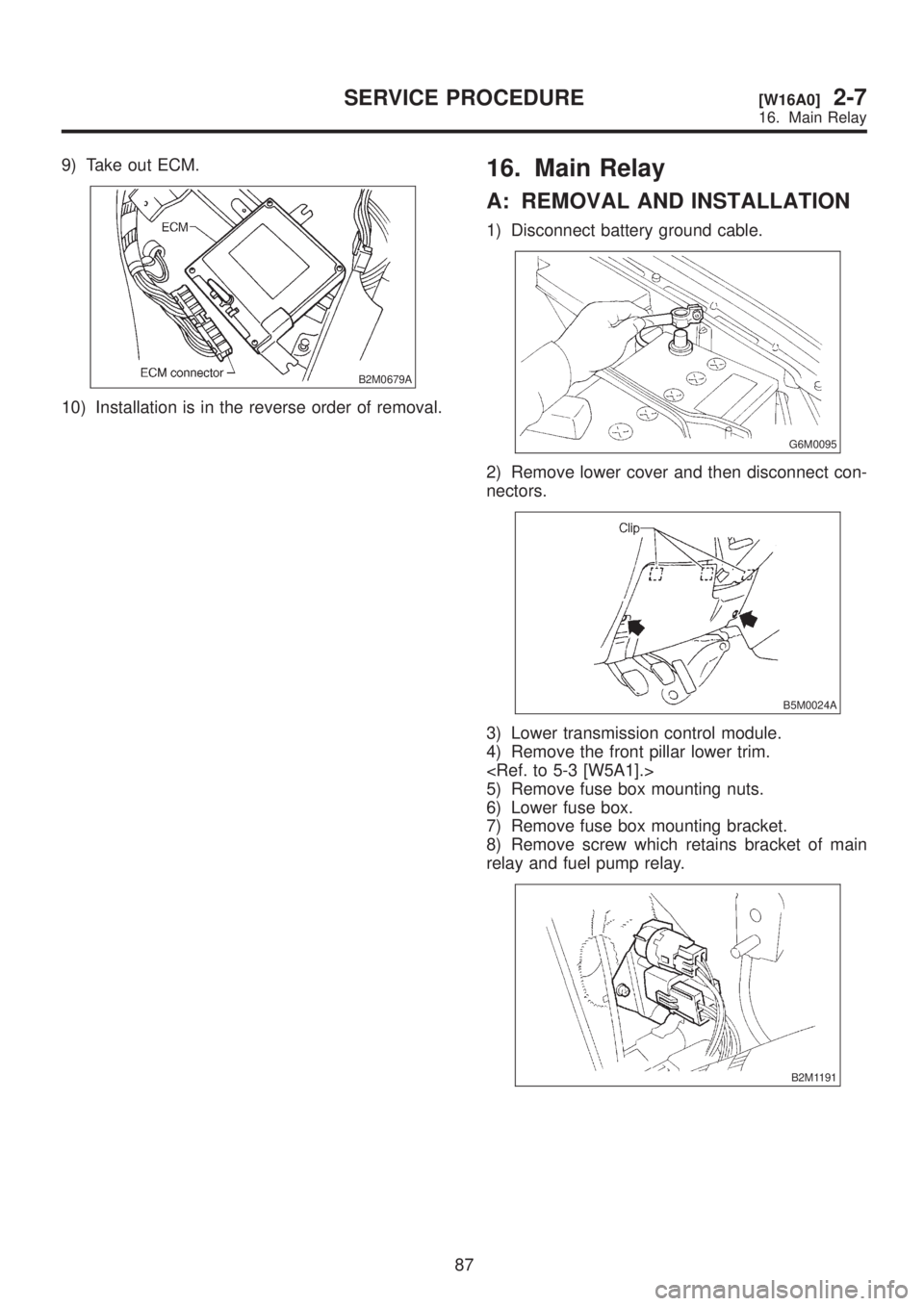
relay and fuel pump relay.
B2M1191
87
[W16A0]2-7SERVICE PROCEDURE
16. Main Relay
Page 354 of 1456
17. Fuel Pump Relay
A: REMOVAL AND INSTALLATION
1) Disconnect battery ground cable.
G6M0095
2) Remove lower cover and then disconnect con-
nectors.
B5M0024A
3) Lower transmission control module.
4) Remove the front pillar lower trim.
5) Remove fuse box mounting nuts.
6) Lower fuse box.
7) Remove fuse box mounting bracket.
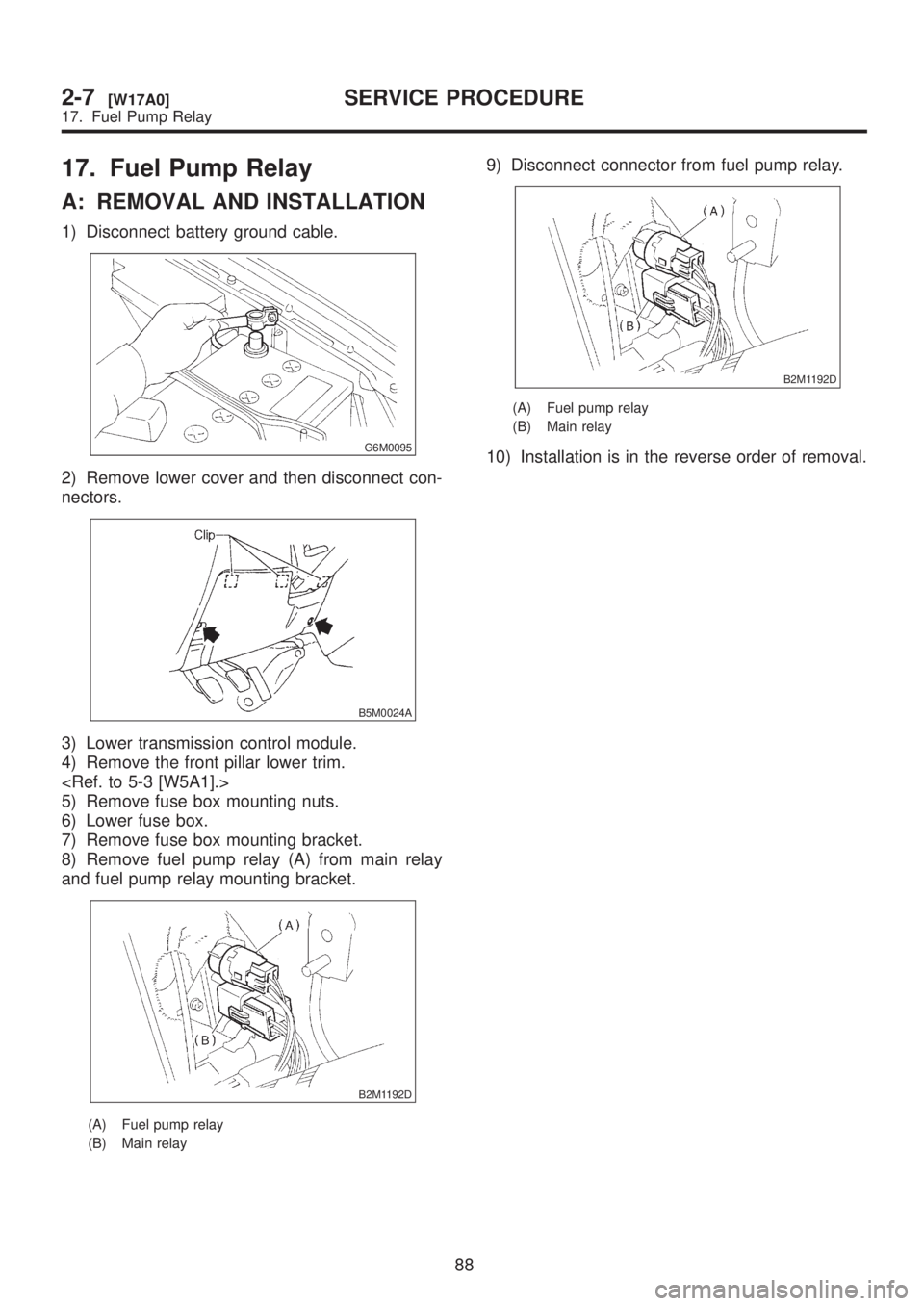
8) Remove fuel pump relay (A) from main relay
and fuel pump relay mounting bracket.
B2M1192D
(A) Fuel pump relay
(B) Main relay
9) Disconnect connector from fuel pump relay.
B2M1192D
(A) Fuel pump relay
(B) Main relay
10) Installation is in the reverse order of removal.
88
2-7[W17A0]SERVICE PROCEDURE
17. Fuel Pump Relay
Page 484 of 1456
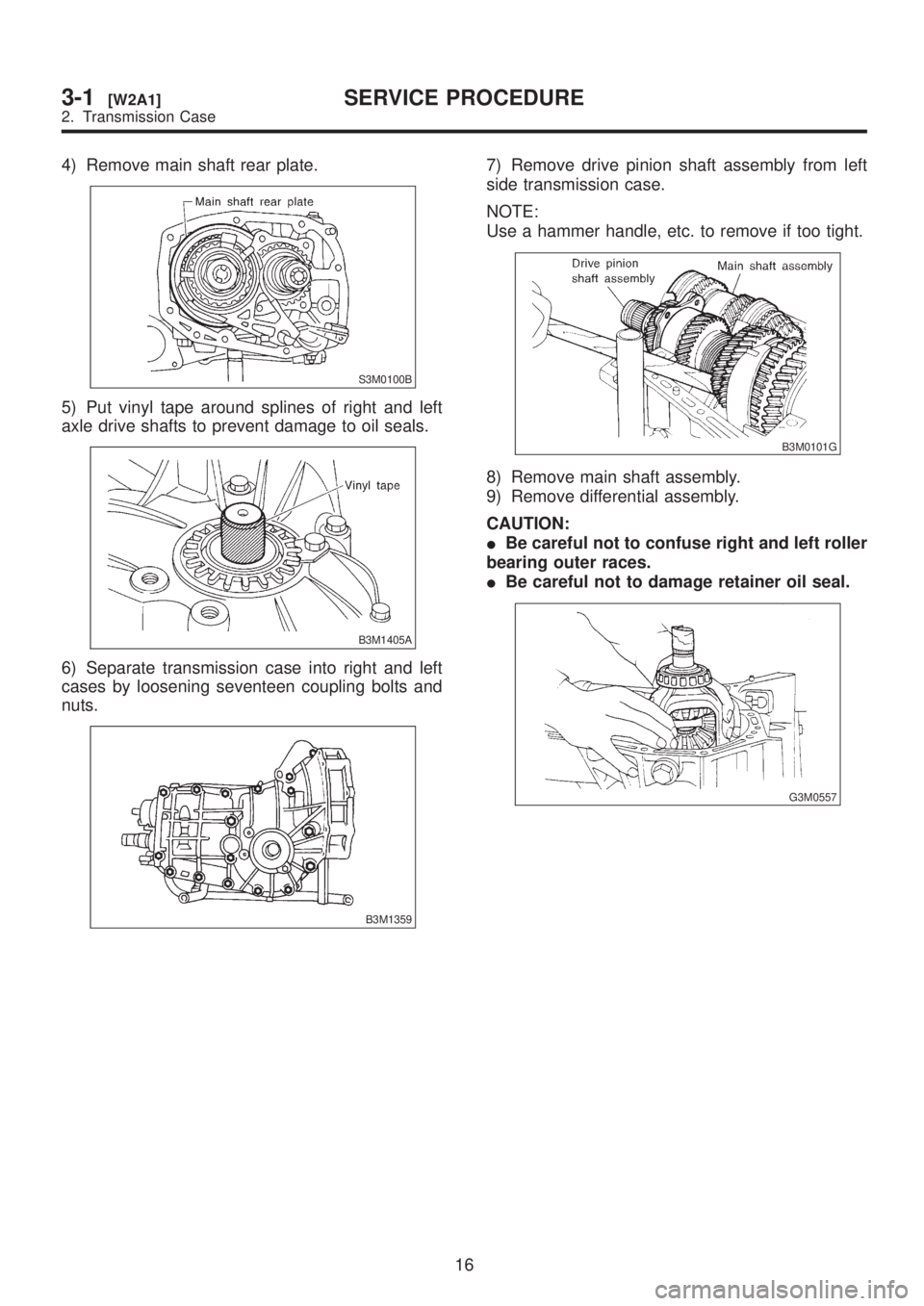
4) Remove main shaft rear plate.
S3M0100B
5) Put vinyl tape around splines of right and left
axle drive shafts to prevent damage to oil seals.
B3M1405A
6) Separate transmission case into right and left
cases by loosening seventeen coupling bolts and
nuts.
B3M1359
7) Remove drive pinion shaft assembly from left
side transmission case.
NOTE:
Use a hammer handle, etc. to remove if too tight.
B3M0101G
8) Remove main shaft assembly.
9) Remove differential assembly.
CAUTION:
IBe careful not to confuse right and left roller
bearing outer races.
IBe careful not to damage retainer oil seal.
G3M0557
16
3-1[W2A1]SERVICE PROCEDURE
2. Transmission Case
Page 525 of 1456
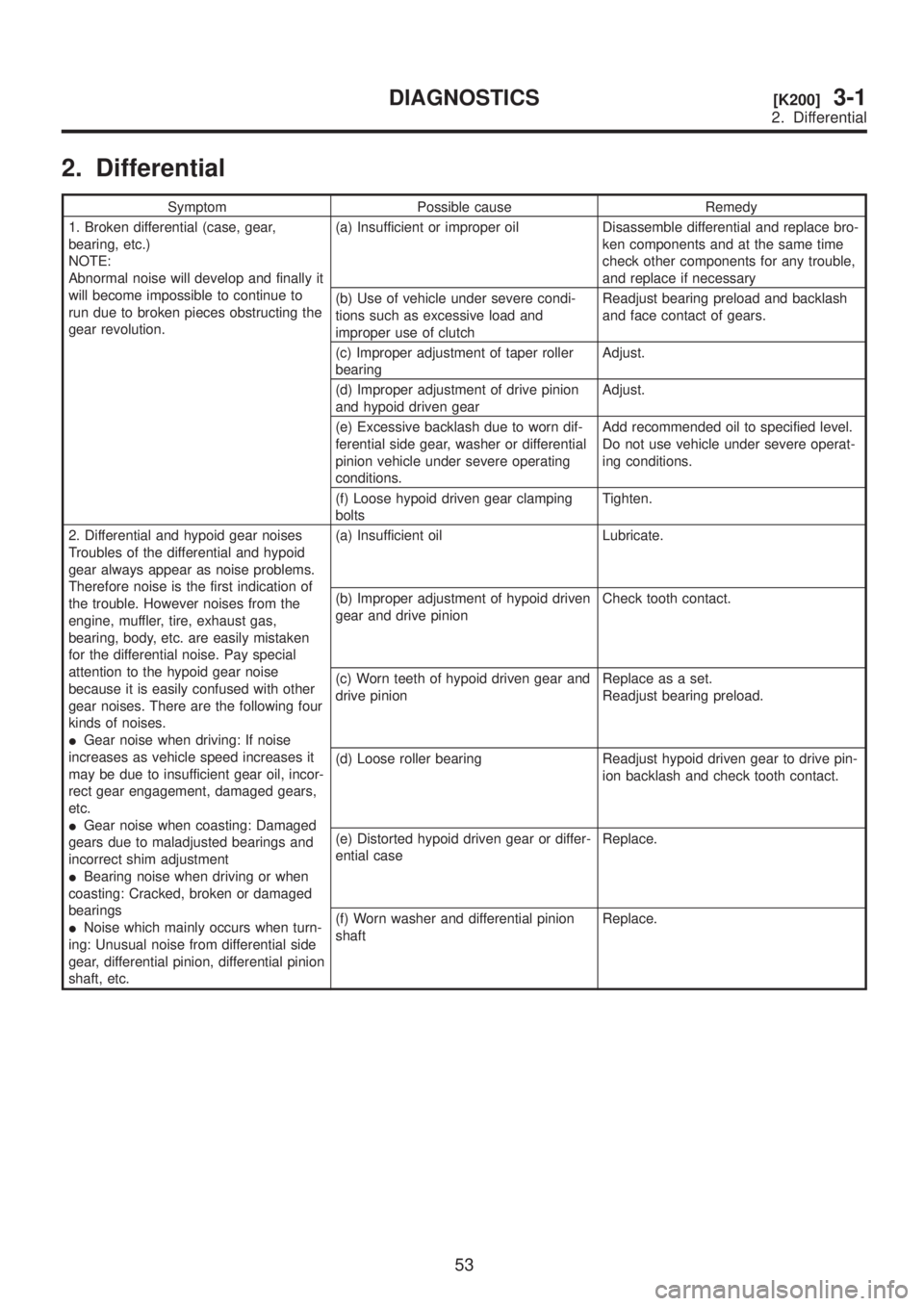
2. Differential
Symptom Possible cause Remedy
1. Broken differential (case, gear,
bearing, etc.)
NOTE:
Abnormal noise will develop and finally it
will become impossible to continue to
run due to broken pieces obstructing the
gear revolution.(a) Insufficient or improper oil Disassemble differential and replace bro-
ken components and at the same time
check other components for any trouble,
and replace if necessary
(b) Use of vehicle under severe condi-
tions such as excessive load and
improper use of clutchReadjust bearing preload and backlash
and face contact of gears.
(c) Improper adjustment of taper roller
bearingAdjust.
(d) Improper adjustment of drive pinion
and hypoid driven gearAdjust.
(e) Excessive backlash due to worn dif-
ferential side gear, washer or differential
pinion vehicle under severe operating
conditions.Add recommended oil to specified level.
Do not use vehicle under severe operat-
ing conditions.
(f) Loose hypoid driven gear clamping
boltsTighten.
2. Differential and hypoid gear noises
Troubles of the differential and hypoid
gear always appear as noise problems.
Therefore noise is the first indication of
the trouble. However noises from the
engine, muffler, tire, exhaust gas,
bearing, body, etc. are easily mistaken
for the differential noise. Pay special
attention to the hypoid gear noise
because it is easily confused with other
gear noises. There are the following four
kinds of noises.
IGear noise when driving: If noise
increases as vehicle speed increases it
may be due to insufficient gear oil, incor-
rect gear engagement, damaged gears,
etc.
IGear noise when coasting: Damaged
gears due to maladjusted bearings and
incorrect shim adjustment
IBearing noise when driving or when
coasting: Cracked, broken or damaged
bearings
INoise which mainly occurs when turn-
ing: Unusual noise from differential side
gear, differential pinion, differential pinion
shaft, etc.(a) Insufficient oil Lubricate.
(b) Improper adjustment of hypoid driven
gear and drive pinionCheck tooth contact.
(c) Worn teeth of hypoid driven gear and
drive pinionReplace as a set.
Readjust bearing preload.
(d) Loose roller bearing Readjust hypoid driven gear to drive pin-
ion backlash and check tooth contact.
(e) Distorted hypoid driven gear or differ-
ential caseReplace.
(f) Worn washer and differential pinion
shaftReplace.
53
[K200]3-1DIAGNOSTICS
2. Differential