front SUBARU OUTBACK 2016 6.G User Guide
[x] Cancel search | Manufacturer: SUBARU, Model Year: 2016, Model line: OUTBACK, Model: SUBARU OUTBACK 2016 6.GPages: 572, PDF Size: 21.79 MB
Page 33 of 572
for the child’s age, height and
weight.
Secure ALL types of child restraint
devices (including forward facing
child seats) in the REAR seats at
all times.
NEVER INSTALL A REARWARD FA-
CING CHILD SEAT IN THE FRONT
SEAT. DOING SO RISKS SERIOUS
INJURY OR DEATH TO THE CHILD
BY PLACING THE CHILD’S HEAD
TOO CLOSE TO THE SRS AIRBAG.
According to accident statistics,
children are safer when properly
restrained in the rear seating posi-
tions than in the front seating posi-
tions. For instructions and precau-
tions concerning child restraint sys-
tems, refer to“Child restraint sys-
tems”F1-27.
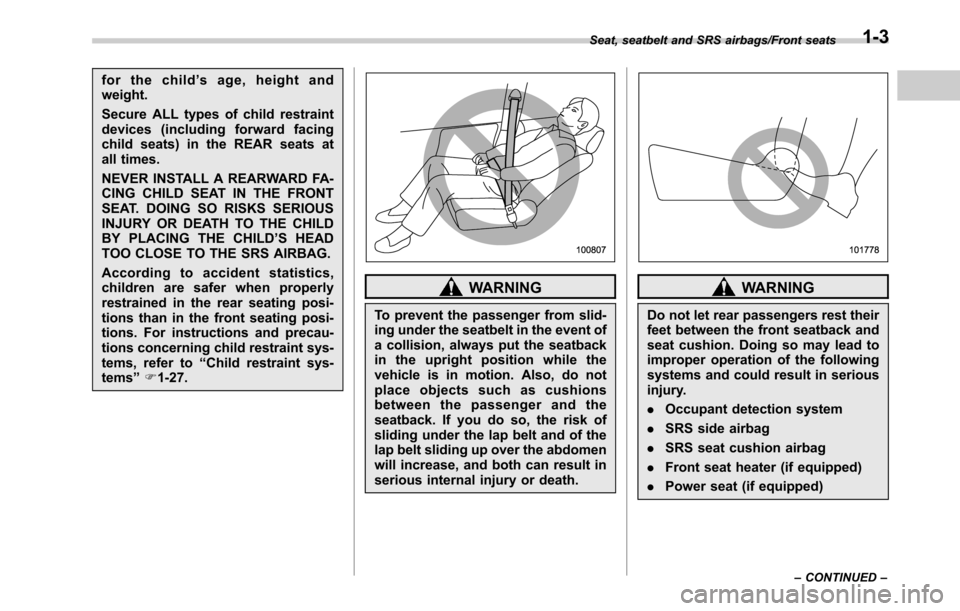
WARNING
To prevent the passenger from slid-
ing under the seatbelt in the event of
a collision, always put the seatback
in the upright position while the
vehicle is in motion. Also, do not
place objects such as cushions
between the passenger and the
seatback. If you do so, the risk of
sliding under the lap belt and of the
lap belt sliding up over the abdomen
will increase, and both can result in
serious internal injury or death.
WARNING
Do not let rear passengers rest their
feet between the front seatback and
seat cushion. Doing so may lead to
improper operation of the following
systems and could result in serious
injury.
.Occupant detection system
.SRS side airbag
.SRS seat cushion airbag
.Front seat heater (if equipped)
.Power seat (if equipped)
Seat, seatbelt and SRS airbags/Front seats
–CONTINUED–1-3
Page 34 of 572
Seat, seatbelt and SRS airbags/Front seats
&Manual seat (if equipped)
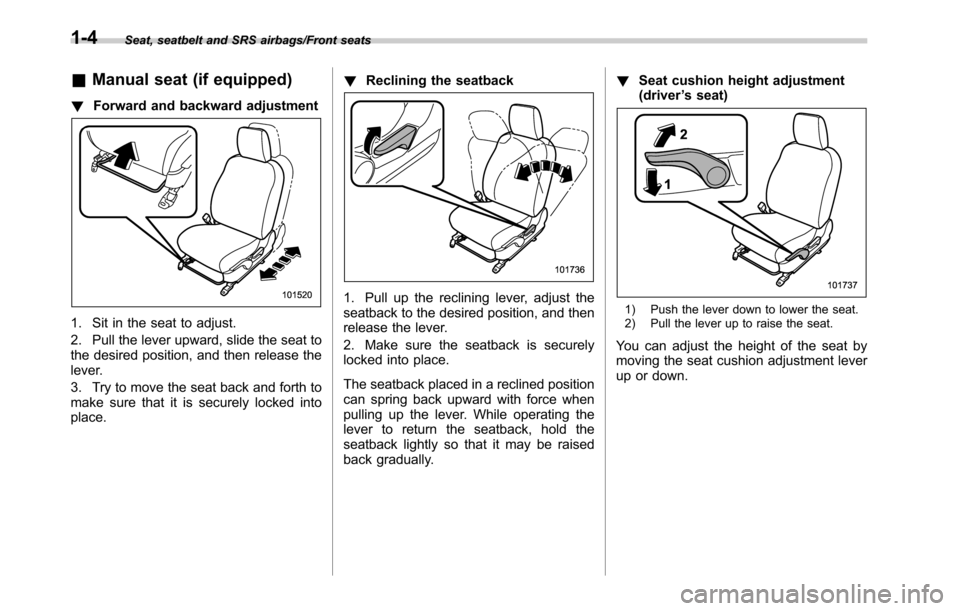
!Forward and backward adjustment
1. Sit in the seat to adjust.
2. Pull the lever upward, slide the seat to
the desired position, and then release the
lever.
3. Try to move the seat back and forth to
make sure that it is securely locked into
place.!Reclining the seatback
1. Pull up the reclining lever, adjust the
seatback to the desired position, and then
release the lever.
2. Make sure the seatback is securely
locked into place.
The seatback placed in a reclined position
can spring back upward with force when
pulling up the lever. While operating the
lever to return the seatback, hold the
seatback lightly so that it may be raised
back gradually.!Seat cushion height adjustment
(driver’s seat)1) Push the lever down to lower the seat.
2) Pull the lever up to raise the seat.
You can adjust the height of the seat by
moving the seat cushion adjustment lever
up or down.
1-4
Page 35 of 572
&Power seat (if equipped)
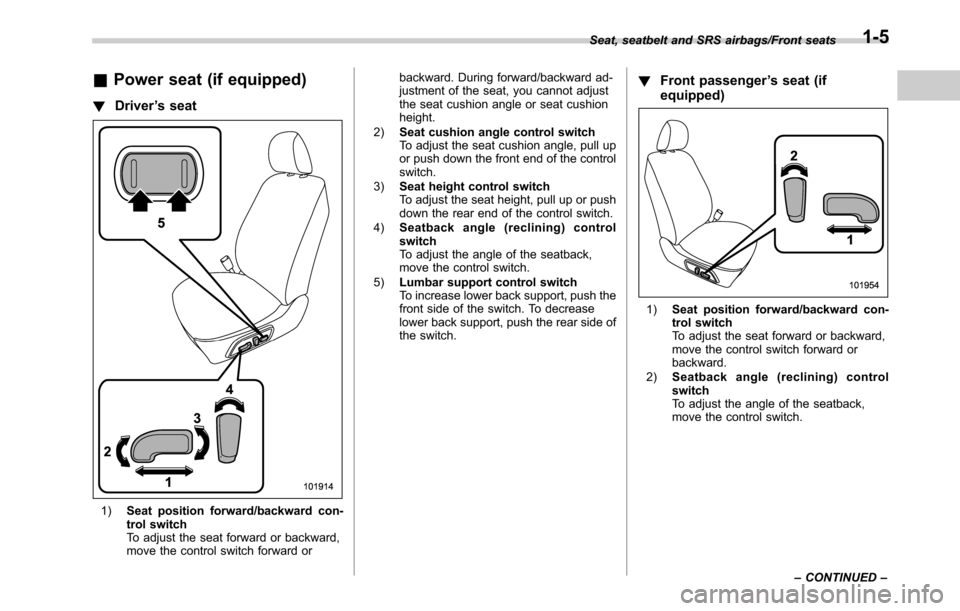
!Driver’s seat
1)Seat position forward/backward con-
trol switch
To adjust the seat forward or backward,
move the control switch forward orbackward. During forward/backward ad-
justment of the seat, you cannot adjust
the seat cushion angle or seat cushion
height.
2)Seat cushion angle control switch
To adjust the seat cushion angle, pull up
or push down the front end of the control
switch.
3)Seat height control switch
To adjust the seat height, pull up or push
down the rear end of the control switch.
4)Seatback angle (reclining) control
switch
To adjust the angle of the seatback,
move the control switch.
5)Lumbar support control switch
To increase lower back support, push the
front side of the switch. To decrease
lower back support, push the rear side of
the switch.
!Front passenger’s seat (if
equipped)
1)Seat position forward/backward con-
trol switch
To adjust the seat forward or backward,
move the control switch forward or
backward.
2)Seatback angle (reclining) control
switch
To adjust the angle of the seatback,
move the control switch. Seat, seatbelt and SRS airbags/Front seats
–CONTINUED–
1-5
Page 36 of 572
Seat, seatbelt and SRS airbags/Front seats
!Memory function (driver’s seat—if
equipped)
WARNING
.Never adjust the seat while driv-
ing to avoid loss of vehicle con-
trol and personal injury.
.Before adjusting the seat, make
sure that cargo or the hands and
feet of rear seat passengers are
clear of the adjusting mechan-
ism.
.Never retrieve the seat position
while driving to avoid loss of
vehicle control and personal in-
jury.
.Perform the seat position retrie-
val before driving. Be sure to
confirm that the select lever is
in the“P”position, and the
parking brake is applied, when
adjusting the seat position. Do
not drive until the retrieval of the
seat position is complete.
.When retrieving a registered seat
position, make sure the hands,
feet and possessions of rear seat
passengers are clear of the seat
adjusting mechanism.
.When any unusual conditions ormalfunctions occur during the
retrieval of the seat position, stop
the retrieval of the seat position
by performing any of the follow-
ing procedures.
–Operate any of the power seat
switches
–Press the“SET”button
–Press button“1”or“2”
Some of your desired seat positions can
be registered. Register the seat position
with button“1”or“2”or each of the access
keys and retrieve the seat position.
The following seat positions can be
registered.
.Forward/backward position of the seat
.Angle of seatback
.Angle of seat cushion
.Height of seat
!Registration of seat position with
button“1”or“2”
1. Adjust the seat position under the
following conditions.
.The parking brake is applied.
.The select lever is in the“P”posi-
tion.
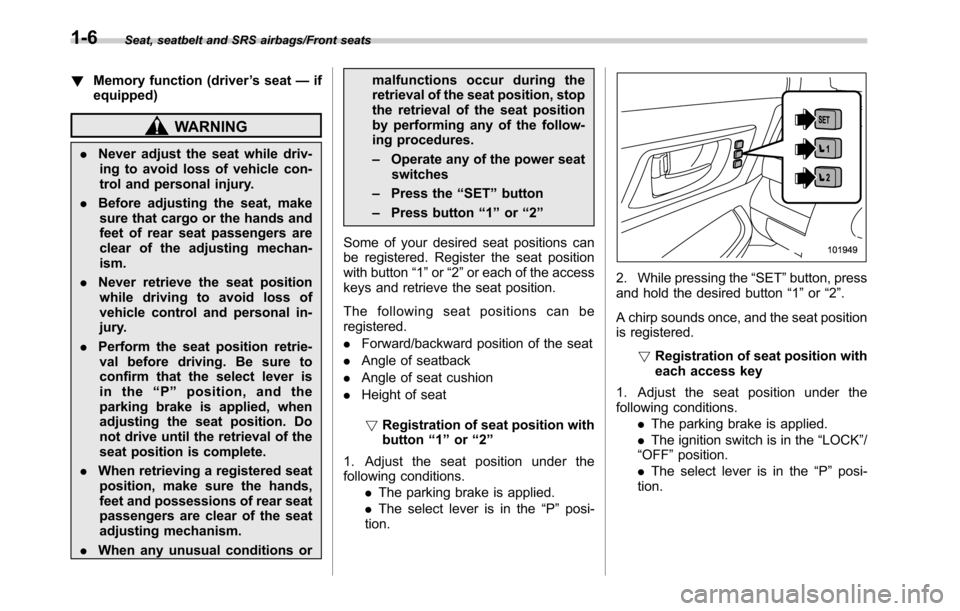
2. While pressing the“SET”button, press
and hold the desired button“1”or“2”.
A chirp sounds once, and the seat position
is registered.
!Registration of seat position with
each access key
1. Adjust the seat position under the
following conditions.
.The parking brake is applied.
.The ignition switch is in the“LOCK”/
“OFF”position.
.The select lever is in the“P”posi-
tion.
1-6
Page 37 of 572
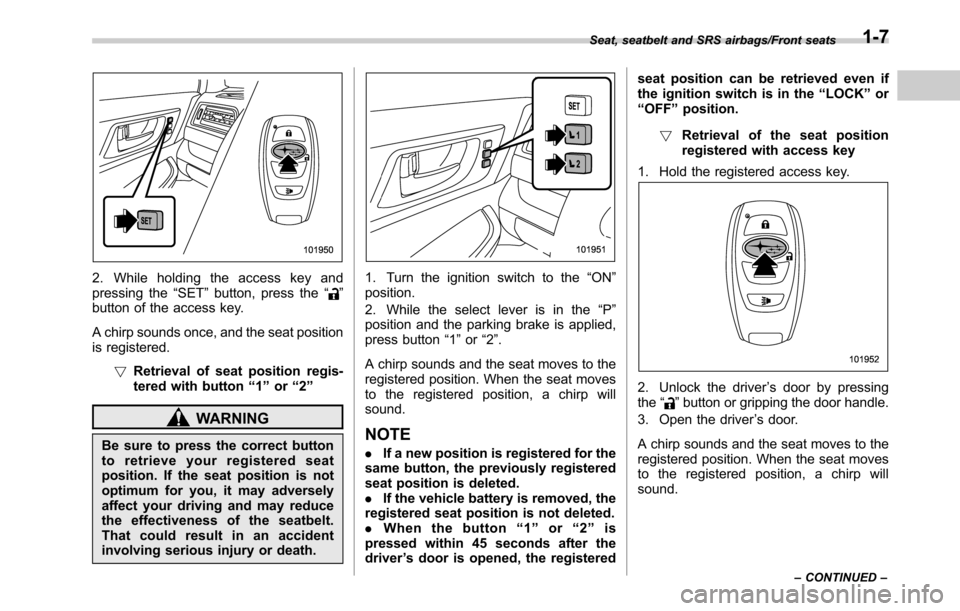
2. While holding the access key and
pressing the“SET”button, press the“”
button of the access key.
A chirp sounds once, and the seat position
is registered.
!Retrieval of seat position regis-
tered with button“1”or“2”
WARNING
Be sure to press the correct button
to retrieve your registered seat
position. If the seat position is not
optimum for you, it may adversely
affect your driving and may reduce
the effectiveness of the seatbelt.
That could result in an accident
involving serious injury or death.
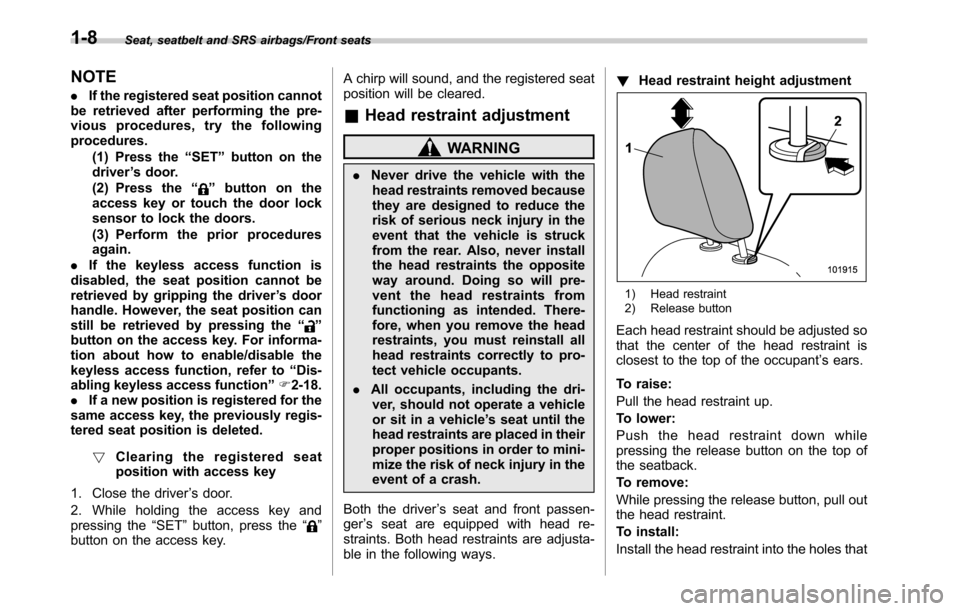
1. Turn the ignition switch to the“ON”
position.
2. While the select lever is in the“P”
position and the parking brake is applied,
press button“1”or“2”.
A chirp sounds and the seat moves to the
registered position. When the seat moves
to the registered position, a chirp will
sound.
NOTE
.If a new position is registered for the
same button, the previously registered
seat position is deleted.
.If the vehicle battery is removed, the
registered seat position is not deleted.
.When the button“1”or“2”is
pressed within 45 seconds after the
driver’s door is opened, the registeredseat position can be retrieved even if
the ignition switch is in the“LOCK”or
“OFF”position.
!Retrieval of the seat position
registered with access key
1. Hold the registered access key.
2. Unlock the driver’s door by pressing
the“”button or gripping the door handle.
3. Open the driver’s door.
A chirp sounds and the seat moves to the
registered position. When the seat moves
to the registered position, a chirp will
sound.
Seat, seatbelt and SRS airbags/Front seats
–CONTINUED–1-7
Page 38 of 572
Seat, seatbelt and SRS airbags/Front seats
NOTE
.If the registered seat position cannot
be retrieved after performing the pre-
vious procedures, try the following
procedures.
(1) Press the“SET”button on the
driver’s door.
(2) Press the“
”button on the
access key or touch the door lock
sensor to lock the doors.
(3) Perform the prior procedures
again.
.If the keyless access function is
disabled, the seat position cannot be
retrieved by gripping the driver’s door
handle. However, the seat position can
still be retrieved by pressing the“
”
button on the access key. For informa-
tion about how to enable/disable the
keyless access function, refer to“Dis-
abling keyless access function”F2-18.
.If a new position is registered for the
same access key, the previously regis-
tered seat position is deleted.
!Clearing the registered seat
position with access key
1. Close the driver’s door.
2. While holding the access key and
pressing the“SET”button, press the“
”
button on the access key.A chirp will sound, and the registered seat
position will be cleared.
&Head restraint adjustment
WARNING
.Never drive the vehicle with the
head restraints removed because
they are designed to reduce the
risk of serious neck injury in the
event that the vehicle is struck
from the rear. Also, never install
the head restraints the opposite
way around. Doing so will pre-
vent the head restraints from
functioning as intended. There-
fore, when you remove the head
restraints, you must reinstall all
head restraints correctly to pro-
tect vehicle occupants.
.All occupants, including the dri-
ver, should not operate a vehicle
or sit in a vehicle’s seat until the
head restraints are placed in their
proper positions in order to mini-
mize the risk of neck injury in the
event of a crash.
Both the driver’s seat and front passen-
ger’s seat are equipped with head re-
straints. Both head restraints are adjusta-
ble in the following ways.!Head restraint height adjustment
1) Head restraint
2) Release button
Each head restraint should be adjusted so
that the center of the head restraint is
closest to the top of the occupant’s ears.
To raise:
Pull the head restraint up.
To lower:
Push the head restraint down while
pressing the release button on the top of
the seatback.
To remove:
While pressing the release button, pull out
the head restraint.
To install:
Install the head restraint into the holes that
1-8
Page 40 of 572
Seat, seatbelt and SRS airbags/Seat heater
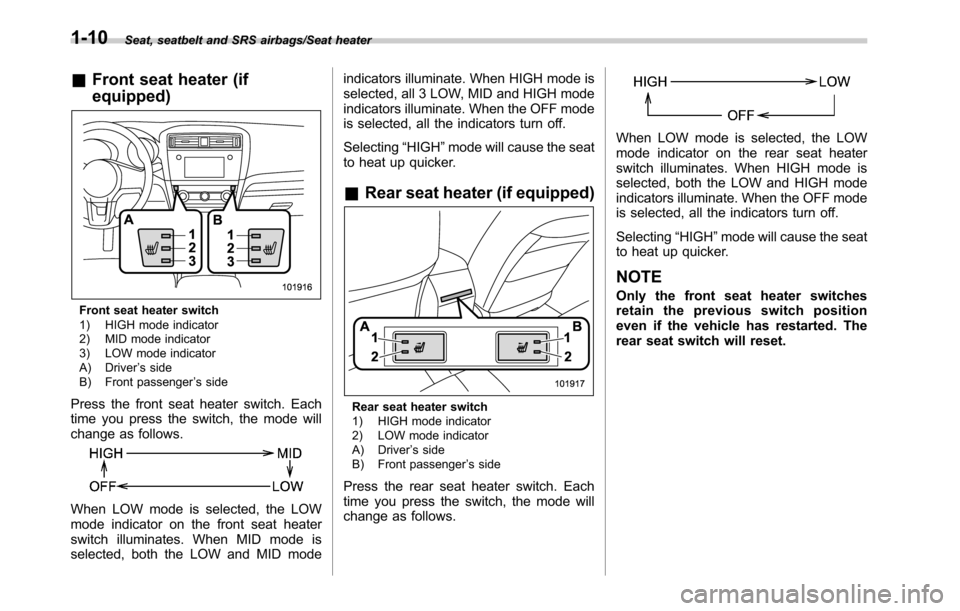
&Front seat heater (if
equipped)
Front seat heater switch
1) HIGH mode indicator
2) MID mode indicator
3) LOW mode indicator
A) Driver’s side
B) Front passenger’s side
Press the front seat heater switch. Each
time you press the switch, the mode will
change as follows.
When LOW mode is selected, the LOW
mode indicator on the front seat heater
switch illuminates. When MID mode is
selected, both the LOW and MID modeindicators illuminate. When HIGH mode is
selected, all 3 LOW, MID and HIGH mode
indicators illuminate. When the OFF mode
is selected, all the indicators turn off.
Selecting“HIGH”mode will cause the seat
to heat up quicker.
&Rear seat heater (if equipped)
Rear seat heater switch
1) HIGH mode indicator
2) LOW mode indicator
A) Driver’s side
B) Front passenger’s side
Press the rear seat heater switch. Each
time you press the switch, the mode will
change as follows.
When LOW mode is selected, the LOW
mode indicator on the rear seat heater
switch illuminates. When HIGH mode is
selected, both the LOW and HIGH mode
indicators illuminate. When the OFF mode
is selected, all the indicators turn off.
Selecting“HIGH”mode will cause the seat
to heat up quicker.
NOTE
Only the front seat heater switches
retainthepreviousswitchposition
even if the vehicle has restarted. The
rear seat switch will reset.
1-10
Page 42 of 572
Seat, seatbelt and SRS airbags/Rear seats
cargo area cover when you re-
cline the rear seat.
.Move the front cover of the cargo
area cover backward so that the
cover is not damaged by the
reclined seatback. Refer to“Car-
go area cover (Outback–if
equipped)”F6-16.
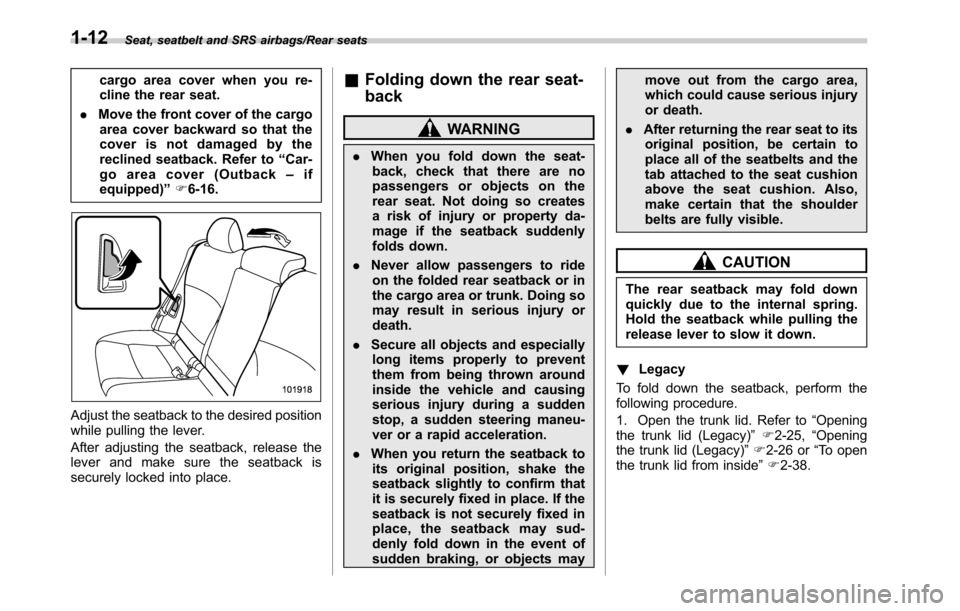
Adjust the seatback to the desired position
while pulling the lever.
After adjusting the seatback, release the
lever and make sure the seatback is
securely locked into place.
&Folding down the rear seat-
back
WARNING
.When you fold down the seat-
back, check that there are no
passengers or objects on the
rear seat. Not doing so creates
a risk of injury or property da-
mage if the seatback suddenly
folds down.
.Never allow passengers to ride
on the folded rear seatback or in
the cargo area or trunk. Doing so
may result in serious injury or
death.
.Secure all objects and especially
long items properly to prevent
them from being thrown around
inside the vehicle and causing
serious injury during a sudden
stop, a sudden steering maneu-
ver or a rapid acceleration.
.When you return the seatback to
its original position, shake the
seatback slightly to confirm that
it is securely fixed in place. If the
seatback is not securely fixed in
place, the seatback may sud-
denly fold down in the event of
sudden braking, or objects maymove out from the cargo area,
which could cause serious injury
or death.
.After returning the rear seat to its
original position, be certain to
place all of the seatbelts and the
tab attached to the seat cushion
above the seat cushion. Also,
make certain that the shoulder
belts are fully visible.
CAUTION
The rear seatback may fold down
quickly due to the internal spring.
Hold the seatback while pulling the
release lever to slow it down.
!Legacy
To fold down the seatback, perform the
following procedure.
1. Open the trunk lid. Refer to“Opening
the trunk lid (Legacy)”F2-25,“Opening
the trunk lid (Legacy)”F2-26 or“To open
the trunk lid from inside”F2-38.
1-12
Page 46 of 572
Seat, seatbelt and SRS airbags/Seatbelts
Seatbelts
&Seatbelt safety tips
WARNING
.All persons in the vehicle should
fasten their seatbelts BEFORE
the vehicle starts to move. Other-
wise, the possibility of serious
injury becomes greater in the
event of a sudden stop or acci-
dent.
.All belts should fit snugly in order
to provide full restraint. Loose
fitting belts are not as effective in
preventing or reducing injury.
.Each seatbelt is designed to
support only one person. Never
use a single belt for two or more
persons–even children. Other-
wise, in an accident, serious
injury or death could result.
.Replace all seatbelt assemblies
including retractors and attach-
ing hardware worn by occupants
of a vehicle that has been in a
serious accident. The entire as-
sembly should be replaced even
if damage is not obvious..Putchildrenintherearseat
properly restrained at all times.
The SRS airbag deploys with
considerable speed and force
and can injure or even kill chil-
dren, especially if they are not
restrained or improperly re-
strained. Because children are
lighter and weaker than adults,
their risk of being injured from
deployment is greater. Conse-
quently, we strongly recommend
that ALL children (including
those in child seats and those
that have outgrown child re-
straint devices) sit in the REAR
seat properly restrained at all
times in a child restraint device
or in a seatbelt, whichever is
appropriate for the child’s height
and weight.
Secure ALL types of child re-
straint devices (including for-
ward facing child seats) in the
REAR seats at all times.
NEVER INSTALL A REARWARD
FACING CHILD SEAT IN THE
FRONT SEAT. DOING SO RISKS
SERIOUS INJURY OR DEATH TO
THE CHILD BY PLACING THE
CHILD’S HEAD TOO CLOSE TO
THE SRS AIRBAG.According to accident statistics,
children are safer when properly
restrained in the rear seating
positions than in the front seat-
ing positions. For instructions
and precautions concerning the
child restraint system, refer to
“Child restraint systems”F1-27.
Your vehicle is equipped with a crash
sensing and diagnostic module, which will
record the use of the seatbelt by the front
passenger when any of the SRS frontal,
side and curtain airbags deploys.
!Infants or small children
Use a child restraint system that is
suitable for your vehicle. Refer to“Child
restraint systems”F1-27.
!Children
If a child is too big for a child restraint
system, the child should sit in the rear seat
and be restrained using the seatbelts.
According to accident statistics, children
are safer when properly restrained in the
rear seating positions than in the front
seating positions. Never allow a child to
stand up or kneel on the seat.
If the shoulder portion of the belt crosses
the face or neck, move the child closer to
the belt buckle to help provide a good
1-16
Page 48 of 572
Seat, seatbelt and SRS airbags/Seatbelts
possible on your hips. In a colli-
sion, this spreads the force of the
lap belt over stronger hip bones
instead of across the weaker
abdomen.
.Seatbelts provide maximum re-
straint when the occupant sits
well back and upright in the seat.
To reduce the risk of sliding
under the seatbelt in a collision,
the front seatbacks should be
always used in the upright posi-
tion while the vehicle is running.
If the front seatbacks are not
used in the upright position in a
collision, the risk of sliding under
the lap belt and of the lap belt
sliding up over the abdomen will
increase, and both can result in
serious internal injury or death.
.Do not put cushions or any other
materials between occupants
and seatbacks or seat cushions.
If you do so, the risk of sliding
under the lap belt and of the lap
belt sliding up over the abdomen
will increase, and both can result
in serious internal injury or
death.
WARNING
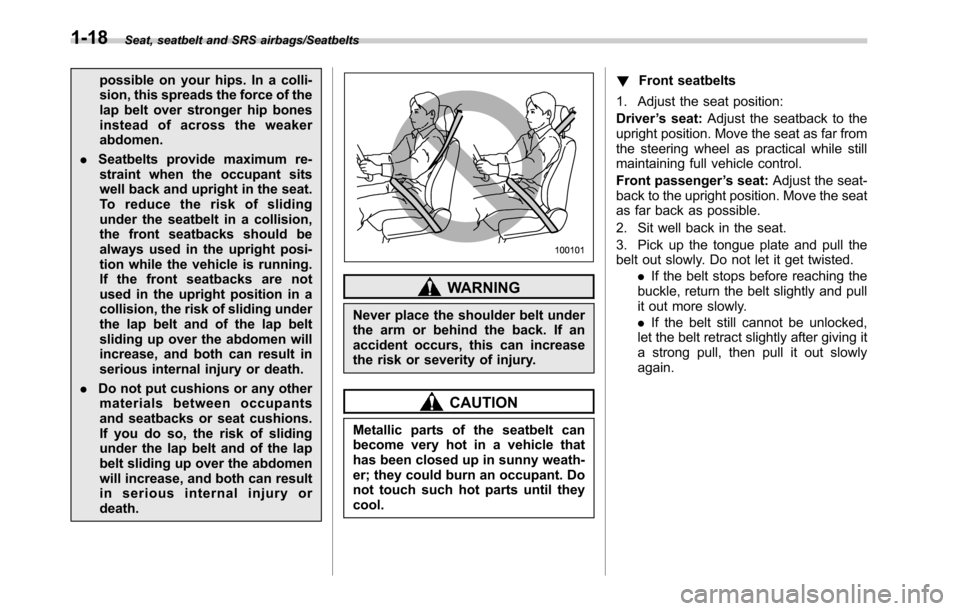
Never place the shoulder belt under
the arm or behind the back. If an
accident occurs, this can increase
the risk or severity of injury.
CAUTION
Metallic parts of the seatbelt can
become very hot in a vehicle that
has been closed up in sunny weath-
er; they could burn an occupant. Do
not touch such hot parts until they
cool.!Front seatbelts
1. Adjust the seat position:
Driver’s seat:Adjust the seatback to the
upright position. Move the seat as far from
the steering wheel as practical while still
maintaining full vehicle control.
Front passenger’s seat:Adjust the seat-
back to the upright position. Move the seat
as far back as possible.
2. Sit well back in the seat.
3. Pick up the tongue plate and pull the
belt out slowly. Do not let it get twisted.
.If the belt stops before reaching the
buckle, return the belt slightly and pull
it out more slowly.
.If the belt still cannot be unlocked,
let the belt retract slightly after giving it
a strong pull, then pull it out slowly
again.
1-18