front SUBARU OUTBACK 2016 6.G Owner's Manual
[x] Cancel search | Manufacturer: SUBARU, Model Year: 2016, Model line: OUTBACK, Model: SUBARU OUTBACK 2016 6.GPages: 572, PDF Size: 21.79 MB
Page 49 of 572
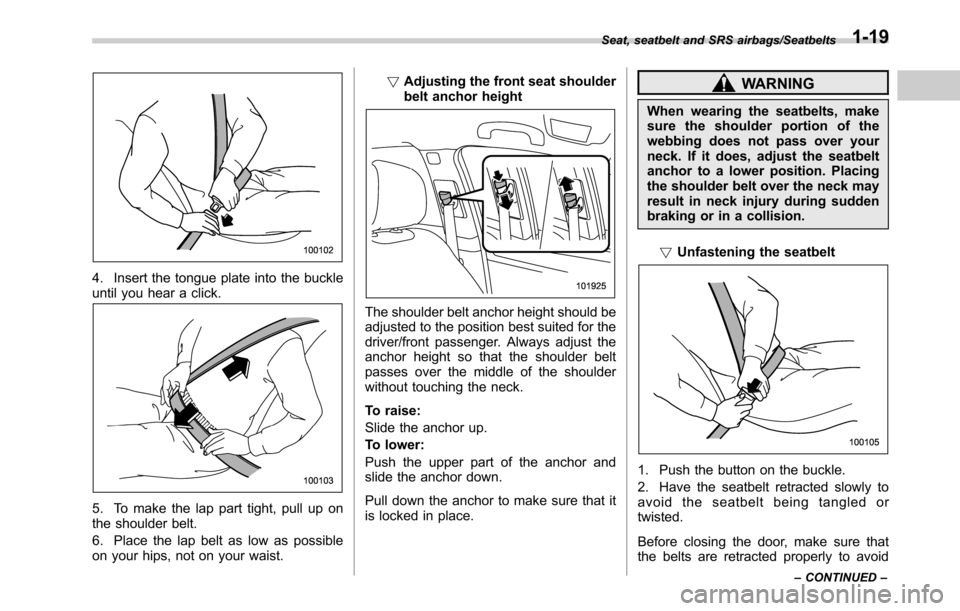
4. Insert the tongue plate into the buckle
until you hear a click.
5. To make the lap part tight, pull up on
the shoulder belt.
6. Place the lap belt as low as possible
on your hips, not on your waist.!Adjusting the front seat shoulder
belt anchor height
The shoulder belt anchor height should be
adjusted to the position best suited for the
driver/front passenger. Always adjust the
anchor height so that the shoulder belt
passes over the middle of the shoulder
without touching the neck.
To raise:
Slide the anchor up.
To lower:
Push the upper part of the anchor and
slide the anchor down.
Pull down the anchor to make sure that it
is locked in place.
WARNING
When wearing the seatbelts, make
sure the shoulder portion of the
webbing does not pass over your
neck. If it does, adjust the seatbelt
anchor to a lower position. Placing
the shoulder belt over the neck may
result in neck injury during sudden
braking or in a collision.
!Unfastening the seatbelt
1. Push the button on the buckle.
2. Have the seatbelt retracted slowly to
avoid the seatbelt being tangled or
twisted.
Before closing the door, make sure that
the belts are retracted properly to avoid
Seat, seatbelt and SRS airbags/Seatbelts
–CONTINUED–1-19
Page 54 of 572
Seat, seatbelt and SRS airbags/Front seatbelt pretensioners
CAUTION
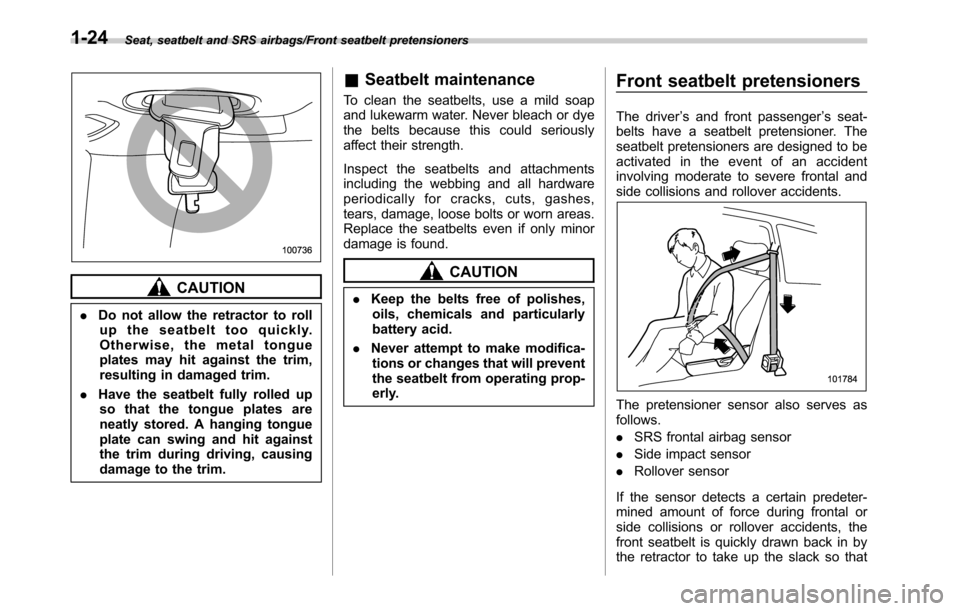
.Do not allow the retractor to roll
up the seatbelt too quickly.
Otherwise, the metal tongue
plates may hit against the trim,
resulting in damaged trim.
.Have the seatbelt fully rolled up
so that the tongue plates are
neatly stored. A hanging tongue
plate can swing and hit against
the trim during driving, causing
damage to the trim.
&Seatbelt maintenance
To clean the seatbelts, use a mild soap
and lukewarm water. Never bleach or dye
the belts because this could seriously
affect their strength.
Inspect the seatbelts and attachments
including the webbing and all hardware
periodically for cracks, cuts, gashes,
tears, damage, loose bolts or worn areas.
Replace the seatbelts even if only minor
damage is found.
CAUTION
.Keep the belts free of polishes,
oils, chemicals and particularly
battery acid.
.Never attempt to make modifica-
tions or changes that will prevent
the seatbelt from operating prop-
erly.
Front seatbelt pretensioners
The driver’s and front passenger’s seat-
belts have a seatbelt pretensioner. The
seatbelt pretensioners are designed to be
activated in the event of an accident
involving moderate to severe frontal and
side collisions and rollover accidents.
The pretensioner sensor also serves as
follows.
.SRS frontal airbag sensor
.Side impact sensor
.Rollover sensor
If the sensor detects a certain predeter-
mined amount of force during frontal or
side collisions or rollover accidents, the
front seatbelt is quickly drawn back in by
the retractor to take up the slack so that
1-24
Page 55 of 572
the belt more effectively restrains the
driver.
When a seatbelt pretensioner is activated,
an operating noise will be heard and a
small amount of smoke will be released.
These occurrences are normal and not
harmful. This smoke does not indicate a
fire in the vehicle.
Once the seatbelt pretensioner has been
activated, the seatbelt retractor remains
locked. Consequently, the seatbelt cannot
be pulled out and retracted and therefore
must be replaced.
NOTE
.Seatbelt pretensioners are not de-
signed to activate in minor impacts.
.In cases of rollover accidents, as the
SRS curtain airbags deploy, the seat-
belt pretensioners are activated simul-
taneously.
.In cases of frontal collisions, the
following components will operate si-
multaneously.
–Seatbelt pretensioner for driver
–Seatbelt pretensioner for front
passenger
–SRS frontal airbag for driver
–SRS frontal airbag for front pas-
senger*
–SRS seat cushion airbag fordriver
–SRS seat cushion airbag for front
passenger*
–SRS curtain airbags (both sides)
(if an offset frontal collision occurs)
*: This does not operate if the occupant
detection system deactivates airbag op-
eration. For details, refer to“Front
passenger’s SRS frontal airbag”F1-52
.
.In cases of side collisions, the
following components will operate si-
multaneously.
–SRS curtain airbag (impacted
side)
–SRS side airbag (impacted side)
(when any of the center pillar im-
pact sensors/front door impact sen-
sors senses an impact force)
–Seatbelt pretensioner for driver
(when the driver’s side front door
impact sensor senses an impact
force)
–Seatbelt pretensioner for front
passenger (when the front passen-
ger’s side front door impact sensor
senses an impact force)
.Pretensioners are designed to func-
tion on a one-time-only basis. In the
event that a pretensioner is activated,
both the driver’s and front passenger’s
seatbelt retractor assemblies should
be replaced only by an authorizedSUBARU dealer. When replacing seat-
belt retractor assemblies, use only
genuine SUBARU parts.
.If either front seatbelt does not
retract or cannot be pulled out due to
a malfunction or activation of the
pretensioner, contact your SUBARU
dealer as soon as possible.
.If the front seatbelt retractor assem-
bly or surrounding area has been
damaged, contact your SUBARU dealer
as soon as possible.
.When you sell your vehicle, we urge
you to explain to the buyer that it has
seatbelt pretensioners by alerting the
buyer to the contents of this section.
WARNING
.To obtain maximum protection,
the occupants should sit in an
upright position with their seat-
belts properly fastened. Refer to
“Seatbelts”F1-16.
.Do not modify, remove or strike
the front seatbelt retractor as-
semblies or surrounding area.
This could result in accidental
activation of the seatbelt preten-
sioners or could make the sys-
tem inoperative, possibly result-
ing in serious injury. Seatbelt
Seat, seatbelt and SRS airbags/Front seatbelt pretensioners
–CONTINUED–1-25
Page 56 of 572
Seat, seatbelt and SRS airbags/Front seatbelt pretensioners
pretensioners have no user-ser-
viceable parts. For required ser-
vicing of front seatbelt retractors
equipped with seatbelt preten-
sioners, consult your SUBARU
dealer.
.When discarding front seatbelt
retractor assemblies or scrap-
ping the entire vehicle due to
collision damage or for other
reasons, consult your SUBARU
dealer.
&System monitors
A diagnostic system continually monitors
the readiness of the seatbelt pretensioner
while the vehicle is being driven. The
seatbelt pretensioners share the control
modulewiththeSRSairbagsystem.
Therefore, if any malfunction occurs in a
seatbelt pretensioner, the SRS airbag
system warning light will illuminate. For
details, refer to“SRS airbag system
monitors”F1-68.
&System servicing
WARNING
.When discarding a seatbelt re-
tractor assembly or scrapping
the entire vehicle damaged by a
collision, consult your SUBARU
dealer.
.Tampering with or disconnecting
the system’s wiring could result
in accidental activation of the
seatbelt pretensioner and/or
SRS airbag or could make the
system inoperative, which may
result in serious injury. Do not
use electrical test equipment on
any circuit related to the seatbelt
pretensioner and SRS airbag
systems. For required servicing
of the seatbelt pretensioner, con-
sult your nearest SUBARU deal-
er.
CAUTION
The sensors and SRS airbag control
modules are located in the following
locations.
.Front sub sensors: on both sides
of the radiator panel
.Front door impact sensors: on
both front doors
.SRS airbag control module (in-
cluding the impact sensors and
rollover sensor): under the cen-
ter console
If you need service or repair in those
areas or near the front seatbelt
retractors, have the work performed
by your authorized SUBARU dealer.
NOTE
If the front part of the vehicle is
damaged in an accident to the extent
that the seatbelt pretensioner does not
operate, contact your SUBARU dealer
as soon as possible.
1-26
Page 57 of 572
&Precautions against vehicle
modification
Always consult your SUBARU dealer if
you want to install any accessory parts to
your vehicle.
CAUTION
Do not perform any of the following
modifications. Such modifications
can interfere with proper operation
of the seatbelt pretensioners.
.Attachment of any equipment
(bush bar, winches, snow plow,
skid plate, etc.) other than genu-
ine SUBARU accessory parts to
the front end.
.Modification of the suspension
system or front end structure.
.Installation of a tire of different
size and construction from the
tires specified on the vehicle
placard attached to the door
pillar or specified for individual
vehicle models in this Owner’s
Manual.
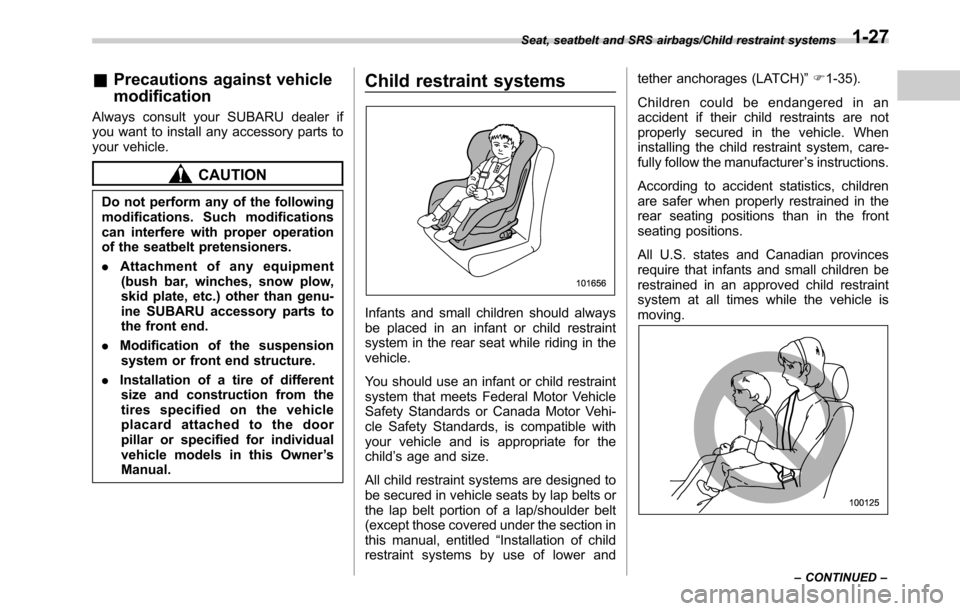
Child restraint systems
Infants and small children should always
be placed in an infant or child restraint
system in the rear seat while riding in the
vehicle.
You should use an infant or child restraint
system that meets Federal Motor Vehicle
Safety Standards or Canada Motor Vehi-
cle Safety Standards, is compatible with
your vehicle and is appropriate for the
child’s age and size.
All child restraint systems are designed to
be secured in vehicle seats by lap belts or
the lap belt portion of a lap/shoulder belt
(except those covered under the section in
this manual, entitled“Installation of child
restraint systems by use of lower andtether anchorages (LATCH)”F1-35).
Children could be endangered in an
accident if their child restraints are not
properly secured in the vehicle. When
installing the child restraint system, care-
fully follow the manufacturer’s instructions.
According to accident statistics, children
are safer when properly restrained in the
rear seating positions than in the front
seating positions.
All U.S. states and Canadian provinces
require that infants and small children be
restrained in an approved child restraint
system at all times while the vehicle is
moving.
Seat, seatbelt and SRS airbags/Child restraint systems
–CONTINUED–1-27
Page 58 of 572
Seat, seatbelt and SRS airbags/Child restraint systems
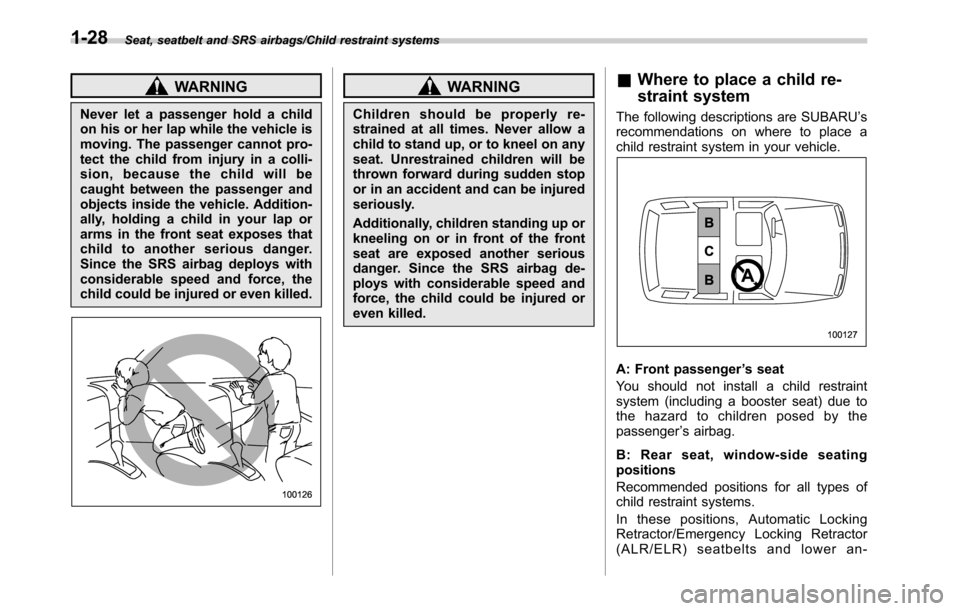
WARNING
Never let a passenger hold a child
on his or her lap while the vehicle is
moving. The passenger cannot pro-
tect the child from injury in a colli-
sion, because the child will be
caught between the passenger and
objects inside the vehicle. Addition-
ally, holding a child in your lap or
arms in the front seat exposes that
child to another serious danger.
Since the SRS airbag deploys with
considerable speed and force, the
child could be injured or even killed.
WARNING
Children should be properly re-
strained at all times. Never allow a
child to stand up, or to kneel on any
seat. Unrestrained children will be
thrown forward during sudden stop
or in an accident and can be injured
seriously.
Additionally, children standing up or
kneeling on or in front of the front
seat are exposed another serious
danger. Since the SRS airbag de-
ploys with considerable speed and
force, the child could be injured or
even killed.
&Where to place a child re-
straint system
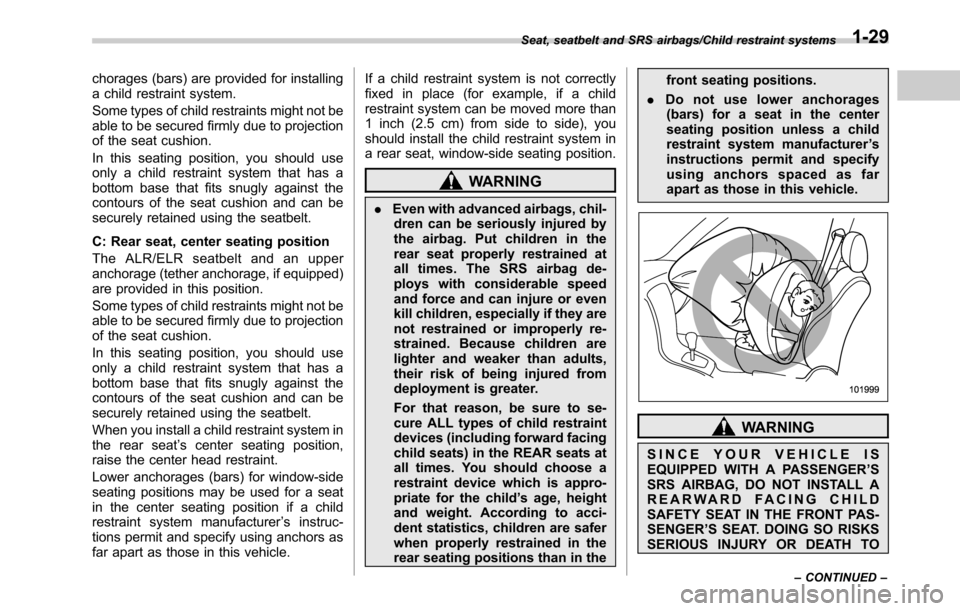
The following descriptions are SUBARU’s
recommendations on where to place a
child restraint system in your vehicle.
A: Front passenger’s seat
You should not install a child restraint
system (including a booster seat) due to
the hazard to children posed by the
passenger’s airbag.
B: Rear seat, window-side seating
positions
Recommended positions for all types of
child restraint systems.
In these positions,Automatic Locking
Retractor/Emergency Locking Retractor
(ALR/ELR) seatbelts and lower an-
1-28
Page 59 of 572
chorages (bars) are provided for installing
a child restraint system.
Some types of child restraints might not be
able to be secured firmly due to projection
of the seat cushion.
In this seating position, you should use
only a child restraint system that has a
bottom base that fits snugly against the
contours of the seat cushion and can be
securely retained using the seatbelt.
C: Rear seat, center seating position
The ALR/ELR seatbelt and an upper
anchorage (tether anchorage, if equipped)
are provided in this position.
Some types of child restraints might not be
able to be secured firmly due to projection
of the seat cushion.
In this seating position, you should use
only a child restraint system that has a
bottom base that fits snugly against the
contours of the seat cushion and can be
securely retained using the seatbelt.
When you install a child restraint system in
the rear seat’s center seating position,
raise the center head restraint.
Lower anchorages (bars) for window-side
seating positions may be used for a seat
in the center seating position if a child
restraint system manufacturer’s instruc-
tions permit and specify using anchors as
far apart as those in this vehicle.If a child restraint system is not correctly
fixed in place (for example, if a child
restraint system can be moved more than
1 inch (2.5 cm) from side to side), you
should install the child restraint system in
a rear seat, window-side seating position.
WARNING
.Even with advanced airbags, chil-
dren can be seriously injured by
the airbag. Put children in the
rear seat properly restrained at
all times. The SRS airbag de-
ploys with considerable speed
and force and can injure or even
kill children, especially if they are
not restrained or improperly re-
strained. Because children are
lighter and weaker than adults,
their risk of being injured from
deployment is greater.
For that reason, be sure to se-
cure ALL types of child restraint
devices (including forward facing
child seats) in the REAR seats at
all times. You should choose a
restraint device which is appro-
priate for the child’s age, height
and weight. According to acci-
dent statistics, children are safer
when properly restrained in the
rear seating positions than in thefront seating positions.
.Do not use lower anchorages
(bars) for a seat in the center
seating position unless a child
restraint system manufacturer’s
instructions permit and specify
using anchors spaced as far
apart as those in this vehicle.
WARNING
SINCE YOUR VEHICLE IS
EQUIPPED WITH A PASSENGER’S
SRS AIRBAG, DO NOT INSTALL A
REARWARD FACING CHILD
SAFETY SEAT IN THE FRONT PAS-
SENGER’S SEAT. DOING SO RISKS
SERIOUS INJURY OR DEATH TO
Seat, seatbelt and SRS airbags/Child restraint systems
–CONTINUED–1-29
Page 62 of 572
Seat, seatbelt and SRS airbags/Child restraint systems
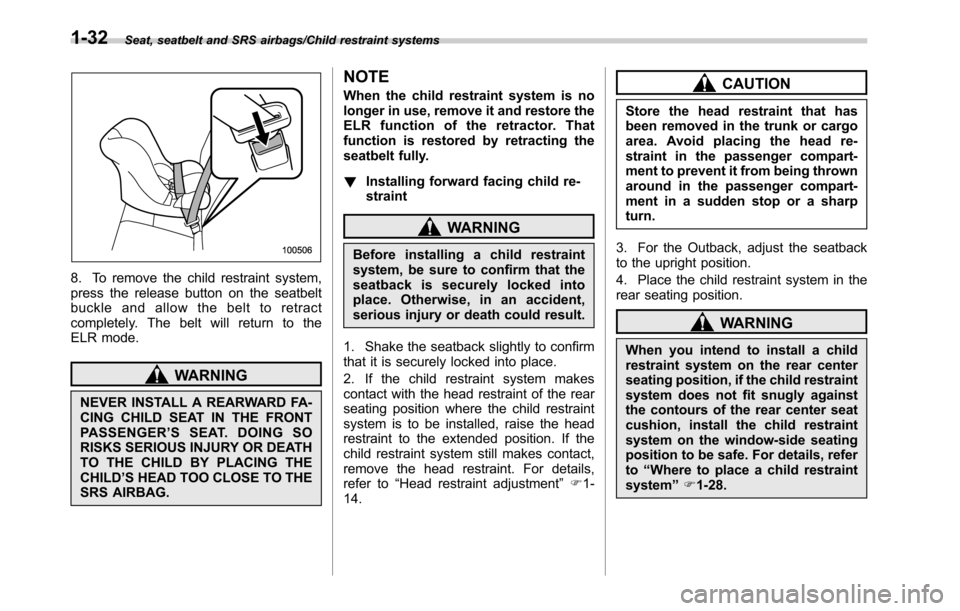
8. To remove the child restraint system,
press the release button on the seatbelt
buckle and allow the belt to retract
completely. The belt will return to the
ELR mode.
WARNING
NEVER INSTALL A REARWARD FA-
CING CHILD SEAT IN THE FRONT
PASSENGER’SSEAT.DOINGSO
RISKS SERIOUS INJURY OR DEATH
TO THE CHILD BY PLACING THE
CHILD’S HEAD TOO CLOSE TO THE
SRS AIRBAG.
NOTE
When the child restraint system is no
longer in use, remove it and restore the
ELR function of the retractor. That
function is restored by retracting the
seatbelt fully.
!Installing forward facing child re-
straint
WARNING
Before installing a child restraint
system, be sure to confirm that the
seatback is securely locked into
place. Otherwise, in an accident,
serious injury or death could result.
1. Shake the seatback slightly to confirm
that it is securely locked into place.
2. If the child restraint system makes
contact with the head restraint of the rear
seating position where the child restraint
system is to be installed, raise the head
restraint to the extended position. If the
child restraint system still makes contact,
remove the head restraint. For details,
refer to“Head restraint adjustment”F1-
14.
CAUTION
Store the head restraint that has
been removed in the trunk or cargo
area. Avoid placing the head re-
straint in the passenger compart-
ment to prevent it from being thrown
around in the passenger compart-
ment in a sudden stop or a sharp
turn.
3. For the Outback, adjust the seatback
to the upright position.
4. Place the child restraint system in the
rear seating position.
WARNING
When you intend to install a child
restraint system on the rear center
seating position, if the child restraint
system does not fit snugly against
the contours of the rear center seat
cushion, install the child restraint
system on the window-side seating
position to be safe. For details, refer
to“Where to place a child restraint
system”F1-28.
1-32
Page 71 of 572
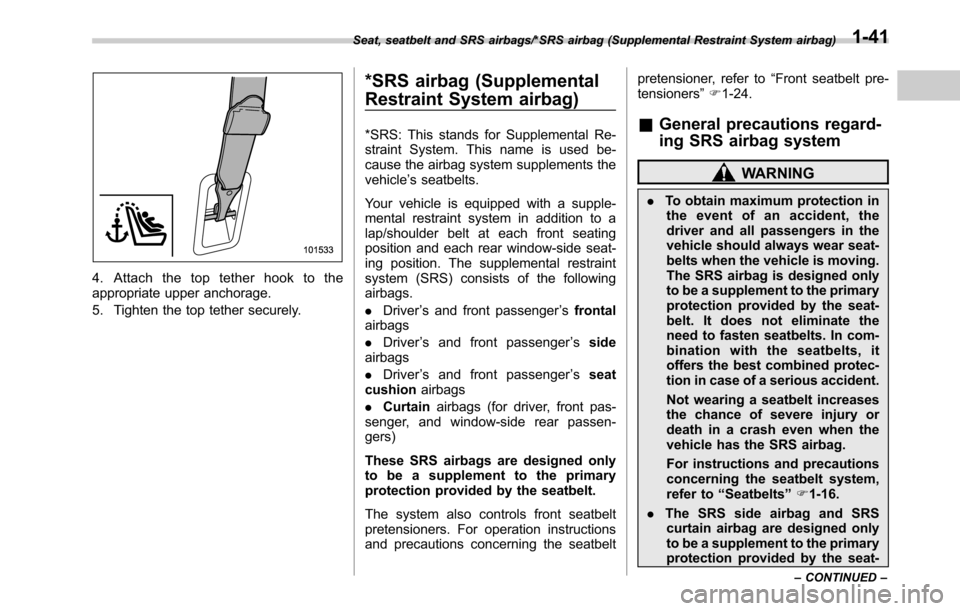
4. Attach the top tether hook to the
appropriate upper anchorage.
5. Tighten the top tether securely.
*SRS airbag (Supplemental
Restraint System airbag)
*SRS: This stands for Supplemental Re-
straint System. This name is used be-
cause the airbag system supplements the
vehicle’s seatbelts.
Your vehicle is equipped with a supple-
mental restraint system in addition to a
lap/shoulder belt at each front seating
position and each rear window-side seat-
ing position. The supplemental restraint
system (SRS) consists of the following
airbags.
.Driver’s and front passenger’sfrontal
airbags
.Driver’s and front passenger’sside
airbags
.Driver’s and front passenger’sseat
cushionairbags
.Curtainairbags (for driver, front pas-
senger, and window-side rear passen-
gers)
These SRS airbags are designed only
to be a supplement to the primary
protection provided by the seatbelt.
The system also controls front seatbelt
pretensioners. For operation instructions
and precautions concerning the seatbeltpretensioner, refer to“Front seatbelt pre-
tensioners”F1-24.&General precautions regard-
ing SRS airbag system
WARNING
.To obtain maximum protection in
the event of an accident, the
driver and all passengers in the
vehicle should always wear seat-
belts when the vehicle is moving.
The SRS airbag is designed only
to be a supplement to the primary
protection provided by the seat-
belt. It does not eliminate the
need to fasten seatbelts. In com-
bination with the seatbelts, it
offers the best combined protec-
tion in case of a serious accident.
Not wearing a seatbelt increases
the chance of severe injury or
death in a crash even when the
vehicle has the SRS airbag.
For instructions and precautions
concerning the seatbelt system,
refer to“Seatbelts”F1-16.
.The SRS side airbag and SRS
curtain airbag are designed only
to be a supplement to the primary
protection provided by the seat-
Seat, seatbelt and SRS airbags/*SRS airbag (Supplemental Restraint System airbag)
–CONTINUED–1-41
Page 72 of 572
Seat, seatbelt and SRS airbags/*SRS airbag (Supplemental Restraint System airbag)
belt. They do not eliminate the
need to fasten seatbelts. It is also
important to wear your seatbelt
to help avoid injuries that can
result when an occupant is not
seated in a proper upright posi-
tion.
WARNING
.The SRS airbags deploy with
considerable speed and force.
Occupants who are out of proper
position when the SRS airbag
deploys could suffer very serious
injuries. Because the SRS airbag
needs enough space for deploy-
ment, the driver should always
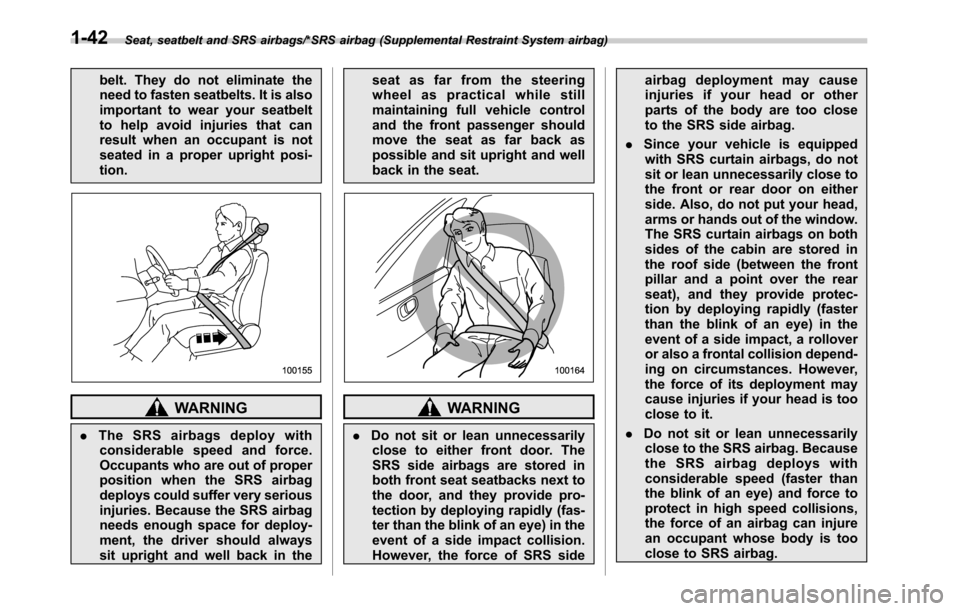
sit upright and well back in theseat as far from the steering
wheel as practical while still
maintaining full vehicle control
and the front passenger should
move the seat as far back as
possible and sit upright and well
back in the seat.
WARNING
.Do not sit or lean unnecessarily
close to either front door. The
SRS side airbags are stored in
both front seat seatbacks next to
the door, and they provide pro-
tection by deploying rapidly (fas-
ter than the blink of an eye) in the
event of a side impact collision.
However, the force of SRS sideairbag deployment may cause
injuries if your head or other
parts of the body are too close
to the SRS side airbag.
.Since your vehicle is equipped
with SRS curtain airbags, do not
sit or lean unnecessarily close to
the front or rear door on either
side. Also, do not put your head,
arms or hands out of the window.
The SRS curtain airbags on both
sides of the cabin are stored in
the roof side (between the front
pillar and a point over the rear
seat), and they provide protec-
tion by deploying rapidly (faster
than the blink of an eye) in the
event of a side impact, a rollover
or also a frontal collision depend-
ing on circumstances. However,
the force of its deployment may
cause injuries if your head is too
close to it.
.Do not sit or lean unnecessarily
close to the SRS airbag. Because
the SRS airbag deploys with
considerable speed (faster than
the blink of an eye) and force to
protect in high speed collisions,
the force of an airbag can injure
an occupant whose body is too
close to SRS airbag.
1-42