front SUBARU OUTBACK 2016 6.G Service Manual
[x] Cancel search | Manufacturer: SUBARU, Model Year: 2016, Model line: OUTBACK, Model: SUBARU OUTBACK 2016 6.GPages: 572, PDF Size: 21.79 MB
Page 85 of 572

nated while the OFF indicator turns off
despite the fact that the actions noted
above have been taken, seat the child/
small adult in the rear seat and im-
mediately contact your SUBARU dealer
for an inspection. Even if the system
has passed the dealer inspection, it is
recommended that on subsequent trips
the child/small adult always take the
rear seat.
Children who have outgrown a child
restraint system should always wear the
seatbelt irrespective of whether the airbag
is deactivated or activated.
!Conditions in which front passen-
ger’s SRS frontal airbag is activated
The front passenger’s SRS frontal airbag
will be activated for deployment upon
impact when any of the following condi-
tions is met regarding the front passen-
ger’s seat.
.When the seat is occupied by an adult.
.When a heavy article is placed on the
seat.
CAUTION
When the front passenger’s seat is
occupied by an adult, observe the
following precautions. Failure to do
so may lessen the load on the front
passenger’s seat, deactivating thefront passenger’s SRS frontal airbag
despite the fact that the seat is
occupied by an adult. This may
result in personal injury.
.Do not allow the rear seat occu-
pant to lift the front passenger’s
seat cushion using his/her feet.
.Do not place any article under the
front passenger’s seat, or
squeeze any article from behind
and under the seat. This may lift
the seat cushion.
.Do not squeeze any article be-
tween the front passenger’s seat
and side trim/pillar, door or cen-
ter console box. This may lift the
seat cushion.
!If the passenger’s frontal airbag
OFF indicator illuminates and
the ON indicator turns off even
when the front passenger’s seat
is occupied by an adult
This can be caused by the adult incor-
rectly sitting in the front passenger’s seat.
1. Turn the ignition switch to the“LOCK”/
“OFF”position.
2. Ask the front passenger to set the
seatback to the upright position, sit up
straight in the center of the seat cushion,
correctly fasten the seatbelt, position his/her legs out forward, and adjust the seat to
the rearmost position.
3. Turn the ignition switch to the“ON”
position.
If the OFF indicator remains illuminated
while the ON indicator remains off, take
the following actions.
1. Turn the ignition switch to the“LOCK”/
“OFF”position.
2. Ensure that there is no article, book,
shoe, or other object trapped under the
seat, at the rear of the seat, or on the side
of the seat.
3. Ensure that the backward-forward
position and seatback of front passenger’s
seat are locked into place securely by
moving the seat back and forth. (Models
equipped with manual seats only)
4. Turn the ignition switch to the“ON”
position and wait 6 seconds to allow the
system to complete self-checking. Follow-
ing the system check, both indicators turn
off for 2 seconds. Now, the ON indicator
should illuminate while the OFF indicator
remains off.
If the OFF indicator still remains illumi-
nated while the ON indicator remains off,
ask the occupant to move to the rear seat
and immediately contact your SUBARU
dealer for an inspection.
Seat, seatbelt and SRS airbags/*SRS airbag (Supplemental Restraint System airbag)
–CONTINUED–1-55
Page 86 of 572

Seat, seatbelt and SRS airbags/*SRS airbag (Supplemental Restraint System airbag)
!How to contact the vehicle manu-
facturer concerning modifications
for persons with disabilities that
may affect the advanced airbag
system
Changing or moving any parts of the front
seats, seatbelts, front bumper, front side
frame, instrument panel, combination me-
ter, steering wheel, steering column, tire,
suspension or floor panel can affect the
operation of the SUBARU advanced air-
bag system. If you have any questions,
you may contact the following SUBARU
distributors:
Subaru of America, Inc.
Customer Dealer Services Department
P.O. Box 6000
Cherry Hill, NJ 08034-6000
1-800-SUBARU3 (1-800-782-2783)
Subaru Hawaii
2850 Pukoloa Street, Suite 202,
Honolulu, HI 96819-4467
808-839-2273
Shen’s Corporation dba Prestige Automo-
bile
491, East Marine Corps Drive, Route 1
Dededo, Guam 96921-6255
671-633-2698
Trebol Motors
P.O. Box 11204, San Juan, Puerto Rico
00910
787-793-2828
Subaru Canada, Inc.
Consumer Support Department
560 Suffork Court, Mississauga, Ontario
L5R 4J7
1-800-894-4212
There are currently no SUBARU distribu-
tors in any other U.S. territories. If you are
in such an area, please contact the
SUBARU distributor or dealer from which
you bought your vehicle.&System operation
CAUTION
Do not touch the SRS airbag system
components with bare hands right
after deployment. Doing so can
cause burns because the compo-
nents can be very hot as a result of
deployment.
The SRS airbags can function only when
the ignition switch is in the“ON”position.
When the SRS airbag(s) deploy(s), a
sudden, fairly loud inflation noise will be
heard and some smoke will be released.
These occurrences are a normal result of
the deployment. This smoke does not
indicate a fire in the vehicle.
1-56
Page 87 of 572
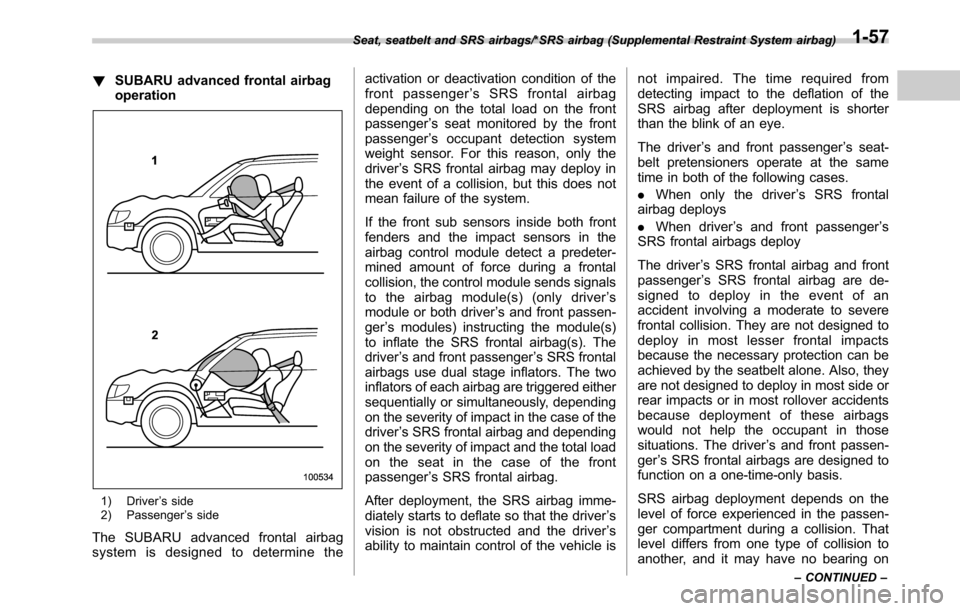
!SUBARU advanced frontal airbag
operation
1) Driver’s side
2) Passenger’s side
The SUBARU advanced frontal airbag
system is designed to determine theactivation or deactivation condition of the
front passenger’s SRS frontal airbag
depending on the total load on the front
passenger’s seat monitored by the front
passenger’s occupant detection system
weight sensor. For this reason, only the
driver’s SRS frontal airbag may deploy in
the event of a collision, but this does not
mean failure of the system.
If the front sub sensors inside both front
fenders and the impact sensors in the
airbag control module detect a predeter-
mined amount of force during a frontal
collision, the control module sends signals
to the airbag module(s) (only driver’s
module or both driver’s and front passen-
ger’s modules) instructing the module(s)
to inflate the SRS frontal airbag(s). The
driver’s and front passenger’s SRS frontal
airbags use dual stage inflators. The two
inflators of each airbag are triggered either
sequentially or simultaneously, depending
on the severity of impact in the case of the
driver’s SRS frontal airbag and depending
on the severity of impact and the total load
on the seat in the case of the front
passenger’s SRS frontal airbag.
After deployment, the SRS airbag imme-
diately starts to deflate so that the driver’s
vision is not obstructed and the driver’s
ability to maintain control of the vehicle isnot impaired. The time required from
detecting impact to the deflation of the
SRS airbag after deployment is shorter
than the blink of an eye.
The driver’s and front passenger’s seat-
belt pretensioners operate at the same
time in both of the following cases.
.When only the driver’s SRS frontal
airbag deploys
.When driver’s and front passenger’s
SRS frontal airbags deploy
The driver’s SRS frontal airbag and front
passenger’s SRS frontal airbag are de-
signed to deploy in the event of an
accident involving a moderate to severe
frontal collision. They are not designed to
deploy in most lesser frontal impacts
because the necessary protection can be
achieved by the seatbelt alone. Also, they
are not designed to deploy in most side or
rear impacts or in most rollover accidents
because deployment of these airbags
would not help the occupant in those
situations. The driver’s and front passen-
ger’s SRS frontal airbags are designed to
function on a one-time-only basis.
SRS airbag deployment depends on the
level of force experienced in the passen-
ger compartment during a collision. That
level differs from one type of collision to
another, and it may have no bearing on
Seat, seatbelt and SRS airbags/*SRS airbag (Supplemental Restraint System airbag)
–CONTINUED–1-57
Page 88 of 572

Seat, seatbelt and SRS airbags/*SRS airbag (Supplemental Restraint System airbag)
the visible damage done to the vehicle
itself.
!Examples of accident in which
the driver’s/driver’s and front
passenger’s SRS frontal
airbag(s) will most likely deploy
A head-on collision against a thick con-
crete wall at a vehicle speed of 12 to 19
mph (20 to 30 km/h) or higher activates
only the driver’s SRS frontal airbag or both
driver’s and front passenger’s SRS frontal
airbags. The airbag(s) will also be acti-
vated when the vehicle is exposed to a
frontal impact similar in fashion and
magnitude to the collision described
above.!Examples of the types of acci-
dents in which it is possible that
the driver’s/driver’s and front
passenger’s SRS frontal
airbag(s) will deploy
Only the driver’s SRS frontal airbag orboth driver’s and front passenger’s SRS
frontal airbags may be activated when the
vehicle sustains a hard impact in the
undercarriage area from the road surface
(such as when the vehicle plunges into a
deep ditch, is severely impacted or
knocked hard against an obstacle on the
road such as a curb).
1-58
Page 89 of 572
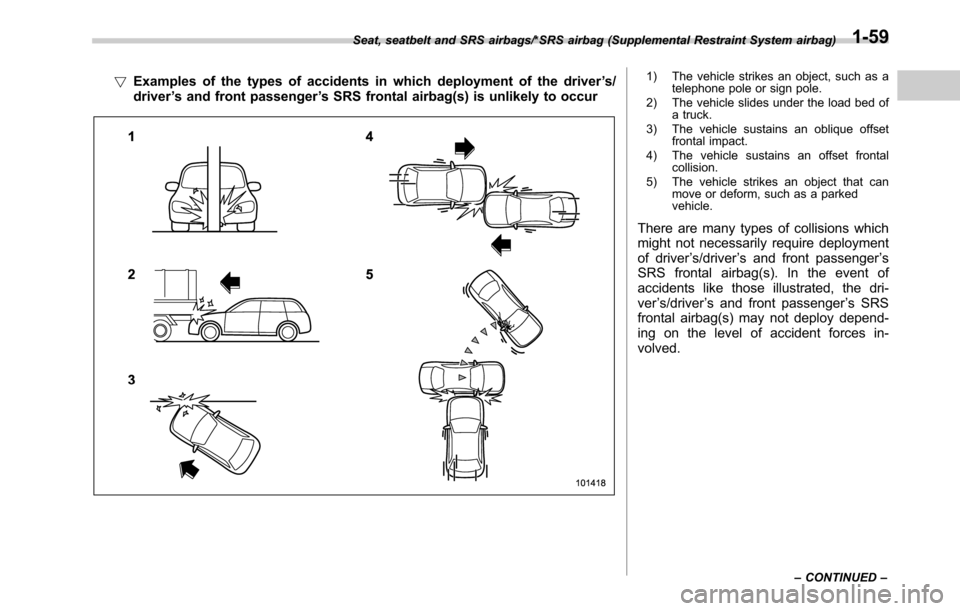
!Examples of the types of accidents in which deployment of the driver’s/
driver’s and front passenger’s SRS frontal airbag(s) is unlikely to occur1) The vehicle strikes an object, such as a
telephone pole or sign pole.
2) The vehicle slides under the load bed of
a truck.
3) The vehicle sustains an oblique offset
frontal impact.
4) The vehicle sustains an offset frontal
collision.
5) The vehicle strikes an object that can
move or deform, such as a parked
vehicle.
There are many types of collisions which
might not necessarily require deployment
of driver’s/driver’s and front passenger’s
SRS frontal airbag(s). In the event of
accidents like those illustrated, the dri-
ver’s/driver’s and front passenger’s SRS
frontal airbag(s) may not deploy depend-
ing on the level of accident forces in-
volved.
Seat, seatbelt and SRS airbags/*SRS airbag (Supplemental Restraint System airbag)
–CONTINUED–1-59
Page 90 of 572
Seat, seatbelt and SRS airbags/*SRS airbag (Supplemental Restraint System airbag)
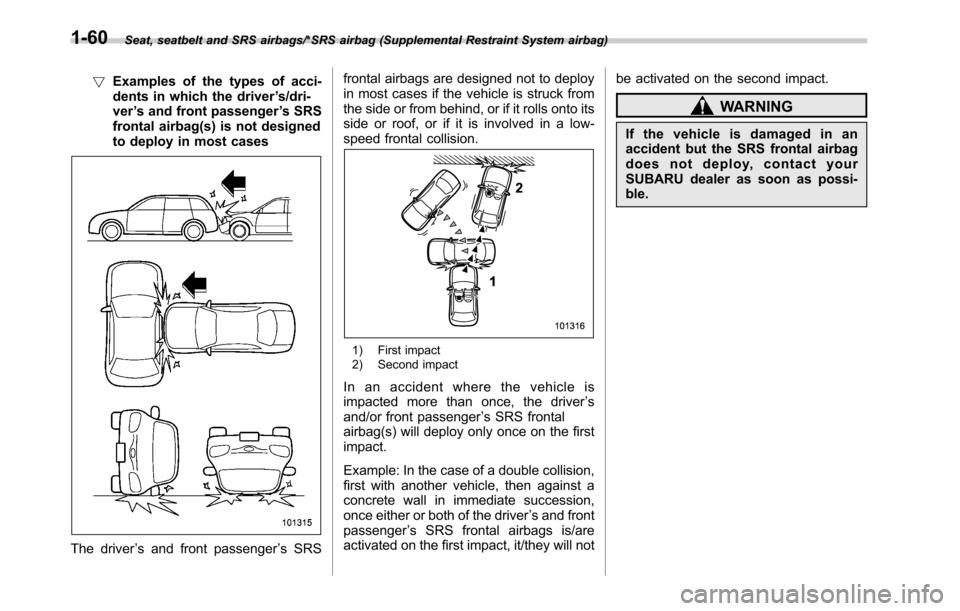
!Examples of the types of acci-
dents in which the driver’s/dri-
ver’s and front passenger’s SRS
frontal airbag(s) is not designed
to deploy in most cases
The driver’s and front passenger’s SRSfrontal airbags are designed not to deploy
in most cases if the vehicle is struck from
the side or from behind, or if it rolls onto its
side or roof, or if it is involved in a low-
speed frontal collision.
1) First impact
2) Second impact
In an accident where the vehicle is
impacted more than once, the driver’s
and/or front passenger’s SRS frontal
airbag(s) will deploy only once on the first
impact.
Example: In the case of a double collision,
first with another vehicle, then against a
concrete wall in immediate succession,
once either or both of the driver’s and front
passenger’s SRS frontal airbags is/are
activated on the first impact, it/they will notbe activated on the second impact.
WARNING
If the vehicle is damaged in an
accident but the SRS frontal airbag
does not deploy, contact your
SUBARU dealer as soon as possi-
ble.
1-60
Page 91 of 572
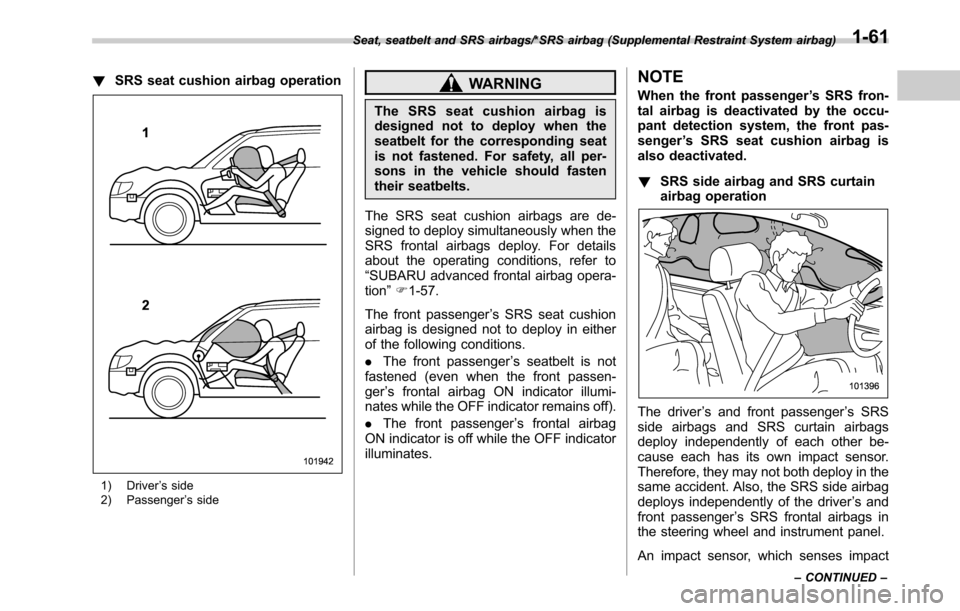
!SRS seat cushion airbag operation
1) Driver’s side
2) Passenger’s side
WARNING
The SRS seat cushion airbag is
designed not to deploy when the
seatbelt for the corresponding seat
is not fastened. For safety, all per-
sons in the vehicle should fasten
their seatbelts.
The SRS seat cushion airbags are de-
signed to deploy simultaneously when the
SRS frontal airbags deploy. For details
about the operating conditions, refer to
“SUBARU advanced frontal airbag opera-
tion”F1-57.
The front passenger’s SRS seat cushion
airbag is designed not to deploy in either
of the following conditions.
.The front passenger’s seatbelt is not
fastened (even when the front passen-
ger’s frontal airbag ON indicator illumi-
nates while the OFF indicator remains off).
.The front passenger’s frontal airbag
ON indicator is off while the OFF indicator
illuminates.
NOTE
When the front passenger’s SRS fron-
tal airbag is deactivated by the occu-
pant detection system, the front pas-
senger’s SRS seat cushion airbag is
also deactivated.
!SRS side airbag and SRS curtain
airbag operation
The driver’s and front passenger’s SRS
side airbags and SRS curtain airbags
deploy independently of each other be-
cause each has its own impact sensor.
Therefore, they may not both deploy in the
same accident. Also, the SRS side airbag
deploys independently of the driver’s and
front passenger’s SRS frontal airbags in
the steering wheel and instrument panel.
An impact sensor, which senses impact
Seat, seatbelt and SRS airbags/*SRS airbag (Supplemental Restraint System airbag)
–CONTINUED–1-61
Page 92 of 572

Seat, seatbelt and SRS airbags/*SRS airbag (Supplemental Restraint System airbag)
force, is located in each of the following
locations.
.In the left and right front doors
.In the left and right center pillars
.In the left and right rear wheel houses
.In the airbag control module
.In the left and right front fenders (only
SRS curtain airbags are designed to
deploy when the front sub sensors sense
a severe impact.)
A rollover sensor is also located inside the
airbag control module.
If the impact sensor that is located in the
airbag control module and one of the
center pillar impact sensors or front door
impact sensors together sense an impact
force above a predetermined level in a
side collision, the control module causes
both the SRS side airbag and curtain
airbag on the impacted side to inflate
regardless of whether the rear wheel
house impact sensor on the same side
senses an impact.
If the impact sensor that is located in the
airbag control module and one of the rear
wheel house impact sensors together
sense an impact force above a predeter-
mined level in a side collision, the control
module causes only the SRS curtain
airbag on the impacted side to inflate.Even if a frontal collision occurs, both right
and left SRS curtain airbags will deploy
when the front sensor and the control unit
determine that the impact results from an
offset frontal collision.
The SRS curtain airbags are designed to
deploy when the driver’sSRSfrontal
airbag deploys or the driver’s and pas-
senger’s SRS frontal airbags deploy in a
frontal collision, and also when the system
determines that the collision is an offset
frontal collision. The SRS curtain airbags
are basically designed not to deploy in a
frontal collision when the SRS frontal
airbags do not deploy or the system
determines that the collision is other than
an offset frontal collision.
If the rollover sensor detects rollover of the
vehicle, the control module inflates the
SRS curtain airbags. At this time, the
driver’s and front passenger’s seatbelt
pretensioners also operate at the same
time.
After the deployment, the SRS side airbag
immediately starts to deflate. The time
required from detection of an impact to
deflation of an SRS side airbag after
deployment is shorter than the blink of
an eye.
The SRS curtain airbag remains inflatedfor a while following deployment then
slowly deflates.
The SRS side airbag and SRS curtain
airbag deploy even when no one occupies
the seat on the side on which an impact is
applied.
The SRS side airbag and SRS curtain
airbag are designed to deploy in the event
of an accident involving a moderate to
severe side impact collision. They are not
designed to deploy in most lesser side
impact. Also, they are not designed to
deploy in most rear impacts because SRS
side airbag and SRS curtain airbag
deployment would not help the occupant
in those situations.
The SRS side airbag and SRS curtain
airbag deployment depend on the level of
force experienced in the passenger com-
partment during a side impact collision.
That level differs from one type of collision
to another, and it may have no bearing on
the visible damage done to the vehicle
itself.
The SRS curtain airbags are also de-
signed to deploy when the vehicle is in an
extremely inclined state such as during a
rollover. They are not designed to deploy
in most lesser inclined state.
Each SRS side airbag and SRS curtain
1-62
Page 93 of 572

airbag are designed to function on a one-
time-only basis.!Example of the type of accident
in which the SRS side airbag will
most likely deploy
A severe side impact near the front seat or
the rear seat.
Seat, seatbelt and SRS airbags/*SRS airbag (Supplemental Restraint System airbag)
–CONTINUED–1-63
Page 94 of 572

Seat, seatbelt and SRS airbags/*SRS airbag (Supplemental Restraint System airbag)
!Examples of the types of accidents in which the SRS curtain airbag will most
likely deploy1) The vehicle is involved in a severe side
impact near the front seat or the rear
seat.
2) The vehicle rolls onto its side or the roof.
3) The angle of vehicle tip-up is marginal or
the skidding vehicle’s tires hit a curb-
stone laterally.
4) An offset frontal collision that is severe
enough to deploy the front airbag.
1-64