Intake SUBARU TRIBECA 2009 1.G Service Workshop Manual
[x] Cancel search | Manufacturer: SUBARU, Model Year: 2009, Model line: TRIBECA, Model: SUBARU TRIBECA 2009 1.GPages: 2453, PDF Size: 46.32 MB
Page 1738 of 2453
GD(H6DO)-126
Diagnostic Trouble Code (DTC) Detecting Criteria
GENERAL DESCRIPTION
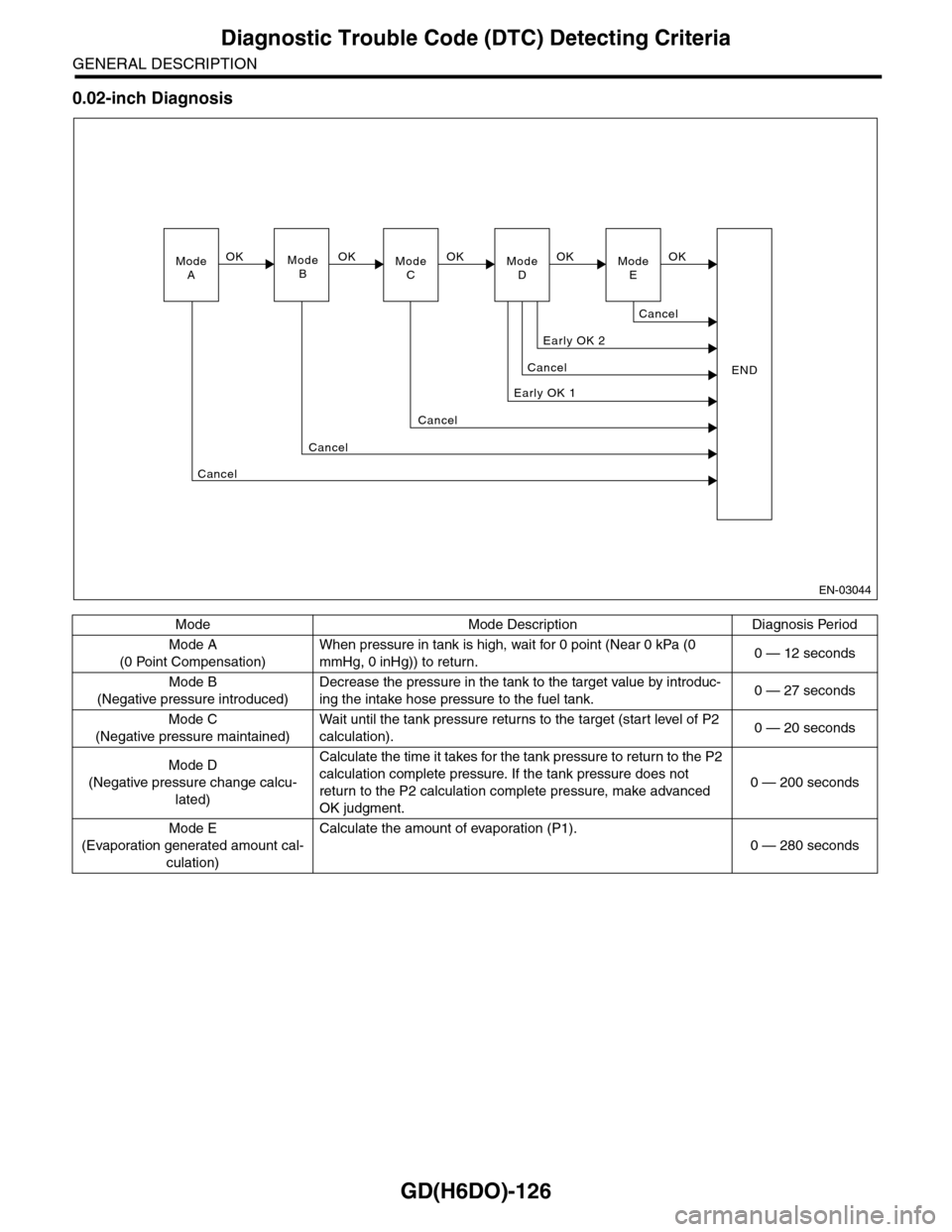
0.02-inch Diagnosis
Mode Mode Description Diagnosis Period
Mode A
(0 Point Compensation)
When pressure in tank is high, wait for 0 point (Near 0 kPa (0
mmHg, 0 inHg)) to return.0 — 12 seconds
Mode B
(Negative pressure introduced)
Decrease the pressure in the tank to the target value by introduc-
ing the intake hose pressure to the fuel tank.0 — 27 seconds
Mode C
(Negative pressure maintained)
Wa i t u nt i l t h e t a nk pr e ss ur e r et u r ns to t he t ar g e t ( s ta r t leve l o f P 2
calculation).0 — 20 seconds
Mode D
(Negative pressure change calcu-
lated)
Calculate the time it takes for the tank pressure to return to the P2
calculation complete pressure. If the tank pressure does not
return to the P2 calculation complete pressure, make advanced
OK judgment.
0 — 200 seconds
Mode E
(Evaporation generated amount cal-
culation)
Calculate the amount of evaporation (P1).
0 — 280 seconds
EN-03044
ModeAModeBModeCModeD
OKOKOK
Early OK 1
Cancel
Cancel
END
Cancel
Cancel
Early OK 2
OKModeE
Cancel
OK
Page 1739 of 2453
GD(H6DO)-127
Diagnostic Trouble Code (DTC) Detecting Criteria
GENERAL DESCRIPTION
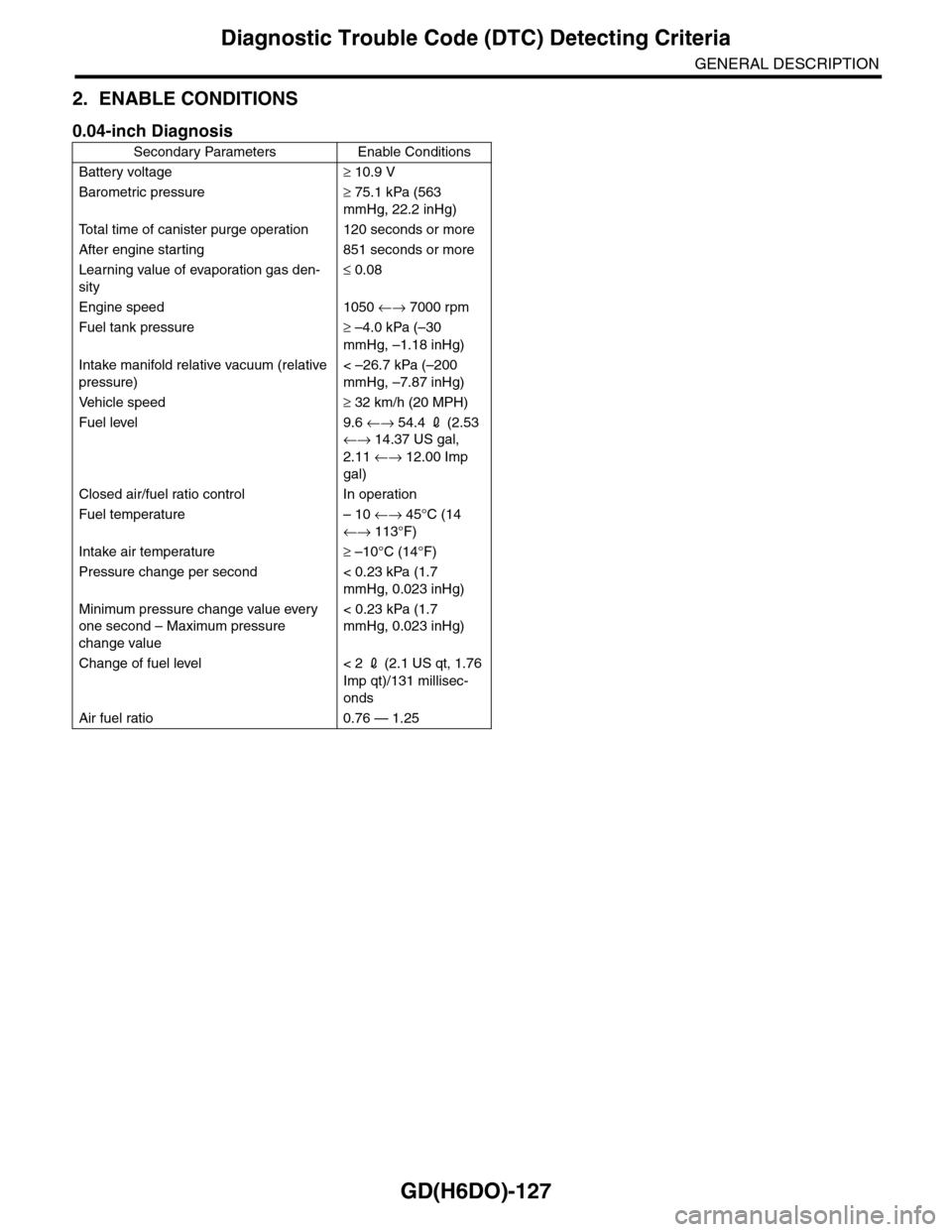
2. ENABLE CONDITIONS
0.04-inch Diagnosis
Secondary Parameters Enable Conditions
Battery voltage≥ 10.9 V
Barometric pressure≥ 75.1 kPa (563
mmHg, 22.2 inHg)
To t a l t i m e o f c a n i s t e r p u r g e o p e r a t i o n 1 2 0 s e c o n d s o r m o r e
After engine starting 851 seconds or more
Learning value of evaporation gas den-
sity
≤ 0.08
Engine speed 1050 ←→ 7000 rpm
Fuel tank pressure≥ –4.0 kPa (–30
mmHg, –1.18 inHg)
Intake manifold relative vacuum (relative
pressure)
< –26.7 kPa (–200
mmHg, –7.87 inHg)
Ve h i c l e s p e e d≥ 32 km/h (20 MPH)
Fuel level 9.6 ←→ 54.4 2 (2.53
←→ 14.37 US gal,
2.11 ←→ 12.00 Imp
gal)
Closed air/fuel ratio control In operation
Fuel temperature – 10 ←→ 45°C (14
←→ 113°F)
Intake air temperature≥ –10°C (14°F)
Pressure change per second < 0.23 kPa (1.7
mmHg, 0.023 inHg)
Minimum pressure change value every
one second – Maximum pressure
change value
< 0.23 kPa (1.7
mmHg, 0.023 inHg)
Change of fuel level < 2 2 (2.1 US qt, 1.76
Imp qt)/131 millisec-
onds
Air fuel ratio 0.76 — 1.25
Page 1740 of 2453
GD(H6DO)-128
Diagnostic Trouble Code (DTC) Detecting Criteria
GENERAL DESCRIPTION
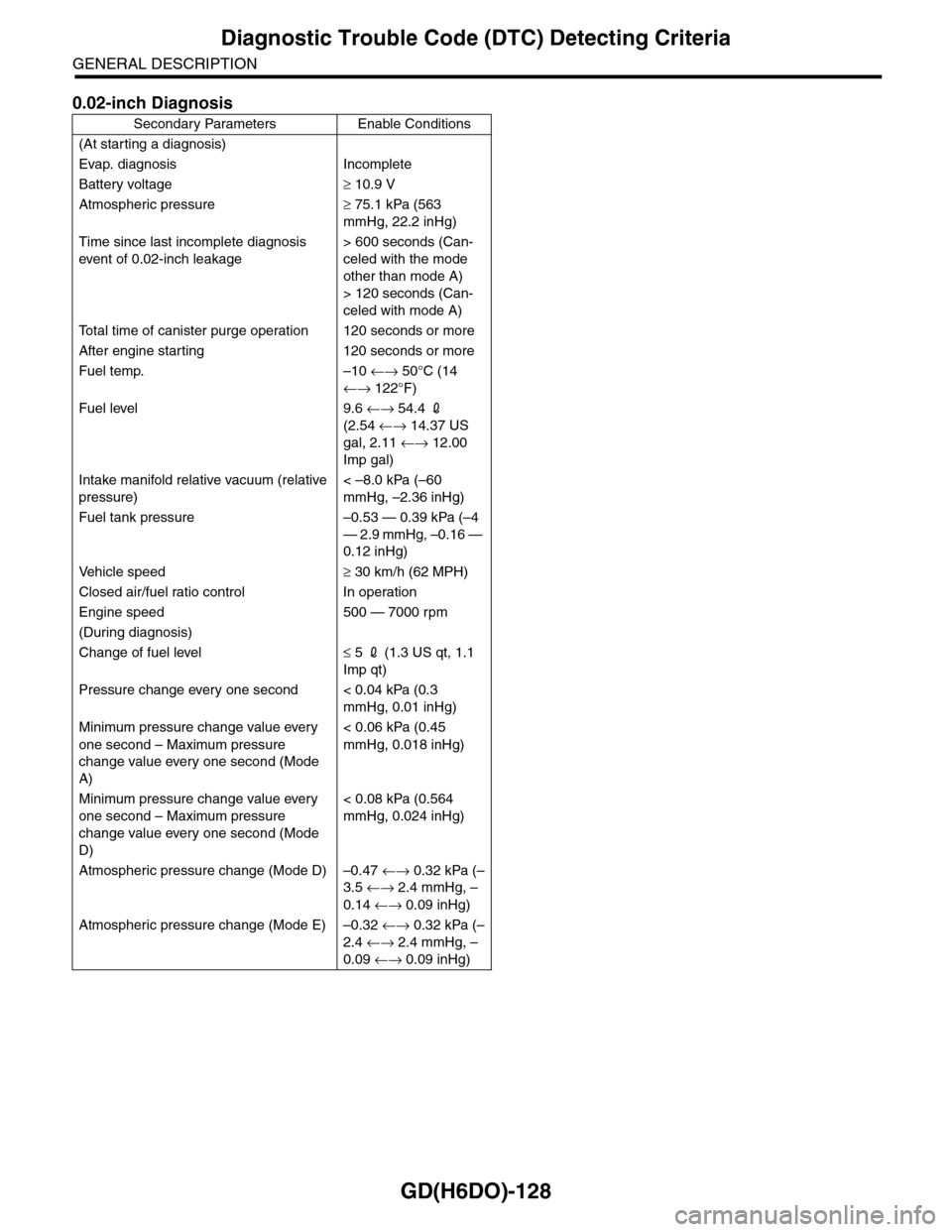
0.02-inch Diagnosis
Secondary Parameters Enable Conditions
(At starting a diagnosis)
Evap. diagnosis Incomplete
Battery voltage≥ 10.9 V
Atmospheric pressure≥ 75.1 kPa (563
mmHg, 22.2 inHg)
Time since last incomplete diagnosis
event of 0.02-inch leakage
> 600 seconds (Can-
celed with the mode
other than mode A)
> 120 seconds (Can-
celed with mode A)
To t a l t i m e o f c a n i s t e r p u r g e o p e r a t i o n 1 2 0 s e c o n d s o r m o r e
After engine starting 120 seconds or more
Fuel temp. –10 ←→ 50°C (14
←→ 122°F)
Fuel level 9.6 ←→ 54.4 2
(2.54 ←→ 14.37 US
gal, 2.11 ←→ 12.00
Imp gal)
Intake manifold relative vacuum (relative
pressure)
< –8.0 kPa (–60
mmHg, –2.36 inHg)
Fuel tank pressure –0.53 — 0.39 kPa (–4
— 2.9 mmHg, –0.16 —
0.12 inHg)
Ve h i c l e s p e e d≥ 30 km/h (62 MPH)
Closed air/fuel ratio control In operation
Engine speed 500 — 7000 rpm
(During diagnosis)
Change of fuel level≤ 5 2 (1.3 US qt, 1.1
Imp qt)
Pressure change every one second < 0.04 kPa (0.3
mmHg, 0.01 inHg)
Minimum pressure change value every
one second – Maximum pressure
change value every one second (Mode
A)
< 0.06 kPa (0.45
mmHg, 0.018 inHg)
Minimum pressure change value every
one second – Maximum pressure
change value every one second (Mode
D)
< 0.08 kPa (0.564
mmHg, 0.024 inHg)
Atmospheric pressure change (Mode D) –0.47 ←→ 0.32 kPa (–
3.5 ←→ 2.4 mmHg, –
0.14 ←→ 0.09 inHg)
Atmospheric pressure change (Mode E) –0.32 ←→ 0.32 kPa (–
2.4 ←→ 2.4 mmHg, –
0.09 ←→ 0.09 inHg)
Page 1744 of 2453
GD(H6DO)-132
Diagnostic Trouble Code (DTC) Detecting Criteria
GENERAL DESCRIPTION
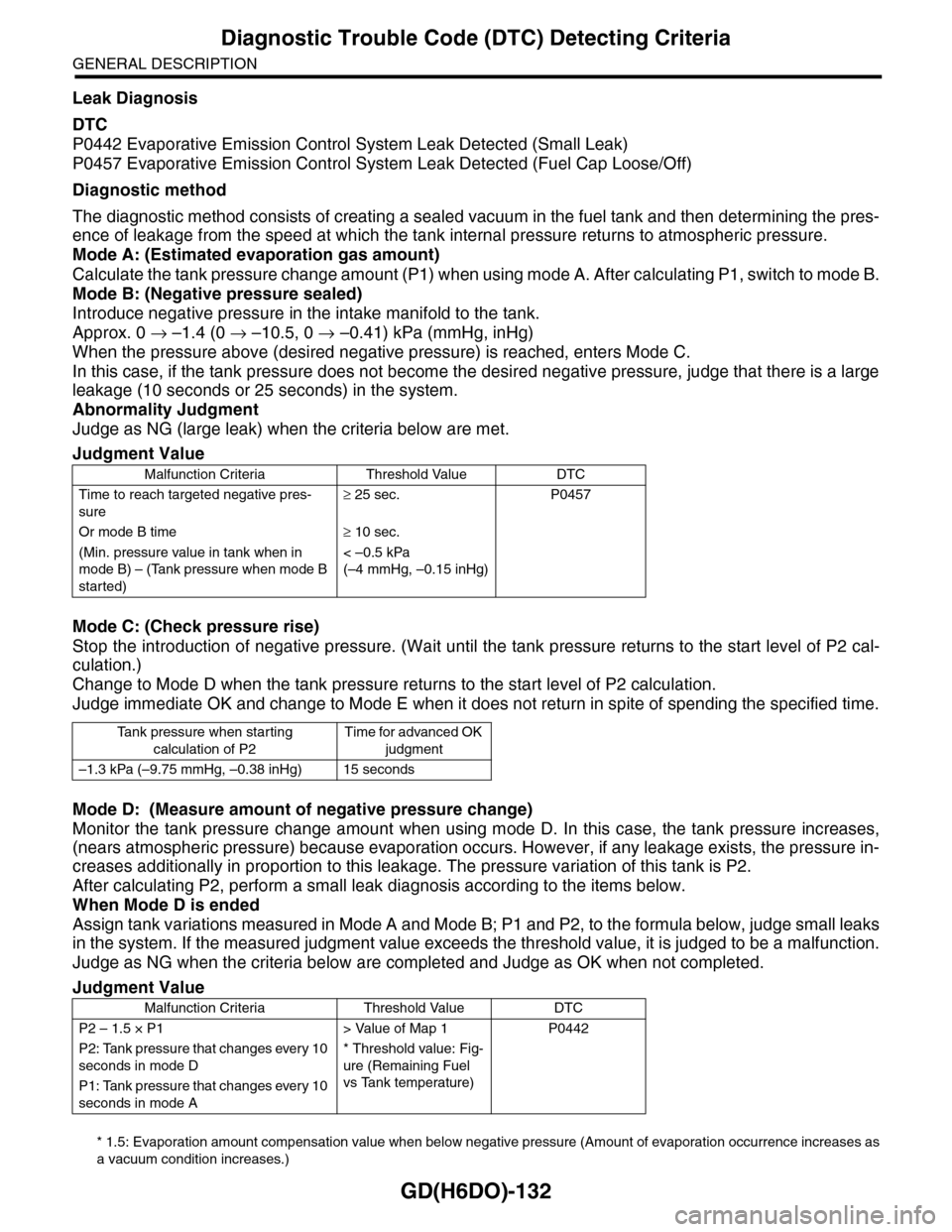
Leak Diagnosis
DTC
P0442 Evaporative Emission Control System Leak Detected (Small Leak)
P0457 Evaporative Emission Control System Leak Detected (Fuel Cap Loose/Off)
Diagnostic method
The diagnostic method consists of creating a sealed vacuum in the fuel tank and then determining the pres-
ence of leakage from the speed at which the tank internal pressure returns to atmospheric pressure.
Mode A: (Estimated evaporation gas amount)
Calculate the tank pressure change amount (P1) when using mode A. After calculating P1, switch to mode B.
Mode B: (Negative pressure sealed)
Introduce negative pressure in the intake manifold to the tank.
Approx. 0 → –1.4 (0 → –10.5, 0 → –0.41) kPa (mmHg, inHg)
When the pressure above (desired negative pressure) is reached, enters Mode C.
In this case, if the tank pressure does not become the desired negative pressure, judge that there is a large
leakage (10 seconds or 25 seconds) in the system.
Abnormality Judgment
Judge as NG (large leak) when the criteria below are met.
Mode C: (Check pressure rise)
Stop the introduction of negative pressure. (Wait until the tank pressure returns to the start level of P2 cal-
culation.)
Change to Mode D when the tank pressure returns to the start level of P2 calculation.
Judge immediate OK and change to Mode E when it does not return in spite of spending the specified time.
Mode D: (Measure amount of negative pressure change)
Monitor the tank pressure change amount when using mode D. In this case, the tank pressure increases,
(nears atmospheric pressure) because evaporation occurs. However, if any leakage exists, the pressure in-
creases additionally in proportion to this leakage. The pressure variation of this tank is P2.
After calculating P2, perform a small leak diagnosis according to the items below.
When Mode D is ended
Assign tank variations measured in Mode A and Mode B; P1 and P2, to the formula below, judge small leaks
in the system. If the measured judgment value exceeds the threshold value, it is judged to be a malfunction.
Judge as NG when the criteria below are completed and Judge as OK when not completed.
* 1.5: Evaporation amount compensation value when below negative pressure (Amount of evaporation occurrence increases as
a vacuum condition increases.)
Judgment Value
Malfunction Criteria Threshold Value DTC
Time to reach targeted negative pres-
sure
≥ 25 sec. P0457
Or mode B time≥ 10 sec.
(Min. pressure value in tank when in
mode B) – (Tank pressure when mode B
started)
< –0.5 kPa
(–4 mmHg, –0.15 inHg)
Ta n k p r e s s u r e w h e n s t a r t i n g
calculation of P2
Time for advanced OK
judgment
–1.3 kPa (–9.75 mmHg, –0.38 inHg) 15 seconds
Judgment Value
Malfunction Criteria Threshold Value DTC
P2 – 1.5 × P1 > Value of Map 1 P0442
P2: Tank pressure that changes every 10
seconds in mode D
* Threshold value: Fig-
ure (Remaining Fuel
vs Tank temperature)
P1: Tank pressure that changes every 10
seconds in mode A
Page 1745 of 2453
GD(H6DO)-133
Diagnostic Trouble Code (DTC) Detecting Criteria
GENERAL DESCRIPTION
Time Needed for Diagnosis: 30 to 100 seconds
0.02-inch Diagnosis
DTC
P0456 Evaporative Emission Control System Leak Detected (very small leak)
Diagnostic method
The diagnostic method consists of creating a sealed vacuum in the fuel tank and then determining the pres-
ence of leakage from the speed at which the tank internal pressure returns to atmospheric pressure.
Mode A: (0 Point Compensation)
When pressure in tank is high, wait for 0 point 0 kPa (Near 0 mmHg, 0 inHg) to return.Shift to mode B when
0 point returns.
Cancel the diagnosis when 0 point does not return in the specified time.
Mode B: (Negative pressure introduced)
Introduce negative pressure in the intake manifold to the tank.
Approx. 0 → –2.0 kPa (0 mmHg → –15 mmHg, 0 → –0.59 inHg)
When the pressure above (desired negative pressure) is reached, Mode C is entered.
Cancel the diagnosis when the targeted pressure in the tank is not reached.
Mode C: (Negative pressure maintained)
Stop the introduction of negative pressure and wait until the tank pressure returns to the start level of P2 cal-
culation.
Change to Mode D either when the tank pressure returns to the start level of P2 calculation, or when the pre-
determined amount of time has passed.
Mode D: (Calculate the amount of negative pressure change)
Monitor the tank pressure in mode D, calculate (P2) the pressure change in the tank, and measure the time
(evpdset) for the tank pressure to return when calculation of P2 is completed. Shift to mode E when pressure
returns. Make an advance OK judgment using the value of P2, or cancel, when the pressure in the tank does
not return after calculation of P2 is completed even when the predetermined amount of time has passed.
When the following conditions are established, it is OK.
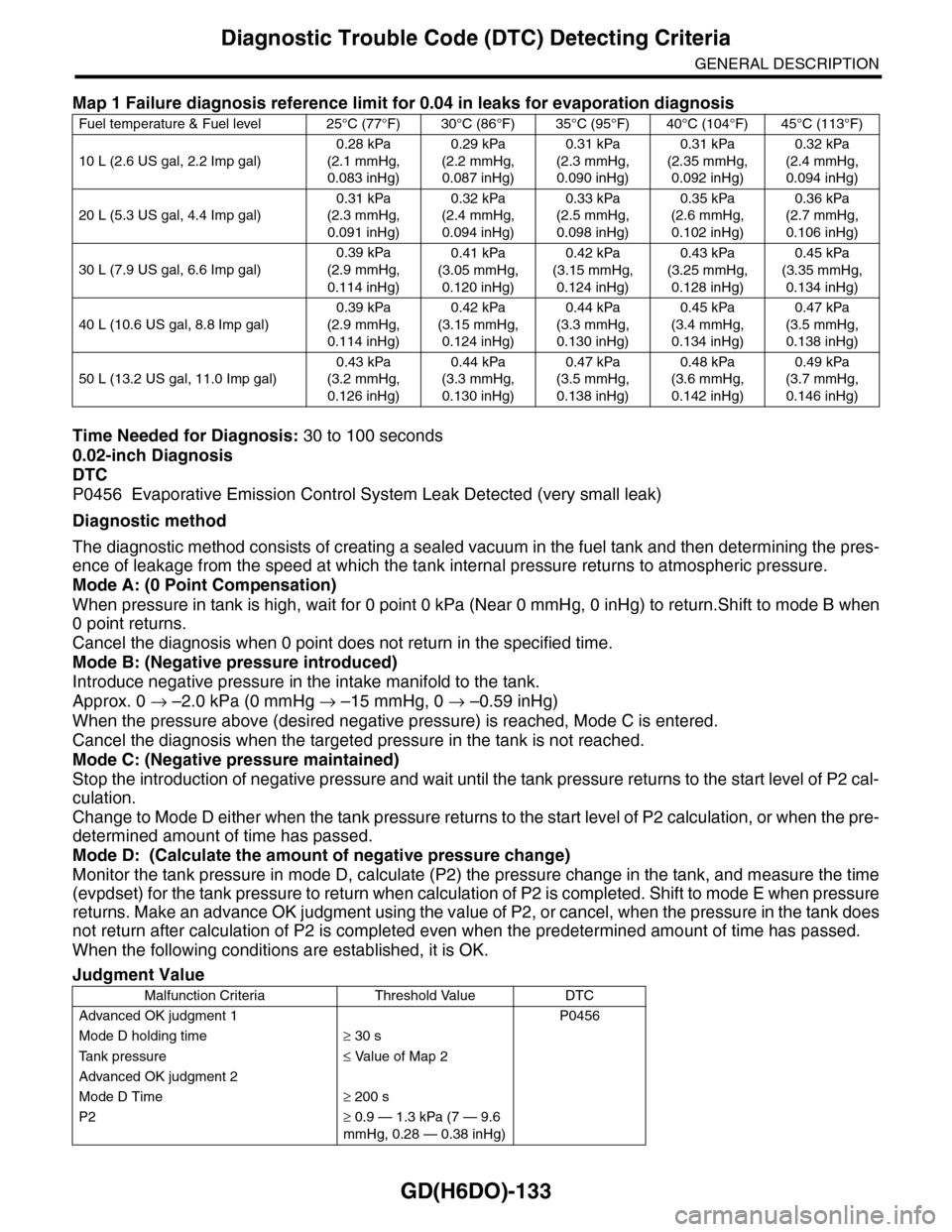
Map 1 Failure diagnosis reference limit for 0.04 in leaks for evaporation diagnosis
Fuel temperature & Fuel level 25°C (77°F) 30°C (86°F) 35°C (95°F) 40°C (104°F) 45°C (113°F)
10 L (2.6 US gal, 2.2 Imp gal)
0.28 kPa
(2.1 mmHg,
0.083 inHg)
0.29 kPa
(2.2 mmHg,
0.087 inHg)
0.31 kPa
(2.3 mmHg,
0.090 inHg)
0.31 kPa
(2.35 mmHg,
0.092 inHg)
0.32 kPa
(2.4 mmHg,
0.094 inHg)
20 L (5.3 US gal, 4.4 Imp gal)
0.31 kPa
(2.3 mmHg,
0.091 inHg)
0.32 kPa
(2.4 mmHg,
0.094 inHg)
0.33 kPa
(2.5 mmHg,
0.098 inHg)
0.35 kPa
(2.6 mmHg,
0.102 inHg)
0.36 kPa
(2.7 mmHg,
0.106 inHg)
30 L (7.9 US gal, 6.6 Imp gal)
0.39 kPa
(2.9 mmHg,
0.114 inHg)
0.41 kPa
(3.05 mmHg,
0.120 inHg)
0.42 kPa
(3.15 mmHg,
0.124 inHg)
0.43 kPa
(3.25 mmHg,
0.128 inHg)
0.45 kPa
(3.35 mmHg,
0.134 inHg)
40 L (10.6 US gal, 8.8 Imp gal)
0.39 kPa
(2.9 mmHg,
0.114 inHg)
0.42 kPa
(3.15 mmHg,
0.124 inHg)
0.44 kPa
(3.3 mmHg,
0.130 inHg)
0.45 kPa
(3.4 mmHg,
0.134 inHg)
0.47 kPa
(3.5 mmHg,
0.138 inHg)
50 L (13.2 US gal, 11.0 Imp gal)
0.43 kPa
(3.2 mmHg,
0.126 inHg)
0.44 kPa
(3.3 mmHg,
0.130 inHg)
0.47 kPa
(3.5 mmHg,
0.138 inHg)
0.48 kPa
(3.6 mmHg,
0.142 inHg)
0.49 kPa
(3.7 mmHg,
0.146 inHg)
Judgment Value
Malfunction Criteria Threshold Value DTC
Advanced OK judgment 1 P0456
Mode D holding time≥ 30 s
Ta n k p r e s s u r e≤ Value of Map 2
Advanced OK judgment 2
Mode D Time≥ 200 s
P2≥ 0.9 — 1.3 kPa (7 — 9.6
mmHg, 0.28 — 0.38 inHg)
Page 1759 of 2453
GD(H6DO)-147
Diagnostic Trouble Code (DTC) Detecting Criteria
GENERAL DESCRIPTION
CK:DTC P0458 EVAPORATIVE EMISSION CONTROL SYSTEM PURGE CON-
TROL VALVE CIRCUIT LOW
1. OUTLINE OF DIAGNOSIS
Detect open or short circuit of the purge control solenoid valve.
Judge as NG when the ECM output level differs from the actual terminal level.
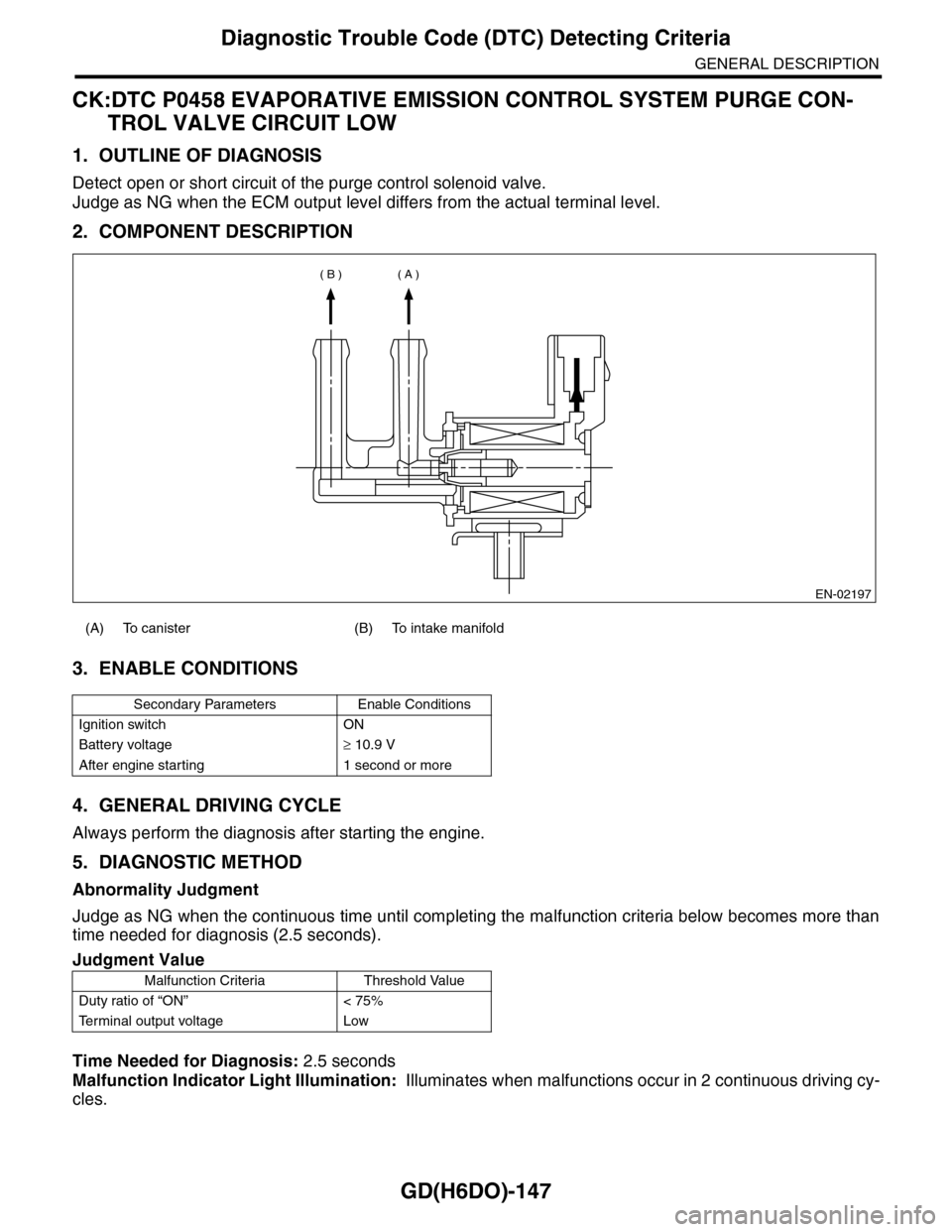
2. COMPONENT DESCRIPTION
3. ENABLE CONDITIONS
4. GENERAL DRIVING CYCLE
Always perform the diagnosis after starting the engine.
5. DIAGNOSTIC METHOD
Abnormality Judgment
Judge as NG when the continuous time until completing the malfunction criteria below becomes more than
time needed for diagnosis (2.5 seconds).
Time Needed for Diagnosis: 2.5 seconds
Malfunction Indicator Light Illumination: Illuminates when malfunctions occur in 2 continuous driving cy-
cles.
(A) To canister (B) To intake manifold
Secondary Parameters Enable Conditions
Ignition switch ON
Battery voltage≥ 10.9 V
After engine starting 1 second or more
Judgment Value
Malfunction Criteria Threshold Value
Duty ratio of “ON” < 75%
Te r m i n a l o u t p u t v o l t a g e L o w
EN-02197
( A )( B )
Page 1761 of 2453
GD(H6DO)-149
Diagnostic Trouble Code (DTC) Detecting Criteria
GENERAL DESCRIPTION
CL:DTC P0459 EVAPORATIVE EMISSION CONTROL SYSTEM PURGE CON-
TROL VALVE CIRCUIT HIGH
1. OUTLINE OF DIAGNOSIS
Detect open or short circuit of the purge control solenoid valve.
Judge as NG when the ECM output level differs from the actual terminal level.
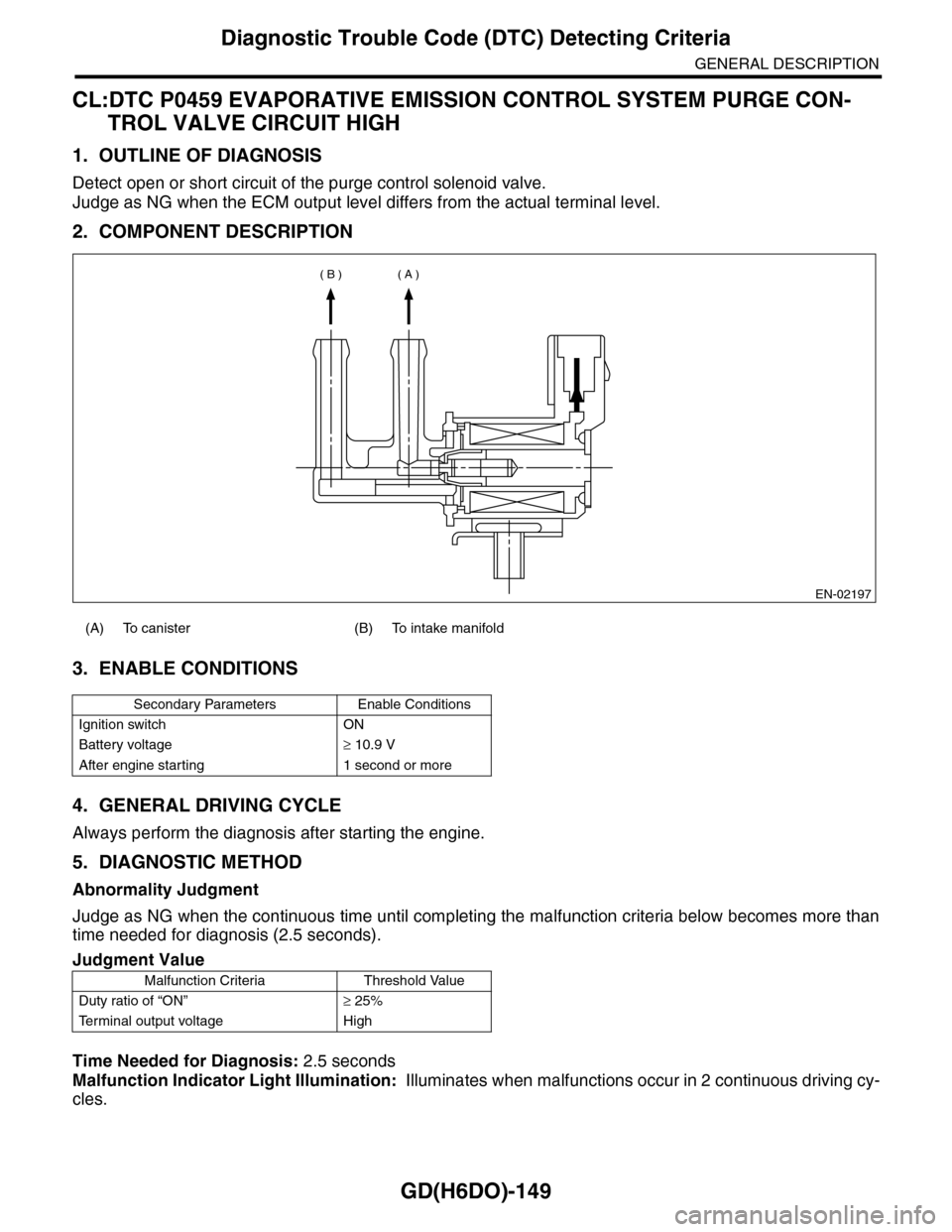
2. COMPONENT DESCRIPTION
3. ENABLE CONDITIONS
4. GENERAL DRIVING CYCLE
Always perform the diagnosis after starting the engine.
5. DIAGNOSTIC METHOD
Abnormality Judgment
Judge as NG when the continuous time until completing the malfunction criteria below becomes more than
time needed for diagnosis (2.5 seconds).
Time Needed for Diagnosis: 2.5 seconds
Malfunction Indicator Light Illumination: Illuminates when malfunctions occur in 2 continuous driving cy-
cles.
(A) To canister (B) To intake manifold
Secondary Parameters Enable Conditions
Ignition switch ON
Battery voltage≥ 10.9 V
After engine starting 1 second or more
Judgment Value
Malfunction Criteria Threshold Value
Duty ratio of “ON”≥ 25%
Te r m i n a l o u t p u t v o l t a g e H i g h
EN-02197
( A )( B )
Page 1763 of 2453
GD(H6DO)-151
Diagnostic Trouble Code (DTC) Detecting Criteria
GENERAL DESCRIPTION
CM:DTC P0461 FUEL LEVEL SENSOR CIRCUIT RANGE/PERFORMANCE
1. OUTLINE OF DIAGNOSIS
Detect malfunctions of the fuel level sensor output property.
If the fuel level does not vary in a particular driving condition/engine condition where it should, judge as NG.
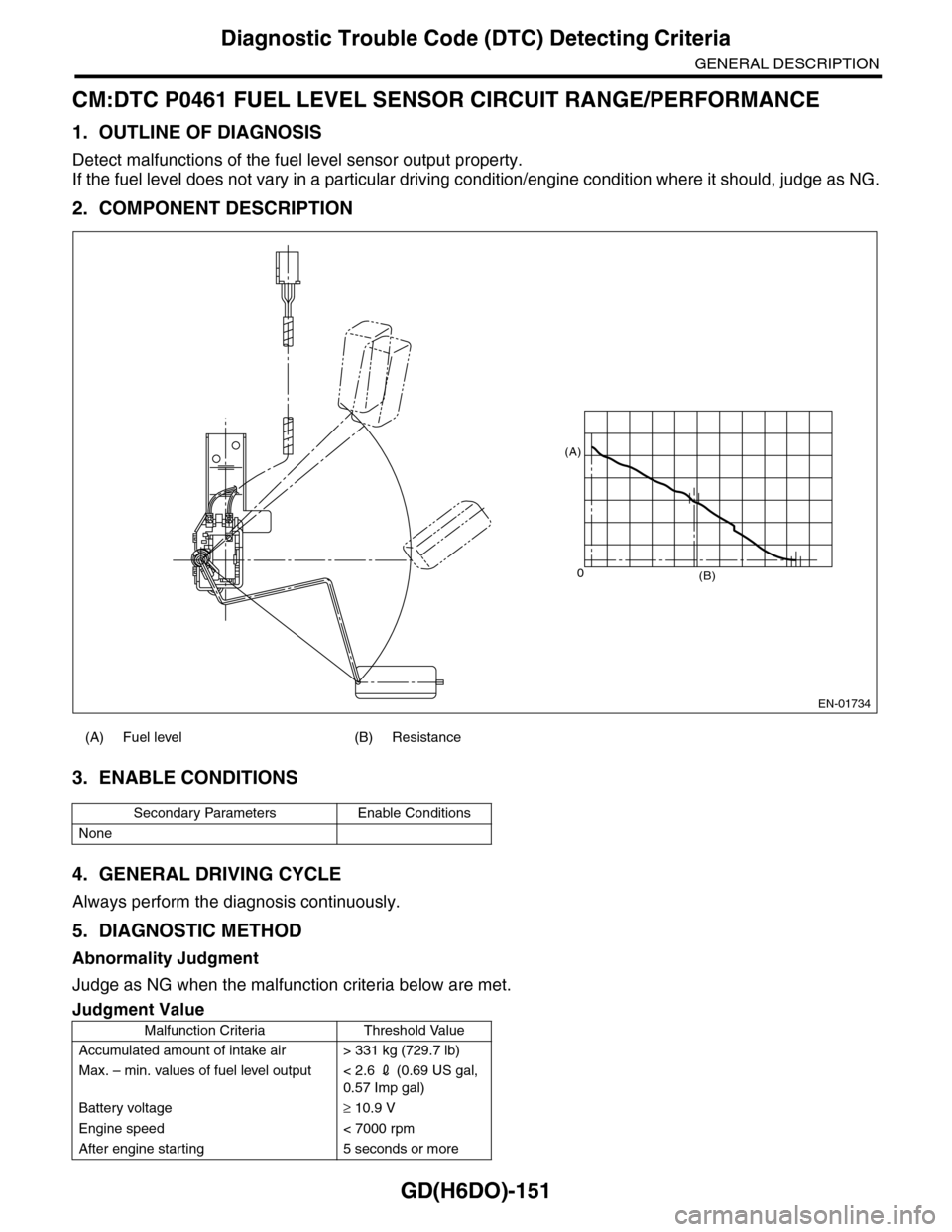
2. COMPONENT DESCRIPTION
3. ENABLE CONDITIONS
4. GENERAL DRIVING CYCLE
Always perform the diagnosis continuously.
5. DIAGNOSTIC METHOD
Abnormality Judgment
Judge as NG when the malfunction criteria below are met.
(A) Fuel level (B) Resistance
Secondary Parameters Enable Conditions
None
Judgment Value
Malfunction Criteria Threshold Value
Accumulated amount of intake air > 331 kg (729.7 lb)
Max. – min. values of fuel level output < 2.6 2 (0.69 US gal,
0.57 Imp gal)
Battery voltage≥ 10.9 V
Engine speed < 7000 rpm
After engine starting 5 seconds or more
EN-01734
0(B)
(A)
Page 1764 of 2453
GD(H6DO)-152
Diagnostic Trouble Code (DTC) Detecting Criteria
GENERAL DESCRIPTION
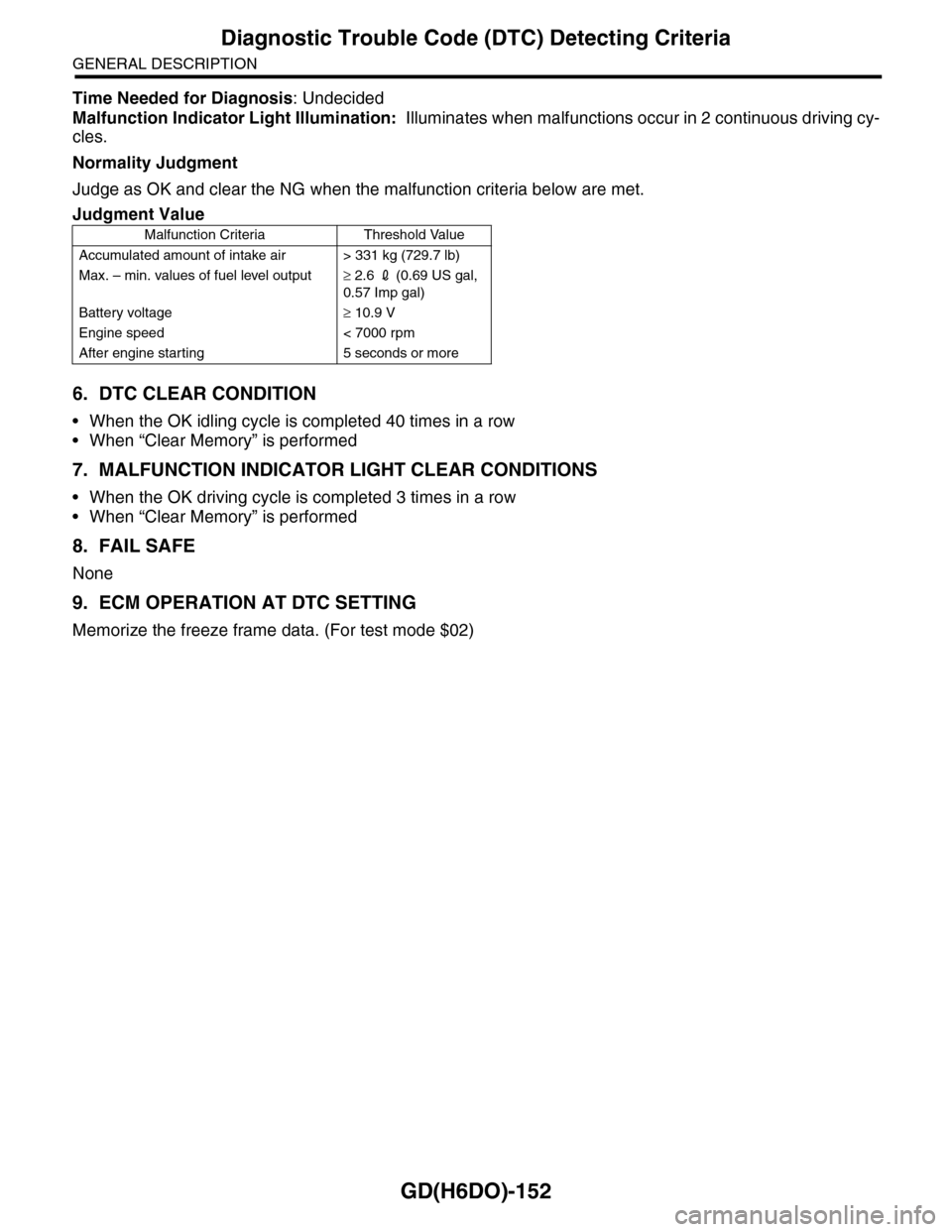
Time Needed for Diagnosis: Undecided
Malfunction Indicator Light Illumination: Illuminates when malfunctions occur in 2 continuous driving cy-
cles.
Normality Judgment
Judge as OK and clear the NG when the malfunction criteria below are met.
6. DTC CLEAR CONDITION
•When the OK idling cycle is completed 40 times in a row
•When “Clear Memory” is performed
7. MALFUNCTION INDICATOR LIGHT CLEAR CONDITIONS
•When the OK driving cycle is completed 3 times in a row
•When “Clear Memory” is performed
8. FAIL SAFE
None
9. ECM OPERATION AT DTC SETTING
Memorize the freeze frame data. (For test mode $02)
Judgment Value
Malfunction Criteria Threshold Value
Accumulated amount of intake air > 331 kg (729.7 lb)
Max. – min. values of fuel level output≥ 2.6 2 (0.69 US gal,
0.57 Imp gal)
Battery voltage≥ 10.9 V
Engine speed < 7000 rpm
After engine starting 5 seconds or more
Page 1775 of 2453
GD(H6DO)-163
Diagnostic Trouble Code (DTC) Detecting Criteria
GENERAL DESCRIPTION
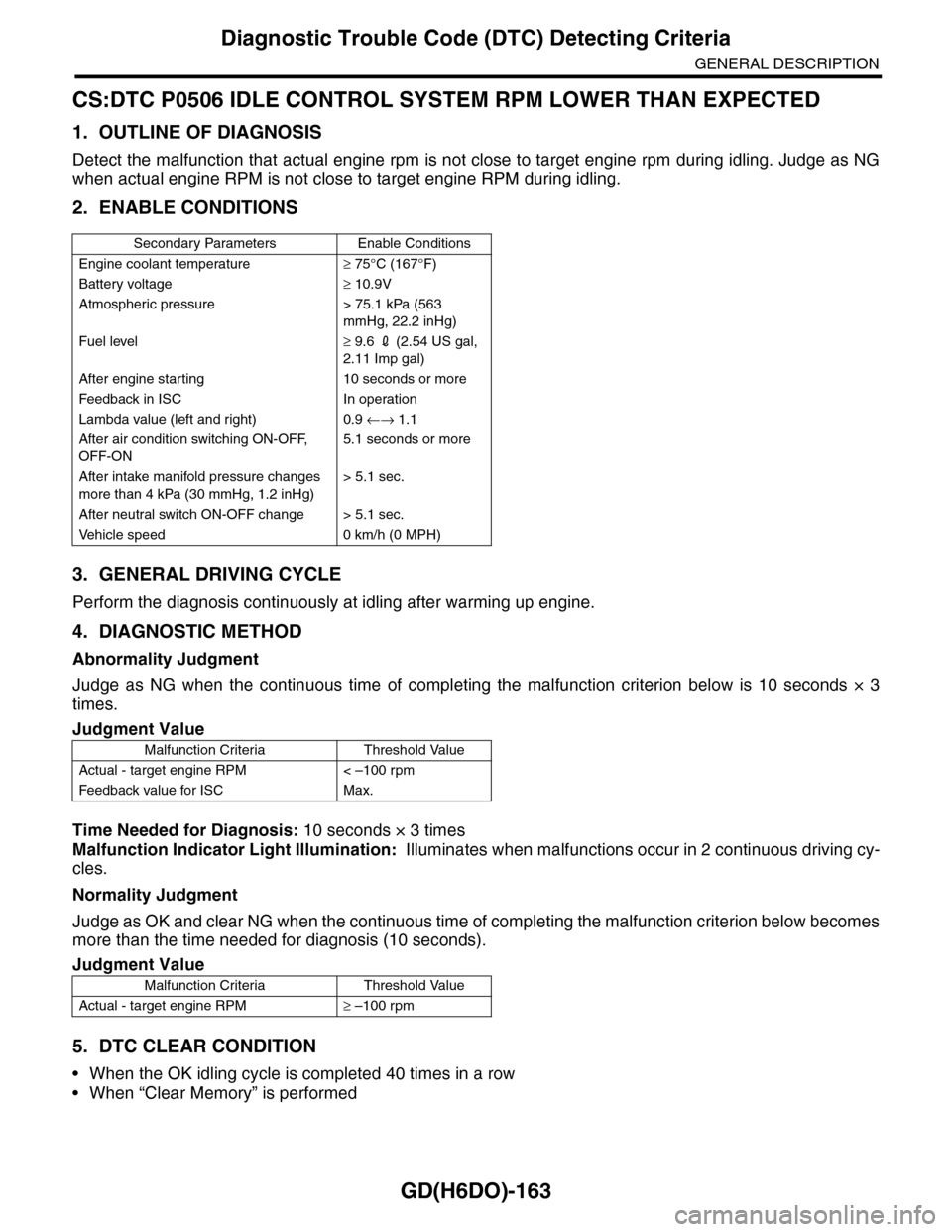
CS:DTC P0506 IDLE CONTROL SYSTEM RPM LOWER THAN EXPECTED
1. OUTLINE OF DIAGNOSIS
Detect the malfunction that actual engine rpm is not close to target engine rpm during idling. Judge as NG
when actual engine RPM is not close to target engine RPM during idling.
2. ENABLE CONDITIONS
3. GENERAL DRIVING CYCLE
Perform the diagnosis continuously at idling after warming up engine.
4. DIAGNOSTIC METHOD
Abnormality Judgment
Judge as NG when the continuous time of completing the malfunction criterion below is 10 seconds × 3
times.
Time Needed for Diagnosis: 10 seconds × 3 times
Malfunction Indicator Light Illumination: Illuminates when malfunctions occur in 2 continuous driving cy-
cles.
Normality Judgment
Judge as OK and clear NG when the continuous time of completing the malfunction criterion below becomes
more than the time needed for diagnosis (10 seconds).
5. DTC CLEAR CONDITION
•When the OK idling cycle is completed 40 times in a row
•When “Clear Memory” is performed
Secondary Parameters Enable Conditions
Engine coolant temperature≥ 75°C (167°F)
Battery voltage≥ 10.9V
Atmospheric pressure > 75.1 kPa (563
mmHg, 22.2 inHg)
Fuel level≥ 9.6 2 (2.54 US gal,
2.11 Imp gal)
After engine starting 10 seconds or more
Feedback in ISC In operation
Lambda value (left and right) 0.9 ←→ 1.1
After air condition switching ON-OFF,
OFF-ON
5.1 seconds or more
After intake manifold pressure changes
more than 4 kPa (30 mmHg, 1.2 inHg)
> 5.1 sec.
After neutral switch ON-OFF change > 5.1 sec.
Ve h i c l e s p e e d 0 k m / h ( 0 M P H )
Judgment Value
Malfunction Criteria Threshold Value
Actual - target engine RPM < –100 rpm
Feedback value for ISC Max.
Judgment Value
Malfunction Criteria Threshold Value
Actual - target engine RPM≥ –100 rpm