ECU SUBARU TRIBECA 2009 1.G Service Workshop Manual
[x] Cancel search | Manufacturer: SUBARU, Model Year: 2009, Model line: TRIBECA, Model: SUBARU TRIBECA 2009 1.GPages: 2453, PDF Size: 46.32 MB
Page 709 of 2453
WW-14
Wiper Relay Unit
WIPER AND WASHER SYSTEMS
6. Wiper Relay Unit
A: REMOVAL
1) Disconnect the ground cable from battery.
2) Remove the wiper arm.
3) Remove the cowl panel.
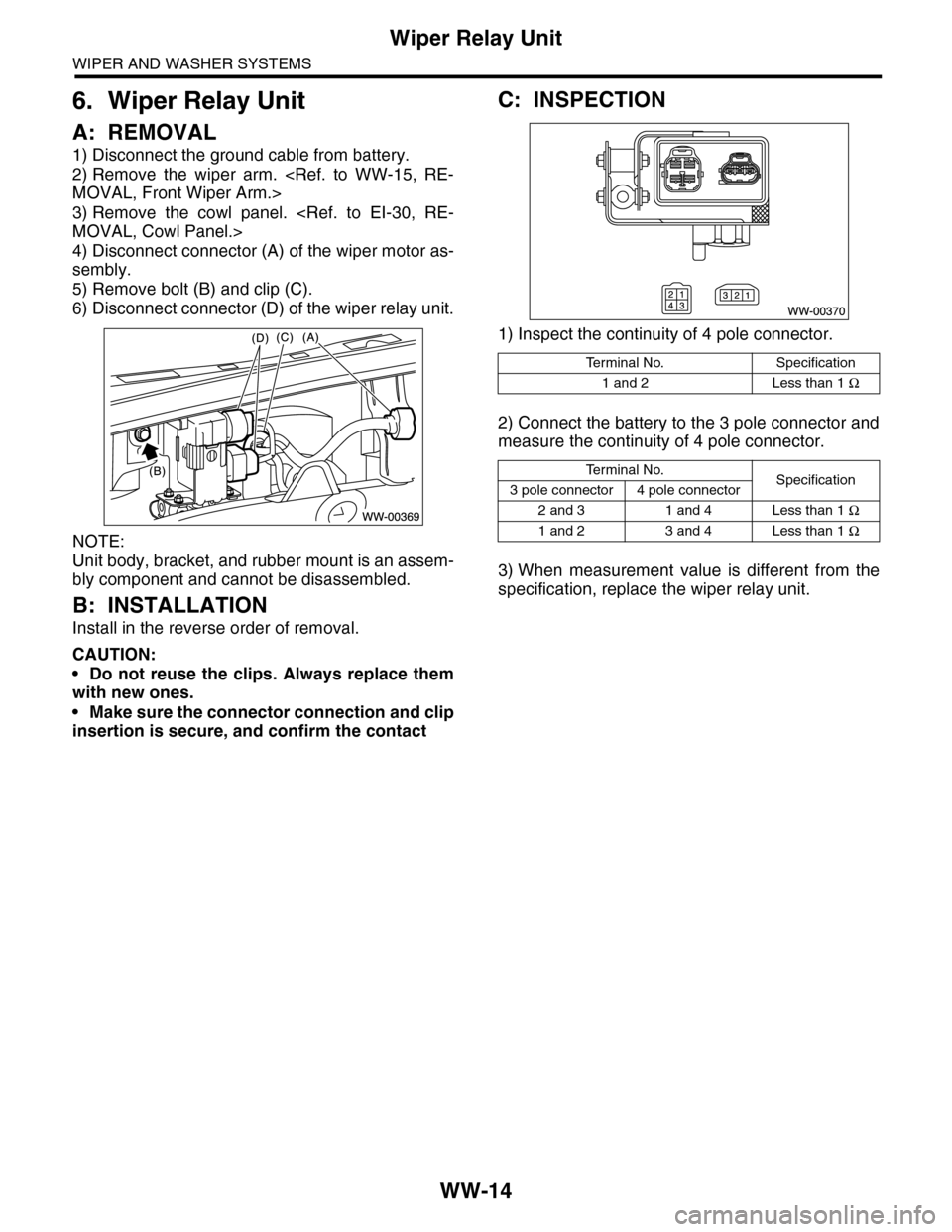
4) Disconnect connector (A) of the wiper motor as-
sembly.
5) Remove bolt (B) and clip (C).
6) Disconnect connector (D) of the wiper relay unit.
NOTE:
Unit body, bracket, and rubber mount is an assem-
bly component and cannot be disassembled.
B: INSTALLATION
Install in the reverse order of removal.
CAUTION:
•Do not reuse the clips. Always replace them
with new ones.
•Make sure the connector connection and clip
insertion is secure, and confirm the contact
C: INSPECTION
1) Inspect the continuity of 4 pole connector.
2) Connect the battery to the 3 pole connector and
measure the continuity of 4 pole connector.
3) When measurement value is different from the
specification, replace the wiper relay unit.
Te r m i n a l N o . S p e c i f i c a t i o n
1 and 2 Less than 1 Ω
Te r m i n a l N o .Specification3 pole connector 4 pole connector
2 and 3 1 and 4 Less than 1 Ω
1 and 2 3 and 4 Less than 1 Ω
Page 725 of 2453
BR-11
General Description
BRAKE
C: CAUTION
Please clearly understand and adhere to the follow-
ing general precautions. They must be strictly fol-
lowed to avoid any injury to the person doing the
work or people in the area.
1. OPERATION
•Wear work clothing, including a cap, protective
goggles and protective shoes during operation.
•Before removal, installation or disassembly, be
sure to clarify the failure. Avoid unnecessary re-
moval, installation, disassembly and replacement.
•Use SUBARU genuine grease etc. or equivalent.
Do not mix grease etc. with that of another grade or
from other manufacturers.
•Before securing a part in a vise, place cushioning
material such as wood blocks, aluminum plate or
cloth between the part and the vise.
•Be sure to tighten fasteners including bolts and
nuts to the specified torque.
•Place shop jacks or rigid racks at the specified
points.
2. OIL
When handling oil, follow the rules below to prevent
unexpected accidents.
•Prepare container and waste cloths when per-
forming work which oil could possibly spill. If oil
spills, wipe it off immediately to prevent from pene-
trating into floor or flowing outside, for environmen-
tal protection.
•Follow all government and local regulations con-
cerning waste disposal.
3. BRAKE FLUID
If brake fluid gets in your eyes or on your skin, do
the following:
•Wash eyes and seek immediate medical atten-
tion.
•Wash your skin with soap and then rinse thor-
oughly with water.
Follow all government and local regulations con-
cerning waste disposal.
D: PREPARATION TOOL
1. GENERAL TOOL
TOOL NAME REMARKS
Snap ring pliers Used for removing and installing snap rings.
Page 728 of 2453
BR-14
Front Disc Rotor
BRAKE
3. Front Disc Rotor
A: REMOVAL
1) Lift-up the vehicle, and remove the front wheels.
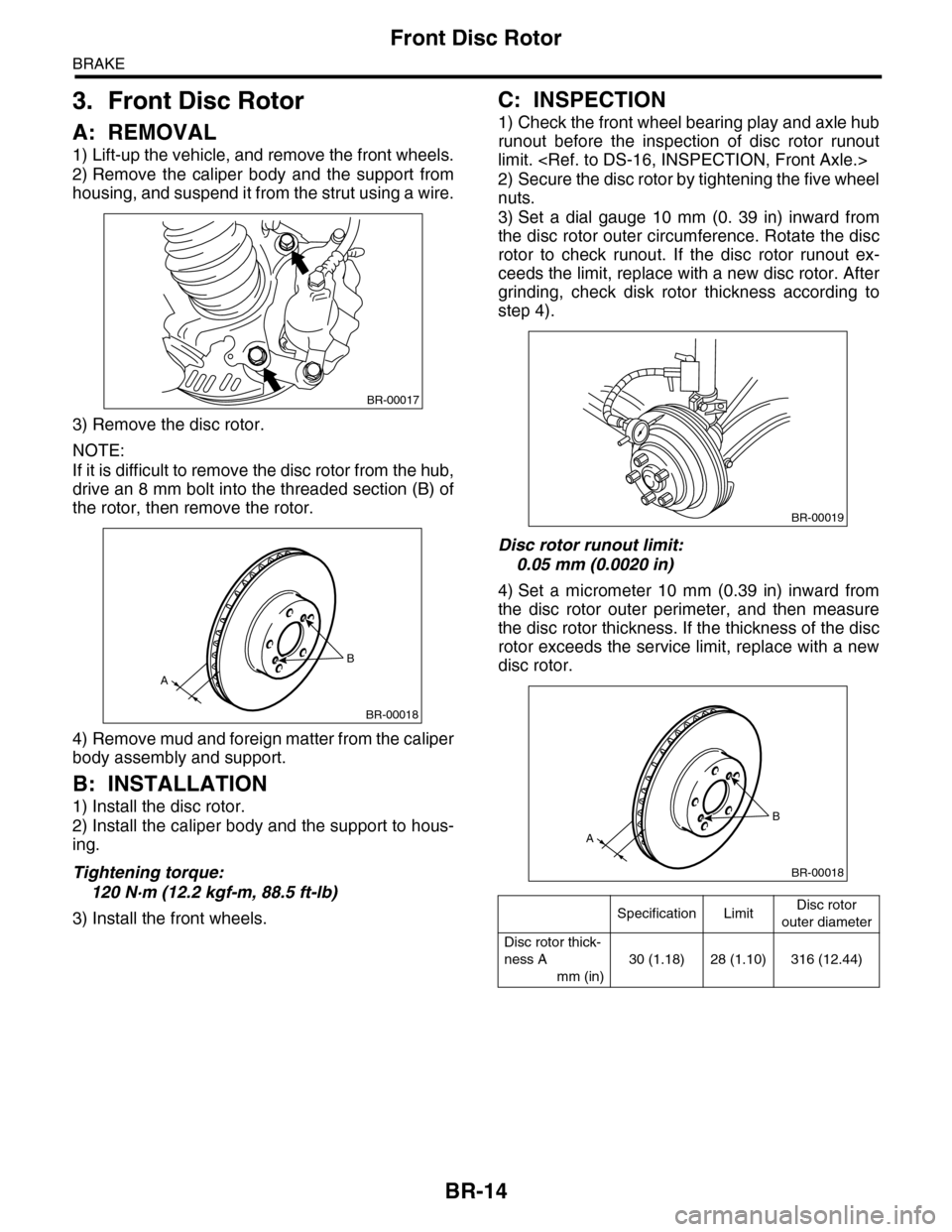
2) Remove the caliper body and the support from
housing, and suspend it from the strut using a wire.
3) Remove the disc rotor.
NOTE:
If it is difficult to remove the disc rotor from the hub,
drive an 8 mm bolt into the threaded section (B) of
the rotor, then remove the rotor.
4) Remove mud and foreign matter from the caliper
body assembly and support.
B: INSTALLATION
1) Install the disc rotor.
2) Install the caliper body and the support to hous-
ing.
Tightening torque:
120 N·m (12.2 kgf-m, 88.5 ft-lb)
3) Install the front wheels.
C: INSPECTION
1) Check the front wheel bearing play and axle hub
runout before the inspection of disc rotor runout
limit.
2) Secure the disc rotor by tightening the five wheel
nuts.
3) Set a dial gauge 10 mm (0. 39 in) inward from
the disc rotor outer circumference. Rotate the disc
rotor to check runout. If the disc rotor runout ex-
ceeds the limit, replace with a new disc rotor. After
grinding, check disk rotor thickness according to
step 4).
Disc rotor runout limit:
0.05 mm (0.0020 in)
4) Set a micrometer 10 mm (0.39 in) inward from
the disc rotor outer perimeter, and then measure
the disc rotor thickness. If the thickness of the disc
rotor exceeds the service limit, replace with a new
disc rotor.
BR-00017
B
A
BR-00018
Specification LimitDisc rotor
outer diameter
Disc rotor thick-
ness A
mm (in)
30 (1.18) 28 (1.10) 316 (12.44)
BR-00019
B
A
BR-00018
Page 729 of 2453
BR-15
Front Disc Brake Assembly
BRAKE
4. Front Disc Brake Assembly
A: REMOVAL
CAUTION:
Do not allow brake fluid to come in contact with
vehicle body. If it does, wash off with water and
wipe away completely.
1) Lift-up the vehicle, and remove the front wheels.
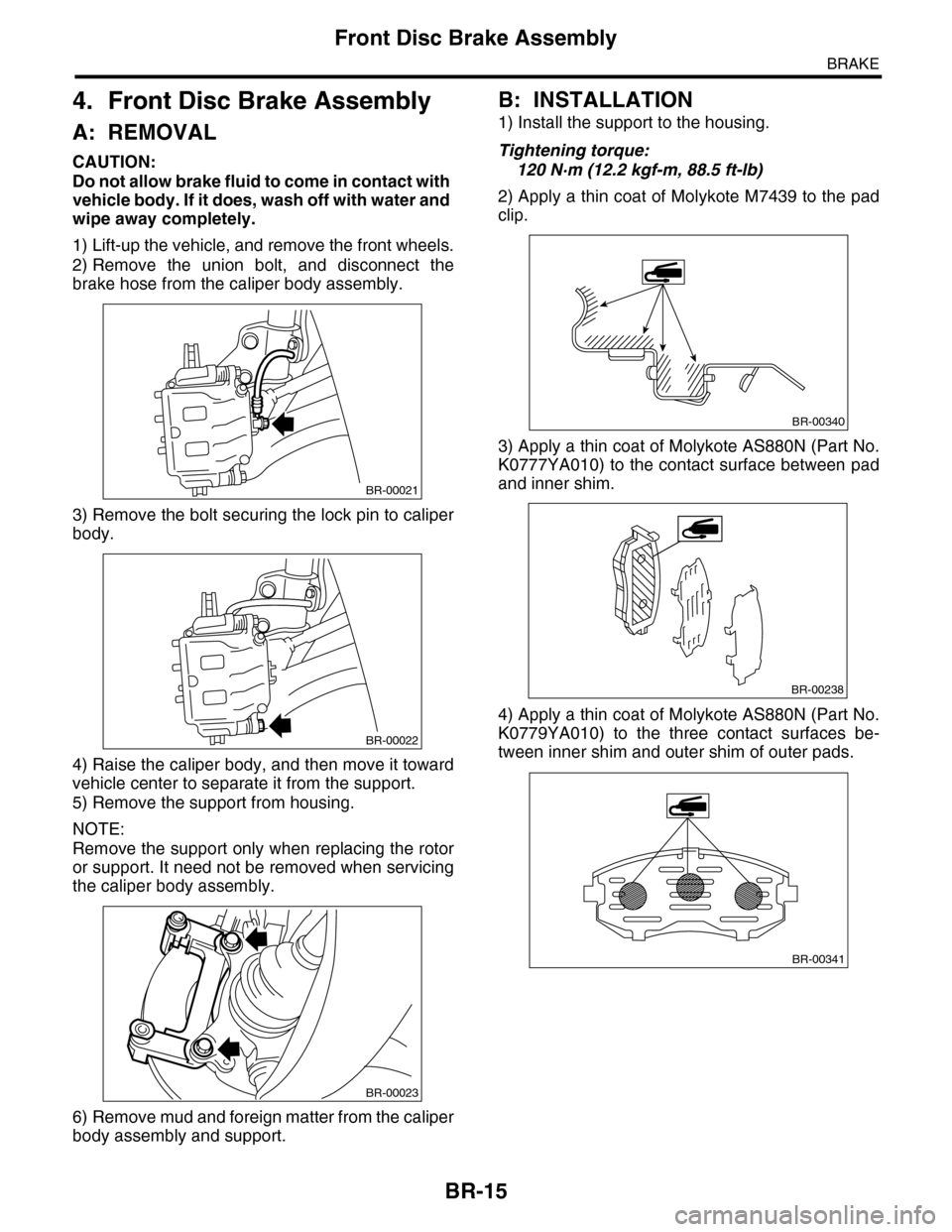
2) Remove the union bolt, and disconnect the
brake hose from the caliper body assembly.
3) Remove the bolt securing the lock pin to caliper
body.
4) Raise the caliper body, and then move it toward
vehicle center to separate it from the support.
5) Remove the support from housing.
NOTE:
Remove the support only when replacing the rotor
or support. It need not be removed when servicing
the caliper body assembly.
6) Remove mud and foreign matter from the caliper
body assembly and support.
B: INSTALLATION
1) Install the support to the housing.
Tightening torque:
120 N·m (12.2 kgf-m, 88.5 ft-lb)
2) Apply a thin coat of Molykote M7439 to the pad
clip.
3) Apply a thin coat of Molykote AS880N (Part No.
K0777YA010) to the contact surface between pad
and inner shim.
4) Apply a thin coat of Molykote AS880N (Part No.
K0779YA010) to the three contact surfaces be-
tween inner shim and outer shim of outer pads.
BR-00021
BR-00022
BR-00023
BR-00340
BR-00238
BR-00341
Page 734 of 2453
BR-20
Rear Disc Rotor
BRAKE
6. Rear Disc Rotor
A: REMOVAL
1) Lift-up the vehicle, and then remove the rear
wheels.
2) Release the parking brake.
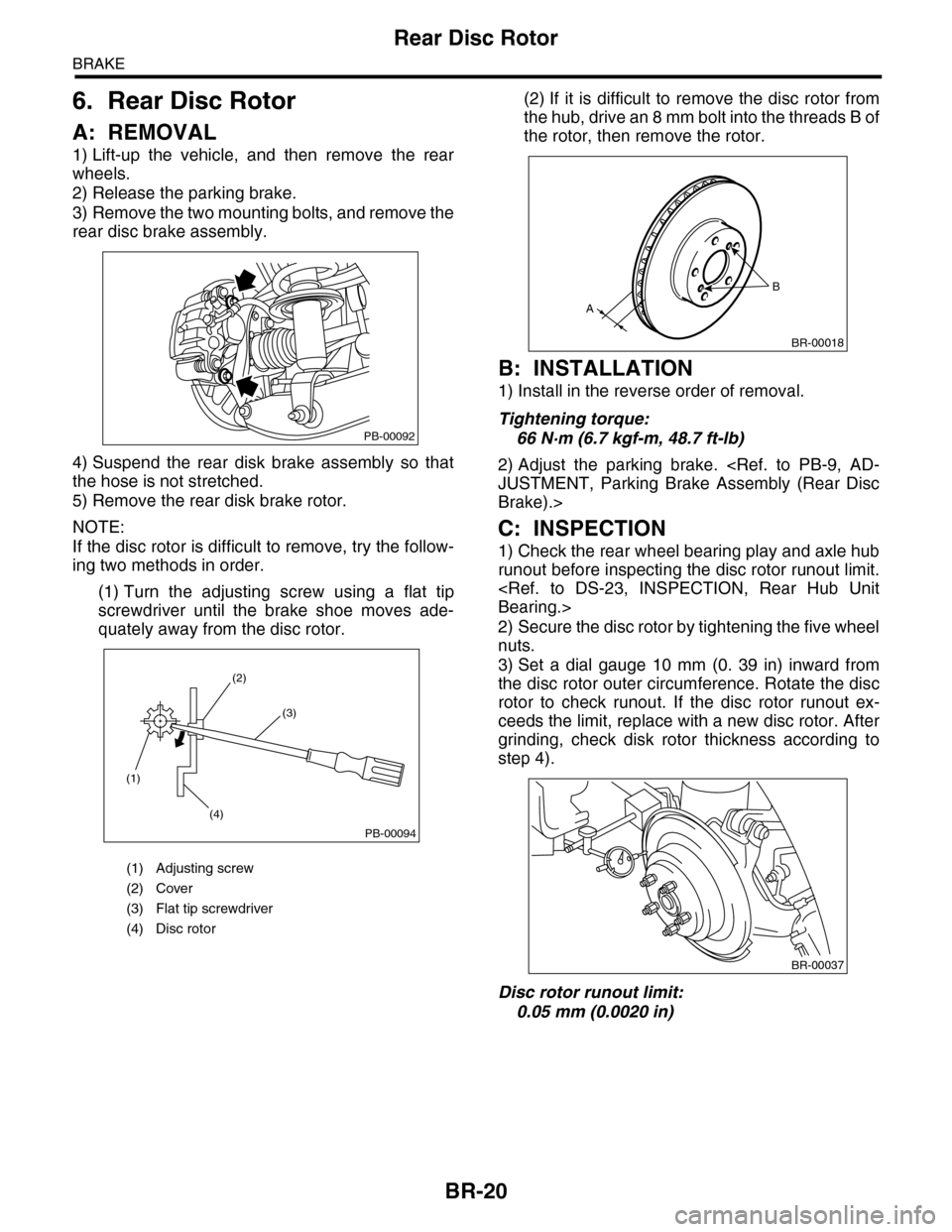
3) Remove the two mounting bolts, and remove the
rear disc brake assembly.
4) Suspend the rear disk brake assembly so that
the hose is not stretched.
5) Remove the rear disk brake rotor.
NOTE:
If the disc rotor is difficult to remove, try the follow-
ing two methods in order.
(1) Turn the adjusting screw using a flat tip
screwdriver until the brake shoe moves ade-
quately away from the disc rotor.
(2) If it is difficult to remove the disc rotor from
the hub, drive an 8 mm bolt into the threads B of
the rotor, then remove the rotor.
B: INSTALLATION
1) Install in the reverse order of removal.
Tightening torque:
66 N·m (6.7 kgf-m, 48.7 ft-lb)
2) Adjust the parking brake.
Brake).>
C: INSPECTION
1) Check the rear wheel bearing play and axle hub
runout before inspecting the disc rotor runout limit.
2) Secure the disc rotor by tightening the five wheel
nuts.
3) Set a dial gauge 10 mm (0. 39 in) inward from
the disc rotor outer circumference. Rotate the disc
rotor to check runout. If the disc rotor runout ex-
ceeds the limit, replace with a new disc rotor. After
grinding, check disk rotor thickness according to
step 4).
Disc rotor runout limit:
0.05 mm (0.0020 in)
(1) Adjusting screw
(2) Cover
(3) Flat tip screwdriver
(4) Disc rotor
PB-00092
(1)
(4)
(2)
(3)
PB-00094
B
A
BR-00018
BR-00037
Page 738 of 2453
BR-24
Master Cylinder
BRAKE
8. Master Cylinder
A: REMOVAL
CAUTION:
Do not allow brake fluid to come in contact with
vehicle body. If it does, wash off with water and
wipe away completely.
1) Drain brake fluid from the reservoir tank com-
pletely.
2) Disconnect the harness connector of the fluid
level gauge.
3) Remove the brake pipe from the master cylinder.
4) Remove the master cylinder mounting nuts, and
remove the master cylinder from the brake booster.
B: INSTALLATION
1) Install in the reverse order of removal.
Tightening torque:
Master cylinder mounting nut
25 N·m (2.5 kgf-m, 18.4 ft-lb)
Brake pipe
19 N·m (1.9 kgf-m, 14.0 ft-lb)
CAUTION:
Be sure to use recommended brake fluid.
2) Bleed air from brake system.
C: REPLACEMENT
1) Remove mud and dirt from the surface of brake
master cylinder.
2) Secure the master cylinder in a vise.
NOTE:
To avoid damaging the master cylinder, place be-
tween aluminum plates or other material when
holding with a vise.
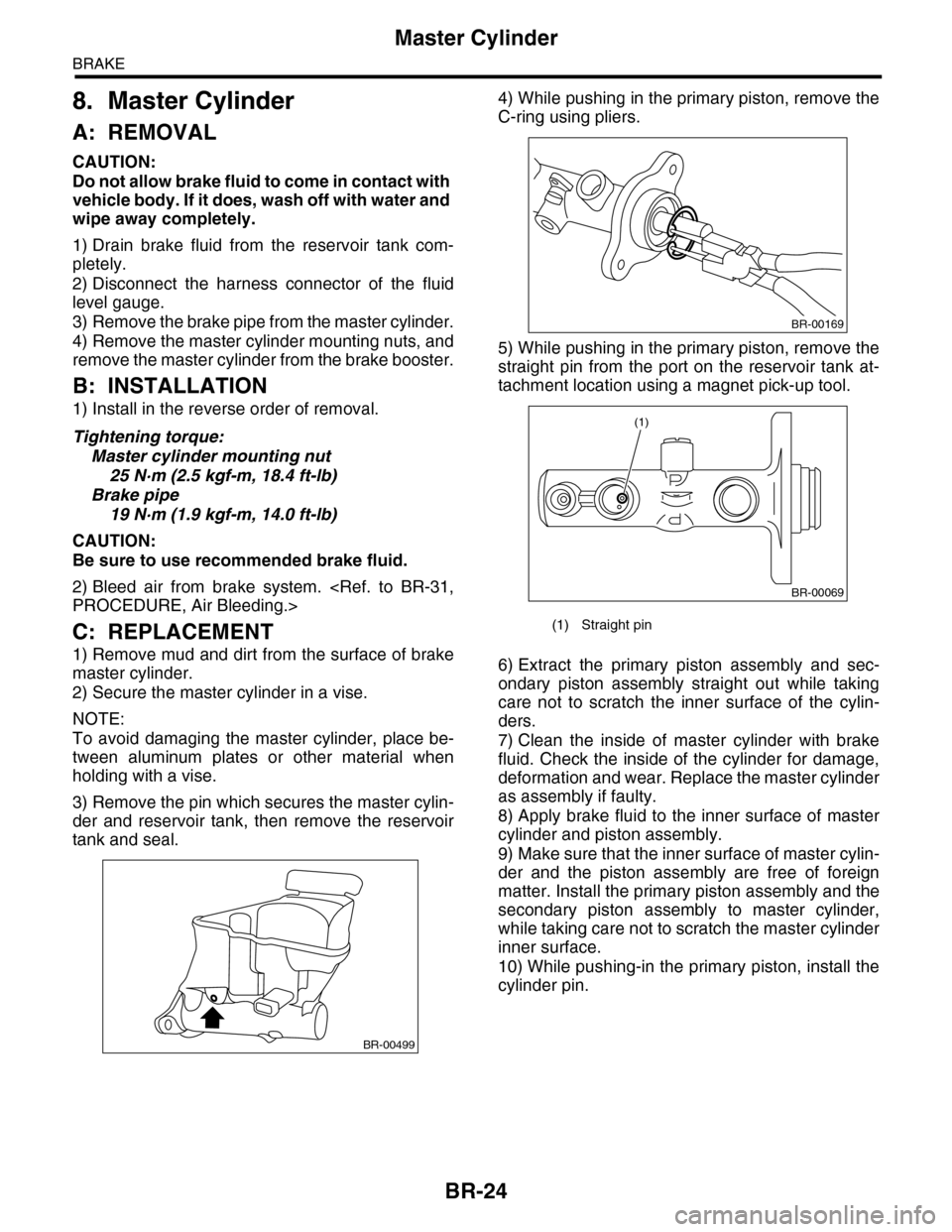
3) Remove the pin which secures the master cylin-
der and reservoir tank, then remove the reservoir
tank and seal.
4) While pushing in the primary piston, remove the
C-ring using pliers.
5) While pushing in the primary piston, remove the
straight pin from the port on the reservoir tank at-
tachment location using a magnet pick-up tool.
6) Extract the primary piston assembly and sec-
ondary piston assembly straight out while taking
care not to scratch the inner surface of the cylin-
ders.
7) Clean the inside of master cylinder with brake
fluid. Check the inside of the cylinder for damage,
deformation and wear. Replace the master cylinder
as assembly if faulty.
8) Apply brake fluid to the inner surface of master
cylinder and piston assembly.
9) Make sure that the inner surface of master cylin-
der and the piston assembly are free of foreign
matter. Install the primary piston assembly and the
secondary piston assembly to master cylinder,
while taking care not to scratch the master cylinder
inner surface.
10) While pushing-in the primary piston, install the
cylinder pin.
BR-00499
(1) Straight pin
BR-00169
(1)
BR-00069
Page 739 of 2453
BR-25
Master Cylinder
BRAKE
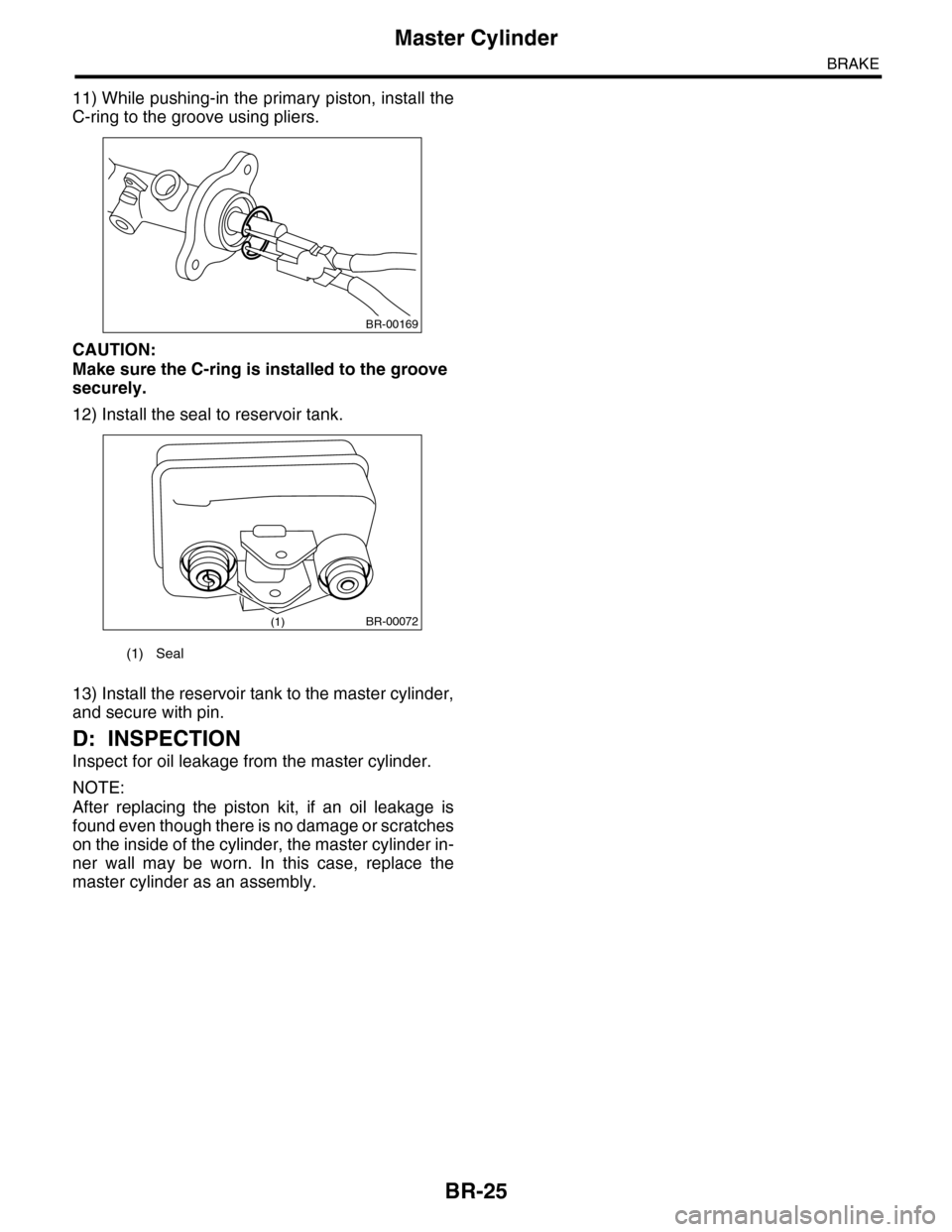
11) While pushing-in the primary piston, install the
C-ring to the groove using pliers.
CAUTION:
Make sure the C-ring is installed to the groove
securely.
12) Install the seal to reservoir tank.
13) Install the reservoir tank to the master cylinder,
and secure with pin.
D: INSPECTION
Inspect for oil leakage from the master cylinder.
NOTE:
After replacing the piston kit, if an oil leakage is
found even though there is no damage or scratches
on the inside of the cylinder, the master cylinder in-
ner wall may be worn. In this case, replace the
master cylinder as an assembly.
(1) Seal
BR-00169
(1) BR-00072
Page 741 of 2453
BR-27
Brake Booster
BRAKE
B: INSTALLATION
1) Check and adjust the operating rod of the brake
booster.
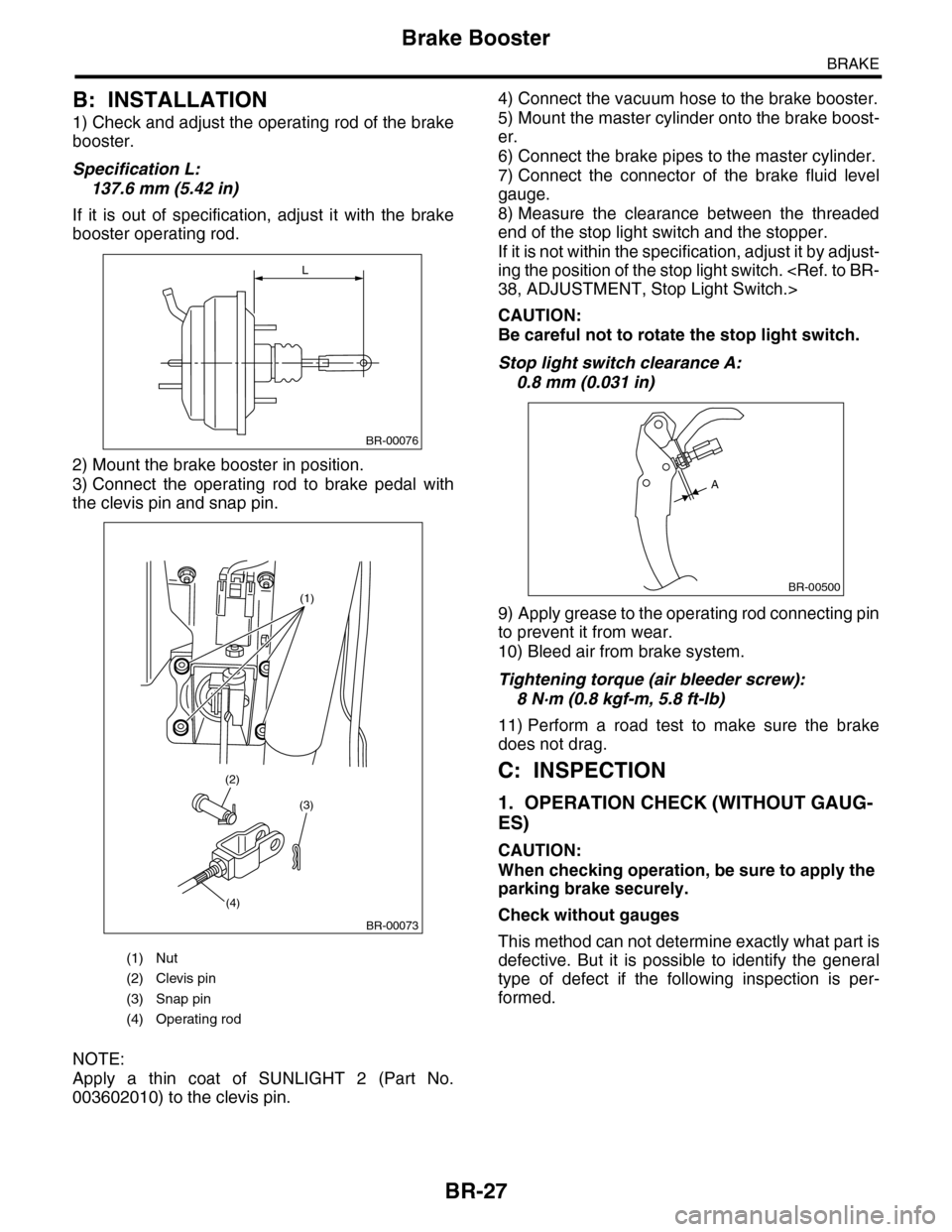
Specification L:
137.6 mm (5.42 in)
If it is out of specification, adjust it with the brake
booster operating rod.
2) Mount the brake booster in position.
3) Connect the operating rod to brake pedal with
the clevis pin and snap pin.
NOTE:
Apply a thin coat of SUNLIGHT 2 (Part No.
003602010) to the clevis pin.
4) Connect the vacuum hose to the brake booster.
5) Mount the master cylinder onto the brake boost-
er.
6) Connect the brake pipes to the master cylinder.
7) Connect the connector of the brake fluid level
gauge.
8) Measure the clearance between the threaded
end of the stop light switch and the stopper.
If it is not within the specification, adjust it by adjust-
ing the position of the stop light switch.
CAUTION:
Be careful not to rotate the stop light switch.
Stop light switch clearance A:
0.8 mm (0.031 in)
9) Apply grease to the operating rod connecting pin
to prevent it from wear.
10) Bleed air from brake system.
Tightening torque (air bleeder screw):
8 N·m (0.8 kgf-m, 5.8 ft-lb)
11) Perform a road test to make sure the brake
does not drag.
C: INSPECTION
1. OPERATION CHECK (WITHOUT GAUG-
ES)
CAUTION:
When checking operation, be sure to apply the
parking brake securely.
Check without gauges
This method can not determine exactly what part is
defective. But it is possible to identify the general
type of defect if the following inspection is per-
formed.
(1) Nut
(2) Clevis pin
(3) Snap pin
(4) Operating rod
L
BR-00076
(1)
(3)
(4)
(2)
BR-00073
BR-00500
A
Page 742 of 2453
BR-28
Brake Booster
BRAKE
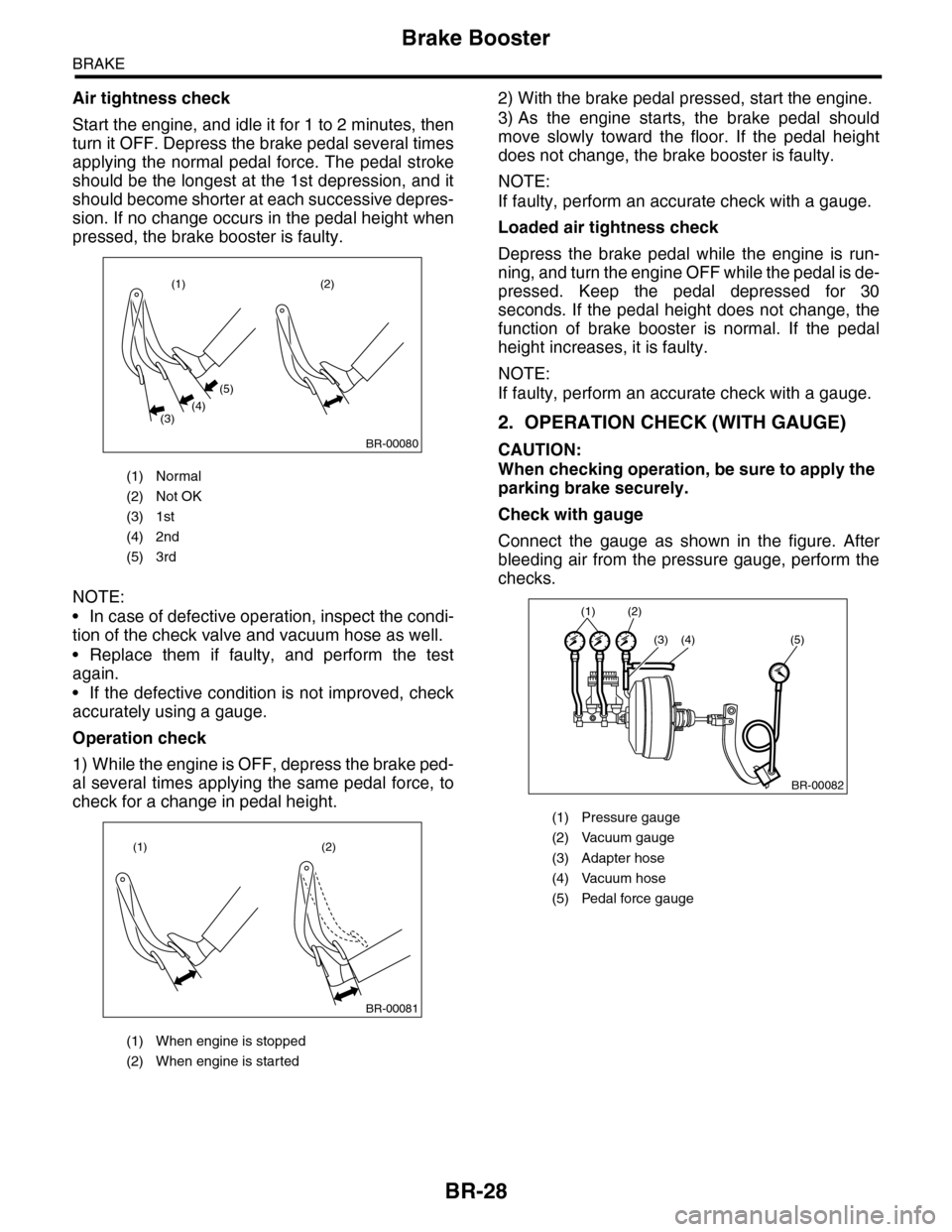
Air tightness check
Start the engine, and idle it for 1 to 2 minutes, then
turn it OFF. Depress the brake pedal several times
applying the normal pedal force. The pedal stroke
should be the longest at the 1st depression, and it
should become shorter at each successive depres-
sion. If no change occurs in the pedal height when
pressed, the brake booster is faulty.
NOTE:
•In case of defective operation, inspect the condi-
tion of the check valve and vacuum hose as well.
•Replace them if faulty, and perform the test
again.
•If the defective condition is not improved, check
accurately using a gauge.
Operation check
1) While the engine is OFF, depress the brake ped-
al several times applying the same pedal force, to
check for a change in pedal height.
2) With the brake pedal pressed, start the engine.
3) As the engine starts, the brake pedal should
move slowly toward the floor. If the pedal height
does not change, the brake booster is faulty.
NOTE:
If faulty, perform an accurate check with a gauge.
Loaded air tightness check
Depress the brake pedal while the engine is run-
ning, and turn the engine OFF while the pedal is de-
pressed. Keep the pedal depressed for 30
seconds. If the pedal height does not change, the
function of brake booster is normal. If the pedal
height increases, it is faulty.
NOTE:
If faulty, perform an accurate check with a gauge.
2. OPERATION CHECK (WITH GAUGE)
CAUTION:
When checking operation, be sure to apply the
parking brake securely.
Check with gauge
Connect the gauge as shown in the figure. After
bleeding air from the pressure gauge, perform the
checks.
(1) Normal
(2) Not OK
(3) 1st
(4) 2nd
(5) 3rd
(1) When engine is stopped
(2) When engine is started
(1)
(3)(4)
(5)
(2)
BR-00080
(1) (2)
BR-00081
(1) Pressure gauge
(2) Vacuum gauge
(3) Adapter hose
(4) Vacuum hose
(5) Pedal force gauge
(1) (2)
(3) (4) (5)
BR-00082
Page 745 of 2453
BR-31
Air Bleeding
BRAKE
11.Air Bleeding
A: PROCEDURE
CAUTION:
•Do not let brake fluid come into contact with
the painted surface of the vehicle body. Wash
away with water immediately and wipe off if it is
spilled by accident.
•Avoid mixing brake fluids of different brands
to prevent fluid performance from degrading.
•Be careful not to allow dirt or dust to enter the
reservoir tank.
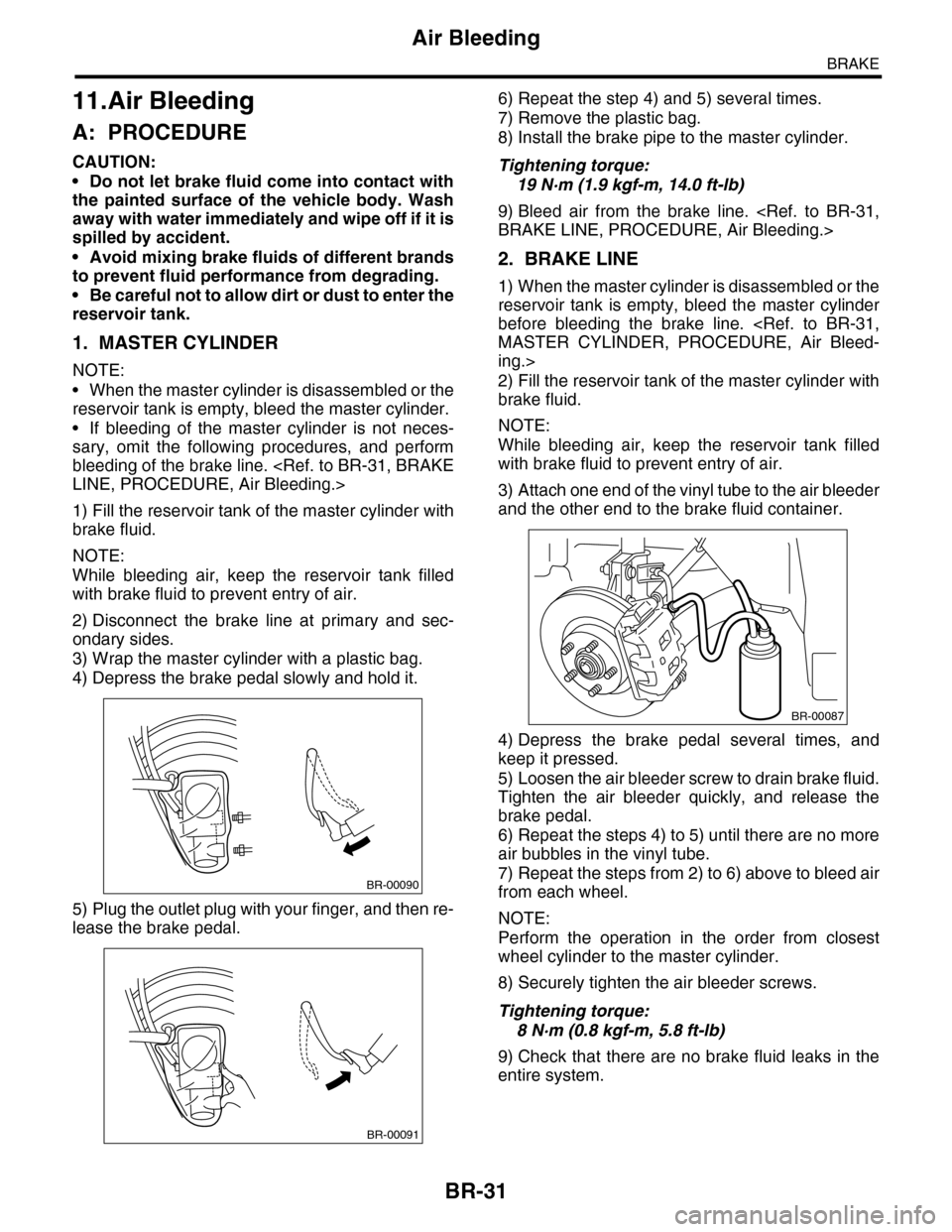
1. MASTER CYLINDER
NOTE:
•When the master cylinder is disassembled or the
reservoir tank is empty, bleed the master cylinder.
•If bleeding of the master cylinder is not neces-
sary, omit the following procedures, and perform
bleeding of the brake line.
1) Fill the reservoir tank of the master cylinder with
brake fluid.
NOTE:
While bleeding air, keep the reservoir tank filled
with brake fluid to prevent entry of air.
2) Disconnect the brake line at primary and sec-
ondary sides.
3) Wrap the master cylinder with a plastic bag.
4) Depress the brake pedal slowly and hold it.
5) Plug the outlet plug with your finger, and then re-
lease the brake pedal.
6) Repeat the step 4) and 5) several times.
7) Remove the plastic bag.
8) Install the brake pipe to the master cylinder.
Tightening torque:
19 N·m (1.9 kgf-m, 14.0 ft-lb)
9) Bleed air from the brake line.
2. BRAKE LINE
1) When the master cylinder is disassembled or the
reservoir tank is empty, bleed the master cylinder
before bleeding the brake line.
ing.>
2) Fill the reservoir tank of the master cylinder with
brake fluid.
NOTE:
While bleeding air, keep the reservoir tank filled
with brake fluid to prevent entry of air.
3) Attach one end of the vinyl tube to the air bleeder
and the other end to the brake fluid container.
4) Depress the brake pedal several times, and
keep it pressed.
5) Loosen the air bleeder screw to drain brake fluid.
Tighten the air bleeder quickly, and release the
brake pedal.
6) Repeat the steps 4) to 5) until there are no more
air bubbles in the vinyl tube.
7) Repeat the steps from 2) to 6) above to bleed air
from each wheel.
NOTE:
Perform the operation in the order from closest
wheel cylinder to the master cylinder.
8) Securely tighten the air bleeder screws.
Tightening torque:
8 N·m (0.8 kgf-m, 5.8 ft-lb)
9) Check that there are no brake fluid leaks in the
entire system.
BR-00090
BR-00091
BR-00087