Exhaust SUBARU TRIBECA 2009 1.G Service Workshop Manual
[x] Cancel search | Manufacturer: SUBARU, Model Year: 2009, Model line: TRIBECA, Model: SUBARU TRIBECA 2009 1.GPages: 2453, PDF Size: 46.32 MB
Page 295 of 2453
EI-53
Heat Shield Cover
EXTERIOR/INTERIOR TRIM
26.Heat Shield Cover
A: REMOVAL
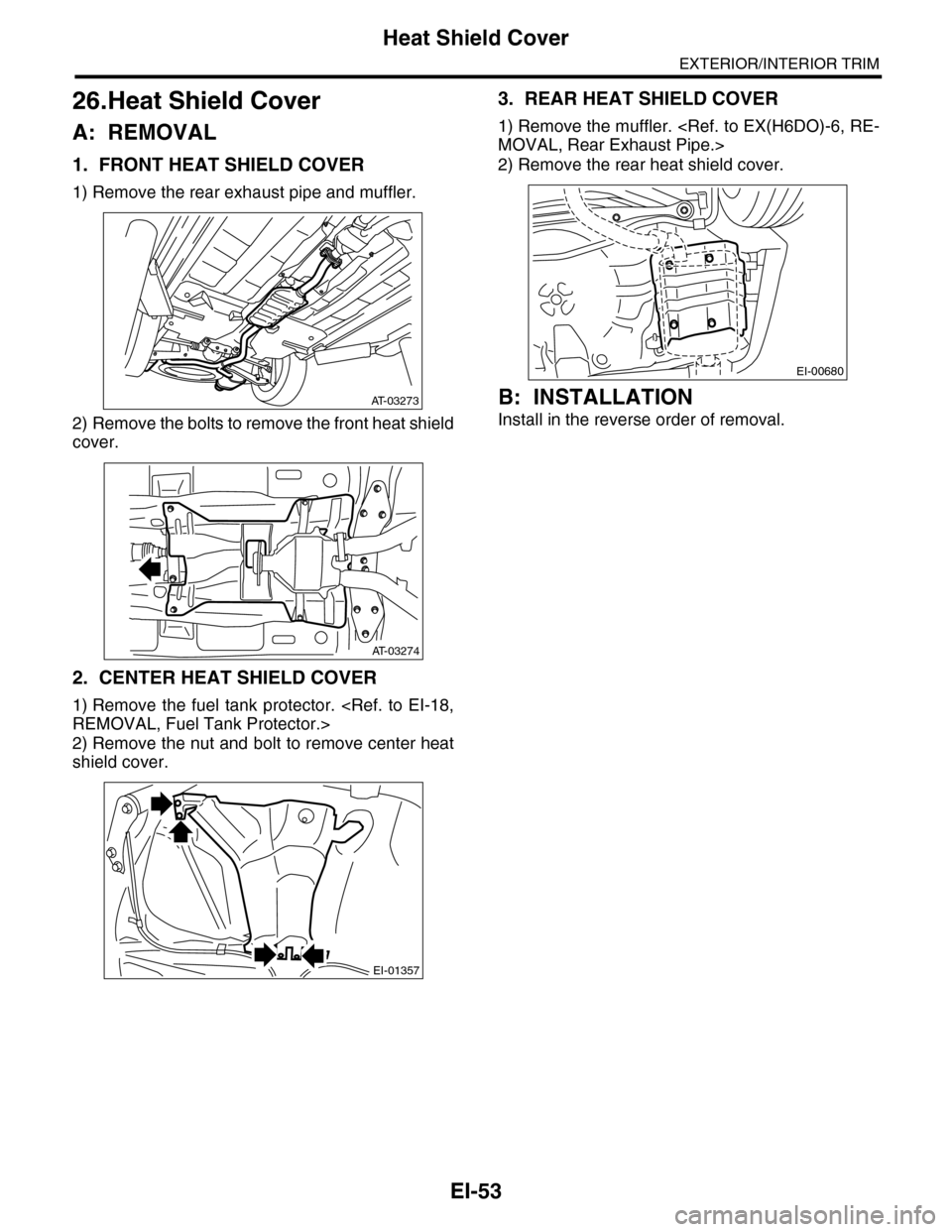
1. FRONT HEAT SHIELD COVER
1) Remove the rear exhaust pipe and muffler.
2) Remove the bolts to remove the front heat shield
cover.
2. CENTER HEAT SHIELD COVER
1) Remove the fuel tank protector.
2) Remove the nut and bolt to remove center heat
shield cover.
3. REAR HEAT SHIELD COVER
1) Remove the muffler.
2) Remove the rear heat shield cover.
B: INSTALLATION
Install in the reverse order of removal.
AT-03273
AT-03274
EI-01357
EI-00680
Page 328 of 2453
AC-2
General Description
HVAC SYSTEM (HEATER, VENTILATOR AND A/C)
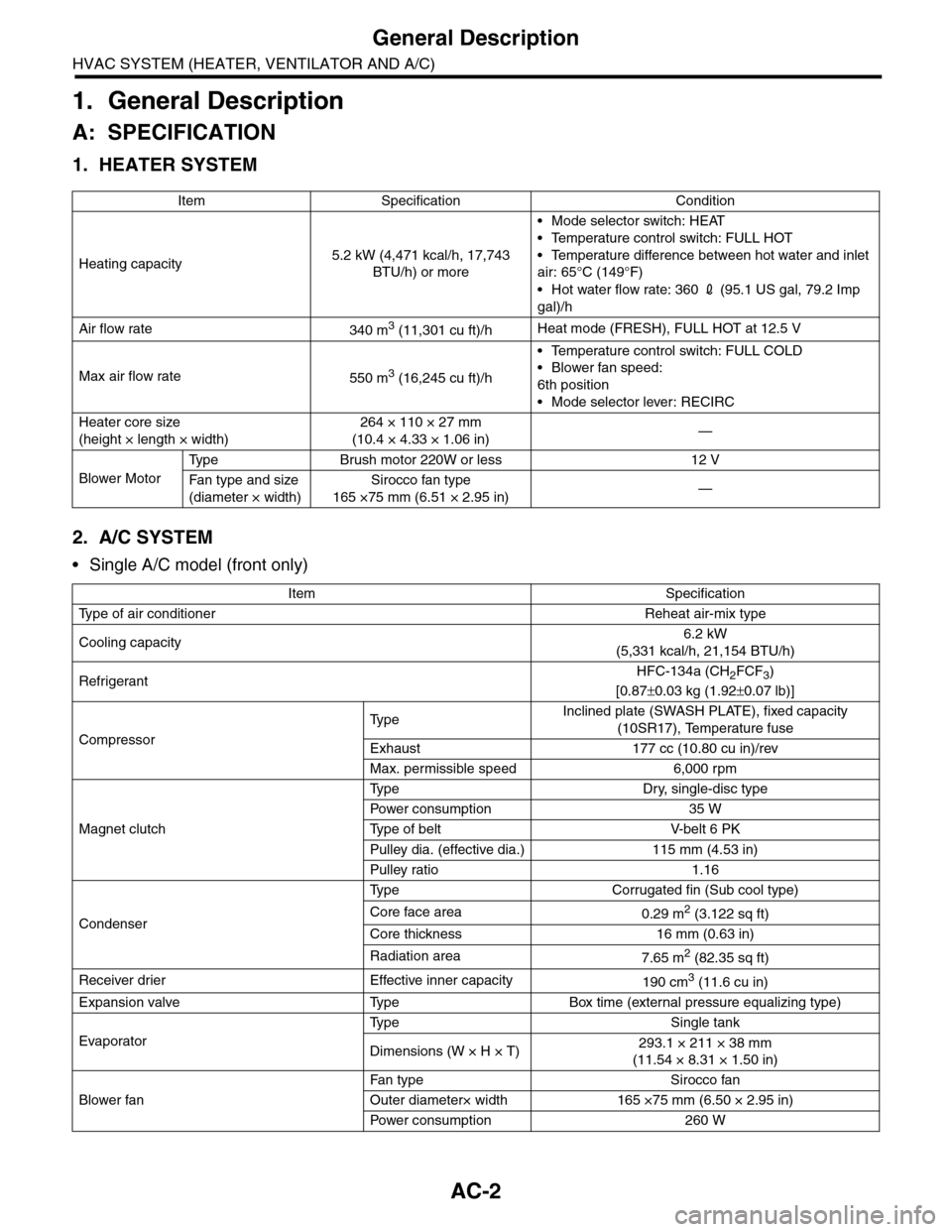
1. General Description
A: SPECIFICATION
1. HEATER SYSTEM
2. A/C SYSTEM
•Single A/C model (front only)
Item Specification Condition
Heating capacity5.2 kW (4,471 kcal/h, 17,743
BTU/h) or more
•Mode selector switch: HEAT
•Temperature control switch: FULL HOT
•Temperature difference between hot water and inlet
air: 65°C (149°F)
•Hot water flow rate: 360 2 (95.1 US gal, 79.2 Imp
gal)/h
Air flow rate340 m3 (11,301 cu ft)/hHeat mode (FRESH), FULL HOT at 12.5 V
Max air flow rate550 m3 (16,245 cu ft)/h
•Temperature control switch: FULL COLD
•Blower fan speed:
6th position
•Mode selector lever: RECIRC
Heater core size
(height × length × width)
264 × 110 × 27 mm
(10.4 × 4.33 × 1.06 in)—
Blower Motor
Ty p e B r u s h m o t o r 2 2 0 W o r l e s s 1 2 V
Fa n t y pe an d si ze
(diameter × width)
Sirocco fan type
165 ×75 mm (6.51 × 2.95 in)—
Item Specification
Ty p e o f a i r c o n d i t i o n e r R e h e a t a i r - m i x t y p e
Cooling capacity6.2 kW
(5,331 kcal/h, 21,154 BTU/h)
RefrigerantHFC-134a (CH2FCF3)
[0.87±0.03 kg (1.92±0.07 lb)]
Compressor
Ty p eInclined plate (SWASH PLATE), fixed capacity
(10SR17), Temperature fuse
Exhaust 177 cc (10.80 cu in)/rev
Max. permissible speed 6,000 rpm
Magnet clutch
Ty p e D r y, s i n g l e - d i s c t y p e
Powe r c on su mp t i on 35 W
Ty p e o f b e l t V- b e l t 6 P K
Pulley dia. (effective dia.) 115 mm (4.53 in)
Pulley ratio 1.16
Condenser
Ty p e C o r r u g a t e d f i n ( S u b c o o l t y p e )
Core face area0.29 m2 (3.122 sq ft)
Core thickness 16 mm (0.63 in)
Radiation area7.65 m2 (82.35 sq ft)
Receiver drier Effective inner capacity190 cm3 (11.6 cu in)
Expansion valve Type Box time (external pressure equalizing type)
Evaporator
Ty p e S i n g l e t a n k
Dimensions (W × H × T)293.1 × 211 × 38 mm
(11.54 × 8.31 × 1.50 in)
Blower fan
Fan t yp e S i r oc co fa n
Outer diameter× width 165 ×75 mm (6.50 × 2.95 in)
Powe r c on su mp t i on 2 60 W
Page 330 of 2453
AC-4
General Description
HVAC SYSTEM (HEATER, VENTILATOR AND A/C)
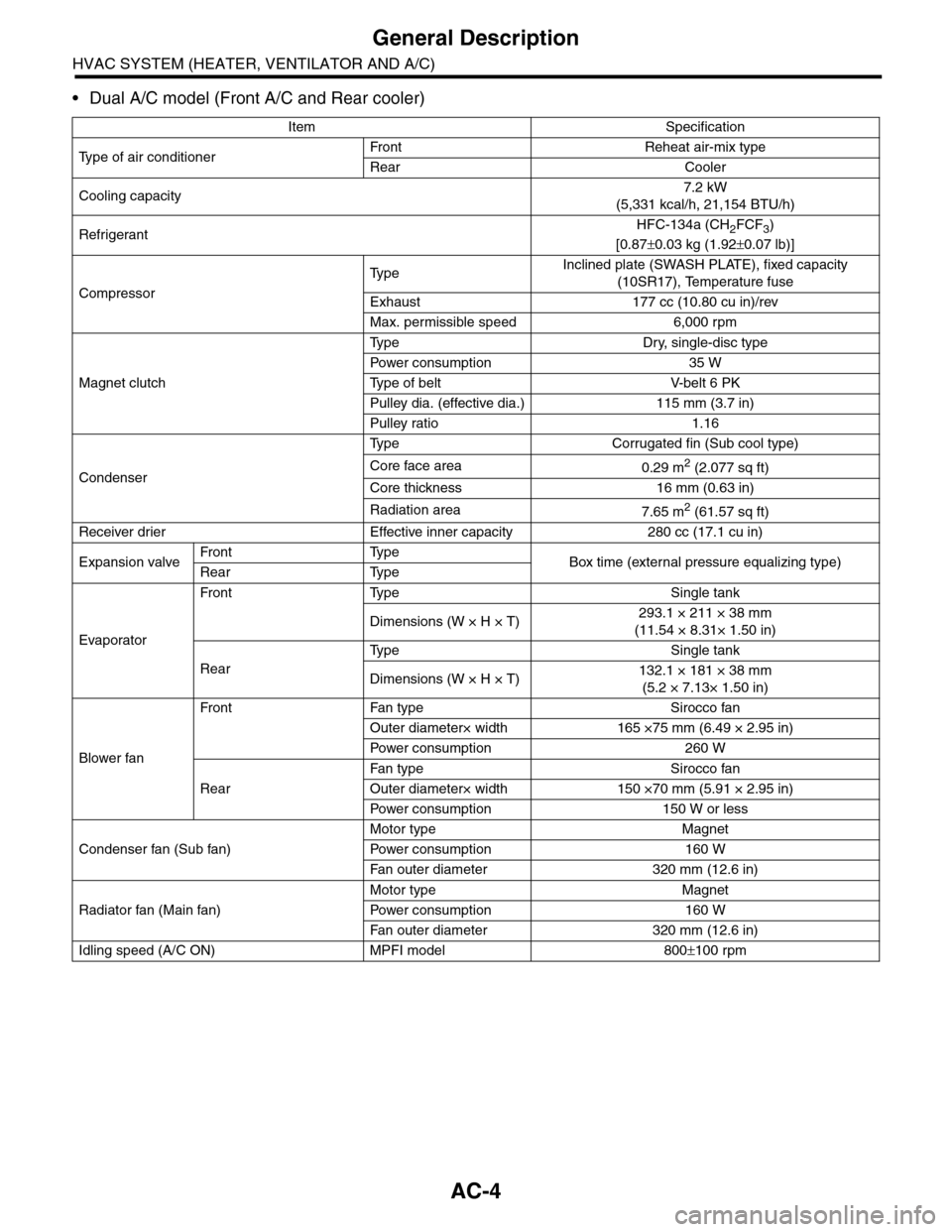
•Dual A/C model (Front A/C and Rear cooler)
Item Specification
Ty p e o f a i r c o n d i t i o n e rFr o nt Reh e at a ir - mi x t y pe
Rear Cooler
Cooling capacity7.2 kW
(5,331 kcal/h, 21,154 BTU/h)
RefrigerantHFC-134a (CH2FCF3)
[0.87±0.03 kg (1.92±0.07 lb)]
Compressor
Ty p eInclined plate (SWASH PLATE), fixed capacity
(10SR17), Temperature fuse
Exhaust 177 cc (10.80 cu in)/rev
Max. permissible speed 6,000 rpm
Magnet clutch
Ty p e D r y, s i n g l e - d i s c t y p e
Powe r c on su mp t i on 35 W
Ty p e o f b e l t V- b e l t 6 P K
Pulley dia. (effective dia.) 115 mm (3.7 in)
Pulley ratio 1.16
Condenser
Ty p e C o r r u g a t e d f i n ( S u b c o o l t y p e )
Core face area0.29 m2 (2.077 sq ft)
Core thickness 16 mm (0.63 in)
Radiation area7.65 m2 (61.57 sq ft)
Receiver drier Effective inner capacity 280 cc (17.1 cu in)
Expansion valveFront TypeBox time (external pressure equalizing type)Rear Type
Evaporator
Front Type Single tank
Dimensions (W × H × T)293.1 × 211 × 38 mm
(11.54 × 8.31× 1.50 in)
Rear
Ty p e S i n g l e t a n k
Dimensions (W × H × T)132.1 × 181 × 38 mm
(5.2 × 7.13× 1.50 in)
Blower fan
Front Fan type Sirocco fan
Outer diameter× width 165 ×75 mm (6.49 × 2.95 in)
Powe r c on su mp t i on 2 60 W
Rear
Fan t yp e S i r oc co fa n
Outer diameter× width 150 ×70 mm (5.91 × 2.95 in)
Powe r c on su mp t i on 1 5 0 W or l es s
Condenser fan (Sub fan)
Motor type Magnet
Powe r c on su mp t i on 1 60 W
Fan o ut e r d i am et e r 3 20 mm (1 2 . 6 i n)
Radiator fan (Main fan)
Motor type Magnet
Powe r c on su mp t i on 1 60 W
Fan o ut e r d i am et e r 3 20 mm (1 2 . 6 i n)
Idling speed (A/C ON) MPFI model 800±100 rpm
Page 798 of 2453
DI-14
Rear Differential (VA–type)
DIFFERENTIALS
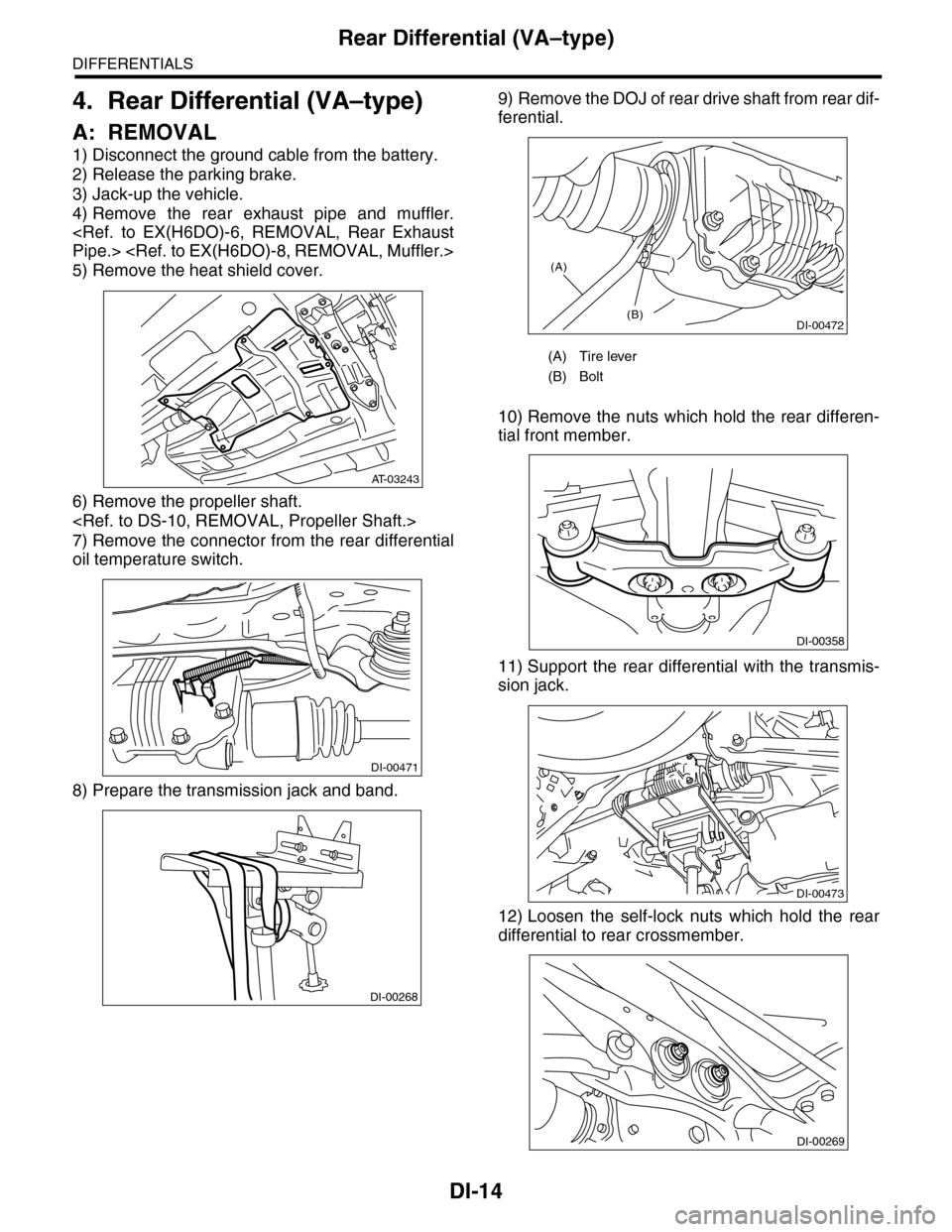
4. Rear Differential (VA–type)
A: REMOVAL
1) Disconnect the ground cable from the battery.
2) Release the parking brake.
3) Jack-up the vehicle.
4) Remove the rear exhaust pipe and muffler.
5) Remove the heat shield cover.
6) Remove the propeller shaft.
7) Remove the connector from the rear differential
oil temperature switch.
8) Prepare the transmission jack and band.
9) Remove the DOJ of rear drive shaft from rear dif-
ferential.
10) Remove the nuts which hold the rear differen-
tial front member.
11) Support the rear differential with the transmis-
sion jack.
12) Loosen the self-lock nuts which hold the rear
differential to rear crossmember.
AT-03243
DI-00471
DI-00268
(A) Tire lever
(B) Bolt
DI-00472
(A)
(B)
DI-00358
DI-00473
DI-00269
Page 801 of 2453
DI-17
Rear Differential (VA–type)
DIFFERENTIALS
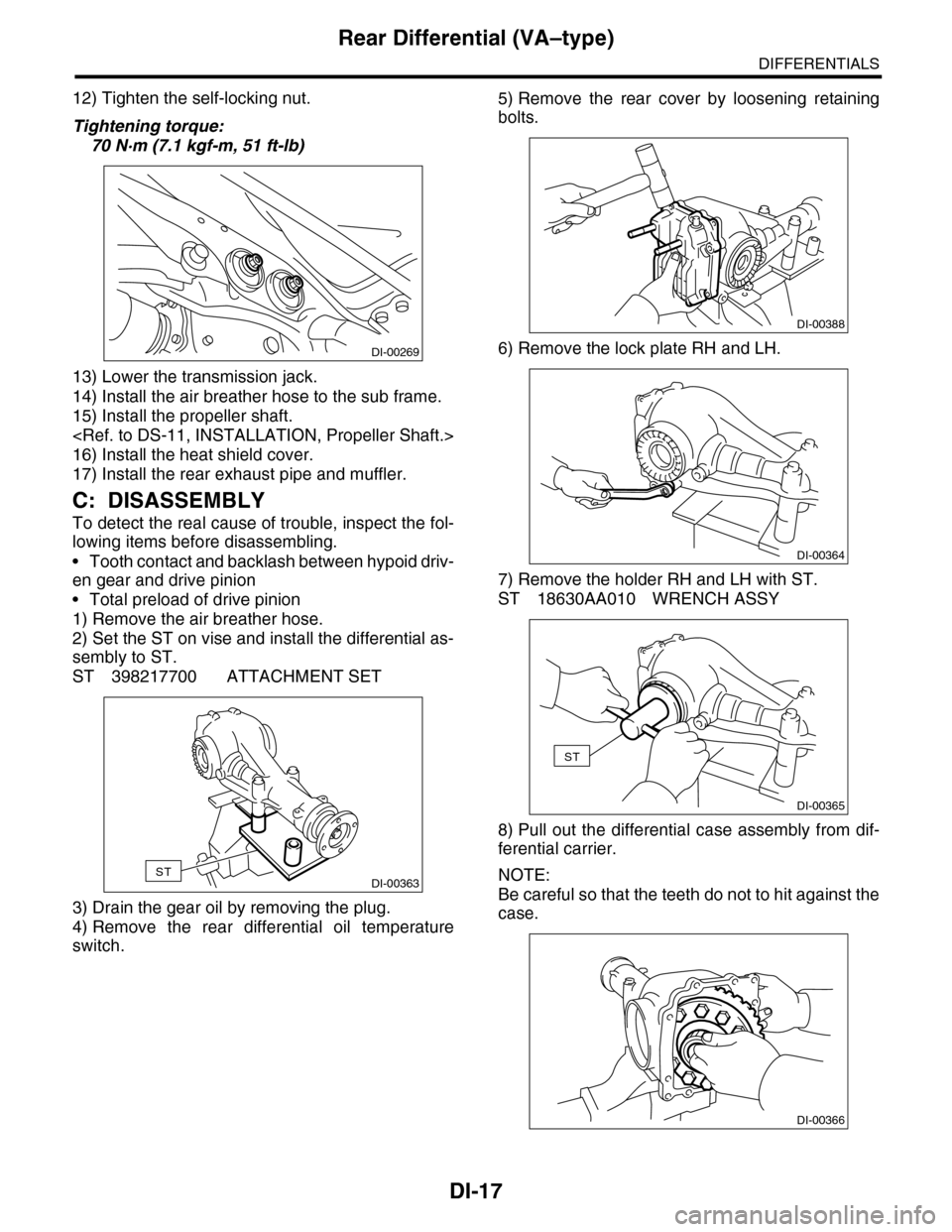
12) Tighten the self-locking nut.
Tightening torque:
70 N·m (7.1 kgf-m, 51 ft-lb)
13) Lower the transmission jack.
14) Install the air breather hose to the sub frame.
15) Install the propeller shaft.
16) Install the heat shield cover.
17) Install the rear exhaust pipe and muffler.
C: DISASSEMBLY
To detect the real cause of trouble, inspect the fol-
lowing items before disassembling.
•Tooth contact and backlash between hypoid driv-
en gear and drive pinion
•Total preload of drive pinion
1) Remove the air breather hose.
2) Set the ST on vise and install the differential as-
sembly to ST.
ST 398217700 ATTACHMENT SET
3) Drain the gear oil by removing the plug.
4) Remove the rear differential oil temperature
switch.
5) Remove the rear cover by loosening retaining
bolts.
6) Remove the lock plate RH and LH.
7) Remove the holder RH and LH with ST.
ST 18630AA010 WRENCH ASSY
8) Pull out the differential case assembly from dif-
ferential carrier.
NOTE:
Be careful so that the teeth do not to hit against the
case.
DI-00269
STDI-00363
DI-00388
DI-00364
ST
DI-00365
DI-00366
Page 814 of 2453
DI-30
Rear Differential Front Oil Seal
DIFFERENTIALS
5. Rear Differential Front Oil
Seal
A: INSPECTION
Make sure that there is no leakage from front oil
seal portion. If there is any leakage replace the oil
seal and inspect the propeller shaft.
B: REPLACEMENT
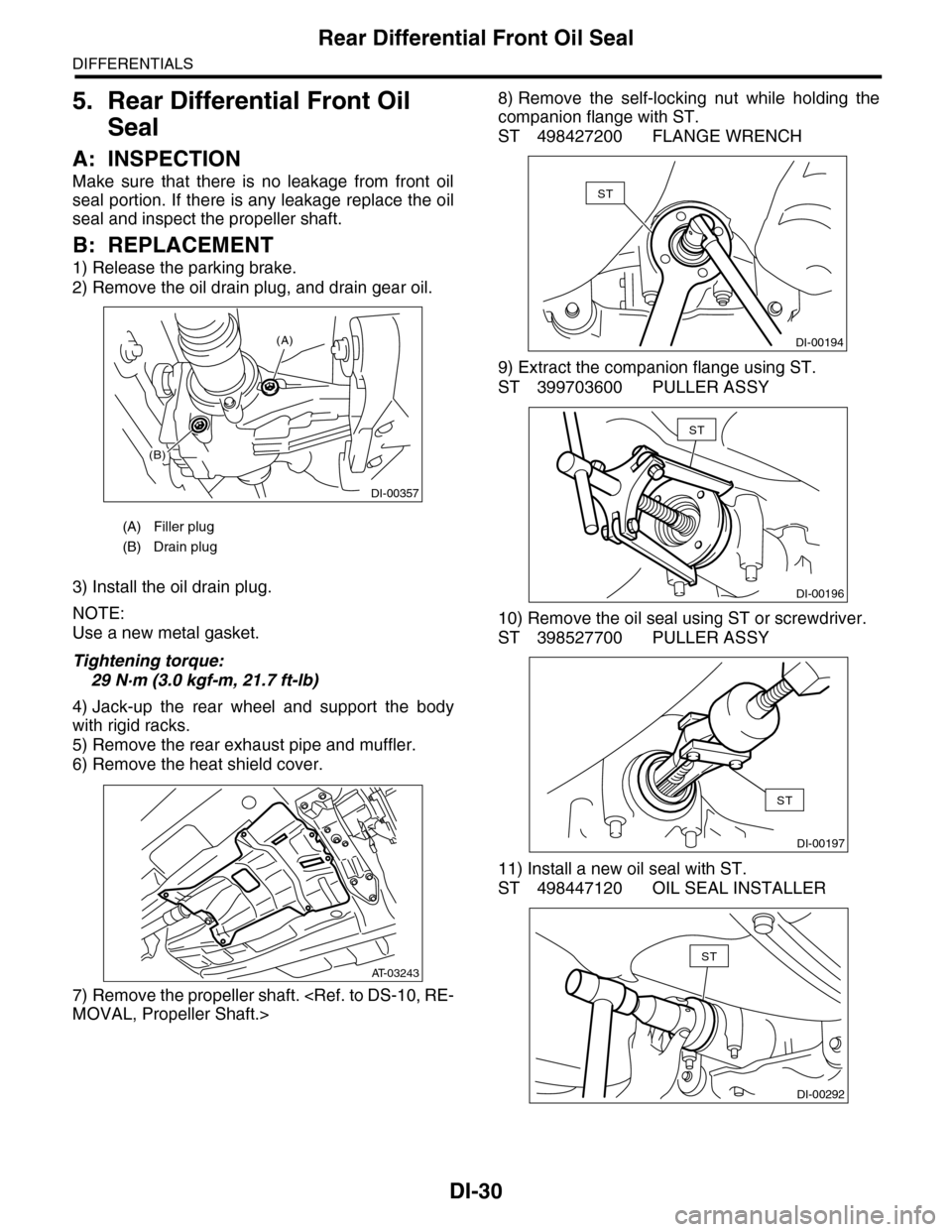
1) Release the parking brake.
2) Remove the oil drain plug, and drain gear oil.
3) Install the oil drain plug.
NOTE:
Use a new metal gasket.
Tightening torque:
29 N·m (3.0 kgf-m, 21.7 ft-lb)
4) Jack-up the rear wheel and support the body
with rigid racks.
5) Remove the rear exhaust pipe and muffler.
6) Remove the heat shield cover.
7) Remove the propeller shaft.
8) Remove the self-locking nut while holding the
companion flange with ST.
ST 498427200 FLANGE WRENCH
9) Extract the companion flange using ST.
ST 399703600 PULLER ASSY
10) Remove the oil seal using ST or screwdriver.
ST 398527700 PULLER ASSY
11) Install a new oil seal with ST.
ST 498447120 OIL SEAL INSTALLER
(A) Filler plug
(B) Drain plug
(A)
DI-00357
(B)
AT-03243
DI-00194
ST
DI-00196
ST
DI-00197
ST
DI-00292
ST
Page 827 of 2453
DS-10
Propeller Shaft
DRIVE SHAFT SYSTEM
2. Propeller Shaft
A: REMOVAL
NOTE:
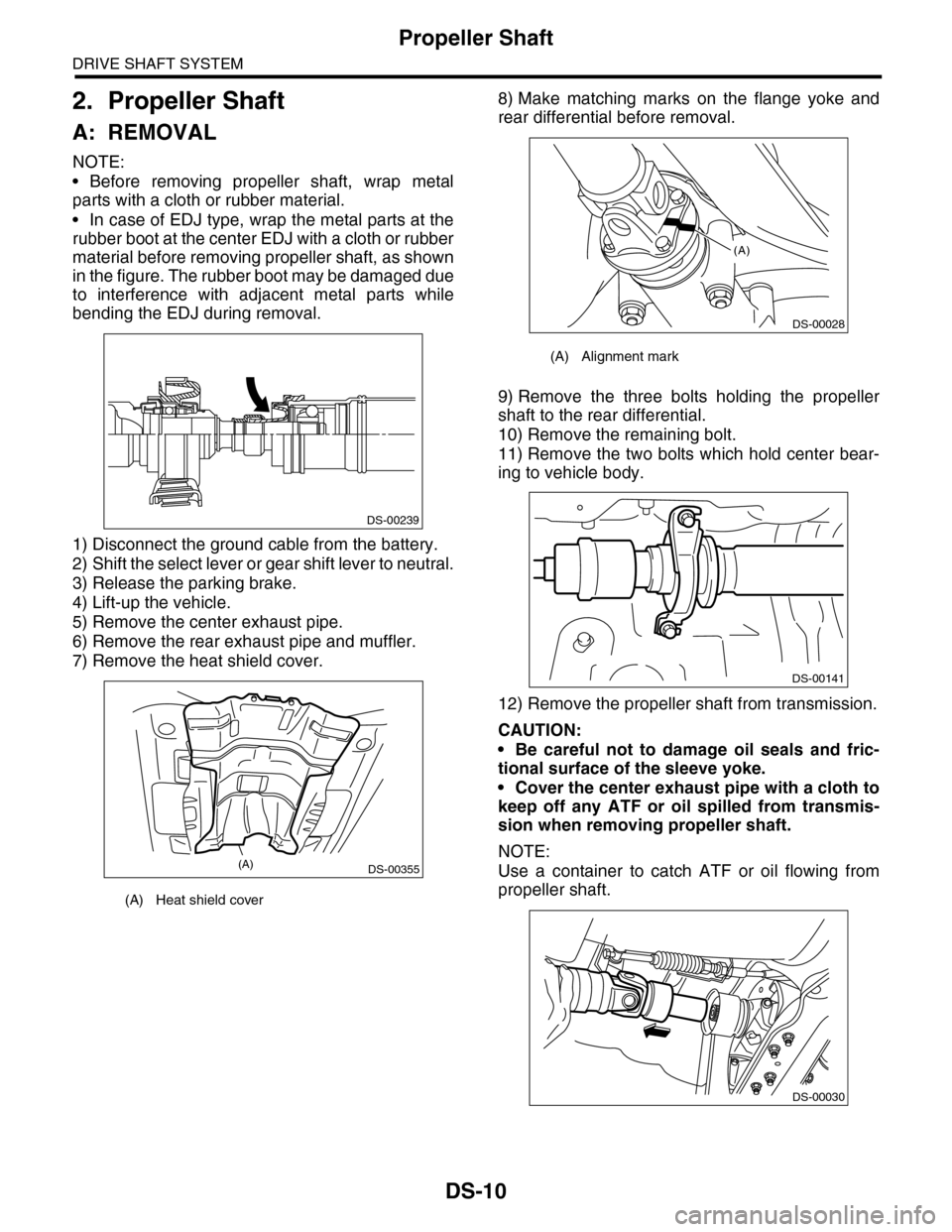
•Before removing propeller shaft, wrap metal
parts with a cloth or rubber material.
•In case of EDJ type, wrap the metal parts at the
rubber boot at the center EDJ with a cloth or rubber
material before removing propeller shaft, as shown
in the figure. The rubber boot may be damaged due
to interference with adjacent metal parts while
bending the EDJ during removal.
1) Disconnect the ground cable from the battery.
2) Shift the select lever or gear shift lever to neutral.
3) Release the parking brake.
4) Lift-up the vehicle.
5) Remove the center exhaust pipe.
6) Remove the rear exhaust pipe and muffler.
7) Remove the heat shield cover.
8) Make matching marks on the flange yoke and
rear differential before removal.
9) Remove the three bolts holding the propeller
shaft to the rear differential.
10) Remove the remaining bolt.
11) Remove the two bolts which hold center bear-
ing to vehicle body.
12) Remove the propeller shaft from transmission.
CAUTION:
•Be careful not to damage oil seals and fric-
tional surface of the sleeve yoke.
•Cover the center exhaust pipe with a cloth to
keep off any ATF or oil spilled from transmis-
sion when removing propeller shaft.
NOTE:
Use a container to catch ATF or oil flowing from
propeller shaft.(A) Heat shield cover
DS-00239
DS-00355(A)
(A) Alignment mark
DS-00028
(A)
DS-00141
DS-00030
Page 828 of 2453
DS-11
Propeller Shaft
DRIVE SHAFT SYSTEM
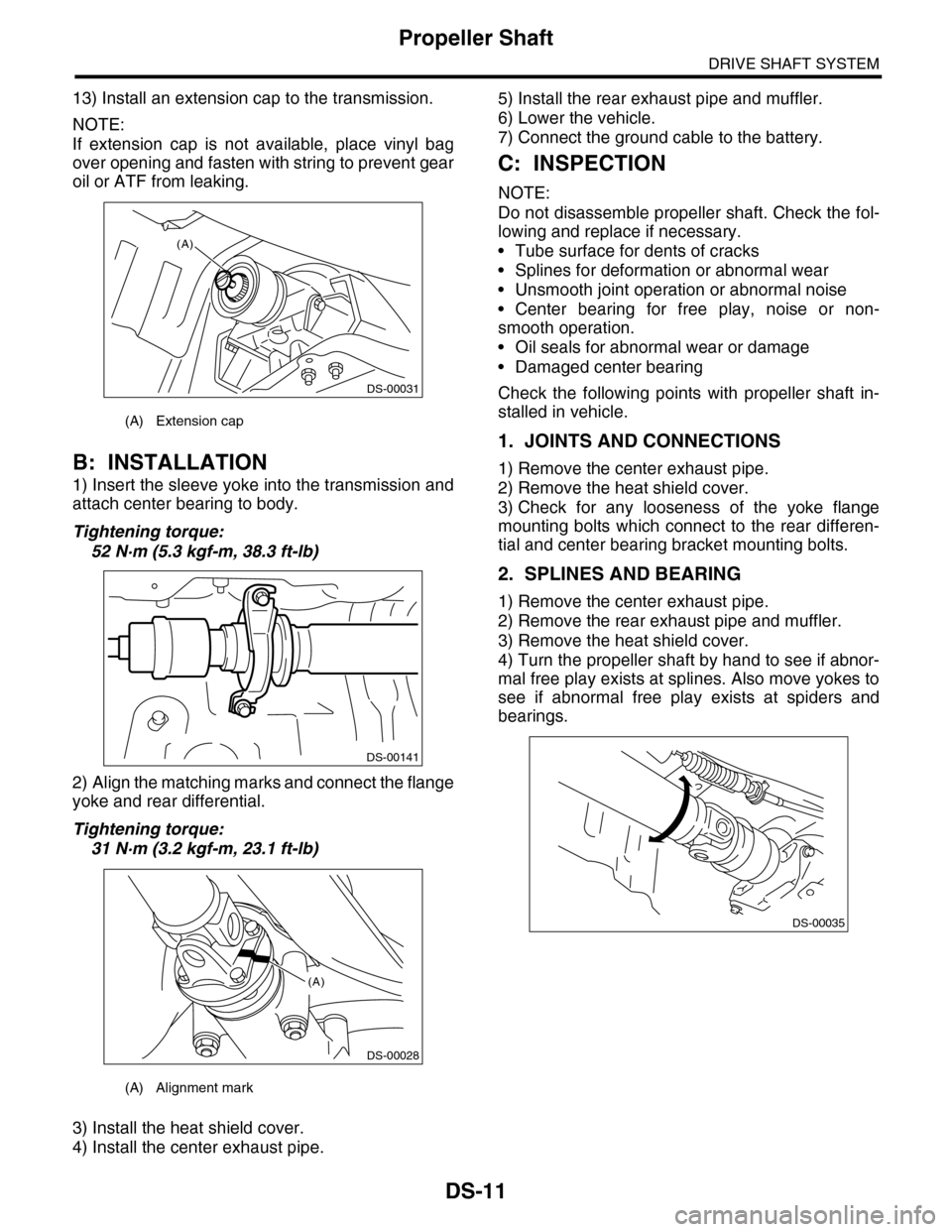
13) Install an extension cap to the transmission.
NOTE:
If extension cap is not available, place vinyl bag
over opening and fasten with string to prevent gear
oil or ATF from leaking.
B: INSTALLATION
1) Insert the sleeve yoke into the transmission and
attach center bearing to body.
Tightening torque:
52 N·m (5.3 kgf-m, 38.3 ft-lb)
2) Align the matching marks and connect the flange
yoke and rear differential.
Tightening torque:
31 N·m (3.2 kgf-m, 23.1 ft-lb)
3) Install the heat shield cover.
4) Install the center exhaust pipe.
5) Install the rear exhaust pipe and muffler.
6) Lower the vehicle.
7) Connect the ground cable to the battery.
C: INSPECTION
NOTE:
Do not disassemble propeller shaft. Check the fol-
lowing and replace if necessary.
•Tube surface for dents of cracks
•Splines for deformation or abnormal wear
•Unsmooth joint operation or abnormal noise
•Center bearing for free play, noise or non-
smooth operation.
•Oil seals for abnormal wear or damage
•Damaged center bearing
Check the following points with propeller shaft in-
stalled in vehicle.
1. JOINTS AND CONNECTIONS
1) Remove the center exhaust pipe.
2) Remove the heat shield cover.
3) Check for any looseness of the yoke flange
mounting bolts which connect to the rear differen-
tial and center bearing bracket mounting bolts.
2. SPLINES AND BEARING
1) Remove the center exhaust pipe.
2) Remove the rear exhaust pipe and muffler.
3) Remove the heat shield cover.
4) Turn the propeller shaft by hand to see if abnor-
mal free play exists at splines. Also move yokes to
see if abnormal free play exists at spiders and
bearings.
(A) Extension cap
(A) Alignment mark
DS-00031
(A)
DS-00141
DS-00028
(A)
DS-00035
Page 829 of 2453
DS-12
Propeller Shaft
DRIVE SHAFT SYSTEM
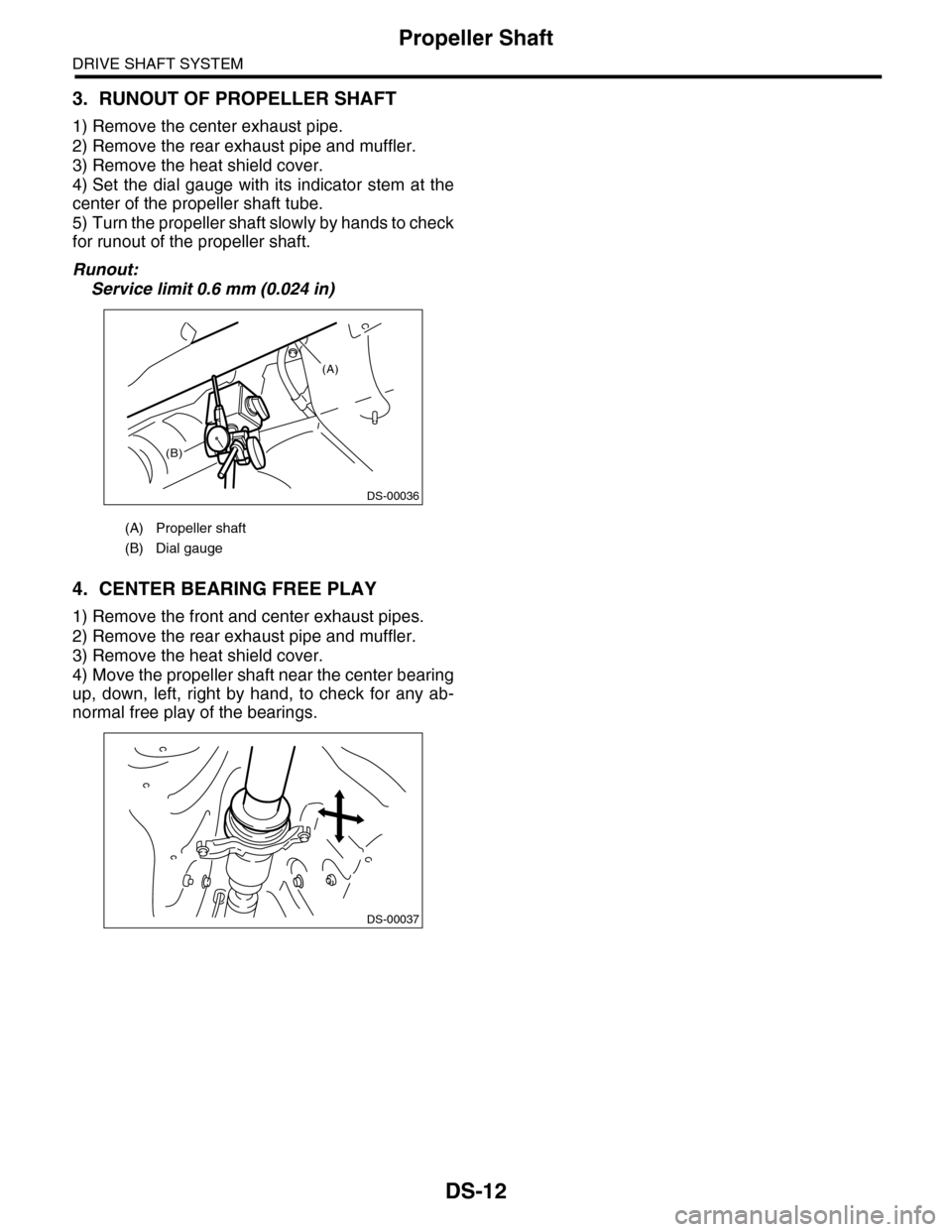
3. RUNOUT OF PROPELLER SHAFT
1) Remove the center exhaust pipe.
2) Remove the rear exhaust pipe and muffler.
3) Remove the heat shield cover.
4) Set the dial gauge with its indicator stem at the
center of the propeller shaft tube.
5) Turn the propeller shaft slowly by hands to check
for runout of the propeller shaft.
Runout:
Service limit 0.6 mm (0.024 in)
4. CENTER BEARING FREE PLAY
1) Remove the front and center exhaust pipes.
2) Remove the rear exhaust pipe and muffler.
3) Remove the heat shield cover.
4) Move the propeller shaft near the center bearing
up, down, left, right by hand, to check for any ab-
normal free play of the bearings.
(A) Propeller shaft
(B) Dial gauge
DS-00036
(B)
(A)
DS-00037
Page 871 of 2453
FS-23
Front Crossmember
FRONT SUSPENSION
8. Front Crossmember
A: REMOVAL
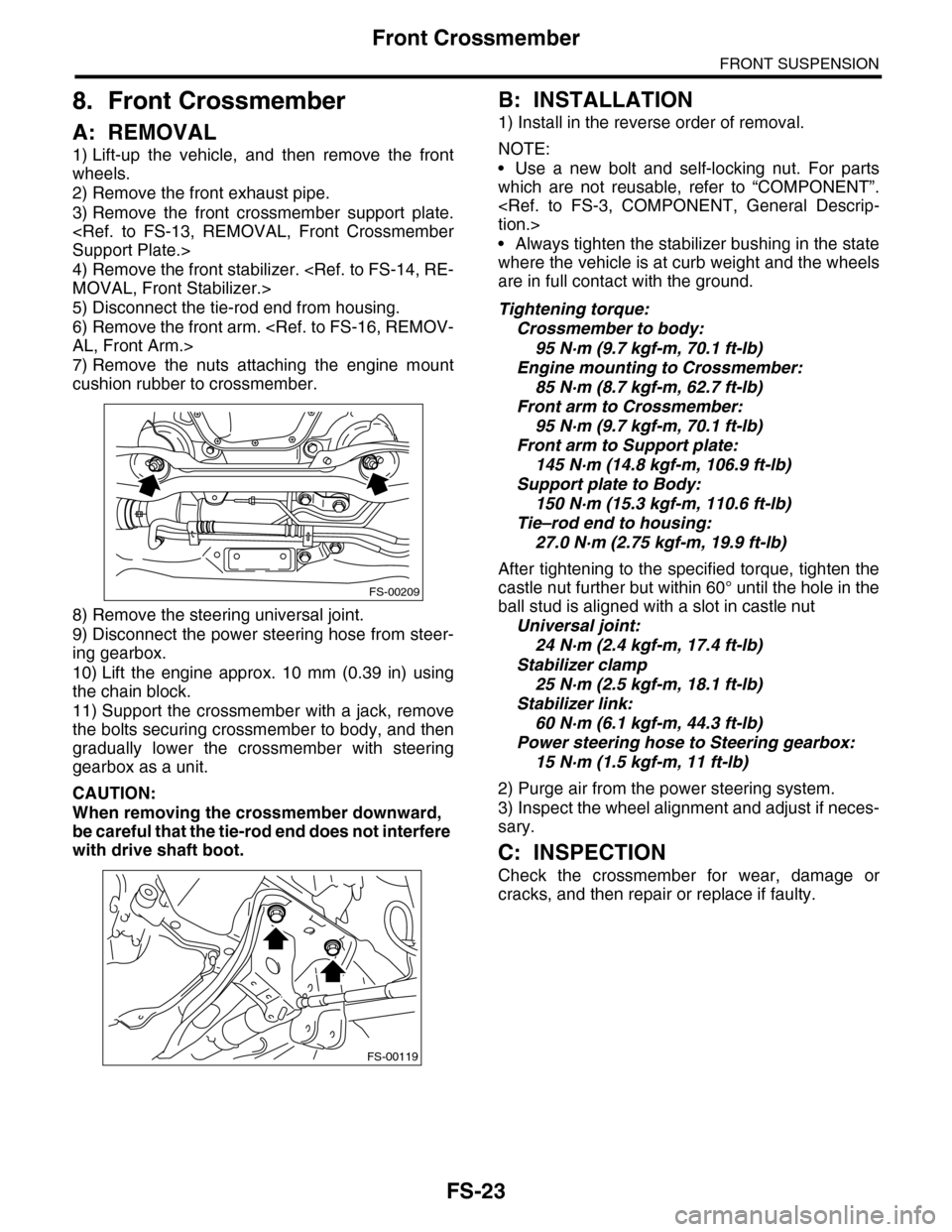
1) Lift-up the vehicle, and then remove the front
wheels.
2) Remove the front exhaust pipe.
3) Remove the front crossmember support plate.
4) Remove the front stabilizer.
5) Disconnect the tie-rod end from housing.
6) Remove the front arm.
7) Remove the nuts attaching the engine mount
cushion rubber to crossmember.
8) Remove the steering universal joint.
9) Disconnect the power steering hose from steer-
ing gearbox.
10) Lift the engine approx. 10 mm (0.39 in) using
the chain block.
11) Support the crossmember with a jack, remove
the bolts securing crossmember to body, and then
gradually lower the crossmember with steering
gearbox as a unit.
CAUTION:
When removing the crossmember downward,
be careful that the tie-rod end does not interfere
with drive shaft boot.
B: INSTALLATION
1) Install in the reverse order of removal.
NOTE:
•Use a new bolt and self-locking nut. For parts
which are not reusable, refer to “COMPONENT”.
•Always tighten the stabilizer bushing in the state
where the vehicle is at curb weight and the wheels
are in full contact with the ground.
Tightening torque:
Crossmember to body:
95 N·m (9.7 kgf-m, 70.1 ft-lb)
Engine mounting to Crossmember:
85 N·m (8.7 kgf-m, 62.7 ft-lb)
Front arm to Crossmember:
95 N·m (9.7 kgf-m, 70.1 ft-lb)
Front arm to Support plate:
145 N·m (14.8 kgf-m, 106.9 ft-lb)
Support plate to Body:
150 N·m (15.3 kgf-m, 110.6 ft-lb)
Tie–rod end to housing:
27.0 N·m (2.75 kgf-m, 19.9 ft-lb)
After tightening to the specified torque, tighten the
castle nut further but within 60° until the hole in the
ball stud is aligned with a slot in castle nut
Universal joint:
24 N·m (2.4 kgf-m, 17.4 ft-lb)
Stabilizer clamp
25 N·m (2.5 kgf-m, 18.1 ft-lb)
Stabilizer link:
60 N·m (6.1 kgf-m, 44.3 ft-lb)
Power steering hose to Steering gearbox:
15 N·m (1.5 kgf-m, 11 ft-lb)
2) Purge air from the power steering system.
3) Inspect the wheel alignment and adjust if neces-
sary.
C: INSPECTION
Check the crossmember for wear, damage or
cracks, and then repair or replace if faulty.
FS-00209
FS-00119