fuel cap SUBARU WRX 2016 User Guide
[x] Cancel search | Manufacturer: SUBARU, Model Year: 2016, Model line: WRX, Model: SUBARU WRX 2016Pages: 594, PDF Size: 19.43 MB
Page 502 of 594
Engine oil CAUTION. If the level gauge is not pulled out
easily, twist the level gauge right
and left, then pull it out. Other-
wise, you may be injured acci-
dentally straining yourself.
. Use only engine oil with the
recommended grade and vis-
cosity.
. Be careful not to spill engine oil
when adding it. If oil touches the
exhaust pipe, it may cause a bad
smell, smoke, and/or a fire. If
engine oil gets on the exhaust
pipe, be sure to wipe it off.
& Engine oil consumption Some engine oil will be consumed while
driving. Under the following conditions, oil
consumption can be increased and thus
require refilling between maintenance
intervals:
. When the engine is new and within the
break-in period
. When the engine oil is of lower quality
. When the incorrect oil viscosity is used . When engine braking is employed
. When the engine is operated at high
engine speeds
. When the engine is operated under
heavy loads
. When the engine idles for long periods
of time
. When the vehicle is operated in stop
and go and/or heavy traffic situations
. When the vehicle is used under severe
thermal conditions
. When the vehicle accelerates and
decelerates frequently
Under these or similar conditions, you
should check your oil at least every 2nd
fuel fill-up and change your engine oil
more frequently. If your oil consumption
rate is greater than 1 quart every 1,200
miles or 1 liter every 2,000 kilometers,
contact your SUBARU dealer who may
perform a test under controlled conditions.
& Checking the oil level 1. Park the vehicle on a level surface and
stop the engine. If you check the oil level
just after stopping the engine, wait a few
minutes for the oil to drain back into the oil
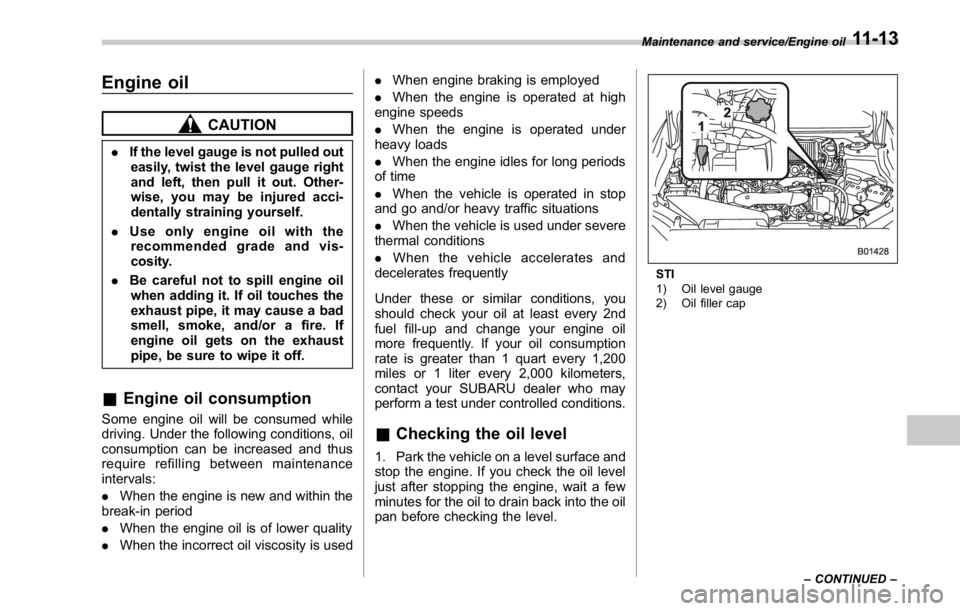
pan before checking the level. STI
1) Oil level gauge
2) Oil filler capMaintenance and service/Engine oil
– CONTINUED –11-13
Page 505 of 594
Maintenance and service/Engine oil
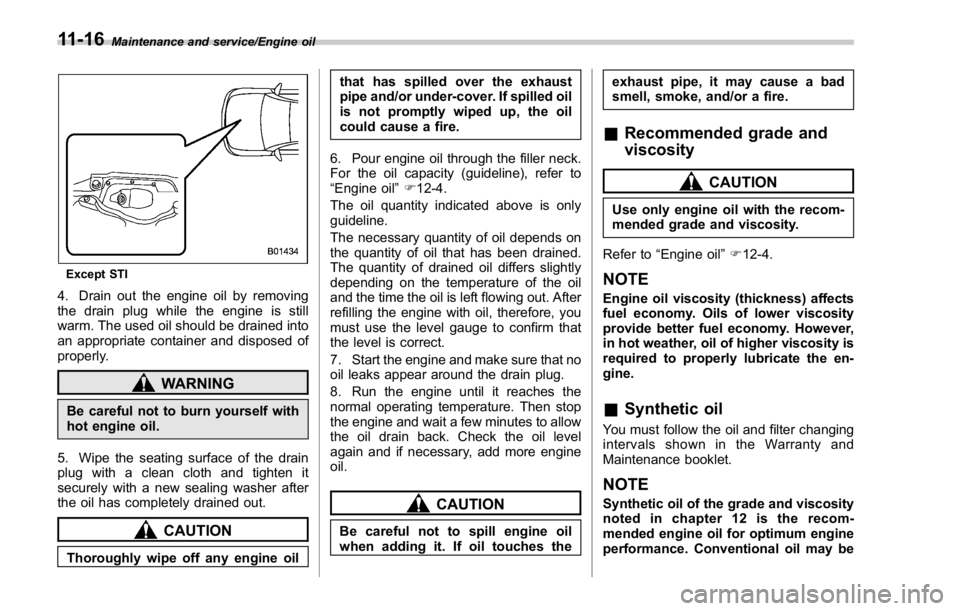
Except STI
4. Drain out the engine oil by removing
the drain plug while the engine is still
warm. The used oil should be drained into
an appropriate container and disposed of
properly.
WARNING
Be careful not to burn yourself with
hot engine oil.
5. Wipe the seating surface of the drain
plug with a clean cloth and tighten it
securely with a new sealing washer after
the oil has completely drained out.
CAUTION
Thoroughly wipe off any engine oil that has spilled over the exhaust
pipe and/or under-cover. If spilled oil
is not promptly wiped up, the oil
could cause a fire.
6. Pour engine oil through the filler neck.
For the oil capacity (guideline), refer to
“ Engine oil ” F 12-4.
The oil quantity indicated above is only
guideline.
The necessary quantity of oil depends on
the quantity of oil that has been drained.
The quantity of drained oil differs slightly
depending on the temperature of the oil
and the time the oil is left flowing out. After
refilling the engine with oil, therefore, you
must use the level gauge to confirm that
the level is correct.
7. Start the engine and make sure that no
oil leaks appear around the drain plug.
8. Run the engine until it reaches the
normal operating temperature. Then stop
the engine and wait a few minutes to allow
the oil drain back. Check the oil level
again and if necessary, add more engine
oil.
CAUTION
Be careful not to spill engine oil
when adding it. If oil touches the exhaust pipe, it may cause a bad
smell, smoke, and/or a fire.
& Recommended grade and
viscosity CAUTIONUse only engine oil with the recom-
mended grade and viscosity.
Refer to “ Engine oil ” F 12-4.
NOTE Engine oil viscosity (thickness) affects
fuel economy. Oils of lower viscosity
provide better fuel economy. However,
in hot weather, oil of higher viscosity is
required to properly lubricate the en-
gine.
& Synthetic oil You must follow the oil and filter changing
intervals shown in the Warranty and
Maintenance booklet.
NOTE Synthetic oil of the grade and viscosity
noted in chapter 12 is the recom-
mended engine oil for optimum engine
performance. Conventional oil may be11-16
Page 507 of 594
Maintenance and service/Cooling system
Check the fuse and replace it if necessary.
Refer to “ Fuses ” F 11-42 and “ Fuses and
circuits ” F 12-10.
If the fuse is not blown, have the cooling
system checked by your SUBARU dealer.
If frequent addition of coolant is neces-
sary, there may be a leak in the engine
cooling system. It is recommended that
the cooling system and connections be
checked for leaks, damage, or looseness.
& Engine coolant! Checking the coolant level
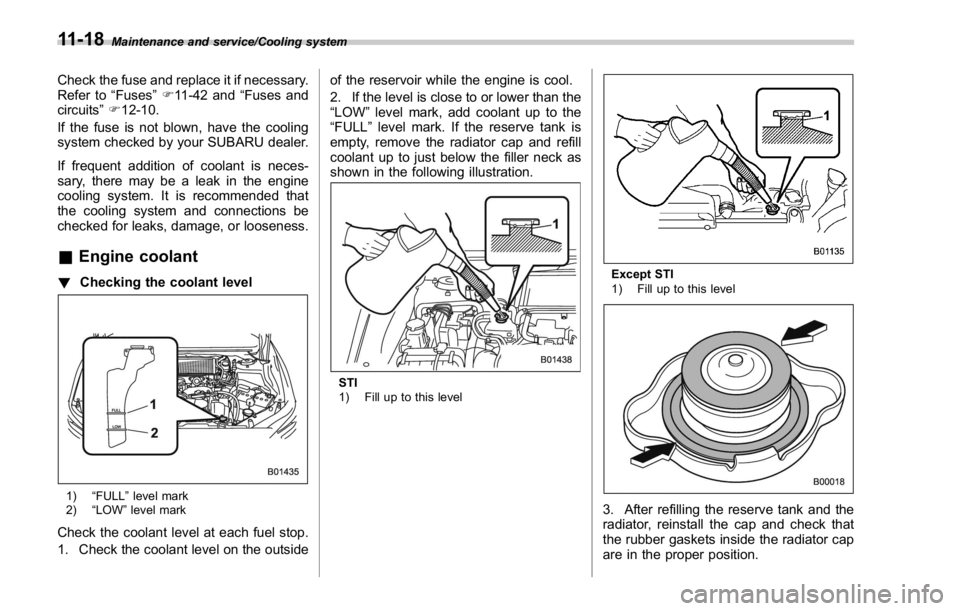
1) “ FULL ” level mark
2) “ LOW ” level mark
Check the coolant level at each fuel stop.
1. Check the coolant level on the outside of the reservoir while the engine is cool.
2. If the level is close to or lower than the
“ LOW ” level mark, add coolant up to the
“ FULL ” level mark. If the reserve tank is
empty, remove the radiator cap and refill
coolant up to just below the filler neck as
shown in the following illustration.
STI
1) Fill up to this level Except STI
1) Fill up to this level
3. After refilling the reserve tank and the
radiator, reinstall the cap and check that
the rubber gaskets inside the radiator cap
are in the proper position.11-18
Page 544 of 594

& Engine Model
STI Except STI
Engine model EJ257
(2.5 L, DOHC, turbo) FA20
(2.0 L, DOHC, turbo)
Engine type Horizontally opposed, liquid cooled 4 cylinder, 4-stroke petrol engine
Displacement cu-in (cc) 150 (2,457) 122 (1,998)
Bore 6 Stroke in (mm) 3.92 6 3.11 (99.5 6 79.0) 3.39 6 3.39 (86.0 6 86.0)
Compression ratio 8.2 : 1 10.6 : 1
Firing order 1 – 3 – 2 – 4
& Fuel
NOTE The engine is designed to operate using unleaded gasoline.
Model Fuel Fuel tank capacity
STI
93 AKI (98 RON) or higher * 1
15.9 US gal (60 liters, 13.2 Imp gal)
Except STI
91 AKI (95 RON) or higher * 2
*1: If unleaded gasoline with an octane rating of 93 AKI (98 RON) is not available, unleaded gasoline with an octane rating of 91 AKI (95 RON) may be
used with no detriment to engine durability or driveability.
*2: If unleaded gasoline with an octane rating of 91 AKI (95 RON) is not available, unleaded gasoline with an octane rating of 87 AKI (90 RON) or higher
may be used. Specifications/Specifications
– CONTINUED –12-3
Page 546 of 594
! Alternative engine oil
If the SUBARU approved oil is unavailable, the following alternative oil can be used.
NOTE . Each quantity indicated here is only a guideline. The necessary quantity for replacement may differ slightly depending on
the temperature and other factors.
. In choosing an oil, you want the proper quality and viscosity, as well as one that will enhance fuel economy. Oils of lower
viscosity provide better fuel economy. However, in hot weather, oil of higher viscosity is required to properly lubricate the
engine. The following table lists the recommended viscosities and applicable temperatures.
. When adding oil, different brands may be used together as long as they are the same API classification and SAE viscosity
as those recommended by SUBARU.
Oil grade SAE viscosity No. and
applicable temperature Engine oil capacity
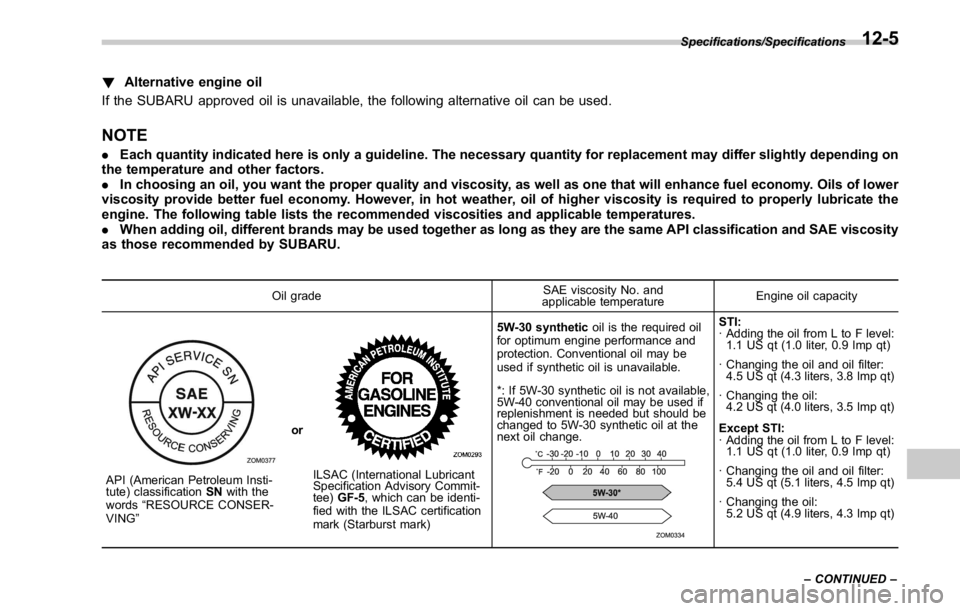
API (American Petroleum Insti-
tute) classification SN with the
words “ RESOURCE CONSER-
VING ” or
ILSAC (International Lubricant
Specification Advisory Commit-
tee) GF-5 , which can be identi-
fied with the ILSAC certification
mark (Starburst mark) 5W-30 synthetic oil is the required oil
for optimum engine performance and
protection. Conventional oil may be
used if synthetic oil is unavailable.
*: If 5W-30 synthetic oil is not available,
5W-40 conventional oil may be used if
replenishment is needed but should be
changed to 5W-30 synthetic oil at the
next oil change. STI:
· Adding the oil from L to F level:
1.1 US qt (1.0 liter, 0.9 Imp qt)
· Changing the oil and oil filter:
4.5 US qt (4.3 liters, 3.8 Imp qt)
· Changing the oil:
4.2 US qt (4.0 liters, 3.5 Imp qt)
Except STI:
· Adding the oil from L to F level:
1.1 US qt (1.0 liter, 0.9 Imp qt)
· Changing the oil and oil filter:
5.4 US qt (5.1 liters, 4.5 Imp qt)
· Changing the oil:
5.2 US qt (4.9 liters, 4.3 Imp qt)Specifications/Specifications
– CONTINUED –12-5
Page 548 of 594

*4: You may use this type of manual transmission oil. However, using this type of oil will detract from driveability and fuel efficiency.
& Fluids Fluid
Fluid type* 1
Fluid capacity* 2
Remarks* 3
Continuously variable transmission
fluid (CVT models) Consult your SUBARU dealer. 13.1 US qt (12.4 liters, 10.9 Imp qt) “ Continuously variable trans-
mission fluid ” F 11-23
Brake fluid FMVSS No. 116, fresh DOT 3 or DOT 4
brake fluid –“ Brake fluid ” F 11-25
Clutch fluid (MT models) FMVSS No. 116, fresh DOT 3 or DOT 4
brake fluid – “ Clutch fluid (MT models) ” F 11 -
26
Power steering fluid (STI) · SUBARU ATF
· “ Dexron III ” Type Automatic Transmis-
sion Fluid
· IDEMITSU ATF HP 0.7 US qt (0.7 liter, 0.6 Imp qt) “ Power steering fluid (STI) ”
F 11-24
*1: Use one of the indicated types of fluid.
*2: The indicated fluid quantity is only a guideline. The necessary quantity for replacement may differ slightly depending on the temperature and other
factors.
*3: For more details about maintenance and service, refer to the indicated section.
& Engine coolant Vehicle model Coolant capacity Coolant type
STI 8.2 US qt (7.7 liters, 6.8 Imp qt)
SUBARU Super Coolant
Except STI MT models 8.7 US qt (8.2 liters, 7.2 Imp qt)
CVT models 8.9 US qt (8.4 liters, 7.4 Imp qt)
The indicated coolant quantity is only a guideline. The necessary quantity for replacement may differ slightly depending on the temperature and other
factors. For more details about maintenance and service, refer to “ Cooling system ” F 11-17. Specifications/Specifications
– CONTINUED –12-7
Page 564 of 594

crease in temperature could cause
tread separation, and failure of the
tire(s). Possible resulting loss of
vehicle control could lead to an
accident. ! Measuring and adjusting air
pressure to achieve proper in-
flation
Check and, if necessary, adjust the
pressure of each tire (including the
spare) at least once a month and
before any long journey. Check the
tire pressures when the tires are
cold. Use a pressure gauge to
adjust the tire pressures to the
specific values. Driving even a
short distance warms up the tires
and increases the tire pressures.
Also, the tire pressures are affected
by the outside temperature. It is
best to check tire pressure out-
doors before driving the vehicle.
When a tire becomes warm, the air
inside it expands, causing the tire
pressure to increase. Be careful not
to mistakenly release air from a
warm tire to reduce its pressure. & Glossary of tire terminology .
Accessory weight
The combined weight (in excess of
those standard items which may be
replaced) of automatic transmis-
sion, power steering, power brakes,
power windows, power seats, radio,
and heater, to the extent that these
items are available as factory-in-
stalled equipment (whether in-
stalled or not). .
Bead
The part of the tire that is made of
steel wires, wrapped or reinforced
by ply cords and that is shaped to fit
the rim. .
Bead separation
A breakdown of the bond between
components in the bead. .
Bias ply tire
A pneumatic tire in which the ply
cords that extend to the beads are
laid at alternate angles substantially
less than 90 degrees to the center-
line of the tread.
.
Carcass
The tire structure, except tread and sidewall rubber which, when in-
flated, bears the load. .
Chunking
The breaking away of pieces of the
tread or sidewall. .
Cold tire pressure
The pressure in a tire that has been
driven less than 1 mile or has been
standing for three hours or more. .
Cord
The strands forming the plies in the
tire. .
Cord separation
The parting of cords from adjacent
rubber compounds. .
Cracking
Any parting within the tread, side-
wall, or inner liner of the tire
extending to cord material. .
Curb weight
The weight of a motor vehicle with
standard equipment including the
maximum capacity of fuel, oil and
coolant, and if so equipped, air
conditioning and additional weight
optional engine.Consumer information and Reporting safety defects/Tire information
– CONTINUED –13-5
Page 580 of 594

Warning ........................................................ 3-22, 7-48
Emergency Locking Retractor (ELR) ............................. 1-13
Engine
Compartment overview .......................................... 11-11
Coolant ........................................................ 11-18, 12-7
Exhaust gas (carbon monoxide) ............................. 5, 8-2
Hood .................................................................... 11-9
Low oil level warning light ....................................... 3-17
Oil............................................................... 11-13, 12-4
Overheating .......................................................... 9-11
Starting & stopping ........................................... 7-9, 7-12
Event data recorder ......................................................... 8
Exterior care .............................................................. 10-2
F
Flat tires ..................................................................... 9-4
Floor mat .................................................................. 6-10
Fluid level
Brake .................................................................. 11-25
Clutch .................................................................. 11-26
Continuously variable transmission .......................... 11-23
Power steering ..................................................... 11-24
Fog light ................................................................... 3-99
Bulb .......................................................... 11-47, 12-16
Indicator light ......................................................... 3-35
Switch .................................................................. 3-99
Front
Differential gear oil ........................................ 11-23, 12-6
Fog light ...................................................... 3-99, 11-47
Fog light indicator light ............................................ 3-35
Seatbelt pretensioners ............................................ 1-17 Front fog light ............................................................. 3-99
Switch ................................................................... 3-99
Front seats ................................................................. 1-2
Forward and backward adjustment ............................ 1-4
Head restraint adjustment ......................................... 1-5
Power seat ............................................................. 1-5
Reclining ................................................................ 1-4
Seat height adjustment (driver ’ s seat) ........................ 1-4
Fuel ........................................................................... 7-3
Consumption indicator ..................................... 3-52, 3-54
Economy hints ........................................................ 8-2
Filler lid and cap ...................................................... 7-5
Gauge ................................................................... 3-10
Requirements ................................................. 7-3, 12-3
Fuses ..................................................................... 11-42
Fuses and circuits .................................................... 12-10
G
GAWR (Gross Axle Weight Rating) .. ............................. 8-12
Glove box ................................................................... 6-5
GVWR (Gross Vehicle Weight Rating) ........................... 8-12
H
Hazard warning flasher .......................................... 3-8, 9-2
Head restraint adjustment
Front seat ............................................................... 1-5
Rear
seat ............................................................... 1-8
Headlight
Beam leveler. ......................................................... 3-99
Bulb replacement ................................................. 11-44
Bulb replacing ...................................................... 11-44 Index
14-5
Page 586 of 594

Tires and wheels. ...................................................... 11-31
Tools .......................................................................... 9-3
Top tether anchorages ........................................ 1-29, 1-32
Towing ...................................................................... 9-12
All wheels on the ground ........................................ 9-15
Flat-bed truck ........................................................ 9-14
Hooks ................................................................... 9-12
Trailer
Towing .................................................................. 8-12
Trip meter ................................................................... 3-9
Trunk lid ................................................................... 2-36
Release handle ..................................................... 2-37
Turn signal
Indicator lights ....................................................... 3-35
Lever .................................................................... 3-97
U
Under-floor storage compartment ................................. 6-12
Useful information ...................................................... 5-28
STARLINK ............................................................ 5-30
V
Valet mode ................................................................ 2-30
Vanity mirror ................................................................ 6-4
Vehicle
Capacity weight ..................................................... 8-11
Identification ........................................................ 12-18
Symbols .................................................................... 3
Vehicle Dynamics Control
OFF indicator light .................................................. 3-27
OFF switch ........................................................... 7-40 Operation indicator light ........................................... 3-26
System .................................................................. 7-38
Warning light .......................................................... 3-26
Ventilator .................................................................... 4-2
Voice command system operation ... ........................... 5-107
Voice command system ........................................ 5-107
W
Warning and indicator lights ......................................... 3-13
Warning chimes
Keyless access with push-button start system .... ........ 3-28
Warning light
ABS...................................................................... 3-20
Access key .................................................... 3-28, 3-29
All-Wheel Drive ...................................................... 3-25
AT OIL TEMP ......................................................... 3-18
Automatic headlight beam leveler ............................. 3-35
Brake system ......................................................... 3-21
Charge .................................................................. 3-17
CHECK ENGINE .................................................... 3-16
Door open ............................................................. 3-25
Driver ’ s Control Center Differential ............................ 3-36
Engine low oil level ................................................. 3-17
Hill start assist ....................................................... 3-24
Keyless access with push-button start system .... ........ 3-28
Low fuel ................................................................ 3-24
Low tire pressure .................................................... 3-19
Oil pressure ...........................................................
3-17
Power steering ....................................................... 3-25
Rear differential oil temperature ................................ 3-18
Seatbelt. ................................................................ 3-14 Index
14-11
Page 593 of 594

GAS STATION REFERENCE
& Fuel:! STI
The engine is designed to operate at maximum performance
using unleaded gasoline with an octane rating of 93 AKI (98
RON) or higher . If 93 AKI (98 RON) fuel is not readily available
in your area, unleaded gasoline with an octane rating of 91 AKI
(95 RON) may be used with no detriment to engine durability or
driveability. However, you may notice a slight decrease in
maximum engine performance while using 91 AKI (95 RON)
fuel. Use of 91 AKI (95 RON) fuel will not affect your warranty
coverage.
! Except STI
Use unleaded gasoline with an octane rating of 91 AKI (95
RON) or higher . If 91 AKI (95 RON) fuel is not readily available,
unleaded gasoline with an octane rating of 87 AKI (90 RON)
may be used.
& Fuel octane rating:This octane rating is the average of the Research Octane and
Motor Octane numbers and is commonly referred to as the Anti
Knock Index (AKI). Refer to “ Fuel octane rating ” F 7-3.& Fuel capacity: 15.9 US gal (60 liters, 13.2 Imp gal)
& Engine oil: Use only the following oils.
. ILSAC GF-5, which can be identified with the ILSAC
certification mark (Starburst mark)
. or API classification SN with the words “ ENERGY CON-
SERVING ” or “ RESOURCE CONSERVING ”
For the complete viscosity requirements, refer to “ Engine oil ”
F 12-4.
& Engine oil capacity: ! STI
4.5 US qt (4.3 liters, 3.8 Imp qt)
! Except STI
5.4 US qt (5.1 liters, 4.5 Imp qt)
The indicated oil quantity is only a guideline and is estimated
based on a case when the engine oil is changed with an oil
filter. After refilling the engine with oil, the oil level should be
checked using an oil level gauge. For more details about
maintenance and service, refer to “ Engine oil ” F 11-13.
& Cold tire pressure: Refer to “ Tires ” F 12-8.