steering wheel SUBARU WRX 2016 User Guide
[x] Cancel search | Manufacturer: SUBARU, Model Year: 2016, Model line: WRX, Model: SUBARU WRX 2016Pages: 594, PDF Size: 19.43 MB
Page 76 of 594

The driver ’ s and front passenger ’ s SRS
frontal airbags use dual stage inflators.
The two inflators of each airbag are
triggered either sequentially or simulta-
neously, depending on the severity of
impact, in the case of the driver ’ s SRS
frontal airbag and depending on the
severity of impact and the characteristic
of item(s) or person on the seat in the case
of the front passenger ’ s SRS frontal
airbag.
After deployment, the SRS airbag imme-
diately starts to deflate so that the driver ’ s
vision is not obstructed. The time required
from detecting impact to the deflation of
the SRS airbag after deployment is short-
er than the blink of an eye.
Both when only the driver ’ s SRS frontal
airbag deploys and the driver ’ s and front
passenger ’ s SRS frontal airbags deploy,
the driver ’ s and front passenger ’ s seatbelt
pretensioners operate at the same time.
Although it is highly unlikely that the SRS
airbag would activate in a non-accident
situation, should it occur, the SRS airbag
will deflate quickly, not obscuring vision
and will not interfere with the driver ’ s
ability to maintain control of the vehicle.
When the SRS airbag deploys, a sudden,
fairly loud inflation noise will be heard and some smoke will be released. These
occurrences are a normal result of the
deployment. This smoke does not indicate
a fire in the vehicle.
CAUTIONDo not touch the SRS airbag system
components around the steering
wheel and dashboard with bare
hands right after deployment. Doing
so can cause burns because the
components can be very hot as a
result of deployment.
The driver ’ s SRS frontal airbag and front
passenger ’ s SRS frontal airbag are de-
signed to deploy in the event of an
accident involving a moderate to severe
frontal collision. They are not designed to
deploy in most lesser frontal impacts
because the necessary protection can be
achieved by the seatbelt alone. Also, they
are not designed to deploy in most side or
rear impacts or in most roll-over accidents
because deployment of only the driver ’ s
SRS frontal airbag or both driver ’ s and
front passenger ’ s SRS frontal airbags
would not help the occupant in those
situations. The driver ’ s and front passen-
ger ’ s SRS frontal airbags are designed to
function on a one-time-only basis. SRS airbag deployment depends on the
level of force experienced in the passen-
ger compartment during a collision. That
level differs from one type of collision to
another, and it may have no bearing on
the visible damage done to the vehicle
itself.
! Example of accident in which the
driver ’ s/driver ’ s and front pas-
senger ’ s SRS frontal airbag(s)
will most likely deploy
A head-on collision against a thick con-
crete wall at a vehicle speed of 12 to 19
mph (20 to 30 km/h) or higher activates
only the driver ’ s SRS frontal airbag or both
driver ’ s and front passenger ’ s SRS frontal
airbags. The airbag(s) will also be acti-
vated when the vehicle is exposed to a
frontal impact similar in fashion andSeat, seatbelt and SRS airbags/*SRS airbag (Supplemental Restraint System airbag)
– CONTINUED –1-47
Page 82 of 594
A hands-free microphone or
other accessory in such a loca-
tion could be propelled through
the cabin with great force by the
curtain airbag, or it could prevent
correct deployment of the curtain
airbag. In either case, the result
could be serious injuries.
. Never hang or place coat hangers
or other hard or pointed objects
near the side windows. If such
items are present when the SRS
curtain airbags deploy, they
could be thrown through the
passenger compartment and
cause serious injuries. They
could also prevent proper opera-
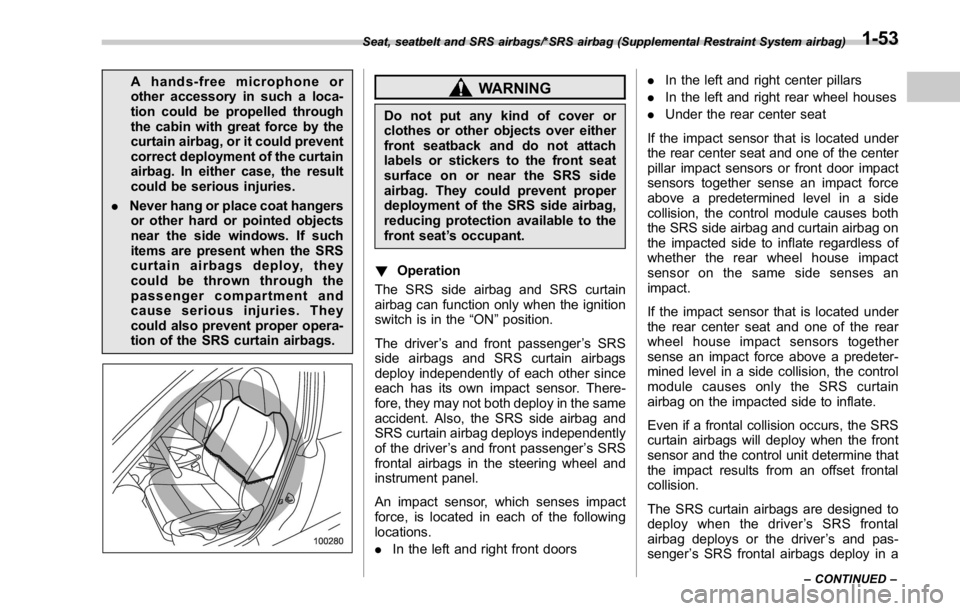
tion of the SRS curtain airbags. WARNINGDo not put any kind of cover or
clothes or other objects over either
front seatback and do not attach
labels or stickers to the front seat
surface on or near the SRS side
airbag. They could prevent proper
deployment of the SRS side airbag,
reducing protection available to the
front seat ’ s occupant.
! Operation
The SRS side airbag and SRS curtain
airbag can function only when the ignition
switch is in the “ ON ” position.
The driver ’ s and front passenger ’ s SRS
side airbags and SRS curtain airbags
deploy independently of each other since
each has its own impact sensor. There-
fore, they may not both deploy in the same
accident. Also, the SRS side airbag and
SRS curtain airbag deploys independently
of the driver ’ s and front passenger ’ s SRS
frontal airbags in the steering wheel and
instrument panel.
An impact sensor, which senses impact
force, is located in each of the following
locations.
. In the left and right front doors . In the left and right center pillars
. In the left and right rear wheel houses
. Under the rear center seat
If the impact sensor that is located under
the rear center seat and one of the center
pillar impact sensors or front door impact
sensors together sense an impact force
above a predetermined level in a side
collision, the control module causes both
the SRS side airbag and curtain airbag on
the impacted side to inflate regardless of
whether the rear wheel house impact
sensor on the same side senses an
impact.
If the impact sensor that is located under
the rear center seat and one of the rear
wheel house impact sensors together
sense an impact force above a predeter-
mined level in a side collision, the control
module causes only the SRS curtain
airbag on the impacted side to inflate.
Even if a frontal collision occurs, the SRS
curtain airbags will deploy when the front
sensor and the control unit determine that
the impact results from an offset frontal
collision.
The SRS curtain airbags are designed to
deploy when the driver ’ s SRS frontal
airbag deploys or the driver ’ s and pas-
senger ’ s SRS frontal airbags deploy in aSeat, seatbelt and SRS airbags/*SRS airbag (Supplemental Restraint System airbag)
– CONTINUED –1-53
Page 88 of 594
ized SUBARU dealer. The SRS air-
bag control module, impact sensors
and airbag modules are stored in
these areas.
. Under the center of the instru-
ment panel
. On both the right and left sides at
the front of the vehicle
. Steering wheel and column and
nearby areas
. Bottom of the steering column
and nearby areas
. Top of the dashboard on front
passenger ’ ssideandnearby
areas
. Each front seat and nearby area
. Inside each center pillar
. Inside each front door
. In each roof side (from the front
pillar to a point over the rear seat)
. Between the rear seat cushion
and rear wheel house on each
side
. Under the rear center seat
In the event that the SRS airbag is
deployed, replacement of the system
should be performed only by an author-
ized SUBARU dealer. When the compo- nents of the SRS airbag system are
replaced, use only genuine SUBARU
parts.
NOTE In the following cases, contact your
SUBARU dealer as soon as possible.
. The front part of the vehicle was
involved in an accident in which only
the driver ’ s SRS frontal airbag or both
driver ’ s and front passenger ’ sSRS
frontal airbags did not deploy.
. The pad of the steering wheel, the
cover over the front passenger ’ s SRS
frontal airbag, or either roof side (from
the front pillar to a point over the rear
seat) is scratched, cracked, or other-
wise damaged.
. The center pillar, front door, rear
wheel house or rear sub frame, or an
area near these parts, was involved in
an accident in which the SRS side
airbag and SRS curtain airbag did not
deploy.
. The fabric or leather of either the
front seatback and seat cushion is cut,
frayed, or otherwise damaged.
. The rear part of the vehicle was
involved in an accident. & Precautions against vehicle
modification WARNING. To avoid accidental activation of
the system or rendering the sys-
tem inoperative, which may re-
sult in serious injury, no modifi-
cations should be made to any
components or wiring of the SRS
airbag system.
This includes following modifica-
tions.
– Installation of custom steering
wheels
– Attachment of additional trim
materials to the dashboard
– Installation of custom seats
– Replacement of seat fabric or
leather
– Installation of additional fabric
or leather on the front seat
– Attachment of a hands-free
microphone or any other ac-
cessory to a front pillar, a
center pillar, a rear pillar, the
windshield, a side window, an
assist grip, or any other cabin
surface that would be near aSeat, seatbelt and SRS airbags/*SRS airbag (Supplemental Restraint System airbag)
– CONTINUED –1-59
Page 130 of 594

Ignition switch (models without push-
button start system) ......................................... 3-4LOCK .................................................................. 3-4
ACC.................................................................... 3-5
ON...................................................................... 3-5
START ................................................................ 3-5
Key reminder chime ............................................ 3-5
Ignition switch light ............................................. 3-6
Push-button ignition switch (models with
push-button start system) ............................... 3-6Safety precautions .............................................. 3-6
Operating range for push-button start system ...... 3-6
Switching power ................................................. 3-7
When access key does not operate properly ........ 3-8
Hazard warning flasher ....................................... 3-8
Meters and gauges. ............................................. 3-8Combination meter illumination ........................... 3-8
Canceling the function for meter/gauge needle
movement upon turning on the ignition
switch ............................................................... 3-9
Speedometer ....................................................... 3-9
Odometer ............................................................ 3-9
Double trip meter ................................................ 3-9
Tachometer ........................................................ 3-10
Fuel gauge ......................................................... 3-10
Temperature gauge ............................................ 3-11
ECO gauge ........................................................ 3-12
REV indicator light and buzzer (STI). ................ 3-12
Warning and indicator lights ............................. 3-13
Seatbelt warning light and chime ........................ 3-14
SRS airbag system warning light ........................ 3-15 Front passenger ’ s frontal airbag ON and OFF
indicators ........................................................ 3-16
CHECK ENGINE warning light/Malfunction
indicator light .................................................. 3-16
Charge warning light .......................................... 3-17
Oil pressure warning light .................................. 3-17
Engine low oil level warning indicator (except
STI) ................................................................. 3-17
Windshield washer fluid warning indicator .......... 3-18
AT OIL TEMP warning light (CVT models) ........... 3-18
Rear differential oil temperature warning light
(STI) ................................................................ 3-18
Low tire pressure warning light (U.S.-spec.
models) ........................................................... 3-19
ABS warning light .............................................. 3-20
Brake system warning light ................................ 3-21
Electronic parking brake indicator light (models
with electronic parking brake system) .............. 3-23
Low fuel warning light ....................................... 3-24
Hill start assist warning light/Hill start assist OFF
indicator light (models without electronic
parking brake system) ..................................... 3-24
Hill Holder indicator light (models with electronic
parking brake system) ..................................... 3-24
Door open warning light .................................... 3-25
All-Wheel Drive warning light (if equipped) ......... 3-25
Power steering warning light (except STI) ........... 3-25
LED headlight warning light (if equipped) ........... 3-25
Vehicle Dynamics Control warning light/Vehicle
Dynamics Control operation indicator light .. ..... 3-26
Vehicle Dynamics Control OFF indicator light/
Traction mode indicator light.. .......................... 3-27Instruments and controls 3
Page 132 of 594

Instruments and controls
Wiper and washer ............................................ 3-101Windshield wiper and washer switches ............. 3-102
Mirrors. .............................................................. 3-103Inside mirror .................................................... 3-103
Auto-dimming mirror/compass (if equipped) ...... 3-104 Auto-dimming mirror/compass with HomeLink ®
(if equipped) .................................................. 3-105
Outside mirrors ................................................ 3-111
Defogger and deicer ........................................ 3-112
Tilt/telescopic steering wheel ......................... 3-113
Horn .................................................................. 3-114
Page 133 of 594
Instruments and controls/Ignition switch (models without push – button start system)
Ignition switch (models with-
out push-button start sys-
tem) WARNING. Never turn the ignition switch to
“ LOCK ” while the vehicle is
being driven or towed because
that will lock the steering wheel,
preventing steering control. And
when the engine is turned off, it
takes a much greater effort than
usual to steer.
. Before leaving the vehicle, al-
ways remove the key from the
ignition switch for safety and
never allow an unattended child
to remain in the vehicle. Failure
to follow this procedure could
result in injury to a child or
others. Children could operate
the power windows, the moon-
roof or other controls or even
make the vehicle move.
CAUTION
Do not attach a large key holder or
key case to either key. If it banged against your knees or hands while
you are driving, it could turn the
ignition switch from the “ ON ” posi-
tion to the “ ACC ” or “ LOCK ” posi-
tion, thereby stopping the engine.
Also, if the key is attached to a
keyholder or to a large bunch of
other keys, centrifugal force may act
on it as the vehicle moves, resulting
in unwanted turning of the ignition
switch.
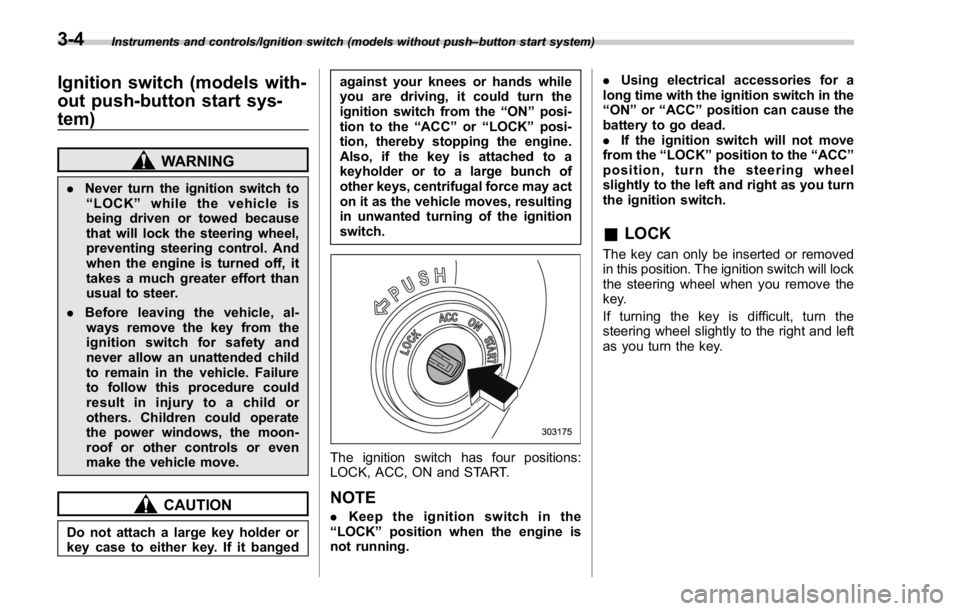
The ignition switch has four positions:
LOCK, ACC, ON and START.
NOTE . Keep the ignition switch in the
“ LOCK ” position when the engine is
not running. . Using electrical accessories for a
long time with the ignition switch in the
“ ON ” or “ ACC ” position can cause the
battery to go dead.
. If the ignition switch will not move
from the “ LOCK ” position to the “ ACC ”
position, turn the steering wheel
slightly to the left and right as you turn
the ignition switch.
& LOCK The key can only be inserted or removed
in this position. The ignition switch will lock
the steering wheel when you remove the
key.
If turning the key is difficult, turn the
steering wheel slightly to the right and left
as you turn the key.3-4
Page 137 of 594
Instruments and controls/Hazard warning flasher
pressed, steering is locked. When this
occurs, press the push-button ignition
switch while turning the steering wheel
left and right.
! Battery drainage prevention func-
tion
When the push-button ignition switch is
left in the “ ACC ” or “ ON ” position for
approximately 1 hour, the push-button
ignition switch will be automatically
switched to “ OFF ” to prevent the battery
from going dead. (In CVT models, this
function is activated when the select lever
is in the “ P ” position.)
& When access key does not
operate properlyRefer to “ Access key – if access key does
not operate properly ” F 9-16. Hazard warning flasher
The hazard warning flasher is used to
warn other drivers when you have to park
your vehicle under emergency conditions.
The hazard warning flasher works regard-
less of the position of the ignition switch.
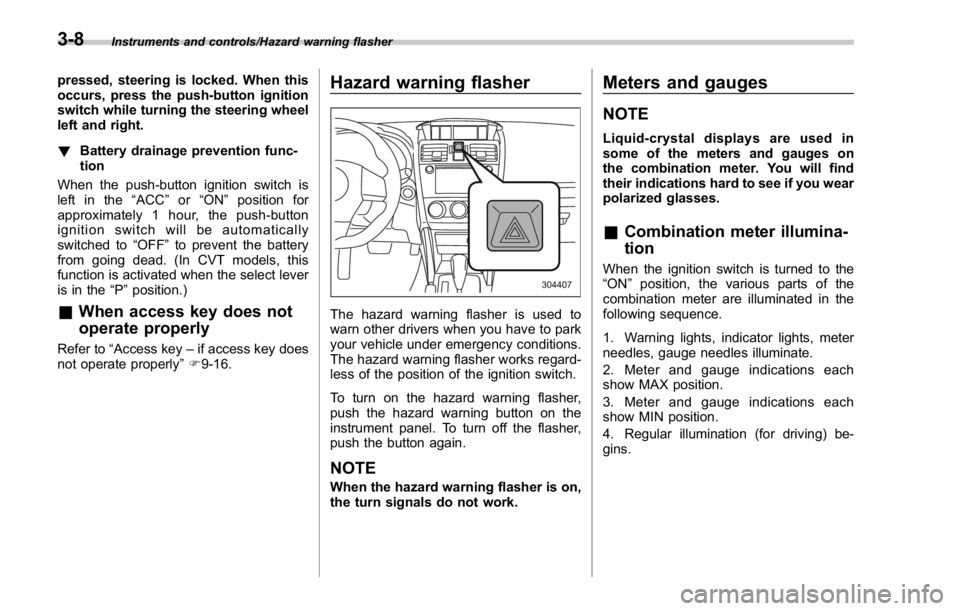
To turn on the hazard warning flasher,
push the hazard warning button on the
instrument panel. To turn off the flasher,
push the button again.
NOTE When the hazard warning flasher is on,
the turn signals do not work. Meters and gauges NOTE Liquid-crystal displays are used in
some of the meters and gauges on
the combination meter. You will find
their indications hard to see if you wear
polarized glasses.
& Combination meter illumina-
tion When the ignition switch is turned to the
“ ON ” position, the various parts of the
combination meter are illuminated in the
following sequence.
1. Warning lights, indicator lights, meter
needles, gauge needles illuminate.
2. Meter and gauge indications each
show MAX position.
3. Meter and gauge indications each
show MIN position.
4. Regular illumination (for driving) be-
gins.3-8
Page 154 of 594
& Door open warning
lightThe warning light illuminates if any door or
the trunk lid is not fully closed. This
function is effective even if the ignition
switch is in the “ LOCK ” / “ OFF ” or “ ACC ”
position, or the key is removed from the
ignition switch.
Always make sure this light is not illumi-
nated before you start to drive.
& All-Wheel Drive warn-
ing light (if equipped)This light flashes if the vehicle is driven
with tires of differing diameters fitted on
the wheels or with an excessively low air
pressure in any of the tires.
WARNING
Continued driving with the AWD
warning light flashing can lead to
powertrain damage. If the AWD
warning light flashes, promptly park
in a safe place then check whether
all four tires are the same diameter
and whether any of the tires has a
puncture or has lost air pressure for
some other reason. & Power steering warn-
ing light (except STI) This warning light illuminates when the
ignition switch is turned to the “ ON ”
position and turns off after the engine
has started. This indicates that the warn-
ing system is working properly.
While the engine is running, this warning
light illuminates when a malfunction has
been detected in the electric power steer-
ing system.
CAUTIONWhen the power steering warning
light is illuminated, there may be
more resistance when the steering
wheel is operated. Drive carefully to
the nearest SUBARU dealer and
have the vehicle inspected immedi-
ately.
NOTE If the steering wheel is operated in the
following ways, the power steering
control system may temporarily limit
the power assist in order to prevent the
system components, such as the con-
trol computer and drive motor, from
overheating. . The steering wheel is operated fre-
quently and turned sharply while the
vehicle is maneuvered at extremely low
speeds, such as while frequently turn-
ing the steering wheel during parallel
parking.
. The steering wheel remains in the
fully turned position for a long period
of time.
At this time, there will be more resis-
tance when steering. However this is
not a malfunction. Normal steering
force will be restored after the steering
wheel is not operated for a while and
the power steering control system has
an opportunity to cool down. However,
if the power steering is operated in a
non-standard way which causes power
assist limitation to occur too fre-
quently, that may result in a malfunc-
tion of the power steering control
system.
& LED headlight warning
light (if equipped) This light illuminates if the LED headlights
malfunction. Have your vehicle inspected
at a SUBARU dealer as soon as possible.Instruments and controls/Warning and indicator lights
– CONTINUED –3-25
Page 157 of 594
Instruments and controls/Warning and indicator lights
! Vehicle Dynamics Control OFF in-
dicator light
This light illuminates when the Vehicle
Dynamics Control OFF switch is operated
to select the traction mode or the Vehicle
Dynamic Control OFF mode. For details,
refer to “ Vehicle Dynamics Control sys-
tem ” F 7-38.
NOTE . The light may remain illuminated for
a while after the engine has been
started, especially in cold weather. This
does not indicate the existence of a
problem. The light should turn off as
soon as the engine has warmed up.
. The indicator light illuminates when
the engine has developed a problem
and the CHECK ENGINE warning light/
malfunction indicator light is on.
The Vehicle Dynamics Control system is
probably malfunctioning under the follow-
ing conditions. Have your vehicle checked
at a SUBARU dealer as soon as possible.
. The light does not illuminate when the
ignition switch is turned to the “ ON ”
position.
. The light does not turn off even after
the lapse of several minutes (the engine
has warmed up) after the engine has
started. ! Traction mode indicator light
The light illuminates when the Vehicle
Dynamics Control OFF switch is pressed
briefly to select the traction mode. For
details, refer to “ Traction mode ” F 7-41.
& Warning chimes and warning
indicator of the keyless ac-
cess with push-button start
system (if equipped)
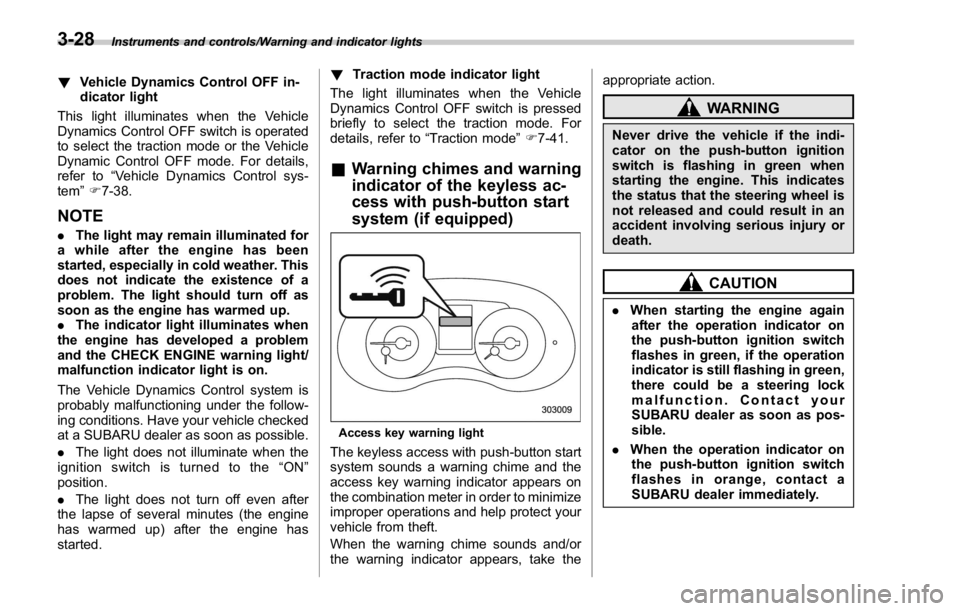
Access key warning light
The keyless access with push-button start
system sounds a warning chime and the
access key warning indicator appears on
the combination meter in order to minimize
improper operations and help protect your
vehicle from theft.
When the warning chime sounds and/or
the warning indicator appears, take the appropriate action.
WARNINGNever drive the vehicle if the indi-
cator on the push-button ignition
switch is flashing in green when
starting the engine. This indicates
the status that the steering wheel is
not released and could result in an
accident involving serious injury or
death.
CAUTION. When starting the engine again
after the operation indicator on
the push-button ignition switch
flashes in green, if the operation
indicator is still flashing in green,
there could be a steering lock
malfunction. Contact your
SUBARU dealer as soon as pos-
sible.
. When the operation indicator on
the push-button ignition switch
flashes in orange, contact a
SUBARU dealer immediately.3-28
Page 161 of 594

Instruments and controls/Warning and indicator lights
Inside warning
chime Outside warning
chime Operation indicator
on push-button igni-
tion switch Status Action
Long beep
(continuous) —— Select lever position warning:
The driver ’ s door was opened while the
push-button ignition switch is in a posi-
tion other than “ OFF ” and the select
lever is in a position other than the “ P ”
position. Shift the select lever to the “ P ” position,
switch the push-button ignition switch to
“ OFF ” and exit the vehicle.
Ding —— The battery of the access key is low. Replace the battery of the access key.
Ding — Flashes in green (15
seconds max.) Steering lock warning:
The engine start procedure was per-
formed, but the steering is still locked. While turning the steering wheel right
and left lightly, depress the brake pedal
and press the push-button ignition
switch.
Ding — Flashes in orange System malfunction warning:
A malfunction was detected in the power
system or steering lock. Contact a SUBARU dealer immediately
and have the vehicle inspected.
NOTE An electronic chirp will sound while the select lever is in the “ R ” position. In this case, the select lever position warning chime
will not sound.3-32