steering wheel SUBARU WRX 2016 Owner's Manual
[x] Cancel search | Manufacturer: SUBARU, Model Year: 2016, Model line: WRX, Model: SUBARU WRX 2016Pages: 594, PDF Size: 19.43 MB
Page 168 of 594
Good-bye Screen ” F 3-47.
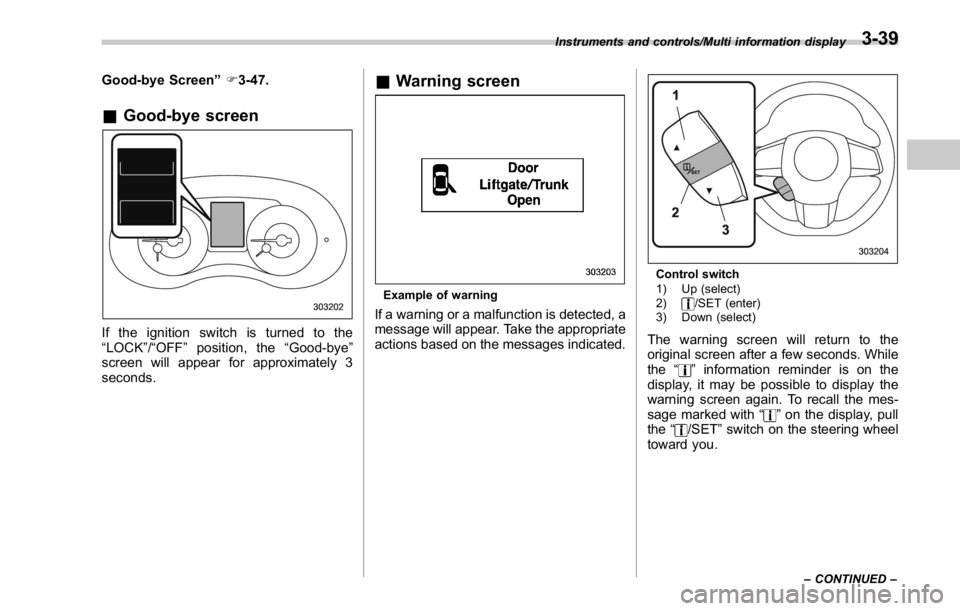
& Good-bye screen
If the ignition switch is turned to the
“ LOCK ” / “ OFF ” position, the “ Good-bye ”
screen will appear for approximately 3
seconds. & Warning screen
Example of warning
If a warning or a malfunction is detected, a
message will appear. Take the appropriate
actions based on the messages indicated. Control switch
1) Up (select)
2) /SET (enter)
3) Down (select)
The warning screen will return to the
original screen after a few seconds. While
the “
” information reminder is on the
display, it may be possible to display the
warning screen again. To recall the mes-
sage marked with “
” on the display, pull
the “ /SET ” switch on the steering wheel
toward you.Instruments and controls/Multi information display
– CONTINUED –3-39
Page 173 of 594
Instruments and controls/Multi information display
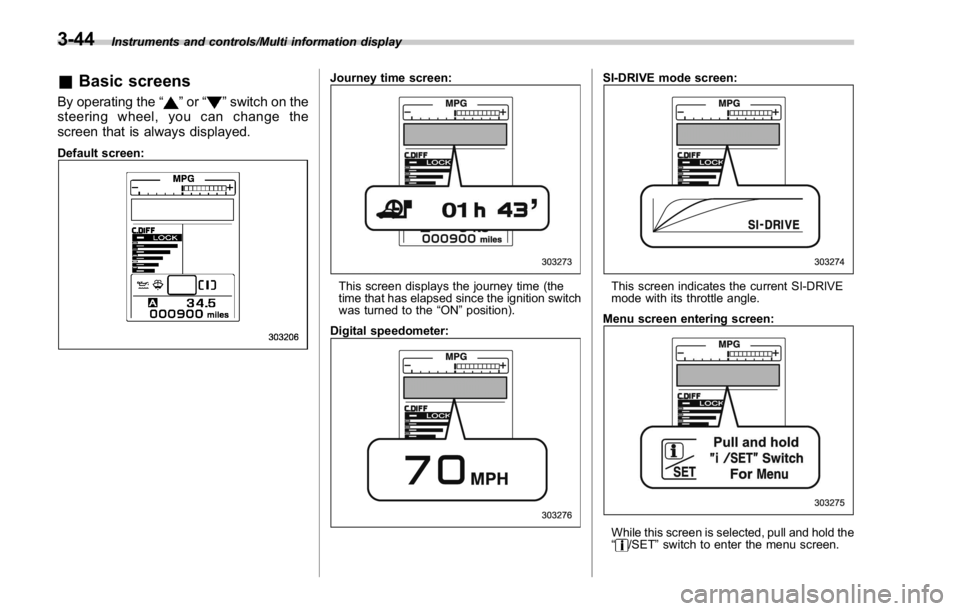
& Basic screensBy operating the “ ” or “ ” switch on the
steering wheel, you can change the
screen that is always displayed. Default screen: Journey time screen:
This screen displays the journey time (the
time that has elapsed since the ignition switch
was turned to the “ ON ” position).
Digital speedometer: SI-DRIVE mode screen:
This screen indicates the current SI-DRIVE
mode with its throttle angle.
Menu screen entering screen:
While this screen is selected, pull and hold the
“ /SET ” switch to enter the menu screen.3-44
Page 176 of 594

By operating the “ ” or “ ” switch on the
steering wheel, you can select the menu.
Pull the “
/SET ” switch to enter the
selected menu.
NOTE If you enter the “ Return ” menu, the
system will return to the previous
screen.
! Screen Settings
After entering the “ Screen Settings ” menu,
select one of the following menus.
! Welcome Good-bye Screen
The welcome screen/good-bye screens
can be activated or deactivated. Select
“ On ” to activate the screens. Select “ Off ”
to deactivate the screens.
! Gauge Initial Movement
The movement of the meter needles and
gauge needles that occurs when the
ignition switch is turned to the “ ON ”
position can be activated or deactivated.
Select “ On ” to activate. Select “ Off ” to
deactivate.
! Gear Position Indicator Setting
(MT models)
Display of the shift position indicator can
be activated or deactivated. Select “ On ” to
activate display of the shift position in- dicator or “ Off ” to deactivate it.
! Languages
Operate the “
” or “ ” switch on the
steering wheel to display the preferred
language. Then pull the “
/SET ” switch to
select the displayed language.
! REV settings (STI)
NOTE If the setting of the REV Indicator Light
is “ Off ” , the setting menus of the REV
Alarm Level Engine Speed and the REV
Buzzer are not displayed.
After entering the “ REV settings ” menu,
select any of the following menus.
! REV Indicator Light
Display of the REV indicator light can be
activated or deactivated. Select “ On ” to
activate display of the REV indicator light
or “ Off ” to deactivate it.
! REV Alarm Level Engine Speed
The alarm-level engine speed can be set
(in 100 rpm steps) within the range from
2,000 rpm to the red zone.
! REV Buzzer
The REV buzzer can be activated or
deactivated. Select “ On ” to activate the
REV buzzer or “ Off ” to deactivate it. ! EyeSight (models with EyeSight
system)
NOTE For models with the EyeSight system,
refer to the Owner ’ s Manual supple-
ment for the EyeSight system.
After entering the “ EyeSight ” menu, select
one of the following menus.
! Warning Volume
The volume of the warning buzzer that
sounds when the EyeSight system is in
use can be set in 3 stages ( “ Max ” , “ Mid ”
and “ Min ” ).
! Lead Vehicle Acquisition Sound
When adaptive cruise control is used, the
buzzer that sounds under any of the
following conditions can be activated or
deactivated.
. A vehicle is detected in front
. Detection is not possible
Select “ On ” to activate the buzzer. Select
“ Off ” to deactivate the buzzer.
! Lead Vehicle Moving Monitor
Function
When the lead vehicle moving monitor
function is operated, the buzzer that
sounds if a vehicle in front has started
can be activated or deactivated. SelectInstruments and controls/Multi information display
– CONTINUED –3-47
Page 242 of 594
damage the conductors printed
on the window.
NOTE . Turn on the defogger and deicer
system if the wipers are frozen to the
windshield.
. If the windshield is covered with
snow, remove the snow so that the
windshield wiper deicer works effec-
tively.
. While the defogger and deicer sys-
tem is in the continuous operation
mode, if the vehicle speed remains at
9mph(15km/h)orlowerfor15
minutes, the windshield wiper deicer
automatically stops operating, though
the rear window defogger and outside
mirror defogger maintain continuous
operation in this condition.
. While the defogger and deicer sys-
tem is in the continuous operation
mode, if the battery voltage drops
below the permissible level, continu-
ous operation of the defogger and
deicer system is canceled and the
system stops operating. Tilt/telescopic steering wheel WARNING. Do not adjust the steering wheel
tilt/telescopic position while driv-
ing. This may cause loss of
vehicle control and result in
personal injury.
. If the lever cannot be raised to
the fixed position, adjust the
steering wheel again. It is dan-
gerous to drive without locking
the steering wheel. This may
cause loss of vehicle control
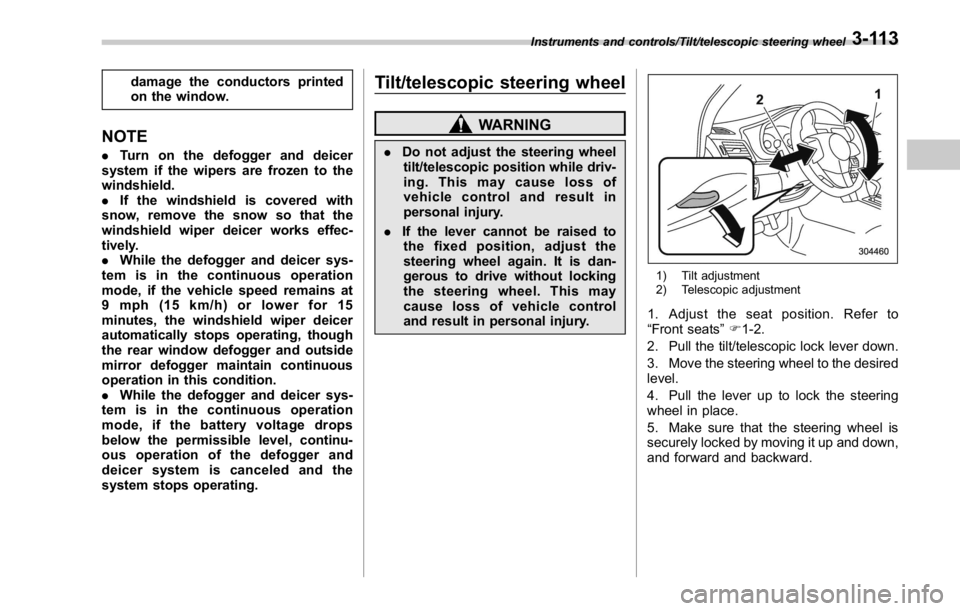
and result in personal injury. 1) Tilt adjustment
2) Telescopic adjustment
1. Adjust the seat position. Refer to
“ Front seats ” F 1-2.
2. Pull the tilt/telescopic lock lever down.
3. Move the steering wheel to the desired
level.
4. Pull the lever up to lock the steering
wheel in place.
5. Make sure that the steering wheel is
securely locked by moving it up and down,
and forward and backward.Instruments and controls/Tilt/telescopic steering wheel
3-113
Page 273 of 594
Audio/Audio/visual remote controls
! Voice command system
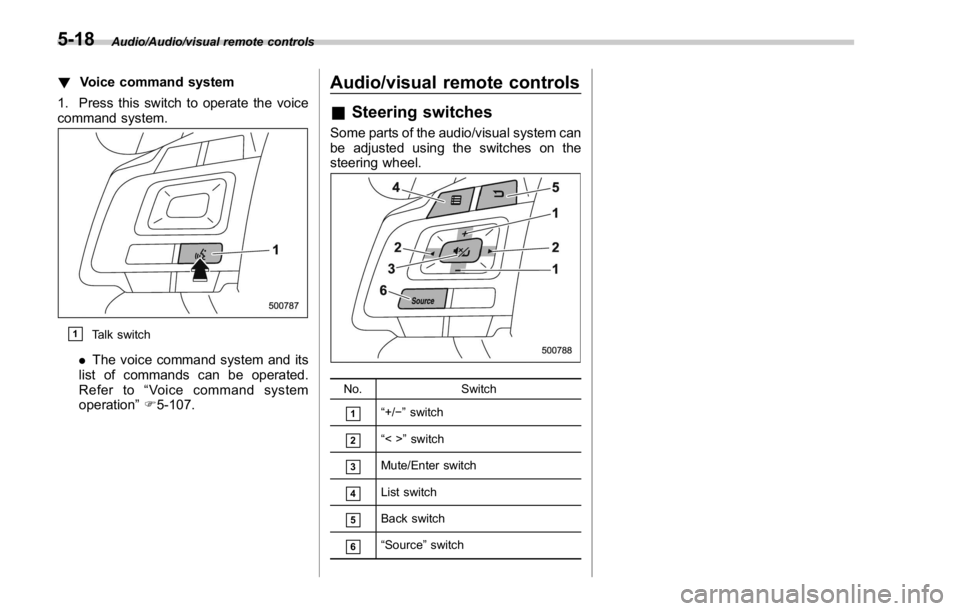
1. Press this switch to operate the voice
command system.
& 1
Talk switch
. The voice command system and its
list of commands can be operated.
Refer to “ Voice command system
operation ” F 5-107. Audio/visual remote controls & Steering switches Some parts of the audio/visual system can
be adjusted using the switches on the
steering wheel.
No. Switch
& 1
“ +/ − ” switch
& 2
“ <> ” switch
& 3
Mute/Enter switch
& 4
List switch
& 5
Back switch
& 6
“ Source ” switch5-18
Page 307 of 594
Audio/Media operation
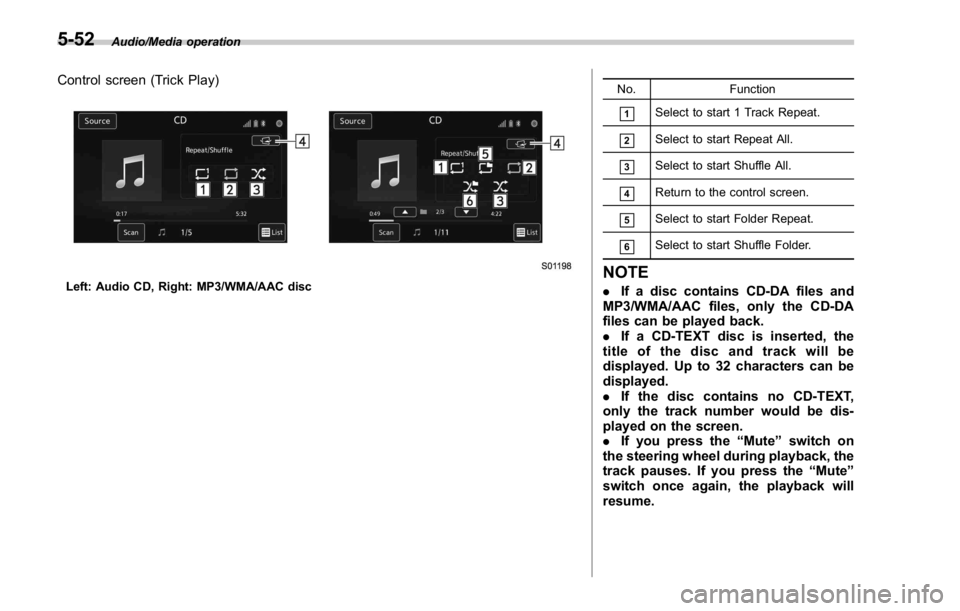
Control screen (Trick Play)
Left: Audio CD, Right: MP3/WMA/AAC disc No. Function
& 1
Select to start 1 Track Repeat.
& 2
Select to start Repeat All.
& 3
Select to start Shuffle All.
& 4
Return to the control screen.
& 5
Select to start Folder Repeat.
& 6
Select to start Shuffle Folder.
NOTE . If a disc contains CD-DA files and
MP3/WMA/AAC files, only the CD-DA
files can be played back.
. If a CD-TEXT disc is inserted, the
title of the disc and track will be
displayed. Up to 32 characters can be
displayed.
. If the disc contains no CD-TEXT,
only the track number would be dis-
played on the screen.
. If you press the “ Mute ” switch on
the steering wheel during playback, the
track pauses. If you press the “ Mute ”
switch once again, the playback will
resume.5-52
Page 311 of 594

Audio/Media operation
CAUTION. Do not leave your portable player
in the car. In particular, high
temperatures inside the vehicle
may damage the portable player.
. Do not push down on or apply
unnecessary pressure to the por-
table player while it is connected
as this may damage the portable
player or its terminal.
. Do not insert foreign objects into
the port as this may damage the
portable player or its terminal.
NOTE If you press the “ Mute ” switch on the
steering wheel during playback, the
track pauses. If you press the “ Mute ”
switch once again, the playback will
resume. & iPod ! Overview
TheiPodoperationscreencanbe
reached by the following methods:
. Connect an iPod. Refer to “ Connecting
and disconnecting a USB memory/porta-
ble device ” F 5-6.
. Select
USB/iPod (USB/iPod) on the
“ Select Audio Source (Select Audio
Source) ” screen. Refer to “ Selecting an
audio source ” F 5-13.5-56
Page 315 of 594
Audio/Media operation
WARNINGDo not operate the player ’ s controls
or connect the iPod while driving.
CAUTION. Do not leave your portable player
in the car. In particular, high
temperatures inside the vehicle
may damage the portable player.
. Do not push down on or apply
unnecessary pressure to the por-
table player while it is connected
as this may damage the portable
player or its terminal.
. Do not insert foreign objects into
the port as this may damage the
portable player or its terminal.
NOTE . When an iPod is connected using a
genuine iPod cable, the iPod starts
charging its battery.
. When an iPod is connected and the
audio source is changed to iPod mode,
the iPod will resume playing from the
same point it was last used.
. Depending on the iPod that is con-
nected to the system, certain functions may not be available.
. Files/tracks selected by operating a
connected iPod may not be recognized
or displayed properly.
. If you press the “ Mute ” switch on
the steering wheel during playback, the
track pauses. If you press the “ Mute ”
switch once again, the playback will
resume.
& Bluetooth audio The Bluetooth audio system enables
users to enjoy listening to music that is
played on a portable player on the vehicle
speakers via wireless communication.
This audio system supports Bluetooth, a
wireless data system capable of playing
portable audio music without cables. If
your device does not support Bluetooth,
the Bluetooth audio system will not func-
tion.
! Overview
Select
BT Audio (BT Audio) on the “ Select
Audio Source (Select Audio Source) ”
screen. Refer to “ Selecting an audio
source ” F 5-13.
Depending on the type of portable player
connected, some functions may not be
available and/or the screen may look
differently than shown in this manual.5-60
Page 342 of 594
! When the cursor is at the “ Device
Name Display Area ”
. Thedevicenamecanbesetor
changed.
. Press the “ PIN ” key to enter a pass-
code.
. If the “ PIN ” key is already selected, the
“ Alphabet ” key is cross-hatched and dis-
abled.
! When the cursor is at the “ Pass-
code Display Area ”
. The passcode can be set/changed.
. Press the “ Name ” key to enter a device
name. Phone operation (Hands-free
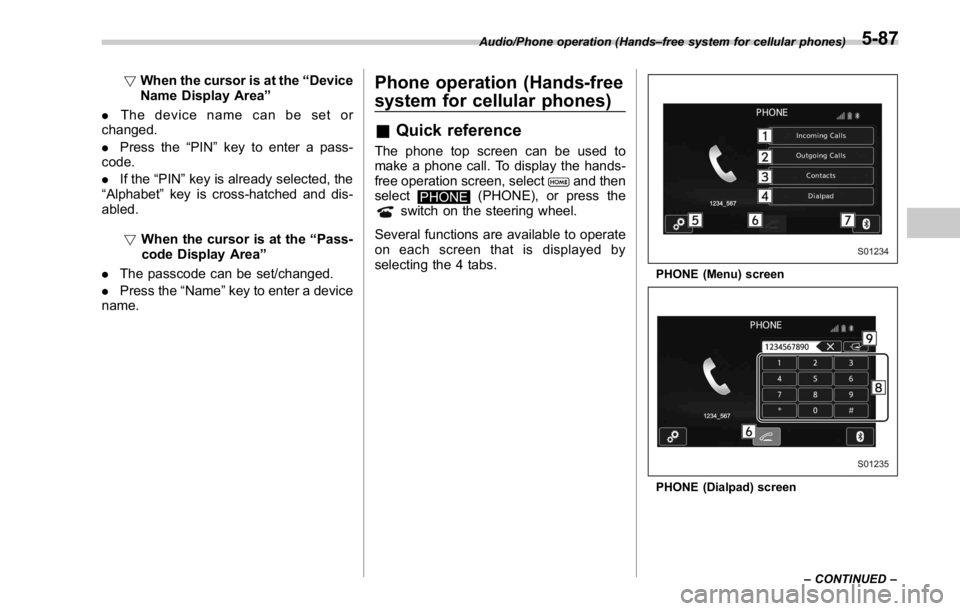
system for cellular phones) & Quick reference The phone top screen can be used to
make a phone call. To display the hands-
free operation screen, select
and then
select
PHONE (PHONE), or press the
switch on the steering wheel.
Several functions are available to operate
on each screen that is displayed by
selecting the 4 tabs. PHONE (Menu) screen
PHONE (Dialpad) screenAudio/Phone operation (Hands – free system for cellular phones)
– CONTINUED –5-87
Page 343 of 594
Audio/Phone operation (Hands – free system for cellular phones)
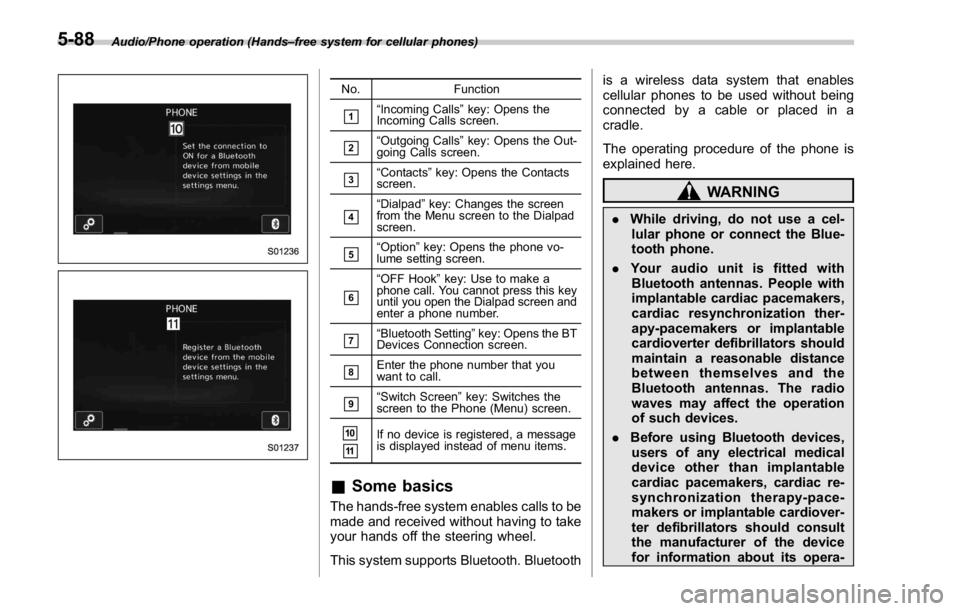
No. Function
& 1
“ Incoming Calls ” key: Opens the
Incoming Calls screen.
& 2
“ Outgoing Calls ” key: Opens the Out-
going Calls screen.
& 3
“ Contacts ” key: Opens the Contacts
screen.
& 4
“ Dialpad ” key: Changes the screen
from the Menu screen to the Dialpad
screen.
& 5
“ Option ” key: Opens the phone vo-
lume setting screen.
& 6
“ OFF Hook ” key: Use to make a
phone call. You cannot press this key
until you open the Dialpad screen and
enter a phone number.
& 7
“ Bluetooth Setting ” key: Opens the BT
Devices Connection screen.
& 8
Enter the phone number that you
want to call.
& 9
“ Switch Screen ” key: Switches the
screen to the Phone (Menu) screen.
& 10
& 11
If no device is registered, a message
is displayed instead of menu items.
& Some basics The hands-free system enables calls to be
made and received without having to take
your hands off the steering wheel.
This system supports Bluetooth. Bluetooth is a wireless data system that enables
cellular phones to be used without being
connected by a cable or placed in a
cradle.
The operating procedure of the phone is
explained here.
WARNING. While driving, do not use a cel-
lular phone or connect the Blue-
tooth phone.
. Your audio unit is fitted with
Bluetooth antennas. People with
implantable cardiac pacemakers,
cardiac resynchronization ther-
apy-pacemakers or implantable
cardioverter defibrillators should
maintain a reasonable distance
between themselves and the
Bluetooth antennas. The radio
waves may affect the operation
of such devices.
. Before using Bluetooth devices,
users of any electrical medical
device other than implantable
cardiac pacemakers, cardiac re-
synchronization therapy-pace-
makers or implantable cardiover-
ter defibrillators should consult
the manufacturer of the device
for information about its opera-5-88