check engine SUZUKI GRAND VITARA 1987 Service Owner's Manual
[x] Cancel search | Manufacturer: SUZUKI, Model Year: 1987, Model line: GRAND VITARA, Model: SUZUKI GRAND VITARA 1987Pages: 962, PDF Size: 27.87 MB
Page 74 of 962
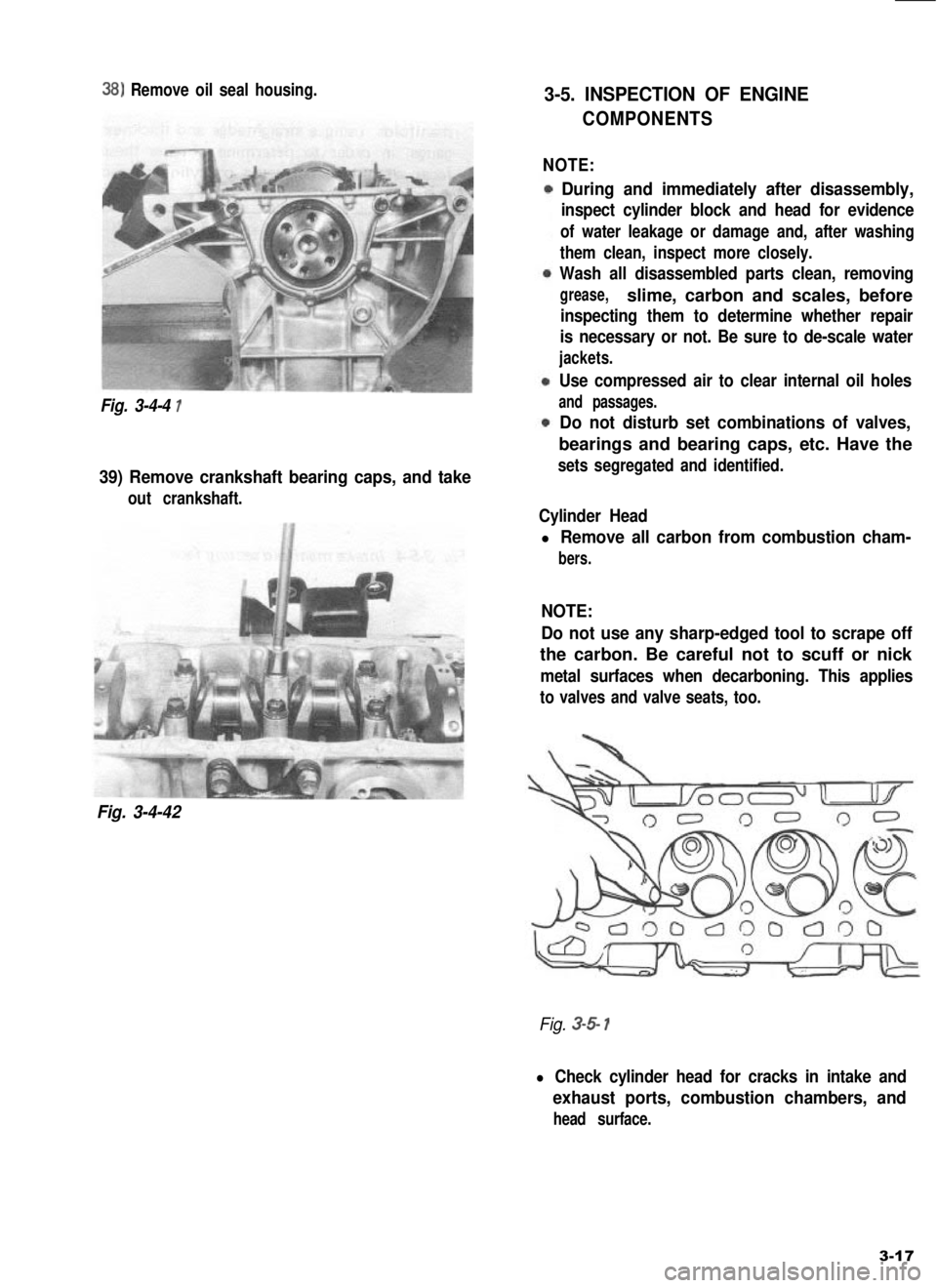
38) Remove oil seal housing.
Fig. 3-4-4 1
39) Remove crankshaft bearing caps, and take
out crankshaft.
Fig. 3-4-42
3-5. INSPECTION OF ENGINE
COMPONENTS
NOTE:
During and immediately after disassembly,
inspect cylinder block and head for evidence
of water leakage or damage and, after washing
them clean, inspect more closely.
Wash all disassembled parts clean, removing
grease,slime, carbon and scales, before
inspecting them to determine whether repair
is necessary or not. Be sure to de-scale water
jackets.
Use compressed air to clear internal oil holes
and passages.
Do not disturb set combinations of valves,
bearings and bearing caps, etc. Have the
sets segregated and identified.
Cylinder Head
l Remove all carbon from combustion cham-
bers.
NOTE:
Do not use any sharp-edged tool to scrape off
the carbon. Be careful not to scuff or nick
metal surfaces when decarboning. This applies
to valves and valve seats, too.
Fig. 3-5 1
l Check cylinder head for cracks in intake and
exhaust ports, combustion chambers, and
head surface.
3-17
Page 92 of 962
3-6. ENGINE REASSEMBLY
NOTE:
l All parts to be used in reassembly must be
perfectly clean.
l Oil sliding and rubbing surfaces of engine
parts just before using them in reassembly.
Use engine oil (Refer to page l-8).
l Have liquid packing ready for use. SUZUKI
BOND NO. 1215 is specified for it. Use it
wherever its use is specified in order to
ensure leak-free (oil and water) workmanship
of reassembly.
l There are many running clearances. During
the course of engine reassembly, be sure to
check these clearances, one after another,
as they form.
l Gaskets, “0” rings and similar sealing mem-
bers must be in perfect condition. For these
members, use replacement parts in stock.
l Tightening torque is specified for impor-
tant fasteners - mainly bolts and nuts -of
the engine and other components. Use torque
wrenches and constantly refer to the specified
values given on p. 3-58.
l Do not disregard match marks provided on
parts. Some of them are those given at the
time of disassembly.
l There are many sets of parts. Crankshaft
bearings, connecting rods, pistons, etc., are
in combination sets. Do not disturb such
combinations and make sure that each part
goes back to where it came from.
Engine reassembly is the reverse of engine disas-
sembly as far as sequence is concerned, but
there are many reassembling steps that involve
measures necessary for restoring engine as close
to factory-assembled condition as possible. Only
those steps will be dealt with here.
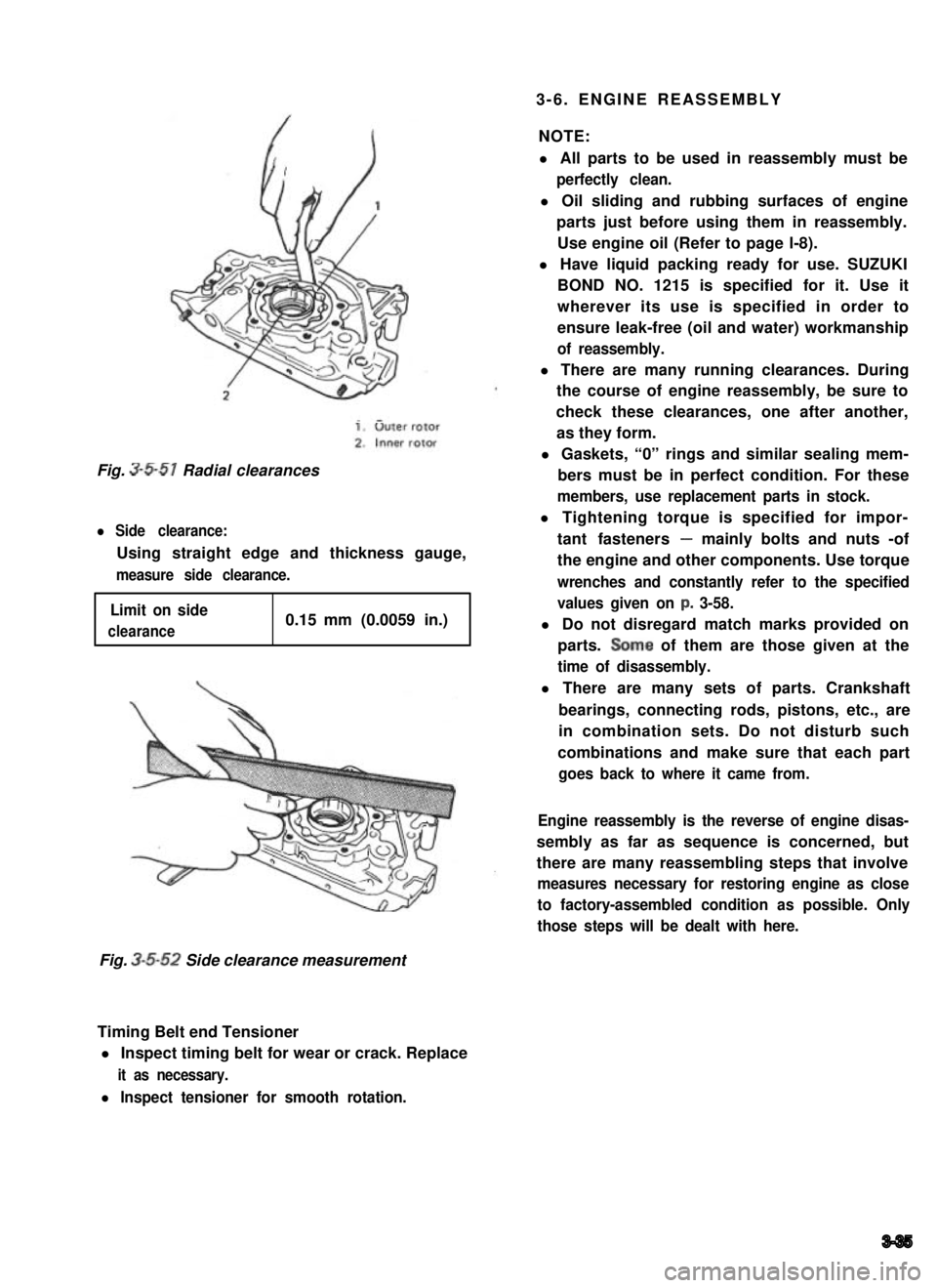
Fig. 3-5-51 Radial clearances
l Side clearance:
Using straight edge and thickness gauge,
measure side clearance.
Limit on side
clearance0.15 mm (0.0059 in.)
Fig. 3-5-52 Side clearance measurement
Timing Belt end Tensioner
l Inspect timing belt for wear or crack. Replace
it as necessary.
l Inspect tensioner for smooth rotation.
3-35
Page 94 of 962
n
U
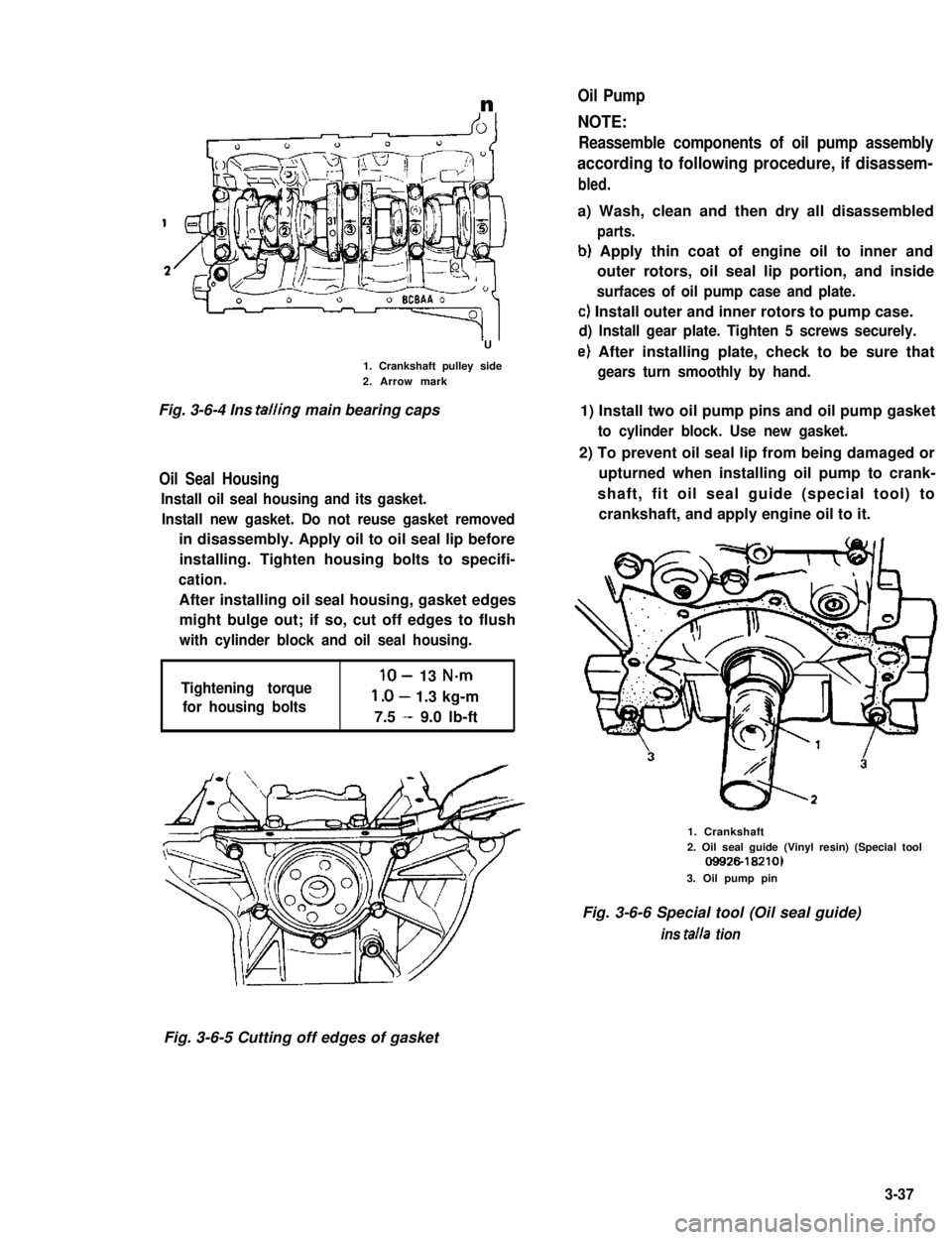
1. Crankshaft pulley side2. Arrow mark
Fig. 3-6-4 Ins tailing main bearing caps
Oil Seal Housing
Install oil seal housing and its gasket.
Install new gasket. Do not reuse gasket removed
in disassembly. Apply oil to oil seal lip before
installing. Tighten housing bolts to specifi-
cation.
After installing oil seal housing, gasket edges
might bulge out; if so, cut off edges to flush
with cylinder block and oil seal housing.
Tightening torque
for housing bolts
lo- 13 N-m
l.O- 1.3 kg-m
7.5 - 9.0 lb-ft
Oil Pump
NOTE:
Reassemble components of oil pump assembly
according to following procedure, if disassem-
bled.
a) Wash, clean and then dry all disassembled
parts.
b) Apply thin coat of engine oil to inner and
outer rotors, oil seal lip portion, and inside
surfaces of oil pump case and plate.
c) Install outer and inner rotors to pump case.
d) Install gear plate. Tighten 5 screws securely.
e) After installing plate, check to be sure that
gears turn smoothly by hand.
1) Install two oil pump pins and oil pump gasket
to cylinder block. Use new gasket.
2) To prevent oil seal lip from being damaged or
upturned when installing oil pump to crank-
shaft, fit oil seal guide (special tool) to
crankshaft, and apply engine oil to it.
1. Crankshaft2. Oil seal guide (Vinyl resin) (Special tool09926-18210)
3. Oil pump pin
Fig. 3-6-6 Special tool (Oil seal guide)
ins talla tion
Fig. 3-6-5 Cutting off edges of gasket
3-37
Page 101 of 962
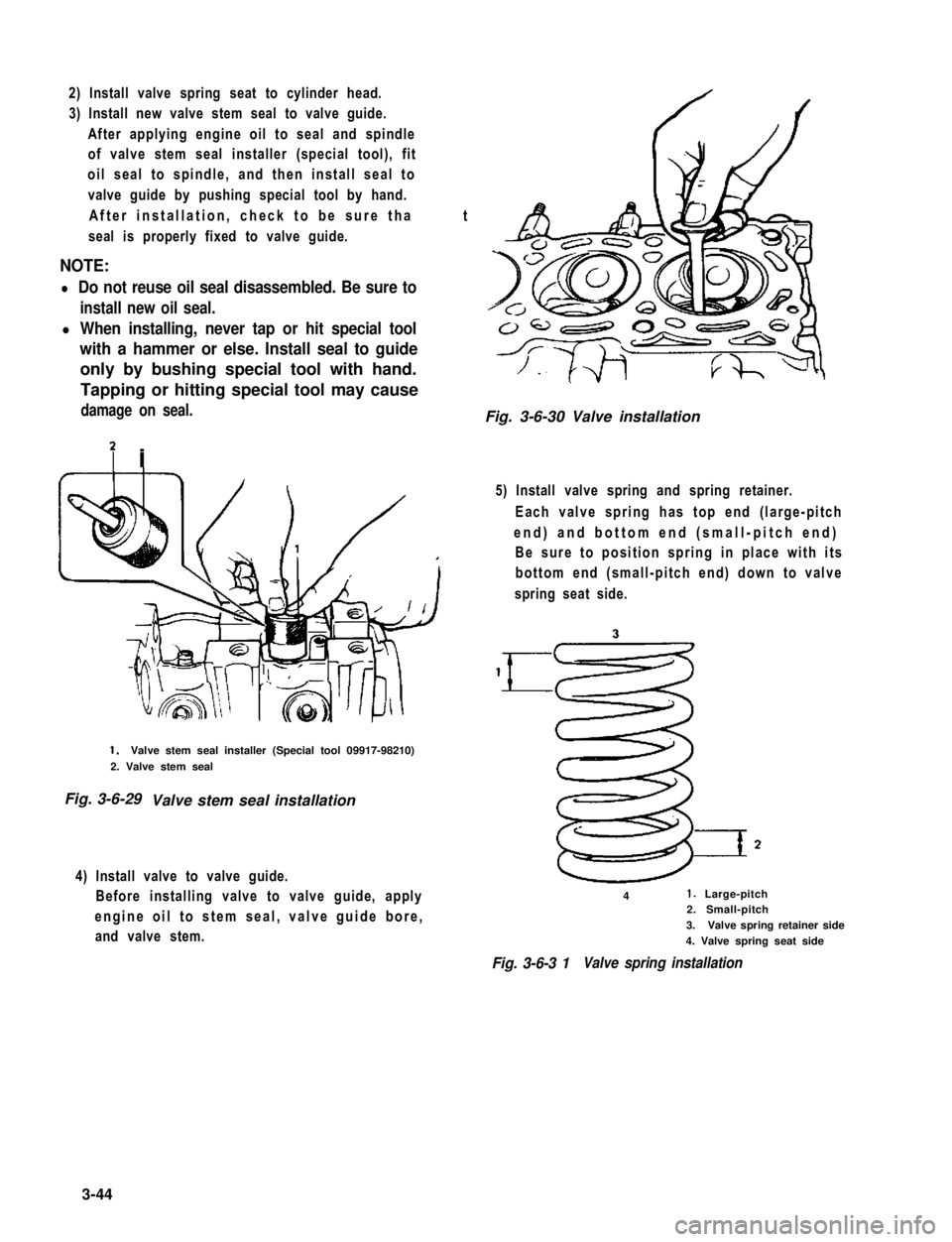
2) Install valve spring seat to cylinder head.
3) Install new valve stem seal to valve guide.
After applying engine oil to seal and spindle
of valve stem seal installer (special tool), fit
oil seal to spindle, and then install seal to
valve guide by pushing special tool by hand.
After installation, check to be sure that
seal is properly fixed to valve guide.
NOTE:
l Do not reuse oil seal disassembled. Be sure to
install new oil seal.
l When installing, never tap or hit special tool
with a hammer or else. Install seal to guide
only by bushing special tool with hand.
Tapping or hitting special tool may cause
damage on seal.
7 i
1.Valve stem seal installer (Special tool 09917-98210)
2. Valve stem seal
Fig. 3-6-29 Valve stem seal installation
4) Install valve to valve guide.
Before installing valve to valve guide, apply
engine oil to stem seal, valve guide bore,
and valve stem.
Fig. 3-6-30 Valve installation
5) Install valve spring and spring retainer.
Each valve spring has top end (large-pitch
end) and bottom end (small-pitch end)
Be sure to position spring in place with its
bottom end (small-pitch end) down to valve
spring seat side.
41. Large-pitch2. Small-pitch
3.Valve spring retainer side
4. Valve spring seat side
Fig. 3-6-3 1Valve spring installation
3-44
Page 109 of 962
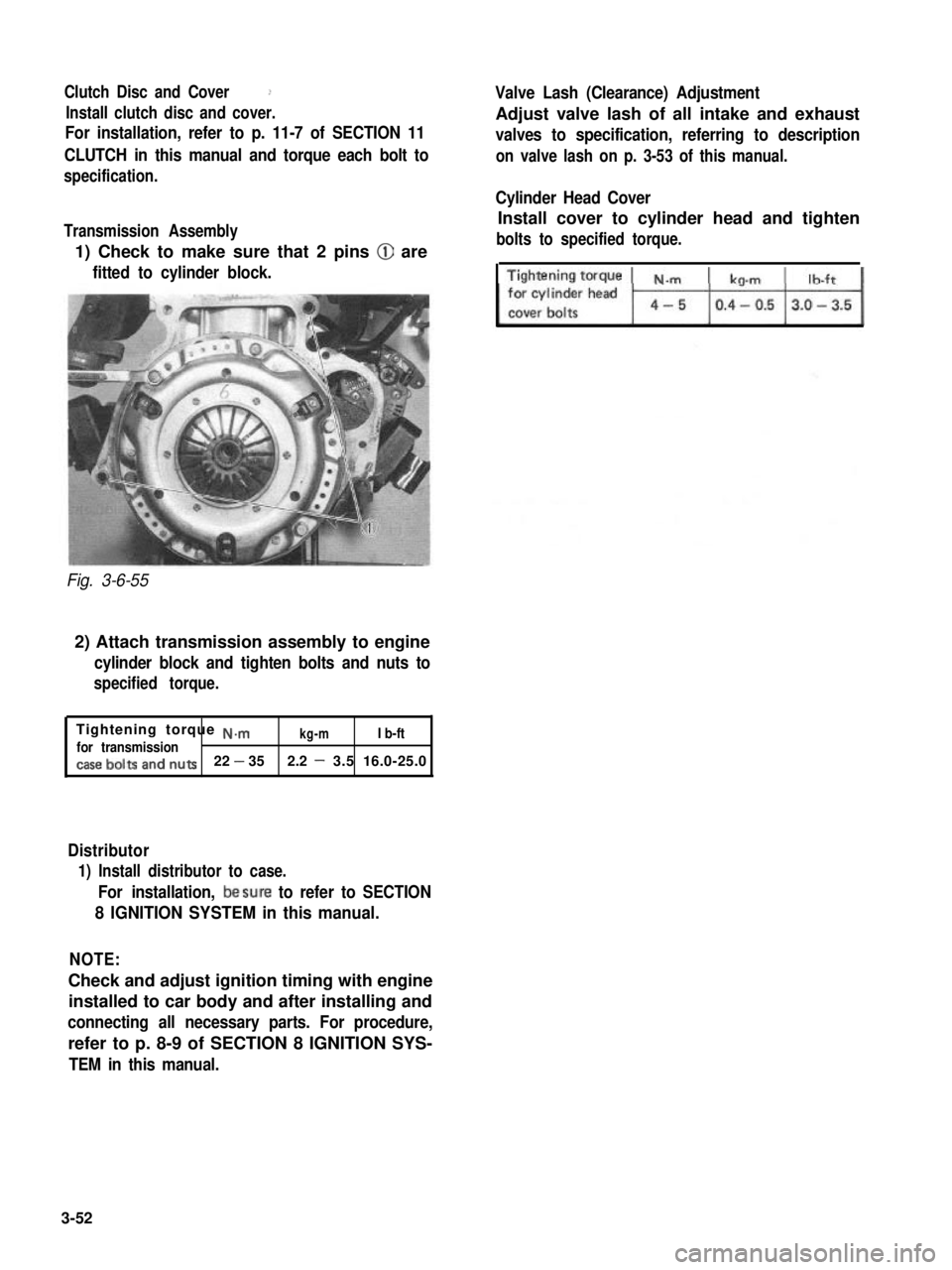
Clutch Disc and Cover?
Install clutch disc and cover.
For installation, refer to p. 11-7 of SECTION 11
CLUTCH in this manual and torque each bolt to
specification.
Transmission Assembly
1) Check to make sure that 2 pins @ are
fitted to cylinder block.
Fig. 3-6-55
2) Attach transmission assembly to engine
cylinder block and tighten bolts and nuts to
specified torque.
Tightening torque ~.mkg-mI b-ftfor transmission,.aSe bolts an,-j nutS22 - 352.2 - 3.5 16.0-25.0
Distributor
1) Install distributor to case.
For installation, besure to refer to SECTION
8 IGNITION SYSTEM in this manual.
Valve Lash (Clearance) Adjustment
Adjust valve lash of all intake and exhaust
valves to specification, referring to description
on valve lash on p. 3-53 of this manual.
Cylinder Head Cover
Install cover to cylinder head and tighten
bolts to specified torque.
NOTE:
Check and adjust ignition timing with engine
installed to car body and after installing and
connecting all necessary parts. For procedure,
refer to p. 8-9 of SECTION 8 IGNITION SYS-
TEM in this manual.
3-52
Page 110 of 962

3-7. ENGINE INSTALLATION
1) Lower engine with transmission into vehicle,
but do not remove lifting device.
2) Tighten engine mounting bracket bolts
(right and left) and transmission mounting
bolts to specification. Refer to p. 3-58.
3) Remove lifting device.
4) Reverse removal procedures for installation
of remainder.
5) Adjust accelerator cable play and clutch
cable play.
6) Connect vacuum hoses securely. Refer to
section 5 “EMISSION CONTROL SYSTEM”
for correct connection.
7) Connect wire harnesses and couplers secure-
IY.
8) Tighten bolts and nuts to specified torque.
For individual specification, refer to each
section.
9) Fill specified amount of specified trans-
mission oil and engine oil. For the detail,
refer to SECTION 1 PERIODIC MAINTE-
NANCE SERVICE of this manual.
10) After adjusting water pump belt tension to
specification, fill specified amount of engine
cooling water.
11) Before starting engine, check again to ensure
that all parts once disassembled or discon-
nected are back in place securely.
12)Start engine and check ignition timing. If
it is not to specified timing, adjust it, referr-
ing to SECTION 8 of this manual.
13) After engine is started, check for oil leak,
abnormal noise and other malcondition.
Also, check each part for operation.
3-8. ENGINE MAINTENANCE SERVICE
Fan Belt
Adjust belt tension as outlined in SECTION 6
ENGINE COOLING SYSTEM (p. 6-10).
Ignition Timing
Refer to IGNITION TIMING, Page 8-9.
Carburetor
fidjustments to be made are detailed in SEC-
TION 4 (p. 4-19).
Valve Lash (Clearance)
Valve lash specifications:
Valve lash refers to gap between rocker arm
adjusting screw and valve stem. Use a thickness
gauge to measure this gap @.
When coldWhen hot(Coolant tempe-(Coolant tempa-
Valve lashrature is 15 - 25%rature is 60 - 66’C
(gap A)or 69 - 77’F)or 140 - 154’F)
specif i-0.13 - 0.17 mm0.23 - 0.27 mmcationIntake(0.0051 - 0.0067 in) (0.009 - 0.011 in)
Exhaust0.16 -0.20 mm0.26 - 0.30 mm(0.0063 - 0.0079 in) (0.0102 - 0.0116 in)
Screw lock nut 15 - 19 N.m(1.5 - 1.9 kg-m, 11 .O - 13.5 lb-ft)
Adjusting screw
8
Valve stem
Fig. 3-8-l
Checking and adjusting procedures:
NOTE:
l Refer to Fig. 3-3-11 of SECTION 3 for
cylinder numbers (No. 1, No. 2, No. 3 and
No. 4) mentioned in this section.
l When adjustment becomes necessary in step
4), loosen adjusting screw lock nut and then
make adjustment by turning adjusting screw.
After adjustment, tighten lock nut to specifi-
ed torque while holding adjusting screw
stationary with straight headed screwdriver,
and then make sure again that gap @ is
within specification.
3-53
Page 111 of 962
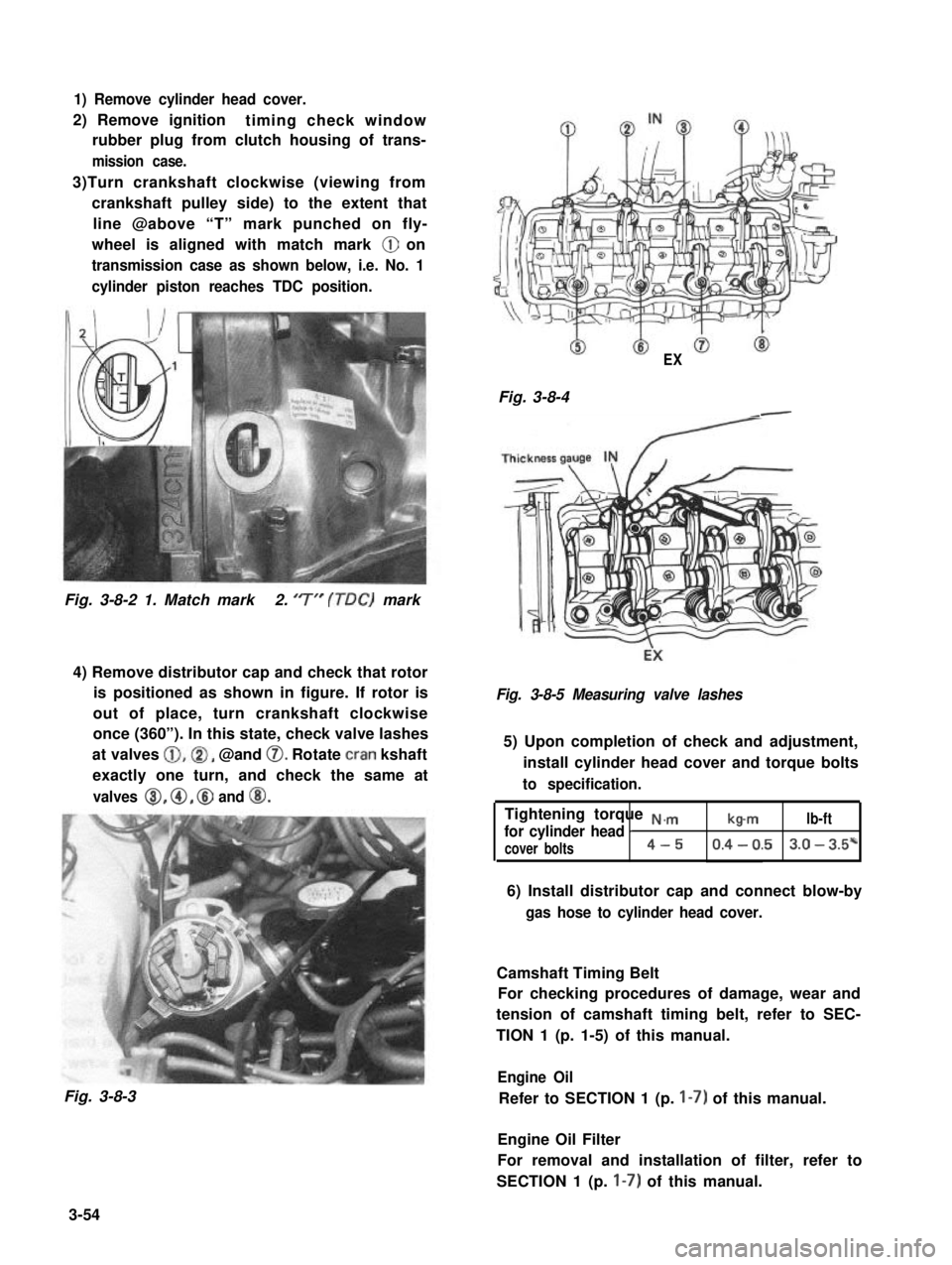
1) Remove cylinder head cover.
2) Remove ignitiontiming check window
rubber plug from clutch housing of trans-
mission case.
3)Turn crankshaft clockwise (viewing from
crankshaft pulley side) to the extent that
line @above “T” mark punched on fly-
wheel is aligned with match mark @ on
transmission case as shown below, i.e. No. 1
cylinder piston reaches TDC position.
Fig. 3-8-2 1. Match mark2. ‘7” (TDC) mark
4) Remove distributor cap and check that rotor
is positioned as shown in figure. If rotor is
out of place, turn crankshaft clockwise
once (360”). In this state, check valve lashes
at valves @,@I, @and 0. Rotate cran kshaft
exactly one turn, and check the same at
valves 8, @, @ and @I.
Fig. 3-8-3
EX
Fig. 3-8-4-
Fig. 3-8-5 Measuring valve lashes
5) Upon completion of check and adjustment,
install cylinder head cover and torque bolts
to specification.
Tightening torque N.,.,.,
for cylinder head Ib-mlb-ft
cover bolts4-50.4 - 0.53.0 - 3.5*
6) Install distributor cap and connect blow-by
gas hose to cylinder head cover.
Camshaft Timing Belt
For checking procedures of damage, wear and
tension of camshaft timing belt, refer to SEC-
TION 1 (p. 1-5) of this manual.
Engine Oil
Refer to SECTION 1 (p. I-7) of this manual.
Engine Oil Filter
For removal and installation of filter, refer to
SECTION 1 (p. I-7) of this manual.
3-54
Page 112 of 962
Engine Coolant
This subject is covered in SECTION 6 ENGINE
COOLING SYSTEM.
Exhaust Line and Muffler
Inspect each exhaust line connection for tight-
ness, and examine muffler and other parts for
evidence of breakage and leakage of gases.
Repair or replace defective parts, if any.
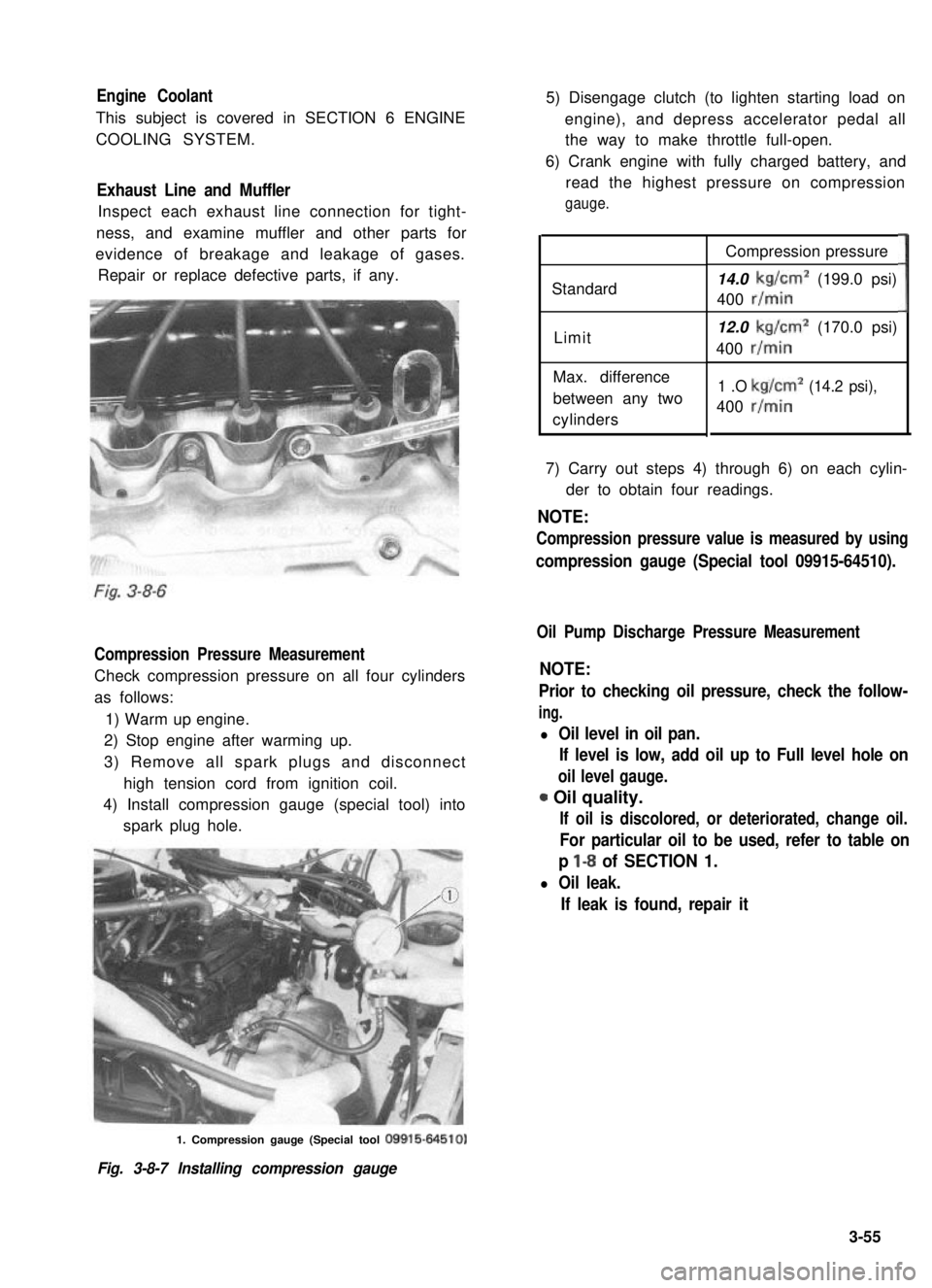
Compression Pressure Measurement
Check compression pressure on all four cylinders
as follows:
1) Warm up engine.
2) Stop engine after warming up.
3) Remove all spark plugs and disconnect
high tension cord from ignition coil.
4) Install compression gauge (special tool) into
spark plug hole.
5) Disengage clutch (to lighten starting load on
engine), and depress accelerator pedal all
the way to make throttle full-open.
6) Crank engine with fully charged battery, and
read the highest pressure on compression
gauge.
Standard
Limit
Max. difference
between any two
cylinders
Compression pressure
14.0 kg/cm2 (199.0 psi)
400 r/min
12.0 kg/cm2 (170.0 psi)
400 r/min
1 .O kg/cm2 (14.2 psi),
400 r/min
3
7) Carry out steps 4) through 6) on each cylin-
der to obtain four readings.
NOTE:
Compression pressure value is measured by using
compression gauge (Special tool 09915-64510).
Oil Pump Discharge Pressure Measurement
NOTE:
Prior to checking oil pressure, check the follow-
ing.
l Oil level in oil pan.
If level is low, add oil up to Full level hole on
oil level gauge.
0 Oil quality.
If oil is discolored, or deteriorated, change oil.
For particular oil to be used, refer to table on
p l-8 of SECTION 1.
l Oil leak.
If leak is found, repair it
1. Compression gauge (Special tool 09915-64510)
Fig. 3-8-7 Installing compression gauge
3-55
Page 113 of 962
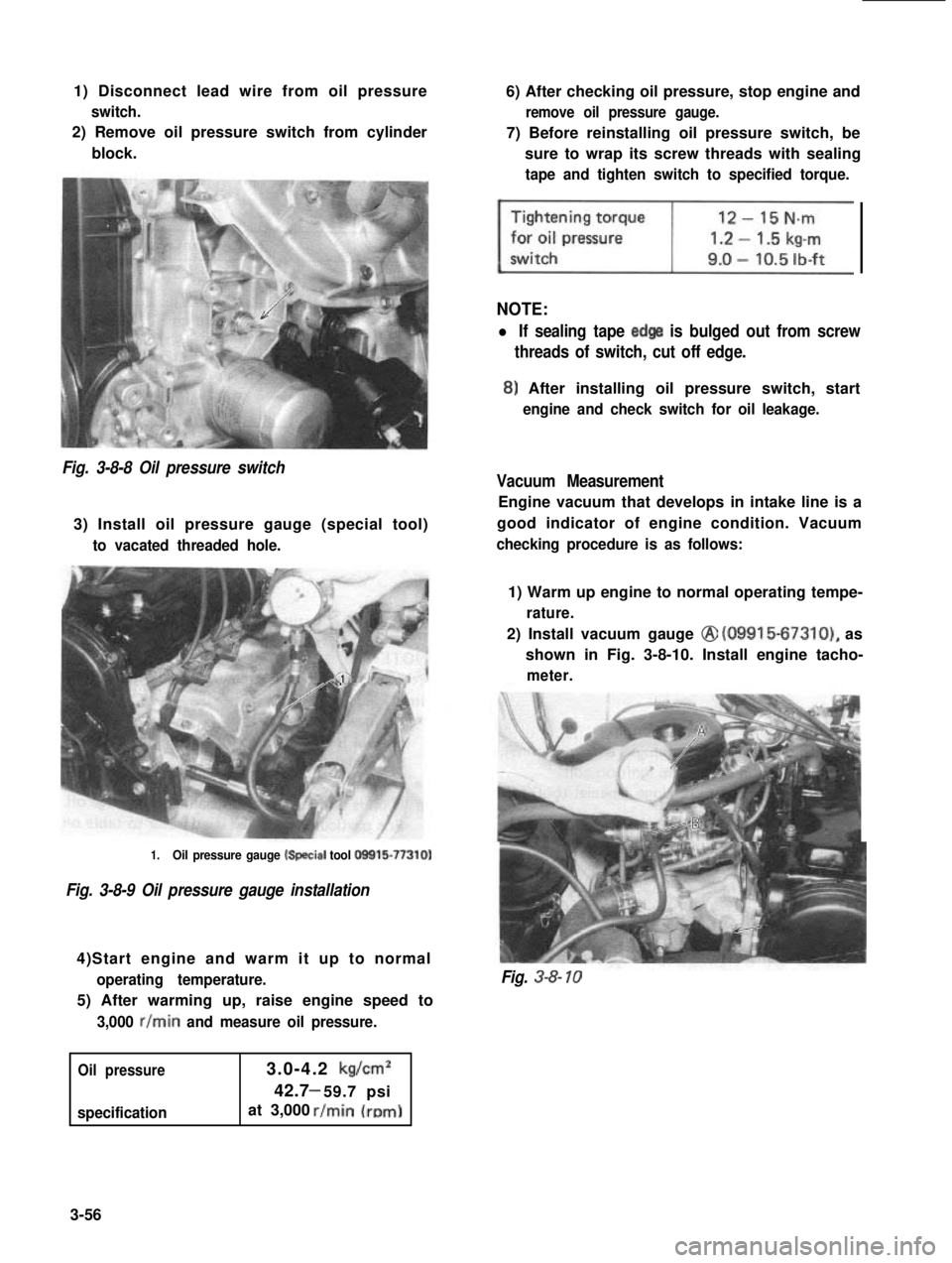
1) Disconnect lead wire from oil pressure
switch.
2) Remove oil pressure switch from cylinder
block.
6) After checking oil pressure, stop engine and
remove oil pressure gauge.
7) Before reinstalling oil pressure switch, be
sure to wrap its screw threads with sealing
tape and tighten switch to specified torque.
NOTE:
l If sealing tape edge is bulged out from screw
threads of switch, cut off edge.
8) After installing oil pressure switch, start
engine and check switch for oil leakage.
Fig. 3-8-8 Oil pressure switch
3) Install oil pressure gauge (special tool)
to vacated threaded hole.
Vacuum Measurement
Engine vacuum that develops in intake line is a
good indicator of engine condition. Vacuum
checking procedure is as follows:
1.Oil pressure gauge k+ecial tool O!Xil5-77310)
Fig. 3-8-9 Oil pressure gauge installation
4)Start engine and warm it up to normal
operating temperature.
5) After warming up, raise engine speed to
3,000 r/min and measure oil pressure.
Oil pressure
specification
3.0-4.2 kg/cm2
42.7 59.7 psi-
at 3,000
1) Warm up engine to normal operating tempe-
rature.
2) Install vacuum gauge @ (09915-67310), as
shown in Fig. 3-8-10. Install engine tacho-
meter.
Fig. 3-8- 10
3-56
Page 114 of 962
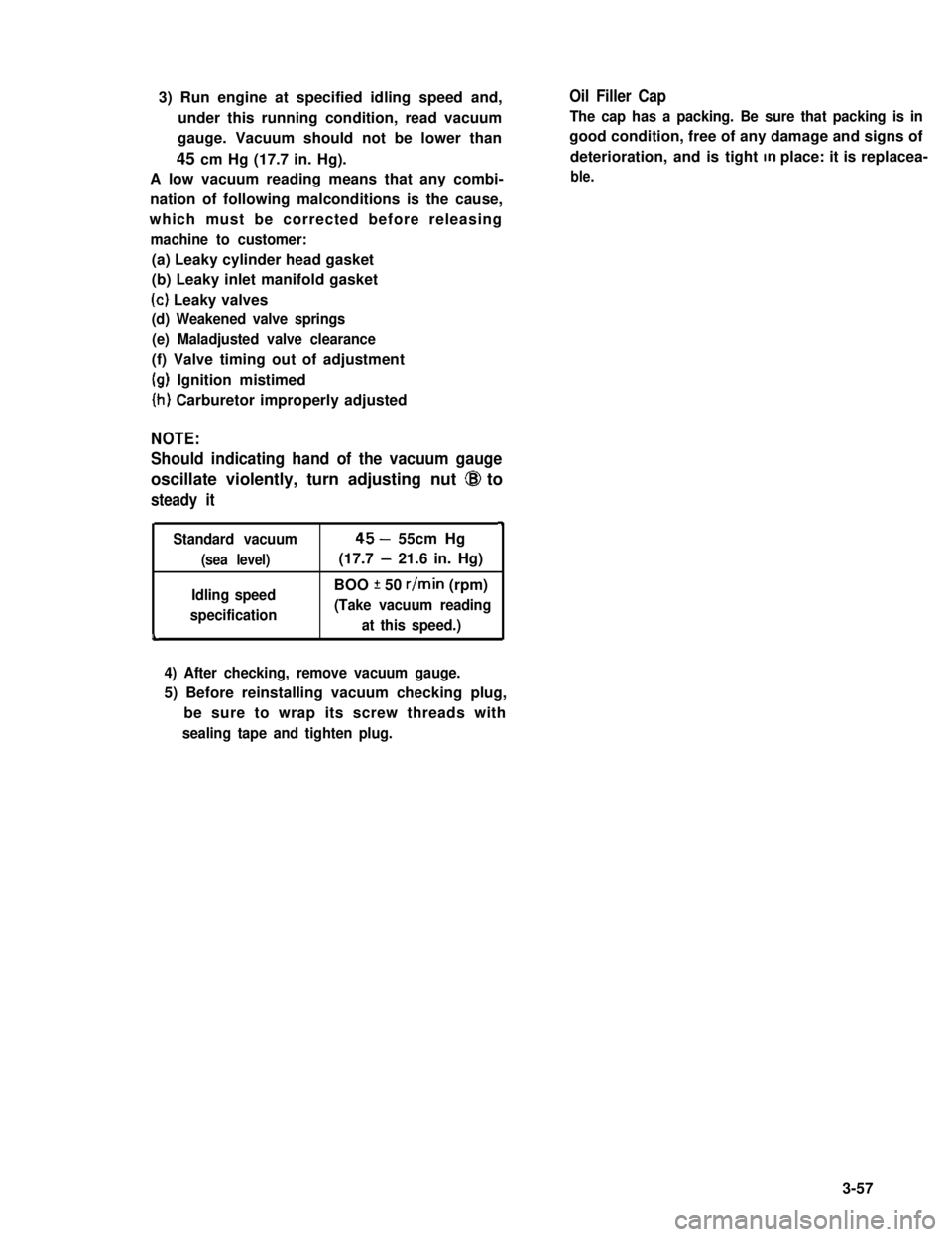
3) Run engine at specified idling speed and,
under this running condition, read vacuum
gauge. Vacuum should not be lower than
45 cm Hg (17.7 in. Hg).
A low vacuum reading means that any combi-
nation of following malconditions is the cause,
which must be corrected before releasing
machine to customer:
Oil Filler Cap
The cap has a packing. Be sure that packing is in
good condition, free of any damage and signs of
deterioration, and is tight In place: it is replacea-
ble.
(a) Leaky cylinder head gasket
(b) Leaky inlet manifold gasket
(c) Leaky valves
(d) Weakened valve springs
(e) Maladjusted valve clearance
(f) Valve timing out of adjustment
(g) Ignition mistimed
(h) Carburetor improperly adjusted
NOTE:
Should indicating hand of the vacuum gauge
oscillate violently, turn adjusting nut @I to
steady it
4
Standard vacuum45- 55cm Hg
(sea level)(17.7 - 21.6 in. Hg)
Idling speedBOO f 50 r/min (rpm)
specification(Take vacuum reading
at this speed.)L
4) After checking, remove vacuum gauge.
5) Before reinstalling vacuum checking plug,
be sure to wrap its screw threads with
sealing tape and tighten plug.
3-57