Lock SUZUKI GRAND VITARA 2001 2.G Owners Manual
[x] Cancel search | Manufacturer: SUZUKI, Model Year: 2001, Model line: GRAND VITARA, Model: SUZUKI GRAND VITARA 2001 2.GPages: 656, PDF Size: 14.31 MB
Page 574 of 656
SEAT BELT 10A-5
Seat belt switch
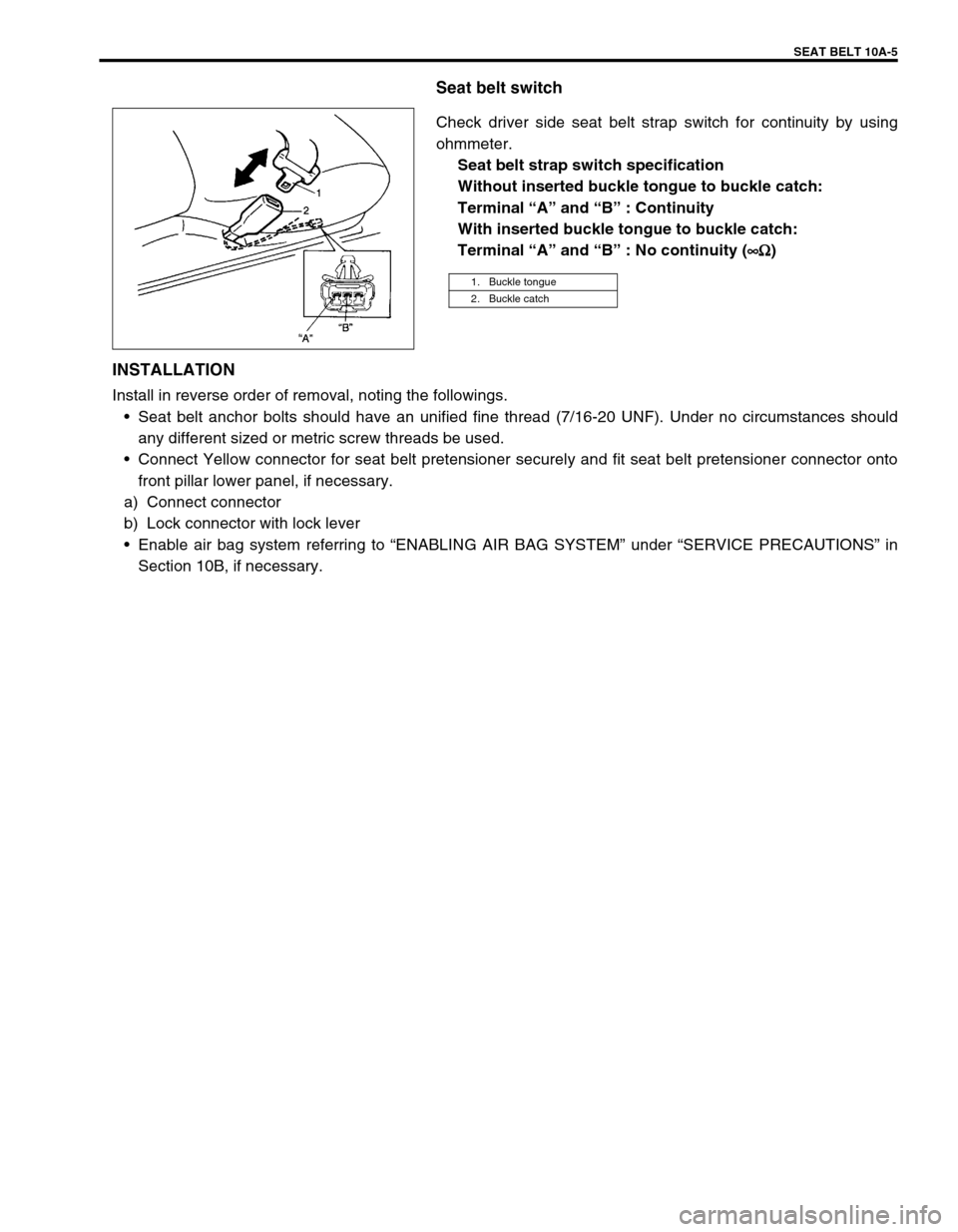
Check driver side seat belt strap switch for continuity by using
ohmmeter.
Seat belt strap switch specification
Without inserted buckle tongue to buckle catch:
Terminal “A” and “B” : Continuity
With inserted buckle tongue to buckle catch:
Terminal “A” and “B” : No continuity (∞Ω
∞Ω∞Ω ∞Ω)
INSTALLATION
Install in reverse order of removal, noting the followings.
•Seat belt anchor bolts should have an unified fine thread (7/16-20 UNF). Under no circumstances should
any different sized or metric screw threads be used.
•Connect Yellow connector for seat belt pretensioner securely and fit seat belt pretensioner connector onto
front pillar lower panel, if necessary.
a) Connect connector
b) Lock connector with lock lever
•Enable air bag system referring to “ENABLING AIR BAG SYSTEM” under “SERVICE PRECAUTIONS” in
Section 10B, if necessary.
1. Buckle tongue
2. Buckle catch
Page 578 of 656
AIR BAG SYSTEM 10B-1
10B
SECTION 10B
AIR BAG SYSTEM
CONTENTS
General Description ......................................10B-3
System Components and Wiring Location
View and Connectors .................................. 10B-4
System Wiring Diagram............................... 10B-5
Diagnosis .......................................................10B-6
Diagnostic Trouble Code (DTC) .................. 10B-6
Use of Special Tool ..................................... 10B-6
Intermittents and Poor Connections ............ 10B-8
Air Bag Diagnostic System Check............... 10B-9
Air Bag Diagnostic System Check Flow
Table ......................................................... 10B-10
DTC Check ................................................ 10B-11
DTC Clearance ......................................... 10B-12
DTC Table ................................................. 10B-14
Table A - “AIR BAG” Warning Lamp
Comes ON Steady .................................... 10B-16
Table B - “AIR BAG” Warning Lamp Does
Not Come ON ............................................ 10B-16
Table C - “AIR BAG” Warning Lamp
Flashes ...................................................... 10B-16Table D - “AIR BAG” Warning Lamp
Cannot Indicate Flashing Pattern of DTC . 10B-16
Table E - SDM Cannot Communicate
through The Serial Data Circuit................. 10B-21
DTC B1015 - Passenger Air Bag Initiator
Circuit Resistance High............................. 10B-23
DTC B1016 - Passenger Air Bag Initiator
Circuit Resistance Low ............................. 10B-23
DTC B1018 - Passenger Air Bag Initiator
Circuit Short to Ground ............................. 10B-23
DTC B1019 - Passenger Air Bag Initiator
Circuit Short to Power Circuit .................... 10B-23
DTC B1021 – Driver Air Bag Initiator
Circuit Resistance High............................. 10B-28
DTC B1022 – Driver Air Bag Initiator
Circuit Resistance Low ............................. 10B-28
DTC B1024 – Driver Air Bag Initiator
Circuit Short to Ground ............................. 10B-28
DTC B1025 – Driver Air Bag Initiator
Circuit Short to Power Circuit .................... 10B-28 WARNING:
Service on or around the air bag system components or wiring must be performed only by an
authorized SUZUKI dealer. Please observe all WARNINGS and “Service Precautions” under “On-
Vehicle Service” in this section before performing service on or around the air bag system compo-
nents or wiring. Failure to follow WARNINGS could result in unintended activation of the system or
could render the system inoperative. Either of these two conditions may result in severe injury.
The procedures in this section must be followed in the order listed to disable the air bag system
temporarily and prevent false diagnostic trouble codes from setting. Failure to follow procedures
could result in possible activation of the air bag system, personal injury or otherwise unneeded air
bag system repairs.
CAUTION:
When fasteners are removed, always reinstall them at the same location from which they were
removed. If a fastener needs to be replaced, use the correct part number fastener for that application.
If the correct part number fastener is not available, a fastener of equal size and strength (or stronger)
may be used. Fasteners that are not reused, and those requiring thread-locking compound, will be
called out. The correct torque value must be used when installing fasteners that require it. If the above
conditions are not followed, parts or system damage could result.
NOTE:
For the descriptions (items) not found in this section, refer to the same section of the Service Manual
mentioned in the FOREWORD of this manual.
Page 598 of 656
AIR BAG SYSTEM 10B-21
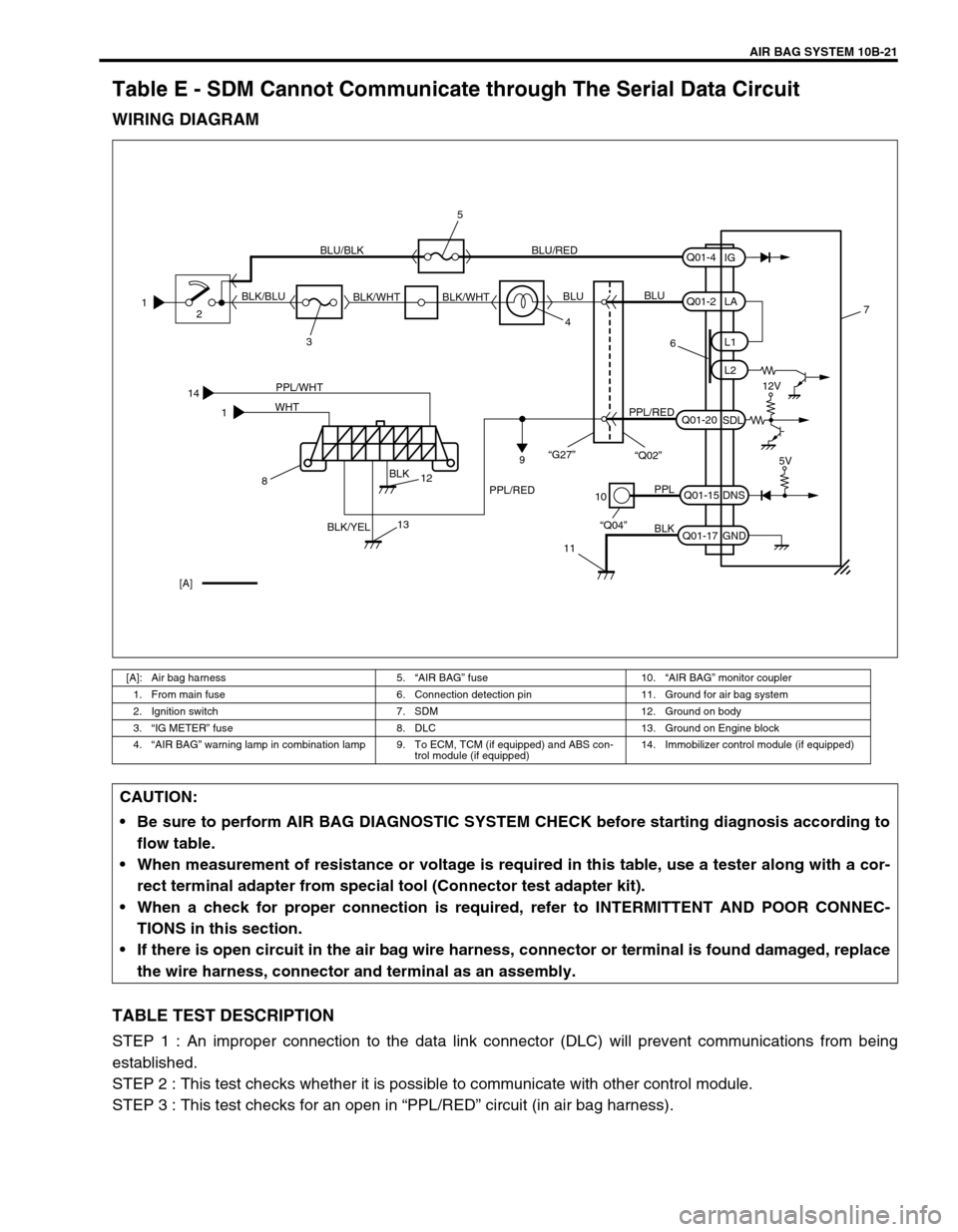
Table E - SDM Cannot Communicate through The Serial Data Circuit
WIRING DIAGRAM
TABLE TEST DESCRIPTION
STEP 1 : An improper connection to the data link connector (DLC) will prevent communications from being
established.
STEP 2 : This test checks whether it is possible to communicate with other control module.
STEP 3 : This test checks for an open in “PPL/RED” circuit (in air bag harness).
[A]: Air bag harness 5.“AIR BAG” fuse 10.“AIR BAG” monitor coupler
1. From main fuse 6. Connection detection pin 11. Ground for air bag system
2. Ignition switch 7. SDM 12. Ground on body
3.“IG METER” fuse 8. DLC 13. Ground on Engine block
4.“AIR BAG” warning lamp in combination lamp 9. To ECM, TCM (if equipped) and ABS con-
trol module (if equipped)14. Immobilizer control module (if equipped)
14
1PPL/WHT
BLK
BLK/YEL WHT
10
11
PPL
BLK
“Q04”Q01-15
Q01-17DNS
GND7
[A]5V
812
13
1
2
34 BLK/BLUBLU/BLK BLU/RED
BLK/WHT BLK/WHTBLUBLU
6
PPL/REDPPL/RED
9
Q01-2
Q01-20L1
L2
SDLLA
Q01-4
IG
12V
“G27”
“Q02”
5
CAUTION:
Be sure to perform AIR BAG DIAGNOSTIC SYSTEM CHECK before starting diagnosis according to
flow table.
When measurement of resistance or voltage is required in this table, use a tester along with a cor-
rect terminal adapter from special tool (Connector test adapter kit).
When a check for proper connection is required, refer to INTERMITTENT AND POOR CONNEC-
TIONS in this section.
If there is open circuit in the air bag wire harness, connector or terminal is found damaged, replace
the wire harness, connector and terminal as an assembly.
Page 627 of 656
10B-50 AIR BAG SYSTEM
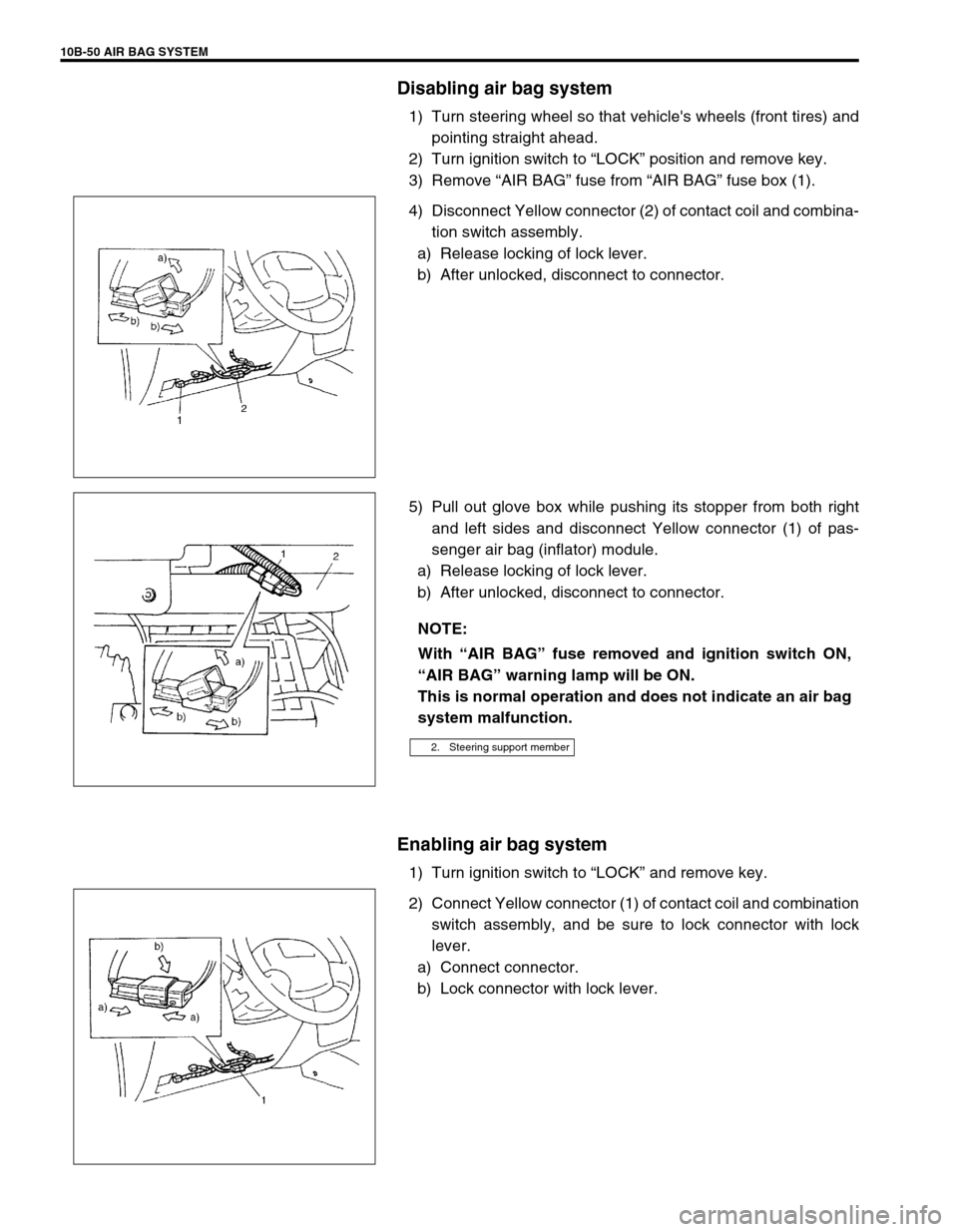
Disabling air bag system
1) Turn steering wheel so that vehicle's wheels (front tires) and
pointing straight ahead.
2) Turn ignition switch to “LOCK” position and remove key.
3) Remove “AIR BAG” fuse from “AIR BAG” fuse box (1).
4) Disconnect Yellow connector (2) of contact coil and combina-
tion switch assembly.
a) Release locking of lock lever.
b) After unlocked, disconnect to connector.
5) Pull out glove box while pushing its stopper from both right
and left sides and disconnect Yellow connector (1) of pas-
senger air bag (inflator) module.
a) Release locking of lock lever.
b) After unlocked, disconnect to connector.
Enabling air bag system
1) Turn ignition switch to “LOCK” and remove key.
2) Connect Yellow connector (1) of contact coil and combination
switch assembly, and be sure to lock connector with lock
lever.
a) Connect connector.
b) Lock connector with lock lever.
NOTE:
With “AIR BAG” fuse removed and ignition switch ON,
“AIR BAG” warning lamp will be ON.
This is normal operation and does not indicate an air bag
system malfunction.
2. Steering support member
Page 628 of 656
AIR BAG SYSTEM 10B-51
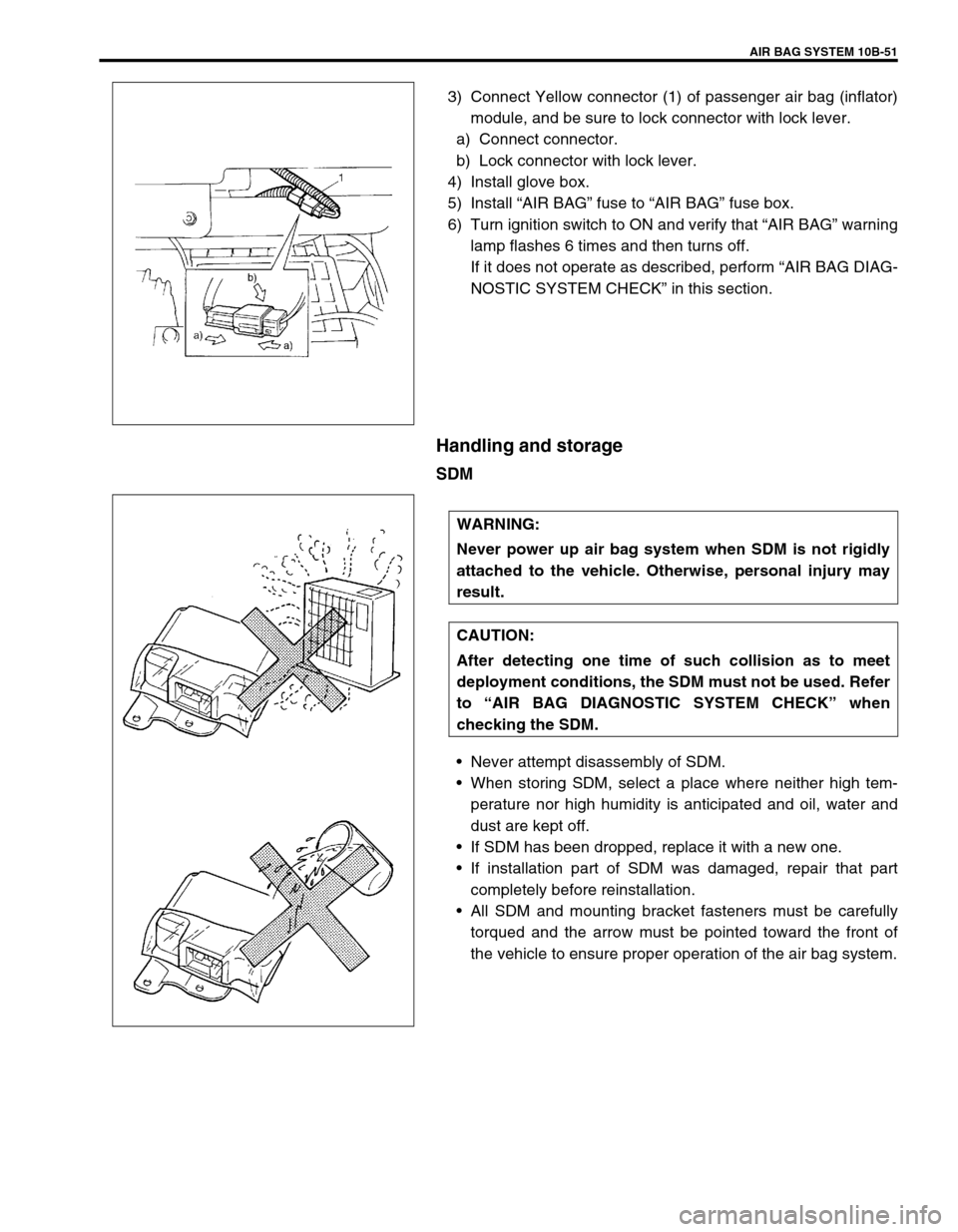
3) Connect Yellow connector (1) of passenger air bag (inflator)
module, and be sure to lock connector with lock lever.
a) Connect connector.
b) Lock connector with lock lever.
4) Install glove box.
5) Install “AIR BAG” fuse to “AIR BAG” fuse box.
6) Turn ignition switch to ON and verify that “AIR BAG” warning
lamp flashes 6 times and then turns off.
If it does not operate as described, perform “AIR BAG DIAG-
NOSTIC SYSTEM CHECK” in this section.
Handling and storage
SDM
•Never attempt disassembly of SDM.
•When storing SDM, select a place where neither high tem-
perature nor high humidity is anticipated and oil, water and
dust are kept off.
•If SDM has been dropped, replace it with a new one.
•If installation part of SDM was damaged, repair that part
completely before reinstallation.
•All SDM and mounting bracket fasteners must be carefully
torqued and the arrow must be pointed toward the front of
the vehicle to ensure proper operation of the air bag system.
WARNING:
Never power up air bag system when SDM is not rigidly
attached to the vehicle. Otherwise, personal injury may
result.
CAUTION:
After detecting one time of such collision as to meet
deployment conditions, the SDM must not be used. Refer
to “AIR BAG DIAGNOSTIC SYSTEM CHECK” when
checking the SDM.
Page 637 of 656
10B-60 AIR BAG SYSTEM
SDM
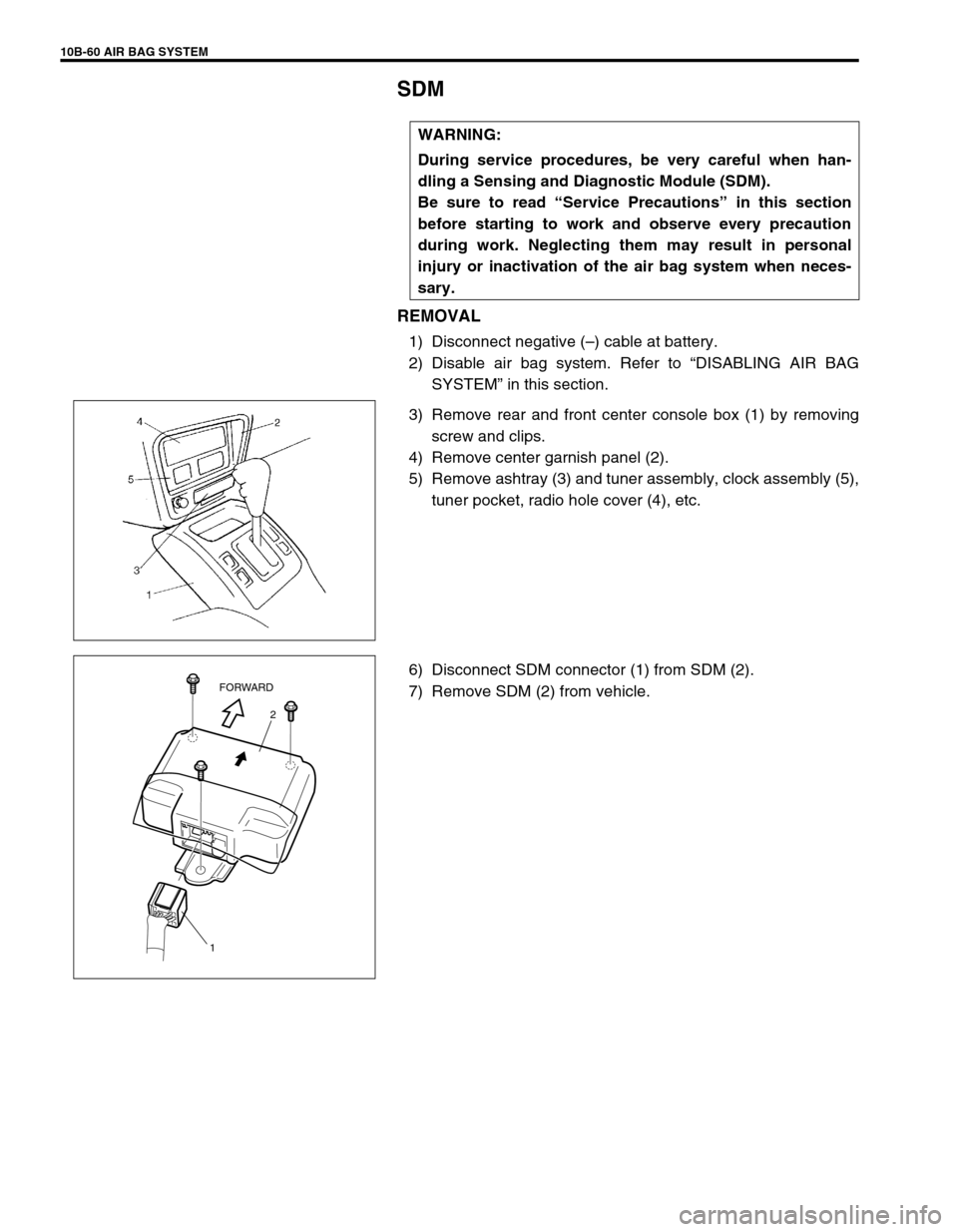
REMOVAL
1) Disconnect negative (–) cable at battery.
2) Disable air bag system. Refer to “DISABLING AIR BAG
SYSTEM” in this section.
3) Remove rear and front center console box (1) by removing
screw and clips.
4) Remove center garnish panel (2).
5) Remove ashtray (3) and tuner assembly, clock assembly (5),
tuner pocket, radio hole cover (4), etc.
6) Disconnect SDM connector (1) from SDM (2).
7) Remove SDM (2) from vehicle.WARNING:
During service procedures, be very careful when han-
dling a Sensing and Diagnostic Module (SDM).
Be sure to read “Service Precautions” in this section
before starting to work and observe every precaution
during work. Neglecting them may result in personal
injury or inactivation of the air bag system when neces-
sary.
2
1FORWARD
Page 638 of 656
AIR BAG SYSTEM 10B-61
INSPECTION
•Check SDM and SDM plate for dents, cracks or deformation.
•Check SDM connector for damage, cracks or lock mecha-
nism.
•Check SDM terminal for bent, corrosion or rust.
If any faulty condition is found in above checks, replace.
INSTALLATION
1) Check that none of following faulty conditions exists.
•Bend, scratch, deformity in vehicle body mounted on SDM
•Foreign matter or rust on mating surface of vehicle body
mounted on SDM
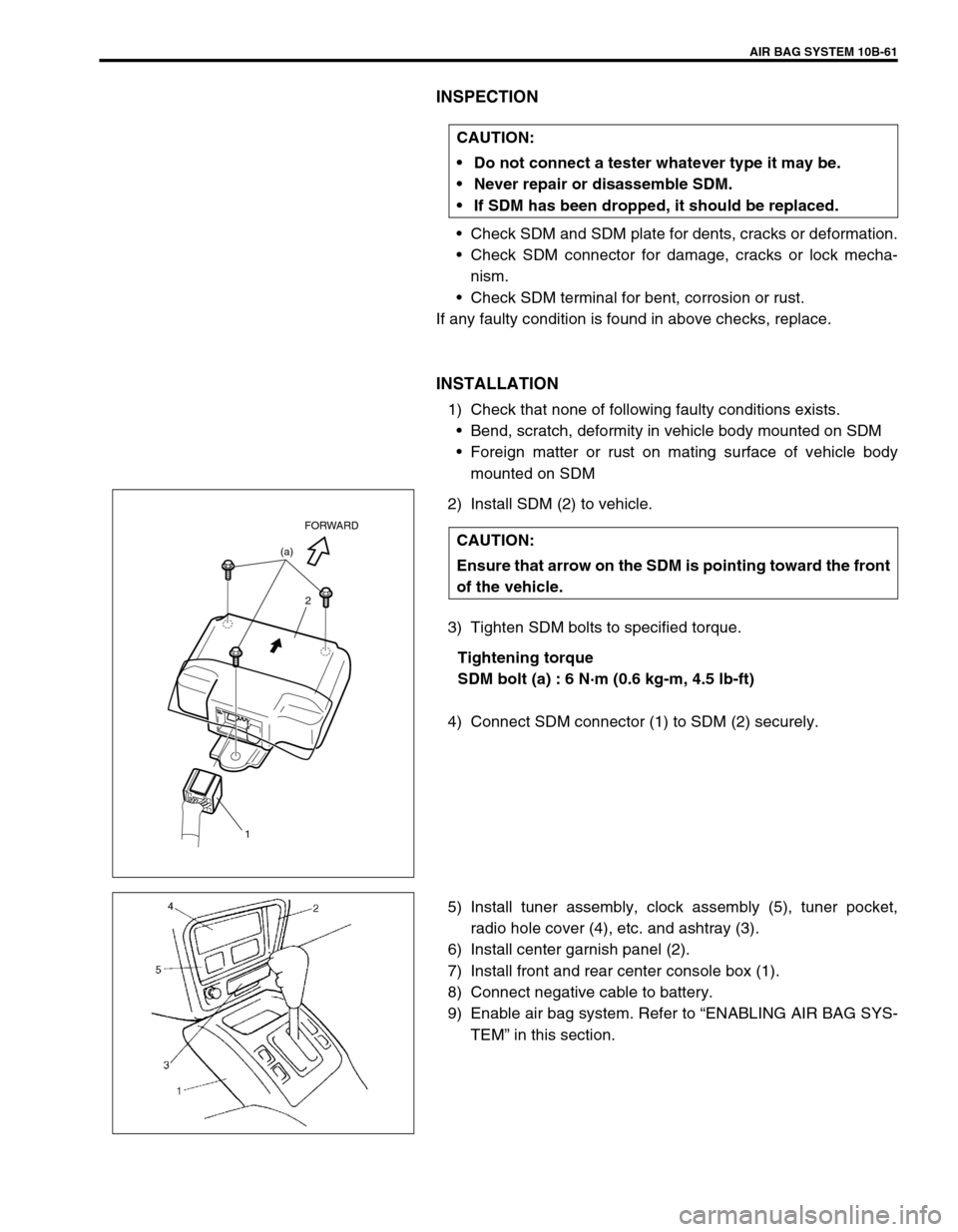
2) Install SDM (2) to vehicle.
3) Tighten SDM bolts to specified torque.
Tightening torque
SDM bolt (a) : 6 N·m (0.6 kg-m, 4.5 lb-ft)
4) Connect SDM connector (1) to SDM (2) securely.
5) Install tuner assembly, clock assembly (5), tuner pocket,
radio hole cover (4), etc. and ashtray (3).
6) Install center garnish panel (2).
7) Install front and rear center console box (1).
8) Connect negative cable to battery.
9) Enable air bag system. Refer to “ENABLING AIR BAG SYS-
TEM” in this section. CAUTION:
Do not connect a tester whatever type it may be.
Never repair or disassemble SDM.
If SDM has been dropped, it should be replaced.
CAUTION:
Ensure that arrow on the SDM is pointing toward the front
of the vehicle.(a)
2
1
FORWARD
Page 640 of 656
AIR BAG SYSTEM 10B-63
INSPECTION
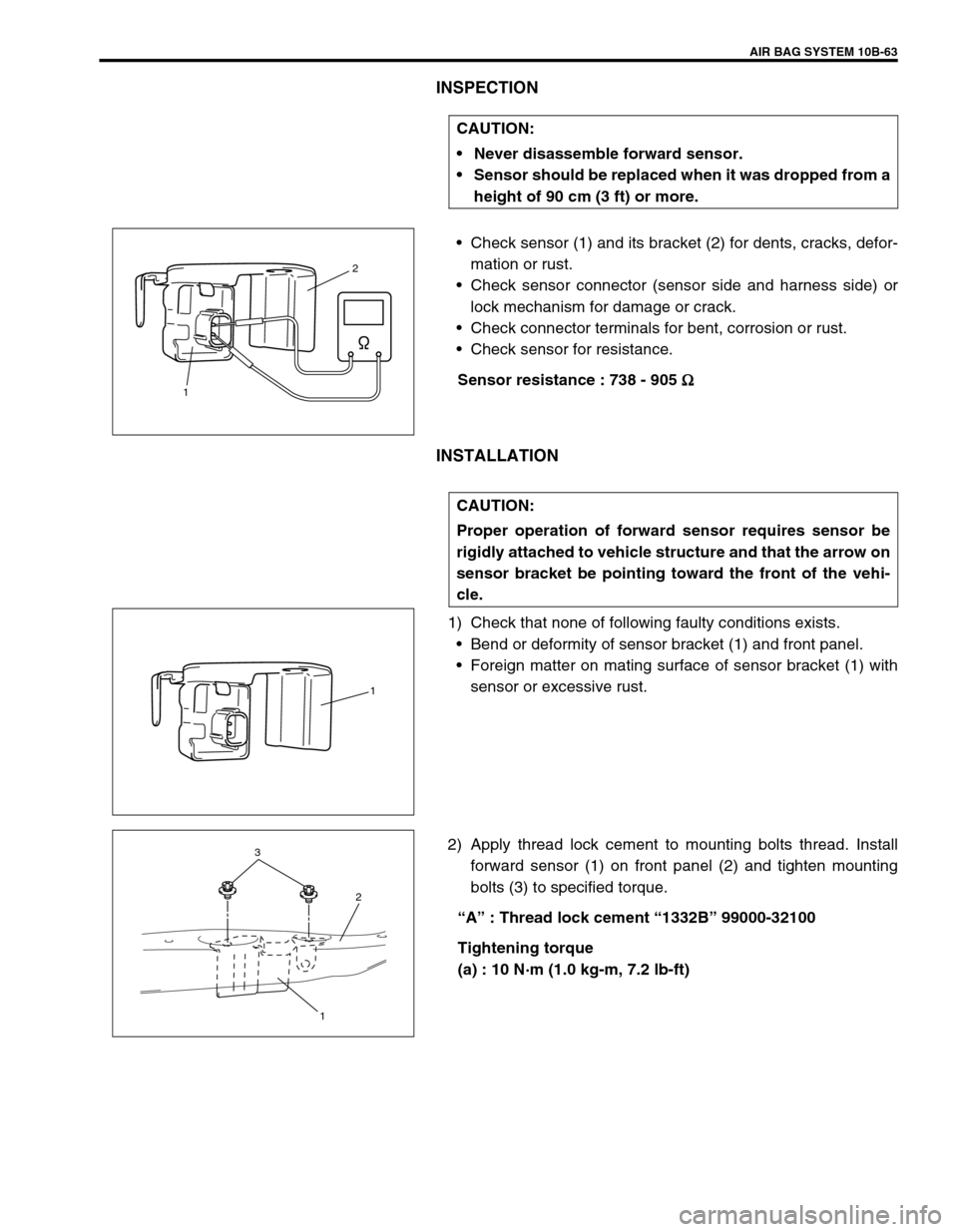
•Check sensor (1) and its bracket (2) for dents, cracks, defor-
mation or rust.
•Check sensor connector (sensor side and harness side) or
lock mechanism for damage or crack.
•Check connector terminals for bent, corrosion or rust.
•Check sensor for resistance.
Sensor resistance : 738 - 905 Ω
ΩΩ Ω
INSTALLATION
1) Check that none of following faulty conditions exists.
•Bend or deformity of sensor bracket (1) and front panel.
•Foreign matter on mating surface of sensor bracket (1) with
sensor or excessive rust.
2) Apply thread lock cement to mounting bolts thread. Install
forward sensor (1) on front panel (2) and tighten mounting
bolts (3) to specified torque.
“A” : Thread lock cement “1332B” 99000-32100
Tightening torque
(a) : 10 N·m (1.0 kg-m, 7.2 lb-ft) CAUTION:
Never disassemble forward sensor.
Sensor should be replaced when it was dropped from a
height of 90 cm (3 ft) or more.
2
1
CAUTION:
Proper operation of forward sensor requires sensor be
rigidly attached to vehicle structure and that the arrow on
sensor bracket be pointing toward the front of the vehi-
cle.
1
3
2
1
Page 643 of 656
10B-66 AIR BAG SYSTEM
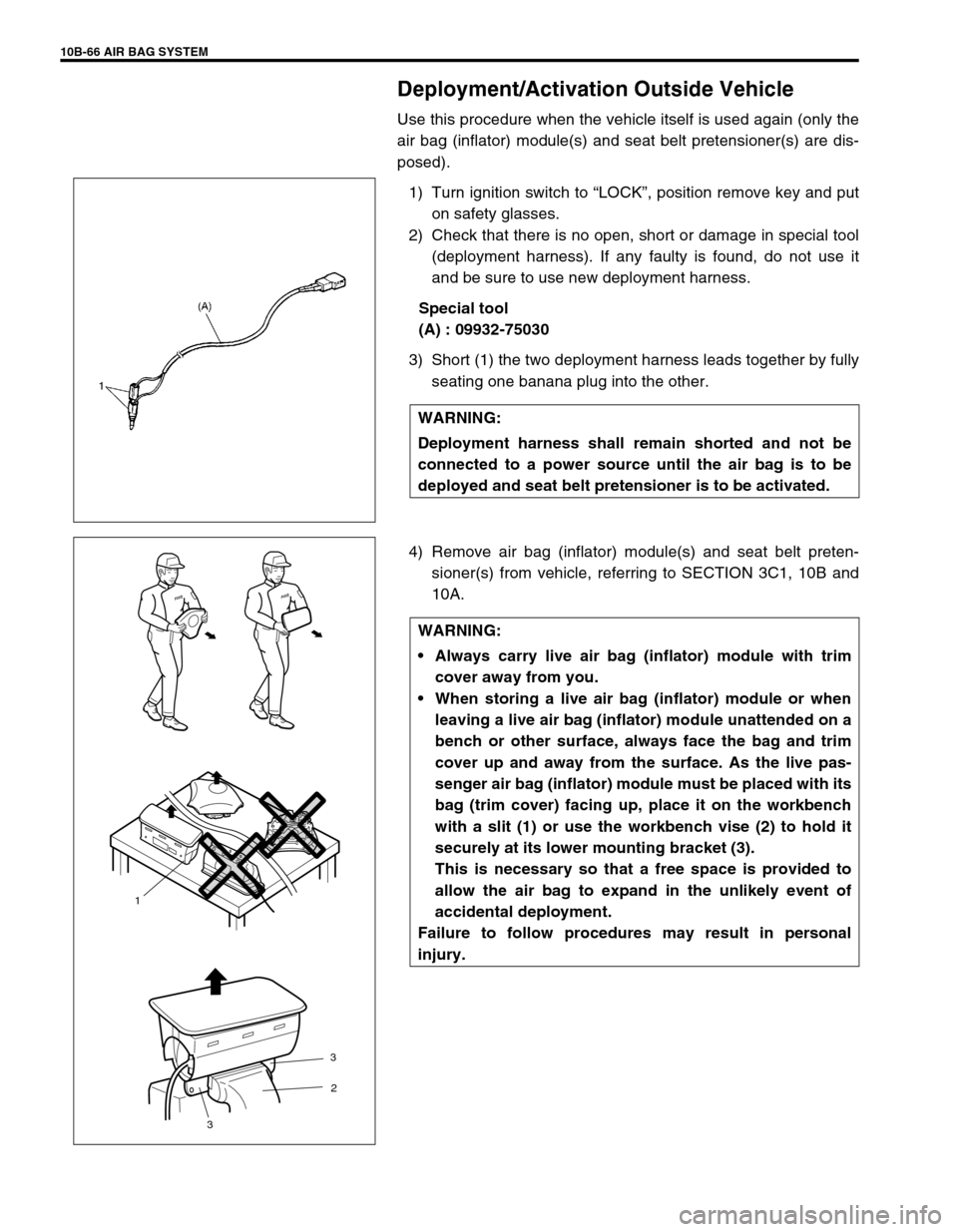
Deployment/Activation Outside Vehicle
Use this procedure when the vehicle itself is used again (only the
air bag (inflator) module(s) and seat belt pretensioner(s) are dis-
posed).
1) Turn ignition switch to “LOCK”, position remove key and put
on safety glasses.
2) Check that there is no open, short or damage in special tool
(deployment harness). If any faulty is found, do not use it
and be sure to use new deployment harness.
Special tool
(A) : 09932-75030
3) Short (1) the two deployment harness leads together by fully
seating one banana plug into the other.
4) Remove air bag (inflator) module(s) and seat belt preten-
sioner(s) from vehicle, referring to SECTION 3C1, 10B and
10A. WARNING:
Deployment harness shall remain shorted and not be
connected to a power source until the air bag is to be
deployed and seat belt pretensioner is to be activated.
WARNING:
Always carry live air bag (inflator) module with trim
cover away from you.
When storing a live air bag (inflator) module or when
leaving a live air bag (inflator) module unattended on a
bench or other surface, always face the bag and trim
cover up and away from the surface. As the live pas-
senger air bag (inflator) module must be placed with its
bag (trim cover) facing up, place it on the workbench
with a slit (1) or use the workbench vise (2) to hold it
securely at its lower mounting bracket (3).
This is necessary so that a free space is provided to
allow the air bag to expand in the unlikely event of
accidental deployment.
Failure to follow procedures may result in personal
injury.
1
3
32
Page 646 of 656
AIR BAG SYSTEM 10B-69
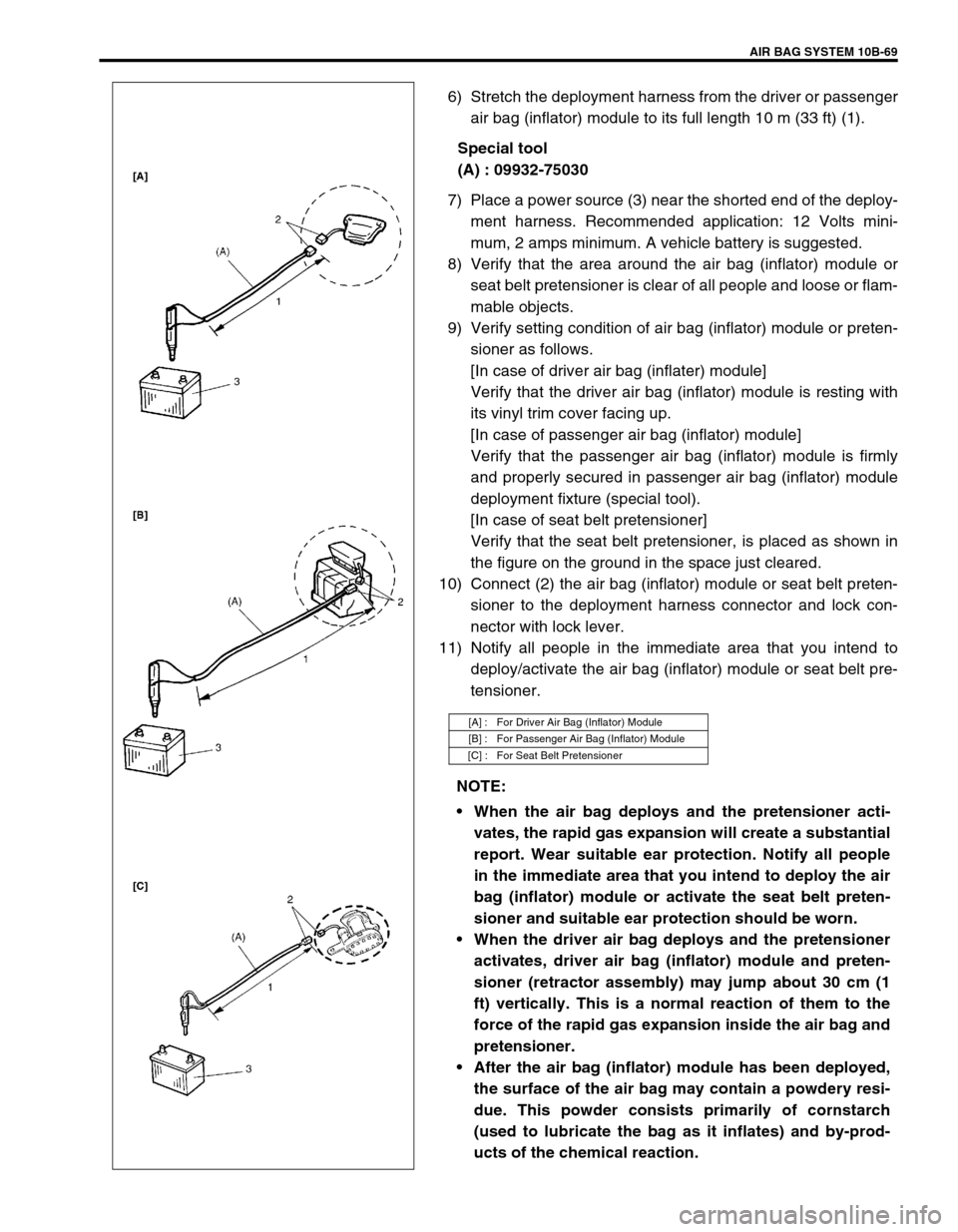
6) Stretch the deployment harness from the driver or passenger
air bag (inflator) module to its full length 10 m (33 ft) (1).
Special tool
(A) : 09932-75030
7) Place a power source (3) near the shorted end of the deploy-
ment harness. Recommended application: 12 Volts mini-
mum, 2 amps minimum. A vehicle battery is suggested.
8) Verify that the area around the air bag (inflator) module or
seat belt pretensioner is clear of all people and loose or flam-
mable objects.
9) Verify setting condition of air bag (inflator) module or preten-
sioner as follows.
[In case of driver air bag (inflater) module]
Verify that the driver air bag (inflator) module is resting with
its vinyl trim cover facing up.
[In case of passenger air bag (inflator) module]
Verify that the passenger air bag (inflator) module is firmly
and properly secured in passenger air bag (inflator) module
deployment fixture (special tool).
[In case of seat belt pretensioner]
Verify that the seat belt pretensioner, is placed as shown in
the figure on the ground in the space just cleared.
10) Connect (2) the air bag (inflator) module or seat belt preten-
sioner to the deployment harness connector and lock con-
nector with lock lever.
11) Notify all people in the immediate area that you intend to
deploy/activate the air bag (inflator) module or seat belt pre-
tensioner.
[A] : For Driver Air Bag (Inflator) Module
[B] : For Passenger Air Bag (Inflator) Module
[C] : For Seat Belt Pretensioner
NOTE:
When the air bag deploys and the pretensioner acti-
vates, the rapid gas expansion will create a substantial
report. Wear suitable ear protection. Notify all people
in the immediate area that you intend to deploy the air
bag (inflator) module or activate the seat belt preten-
sioner and suitable ear protection should be worn.
When the driver air bag deploys and the pretensioner
activates, driver air bag (inflator) module and preten-
sioner (retractor assembly) may jump about 30 cm (1
ft) vertically. This is a normal reaction of them to the
force of the rapid gas expansion inside the air bag and
pretensioner.
After the air bag (inflator) module has been deployed,
the surface of the air bag may contain a powdery resi-
due. This powder consists primarily of cornstarch
(used to lubricate the bag as it inflates) and by-prod-
ucts of the chemical reaction.