drive SUZUKI JIMNY 2019 Manual PDF
[x] Cancel search | Manufacturer: SUZUKI, Model Year: 2019, Model line: JIMNY, Model: SUZUKI JIMNY 2019Pages: 421, PDF Size: 6.35 MB
Page 188 of 421

OPERATING YOUR VEHICLE
Other than the described above, the dual sensor cannot be detected the vehicle in front of you or light source, and there is a case where high beam assist may not activate properly. Refer to "Situations where the dual sensor may not activate properly" in this section for details.
Under the following situations, switch high beam or low beam manually, When switching back and forth between the high beams (main beams) and low beams frequently When there is a problem using the high beams (main beams) When it is considered disturbing to other drivers or pedestrians
There is a case where high beams (main beams) is switched to low beams by the fog lights of the vehicle in front of you.
Street lights, traffic signals, and illumination of billboards or signs may cause the high beams (main beams) to switch to the low beams, or low beam to remain on.
3-37
Dual sensor brake support OFF switch
You can turn off the dual sensor brake support system. In the following situations, push and hold the dual sensor brake support OFF switch as unexpected dangers may be possible if ii is activated. -When the vehicle is placed upon atester such as when undergoing a vehicle inspection -When the vehicle is put up on a lift, and the tyres are idling -When the vehicle is being towed -When the vehicle is being carried on a car carrier -When the vehicle is being operated on a race track -When there is vinyl curtains or pendulous branches in front of the vehicle -When driving in the field covered with grown grass -When using an automatic car washer -When the vehicle is placed upon a car elevator or placed in a mechanical parking lot -With a spare tyre or snow chains equipped -When you have a temporarily repaired flat tyre -When you have an accident or breakdown -When the automatic brake system is activated frequently
-When tyres are not inflated to the recommended tyre pressure -With worn tyres equipped -With non-specified sized tyres or wheels equipped -With a modified suspension equipped -When attaching an item which inter-feres with the visibility of the dual sensor -When the vehicle is being weighed down by heavy items -When the vehicle is used to tow a trailer
78RB03010
Page 190 of 421
OPERATING YOUR VEHICLE
Traffic sign recognition
(if equipped)
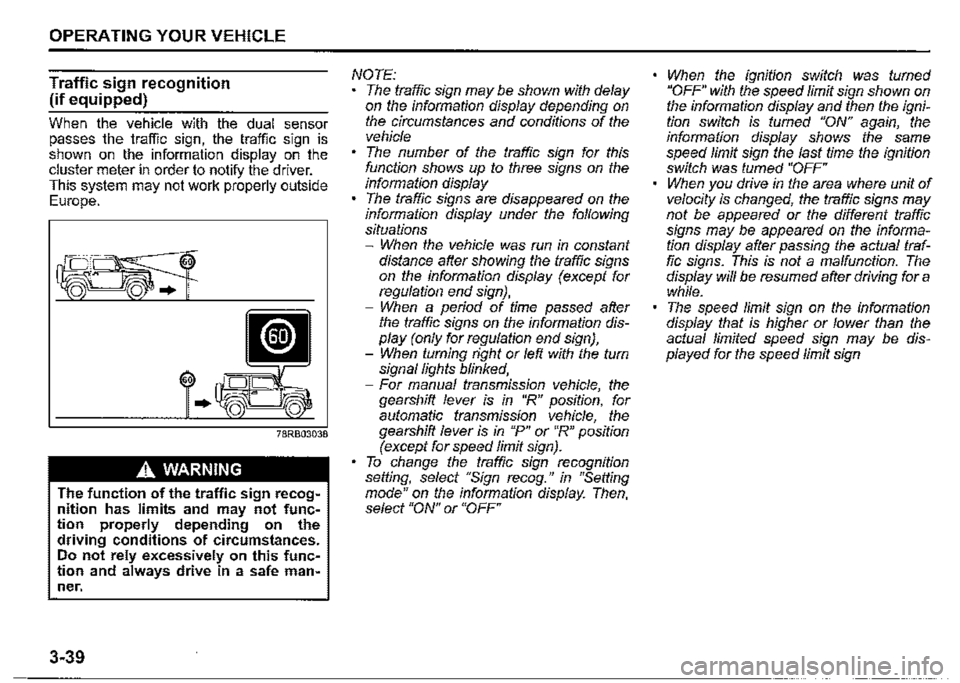
When the vehicle with the dual sensor passes the traffic sign, the traffic sign is shown on the information display on the cluster meter in order to notify the driver. This system may not work properly outside Europe.
60
..
A WARNING
The function of the traffic sign recognition has limits and may not function properly depending on the driving conditions of circumstances. Do not rely excessively on this function and always drive in a safe man~ ner.
3-39
NOTE: The traffic sign may be shown with delay on the information display depending on the circumstances and conditions of the vehicle The number of the traffic sign for this function shows up to three signs on the information display The traffic signs are disappeared on the information display under the following situations -When the vehicle was run in constant distance after showing the traffic signs on the information display (except for regulation end sign}, -When a period of time passed after the traffic signs on the information display (only for regulation end sign), -When turning right or left with the turn signal lights blinked, -For manual transmission vehicle, the gearshift lever is in "R" position, for automatic transmission vehicle, the gearshift lever is in "P" or "R" position (except for speed limit sign). To change the traffic sign recognition setting, select "Sign recog." in "Setting mode" on the information display. Then, select "ON" or "OFF"
When the ignition switch was turned "OFF" with the speed limit sign shown on the information display and then the ignition switch is fumed "ON" again, the information display shows the same speed limit sign the last time the ignition switch was fumed "OFF" When you drive in the area where unit of velocity is changed, the traffic signs may not be appeared or the different traffic signs may be appeared on the information display after passing the actual traffic signs. This is not a malfunction. The display will be resumed after driving for a while. The speed limit sign on the information display that is higher or lower than the actual limited speed sign may be displayed for the speed limit sign
Page 191 of 421

Situations where the system does not activate Under the following situations, the system does not activate. When the engine is off When dual sensor brake support indicator light and lane departure warning indicator light are initially lighting immediately after the ignition switch is in "ON" position For manual transmission vehicle, the gearshift lever is in "R" position, for automatic transmission vehicle, the gearshift lever is in "P", "R", or "N" position When the dual sensor is temporarily stopped or malfunctioning When the ESP® OFF switch is pushed and the system is turned off When the traffic sign recognition is turned off by operating the setting mode of information display When parking brake is applied When you drive in the area that there are no speed limit signs and has speed limit
OPERATING YOUR VEHICLE
3-40
Page 192 of 421

OPERATING YOUR VEHICLE
Types of recognized traffic signs
Information Type of the traffic sign message
[l[I Speed limit begins/ends
~~
No overtaking begins/ends
Speed limit with supplemental mark (Displayed simultaneously with speed limit)
Supplemental mark exists
I
(Display example)
~
All canceled (All restrictions canceled. Returns to default road regu-lation.)
NOTE: The above traffic signs are representative examples. The traffic signs may be different in every country.
3-41
Situations where the dual sensor may not activate properly There may be high possibility not to detect the traffic signs by the dual sensor under the following situations. Also the function of the dual sensor may be stopped temporarily. When the situations are improved, the temporary stop of the function will be canceled. When there is bad weather such as heavy rain, fog or a blizzard When the dual sensor is hit by a bright light such as sunlight or the headlight of oncoming vehicle When there is a sight of similar tone and color such as a snowscape When the vehicle runs on the road which became bright by the reflected light, When there are no lights or lamps as street lamps, etc around in the dark Front visibility is poor due to that there is water vapor, sand or smoke or when the vehicle in front of you is surrounded by exhaust gas, water or snow When you drive in the dawn, the dusk and the night or when you drive in a dark place as an indoor parking lot When the vehicle direction to go ahead or the vehicle position was largely changed (for example, the lane change, left turn, or right turn), When the windshield is covered in fog, snow, ice or dirt
Page 193 of 421

81M40380
When raindrop, water or dirt on the windshield is not wiped up enough While using the windshield washer When a wiper blade other than SUZUKI genuine parts, including short type wiper
blade is used When the tyres are not inflated to the recommended tyre inflation pressure or when the tyres except the assignment size are equipped,
72M20405
When your vehicle is weighed down by heavy items in the luggage compartment or rear seat
When the headlights are covered in dirt, snow, ice or mud When the optical axis of the headlight is deviated When the brightness changes extremely (for example, passing the entrance or exit of tunnel), When the vehicle is swaying on the rough roads (for example, unevenness roads or stone pavement roads) and the visibility of the monocular camera is unstable, There may be a case to display the traffic sign irrelevant to the vehicle, the traffic sign that is not existed around the vehicle under the following situations. -When the traffic sign is existed on the branched road, the junction or the adjacent lane near the road that the vehicle is moving, -When there are similar things to the color and the object of the traffic sign (for example, the similar traffic sign, the signboard or the structures) -When the vehicle that the decal or sticker like the traffic sign is pasted on is existed in front of your vehicle, or when you overtake such a vehicle, -When the traffic sign is in front of the vehicle on the roundabout,
OPERATING YOUR VEHICLE
NOTE: The traffic sign may be continued to display on the information display under the following situations. Drive safely according to the actual traffic rules. -When you drive in the area where the different speed limit is established even though there is no speed limit sign, -When you drive in the area where the end of traffic regulation is indicated by the lane on the road even though there is no traffic sign to indicate the end of the traffic regulation,
Situations where the dual sensor cannot be detected accurately by the positions or conditions of the traffic signs The detection of traffic sign may be done with delay or there may be a possibility to occur no detection or inaccurate detection of the traffic sign including the supplemental mark under the following situations. When the traffic sign is dirt and hidden by the leaves of the tree or the vehicle in front of your vehicle and then it is hard to recognize the traffic sign, When the circumstance of the traffic sign is complicated and it is hard to recognize the traffic sign, When the traffic sign is far from the vehicle, When the traffic sign is bended or
deformed, When the color of the traffic sign is
faded,
3-42
Page 194 of 421
OPERATING YOUR VEHICLE
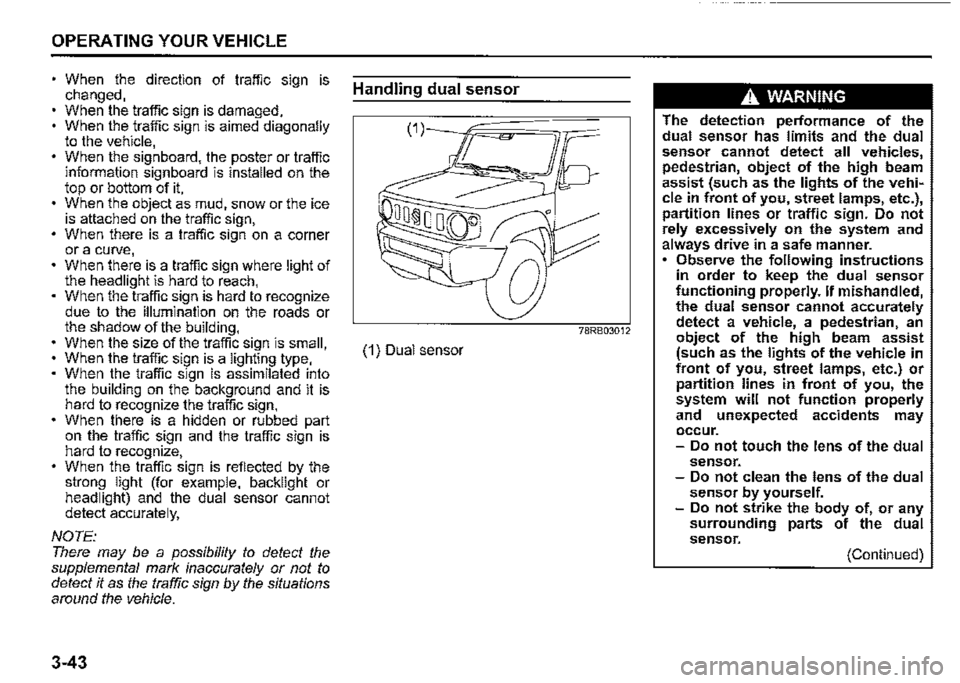
When the direction of traffic sign is Handling dual sensor changed, • When the traffic sign is damaged, • When the traffic sign is aimed diagonally to the vehicle, When the signboard, the poster or traffic information signboard is installed on the top or bottom of it, When the object as mud, snow or the ice is attached on the traffic sign, • When there is a traffic sign on a corner or a curve, When there is a traffic sign where light of the headlight is hard to reach, When the traffic sign is hard to recognize due to the illumination on the roads or the shadow of the building,
When the size of the traffic sign is small, (1) Dual sensor When the traffic sign is a lighting type, When the traffic sign is assimilated into the building on the background and it is hard to recognize the traffic sign, When there is a hidden or rubbed part on the traffic sign and the traffic sign is hard to recognize, When the traffic sign is refiected by the strong light (for example, backlight or headlight) and the dual sensor cannot detect accurately,
NOTE: There may be a possibility to detect the supplemental mark inaccurately or not to detect it as the traffic sign by the situations around the vehicle.
3-43
78RB03012
A WARNING
The detection performance of the dual sensor has limits and the dual sensor cannot detect all vehicles, pedestrian, object of the high beam assist (such as the lights of the vehicle in front of you, street lamps, etc.), partition lines or traffic sign. Do not rely excessively on the system and always drive in a safe manner. • Observe the following instructions in order to keep the dual sensor functioning properly. If mishandled, the dual sensor cannot accurately detect a vehicle, a pedestrian, an object of the high beam assist (such as the lights of the vehicle in front of you, street lamps, etc.) or partition lines in front of you, the system will not function properly and unexpected accidents may occur. -Do not touch the lens of the dual sensor. -Do not clean the lens of the dual sensor by yourself. -Do not strike the body of, or any surrounding parts of the dual sensor. (Continued)
Page 200 of 421
OPERATING YOUR VEHICLE
A WARNING
Even when the detection conditions are satisfied, not all pedestrians may be detected by the dual sensor. In the following situations, there may be a high possibility of undetectable or delay of detection. Always drive in a safe manner. • A person who walks in a group • A person who walks beside a wall or another obstacle A person who has an umbrella up A person whose color is similar to the background and who is blended into the scenery • A person who has a big luggage • A person who walks with a stoop or who crouches. • A person who is lying down • A person who is in a dark place • A person who jumps out in front of you • A person at night
NOTE: As the function of the dual sensor brake support is different depending on some destinations or areas, there are type of vehicles with the function not to detect the pedestrians.
3-49
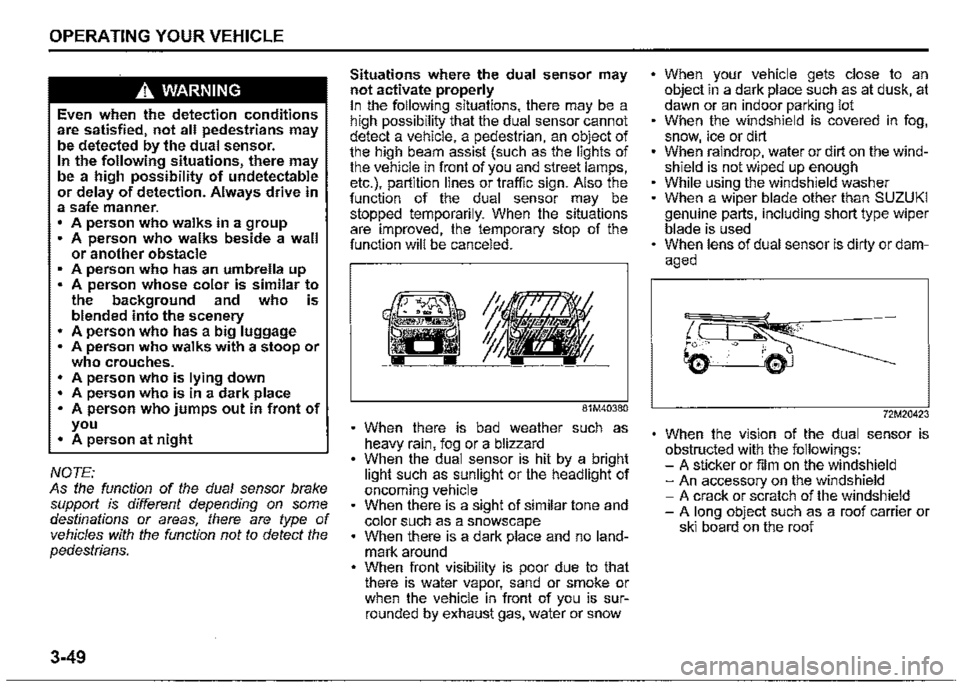
Situations where the dual sensor may not activate properly In the following situations, there may be a high possibility that the dual sensor cannot detect a vehicle, a pedestrian, an object of the high beam assist (such as the lights of the vehicle in front of you and street lamps, etc.), partition lines or traffic sign. Also the function of the dual sensor may be stopped temporarily. When the situations are improved, the temporary stop of the function will be canceled.
81M40380
When there is bad weather such as heavy rain, fog or a blizzard When the dual sensor is hit by a bright light such as sunlight or the headlight of oncoming vehicle When there is a sight of similar tone and color such as a snowscape When there is a dark place and no landmark around When front visibility is poor due to that there is water vapor, sand or smoke or when the vehicle in front of you is surrounded by exhaust gas, water or snow
• When your vehicle gets close to an object in a dark place such as at dusk, at dawn or an indoor parking lot When the windshield is covered in fog, snow, ice or dirt • When raindrop, water or dirt on the windshield is not wiped up enough While using the windshield washer When a wiper blade other than SUZUKI genuine parts, including short type wiper blade is used When lens of dual sensor is dirty or dam
aged
72M20423
When the vision of the dual sensor is obstructed with the followings: -A sticker or film on the windshield -An accessory on the windshield -A crack or scratch of the windshield -A long object such as a roof carrier or ski board on the roof
Page 203 of 421
Emergency stop signal (ESS) (if equipped)
ESS stands for Emergency Stop Signal.
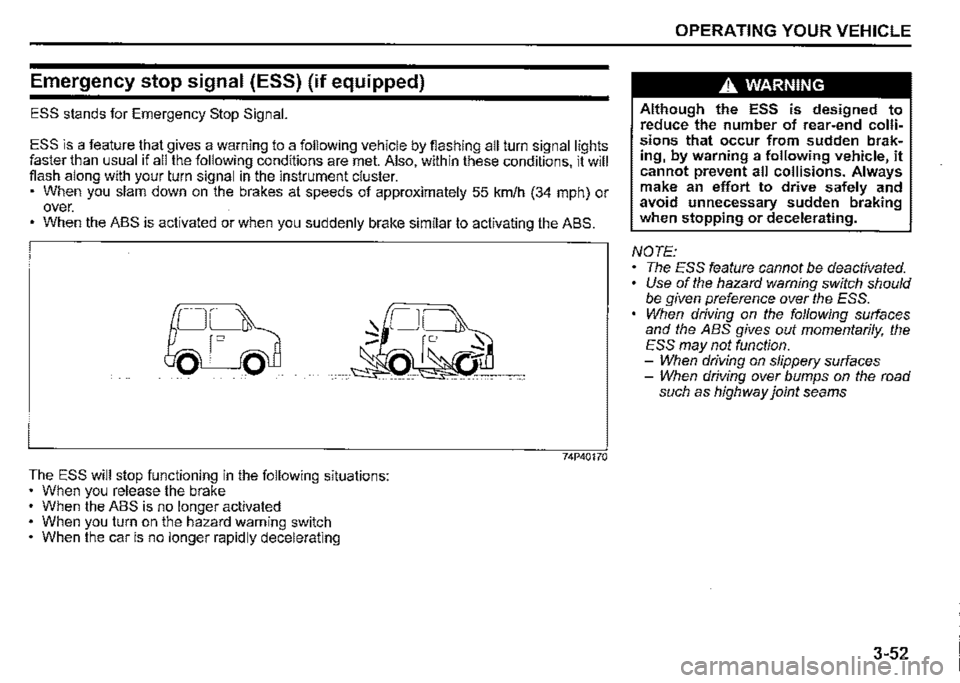
ESS is a feature t_hat gives a warning to a following vehicle by fiashing all turn signal lights faster than usual 1f all the following conditions are met. Also, within these conditions, it will fiash along with your turn signal in the instrument cluster. • When you slam down on the brakes at speeds of approximately 55 km/h (34 mph) or over. • When the ABS is activated or when you suddenly brake similar to activating the ABS.
The ESS will stop functioning in the following situations: • When you release the brake When the ABS is no longer activated When you turn on the hazard warning switch When the car is no longer rapidly decelerating
0
74P40170
OPERATING YOUR VEHICLE
A WARNING
Although the ESS is designed to reduce the number of rear-end collisions that occur from sudden braking, by warning a following vehicle, it cannot prevent all collisions. Always make an effort to drive safely and avoid unnecessary sudden braking when stopping or decelerating.
NOTE: The ESS feature cannot be deactivated. • Use of the hazard warning switch should be given preference over the ESS. When driving on the following surfaces and the ABS gives out momentarily, the ESS may not function. -When driving on slippery surfaces -When driving over bumps on the road such as highway joint seams
3-52
Page 204 of 421

OPERATING YOUR VEHICLE
Braking
60G165S
The distance needed to bring any vehicle to a halt increases with the speed of the vehicle. The braking distance needed, for example, at 60 km/h (37 mph) will be approximately 4 times greater than the braking distance needed at 30 km/h (19 mph). Start to depress the brake pedal when there is plenty of distance between your vehicle and the stopping point, and slow down gradually.
3-53
A WARNING
If water gets into the brake devices, brake performance may become poor and unpredictable. After driving through water or washing the underside of the vehicle, test the brakes while driving at a slow speed to see if they have maintained their normal effectiveness. If the brakes are less effective than normal, dry them by repeatedly applying the brakes while driving slowly until the brakes have regained their normal effectiveness.
Power-assisted brakes
Your vehicle has power-assisted brakes. If power assistance is lost due to a stalled engine or other failures, the system is still fully operational on reserve power and you can bring the vehicle to a complete stop by pressing the brake pedal once and holding it down. The reserve power is partly used up when you depress the brake pedal and reduces each time the pedal is pressed. Apply smooth and even pressure to the pedal. Do not pump the pedal.
A WARNING
Even without reserve power in the brake system, you can still stop the vehicle by pressing the brake pedal harder than normally required. However, the stopping distance may be
longer.
Brake assist system
When you slam the brakes on, the brake assist system determines it to be an emergency stop and provides more powerful braking for a driver who cannot hold down the brake pedal firmly.
Page 205 of 421
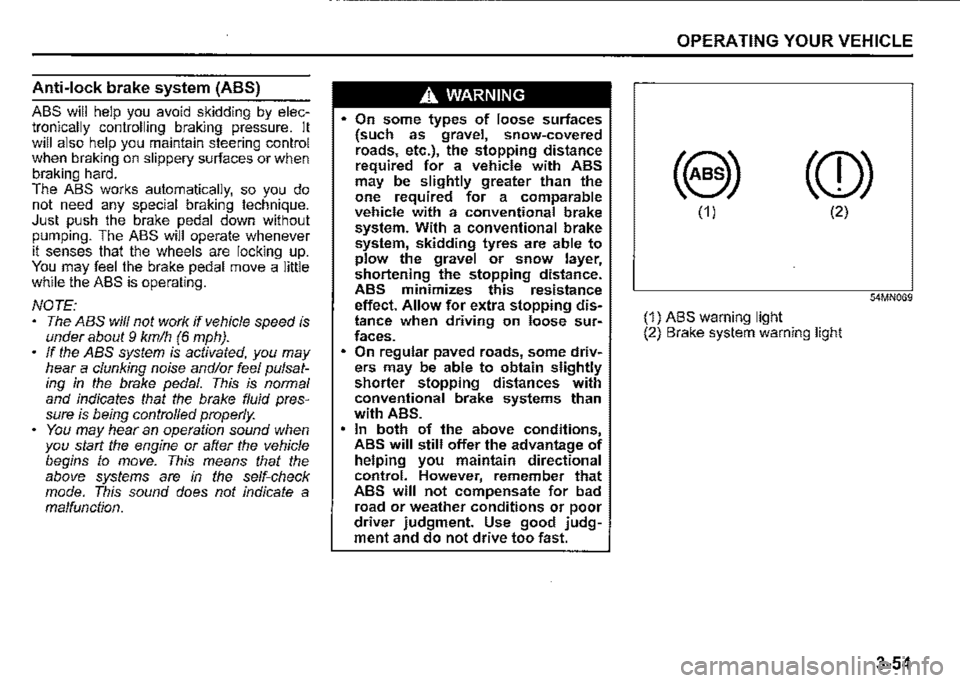
Anti-lock brake system (ABS)
ABS will help you avoid skidding by electronically controlling braking pressure. It will also help you maintain steering control when braking on slippery surfaces or when braking hard. The ABS works automatically, so you do not need any special braking technique. Just push the brake pedal down without pumping. The ABS will operate whenever it senses that the wheels are locking up. You may feel the brake pedal move a little while the ABS is operating.
NOTE: The ABS will not work if vehicle speed is under about 9 km/h (6 mph). ff the ABS system is activated, you may hear a clunking noise and/or feel pulsating in the brake pedal. This is normal and indicates that the brake fluid pressure is being controlled properly. You may hear an operation sound when you start the engine or after the vehicle begins to move. This means that the above systems are in the self-check mode. This sound does not indicate a malfunction.
A WARNING
On some types of loose surfaces (such as gravel, snow-covered roads, etc.), the stopping distance required for a vehicle with ABS may be slightly greater than the one required for a comparable vehicle with a conventional brake system. With a conventional brake system, skidding tyres are able to plow the gravel or snow layer, shortening the stopping distance. ABS minimizes this resistance effect. Allow for extra stopping distance when driving on loose surfaces. On regular paved roads, some drivers may be able to obtain slightly shorter stopping distances with conventional brake systems than with ABS. In both of the above conditions, ABS will still offer the advantage of helping you maintain directional control. However, remember that ABS will not compensate for bad road or weather conditions or poor driver judgment. Use good judgment and do not drive too fast.
OPERATING YOUR VEHICLE
(8) (CD)
(1) (2)
54MN069
(1) ABS warning light (2) Brake system warning light
3-54