wheel SUZUKI SX4 2006 1.G Service Workshop Manual
[x] Cancel search | Manufacturer: SUZUKI, Model Year: 2006, Model line: SX4, Model: SUZUKI SX4 2006 1.GPages: 1556, PDF Size: 37.31 MB
Page 878 of 1556

Downloaded from www.Manualslib.com manuals search engine 6B-9 Steering Wheel and Column:
Steering Lock Assembly (Ignition Switch)
Removal and Installation
S6RW0D6206011
Removal
1) Remove steering column. Refer to “Steering Column
Removal and Installation”.
2) Using center punch (1), loosen and remove steering
lock mounting bolts (2).
NOTE
Use care not to damage aluminum part of
steering lock body with center punch.
3) Turn ignition key to “ACC” or “ON” position and
remove steering lock assembly from steering
column.Installation
1) Position oblong hole (1) of steering shaft (2) in the
center of hole (3) in column (4).
2) Turn ignition key to “ACC” or “ON” position and
install steering lock assembly (5) onto column (4).
3) Now turn ignition key to “LOCK” position and pull it
out.
4) Align hub on lock with oblong hole (1) of steering
shaft (2) and rotate shaft to assure that steering shaft
is locked.
5) Tighten new bolts (1) until head of each bolt is
broken off.
6) Turn ignition key to “ACC” or “ON” position and
check to be sure that steering shaft (2) rotates
smoothly. Also check for lock operation.
7) Install steering column. Refer to “Steering Column
Removal and Installation”.
8) (Keyless start model)
If steering lock assembly has replaced, after
completing installation, register steering lock unit ID
code to keyless start control module as following.
• Immobilizer model:
Register ignition key transponder code in ECM
referring to “Registration of the Ignition Key in
Section 10C”.
• Non-immobilizer model:
Register steering lock unit ID code in keyless start
control module referring to “Keyless Start
Registration in Section 10E”.
I4RS0B620005-02
1
32
4
5
I4RS0B620006-02
I4RS0B620007-02
Page 879 of 1556
Downloaded from www.Manualslib.com manuals search engine Steering Wheel and Column: 6B-10
Steering Lower Shaft Removal and InstallationS6RW0D6206012
CAUTION!
Never turn steering wheel while steering
lower shaft is removed.
Should it have been turned and contact coil
have got out of its centered position, it needs
to be centered again. Also, turning steering
wheel more than about two and a half turns
will break contact coil.
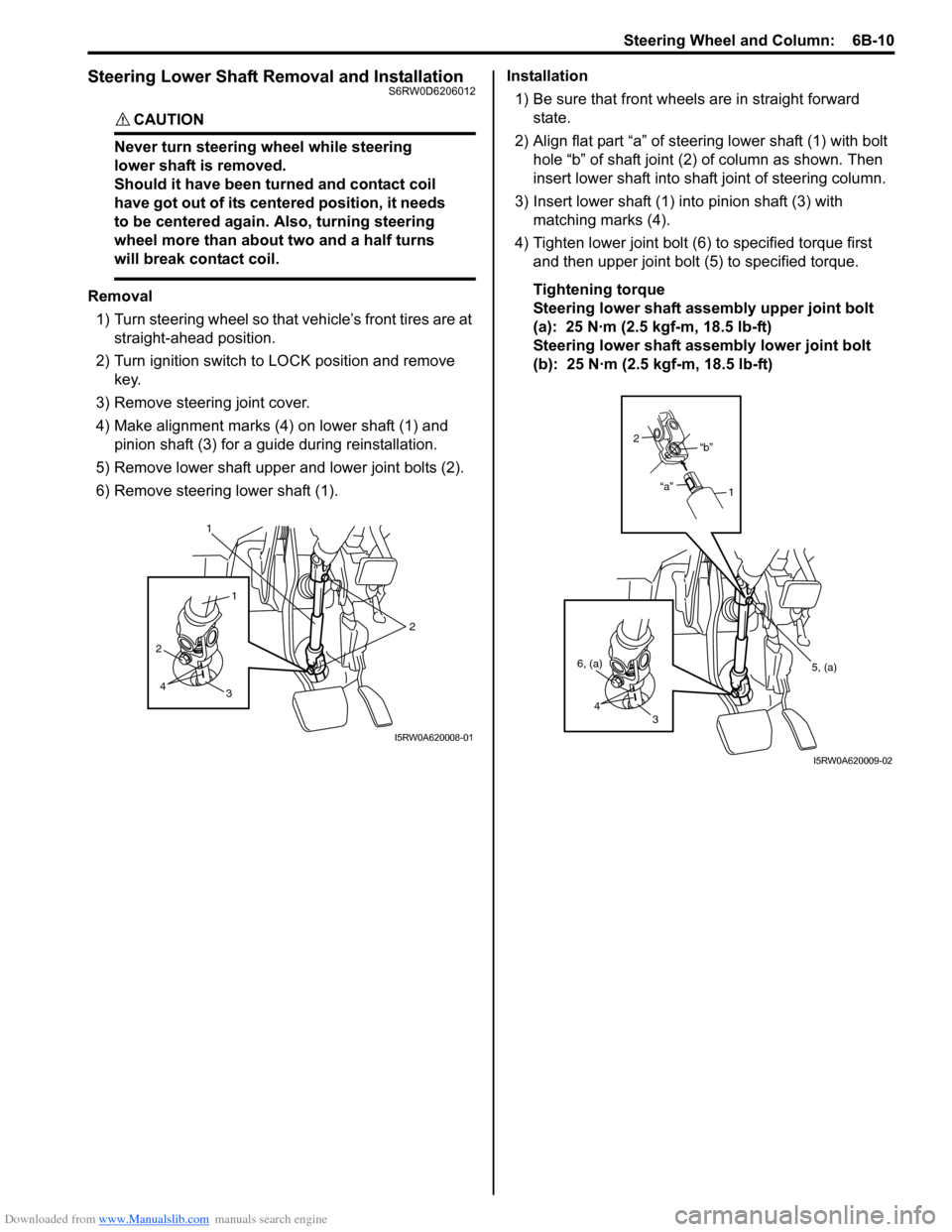
Removal
1) Turn steering wheel so that vehicle’s front tires are at
straight-ahead position.
2) Turn ignition switch to LOCK position and remove
key.
3) Remove steering joint cover.
4) Make alignment marks (4) on lower shaft (1) and
pinion shaft (3) for a guide during reinstallation.
5) Remove lower shaft upper and lower joint bolts (2).
6) Remove steering lower shaft (1).Installation
1) Be sure that front wheels are in straight forward
state.
2) Align flat part “a” of steering lower shaft (1) with bolt
hole “b” of shaft joint (2) of column as shown. Then
insert lower shaft into shaft joint of steering column.
3) Insert lower shaft (1) into pinion shaft (3) with
matching marks (4).
4) Tighten lower joint bolt (6) to specified torque first
and then upper joint bolt (5) to specified torque.
Tightening torque
Steering lower shaft assembly upper joint bolt
(a): 25 N·m (2.5 kgf-m, 18.5 lb-ft)
Steering lower shaft assembly lower joint bolt
(b): 25 N·m (2.5 kgf-m, 18.5 lb-ft)
1
2
1
3
2
4
I5RW0A620008-01
“a”“b”
1 2
6, (a)
4
3
5, (a)
I5RW0A620009-02
Page 880 of 1556
Downloaded from www.Manualslib.com manuals search engine 6B-11 Steering Wheel and Column:
Specifications
Tightening Torque SpecificationsS6RW0D6207001
NOTE
The specified tightening torque is also described in the following.
“Steering Wheel and Column Construction”
Reference:
For the tightening torque of fastener not specified in this section, refer to “Fasteners Information in Section 0A”.
Special Tools and Equipment
Special ToolS6RW0D6208001
Fastening partTightening torque
Note
N⋅mkgf-mlb-ft
Steering shaft nut 33 3.3 24.0)
Steering column mounting nut No.1 14 1.4 10.5)
Steering column mounting nut No.2 14 1.4 10.5)
Steering lower shaft assembly upper joint bolt 25 2.5 18.5) / )
Steering lower shaft assembly lower joint bolt 25 2.5 18.5)
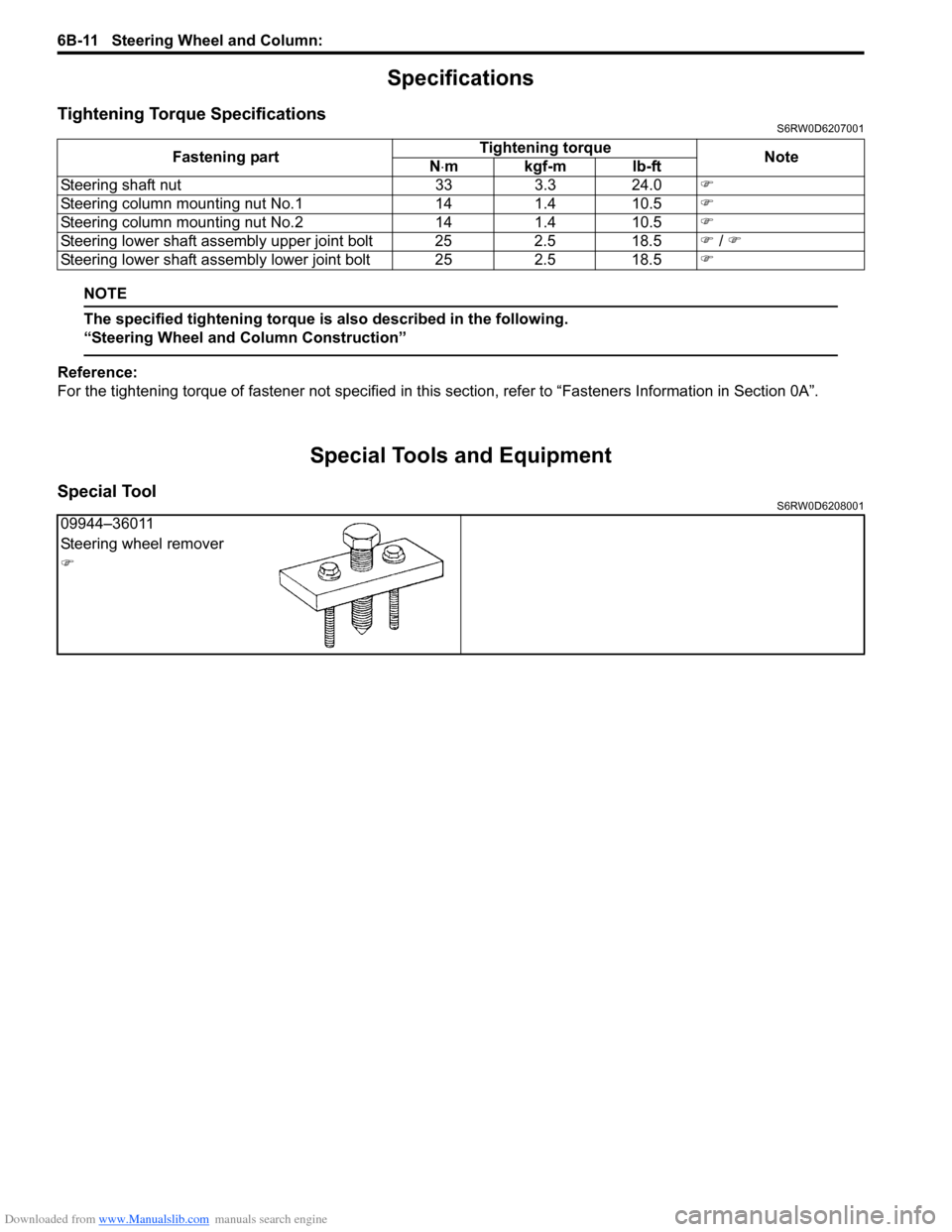
09944–36011
Steering wheel remover
)
Page 882 of 1556
Downloaded from www.Manualslib.com manuals search engine 6C-2 Power Assisted Steering System:
General Description
P/S System DescriptionS6RW0D6301001
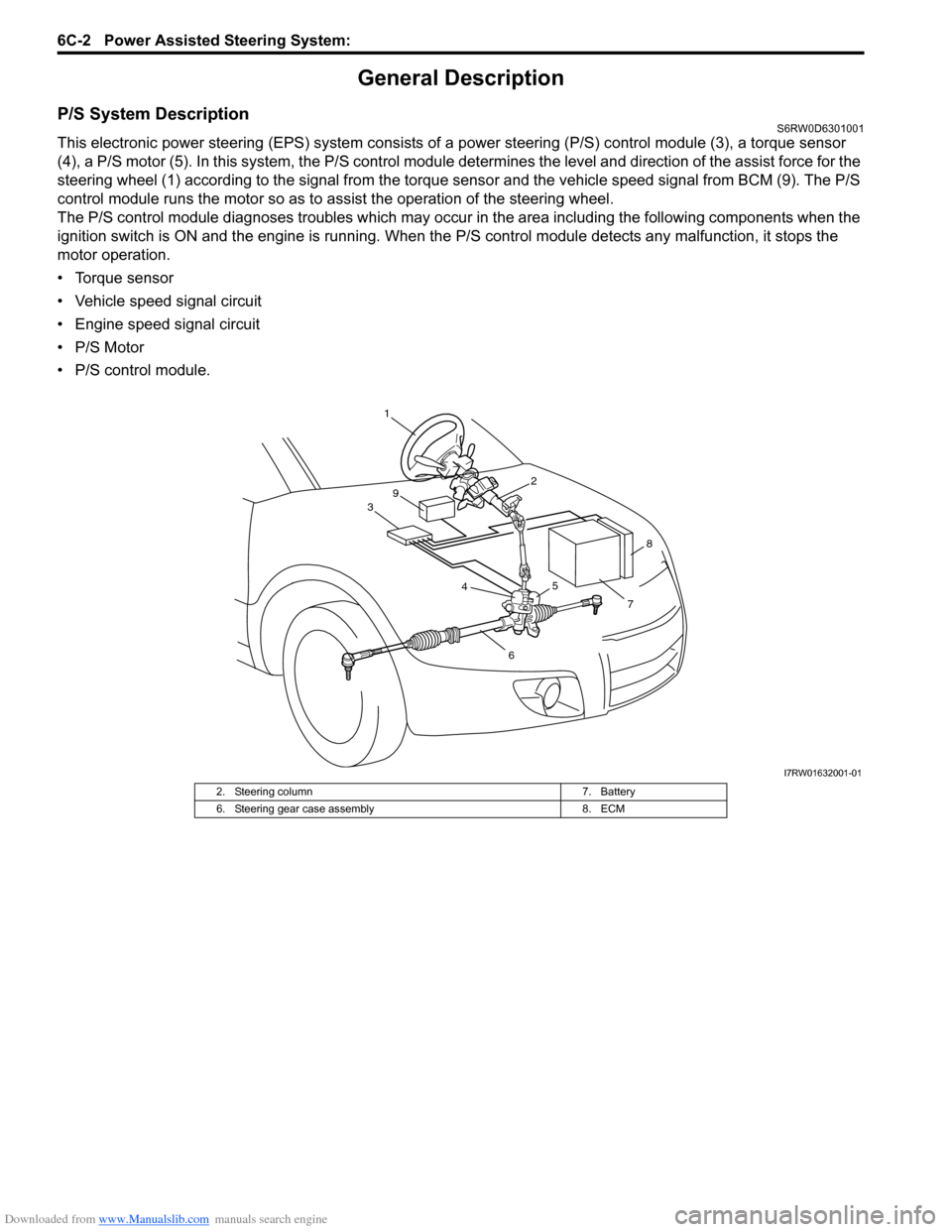
This electronic power steering (EPS) system consists of a power steering (P/S) control module (3), a torque sensor
(4), a P/S motor (5). In this system, the P/S control module determines the level and direction of the assist force for the
steering wheel (1) according to the signal from the torque sensor and the vehicle speed signal from BCM (9). The P/S
control module runs the motor so as to assist the operation of the steering wheel.
The P/S control module diagnoses troubles which may occur in the area including the following components when the
ignition switch is ON and the engine is running. When the P/S control module detects any malfunction, it stops the
motor operation.
• Torque sensor
• Vehicle speed signal circuit
• Engine speed signal circuit
• P/S Motor
• P/S control module.
1
32
4
6
7
5
8
9
I7RW01632001-01
2. Steering column 7. Battery
6. Steering gear case assembly 8. ECM
Page 884 of 1556
![SUZUKI SX4 2006 1.G Service Workshop Manual Downloaded from www.Manualslib.com manuals search engine 6C-4 Power Assisted Steering System:
Schematic and Routing Diagram
EPS System Wiring Circuit DiagramS6RW0D6302001
[A]
123
45
3 21
4
567
8
9 11](/img/20/7612/w960_7612-883.png "SUZUKI SX4 2006 1.G Service Workshop Manual Downloaded from www.Manualslib.com manuals search engine 6C-4 Power Assisted Steering System:
Schematic and Routing Diagram
EPS System Wiring Circuit DiagramS6RW0D6302001
[A]
123
45
3 21
4
567
8
9 11")
Downloaded from www.Manualslib.com manuals search engine 6C-4 Power Assisted Steering System:
Schematic and Routing Diagram
EPS System Wiring Circuit DiagramS6RW0D6302001
[A]
123
45
3 21
4
567
8
9 11
10 12 13
141516
17 18 19201
2
[B]
1
2
[C] [D]
10 9 8 7654 3 21
16 15 14 13 12 11
26 25 24 2322 21 20 19 18 17
32 31 30 29 28 27
[F][E]
12
BRN RED/
BLU GRY LT GRN/
BLK
BLK
RED
WHT GRN
BLK
E11-1
E11-5
E11-14
E11-12
[J]:E01-44E01-4
[J]:E01-27E01-26
E12-1
E12-2
E11-10E11-8
E11-9
E11-19
E13-1 GRN
GRY
GRN
WHT
G241-25G241-31
RED/BLK
11
12
1314 3 18
20
21
7 19
4 12
22
12V
E13-2BLK
9V
REDE11-20
12V
12V
E61-2
E61-1
610
55
5V
8
E11-115V
PPL
E11-4
9
23
+BB
BLU/
WHTE04-9
1524YELE11-18E31-5
E31-2
E31-39V
3V
E31-4
E31-1IG11617
C07-25
[H]
[G]
G04-15
[I]:G04-22
25L313-3
[I]
I6RW0D630001-01
[A]: P/S control module connector No.1 “E11” (viewed from harness side) 3. Junction block assembly 15. BCM
[B]: P/S control module connector No.2 “E13” (viewed from harness side) 4. Main fuse 16. Output shaft speed sensor
[C]: P/S control module connector No.3 “E12” (viewed from harness side) 5. Front (left/right) wheel speed sensor 17. TCM
[D]: Combination meter connector “G241” (viewed from harness side) 6. ABS control module 18. Individual circuit fuse box No.1
[E]: Torque sensor connector “E31” (viewed from harness side) 7. Combination meter 19. “IGN” fuse
[F]: Motor connector “E61” (viewed from harness side) 8. “EPS” warning light 20. “P/S” fuse
[G]: M/T model 9. Data link connector (DLC) 21. “IG1 SIG” fuse
[H]: A/T model 10. ECM 22. “MTR” fuse
[I]: Junction block without BCM model (Taiwan model) 11. P/S control module 23. To ABS control module
[J]: M15A engine with 4A/T equipped with slip control model (Hong Kong
model)12. P/S motor 24. To HVAC control module
1. Main fuse box 13. Shield 25. To SDM
2. Ignition switch 14. Torque sensor (built into steering gear case)
Page 887 of 1556

Downloaded from www.Manualslib.com manuals search engine Power Assisted Steering System: 6C-7
Step 1: Customer Complaint Analysis
Record details of the problem (failure, complaint) and how it occurred as described by the customer. For this purpose,
use of such an inspection form will facilitate collecting information to the point required for proper analysis and
diagnosis. Check if the problem described in “Customer questionnaire” actually occurs in the vehicle if necessary.
(This step should be performed with the customer if possible)
Customer questionnaire (Example)
NOTE
This form is a standard sample. It should be modified according to conditions characteristic of each
market.
Step 2: DTC check, record and clearance
First, referring to “DTC Check”, check DTC (including
pending DTC). If DTC exists, print or write down DTC
and then clear them by referring to “DTC Clearance”.
DTC indicates malfunction in the system but it is not
possible to know from it whether the malfunction is
occurring now or it occurred in the past and normal
condition has been restored. In order to know that, check
symptom in question according to Step 5 and then
recheck DTC according to Step 6 and 7.
Diagnosing a trouble based on the DTC in this step only
or failure to clear the DTC in this step may result in an
faulty diagnosis, trouble diagnosis of a normal circuit or
difficulty in troubleshooting which is otherwise
unnecessary.Step 3 and Step 4: Visual inspection
As a preliminary step, be sure to perform visual check of
the items that support proper function of the P/S system
referring to “Visual Inspection”.
Step 5: Trouble Symptom Confirmation
Based on information obtained in “Step 1: Customer
Complaint Analysis:” and “Step 2: DTC Check, Record
and Clearance:”, confirm trouble symptoms. Also,
reconfirm trouble symptom by performing test drive and
turning steering wheel fully to right and left at stopped
vehicle.
Step 6 and 7: Rechecking and Record of DTC
Refer to “DTC Check” for checking procedure.
I7RW01632004-02
Page 892 of 1556
Downloaded from www.Manualslib.com manuals search engine 6C-12 Power Assisted Steering System:
Scan Tool DataS6RW0D6304007
NOTE
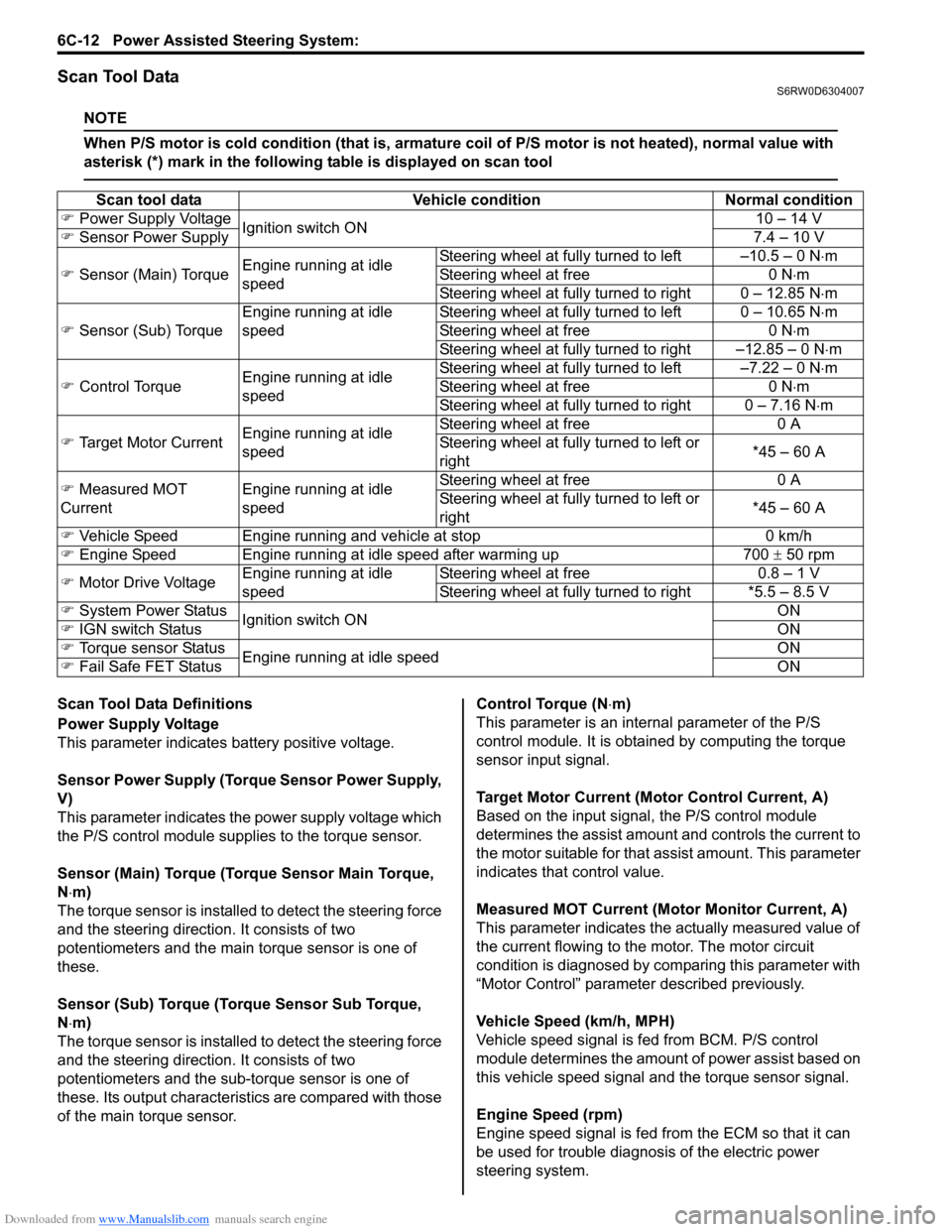
When P/S motor is cold condition (that is, armature coil of P/S motor is not heated), normal value with
asterisk (*) mark in the following table is displayed on scan tool
Scan Tool Data Definitions
Power Supply Voltage
This parameter indicates battery positive voltage.
Sensor Power Supply (Torque Sensor Power Supply,
V)
This parameter indicates the power supply voltage which
the P/S control module supplies to the torque sensor.
Sensor (Main) Torque (Torque Sensor Main Torque,
N⋅m)
The torque sensor is installed to detect the steering force
and the steering direction. It consists of two
potentiometers and the main torque sensor is one of
these.
Sensor (Sub) Torque (Torque Sensor Sub Torque,
N⋅m)
The torque sensor is installed to detect the steering force
and the steering direction. It consists of two
potentiometers and the sub-torque sensor is one of
these. Its output characteristics are compared with those
of the main torque sensor.Control Torque (N⋅m)
This parameter is an internal parameter of the P/S
control module. It is obtained by computing the torque
sensor input signal.
Target Motor Current (Motor Control Current, A)
Based on the input signal, the P/S control module
determines the assist amount and controls the current to
the motor suitable for that assist amount. This parameter
indicates that control value.
Measured MOT Current (Motor Monitor Current, A)
This parameter indicates the actually measured value of
the current flowing to the motor. The motor circuit
condition is diagnosed by comparing this parameter with
“Motor Control” parameter described previously.
Vehicle Speed (km/h, MPH)
Vehicle speed signal is fed from BCM. P/S control
module determines the amount of power assist based on
this vehicle speed signal and the torque sensor signal.
Engine Speed (rpm)
Engine speed signal is fed from the ECM so that it can
be used for trouble diagnosis of the electric power
steering system. Scan tool data Vehicle condition Normal condition
) Power Supply Voltage
Ignition switch ON10 – 14 V
) Sensor Power Supply7.4 – 10 V
) Sensor (Main) TorqueEngine running at idle
speedSteering wheel at fully turned to left –10.5 – 0 N⋅m
Steering wheel at free 0 N⋅m
Steering wheel at fully turned to right 0 – 12.85 N⋅m
) Sensor (Sub) Torque Engine running at idle
speedSteering wheel at fully turned to left 0 – 10.65 N⋅m
Steering wheel at free 0 N⋅m
Steering wheel at fully turned to right –12.85 – 0 N⋅m
) Control TorqueEngine running at idle
speedSteering wheel at fully turned to left –7.22 – 0 N⋅m
Steering wheel at free 0 N⋅m
Steering wheel at fully turned to right 0 – 7.16 N⋅m
) Target Motor CurrentEngine running at idle
speedSteering wheel at free 0 A
Steering wheel at fully turned to left or
right*45 – 60 A
) Measured MOT
Current
Engine running at idle
speedSteering wheel at free 0 A
Steering wheel at fully turned to left or
right*45 – 60 A
) Vehicle Speed Engine running and vehicle at stop 0 km/h
) Engine Speed Engine running at idle speed after warming up 700 ± 50 rpm
) Motor Drive VoltageEngine running at idle
speedSteering wheel at free 0.8 – 1 V
Steering wheel at fully turned to right *5.5 – 8.5 V
) System Power Status
Ignition switch ONON
) IGN switch StatusON
) Torque sensor Status
Engine running at idle speedON
) Fail Safe FET StatusON
Page 893 of 1556
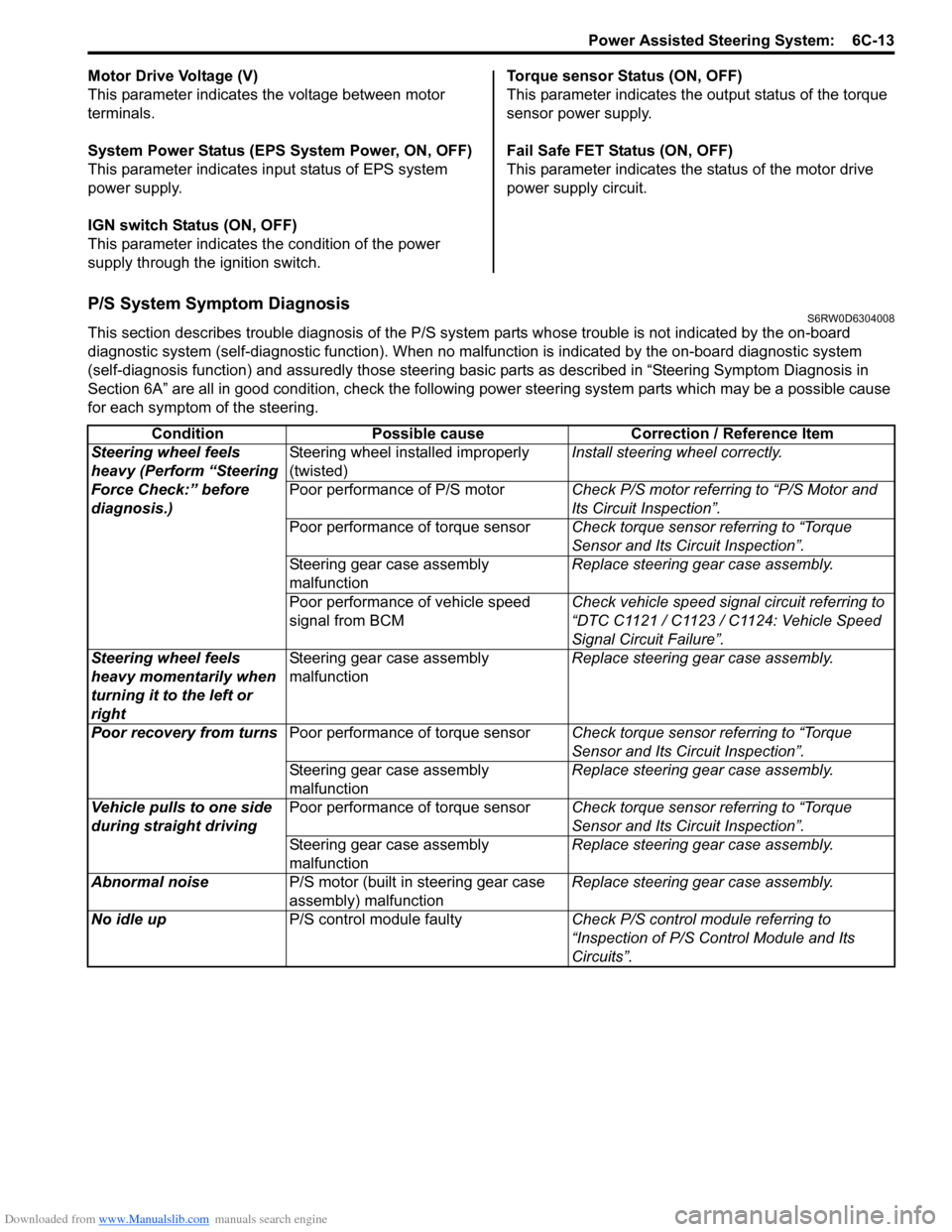
Downloaded from www.Manualslib.com manuals search engine Power Assisted Steering System: 6C-13
Motor Drive Voltage (V)
This parameter indicates the voltage between motor
terminals.
System Power Status (EPS System Power, ON, OFF)
This parameter indicates input status of EPS system
power supply.
IGN switch Status (ON, OFF)
This parameter indicates the condition of the power
supply through the ignition switch.Torque sensor Status (ON, OFF)
This parameter indicates the output status of the torque
sensor power supply.
Fail Safe FET Status (ON, OFF)
This parameter indicates the status of the motor drive
power supply circuit.
P/S System Symptom DiagnosisS6RW0D6304008
This section describes trouble diagnosis of the P/S system parts whose trouble is not indicated by the on-board
diagnostic system (self-diagnostic function). When no malfunction is indicated by the on-board diagnostic system
(self-diagnosis function) and assuredly those steering basic parts as described in “Steering Symptom Diagnosis in
Section 6A” are all in good condition, check the following power steering system parts which may be a possible cause
for each symptom of the steering.
Condition Possible cause Correction / Reference Item
Steering wheel feels
heavy (Perform “Steering
Force Check:” before
diagnosis.)Steering wheel installed improperly
(twisted)Install steering wheel correctly.
Poor performance of P/S motorCheck P/S motor referring to “P/S Motor and
Its Circuit Inspection”.
Poor performance of torque sensorCheck torque sensor referring to “Torque
Sensor and Its Circuit Inspection”.
Steering gear case assembly
malfunctionReplace steering gear case assembly.
Poor performance of vehicle speed
signal from BCMCheck vehicle speed signal circuit referring to
“DTC C1121 / C1123 / C1124: Vehicle Speed
Signal Circuit Failure”.
Steering wheel feels
heavy momentarily when
turning it to the left or
rightSteering gear case assembly
malfunctionReplace steering gear case assembly.
Poor recovery from turnsPoor performance of torque sensorCheck torque sensor referring to “Torque
Sensor and Its Circuit Inspection”.
Steering gear case assembly
malfunctionReplace steering gear case assembly.
Vehicle pulls to one side
during straight drivingPoor performance of torque sensorCheck torque sensor referring to “Torque
Sensor and Its Circuit Inspection”.
Steering gear case assembly
malfunctionReplace steering gear case assembly.
Abnormal noiseP/S motor (built in steering gear case
assembly) malfunctionReplace steering gear case assembly.
No idle upP/S control module faultyCheck P/S control module referring to
“Inspection of P/S Control Module and Its
Circuits”.
Page 902 of 1556
Downloaded from www.Manualslib.com manuals search engine 6C-22 Power Assisted Steering System:
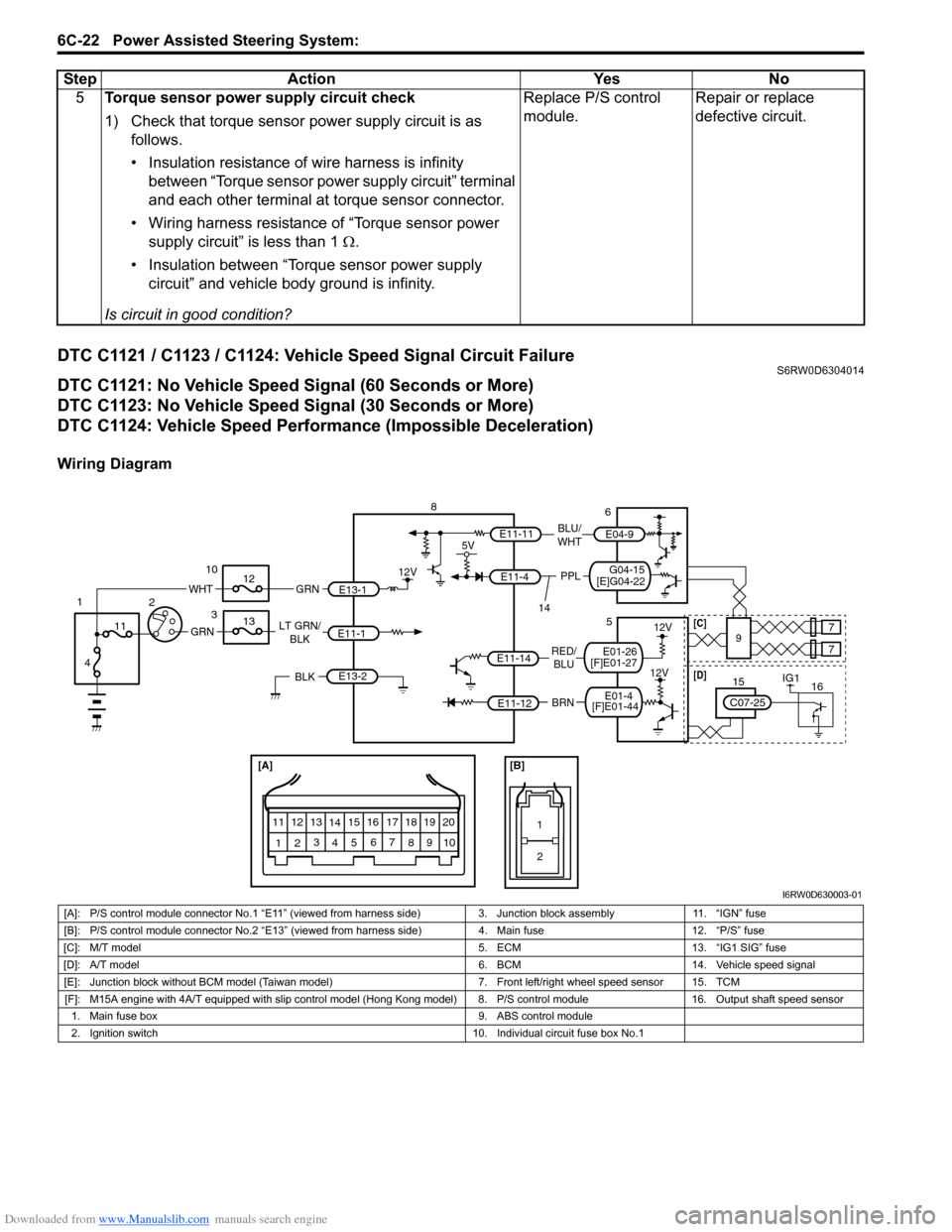
DTC C1121 / C1123 / C1124: Vehicle Speed Signal Circuit FailureS6RW0D6304014
DTC C1121: No Vehicle Speed Signal (60 Seconds or More)
DTC C1123: No Vehicle Speed Signal (30 Seconds or More)
DTC C1124: Vehicle Speed Performance (Impossible Deceleration)
Wiring Diagram5Torque sensor power supply circuit check
1) Check that torque sensor power supply circuit is as
follows.
• Insulation resistance of wire harness is infinity
between “Torque sensor power supply circuit” terminal
and each other terminal at torque sensor connector.
• Wiring harness resistance of “Torque sensor power
supply circuit” is less than 1 Ω.
• Insulation between “Torque sensor power supply
circuit” and vehicle body ground is infinity.
Is circuit in good condition?Replace P/S control
module.Repair or replace
defective circuit. Step Action Yes No
[A]
123
4567
8
9 11
10 12 13
141516
17 18 1920
1
2
[B]
BRN RED/
BLU LT GRN/
BLK
E11-1
E11-14
E11-12
E13-1 GRN
GRN
WHT
8
3 10
12
13
11
4 1
2
12V
E13-2BLK
12V
12V
9 5
77
E11-11
G04-15
[E]G04-22
5V
PPL
E11-4
BLU/
WHTE04-9
6
14
IG11615
C07-25
[D][C]
[F]E01-44E01-4
[F]E01-27E01-26
I6RW0D630003-01
[A]: P/S control module connector No.1 “E11” (viewed from harness side) 3. Junction block assembly 11. “IGN” fuse
[B]: P/S control module connector No.2 “E13” (viewed from harness side) 4. Main fuse 12. “P/S” fuse
[C]: M/T model 5. ECM 13. “IG1 SIG” fuse
[D]: A/T model 6. BCM 14. Vehicle speed signal
[E]: Junction block without BCM model (Taiwan model) 7. Front left/right wheel speed sensor 15. TCM
[F]: M15A engine with 4A/T equipped with slip control model (Hong Kong model) 8. P/S control module 16. Output shaft speed sensor
1. Main fuse box 9. ABS control module
2. Ignition switch 10. Individual circuit fuse box No.1
Page 909 of 1556

Downloaded from www.Manualslib.com manuals search engine Power Assisted Steering System: 6C-29
P/S Control Module Power Supply and Ground Circuit CheckS6RW0D6304019
Wiring Diagram
Refer to “DTC C1153: P/S Control Module Power Supply Circuit”.
DTC Troubleshooting
Step Action Yes No
1Circuit fuse check
1) Disconnect P/S control module connector with ignition
switch turned OFF.
2) Check for proper connection to P/S control module
connector at “E13-1”, “E13-2” and “E11-1” terminals.
3) If OK, check “P/S” fuse and “IG1 SIG” fuse for blowing.
Are “P/S” fuse and “IG1 SIG” fuse in good condition?Go to Step 2. Replace fuse (s) and
check for short in
circuits connected to
fuse(s).
2Power supply circuit check
1) Measure voltage between “E13-1” terminal of P/S
control module connector and body ground.
Is voltage 10 – 14 V?Go to Step 3. “GRN” or “WHT” wire is
open circuit.
3Ignition signal check
1) Turn ignition switch to ON position.
2) Measure voltage between “E11-1” terminal of P/S control
module connector and body ground.
Is voltage 10 – 14 V?Go to Step 4. “LT GRN / BLK” or
“GRN” wire is open
circuit.
4P/S control module ground circuit check
1) Turn ignition switch to OFF position.
2) Disconnect connectors from P/S control module.
3) Measure resistance between “E13-2” terminals of P/S
control module connector and body ground.
Is resistance 1
Ω or less?Go to Step 5. “BLK” wire is open or
high resistance circuit.
5P/S control module ground circuit check
1) Connect connectors to P/S control module.
2) Start engine.
3) Measure voltage between “E13-2” terminals of P/S
control module connector and body ground when
steering wheel fully turned to left or right.
Is voltage 0.3 V or less?P/S Control Module
Power Supply and
Ground Circuit is in
good condition.“BLK” wire is high
resistance circuit.