Eps SUZUKI SX4 2006 1.G Service User Guide
[x] Cancel search | Manufacturer: SUZUKI, Model Year: 2006, Model line: SX4, Model: SUZUKI SX4 2006 1.GPages: 1556, PDF Size: 37.31 MB
Page 274 of 1556
Downloaded from www.Manualslib.com manuals search engine 1C-6 Engine Electrical Devices:
Removal
1) Disconnect negative cable at battery.
2) Disconnect connector from APP sensor assembly.
3) Remove APP sensor assembly from its bracket.
Installation
Reverse removal procedure for installation noting the
following.
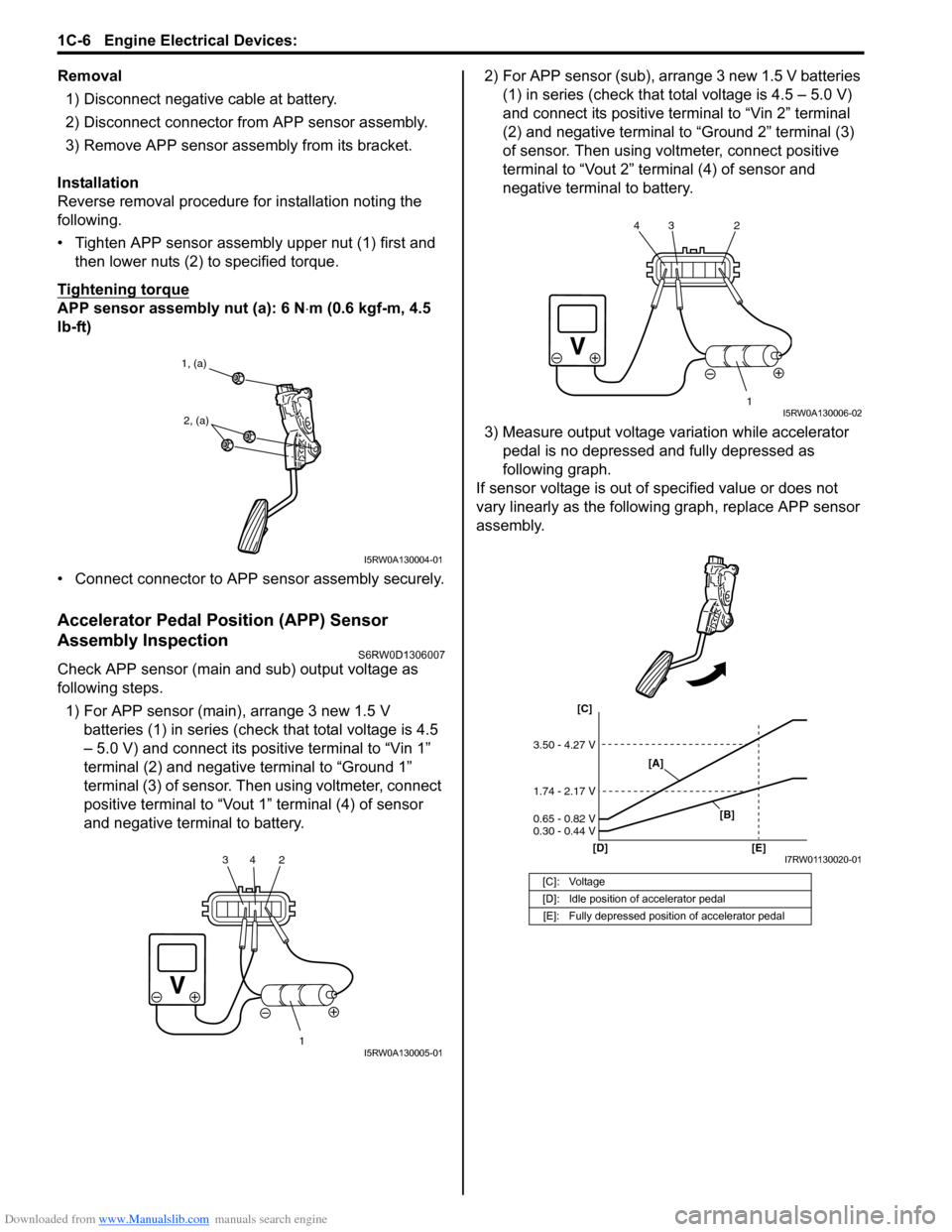
• Tighten APP sensor assembly upper nut (1) first and
then lower nuts (2) to specified torque.
Tightening torque
APP sensor assembly nut (a): 6 N⋅m (0.6 kgf-m, 4.5
lb-ft)
• Connect connector to APP sensor assembly securely.
Accelerator Pedal Position (APP) Sensor
Assembly Inspection
S6RW0D1306007
Check APP sensor (main and sub) output voltage as
following steps.
1) For APP sensor (main), arrange 3 new 1.5 V
batteries (1) in series (check that total voltage is 4.5
– 5.0 V) and connect its positive terminal to “Vin 1”
terminal (2) and negative terminal to “Ground 1”
terminal (3) of sensor. Then using voltmeter, connect
positive terminal to “Vout 1” terminal (4) of sensor
and negative terminal to battery.2) For APP sensor (sub), arrange 3 new 1.5 V batteries
(1) in series (check that total voltage is 4.5 – 5.0 V)
and connect its positive terminal to “Vin 2” terminal
(2) and negative terminal to “Ground 2” terminal (3)
of sensor. Then using voltmeter, connect positive
terminal to “Vout 2” terminal (4) of sensor and
negative terminal to battery.
3) Measure output voltage variation while accelerator
pedal is no depressed and fully depressed as
following graph.
If sensor voltage is out of specified value or does not
vary linearly as the following graph, replace APP sensor
assembly.
1, (a)
2, (a)
I5RW0A130004-01
1 2 34I5RW0A130005-01
[C]: Voltage
[D]: Idle position of accelerator pedal
[E]: Fully depressed position of accelerator pedal
1 2 3 4I5RW0A130006-02
[C]
[D] [E]
3.50 - 4.27 V
1.74 - 2.17 V
0.65 - 0.82 V
0.30 - 0.44 V
[A]
[B]
I7RW01130020-01
Page 288 of 1556
Downloaded from www.Manualslib.com manuals search engine 1D-6 Engine Mechanical:
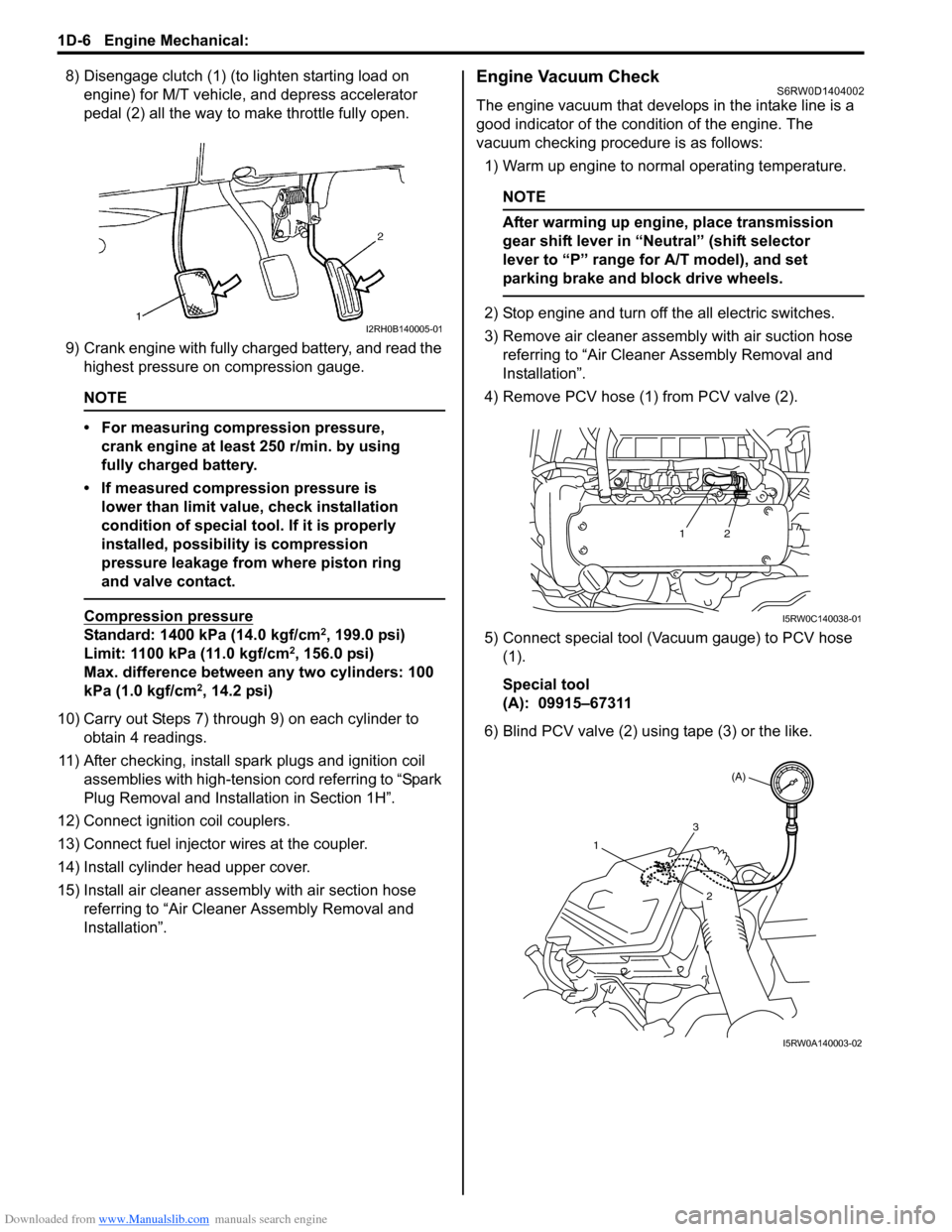
8) Disengage clutch (1) (to lighten starting load on
engine) for M/T vehicle, and depress accelerator
pedal (2) all the way to make throttle fully open.
9) Crank engine with fully charged battery, and read the
highest pressure on compression gauge.
NOTE
• For measuring compression pressure,
crank engine at least 250 r/min. by using
fully charged battery.
• If measured compression pressure is
lower than limit value, check installation
condition of special tool. If it is properly
installed, possibility is compression
pressure leakage from where piston ring
and valve contact.
Compression pressure
Standard: 1400 kPa (14.0 kgf/cm2, 199.0 psi)
Limit: 1100 kPa (11.0 kgf/cm2, 156.0 psi)
Max. difference between any two cylinders: 100
kPa (1.0 kgf/cm
2, 14.2 psi)
10) Carry out Steps 7) through 9) on each cylinder to
obtain 4 readings.
11) After checking, install spark plugs and ignition coil
assemblies with high-tension cord referring to “Spark
Plug Removal and Installation in Section 1H”.
12) Connect ignition coil couplers.
13) Connect fuel injector wires at the coupler.
14) Install cylinder head upper cover.
15) Install air cleaner assembly with air section hose
referring to “Air Cleaner Assembly Removal and
Installation”.
Engine Vacuum CheckS6RW0D1404002
The engine vacuum that develops in the intake line is a
good indicator of the condition of the engine. The
vacuum checking procedure is as follows:
1) Warm up engine to normal operating temperature.
NOTE
After warming up engine, place transmission
gear shift lever in “Neutral” (shift selector
lever to “P” range for A/T model), and set
parking brake and block drive wheels.
2) Stop engine and turn off the all electric switches.
3) Remove air cleaner assembly with air suction hose
referring to “Air Cleaner Assembly Removal and
Installation”.
4) Remove PCV hose (1) from PCV valve (2).
5) Connect special tool (Vacuum gauge) to PCV hose
(1).
Special tool
(A): 09915–67311
6) Blind PCV valve (2) using tape (3) or the like.I2RH0B140005-01
12
I5RW0C140038-01
(A)
1
2
3
I5RW0A140003-02
Page 312 of 1556
Downloaded from www.Manualslib.com manuals search engine 1D-30 Engine Mechanical:
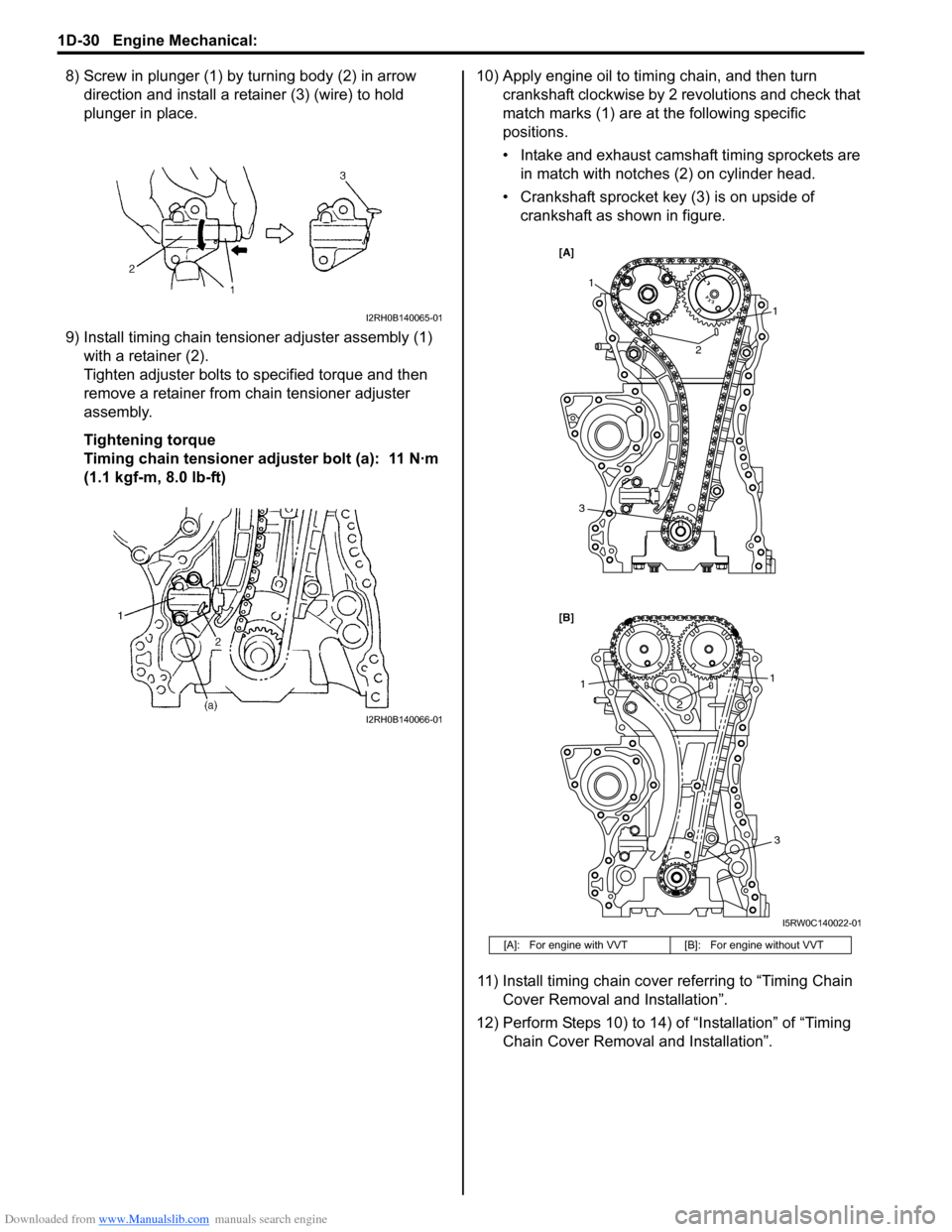
8) Screw in plunger (1) by turning body (2) in arrow
direction and install a retainer (3) (wire) to hold
plunger in place.
9) Install timing chain tensioner adjuster assembly (1)
with a retainer (2).
Tighten adjuster bolts to specified torque and then
remove a retainer from chain tensioner adjuster
assembly.
Tightening torque
Timing chain tensioner adjuster bolt (a): 11 N·m
(1.1 kgf-m, 8.0 lb-ft)10) Apply engine oil to timing chain, and then turn
crankshaft clockwise by 2 revolutions and check that
match marks (1) are at the following specific
positions.
• Intake and exhaust camshaft timing sprockets are
in match with notches (2) on cylinder head.
• Crankshaft sprocket key (3) is on upside of
crankshaft as shown in figure.
11) Install timing chain cover referring to “Timing Chain
Cover Removal and Installation”.
12) Perform Steps 10) to 14) of “Installation” of “Timing
Chain Cover Removal and Installation”.
I2RH0B140065-01
I2RH0B140066-01
[A]: For engine with VVT [B]: For engine without VVT
1
1
2
3
21
1
3
[A]
[B]
I5RW0C140022-01
Page 317 of 1556
Downloaded from www.Manualslib.com manuals search engine Engine Mechanical: 1D-35
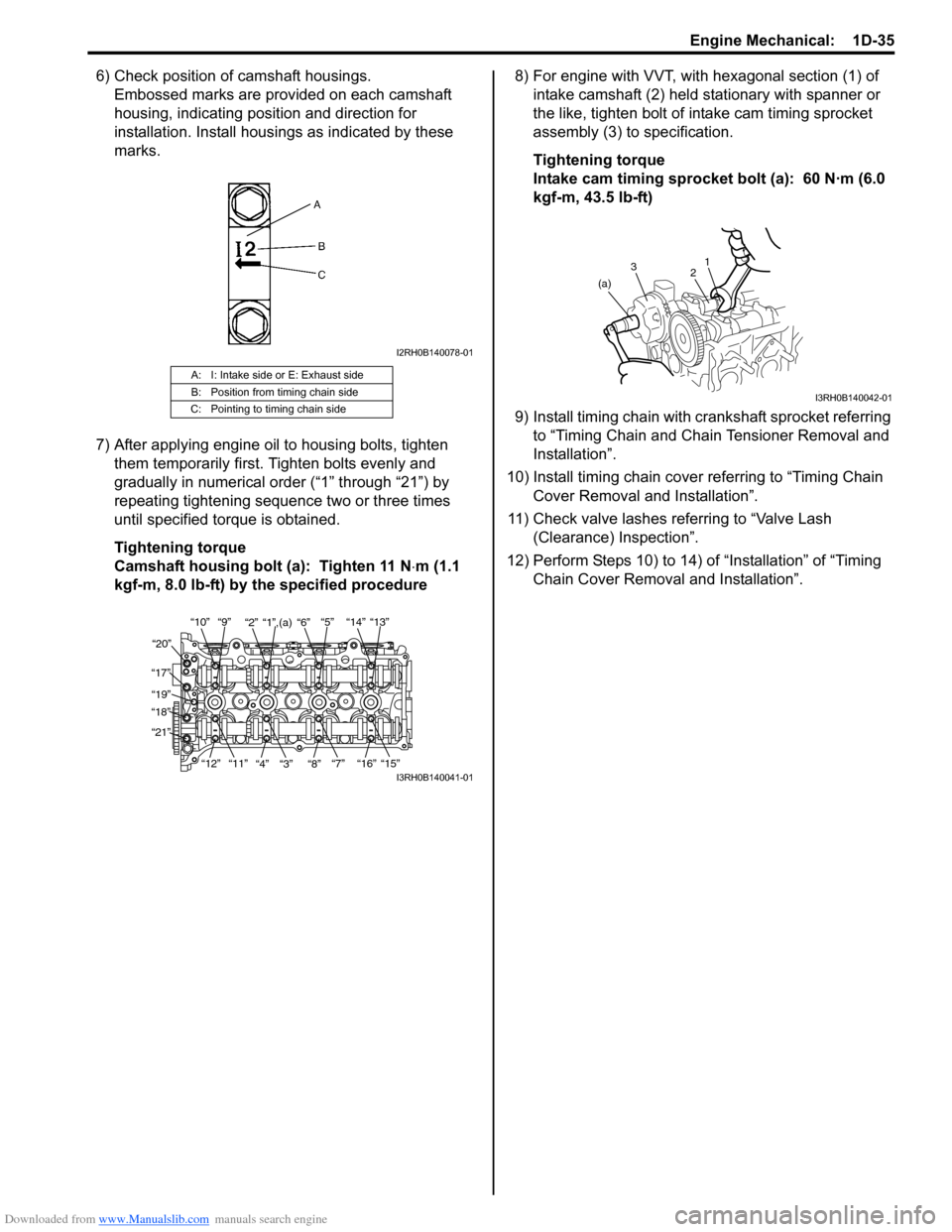
6) Check position of camshaft housings.
Embossed marks are provided on each camshaft
housing, indicating position and direction for
installation. Install housings as indicated by these
marks.
7) After applying engine oil to housing bolts, tighten
them temporarily first. Tighten bolts evenly and
gradually in numerical order (“1” through “21”) by
repeating tightening sequence two or three times
until specified torque is obtained.
Tightening torque
Camshaft housing bolt (a): Tighten 11 N⋅m (1.1
kgf-m, 8.0 lb-ft) by the specified procedure8) For engine with VVT, with hexagonal section (1) of
intake camshaft (2) held stationary with spanner or
the like, tighten bolt of intake cam timing sprocket
assembly (3) to specification.
Tightening torque
Intake cam timing sprocket bolt (a): 60 N·m (6.0
kgf-m, 43.5 lb-ft)
9) Install timing chain with crankshaft sprocket referring
to “Timing Chain and Chain Tensioner Removal and
Installation”.
10) Install timing chain cover referring to “Timing Chain
Cover Removal and Installation”.
11) Check valve lashes referring to “Valve Lash
(Clearance) Inspection”.
12) Perform Steps 10) to 14) of “Installation” of “Timing
Chain Cover Removal and Installation”.
A: I: Intake side or E: Exhaust side
B: Position from timing chain side
C: Pointing to timing chain side
I2RH0B140078-01
“10”“9”
“2” “1”,(a) “6”“5” “14” “13”
“20”
“17”
“19”
“18”
“21”
“12”
“11”
“4” “3” “8”“7” “16” “15”
I3RH0B140041-01
1
2 3
(a)
I3RH0B140042-01
Page 322 of 1556
Downloaded from www.Manualslib.com manuals search engine 1D-40 Engine Mechanical:
Valves and Cylinder Head Removal and
Installation
S6RW0D1406026
Removal
1) Remove engine assembly from vehicle referring to
“Engine Assembly Removal and Installation”.
2) Remove oil pan referring to “Oil Pan and Oil Pump
Strainer Removal and Installation in Section 1E”.
3) Remove cylinder head cover referring to “Cylinder
Head Cover Removal and Installation”.
4) Remove timing chain cover referring to Steps 2) to
11) of “Removal” in “Timing Chain Cover Removal
and Installation”.
5) Remove timing chain referring to Steps 2) to 6) of
“Removal” in “Timing Chain and Chain Tensioner
Removal and Installation”.
6) Remove intake and exhaust camshafts referring to
Steps 3) to 8) of “Removal” in “Camshaft, Tappet and
Shim Removal and Installation”.
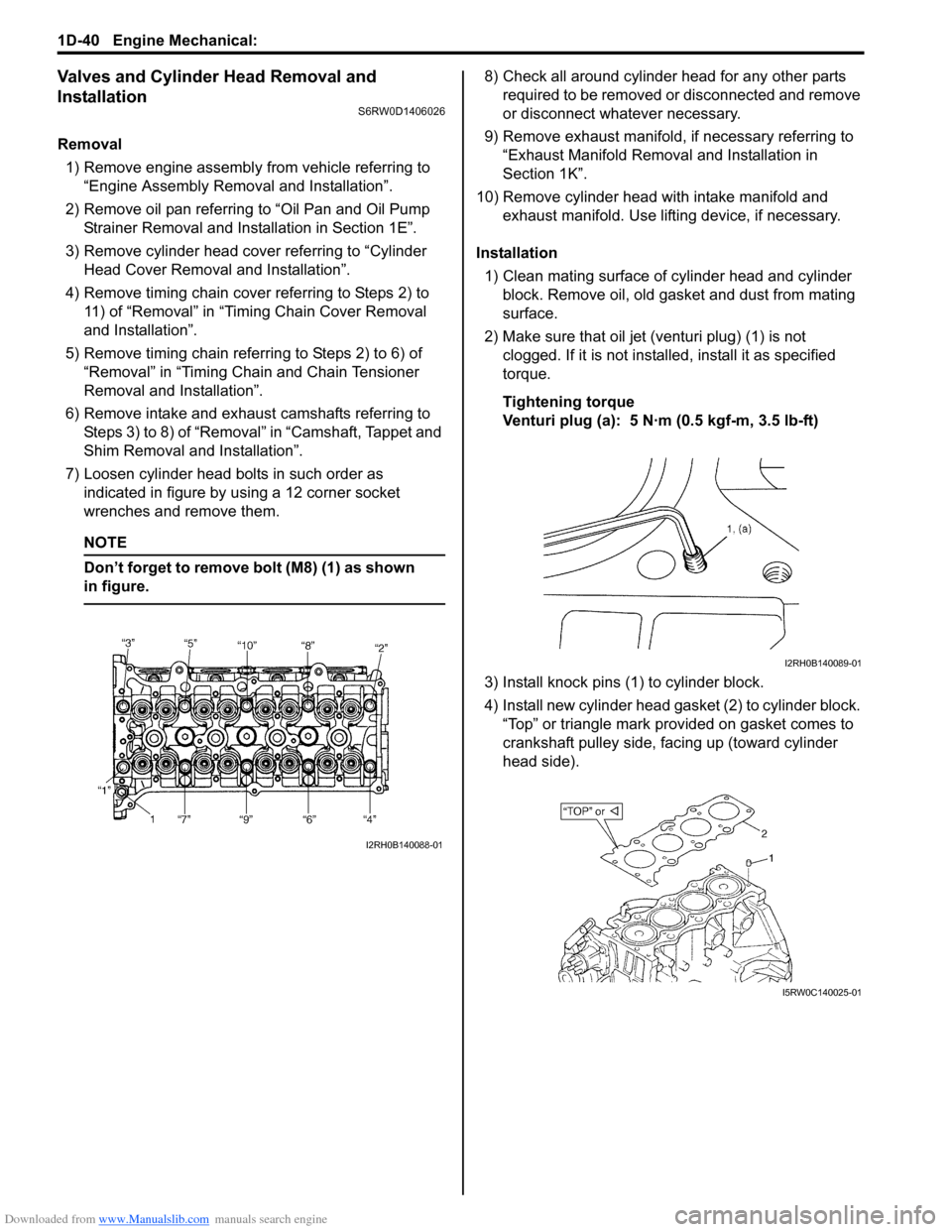
7) Loosen cylinder head bolts in such order as
indicated in figure by using a 12 corner socket
wrenches and remove them.
NOTE
Don’t forget to remove bolt (M8) (1) as shown
in figure.
8) Check all around cylinder head for any other parts
required to be removed or disconnected and remove
or disconnect whatever necessary.
9) Remove exhaust manifold, if necessary referring to
“Exhaust Manifold Removal and Installation in
Section 1K”.
10) Remove cylinder head with intake manifold and
exhaust manifold. Use lifting device, if necessary.
Installation
1) Clean mating surface of cylinder head and cylinder
block. Remove oil, old gasket and dust from mating
surface.
2) Make sure that oil jet (venturi plug) (1) is not
clogged. If it is not installed, install it as specified
torque.
Tightening torque
Venturi plug (a): 5 N·m (0.5 kgf-m, 3.5 lb-ft)
3) Install knock pins (1) to cylinder block.
4) Install new cylinder head gasket (2) to cylinder block.
“Top” or triangle mark provided on gasket comes to
crankshaft pulley side, facing up (toward cylinder
head side).
I2RH0B140088-01
I2RH0B140089-01
I5RW0C140025-01
Page 324 of 1556
Downloaded from www.Manualslib.com manuals search engine 1D-42 Engine Mechanical:
Valves and Cylinder Head Disassembly and
Assembly
S6RW0D1406027
Disassembly
1) For ease in servicing cylinder head, remove intake
manifold, injectors, exhaust manifold from cylinder
head.
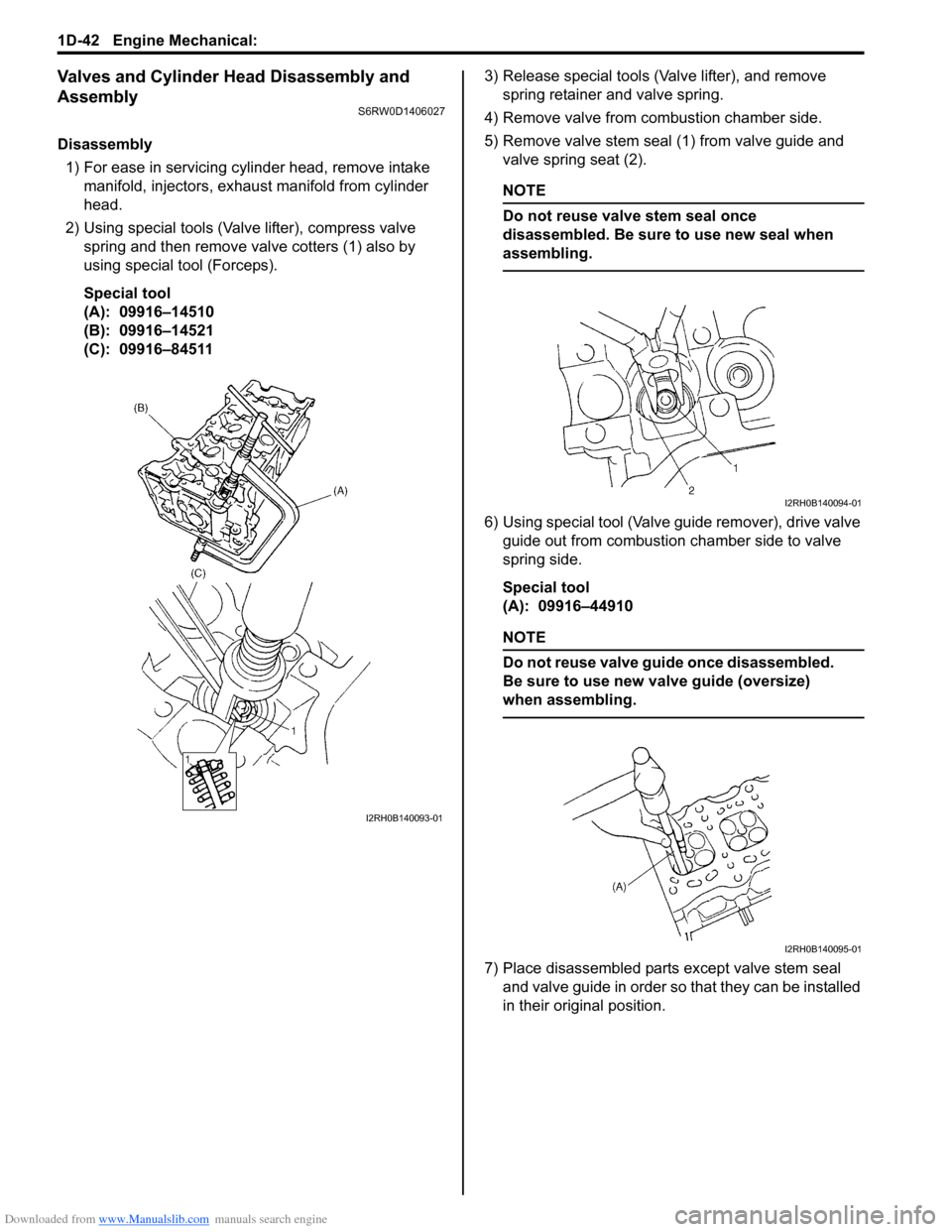
2) Using special tools (Valve lifter), compress valve
spring and then remove valve cotters (1) also by
using special tool (Forceps).
Special tool
(A): 09916–14510
(B): 09916–14521
(C): 09916–845113) Release special tools (Valve lifter), and remove
spring retainer and valve spring.
4) Remove valve from combustion chamber side.
5) Remove valve stem seal (1) from valve guide and
valve spring seat (2).
NOTE
Do not reuse valve stem seal once
disassembled. Be sure to use new seal when
assembling.
6) Using special tool (Valve guide remover), drive valve
guide out from combustion chamber side to valve
spring side.
Special tool
(A): 09916–44910
NOTE
Do not reuse valve guide once disassembled.
Be sure to use new valve guide (oversize)
when assembling.
7) Place disassembled parts except valve stem seal
and valve guide in order so that they can be installed
in their original position.
I2RH0B140093-01
I2RH0B140094-01
I2RH0B140095-01
Page 328 of 1556
Downloaded from www.Manualslib.com manuals search engine 1D-46 Engine Mechanical:
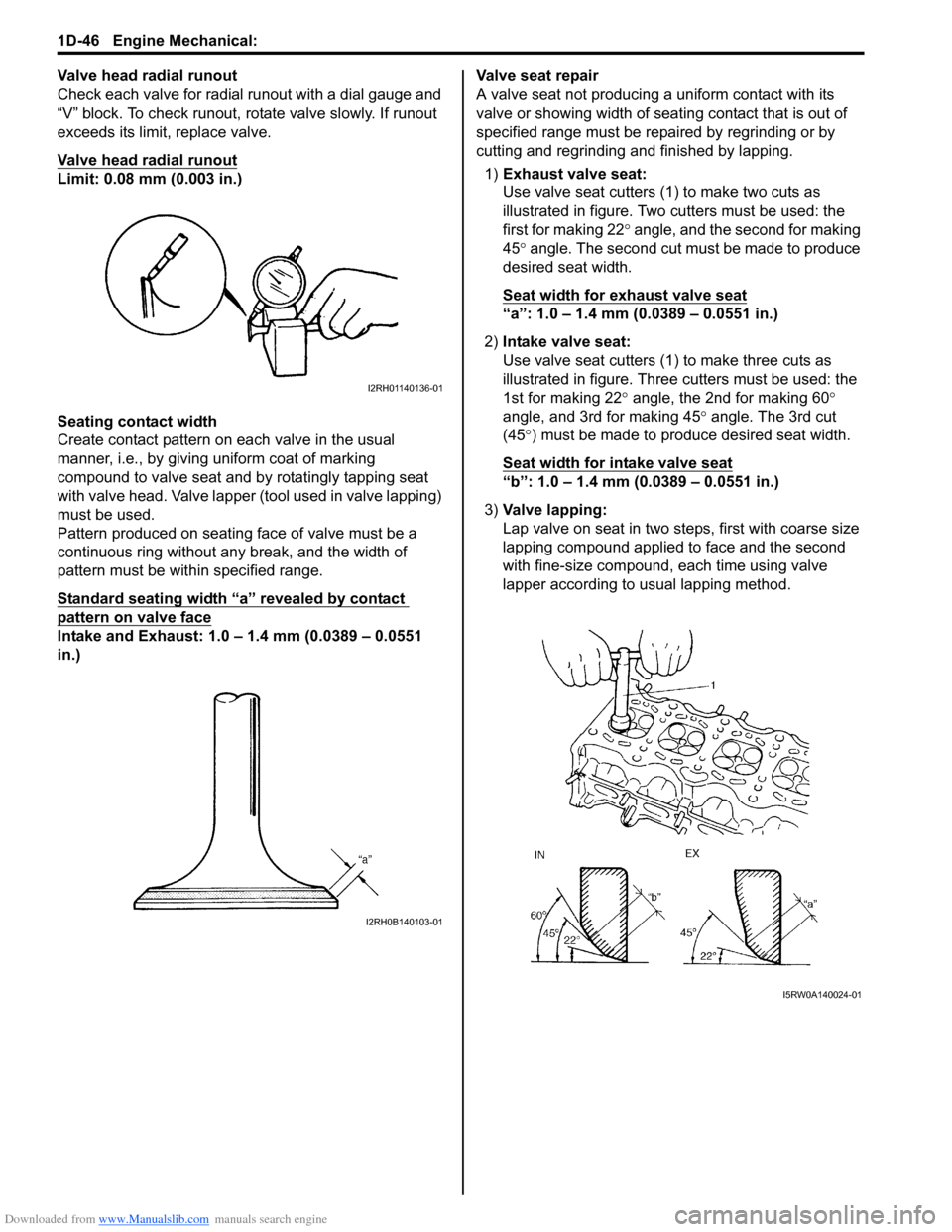
Valve head radial runout
Check each valve for radial runout with a dial gauge and
“V” block. To check runout, rotate valve slowly. If runout
exceeds its limit, replace valve.
Valve head radial runout
Limit: 0.08 mm (0.003 in.)
Seating contact width
Create contact pattern on each valve in the usual
manner, i.e., by giving uniform coat of marking
compound to valve seat and by rotatingly tapping seat
with valve head. Valve lapper (tool used in valve lapping)
must be used.
Pattern produced on seating face of valve must be a
continuous ring without any break, and the width of
pattern must be within specified range.
Standard seating width “a” revealed by contact
pattern on valve face
Intake and Exhaust: 1.0 – 1.4 mm (0.0389 – 0.0551
in.)Valve seat repair
A valve seat not producing a uniform contact with its
valve or showing width of seating contact that is out of
specified range must be repaired by regrinding or by
cutting and regrinding and finished by lapping.
1)Exhaust valve seat:
Use valve seat cutters (1) to make two cuts as
illustrated in figure. Two cutters must be used: the
first for making 22° angle, and the second for making
45° angle. The second cut must be made to produce
desired seat width.
Seat width for exhaust valve seat
“a”: 1.0 – 1.4 mm (0.0389 – 0.0551 in.)
2)Intake valve seat:
Use valve seat cutters (1) to make three cuts as
illustrated in figure. Three cutters must be used: the
1st for making 22° angle, the 2nd for making 60°
angle, and 3rd for making 45° angle. The 3rd cut
(45°) must be made to produce desired seat width.
Seat width for intake valve seat
“b”: 1.0 – 1.4 mm (0.0389 – 0.0551 in.)
3)Valve lapping:
Lap valve on seat in two steps, first with coarse size
lapping compound applied to face and the second
with fine-size compound, each time using valve
lapper according to usual lapping method.
I2RH01140136-01
I2RH0B140103-01
I5RW0A140024-01
Page 356 of 1556
Downloaded from www.Manualslib.com manuals search engine 1D-74 Engine Mechanical:
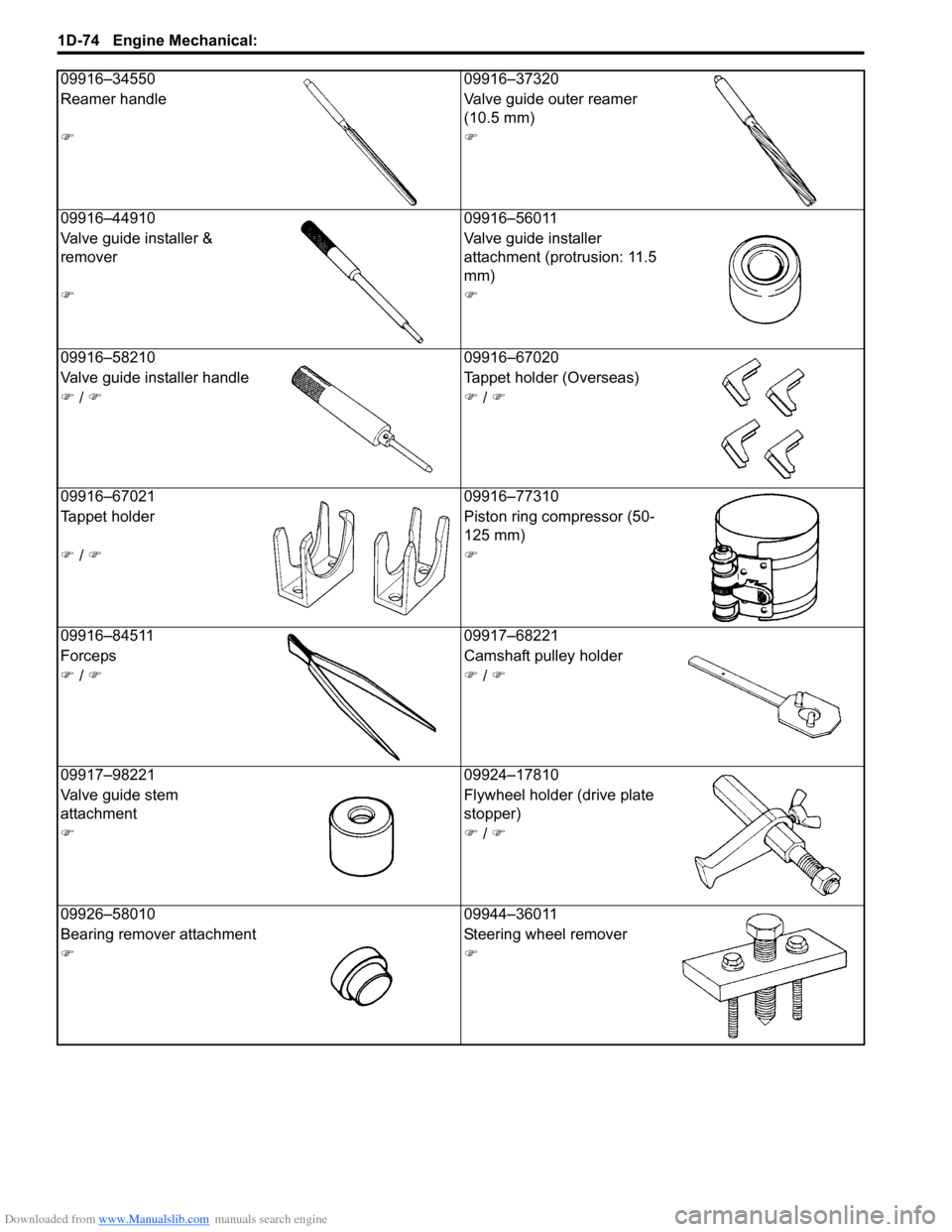
09916–34550 09916–37320
Reamer handle Valve guide outer reamer
(10.5 mm)
))
09916–44910 09916–56011
Valve guide installer &
removerValve guide installer
attachment (protrusion: 11.5
mm)
))
09916–58210 09916–67020
Valve guide installer handle Tappet holder (Overseas)
) / )) / )
09916–67021 09916–77310
Tappet holder Piston ring compressor (50-
125 mm)
) / ))
09916–84511 09917–68221
Forceps Camshaft pulley holder
) / )) / )
09917–98221 09924–17810
Valve guide stem
attachmentFlywheel holder (drive plate
stopper)
)) / )
09926–58010 09944–36011
Bearing remover attachment Steering wheel remover
))
Page 371 of 1556
Downloaded from www.Manualslib.com manuals search engine Engine Cooling System: 1F-6
Cooling System Flush and RefillS6RW0D1606005
WARNING!
To help avoid danger of being burned, do not
remove radiator cap while engine and
radiator are still hot. Scalding fluid and steam
can be blown out under pressure if cap is
taken off too soon.
NOTE
For detail of coolant specification, refer to
“Coolant Description”.
1) Remove radiator cap when engine is cool as follows.
a) Turn cap counterclockwise slowly until it reaches
a “stop” (Do not press down while turning it).
b) Wait until pressure is relieved (indicated by a
hissing sound) then press down on cap and
continue to turn it counterclockwise.
2) With radiator cap removed, run engine until upper
radiator hose is hot (this shows that thermostat is
open and coolant is flowing through system).
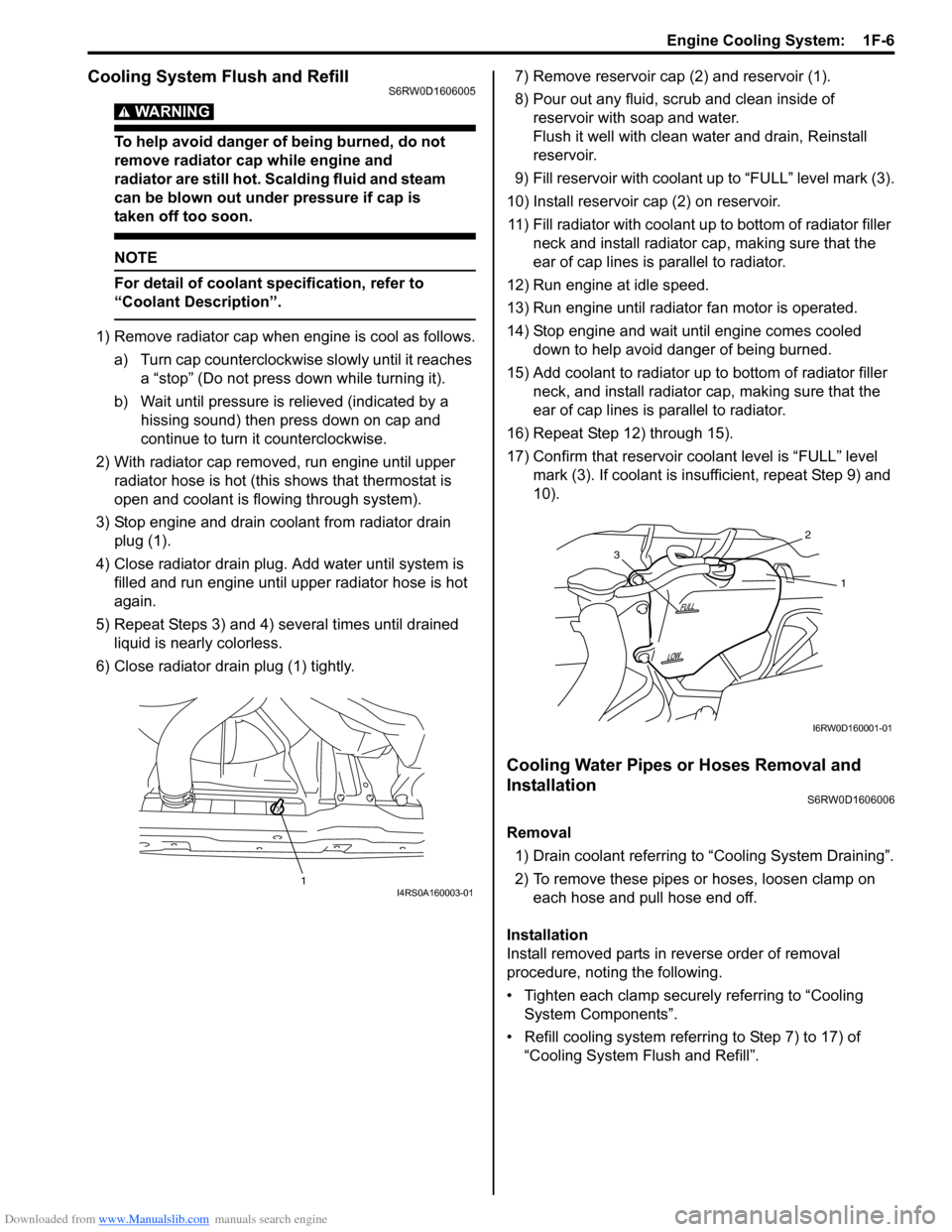
3) Stop engine and drain coolant from radiator drain
plug (1).
4) Close radiator drain plug. Add water until system is
filled and run engine until upper radiator hose is hot
again.
5) Repeat Steps 3) and 4) several times until drained
liquid is nearly colorless.
6) Close radiator drain plug (1) tightly.7) Remove reservoir cap (2) and reservoir (1).
8) Pour out any fluid, scrub and clean inside of
reservoir with soap and water.
Flush it well with clean water and drain, Reinstall
reservoir.
9) Fill reservoir with coolant up to “FULL” level mark (3).
10) Install reservoir cap (2) on reservoir.
11) Fill radiator with coolant up to bottom of radiator filler
neck and install radiator cap, making sure that the
ear of cap lines is parallel to radiator.
12) Run engine at idle speed.
13) Run engine until radiator fan motor is operated.
14) Stop engine and wait until engine comes cooled
down to help avoid danger of being burned.
15) Add coolant to radiator up to bottom of radiator filler
neck, and install radiator cap, making sure that the
ear of cap lines is parallel to radiator.
16) Repeat Step 12) through 15).
17) Confirm that reservoir coolant level is “FULL” level
mark (3). If coolant is insufficient, repeat Step 9) and
10).
Cooling Water Pipes or Hoses Removal and
Installation
S6RW0D1606006
Removal
1) Drain coolant referring to “Cooling System Draining”.
2) To remove these pipes or hoses, loosen clamp on
each hose and pull hose end off.
Installation
Install removed parts in reverse order of removal
procedure, noting the following.
• Tighten each clamp securely referring to “Cooling
System Components”.
• Refill cooling system referring to Step 7) to 17) of
“Cooling System Flush and Refill”.
1I4RS0A160003-01
2
1
3
I6RW0D160001-01
Page 375 of 1556
Downloaded from www.Manualslib.com manuals search engine Engine Cooling System: 1F-10
Water Pump / Generator Drive Belt Tension
Inspection and Adjustment
S6RW0D1606014
WARNING!
• Disconnect negative cable at battery
before checking and adjusting belt
tension.
• To help avoid danger of being burned, do
not remove radiator cap while engine and
radiator are still hot. Scalding fluid and
steam can be blown out under pressure if
cap is taken off too soon.
1) Inspect belt for cracks, cuts, deformation, wear and
cleanliness. If it is necessary to replace belt, refer to
“Water Pump / Generator Drive Belt Removal and
Installation”.
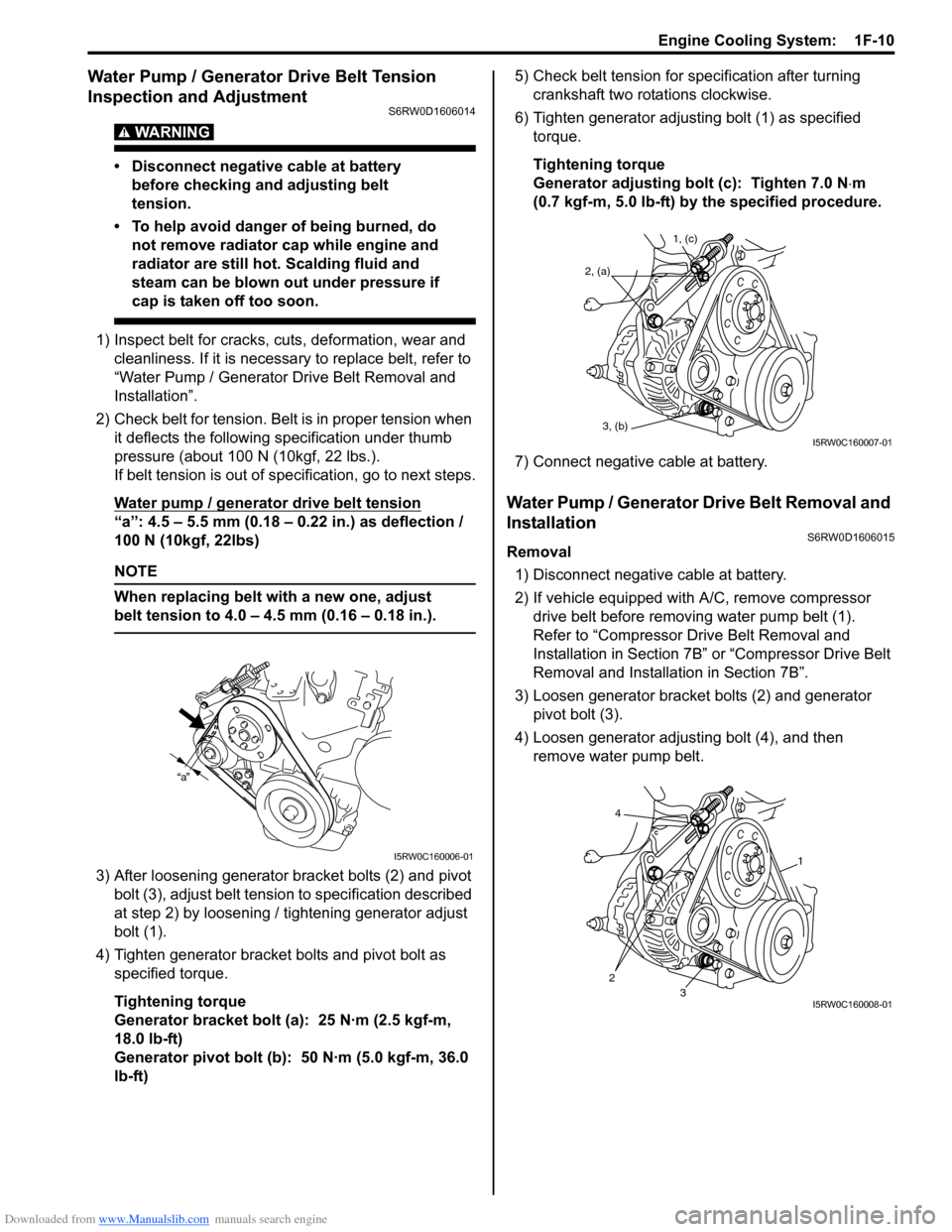
2) Check belt for tension. Belt is in proper tension when
it deflects the following specification under thumb
pressure (about 100 N (10kgf, 22 lbs.).
If belt tension is out of specification, go to next steps.
Water pump / generator drive belt tension
“a”: 4.5 – 5.5 mm (0.18 – 0.22 in.) as deflection /
100 N (10kgf, 22lbs)
NOTE
When replacing belt with a new one, adjust
belt tension to 4.0 – 4.5 mm (0.16 – 0.18 in.).
3) After loosening generator bracket bolts (2) and pivot
bolt (3), adjust belt tension to specification described
at step 2) by loosening / tightening generator adjust
bolt (1).
4) Tighten generator bracket bolts and pivot bolt as
specified torque.
Tightening torque
Generator bracket bolt (a): 25 N·m (2.5 kgf-m,
18.0 lb-ft)
Generator pivot bolt (b): 50 N·m (5.0 kgf-m, 36.0
lb-ft)5) Check belt tension for specification after turning
crankshaft two rotations clockwise.
6) Tighten generator adjusting bolt (1) as specified
torque.
Tightening torque
Generator adjusting bolt (c): Tighten 7.0 N⋅m
(0.7 kgf-m, 5.0 lb-ft) by the specified procedure.
7) Connect negative cable at battery.
Water Pump / Generator Drive Belt Removal and
Installation
S6RW0D1606015
Removal
1) Disconnect negative cable at battery.
2) If vehicle equipped with A/C, remove compressor
drive belt before removing water pump belt (1).
Refer to “Compressor Drive Belt Removal and
Installation in Section 7B” or “Compressor Drive Belt
Removal and Installation in Section 7B”.
3) Loosen generator bracket bolts (2) and generator
pivot bolt (3).
4) Loosen generator adjusting bolt (4), and then
remove water pump belt.
a
I5RW0C160006-01
1, (c)
2, (a)
3, (b)
I5RW0C160007-01
4
23
1
I5RW0C160008-01