Water SUZUKI SX4 2006 1.G Service Owner's Manual
[x] Cancel search | Manufacturer: SUZUKI, Model Year: 2006, Model line: SX4, Model: SUZUKI SX4 2006 1.GPages: 1556, PDF Size: 37.31 MB
Page 306 of 1556
Downloaded from www.Manualslib.com manuals search engine 1D-24 Engine Mechanical:
Installation
1) Clean sealing surface on timing chain cover, cylinder
block and cylinder head.
Remove oil, old sealant and dust from sealing
surface.
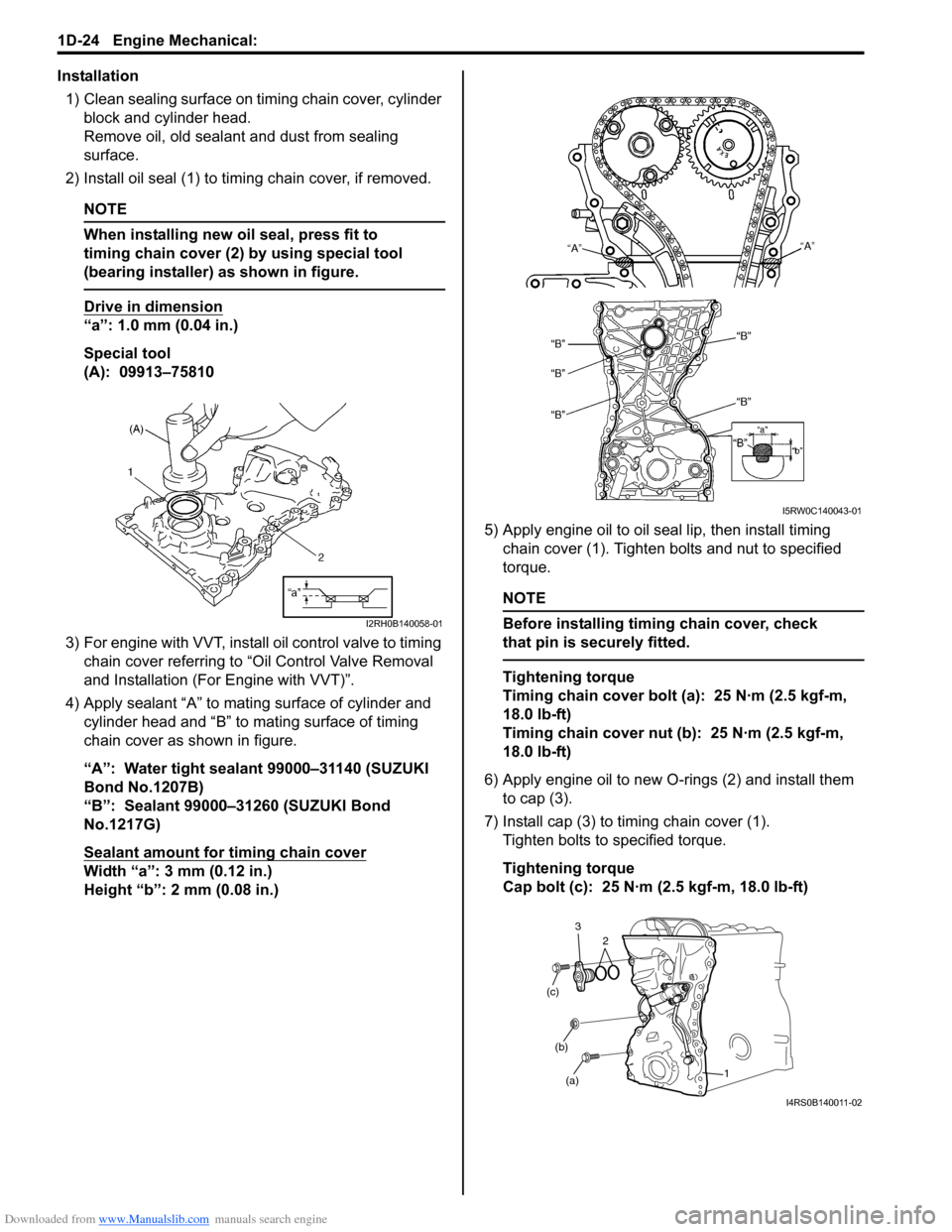
2) Install oil seal (1) to timing chain cover, if removed.
NOTE
When installing new oil seal, press fit to
timing chain cover (2) by using special tool
(bearing installer) as shown in figure.
Drive in dimension
“a”: 1.0 mm (0.04 in.)
Special tool
(A): 09913–75810
3) For engine with VVT, install oil control valve to timing
chain cover referring to “Oil Control Valve Removal
and Installation (For Engine with VVT)”.
4) Apply sealant “A” to mating surface of cylinder and
cylinder head and “B” to mating surface of timing
chain cover as shown in figure.
“A”: Water tight sealant 99000–31140 (SUZUKI
Bond No.1207B)
“B”: Sealant 99000–31260 (SUZUKI Bond
No.1217G)
Sealant amount for timing chain cover
Width “a”: 3 mm (0.12 in.)
Height “b”: 2 mm (0.08 in.)5) Apply engine oil to oil seal lip, then install timing
chain cover (1). Tighten bolts and nut to specified
torque.
NOTE
Before installing timing chain cover, check
that pin is securely fitted.
Tightening torque
Timing chain cover bolt (a): 25 N·m (2.5 kgf-m,
18.0 lb-ft)
Timing chain cover nut (b): 25 N·m (2.5 kgf-m,
18.0 lb-ft)
6) Apply engine oil to new O-rings (2) and install them
to cap (3).
7) Install cap (3) to timing chain cover (1).
Tighten bolts to specified torque.
Tightening torque
Cap bolt (c): 25 N·m (2.5 kgf-m, 18.0 lb-ft)
I2RH0B140058-01
I5RW0C140043-01
(a) (b) (c)
1 2 3
I4RS0B140011-02
Page 307 of 1556
Downloaded from www.Manualslib.com manuals search engine Engine Mechanical: 1D-25
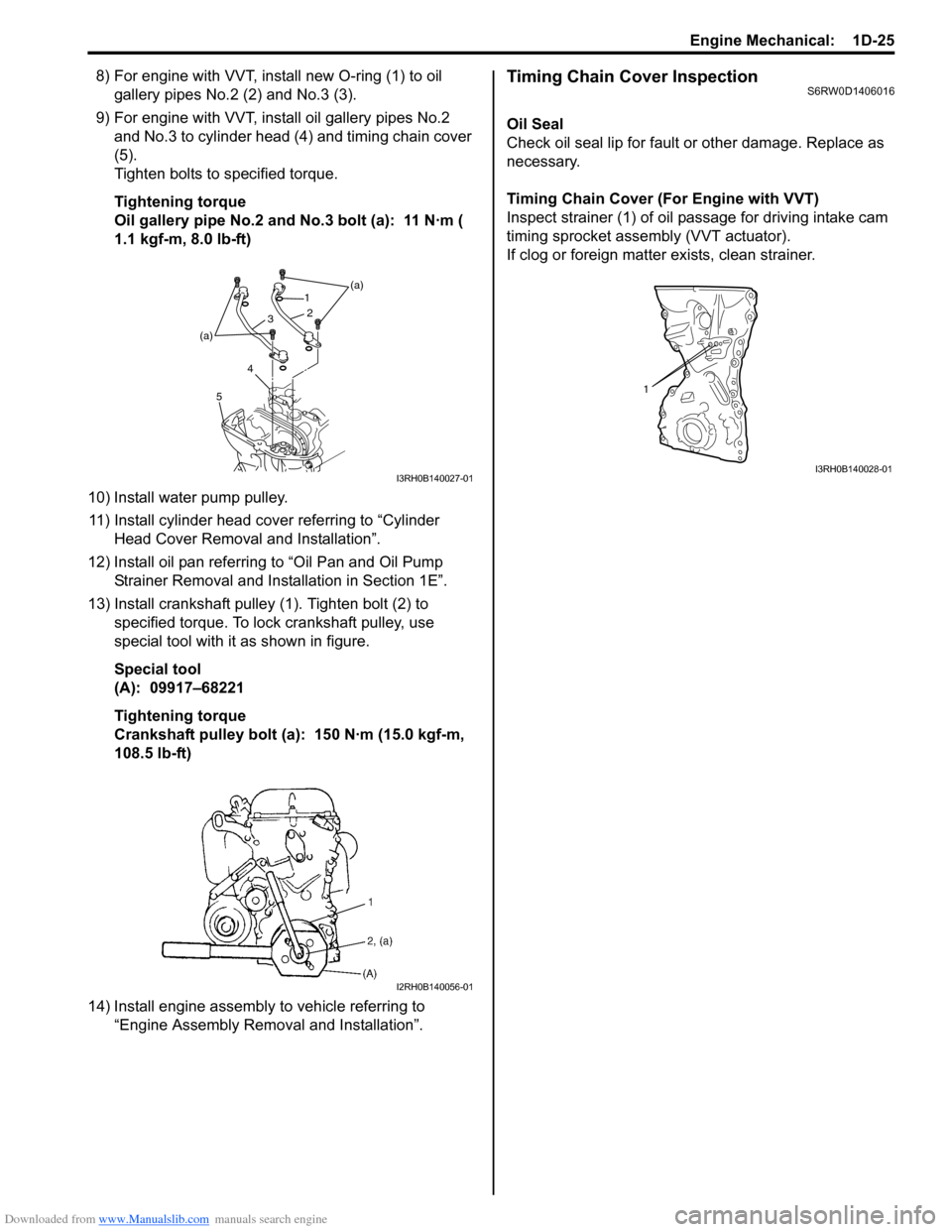
8) For engine with VVT, install new O-ring (1) to oil
gallery pipes No.2 (2) and No.3 (3).
9) For engine with VVT, install oil gallery pipes No.2
and No.3 to cylinder head (4) and timing chain cover
(5).
Tighten bolts to specified torque.
Tightening torque
Oil gallery pipe No.2 and No.3 bolt (a): 11 N·m (
1.1 kgf-m, 8.0 lb-ft)
10) Install water pump pulley.
11) Install cylinder head cover referring to “Cylinder
Head Cover Removal and Installation”.
12) Install oil pan referring to “Oil Pan and Oil Pump
Strainer Removal and Installation in Section 1E”.
13) Install crankshaft pulley (1). Tighten bolt (2) to
specified torque. To lock crankshaft pulley, use
special tool with it as shown in figure.
Special tool
(A): 09917–68221
Tightening torque
Crankshaft pulley bolt (a): 150 N·m (15.0 kgf-m,
108.5 lb-ft)
14) Install engine assembly to vehicle referring to
“Engine Assembly Removal and Installation”.Timing Chain Cover InspectionS6RW0D1406016
Oil Seal
Check oil seal lip for fault or other damage. Replace as
necessary.
Timing Chain Cover (For Engine with VVT)
Inspect strainer (1) of oil passage for driving intake cam
timing sprocket assembly (VVT actuator).
If clog or foreign matter exists, clean strainer.
(a)
(a)1
2
3
4
5
I3RH0B140027-01
I2RH0B140056-01
1
I3RH0B140028-01
Page 329 of 1556
Downloaded from www.Manualslib.com manuals search engine Engine Mechanical: 1D-47
Cylinder Head InspectionS6RW0D1406029
• Remove all carbon deposits from combustion
chambers.
NOTE
Do not use any sharp-edged tool to scrape
off carbon deposits. Be careful not to scuff or
nick metal surfaces when decarbonizing. The
same applies to valves and valve seats, too.
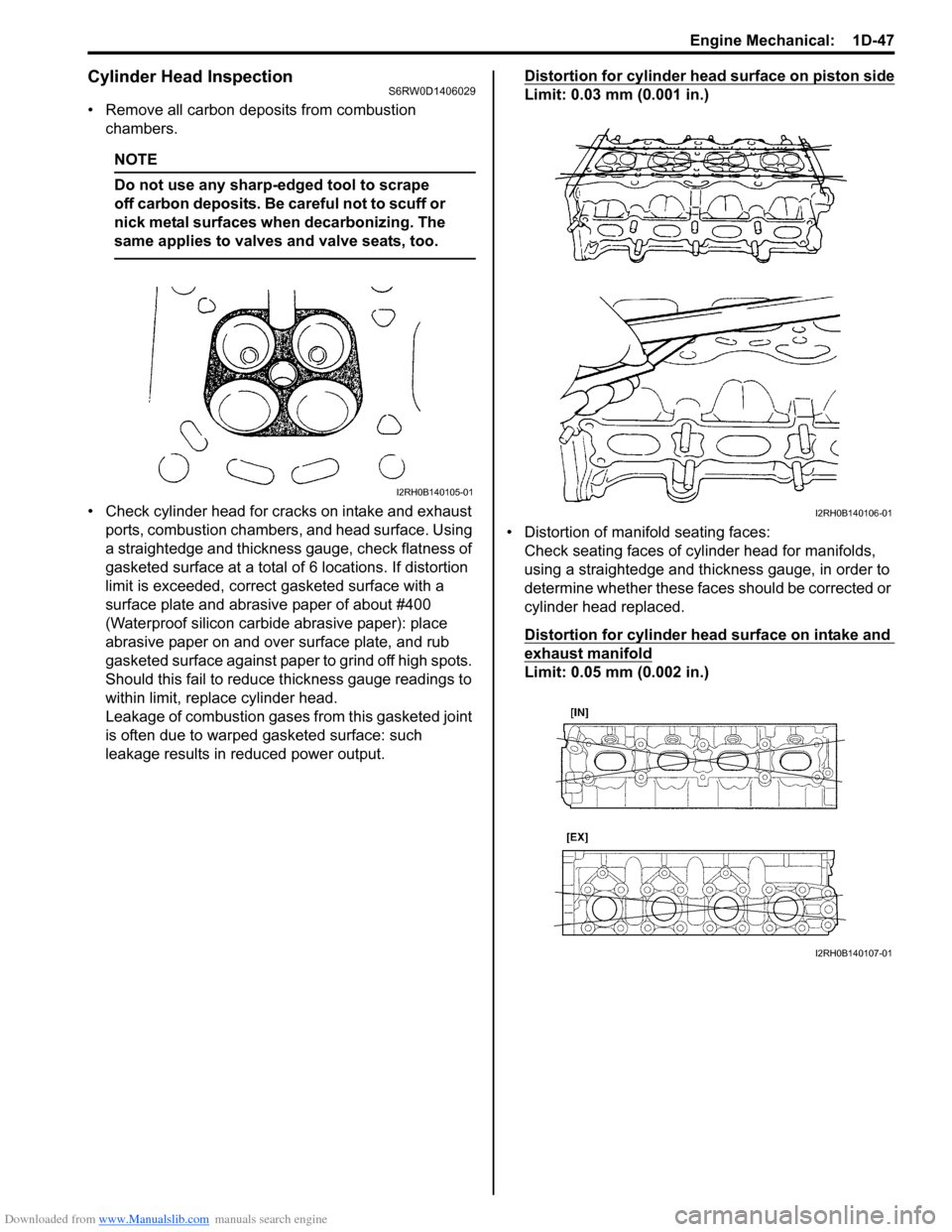
• Check cylinder head for cracks on intake and exhaust
ports, combustion chambers, and head surface. Using
a straightedge and thickness gauge, check flatness of
gasketed surface at a total of 6 locations. If distortion
limit is exceeded, correct gasketed surface with a
surface plate and abrasive paper of about #400
(Waterproof silicon carbide abrasive paper): place
abrasive paper on and over surface plate, and rub
gasketed surface against paper to grind off high spots.
Should this fail to reduce thickness gauge readings to
within limit, replace cylinder head.
Leakage of combustion gases from this gasketed joint
is often due to warped gasketed surface: such
leakage results in reduced power output.Distortion for cylinder head surface on piston side
Limit: 0.03 mm (0.001 in.)
• Distortion of manifold seating faces:
Check seating faces of cylinder head for manifolds,
using a straightedge and thickness gauge, in order to
determine whether these faces should be corrected or
cylinder head replaced.
Distortion for cylinder head surface on intake and
exhaust manifold
Limit: 0.05 mm (0.002 in.)
I2RH0B140105-01
I2RH0B140106-01
I2RH0B140107-01
Page 344 of 1556
Downloaded from www.Manualslib.com manuals search engine 1D-62 Engine Mechanical:
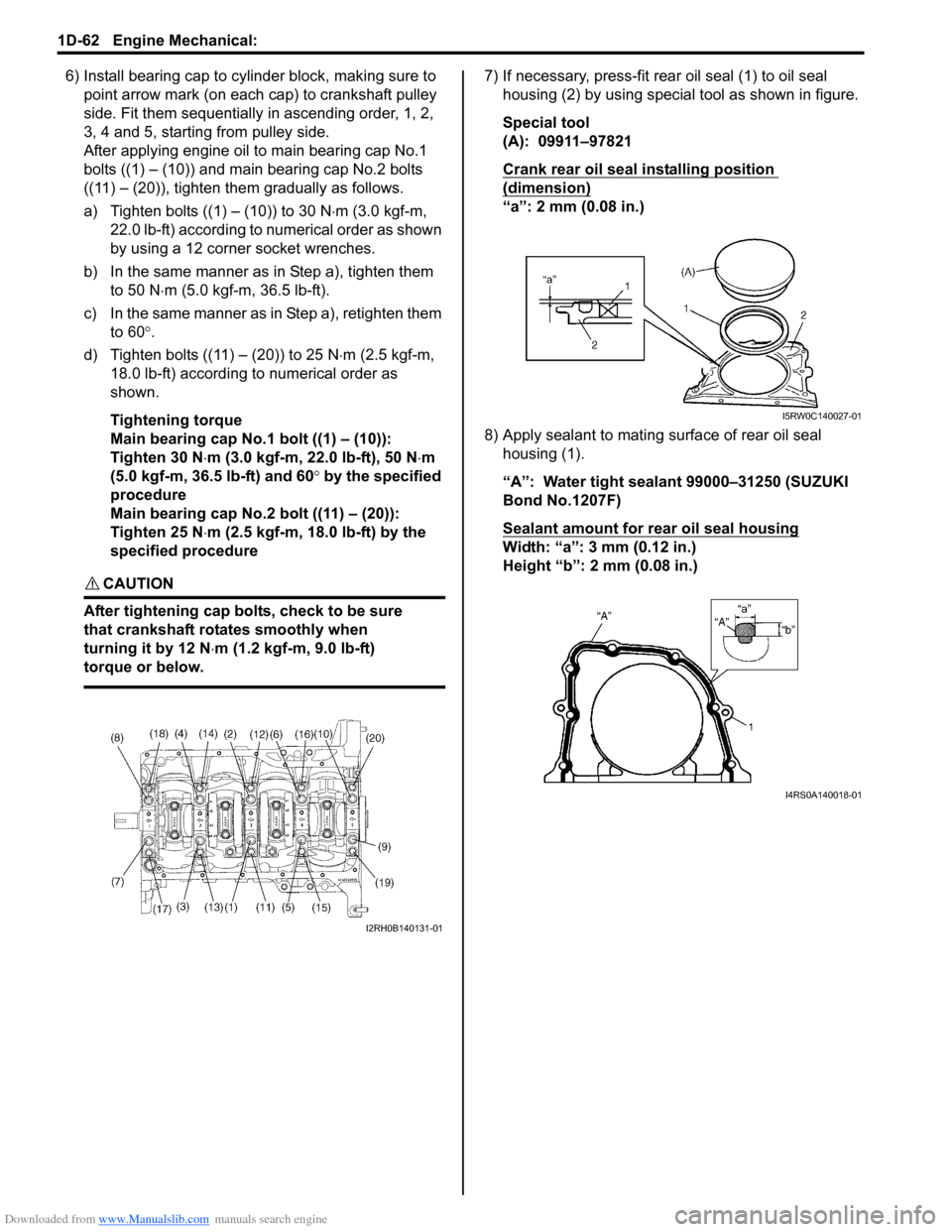
6) Install bearing cap to cylinder block, making sure to
point arrow mark (on each cap) to crankshaft pulley
side. Fit them sequentially in ascending order, 1, 2,
3, 4 and 5, starting from pulley side.
After applying engine oil to main bearing cap No.1
bolts ((1) – (10)) and main bearing cap No.2 bolts
((11) – (20)), tighten them gradually as follows.
a) Tighten bolts ((1) – (10)) to 30 N⋅m (3.0 kgf-m,
22.0 lb-ft) according to numerical order as shown
by using a 12 corner socket wrenches.
b) In the same manner as in Step a), tighten them
to 50 N⋅m (5.0 kgf-m, 36.5 lb-ft).
c) In the same manner as in Step a), retighten them
to 60°.
d) Tighten bolts ((11) – (20)) to 25 N⋅m (2.5 kgf-m,
18.0 lb-ft) according to numerical order as
shown.
Tightening torque
Main bearing cap No.1 bolt ((1) – (10)):
Tighten 30 N⋅m (3.0 kgf-m, 22.0 lb-ft), 50 N⋅m
(5.0 kgf-m, 36.5 lb-ft) and 60° by the specified
procedure
Main bearing cap No.2 bolt ((11) – (20)):
Tighten 25 N⋅m (2.5 kgf-m, 18.0 lb-ft) by the
specified procedure
CAUTION!
After tightening cap bolts, check to be sure
that crankshaft rotates smoothly when
turning it by 12 N⋅m (1.2 kgf-m, 9.0 lb-ft)
torque or below.
7) If necessary, press-fit rear oil seal (1) to oil seal
housing (2) by using special tool as shown in figure.
Special tool
(A): 09911–97821
Crank rear oil seal installing position
(dimension)
“a”: 2 mm (0.08 in.)
8) Apply sealant to mating surface of rear oil seal
housing (1).
“A”: Water tight sealant 99000–31250 (SUZUKI
Bond No.1207F)
Sealant amount for rear oil seal housing
Width: “a”: 3 mm (0.12 in.)
Height “b”: 2 mm (0.08 in.)
I2RH0B140131-01
I5RW0C140027-01
I4RS0A140018-01
Page 355 of 1556
Downloaded from www.Manualslib.com manuals search engine Engine Mechanical: 1D-73
Special Tools and Equipment
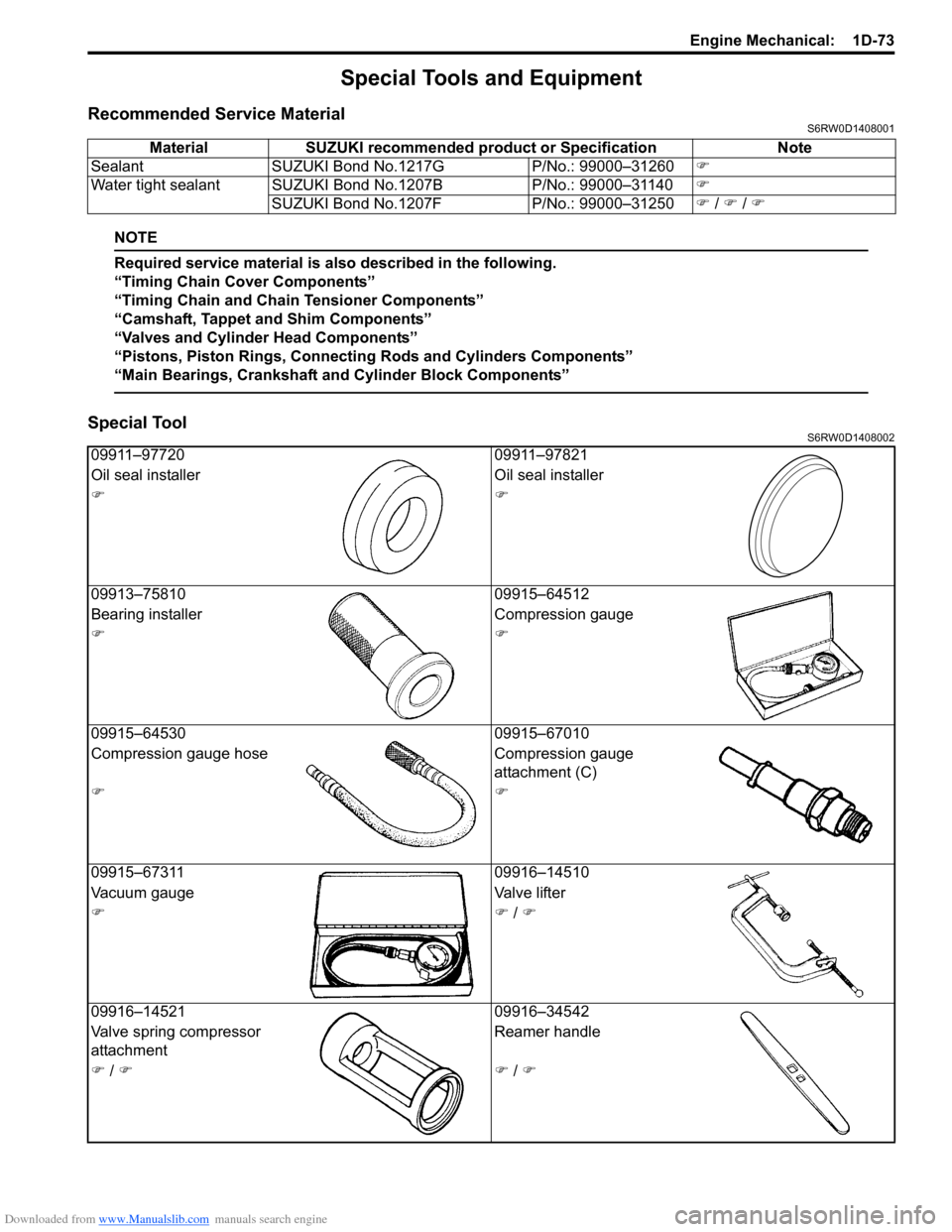
Recommended Service MaterialS6RW0D1408001
NOTE
Required service material is also described in the following.
“Timing Chain Cover Components”
“Timing Chain and Chain Tensioner Components”
“Camshaft, Tappet and Shim Components”
“Valves and Cylinder Head Components”
“Pistons, Piston Rings, Connecting Rods and Cylinders Components”
“Main Bearings, Crankshaft and Cylinder Block Components”
Special ToolS6RW0D1408002
Material SUZUKI recommended product or Specification Note
Sealant SUZUKI Bond No.1217G P/No.: 99000–31260)
Water tight sealant SUZUKI Bond No.1207B P/No.: 99000–31140)
SUZUKI Bond No.1207F P/No.: 99000–31250) / ) / )
09911–97720 09911–97821
Oil seal installer Oil seal installer
))
09913–75810 09915–64512
Bearing installer Compression gauge
))
09915–64530 09915–67010
Compression gauge hose Compression gauge
attachment (C)
))
09915–67311 09916–14510
Vacuum gauge Valve lifter
)) / )
09916–14521 09916–34542
Valve spring compressor
attachmentReamer handle
) / )) / )
Page 366 of 1556
Downloaded from www.Manualslib.com manuals search engine 1F-1 Engine Cooling System:
Engine
Engine Cooling System
General Description
Cooling System DescriptionS6RW0D1601001
The cooling system consists of the radiator cap, radiator,
coolant reservoir, hoses, water pump, cooling fan and
thermostat. The radiator is of tube-and-fin type.
Coolant DescriptionS6RW0D1601002
WARNING!
• Do not remove radiator cap to check
engine coolant level; check coolant
visually at the see-through coolant
reservoir. Coolant should be added only to
reservoir as necessary.
• As long as there is pressure in the cooling
system, the temperature can be
considerably higher than the boiling
temperature of the solution in the radiator
without causing the solution to boil.
Removal of the radiator cap while engine is
hot and pressure is high will cause the
solution to boil instantaneously and
possibly with explosive force, spewing the
solution over engine, fenders and person
removing cap. If the solution contains
flammable anti-freeze such as alcohol (not
recommended for use at any time), there is
also the possibility of causing a serious
fire.
• Check to make sure that engine coolant
temperature is cold before removing any
part of cooling system.
• Also be sure to disconnect negative cable
from battery terminal before removing any
part.
The coolant recovery system is standard. The coolant in
the radiator expands with heat, and the coolant is
overflowed to the reservoir.
When the system cools down, the coolant is drawn back
into the radiator.
The cooling system has been filled with a quality coolant
that is a 50/50 mixture of water and ethylene glycol
antifreeze.
This 50/50 mixture coolant solution provides freezing
protection to –36 °C (–33 °F).
• Maintain cooling system freeze protection at –36 °C (–
33 °F) to ensure protection against corrosion and loss
of coolant from boiling. This should be done even if
freezing temperatures are not expected.
• Add ethylene glycol base coolant when coolant has to
be added because of coolant loss or to provide added
protection against freezing at temperature lower than
–36 °C (–33 °F).
NOTE
• Alcohol or methanol base coolant or plain
water alone should not be used in cooling
system at any time as damage to cooling
system could occur.
• Coolant must be mixed with demineralized
water or distilled water.
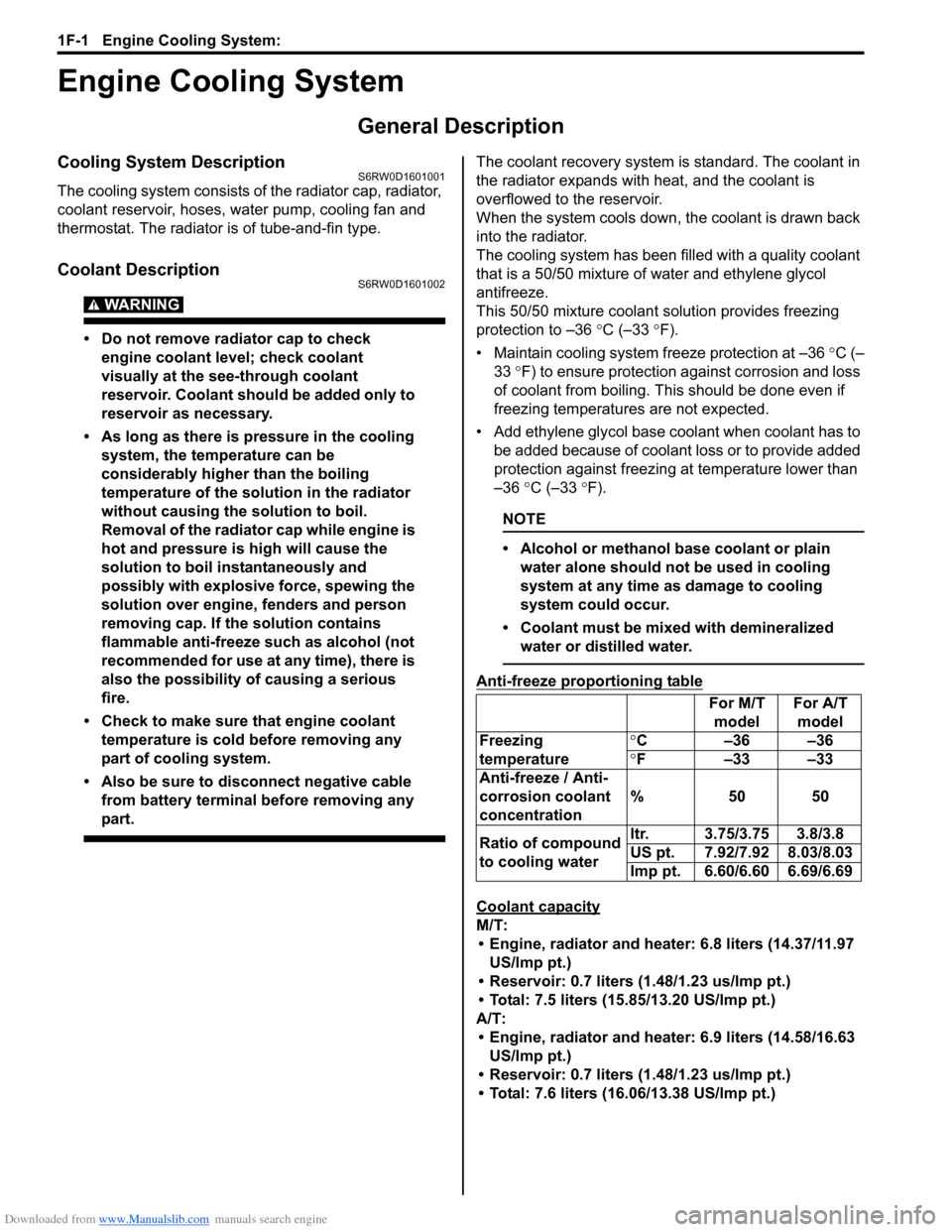
Anti-freeze proportioning table
Coolant capacity
M/T:
• Engine, radiator and heater: 6.8 liters (14.37/11.97
US/lmp pt.)
• Reservoir: 0.7 liters (1.48/1.23 us/lmp pt.)
• Total: 7.5 liters (15.85/13.20 US/lmp pt.)
A/T:
• Engine, radiator and heater: 6.9 liters (14.58/16.63
US/lmp pt.)
• Reservoir: 0.7 liters (1.48/1.23 us/lmp pt.)
• Total: 7.6 liters (16.06/13.38 US/lmp pt.)For M/T
modelFor A/T
model
Freezing
temperature°C–36–36
°F–33–33
Anti-freeze / Anti-
corrosion coolant
concentration%5050
Ratio of compound
to cooling waterltr. 3.75/3.75 3.8/3.8
US pt. 7.92/7.92 8.03/8.03
Imp pt. 6.60/6.60 6.69/6.69
Page 367 of 1556
Downloaded from www.Manualslib.com manuals search engine Engine Cooling System: 1F-2
Schematic and Routing Diagram
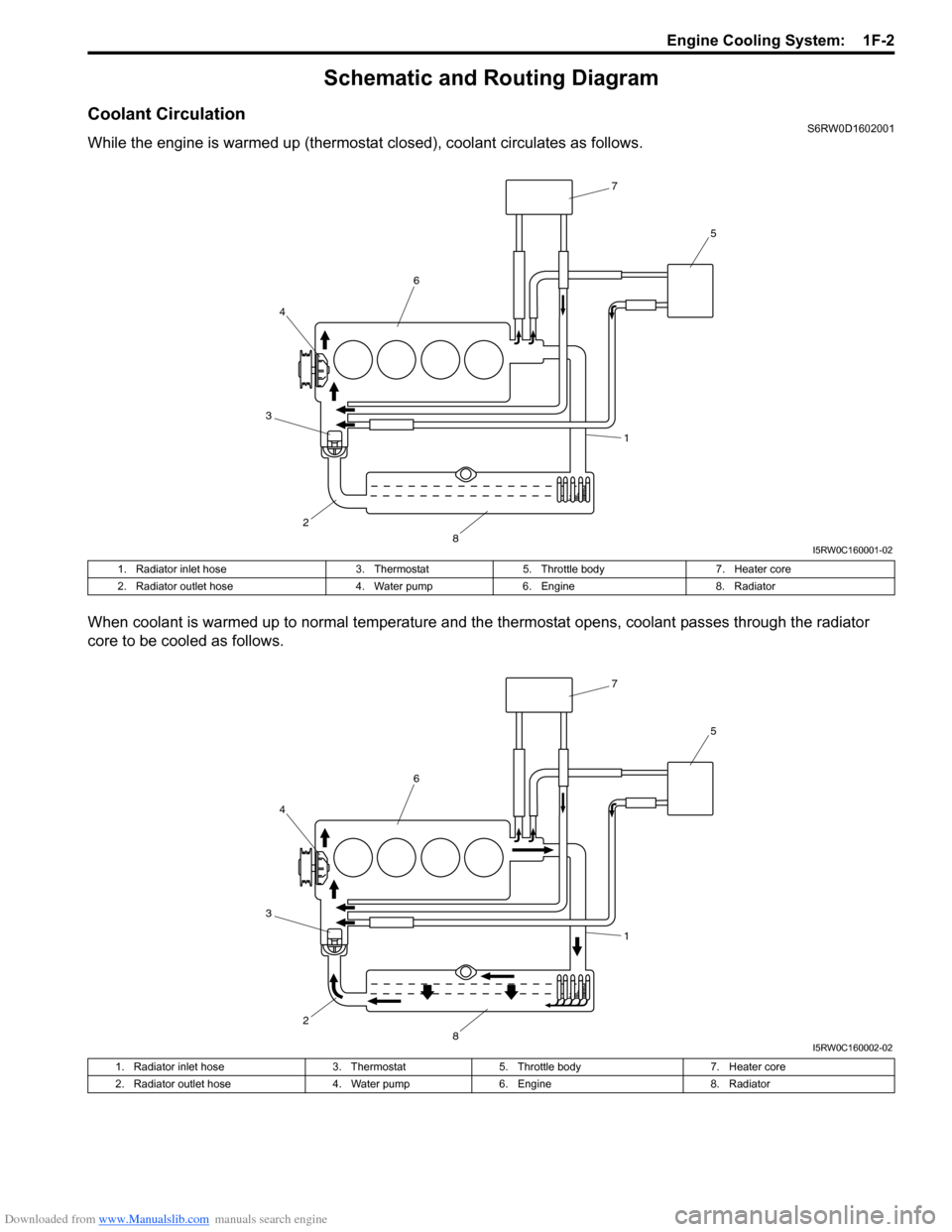
Coolant CirculationS6RW0D1602001
While the engine is warmed up (thermostat closed), coolant circulates as follows.
When coolant is warmed up to normal temperature and the thermostat opens, coolant passes through the radiator
core to be cooled as follows.
7
5
6
4
3
2
81
I5RW0C160001-02
1. Radiator inlet hose 3. Thermostat 5. Throttle body 7. Heater core
2. Radiator outlet hose 4. Water pump 6. Engine 8. Radiator
7
5
6
4
3
2
81
I5RW0C160002-02
1. Radiator inlet hose 3. Thermostat 5. Throttle body 7. Heater core
2. Radiator outlet hose 4. Water pump 6. Engine 8. Radiator
Page 368 of 1556
Downloaded from www.Manualslib.com manuals search engine 1F-3 Engine Cooling System:
Diagnostic Information and Procedures
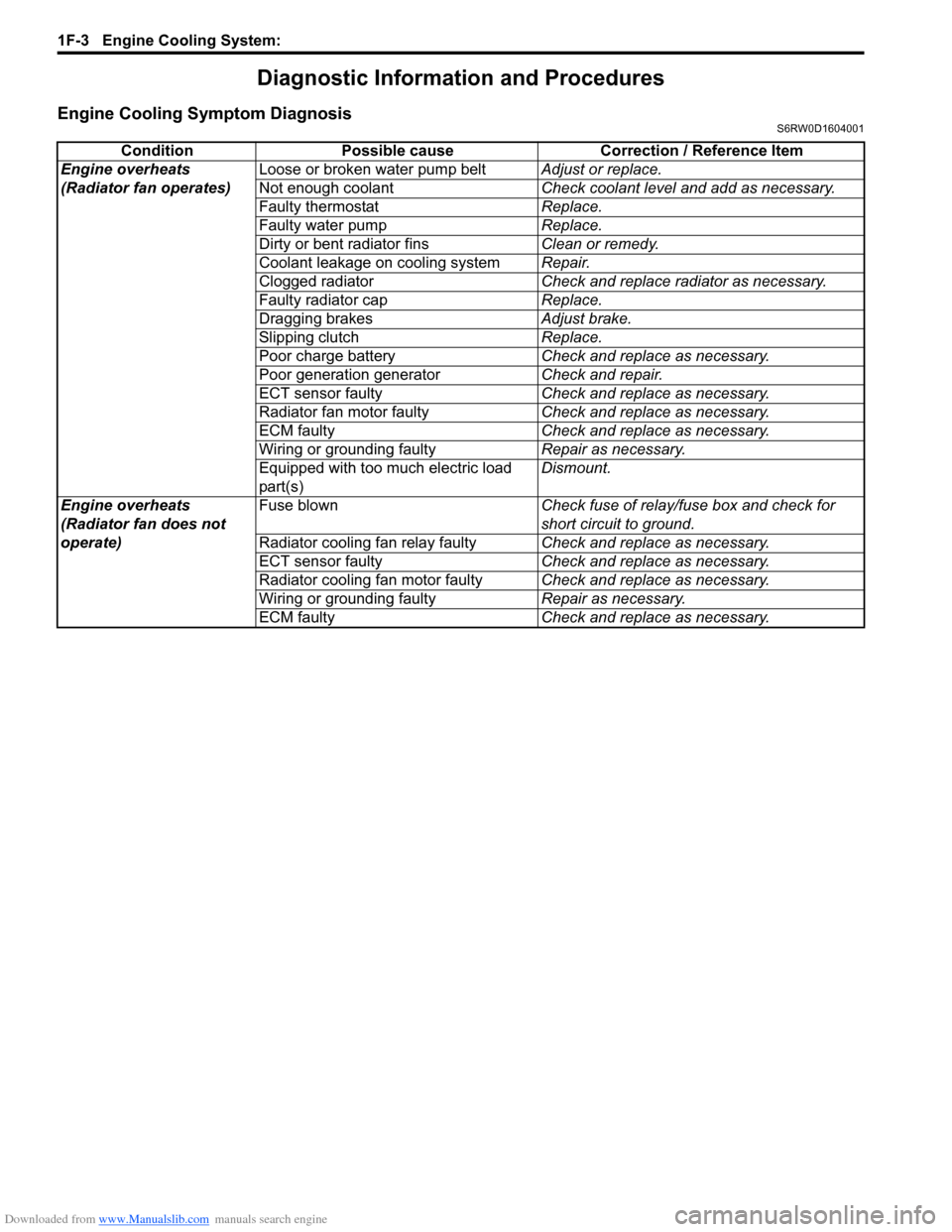
Engine Cooling Symptom DiagnosisS6RW0D1604001
Condition Possible cause Correction / Reference Item
Engine overheats
(Radiator fan operates)Loose or broken water pump beltAdjust or replace.
Not enough coolantCheck coolant level and add as necessary.
Faulty thermostatReplace.
Faulty water pumpReplace.
Dirty or bent radiator finsClean or remedy.
Coolant leakage on cooling systemRepair.
Clogged radiatorCheck and replace radiator as necessary.
Faulty radiator capReplace.
Dragging brakesAdjust brake.
Slipping clutchReplace.
Poor charge batteryCheck and replace as necessary.
Poor generation generatorCheck and repair.
ECT sensor faultyCheck and replace as necessary.
Radiator fan motor faultyCheck and replace as necessary.
ECM faultyCheck and replace as necessary.
Wiring or grounding faultyRepair as necessary.
Equipped with too much electric load
part(s)Dismount.
Engine overheats
(Radiator fan does not
operate)Fuse blownCheck fuse of relay/fuse box and check for
short circuit to ground.
Radiator cooling fan relay faultyCheck and replace as necessary.
ECT sensor faultyCheck and replace as necessary.
Radiator cooling fan motor faultyCheck and replace as necessary.
Wiring or grounding faultyRepair as necessary.
ECM faultyCheck and replace as necessary.
Page 369 of 1556
Downloaded from www.Manualslib.com manuals search engine Engine Cooling System: 1F-4
Repair Instructions
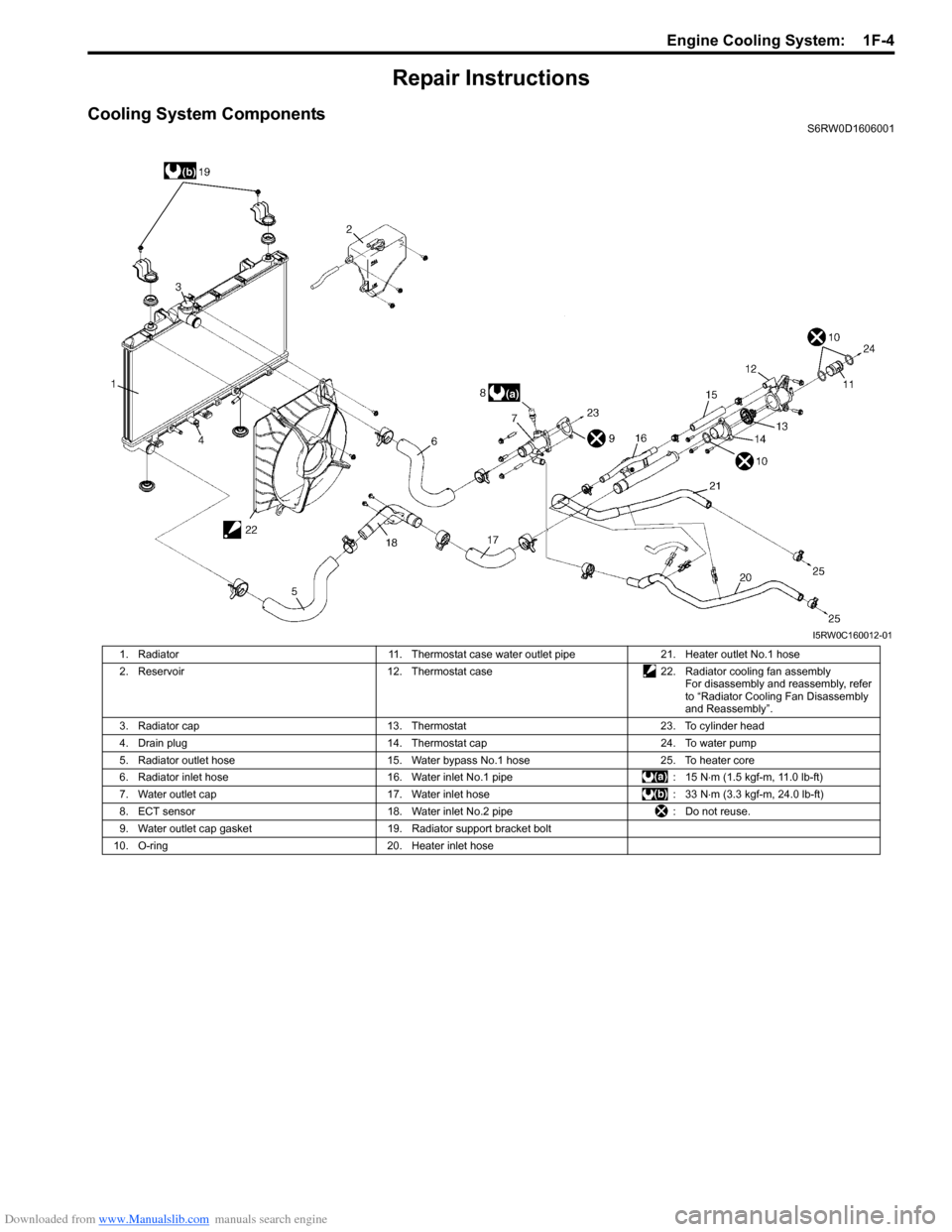
Cooling System ComponentsS6RW0D1606001
I5RW0C160012-01
1. Radiator 11. Thermostat case water outlet pipe 21. Heater outlet No.1 hose
2. Reservoir 12. Thermostat case 22. Radiator cooling fan assembly
For disassembly and reassembly, refer
to “Radiator Cooling Fan Disassembly
and Reassembly”.
3. Radiator cap 13. Thermostat 23. To cylinder head
4. Drain plug 14. Thermostat cap 24. To water pump
5. Radiator outlet hose 15. Water bypass No.1 hose 25. To heater core
6. Radiator inlet hose 16. Water inlet No.1 pipe : 15 N⋅m (1.5 kgf-m, 11.0 lb-ft)
7. Water outlet cap 17. Water inlet hose : 33 N⋅m (3.3 kgf-m, 24.0 lb-ft)
8. ECT sensor 18. Water inlet No.2 pipe : Do not reuse.
9. Water outlet cap gasket 19. Radiator support bracket bolt
10. O-ring 20. Heater inlet hose
Page 370 of 1556
Downloaded from www.Manualslib.com manuals search engine 1F-5 Engine Cooling System:
Coolant Level CheckS6RW0D1606002
WARNING!
To help avoid danger of being burned, do not
remove radiator cap while engine and
radiator are still hot. Scalding fluid and steam
can be blown out under pressure if radiator
cap is taken off too soon.
To check level, lift hood and look at “see-through”
coolant reservoir.
It is not necessary to remove radiator cap to check
coolant level.
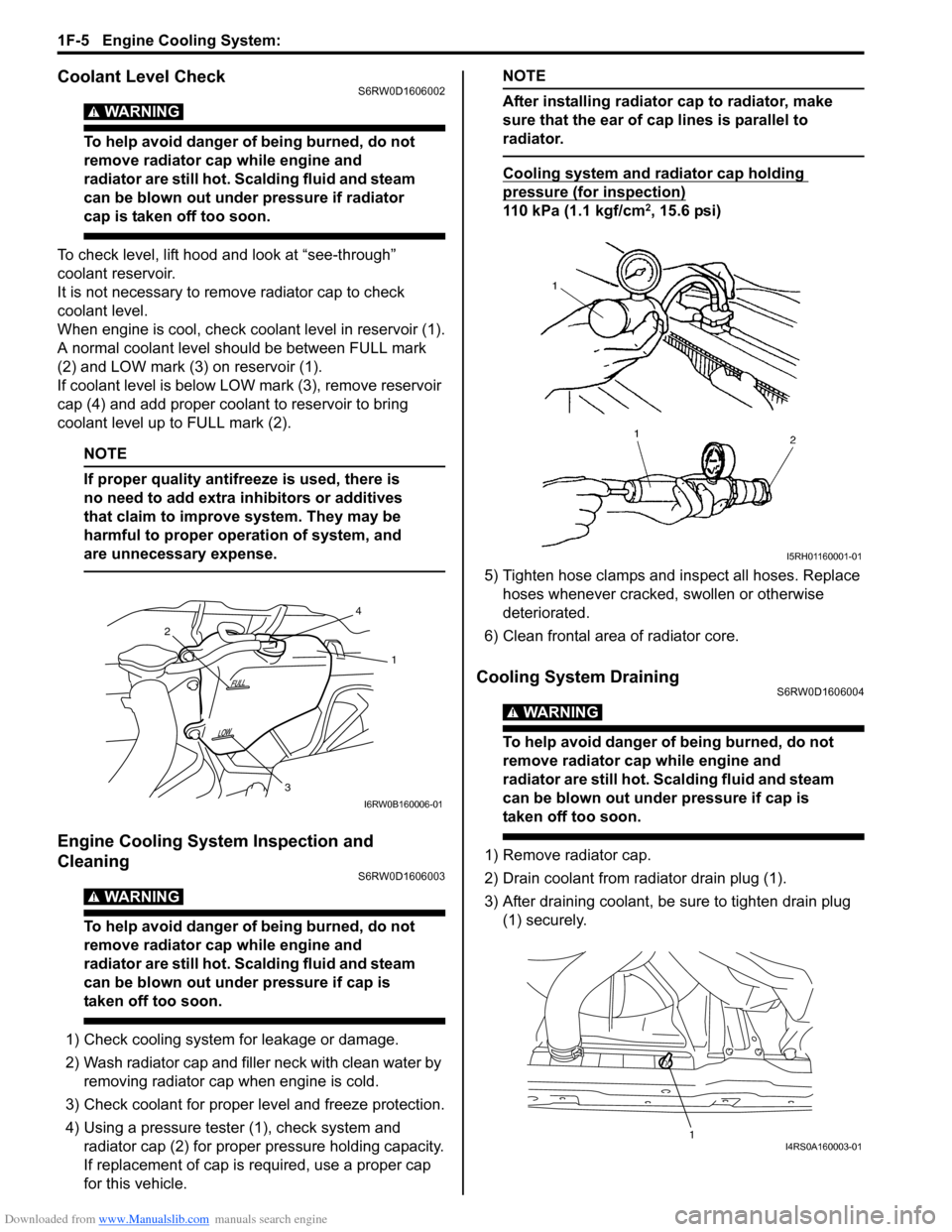
When engine is cool, check coolant level in reservoir (1).
A normal coolant level should be between FULL mark
(2) and LOW mark (3) on reservoir (1).
If coolant level is below LOW mark (3), remove reservoir
cap (4) and add proper coolant to reservoir to bring
coolant level up to FULL mark (2).
NOTE
If proper quality antifreeze is used, there is
no need to add extra inhibitors or additives
that claim to improve system. They may be
harmful to proper operation of system, and
are unnecessary expense.
Engine Cooling System Inspection and
Cleaning
S6RW0D1606003
WARNING!
To help avoid danger of being burned, do not
remove radiator cap while engine and
radiator are still hot. Scalding fluid and steam
can be blown out under pressure if cap is
taken off too soon.
1) Check cooling system for leakage or damage.
2) Wash radiator cap and filler neck with clean water by
removing radiator cap when engine is cold.
3) Check coolant for proper level and freeze protection.
4) Using a pressure tester (1), check system and
radiator cap (2) for proper pressure holding capacity.
If replacement of cap is required, use a proper cap
for this vehicle.
NOTE
After installing radiator cap to radiator, make
sure that the ear of cap lines is parallel to
radiator.
Cooling system and radiator cap holding
pressure (for inspection)
110 kPa (1.1 kgf/cm2, 15.6 psi)
5) Tighten hose clamps and inspect all hoses. Replace
hoses whenever cracked, swollen or otherwise
deteriorated.
6) Clean frontal area of radiator core.
Cooling System DrainingS6RW0D1606004
WARNING!
To help avoid danger of being burned, do not
remove radiator cap while engine and
radiator are still hot. Scalding fluid and steam
can be blown out under pressure if cap is
taken off too soon.
1) Remove radiator cap.
2) Drain coolant from radiator drain plug (1).
3) After draining coolant, be sure to tighten drain plug
(1) securely.
4
1
2
3
I6RW0B160006-01
I5RH01160001-01
1I4RS0A160003-01