display TESLA MODEL S 2014 (Europe) Workshop Manual
[x] Cancel search | Manufacturer: TESLA, Model Year: 2014, Model line: MODEL S, Model: TESLA MODEL S 2014Pages: 152, PDF Size: 17.5 MB
Page 111 of 152
Cleaning
MAINTENANCE7.13
Cleaning the Interior
Frequently inspect and clean the interior to
maintain its appearance and to prevent
premature wear. If possible, immediately wipe
up spills and remove marks. For general
cleaning, wipe interior surfaces using a soft
cloth (such as micro fiber) dampened with a
mixture of warm water and mild non-detergent
cleaner (test all cleaners on a concealed area
before use). To avoid streaks, dry immediately
with a soft lint-free cloth.
Interior Glass
Do not scrape, or use any abrasive cleaning
fluid on glass or mirrored surfaces. This can
damage the reflective surface of the mirror and
the heating elements in the rear window.
Airbags
Do not allow any substance to enter an airbag
cover. This could affect correct operation.
Dashboard and Plastic Surfaces
Do not polish the upper surfaces of the
dashboard. Polished surfaces are reflective and
could interfere with your driving view.
Leather Seats
Leather is prone to dye-transfer which can
cause discoloration, particularly on light
colored leather. White and tan leather is coated
with an anti-soiling treatment. Wipe spills as
soon as possible using a soft cloth moistened
with warm water and non-detergent soap.
Wipe gently in a circular motion. Then wipe dry
using a soft, lint-free cloth. Using detergents or
commercially available leather cleaners and
conditioners is not recommended because they
can discolor or dry out the leather.
Cloth Seats
Wipe spills as soon as possible using a soft
cloth moistened with warm water and
non-detergent soap. Wipe gently in a circular
motion. Then wipe dry using a soft, lint-free
cloth. Vacuum the seats as needed to remove
any loose dirt.
Carpets
Avoid over-wetting carpets. For heavily soiled
areas, use a diluted upholstery cleaner.
Seat Belts
Extend the belts to wipe. Do not use any type
of detergent or chemical cleaning agent. Allow
the belts to dry naturally while extended,
preferably away from direct sunlight.
Tesla Built In Rear Facing Child Seats
Vacuum the seats to remove any loose dirt.
Wipe the seats with a soft cloth dampened with
warm water. You can also use an upholstery
cleaner designer for automotive use. Extend
the belts to wipe. Allow the belts to dry
naturally, preferably away from direct sunlight.
Touchscreen and Instrument Panel
Clean the touchscreen and instrument panel
using a soft lint-free cloth specifically designed
to clean monitors and displays. Do not use
cleaners (such as a glass cleaner) and do not
use a wet wipe or a dry statically-charged cloth
(such as a recently washed microfiber).
Chrome and Metal Surfaces
Polish, abrasive cleaners or hard cloths can
damage the finish on chrome and metal
surfaces.
Cautions for Interior Cleaning
WARNING: If you notice any damage on
an airbag or seat belt, contact Tesla
immediately.
WARNING: Do not allow any water,
cleaners, or fabric to enter a seat belt
mechanism.
CAUTION: Using solvents (including
alcohol), bleach, citrus, naphtha, or
silicone based products or additives on
interior components can cause damage.
book.book Page 13 Friday, July 19, 2013 12:53 PM
Page 114 of 152
Fluid ReservoirsFluid Reservoirs
7.16MODEL S OWNERS MANUAL
Fluid ReservoirsRemoving the Maintenance Panel
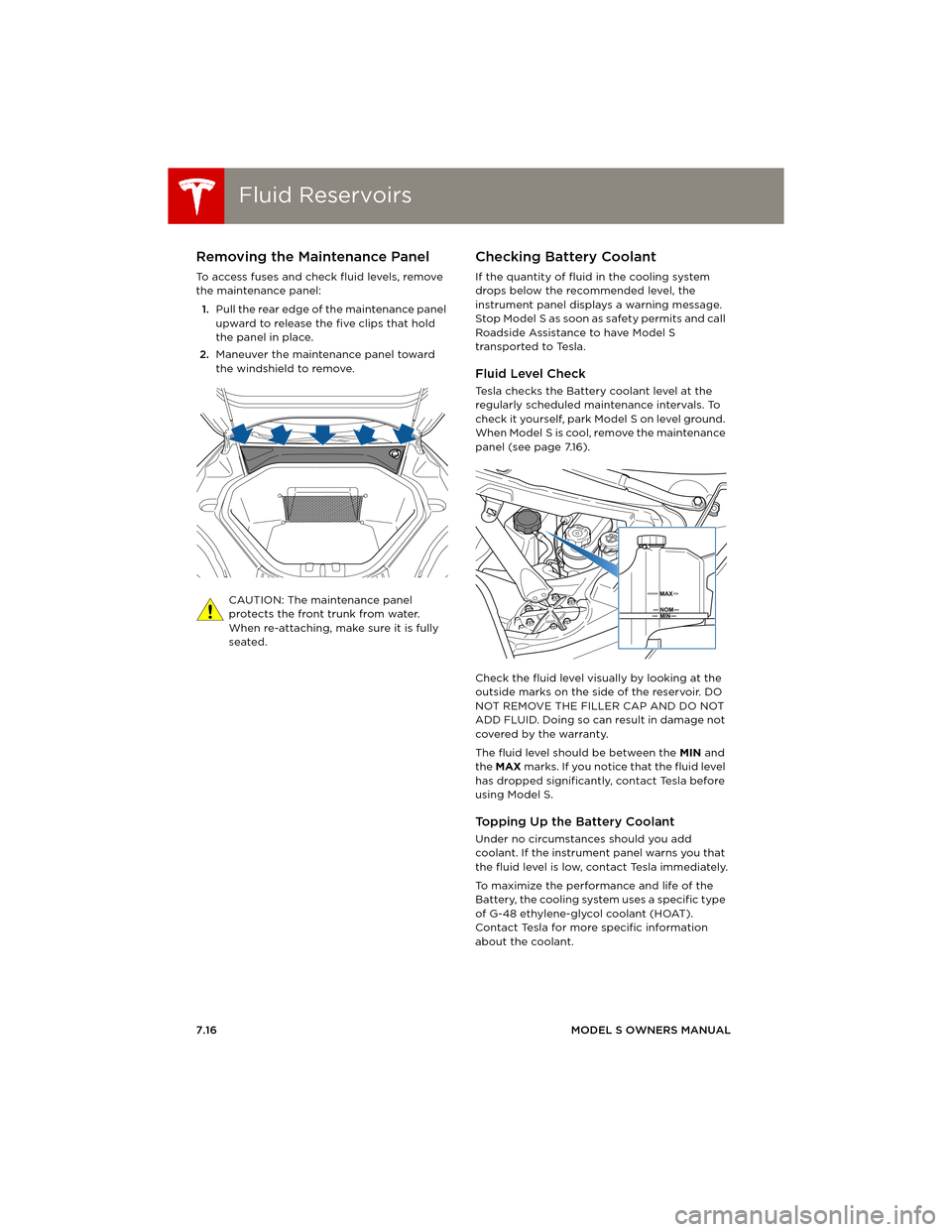
To access fuses and check fluid levels, remove
the maintenance panel:
1.Pull the rear edge of the maintenance panel
upward to release the five clips that hold
the panel in place.
2.Maneuver the maintenance panel toward
the windshield to remove.
CAUTION: The maintenance panel
protects the front trunk from water.
When re-attaching, make sure it is fully
seated.
Checking Battery Coolant
If the quantity of fluid in the cooling system
drops below the recommended level, the
instrument panel displays a warning message.
Stop Model S as soon as safety permits and call
Roadside Assistance to have Model S
transported to Tesla.
Fluid Level Check
Tesla checks the Battery coolant level at the
regularly scheduled maintenance intervals. To
check it yourself, park Model S on level ground.
When Model S is cool, remove the maintenance
panel (see page 7.16).
Check the fluid level visually by looking at the
outside marks on the side of the reservoir. DO
NOT REMOVE THE FILLER CAP AND DO NOT
ADD FLUID. Doing so can result in damage not
covered by the warranty.
The fluid level should be between the MIN and
the MAX marks. If you notice that the fluid level
has dropped significantly, contact Tesla before
using Model S.
To p p i n g U p t h e B a t t e r y C o o l a n t
Under no circumstances should you add
coolant. If the instrument panel warns you that
the fluid level is low, contact Tesla immediately.
To maximize the performance and life of the
Battery, the cooling system uses a specific type
of G-48 ethylene-glycol coolant (HOAT).
Contact Tesla for more specific information
about the coolant.
book.book Page 16 Friday, July 19, 2013 12:53 PM
Page 115 of 152
Fluid Reservoirs
MAINTENANCE7.17
Checking Brake Fluid
WARNING: Contact Tesla immediately if
you notice increased movement of the
brake pedal or a significant loss of brake fluid.
Driving under these conditions can result in
extended stopping distances or complete
brake failure.
The Brake indicator on the instrument
panel alerts you if the quantity of fluid in
the brake reservoir drops below the
recommended level. If it displays while driving,
stop as soon as safety permits by gently
applying the brakes. Do not continue driving.
Contact Tesla immediately for assistance.
Fluid Level Check
Tesla checks the brake fluid level at the
regularly scheduled maintenance intervals. To
check it yourself, park Model S on level ground.
When Model S is cool, remove the maintenance
panel (see page 7.16).
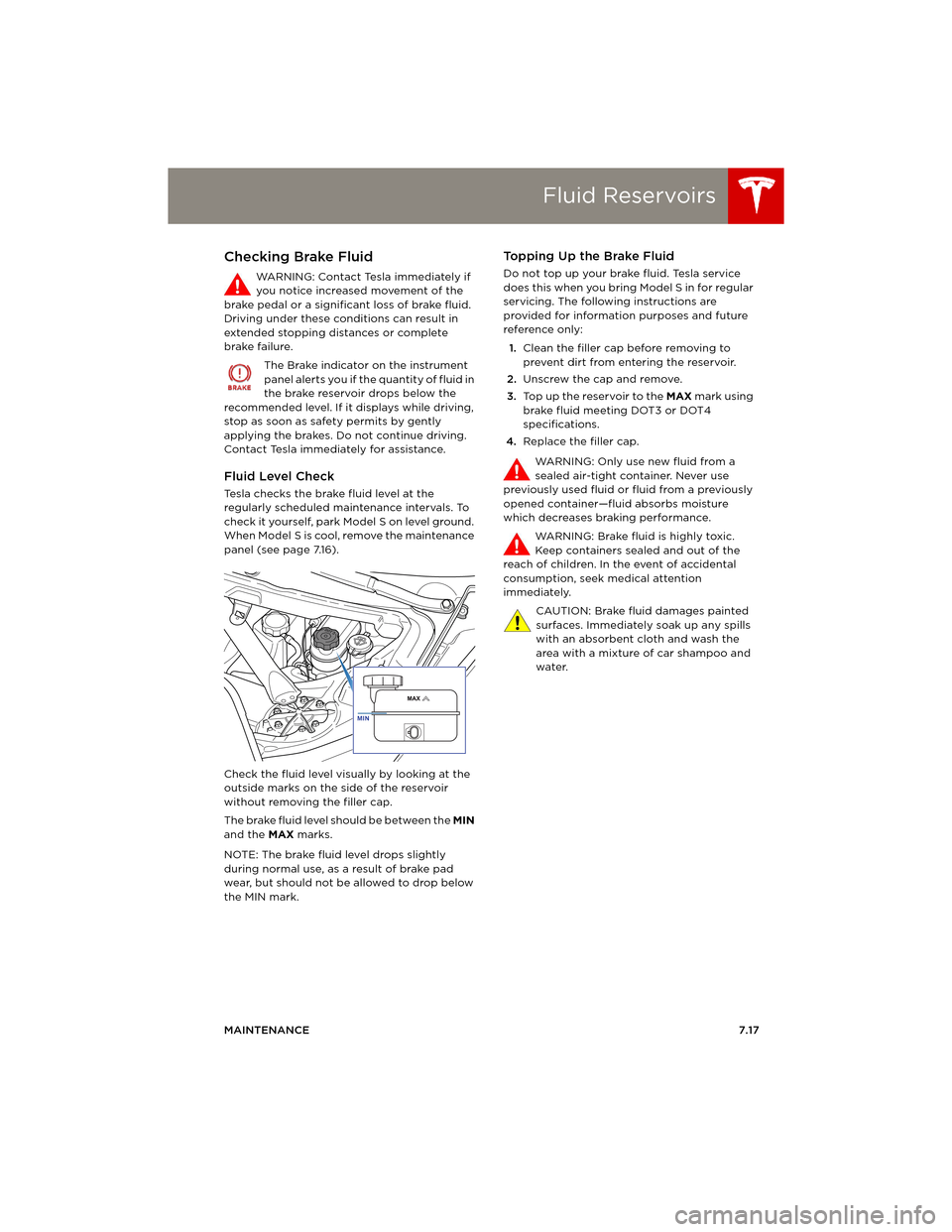
Check the fluid level visually by looking at the
outside marks on the side of the reservoir
without removing the filler cap.
The brake fluid level should be between the MIN
and the MAX marks.
NOTE: The brake fluid level drops slightly
during normal use, as a result of brake pad
wear, but should not be allowed to drop below
the MIN mark.
To p p i n g U p t h e B r a k e F l u i d
Do not top up your brake fluid. Tesla service
does this when you bring Model S in for regular
servicing. The following instructions are
provided for information purposes and future
reference only:
1.Clean the filler cap before removing to
prevent dirt from entering the reservoir.
2.Unscrew the cap and remove.
3.Top up the reservoir to the MAX mark using
brake fluid meeting DOT3 or DOT4
specifications.
4.Replace the filler cap.
WARNING: Only use new fluid from a
sealed air-tight container. Never use
previously used fluid or fluid from a previously
opened container—fluid absorbs moisture
which decreases braking performance.
WARNING: Brake fluid is highly toxic.
Keep containers sealed and out of the
reach of children. In the event of accidental
consumption, seek medical attention
immediately.
CAUTION: Brake fluid damages painted
surfaces. Immediately soak up any spills
with an absorbent cloth and wash the
area with a mixture of car shampoo and
water.
book.book Page 17 Friday, July 19, 2013 12:53 PM
Page 116 of 152
Fluid ReservoirsFluid Reservoirs
7.18MODEL S OWNERS MANUAL
Topping Up Washer Fluid
Model S has only one reservoir into which you
can add fluid. This is the washer fluid reservoir
under the front trunk. When the level is low, a
message displays on the instrument panel. Fill
until the fluid level is visible just below the filler
neck.
Do not use formulated washer fluids that
contain water repellent or bug wash. These
fluids can cause streaking, smearing, and
squeaking, or other noises.
Operate the washers periodically to check that
the nozzles are clear and properly directed.
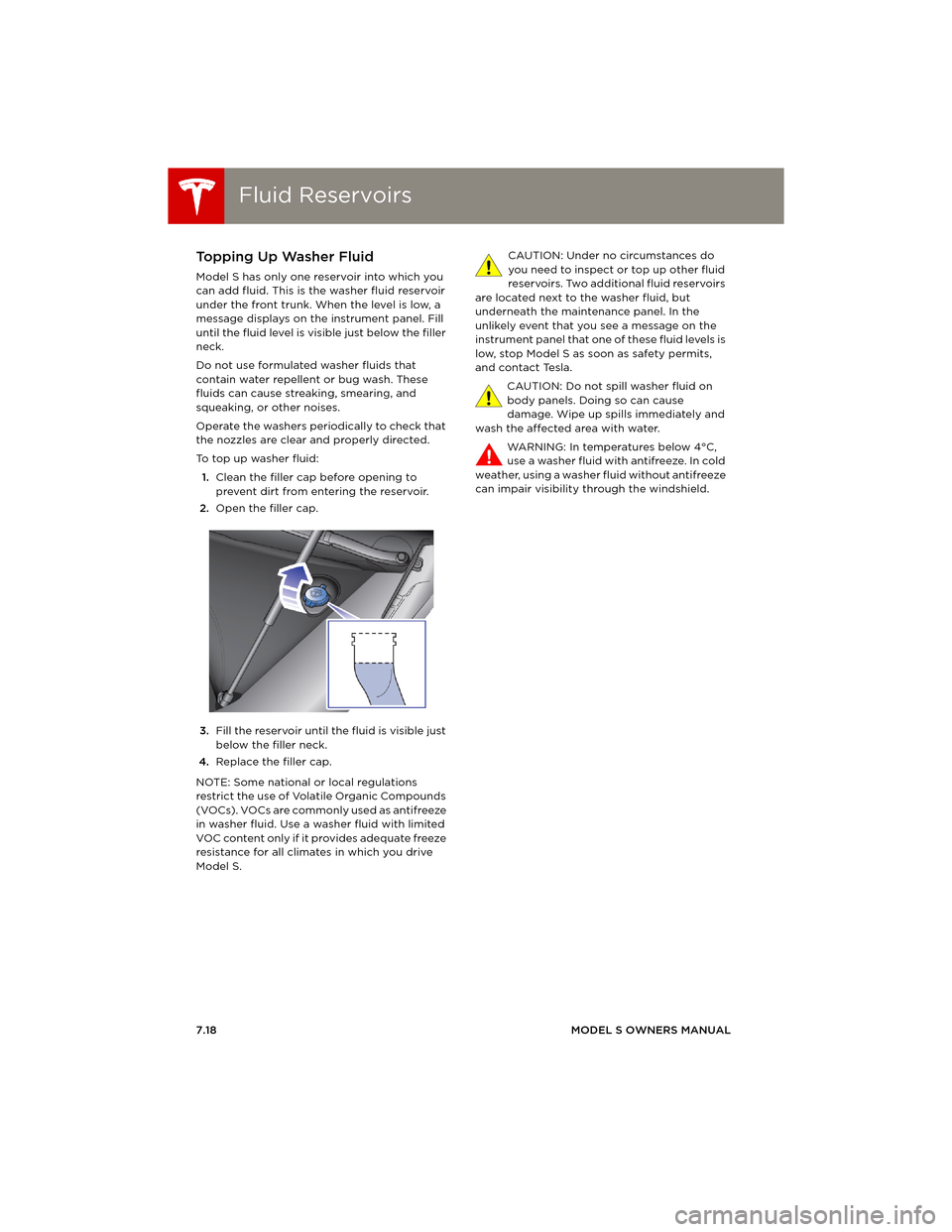
To top up washer fluid:
1.Clean the filler cap before opening to
prevent dirt from entering the reservoir.
2.Open the filler cap.
3.Fill the reservoir until the fluid is visible just
below the filler neck.
4.Replace the filler cap.
NOTE: Some national or local regulations
restrict the use of Volatile Organic Compounds
(VOCs). VOCs are commonly used as antifreeze
in washer fluid. Use a washer fluid with limited
VOC content only if it provides adequate freeze
resistance for all climates in which you drive
Model S.CAUTION: Under no circumstances do
you need to inspect or top up other fluid
reservoirs. Two additional fluid reservoirs
are located next to the washer fluid, but
underneath the maintenance panel. In the
unlikely event that you see a message on the
instrument panel that one of these fluid levels is
low, stop Model S as soon as safety permits,
and contact Tesla.
CAUTION: Do not spill washer fluid on
body panels. Doing so can cause
damage. Wipe up spills immediately and
wash the affected area with water.
WARNING: In temperatures below 4°C,
use a washer fluid with antifreeze. In cold
weather, using a washer fluid without antifreeze
can impair visibility through the windshield.
book.book Page 18 Friday, July 19, 2013 12:53 PM
Page 121 of 152
Jacking and Lifting
MAINTENANCE7.23
Jacking and LiftingJacking Procedure
Follow the steps below to lift Model S. Ensure
that any non-Tesla repair facility is aware of
these lifting points.
1.Position Model S centrally between the lift
posts.
2.If your Model S is equipped with Active Air
Suspension, it automatically self-levels,
even when power is off. Use the
touchscreen to set the suspension as
follows:
•To u c h Controls.
•Press the brake pedal, then touch Ve r y
High to maximize the height of the
suspension.
•To u c h Jack to disable self-leveling.
When Jack mode is active,
Model S displays this indicator
light on the instrument panel,
along with a message telling you
that active suspension is
disabled.
NOTE: Jack mode cancels automatically
when Model S is driven over 7 km/h.
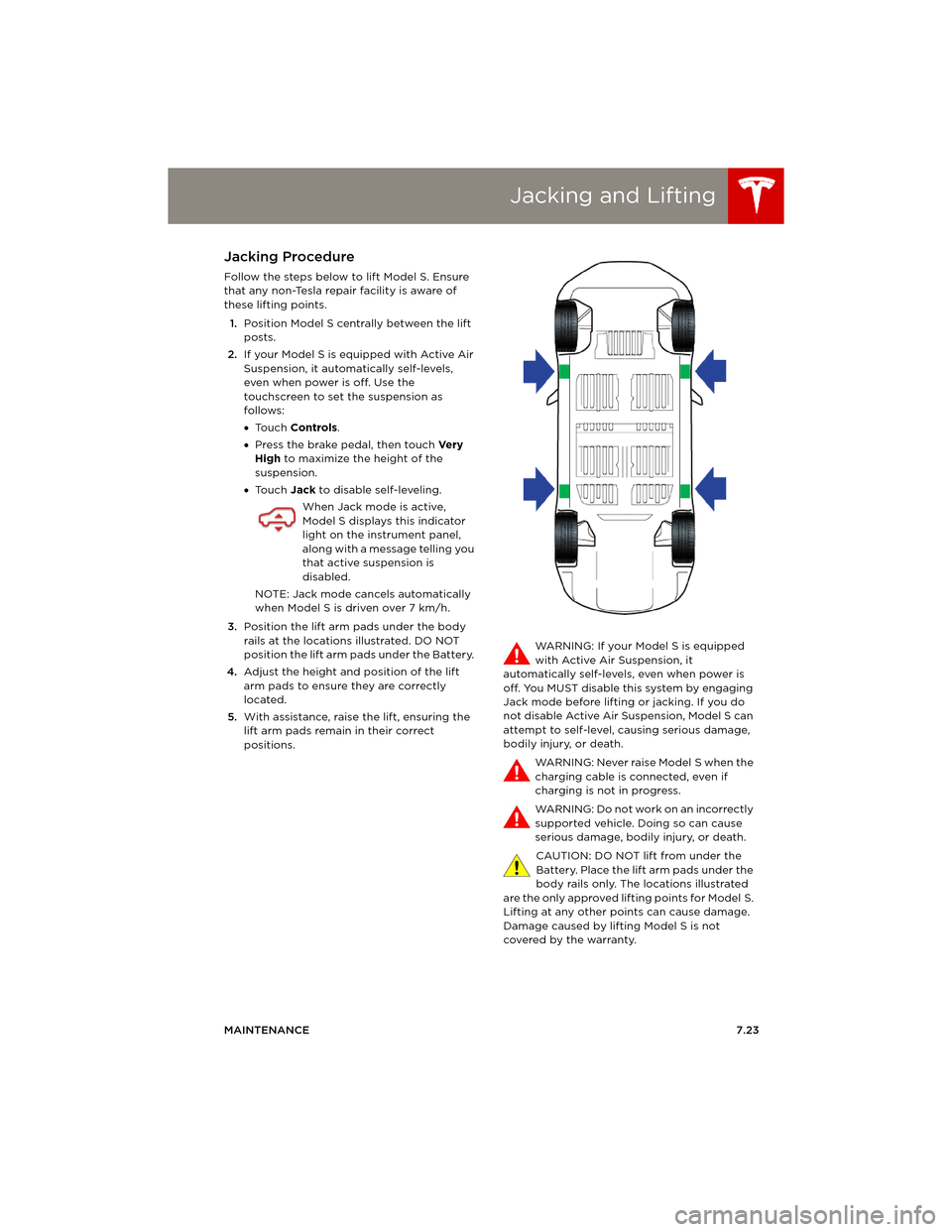
3.Position the lift arm pads under the body
rails at the locations illustrated. DO NOT
position the lift arm pads under the Battery.
4.Adjust the height and position of the lift
arm pads to ensure they are correctly
located.
5.With assistance, raise the lift, ensuring the
lift arm pads remain in their correct
positions.WARNING: If your Model S is equipped
with Active Air Suspension, it
automatically self-levels, even when power is
off. You MUST disable this system by engaging
Jack mode before lifting or jacking. If you do
not disable Active Air Suspension, Model S can
attempt to self-level, causing serious damage,
bodily injury, or death.
WARNING: Never raise Model S when the
charging cable is connected, even if
charging is not in progress.
WARNING: Do not work on an incorrectly
supported vehicle. Doing so can cause
serious damage, bodily injury, or death.
CAUTION: DO NOT lift from under the
Battery. Place the lift arm pads under the
body rails only. The locations illustrated
are the only approved lifting points for Model S.
Lifting at any other points can cause damage.
Damage caused by lifting Model S is not
covered by the warranty.
book.book Page 23 Friday, July 19, 2013 12:53 PM
Page 137 of 152
Instructions for Transporters
ROADSIDE ASSISTANCE9.3
Instructions for TransportersUse a Flatbed Only
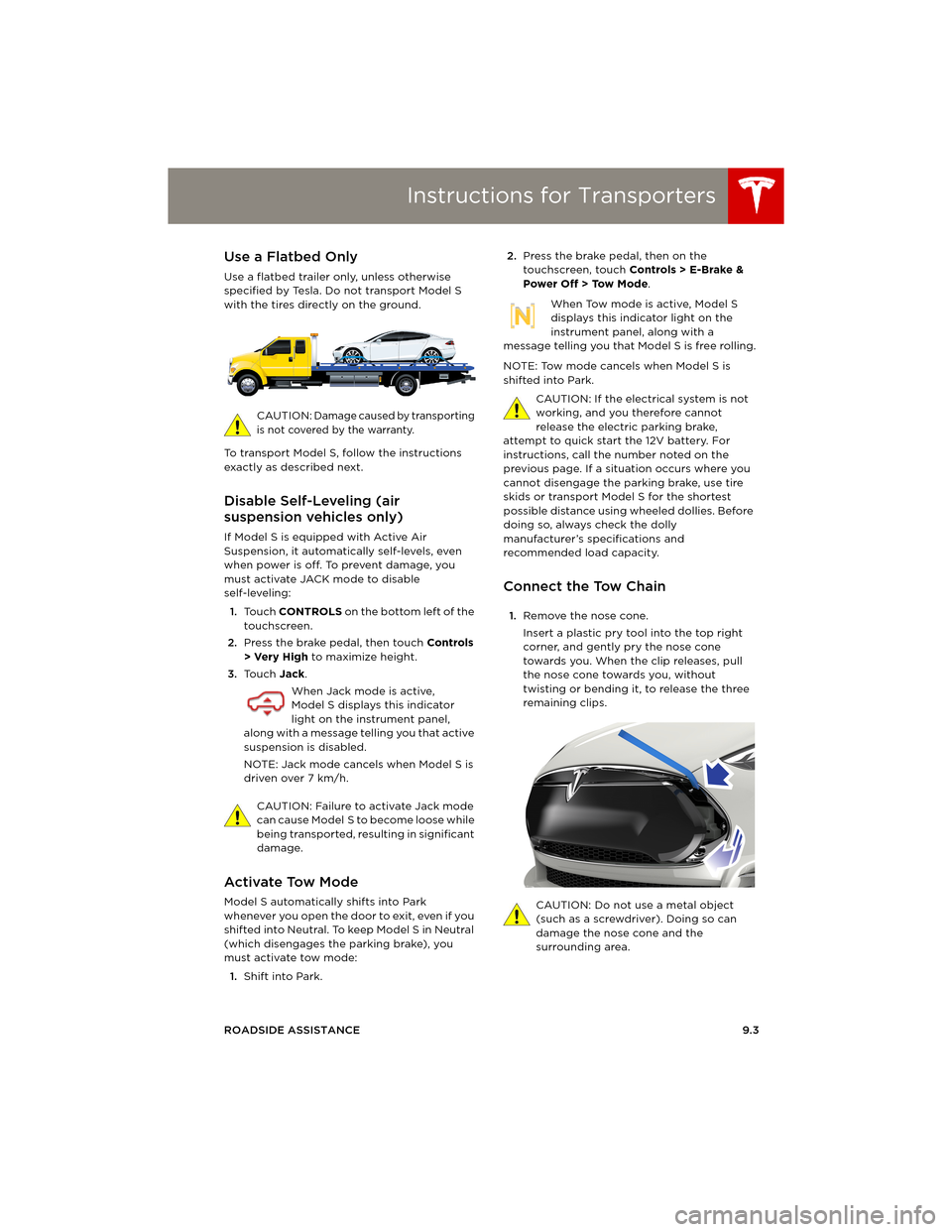
Use a flatbed trailer only, unless otherwise
specified by Tesla. Do not transport Model S
with the tires directly on the ground.
CAUTION:
D a m a g e c a u s e d b y t r a n s p o r t i n g
is not covered by the warranty.
To transport Model S, follow the instructions
exactly as described next.
Disable Self-Leveling (air
suspension vehicles only)
If Model S is equipped with Active Air
Suspension, it automatically self-levels, even
when power is off. To prevent damage, you
must activate JACK mode to disable
self-leveling:
1.To u c h CONTROLS on the bottom left of the
touchscreen.
2.Press the brake pedal, then touch Controls
> Very High to maximize height.
3.To u c h Jack.
When Jack mode is active,
Model S displays this indicator
light on the instrument panel,
along with a message telling you that active
suspension is disabled.
NOTE: Jack mode cancels when Model S is
driven over 7 km/h.
CAUTION: Failure to activate Jack mode
can cause Model S to become loose while
being transported, resulting in significant
damage.
Activate Tow Mode
Model S automatically shifts into Park
whenever you open the door to exit, even if you
shifted into Neutral. To keep Model S in Neutral
(which disengages the parking brake), you
must activate tow mode:
1.Shift into Park.2.Press the brake pedal, then on the
touchscreen, touch Controls > E-Brake &
Power Off > Tow Mode.
When Tow mode is active, Model S
displays this indicator light on the
instrument panel, along with a
message telling you that Model S is free rolling.
NOTE: Tow mode cancels when Model S is
shifted into Park.
CAUTION:
If the electrical system is not
working, and you therefore cannot
release the electric parking brake,
attempt to quick start the 12V battery. For
instructions, call the number noted on the
previous page. If a situation occurs where you
cannot disengage the parking brake, use tire
skids or transport Model S for the shortest
possible distance using wheeled dollies. Before
doing so, always check the dolly
manufacturer’s specifications and
recommended load capacity.
Connect the Tow Chain
1.Remove the nose cone.
Insert a plastic pry tool into the top right
corner, and gently pry the nose cone
towards you. When the clip releases, pull
the nose cone towards you, without
twisting or bending it, to release the three
remaining clips.
CAUTION: Do not use a metal object
(such as a screwdriver). Doing so can
damage the nose cone and the
surrounding area.
book.book Page 3 Friday, July 19, 2013 12:53 PM
Page 144 of 152
ii
INDEXINDEX
safety information ......................................... 3-10
seat belt retained, installing ........................ 3-8
testing ................................................................ 3-10
upper tether straps ....................................... 3-10
cleaning
exterior
...............................................................7-12
interior ............................................................... 7-13
climate control
operating tips
.................................................. 5-10
overview .............................................................. 5-8
cold weather option .......................................... 4-15
console
armrests
............................................................ 2-14
cup holders ...................................................... 2-14
power socket ................................................... 5-16
USB ports .......................................................... 5-16
contact information
Tesla
.................................................................... 10-3
coolant
Battery (high voltage)
................................. 7-16
replacement of ................................................. 7-2
cornering lights ................................................... 4-13
cruise control ...................................................... 4-23
cup holders ........................................................... 2-14
current, charging .................................................. 6-7
customizing Model S ........................................... 5-6
D
DAB radio .............................................................. 5-13
dashboard overview ............................................. 1-2
data recording ..................................................... 10-2
de-icing ................................................................... 4-15
delivery mileage .................................................. 10-2
devices
Bluetooth, playing audio files
................... 5-15
connecting ....................................................... 5-16
playing audio files from ............................... 5-15
dimensions .............................................................. 8-5
dome (map) lights .............................................. 4-11
door handles
exterior
................................................................2-4
interior .................................................................2-4
door labels ............................................................... 8-3
doors
child protection locks
.................................... 2-5
drive-away locking .......................................... 2-5
interior rear, opening with no power ....... 2-6
locking and unlocking, key .......................... 2-2
locking and unlocking, touchscreen ........2-4
opening exterior, no power ......................... 2-5
opening, exterior handles .............................2-4
opening, interior handles ..............................2-4
unlocking when key does not work ......... 2-5
walk-away locking ........................................... 2-5
drive gear ................................................................4-7
drive-away locking ............................................... 2-5driver
profiles, creating
............................................. 4-2
seat adjustment ................................................3-2
seating position ................................................3-2
driving
energy gains
.................................................... 4-21
seating position ................................................3-2
starting Model S .............................................. 4-6
tips to maximize range ................................ 4-19
E
electric parking brake ....................................... 4-21
emergency flashers ............................................4-14
emergency rear door opening ........................ 2-6
energy
app
....................................................................... 4-19
displaying usage of .......................................4-19
gained from regenerative braking .......... 4-21
graph .................................................................. 4-19
range information ........................................... 4-8
tips to minimize usage of ........................... 4-19
event data recording ......................................... 10-2
exterior
car cover
........................................................... 7-14
cleaning ............................................................. 7-12
dimensions ..........................................................8-5
overview ...............................................................1-3
polishing, touch up, & repair ...................... 7-14
specifications .....................................................8-5
exterior lights, controlling ................................ 4-11
F
fan speed, interior ................................................ 5-9
favorites, adding and removing .................... 5-15
features, downloading new ........................... 5-24
flash drives
connecting
........................................................ 5-16
playing audio from ........................................ 5-15
flashers, warning .................................................4-14
flat tire repair ..........................................................7-8
floor mats ............................................................... 7-14
fluids
Battery (high voltage)
................................. 7-16
brake ................................................................... 7-17
replacement of ..................................................7-2
windshield washer ......................................... 7-18
fog lights ................................................................. 4-11
free rolling .............................................................. 4-7
front passenger detection ............................... 3-17
front suspension specifications .......................8-7
front trunk
closing
................................................................ 2-10
opening .............................................................. 2-10
book.book Page ii Friday, July 19, 2013 12:53 PM
Page 147 of 152
v
INDEX
range
displayed on instrument panel ................... 4-8
driving tips to maximize ............................. 4-19
regenerative braking .................................... 4-21
Rated range ............................................................ 4-8
rear facing child seats
folding
.................................................................3-12
opening ...............................................................3-11
safety information ......................................... 3-14
seating a child ..................................................3-13
usage restrictions ............................................3-11
rear seats
folding
.................................................................. 3-3
raising .................................................................. 3-3
rear view camera ............................................... 4-24
rear window switches, disabling .................... 2-7
regenerative braking ......................................... 4-21
release notes ....................................................... 5-24
remote window opening ................................... 2-7
reverse gear ............................................................ 4-7
roadside assistance ............................................. 9-2
S
safety information
airbags ................................................................3-18
child seats ........................................................ 3-10
rear facing child seats ................................. 3-14
seat belts ............................................................ 3-6
seat belts
cleaning
..............................................................7-13
fastening ............................................................. 3-4
in a collision ....................................................... 3-5
overview ............................................................. 3-4
pre-tensioners ................................................... 3-5
safety instructions ........................................... 3-6
testing .................................................................. 3-5
wearing ................................................................ 3-4
wearing when pregnant ................................ 3-4
seat covers .............................................................. 3-3
seat heaters ............................................................ 5-8
seating capacity .................................................... 8-3
seating position, driver ...................................... 3-2
seats
adjusting
............................................................. 3-2
heaters ................................................................. 5-8
rear facing, folding .........................................3-12
rear facing, opening ........................... 3-11, 3-12
rear facing, safety information ................. 3-14
rear facing, seating a child ..........................3-13
rear facing, usage restrictions ....................3-11
security settings .................................................5-22
service data recording ..................................... 10-2
service intervals .................................................... 7-2
Settings .................................................................... 5-6
shifting gears ......................................................... 4-7
software updates .............................................. 5-24specifications
12V battery
......................................................... 8-7
brakes ...................................................................8-6
dimensions .........................................................8-5
exterior ................................................................8-5
high voltage Battery ....................................... 8-7
motor ....................................................................8-6
steering ................................................................8-6
suspension .......................................................... 8-7
tires .......................................................................8-8
transmission .......................................................8-6
weights ................................................................8-5
wheels ..................................................................8-8
stability control .................................................. 4-22
starting Model S ................................................... 4-6
Statutory Plate ...................................................... 8-4
steering specifications ........................................8-6
steering wheel
adjusting position
............................................4-3
adjusting sensitivity ........................................4-3
controls, left .......................................................4-3
controls, right ................................................... 4-4
sunroof .................................................................... 2-12
suspension
automatic adjustments
................................. 5-11
indicator lights ................................................. 5-11
Jack mode ......................................................... 5-11
manual settings ............................................... 5-11
T
telematics .............................................................. 10-2
telephone
answering a call
............................................... 4-4
Bluetooth, general information ................ 5-17
call menu ........................................................... 5-18
connecting ........................................................ 5-18
displaying call menu ...................................... 4-4
instrument panel menu ............................... 5-18
making a call .................................................... 5-18
receiving a call ................................................ 5-18
steering wheel buttons ................................. 4-4
temperature
Battery (high voltage), limits
..................... 6-4
cabin, controls for ...........................................5-8
cabin, operating tips ..................................... 5-10
outside ................................................................ 4-8
tie-down straps .................................................... 9-4
tilt detection ........................................................ 5-22
Tire Pressure Monitoring System
malfunction
........................................................7-6
overview ..............................................................7-6
replacing a tire sensor ................................... 7-7
tire pressure, checking ....................................... 7-3
tire repair kit ........................................................... 7-8
inflating with air only .................................... 7-10
inflating with sealant ......................................7-9
replacing the sealant canister .................... 7-11
book.book Page v Friday, July 19, 2013 12:53 PM