warning TOYOTA 86 2017 Owner's Manual
[x] Cancel search | Manufacturer: TOYOTA, Model Year: 2017, Model line: 86, Model: TOYOTA 86 2017Pages: 428, PDF Size: 5.25 MB
Page 60 of 428

601-5. Refueling
WARNING■ When refueling
Observe the following precautions to prevent fuel overflowing from the fuel
tank:
● Securely insert the fuel nozzle into the fuel filler neck
● Stop filling the tank after the fuel nozzle automatically clicks off
● Do not top off the fuel tank
● Observe other precautions that are posted at the service station.
● Turn the cap to the right until it clicks to ensure that it is fully tightened. If
the cap is not securely tightened, fuel spillage could occur in the event of
an accident, creating a fire hazard.
■ When replacing the fuel cap
Do not use anything but a genuine Toyota fuel tank cap designed for your
vehicle. Doing so may cause a fire or other incident which may result in
death or serious injury.
NOTICE■ Refueling
● Do not spill fuel during refueling.
Doing so may damage the vehicle, such as causing the emission control
system to operate abnormally or damaging fuel system components or the
vehicle's painted surface.
● Never add any cleaning agents to the fuel tank. The addition of a cleaning
agent may cause damage to the fuel system.
● Immediately put fuel in the tank whenever the low fuel warning light illumi-
nates. Engine misfires as a result of an empty tank could cause damage to
the engine.
Page 62 of 428

621-6. Theft deterrent system
■ Certification for engi ne immobilizer system
For vehicles sold in the U.S.A.
FCC ID: MOZRI-38BFH
This device complies with part 15 of the FCC Rules. Operation is subject to
the following two conditions: (1) This device may not cause harmful interfer-
ence, and (2) this device must accept any interference received, including
interference that may cause undesired operation.
FCC WARNING
Changes or modifications not expressly approved by the party responsible
for compliance could void the user’s authority to operate the equipment.
For vehicles sold in Canada
NOTE:
This device complies with Industry Canada’s licence-exempt RSSs. Opera-
tion is subject to the following two conditions: (1) This device may not cause
interference, and (2) This device must accept any interference, including
interference that may cause undesired operation of the device.
NOTE:
Le présent appareil est conforme aux CNR d’Industrie Canada applicables
aux appareils radio exempts de licence. L’exploitation est autorisée aux
deux conditions suivantes: (1) l’appareil ne doit pas produire de brouillage;
(2) l’utilisateur de l’appareil doit accepter tout brouillage radioélectrique subi,
même si le brouillage est susceptible d’en compromettre le fonctionnement.
NOTICE
■ To ensure the system operates correctly
Do not modify or remove the system. If modified or removed, the proper
operation of the system cannot be guaranteed.
Page 65 of 428

651-7. Safety information
1
Before driving WARNING■ While driving
● Do not adjust the position of the driver's seat.
Doing so could cause the driver to lose control of the vehicle.
● Do not place a cushion between the driver or passenger and the seatback.
A cushion may prevent correct posture from being achieved, and reduce
the effectiveness of the seat belt and head restraint, increasing the risk of
death or serious injury to the driver or passenger.
● Do not place anything under the front seats.
Objects placed under the front seats may become jammed in the seat
tracks and stop the seat from locking in place. This may lead to an acci-
dent resulting in serious injury or death. The adjustment mechanism may
also be damaged.
■ Adjusting the seat position
● Take care when adjusting the seat position to ensure that other passen-
gers are not injured by the moving seat.
● Do not put your hands under the seat or near the moving parts to avoid
injury.
Fingers or hands may become jammed in the seat mechanism.
Page 68 of 428

681-7. Safety information
WARNING■ SRS airbag
● To obtain maximum protection in the event of an accident, the driver and
all passengers in the vehicle should always wear seat belts when the vehi-
cle is moving. The SRS airbag is designed only to be a supplement to the
primary protection provided by the seat belt. It does not eliminate the need
to fasten seat belts. In combination with the seat belts, it offers the best
combined protection in case of a serious accident.
Not wearing a seat belt increases the chance of severe injury or death in a
crash even when the vehicle has the SRS airbag.
For instructions and precautions concerning the seat belt system, refer to
“Seat belts”. ( → P. 42)
● Do not sit or lean unnecessarily close to the SRS airbag. Because the
SRS airbag deploys with considerable speed - faster than the blink of an
eye - and force to protect in high speed collisions, the force of an airbag
can injure an occupant whose body is too close to SRS airbag.
It is also important to wear your seat belt to help avoid injuries that can
result when the SRS airbag contacts an occupant not in proper position
such as one thrown forward during pre-accident braking.
Even when properly positioned, there remains a possibility that an occu-
pant may suffer minor injury such as abrasions and bruises to the face or
arms because of the SRS airbag deployment force.
● The SRS airbags deploy with considerable speed and force. Occupants
who are out of proper position when the SRS airbag deploys could suffer
very serious injuries. Because the SRS airbag needs enough space for
deployment, the driver should always sit upright and well back in the seat
as far from the steering wheel as practical while still maintaining full vehi-
cle control and the front passenger should move the seat as far back as
possible and sit upright and well back in the seat.
● Do not place any objects over or near the SRS airbag cover or between
you and the SRS airbag. If the SRS airbag deploys, those objects could
interfere with its proper operation and could be propelled inside the vehicle
and cause injury.
Page 69 of 428
691-7. Safety information
1
Before driving WARNING■ SRS airbag
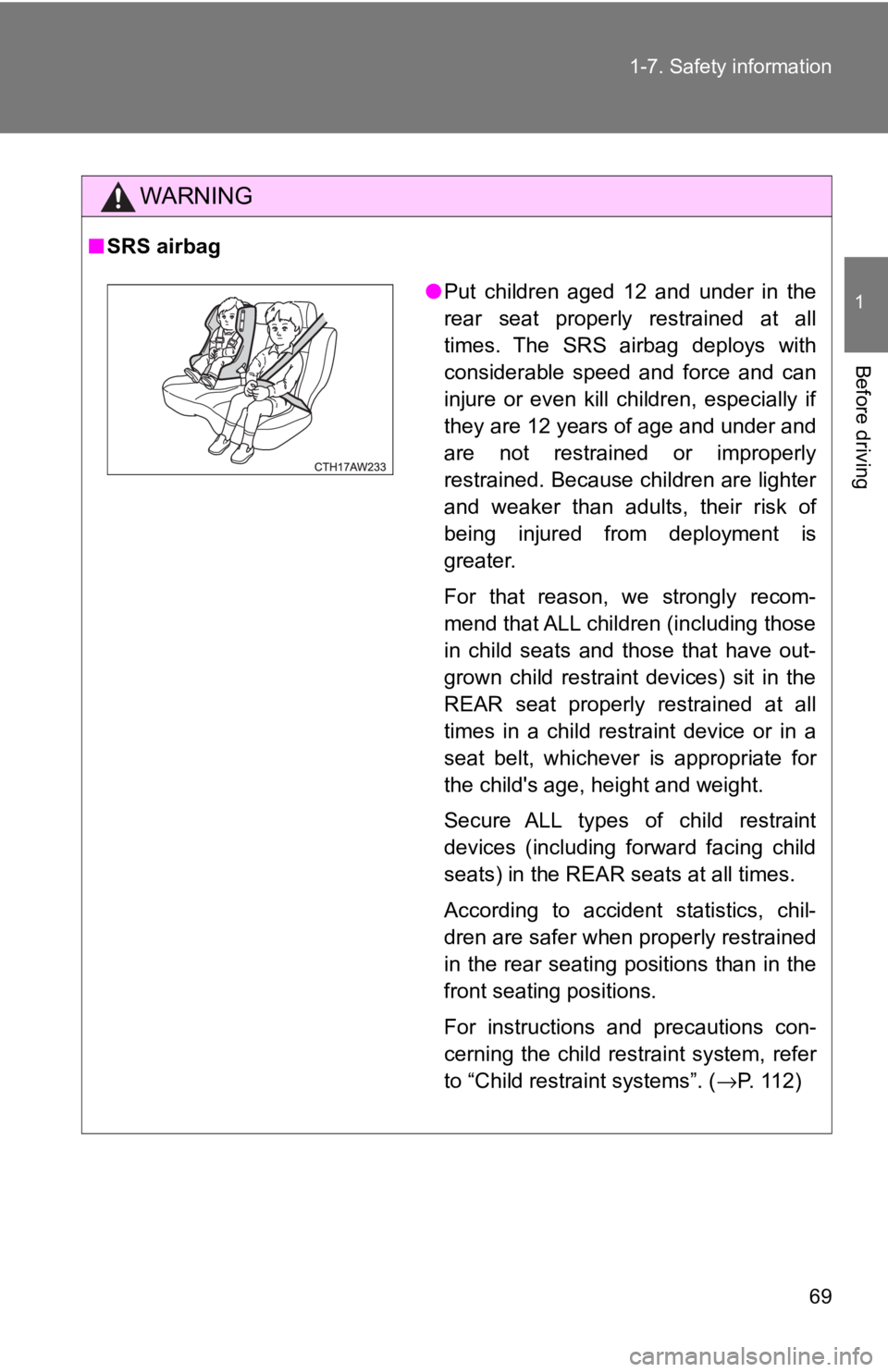
● Put children aged 12 and under in the
rear seat properly restrained at all
times. The SRS airbag deploys with
considerable speed and force and can
injure or even kill children, especially if
they are 12 years of age and under and
are not restrained or improperly
restrained. Because children are lighter
and weaker than adults, their risk of
being injured from deployment is
greater.
For that reason, we strongly recom-
mend that ALL children (including those
in child seats and those that have out-
grown child restraint devices) sit in the
REAR seat properly restrained at all
times in a child restraint device or in a
seat belt, whichever is appropriate for
the child's age, height and weight.
Secure ALL types of child restraint
devices (including forward facing child
seats) in the REAR seats at all times.
According to accident statistics, chil-
dren are safer when properly restrained
in the rear seating positions than in the
front seating positions.
For instructions and precautions con-
cerning the child restraint system, refer
to “Child restraint systems”. ( → P. 112)
Page 70 of 428

701-7. Safety information
WARNING■ SRS airbag
● NEVER INSTALL A REARWARD FACING CHILD SEAT IN THE FRONT
SEAT. DOING SO RISKS SERIOUS INJURY OR DEATH TO THE CHILD
BY PLACING THE CHILD’S HEAD TOO CLOSE TO THE SRS AIRBAG.
● Never allow a child to stand up, or to kneel on the front passenger’s seat,
or never hold a child on your lap or in your arms. The SRS airbag deploys
with considerable force and can injure or even kill the child.
● When the SRS airbag deploys, some smoke will be released. This smoke
could cause breathing problems for people with a history of asthma or
other breathing trouble. If you or your passengers have breathing prob-
lems after SRS airbag deploys, get fresh air promptly.
● A deploying SRS airbag releases hot gas. Occupants could get burned if
they come into direct contact with the hot gas.
Page 71 of 428
711-7. Safety information
1
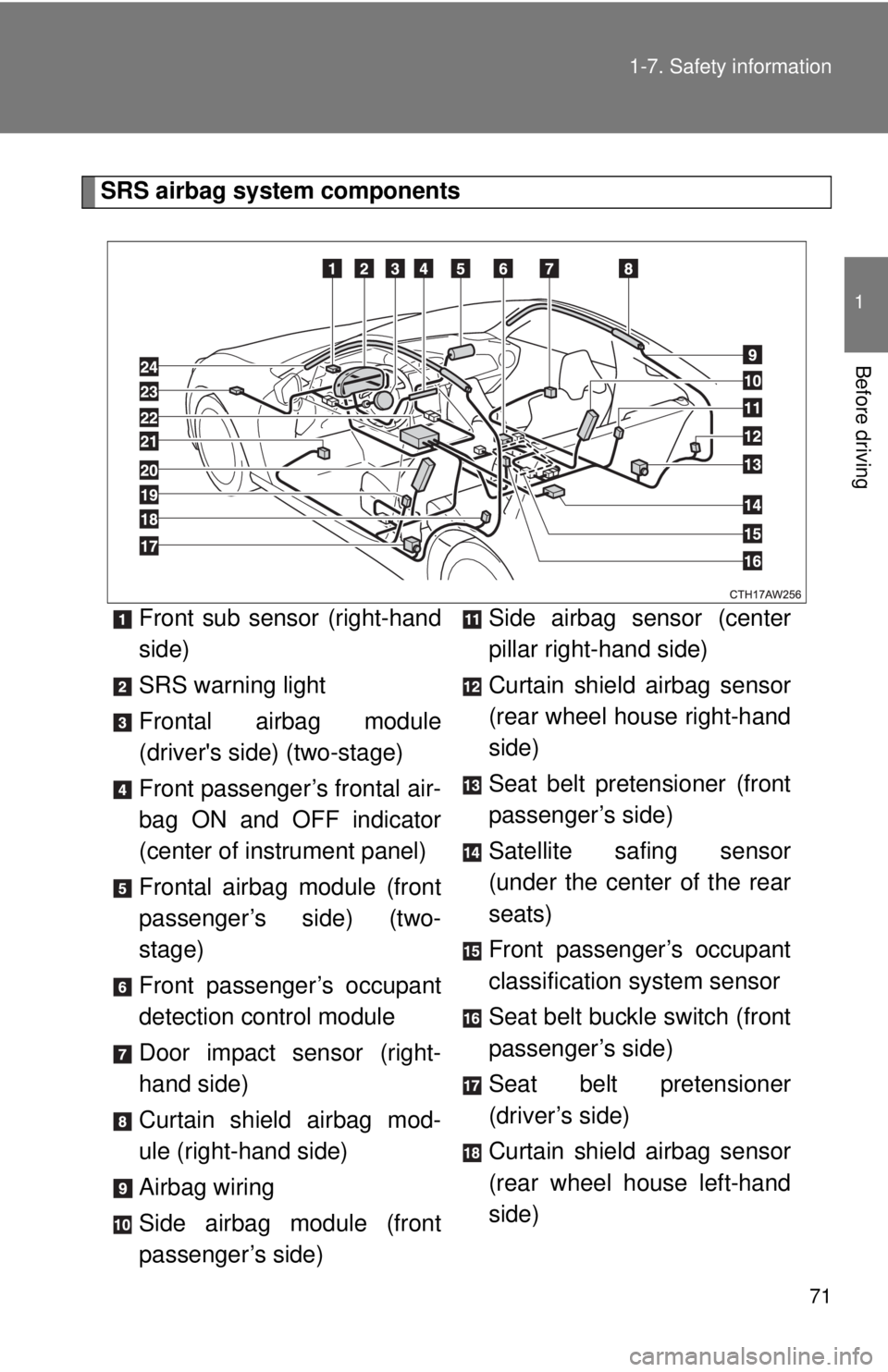
Before driving SRS airbag system components
Front sub sensor (right-hand
side)
SRS warning light
Frontal airbag module
(driver's side) (two-stage)
Front passenger’s frontal air-
bag ON and OFF indicator
(center of instrument panel)
Frontal airbag module (front
passenger’s side) (two-
stage)
Front passenger’s occupant
detection control module
Door impact sensor (right-
hand side)
Curtain shield airbag mod-
ule (right-hand side)
Airbag wiring
Side airbag module (front
passenger’s side) Side airbag sensor (center
pillar right-hand side)
Curtain shield airbag sensor
(rear wheel house right-hand
side)
Seat belt pretensioner (front
passenger’s side)
Satellite safing sensor
(under the center of the rear
seats)
Front passenger’s occupant
classification system sensor
Seat belt buckle switch (front
passenger’s side)
Seat belt pretensioner
(driver’s side)
Curtain shield airbag sensor
(rear wheel house left-hand
side)
Page 73 of 428

731-7. Safety information
1
Before driving Toyota advanced frontal airbag system
Your vehicle is equipped with a To yota advanced frontal airbag sys-
tem that complies with the new advanced frontal airbag requirements
in the amended Federal Motor Vehicle Safety Standard (FMVSS) No.
208.
The Toyota advanced frontal airbag system automatically determines
the deployment force of the driver’s SRS frontal airbag at the time of
deployment as well as whether or not to activate the front passen-
ger’s SRS frontal airbag and, if acti vated, the deployment force of the
SRS frontal airbag at the time of deployment.
Your vehicle has warning labels on the driver’s and front passenger’s
sun visors beginning with the phrase “EVEN WITH ADVANCED AIR
BAGS” and a tag attached to the gl ove box lid beginning with the
phrase “Even with Advanced Air Bags”. Make sure that you carefully
read the instructions on the warning labels and tag.
Always wear your seat belt. The Toyota advanced frontal airbag sys-
tem is a supplemental restraint system and must be used in combina-
tion with a seat belt. All occupant s should wear a seat belt or be
seated in an appropriate child restraint system.
The driver’s SRS frontal airbag is st owed in the center portion of the
steering wheel. The front passenger’s SRS frontal airbag is stowed
near the top of the dashboard under an “SRS AIRBAG” mark.
In a moderate to severe frontal collision, the following components
deploy.
● SRS frontal airbag for driver
● SRS frontal airbag for front passenger
These components supplement the s eat belts by reducing the impact
to the occupant’s head and chest.
Page 74 of 428

741-7. Safety information
■ Driver’s SRS frontal airbag
The driver’s SRS frontal airbag uses a dual stage inflator. The inflator oper-
ates in different ways depending on the severity of impact.
Have the system inspected by your Toyota dealer immediately if the SRS
warning light illuminates.
NOTE
The driver’s SRS side airbag and SRS curtain shield airbag are not con-
trolled by the Toyota advanced frontal airbag system.
■ Front passenger’s SRS frontal airbag
The front passenger’s SRS frontal airbag uses a dual stage inflator. The
inflator operates in different ways depending on the severity of impact.
The occupant classification system sensor is installed under the seat uphol-
stery and monitors the physique and posture of the front passenger. Using
this information, the occupant classification system determines whether the
front passenger’s SRS frontal airbag should be deployed or not.
The occupant classification system may not inflate the front passenger’s
SRS frontal airbag even when the driver’s SRS frontal airbag deploys. This
is normal. In this case, although the front passenger’s SRS frontal airbag
does not operate, the front passenger’s seat belt pretensioner operates with
the driver’s seat belt pretensioner. For details about the seat belt preten-
sioner, refer to “Seat belt pretensioners”. ( → P. 43)
Observe the following precautions. Failure to do so may prevent the Toyota
advanced frontal airbag system from functioning correctly or cause the sys-
tem to fail.
● Do not apply any strong impact to the front passenger’s seat.
● Do not spill liquid on the front passenger’s seat. If liquid is spilled, wipe it
off immediately.
● Do not remove or disassemble the front passenger’s seat.
● Do not install any accessory (such as an audio amplifier) other than a
genuine Toyota accessory under the front passenger’s seat.
● Do not place anything (shoes, umbrella, etc.) under the front passenger’s
seat.
● Do not place a magnet near the seat belt buckle.
Page 75 of 428

751-7. Safety information
1
Before driving If the seat belt buckle switch and/or front passenger’s occupant classification
system have failed, the SRS warning light will illuminate. Have the system
inspected by your Toyota dealer immediately if the SRS warning light illumi-
nates.
If your vehicle has sustained impact, this may affect the proper function of
the Toyota advanced frontal airbag system. Have your vehicle inspected at
your Toyota dealer. Do not use the front passenger’s seat while driving the
vehicle to your Toyota dealer.
NOTE
The front passenger’s SRS side airbag an d SRS curtain shield airbag are
not controlled by the Toyota advanced frontal airbag system.
■ Passenger’s frontal airbag ON and OFF indicators
→ P. 104
■ Occupant classification system
The occupant classification system sensor is installed under the seat uphol-
stery and monitors the physique and posture of the front passenger. Using
this information, the occupant classification system determines whether the
front passenger’s SRS frontal airbag should be deployed or not.
If the front passenger’s seat cushion is wet, this may adversely affect the
ability of the system to determine deployment. If the seat cushion is wet, the
front passenger should stop sitting on the front passenger’s seat. Wipe off
liquid from the seat immediately, let the seat dry naturally and then check the
SRS warning light as follows.
● If the SRS warning light illuminates, keep the seat dry until the warning
light turns off. If the SRS warning light stays on even when the seat has
dried, do not allow anyone to sit on the front passenger’s seat and have
the system checked by your Toyota dealer.
● If the SRS warning light does not illuminate, check that the front passen-
ger’s frontal airbag ON and OFF indicators work properly. If the indicators
do not work properly, do not allow anyone to sit on the front passenger’s
seat and have the system checked by your Toyota dealer.