warning TOYOTA 86 2017 Owner's Guide
[x] Cancel search | Manufacturer: TOYOTA, Model Year: 2017, Model line: 86, Model: TOYOTA 86 2017Pages: 428, PDF Size: 5.25 MB
Page 76 of 428

761-7. Safety information
Also, if luggage or electronic devices are placed on the front passenger’s
seat, this may adversely affect the ability of the system to determine deploy-
ment. This may prevent the front passenger’s frontal airbag ON and OFF
indicators from working properly. Check that the indicators work properly.
When the OFF indicator turns off and the ON indicator illuminates, the front
passenger’s frontal airbag may deploy during a collision. Remove luggage
and electronic devices from the front passenger’s seat.
NOTE
This device complies with Part 18 of the FCC Rules. This device may cause
interference. If this device causes interference, consult the nearest Toyota
dealer. Also, for maintenance of the system, consult the nearest Toyota
dealer.
■ Conditions in which front passenger’ s SRS frontal airbag is not acti-
vated
The front passenger’s SRS frontal airbag will not be activated when any of
the following conditions are met regarding the front passenger’s seat:
● The seat is empty.
● The seat is equipped with an appropriate child restraint system and an
infant is restrained in it.
● The occupant changed their posture after the occupant load is judged.
● The front passenger’s occupant classification system is malfunctioning.
WARNING
When the front passenger’s seat is occupied by an infant in an appropriate
child restraint system, observe the following precautions. Failure to do so may
interfere with the proper operation of the occupant classification system, acti-
vating the front passenger’s SRS frontal airbag even though that seat is occu-
pied by the infant in the child restraint system.
● Do not place any article (including electronic devices) on the seat other than
the infant in the child restraint system.
● Do not place more than one infant in the child restraint system.
Page 86 of 428

861-7. Safety information
WARNING■ If the SRS airbags deploy
Do not touch the SRS airbag system components around the steering wheel
and dashboard with bare hands right after deployment. Doing so can cause
burns because the components can be very hot as a result of deployment.
■ Child restraint precautions
NEVER INSTALL A REARWARD FACING CHILD SEAT IN THE FRONT
PASSENGER’S SEAT EVEN IF THE FRONT PASSENGER’S SRS FRON-
TAL AIRBAG IS DEACTIVATED. Be sure to install it in the REAR seat in a
correct manner. Also, it is strongly recommended that any forward facing
child seat or booster seat be installed in the REAR seat, and that even chil-
dren who have outgrown a child restraint system be also seated in the
REAR seat. This is because children sitting in the front passenger’s seat
may be killed or severely injured should the front passenger’s SRS frontal
airbag deploy. REAR seats are the safest place for children.
Page 95 of 428

951-7. Safety information
1
Before driving WARNING■ If the SRS airbags deploy
Do not touch the SRS side airbag system components around the front seat
seatback with bare hands right after deployment. Doing so can cause burns
because the components can be very hot as a result of deployment.
After deployment, do not touch any part of the SRS curtain shield airbag sys-
tem (from the front pillar to the part of the roof side over the rear seat). Doing
so can cause burns because the components can be very hot as a result of
deployment.
■ SRS side airbag and SRS curtain shield airbag precautions
The SRS side airbag and SRS curtain shield airbag are designed only to be
a supplement to the primary protection provided by the seat belt. They do
not do away with the need to fasten seat belts. It is also important to wear
your seat belt to help avoid injuries that can result when an occupant is not
seated in a proper upright position.
Page 97 of 428
971-7. Safety information
1
Before driving
WARNING■ SRS airbag precautions
Observe the following precautions regarding the SRS airbags.
Failure to do so may cause death or serious injury.
● The driver and all passengers in the vehicle must wear their seat belts
properly.
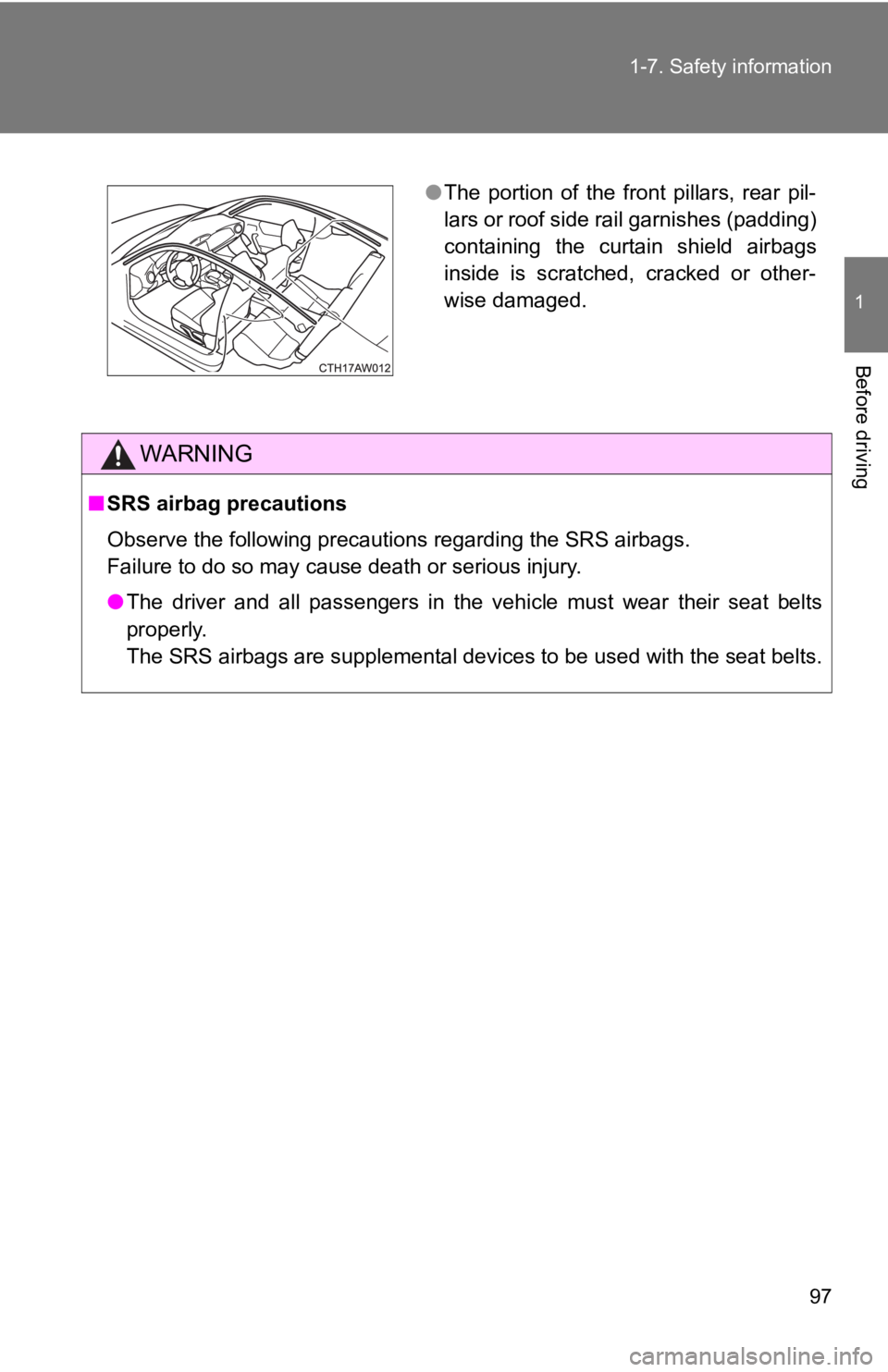
The SRS airbags are supplemental devices to be used with the seat belts. ● The portion of the front pillars, rear pil-
lars or roof side rail garnishes (padding)
containing the curtain shield airbags
inside is scratched, cracked or other-
wise damaged.
Page 98 of 428

981-7. Safety information
WARNING■ SRS airbag precautions
● The SRS driver airbag deploys with considerable force, and can cause
death or serious injury especially if the driver is very close to the airbag.
The National Highway Traffic Safety Administration (“NHTSA”) advises:
Since the risk zone for the driver’s airbag is the first 2 - 3 in. (50 - 75 mm)
of inflation, placing yourself 10 in. (250 mm) from your driver airbag pro-
vides you with a clear margin of safety. This distance is measured from the
center of the steering wheel to your breastbone. If you sit less than 10 in.
(250 mm) away now, you can change your driving position in several
ways:
• Move your seat to the rear as far as you can while still reaching the
pedals comfortably.
• Slightly recline the back of the seat. Although vehicle designs vary,
many drivers can achieve the 10 in. (250 mm) distance, even with the
driver seat all the way forward, simply by reclining the back of the seat
somewhat. If reclining the back of your seat makes it hard to see the
road, raise yourself by using a firm, non-slippery cushion, or raise the
seat if your vehicle has that feature.
• If your steering wheel is adjustable, tilt it downward. This points the air-
bag toward your chest instead of your head and neck.
The seat should be adjusted as recommended by NHTSA above, while
still maintaining control of the foot pedals, steering wheel, and your view of
the instrument panel controls.
● The SRS front passenger airbag also deploys with considerable force, and
can cause death or serious injury especially if the front passenger is very
close to the airbag. The front passenger seat should be as far from the air-
bag as possible with the seatback adjusted, so the front passenger sits
upright.
● Improperly seated and/or restrained infants and children can be killed or
seriously injured by a deploying airbag. An infant or child who is too small
to use a seat belt should be properly secured using a child restraint sys-
tem. Toyota strongly recommends that all infants and children be placed in
the rear seats of the vehicle and properly restrained. The rear seats are
safer for infants and children than the front passenger seat. ( → P. 112)
Page 99 of 428
991-7. Safety information
1
Before driving WARNING■ SRS airbag precautions
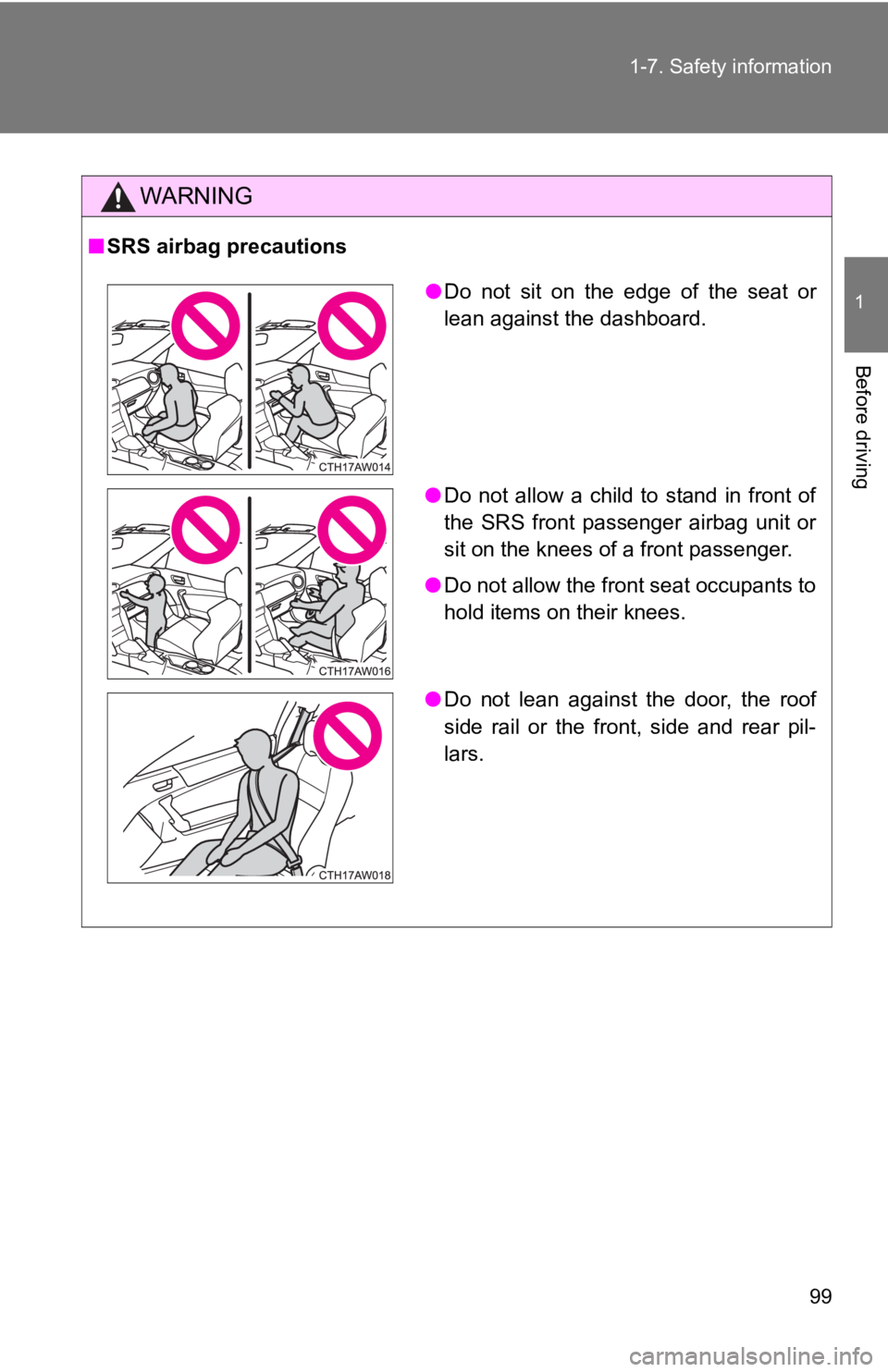
● Do not sit on the edge of the seat or
lean against the dashboard.
● Do not allow a child to stand in front of
the SRS front passenger airbag unit or
sit on the knees of a front passenger.
● Do not allow the front seat occupants to
hold items on their knees.
● Do not lean against the door, the roof
side rail or the front, side and rear pil-
lars.
Page 100 of 428
1001-7. Safety information
WARNING■ SRS airbag precautions
● Do not use seat accessories which cover the parts where the SRS side
airbags inflate as they may interfere with inflation of the airbags. Such
accessories may prevent the side airbags from activating correctly, disable
the system or cause the side airbags to inflate accidentally, resulting in
death or serious injury.
● Do not strike or apply significant levels of force to the area of the SRS air-
bag components ( → P. 71).
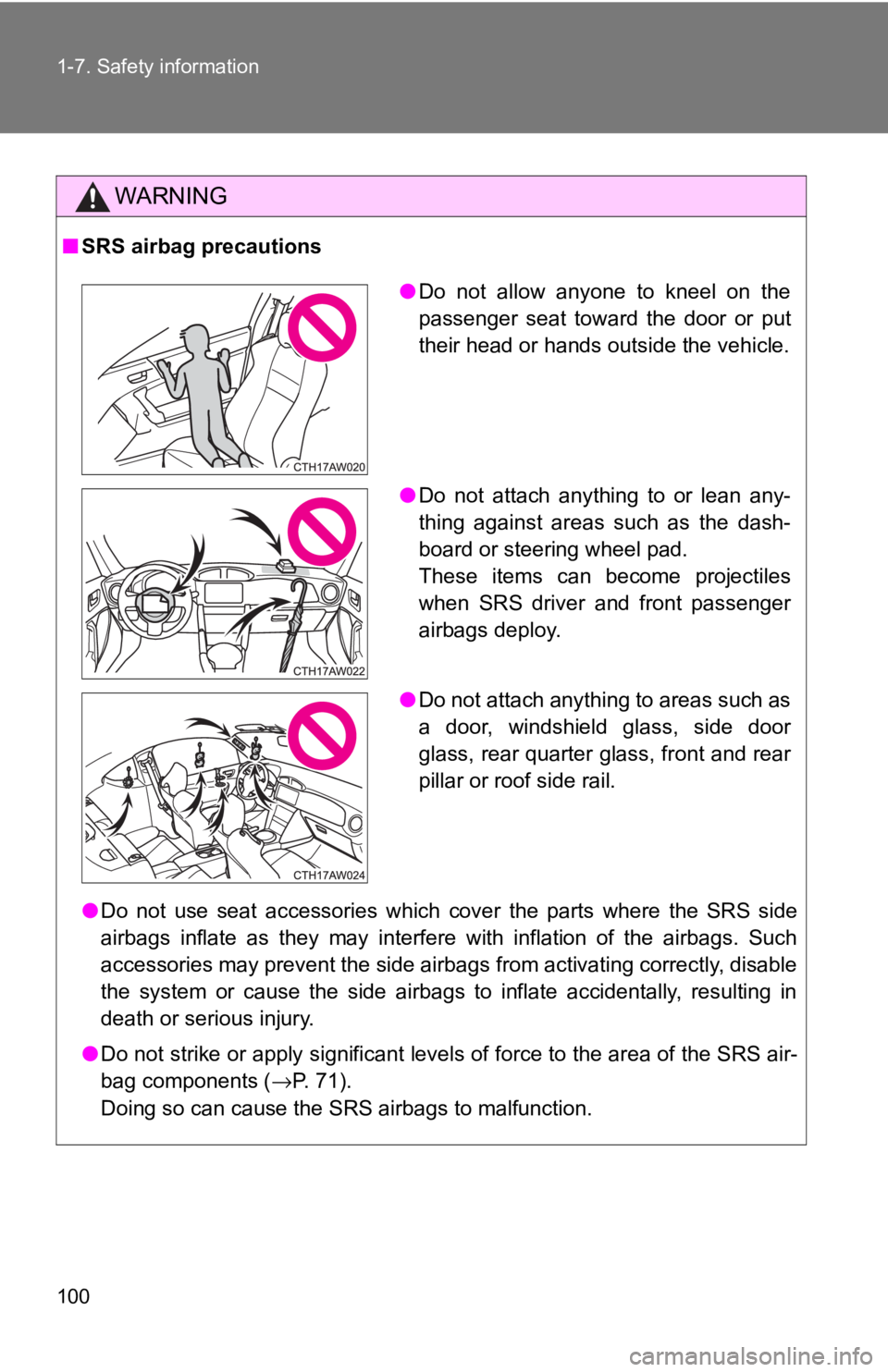
Doing so can cause the SRS airbags to malfunction. ● Do not allow anyone to kneel on the
passenger seat toward the door or put
their head or hands outside the vehicle.
● Do not attach anything to or lean any-
thing against areas such as the dash-
board or steering wheel pad.
These items can become projectiles
when SRS driver and front passenger
airbags deploy.
● Do not attach anything to areas such as
a door, windshield glass, side door
glass, rear quarter glass, front and rear
pillar or roof side rail.
Page 101 of 428
1011-7. Safety information
1
Before driving WARNING■ SRS airbag precautions
● Do not touch any of the component parts immediately after the SRS air-
bags have deployed (inflated) as they may be hot.
● If breathing becomes difficult after the SRS airbag has deployed, open a
door or window to allow fresh air in, or leave the vehicle if it is safe to do
so. Wash off any residue as soon as possible to prevent skin irritation.
● If the areas where the SRS airbags are stored, such as the steering wheel
pad and front and rear pillar garnishes, are damaged or cracked, have
them replaced by your Toyota dealer.
■ Modification and disposal of SRS airbag system components
Do not dispose of your vehicle or perform any of the following modifications
without consulting your Toyota dealer.
The SRS airbags may malfunction or deploy (inflate) accidentally, causing
death or serious injury.
● Installation, removal, disassembly and repair of the SRS airbags.
● Repairs, modifications, removal or replacement of the steering wheel,
instrument panel, dashboard, seats or seat upholstery, front, side and rear
pillars or roof side rails.
● Repairs or modifications of the front fender, front bumper, or side of the
occupant compartment.
● Installation of a grille guard (bull bars, kangaroo bar, etc.), snow plows,
winches.
● Modifications to the vehicle's suspension system.
● Installation of electronic devices such as mobile two-way radios and CD
players.
● Modifications to your vehicle for a person with a physical disability.
Page 102 of 428
1021-7. Safety information
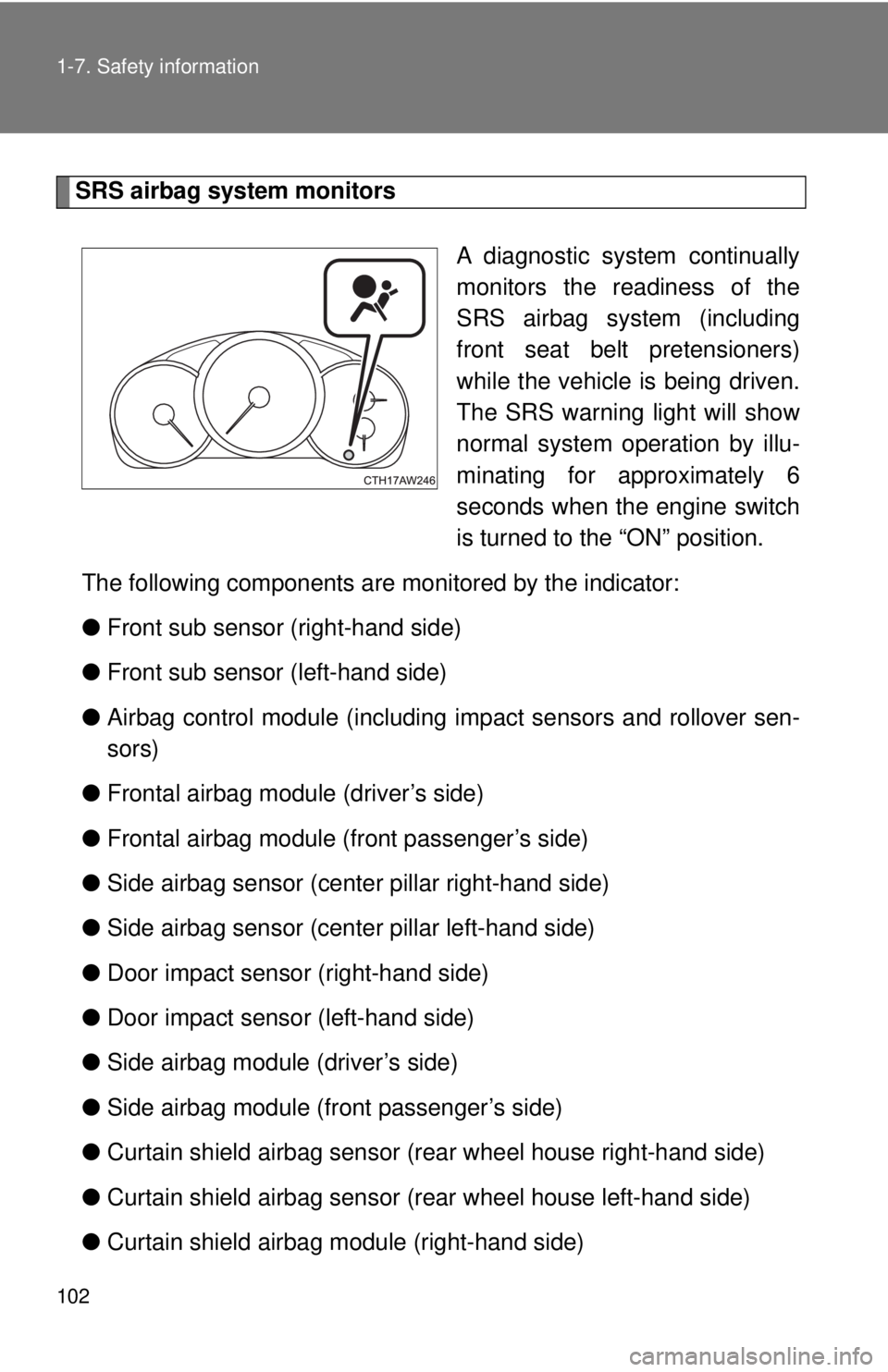
SRS airbag system monitors
A diagnostic system continually
monitors the readiness of the
SRS airbag system (including
front seat belt pretensioners)
while the vehicle is being driven.
The SRS warning light will show
normal system operation by illu-
minating for approximately 6
seconds when the engine switch
is turned to the “ON” position.
The following components are monitored by the indicator:
● Front sub sensor (right-hand side)
● Front sub sensor (left-hand side)
● Airbag control module (including impact sensors and rollover sen-
sors)
● Frontal airbag module (driver’s side)
● Frontal airbag module (front passenger’s side)
● Side airbag sensor (center pillar right-hand side)
● Side airbag sensor (center pillar left-hand side)
● Door impact sensor (right-hand side)
● Door impact sensor (left-hand side)
● Side airbag module (driver’s side)
● Side airbag module (front passenger’s side)
● Curtain shield airbag sensor (rear wheel house right-hand side)
● Curtain shield airbag sensor (rear wheel house left-hand side)
● Curtain shield airbag module (right-hand side)
Page 103 of 428

1031-7. Safety information
1
Before driving ● Curtain shield airbag module (left-hand side)
● Satellite safing sensor (under the center of the rear seats)
● Seat belt pretensioner (driver’s side)
● Seat belt pretensioner (front passenger’s side)
● Seat belt buckle switch (front passenger’s side)
● Front passenger’s occupant classification system sensor
● Front passenger’s occupant detection control module
● Front passenger’s frontal airbag ON and OFF indicator
● All related wiring
WARNING■ SRS warning light
If the warning light exhibits any of the following conditions, there may be a
malfunction in the seat belt pretensioners, SRS airbag system and/or front
passenger occupant classification system. Immediately take your vehicle to
your nearest Toyota dealer to have the system checked. Unless checked
and properly repaired, the seat belt pretensioners, SRS airbag and/or front
passenger occupant classification system will not operate properly in the
event of a collision, which may increase the risk of death or serious injury.
● Flashing or flickering of the warning light
● No illumination of the warning light when the engine switch is first turned to
the “ON” position.
● Continuous illumination of the warning light
● Illumination of the warning light while driving