belt TOYOTA 86 2017 Owner's Guide
[x] Cancel search | Manufacturer: TOYOTA, Model Year: 2017, Model line: 86, Model: TOYOTA 86 2017Pages: 428, PDF Size: 5.25 MB
Page 78 of 428

781-7. Safety information
● Ensure that no article is placed on the seat other than the occupant.
If the ON indicator still remains illuminated while the OFF indicator turns off
despite the fact that the actions noted above have been taken, seat the
child/small adult in the rear seat and immediately contact your Toyota dealer
for an inspection. Even if the system has passed the dealer inspection, it is
recommended that on subsequent trips the child/small adult always take the
rear seat.
Children who have outgrown a child restraint system should always wear the
seat belt irrespective of whether the airbag is deactivated or activated.
■ Conditions in which front passenger’ s SRS frontal airbag is activated
The front passenger’s SRS frontal airbag will be activated for deployment
upon impact when any of the following conditions are met regarding the front
passenger’s seat.
● When the seat is occupied by an adult.
● When a certain item(s) (e.g. jug of water) is placed on the seat.
Page 79 of 428

791-7. Safety information
1
Before driving ■ If the passenger’s frontal airbag OFF indicator illum inates and the ON
indicator turns off even when the fr ont passenger’s seat is occupied by
an adult
This can be caused by the adult incorrectly sitting in the front passenger’s
seat. Turn the engine switch to the “LOCK” position. Ask the front passenger
to set the seatback to the upright position, sit up straight in the center of the
seat cushion, correctly fasten the seat belt, position his/her legs out forward,
and adjust the seat to the rearmost position. Turn the engine switch to the
“ON” position. If the OFF indicator remains illuminated while the ON indica-
tor remains off, take the following actions.
● Turn the engine switch to the “LOCK” position.
● Make sure that the front passenger does not use a blanket, seat cushion,
seat cover, seat heater or massager, etc.
● If wearing excessive layers of clothing, the front passenger should
remove any unnecessary items before sitting in the front passenger’s
seat, or should sit in a rear seat.
● Next, turn the engine switch to the “ON” position and wait 6 seconds to
allow the system to complete self-checking. Following the system check,
both indicators turn off for 2 seconds. Now, the ON indicator should illu-
minate while the OFF indicator remains off.
If the OFF indicator still remains illuminated while the ON indicator remains
off, ask the occupant to move to the rear seat and immediately contact your
Toyota dealer for an inspection.
Page 81 of 428

811-7. Safety information
1
Before driving The SRS airbag can function only when the engine switch is in the “ON”
position.
The Toyota advanced frontal airbag system is designed to determine the
activation or deactivation condition of the front passenger’s SRS frontal air-
bag depending on the characteristic of the item(s) or person on the front
passenger’s seat monitored by the front passenger’s occupant classification
system sensor. For this reason, only the driver’s SRS frontal airbag may
deploy in the event of a collision, but this does not mean failure of the sys-
tem.
If the front sub sensors and the impact sensors in the airbag control module
detect a predetermined amount of force during a frontal collision, the control
module sends signals to the airbag modu le(s) (only driver’s module or both
driver’s and front passenger’s modules) instructing the module(s) to inflate
the SRS frontal airbag(s).
The driver’s and front passenger’s SRS frontal airbags use dual stage infla-
tors. The two inflators of each airbag are triggered either sequentially or
simultaneously, depending on the severity of impact, in the case of the
driver’s SRS frontal airbag and depending on the severity of impact and the
characteristic of the item(s) or person on the seat in the case of the front
passenger’s SRS frontal airbag.
After deployment, the SRS airbag immediately starts to deflate so that the
driver’s vision is not obstructed. The time required from detecting impact to
the deflation of the SRS airbag after deployment is shorter than the blink of
an eye.
Both when only the driver’s SRS frontal airbag deploys and the driver’s and
front passenger’s SRS frontal airbags deploy, the driver’s and front passen-
ger’s seat belt pretensioners operate at the same time.
Although it is highly unlikely that the SRS airbag would activate in a non-
accident situation, should it occur, the SRS airbag will deflate quickly, not
obscuring vision and will not interfere with the driver's ability to maintain con-
trol of the vehicle.
When the SRS airbag deploys, a sudden, fairly loud inflation noise will be
heard and some smoke will be released. These occurrences are a normal
result of the deployment. This smoke does not indicate a fire in the vehicle.
Page 82 of 428
821-7. Safety information
The driver’s SRS frontal airbag and fr ont passenger’s SRS frontal airbag are
designed to deploy in the event of an accident involving a moderate to
severe frontal collision. They are not designed to deploy in most lesser fron-
tal impacts because the necessary protection can be achieved by the seat
belt alone. Also, they are not designed to deploy in most side or rear impacts
or in most roll-over accidents because deployment of only the driver’s SRS
frontal airbag or both driver’s and front passenger’s SRS frontal airbags
would not help the occupant in those situations. The driver’s and front pas-
senger’s SRS frontal airbags are des igned to function on a one-time-only
basis.
SRS airbag deployment depends on the level of force experienced in the
passenger compartment during a collision. That level differs from one type of
collision to another, and it may have no bearing on the visible damage done
to the vehicle itself.
■ Example of accident in which the driver’s/driver’s and front passen-
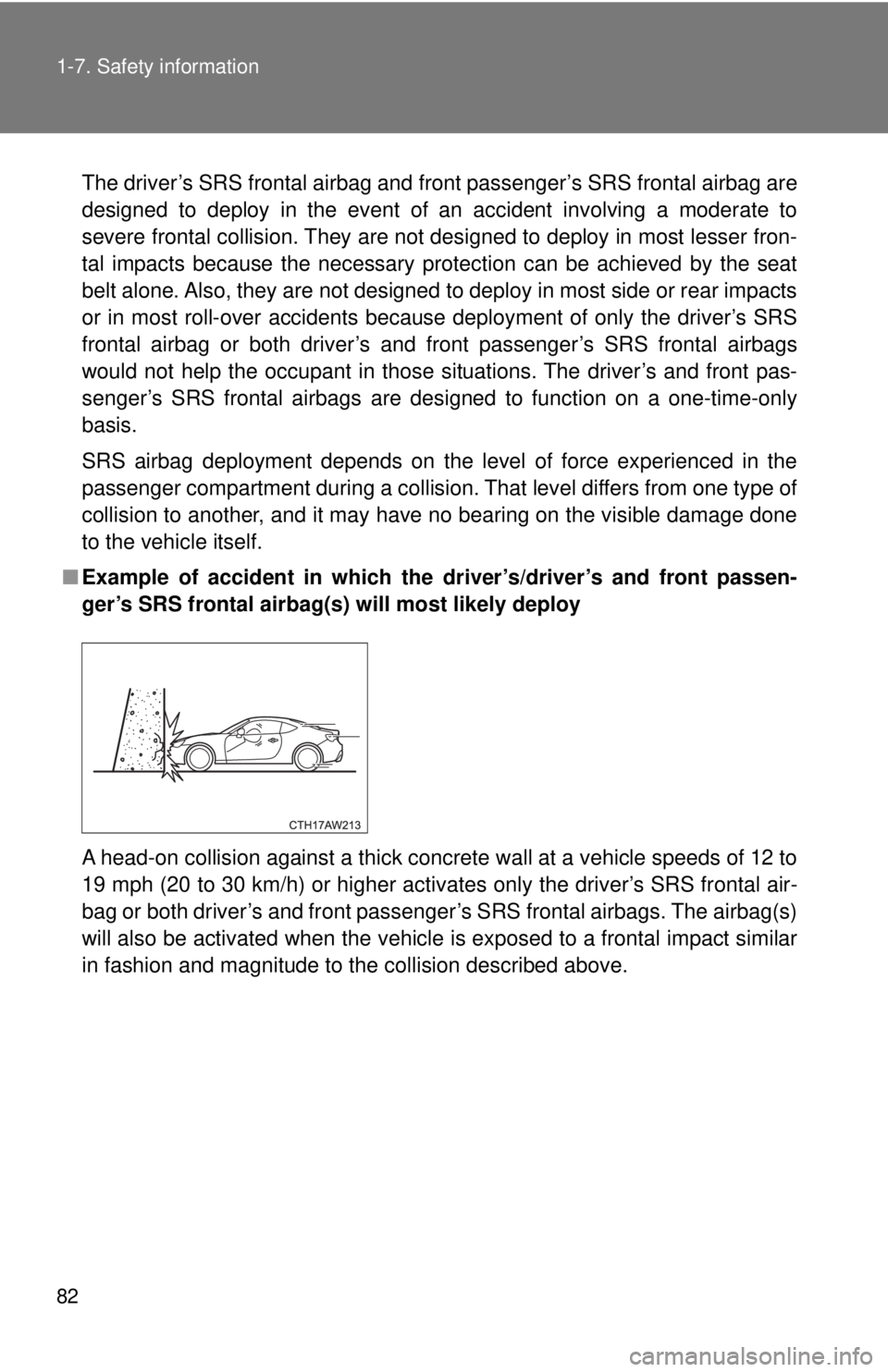
ger’s SRS frontal airbag(s) will most likely deploy
A head-on collision against a thick concrete wall at a vehicle speeds of 12 to
19 mph (20 to 30 km/h) or higher activates only the driver’s SRS frontal air-
bag or both driver’s and front passenger’s SRS frontal airbags. The airbag(s)
will also be activated when the vehicle is exposed to a frontal impact similar
in fashion and magnitude to the collision described above.
Page 87 of 428

871-7. Safety information
1
Before driving SRS side airbag and SRS curtain shield airbag
The SRS side airbag is stored in the door side of each front seat
seatback, which bears an “SRS AIRBAG” label.
In a moderate to severe side impact collision, the SRS side airbag on
the impacted side of the vehicle deploys between the occupant and
the door panel and supplements the seat belt by reducing the impact
on the occupant’s chest and waist. The SRS side airbag operates
only for front seat occupants.
The SRS curtain shield airbag on ea ch side of the cabin is stored in
the roof side (bet ween the front pillar and a poi nt over the rear seat).
An “SRS AIRBAG” mark is located at the top of each front and rear
pillar.
In a moderate to severe side impact collision, the SRS curtain shield
airbag on the impacted side of the vehicle deploys between the occu-
pant and the side window and supplements the seat belt by reducing
the impact on the occupant’s head.
Page 88 of 428

881-7. Safety information
■ Operation
The SRS side airbag and SRS curtain shield airbag can function only when
the engine switch is in the “ON” position.
The driver’s and front passenger’s SRS side airbags and SRS curtain shield
airbags deploy independently of each other since each has its own impact
sensor. Therefore, they may not both deploy in the same accident. Also, the
SRS side airbag and SRS curtain shield airbag deploys independently of the
driver’s and front passenger’s SRS front airbags in the steering wheel and
instrument panel.
A rollover sensor is also located inside the airbag control module.
An impact sensor, which senses impact force, is located in each of the left
and right center pillars, doors and rear wheel houses. Another impact sen-
sor, which also senses impact force, is located under the center of the rear
seats.
If the impact sensor that is located under the center of the rear seats and
one of the center pillar impact sensors or door impact sensors together
sense an impact force above a predetermined level in a side collision, the
control module causes both the SRS side airbag and curtain shield airbag on
the impacted side to inflate regardless of whether the rear wheel house
impact sensor on the same side senses an impact.
If the impact sensor that is located under the center of the rear seats and
one of the rear wheel house impact sensors together sense an impact force
above a predetermined level, the control module causes only the SRS cur-
tain shield airbag on the impacted side to inflate.
If the rollover sensor detects rollover of the vehicle, the control module
inflates the SRS curtain shield airbags. At this time, the driver's and front
passenger’s seat belt pretensioners also operate at the same time.
Page 95 of 428

951-7. Safety information
1
Before driving WARNING■ If the SRS airbags deploy
Do not touch the SRS side airbag system components around the front seat
seatback with bare hands right after deployment. Doing so can cause burns
because the components can be very hot as a result of deployment.
After deployment, do not touch any part of the SRS curtain shield airbag sys-
tem (from the front pillar to the part of the roof side over the rear seat). Doing
so can cause burns because the components can be very hot as a result of
deployment.
■ SRS side airbag and SRS curtain shield airbag precautions
The SRS side airbag and SRS curtain shield airbag are designed only to be
a supplement to the primary protection provided by the seat belt. They do
not do away with the need to fasten seat belts. It is also important to wear
your seat belt to help avoid injuries that can result when an occupant is not
seated in a proper upright position.
Page 97 of 428
971-7. Safety information
1
Before driving
WARNING■ SRS airbag precautions
Observe the following precautions regarding the SRS airbags.
Failure to do so may cause death or serious injury.
● The driver and all passengers in the vehicle must wear their seat belts
properly.
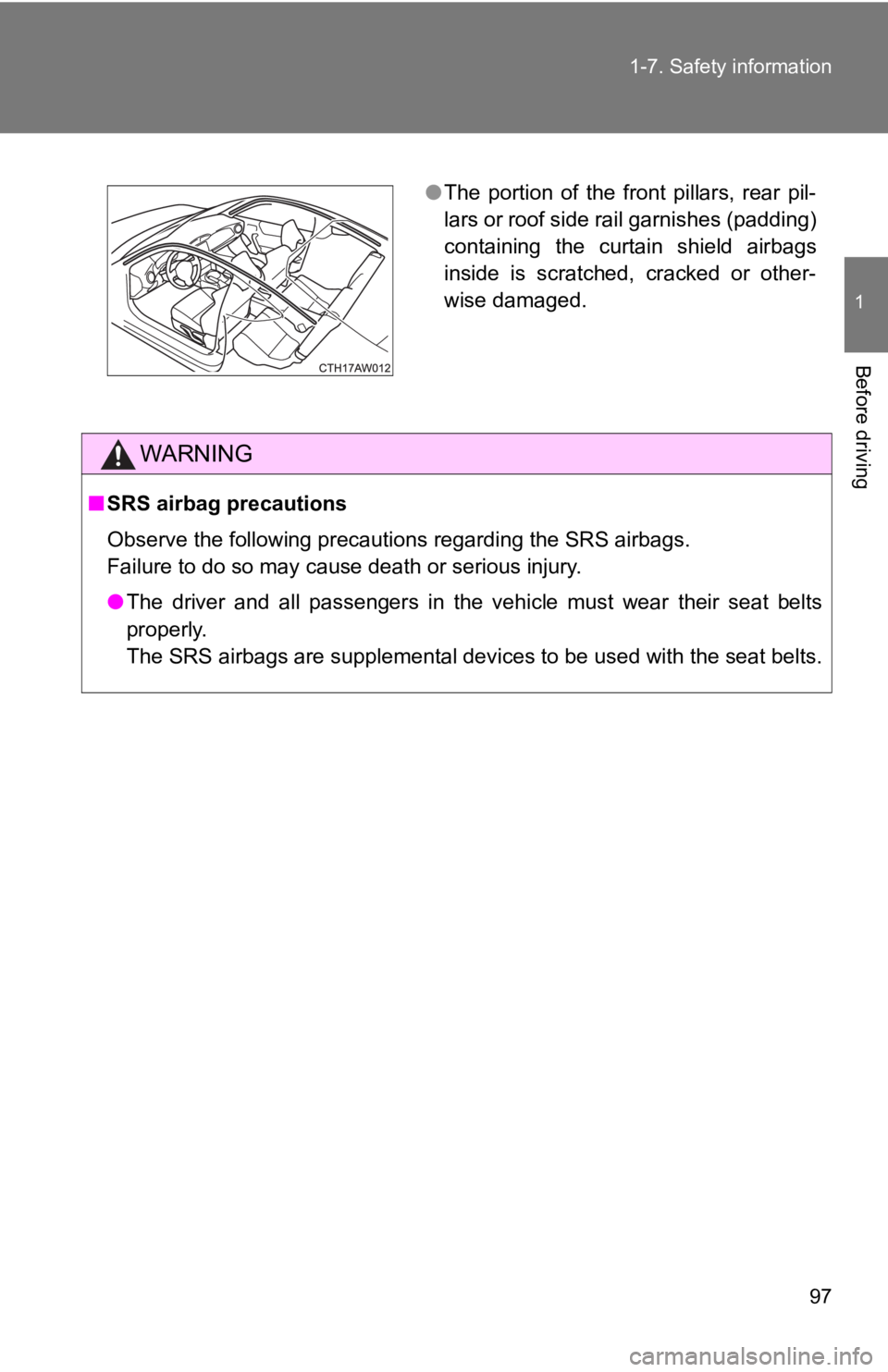
The SRS airbags are supplemental devices to be used with the seat belts. ● The portion of the front pillars, rear pil-
lars or roof side rail garnishes (padding)
containing the curtain shield airbags
inside is scratched, cracked or other-
wise damaged.
Page 98 of 428

981-7. Safety information
WARNING■ SRS airbag precautions
● The SRS driver airbag deploys with considerable force, and can cause
death or serious injury especially if the driver is very close to the airbag.
The National Highway Traffic Safety Administration (“NHTSA”) advises:
Since the risk zone for the driver’s airbag is the first 2 - 3 in. (50 - 75 mm)
of inflation, placing yourself 10 in. (250 mm) from your driver airbag pro-
vides you with a clear margin of safety. This distance is measured from the
center of the steering wheel to your breastbone. If you sit less than 10 in.
(250 mm) away now, you can change your driving position in several
ways:
• Move your seat to the rear as far as you can while still reaching the
pedals comfortably.
• Slightly recline the back of the seat. Although vehicle designs vary,
many drivers can achieve the 10 in. (250 mm) distance, even with the
driver seat all the way forward, simply by reclining the back of the seat
somewhat. If reclining the back of your seat makes it hard to see the
road, raise yourself by using a firm, non-slippery cushion, or raise the
seat if your vehicle has that feature.
• If your steering wheel is adjustable, tilt it downward. This points the air-
bag toward your chest instead of your head and neck.
The seat should be adjusted as recommended by NHTSA above, while
still maintaining control of the foot pedals, steering wheel, and your view of
the instrument panel controls.
● The SRS front passenger airbag also deploys with considerable force, and
can cause death or serious injury especially if the front passenger is very
close to the airbag. The front passenger seat should be as far from the air-
bag as possible with the seatback adjusted, so the front passenger sits
upright.
● Improperly seated and/or restrained infants and children can be killed or
seriously injured by a deploying airbag. An infant or child who is too small
to use a seat belt should be properly secured using a child restraint sys-
tem. Toyota strongly recommends that all infants and children be placed in
the rear seats of the vehicle and properly restrained. The rear seats are
safer for infants and children than the front passenger seat. ( → P. 112)
Page 102 of 428
1021-7. Safety information
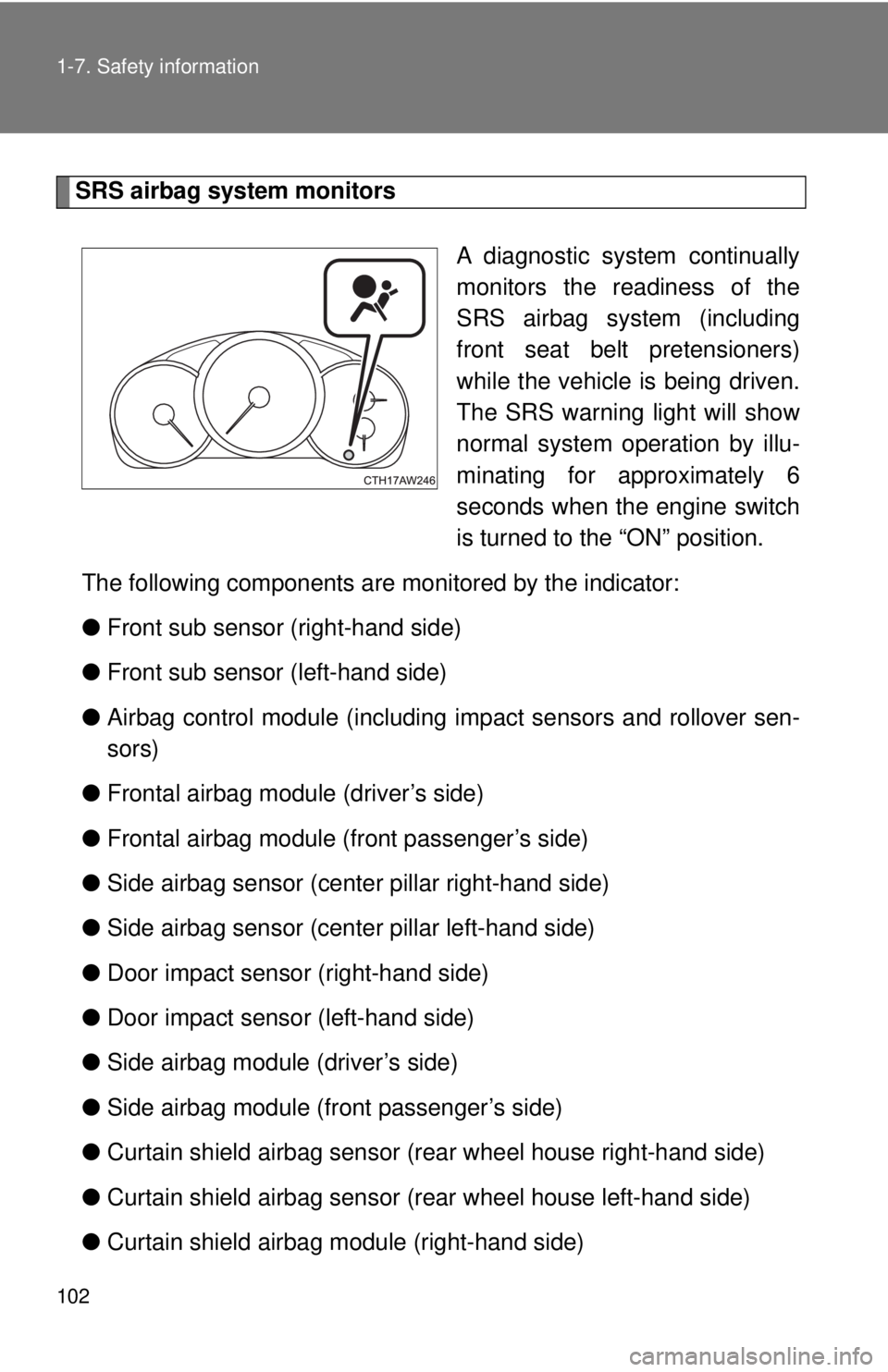
SRS airbag system monitors
A diagnostic system continually
monitors the readiness of the
SRS airbag system (including
front seat belt pretensioners)
while the vehicle is being driven.
The SRS warning light will show
normal system operation by illu-
minating for approximately 6
seconds when the engine switch
is turned to the “ON” position.
The following components are monitored by the indicator:
● Front sub sensor (right-hand side)
● Front sub sensor (left-hand side)
● Airbag control module (including impact sensors and rollover sen-
sors)
● Frontal airbag module (driver’s side)
● Frontal airbag module (front passenger’s side)
● Side airbag sensor (center pillar right-hand side)
● Side airbag sensor (center pillar left-hand side)
● Door impact sensor (right-hand side)
● Door impact sensor (left-hand side)
● Side airbag module (driver’s side)
● Side airbag module (front passenger’s side)
● Curtain shield airbag sensor (rear wheel house right-hand side)
● Curtain shield airbag sensor (rear wheel house left-hand side)
● Curtain shield airbag module (right-hand side)