belt TOYOTA 86 2017 Service Manual
[x] Cancel search | Manufacturer: TOYOTA, Model Year: 2017, Model line: 86, Model: TOYOTA 86 2017Pages: 428, PDF Size: 5.25 MB
Page 103 of 428
1031-7. Safety information
1
Before driving ● Curtain shield airbag module (left-hand side)
● Satellite safing sensor (under the center of the rear seats)
● Seat belt pretensioner (driver’s side)
● Seat belt pretensioner (front passenger’s side)
● Seat belt buckle switch (front passenger’s side)
● Front passenger’s occupant classification system sensor
● Front passenger’s occupant detection control module
● Front passenger’s frontal airbag ON and OFF indicator
● All related wiring
WARNING■ SRS warning light
If the warning light exhibits any of the following conditions, there may be a
malfunction in the seat belt pretensioners, SRS airbag system and/or front
passenger occupant classification system. Immediately take your vehicle to
your nearest Toyota dealer to have the system checked. Unless checked
and properly repaired, the seat belt pretensioners, SRS airbag and/or front
passenger occupant classification system will not operate properly in the
event of a collision, which may increase the risk of death or serious injury.
● Flashing or flickering of the warning light
● No illumination of the warning light when the engine switch is first turned to
the “ON” position.
● Continuous illumination of the warning light
● Illumination of the warning light while driving
Page 104 of 428
1041-7. Safety information
Front passenger occupant classification systemYour vehicle is equipped with a front passenger occupant classifica-
tion system. Using the sensors installed under the seat cover, the
system detects the conditions of the front passenger seat and acti-
vates or deactivates the frontal ai rbag for front passenger seat. The
occupant classification system may not inflate the front passenger’s
SRS frontal airbag even when the driver’s SRS frontal airbag
deploys. This is not a malfunction. If the seat belt buckle switch and/
or front passenger’s occupant classi fication system have failed, the
SRS warning light will illuminate. Have the system inspected by your
Toyota dealer immediately if the SRS warning light illuminates.
If your vehicle has sust ained impact, this may affect the proper func-
tion of the Toyota advanced frontal airbag system. Immediately con-
tact your Toyota dealer and have your vehicle inspected. Do not use
the front passenger seat while driv ing to your Toyota dealer.
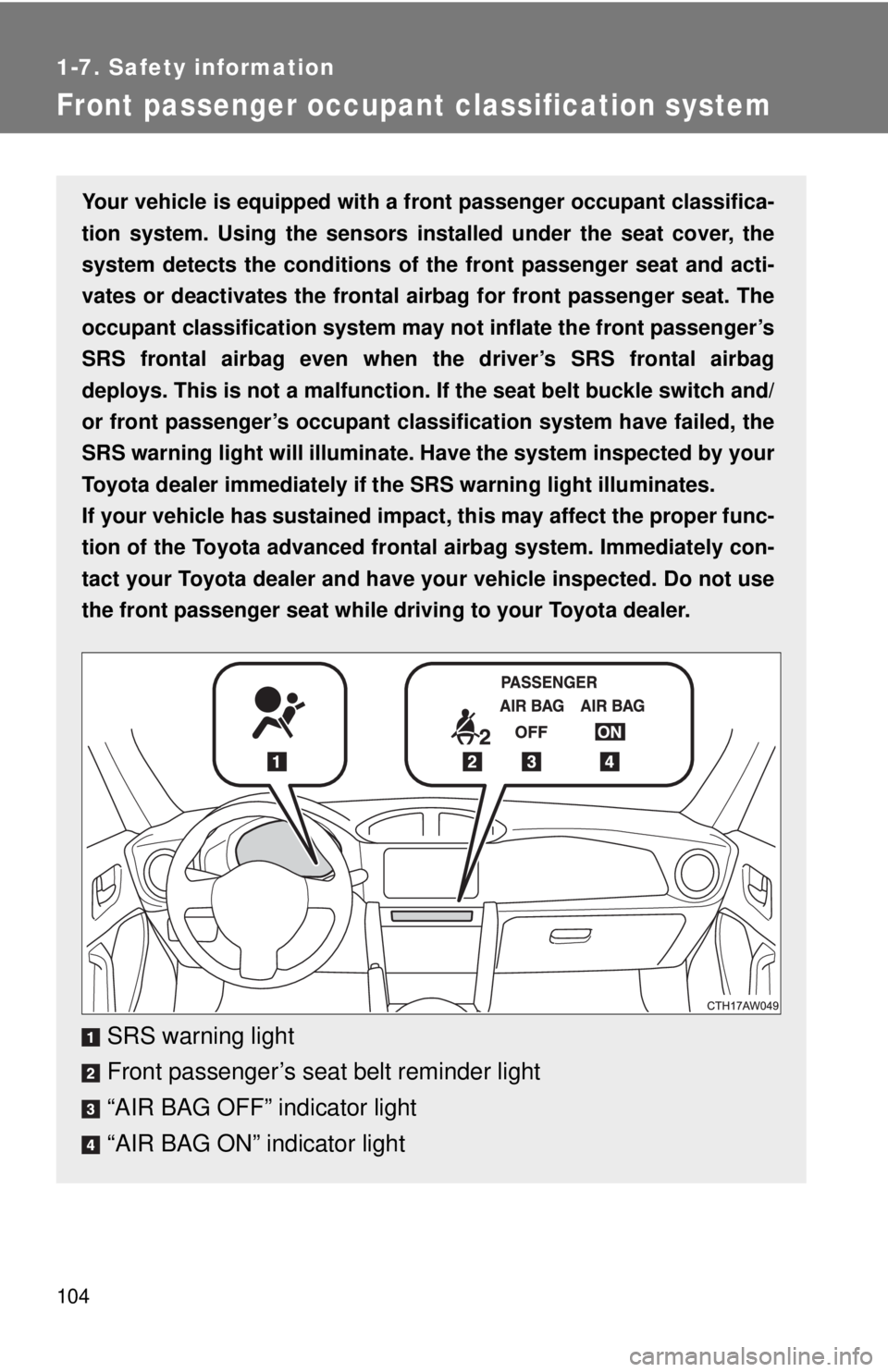
SRS warning light
Front passenger’s seat belt reminder light
“AIR BAG OFF” indicator light
“AIR BAG ON” indicator light
Page 105 of 428
1051-7. Safety information
1
Before driving
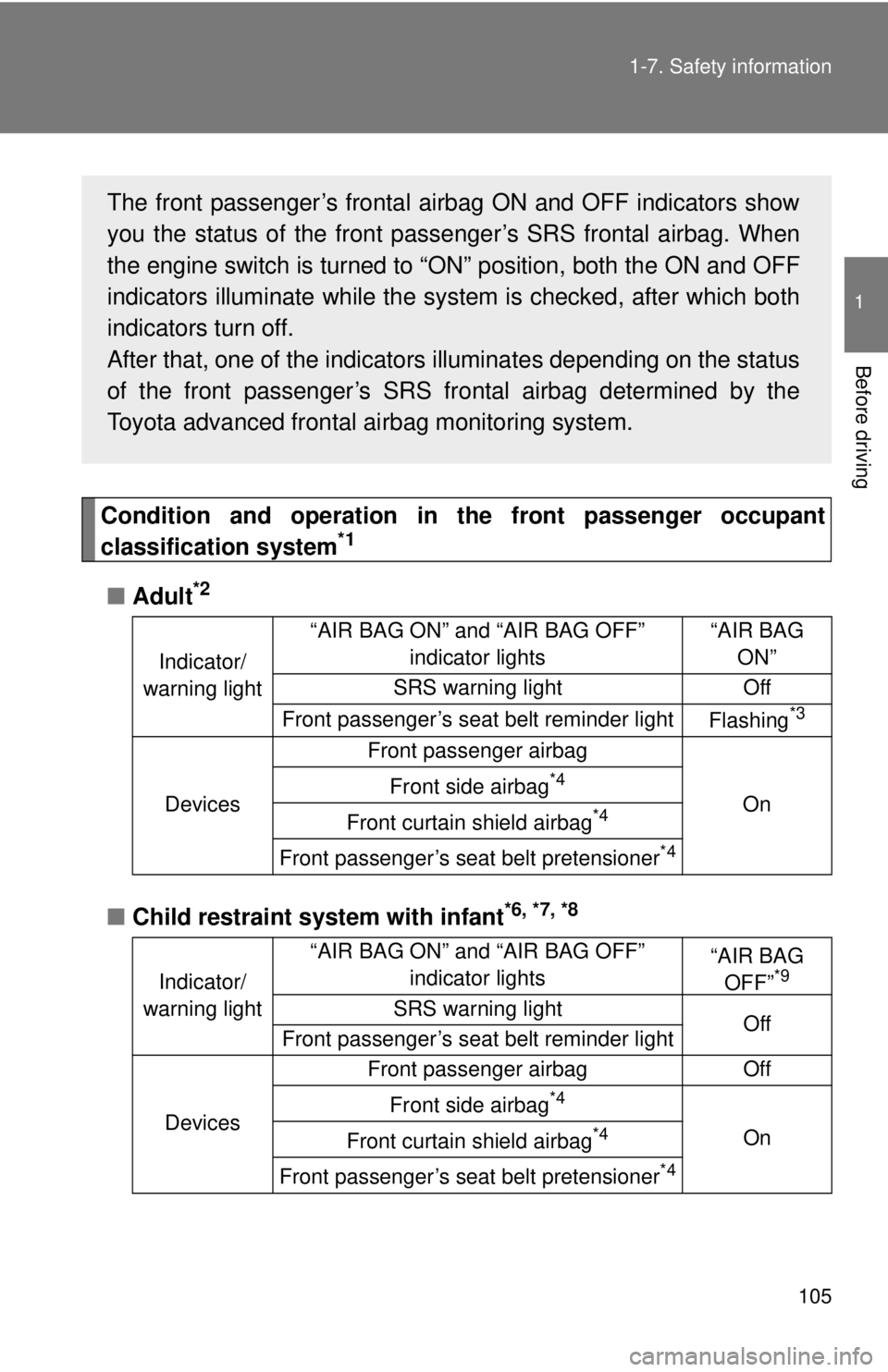
Condition and operation in th e front passenger occupant
classification system *1
■ Adult *2
■ Child restraint system with infant *6, *7, *8Indicator/
warning light “AIR BAG ON” and “AIR BAG OFF”
indicator lights “AIR BAG
ON”
SRS warning light Off
Front passenger’s seat belt reminder light
Flashing *3
Devices Front passenger airbag
OnFront side airbag *4
Front curtain shield airbag *4
Front passenger’s seat belt pretensioner *4
Indicator/
warning light “AIR BAG ON” and “AIR BAG OFF”
indicator lights “AIR BAG
OFF” *9
SRS warning light
Off
Front passenger’s seat belt reminder light
Devices Front passenger airbag Off
Front side airbag *4
On
Front curtain shield airbag *4
Front passenger’s seat belt pretensioner *4The front passenger’s frontal airbag ON and OFF indicators show
you the status of the front pass enger’s SRS frontal airbag. When
the engine switch is turned to “O N” position, both the ON and OFF
indicators illuminate while the system is checked, after which both
indicators turn off.
After that, one of the indicators illuminates depending on the status
of the front passenger’s SRS fr ontal airbag determined by the
Toyota advanced frontal ai rbag monitoring system.
Page 106 of 428

1061-7. Safety information
■ Child *5, *7
■ Unoccupied
■ There is a malfunction in the system Indicator/
warning light “AIR BAG ON” and “AIR BAG OFF”
indicator lights “AIR BAG
OFF” or “AIR
BAG ON” *5
SRS warning light Off
Front passenger’s seat belt reminder light Off or
flashing *3, *5
Devices Front passenger airbag Off or on *5
Front side airbag *4
On
Front curtain shield airbag *4
Front passenger’s seat belt pretensioner *4
Indicator/
warning light “AIR BAG ON” and “AIR BAG OFF”
indicator lights “AIR BAG
OFF”
SRS warning light
Off
Front passenger’s seat belt reminder light
Devices Front passenger airbag Off
Front side airbag *4
On
Front curtain shield airbag *4
Front passenger’s seat belt pretensioner *4
Indicator/
warning light “AIR BAG ON” and “AIR BAG OFF”
indicator lights “AIR BAG
OFF”
SRS warning light On
Front passenger’s seat belt reminder light Off
Devices Front passenger airbag Off
Front side airbag *4
On
Front curtain shield airbag *4
Front passenger’s seat belt pretensioner *4
Page 107 of 428

1071-7. Safety information
1
Before driving * 1
: The occupant classification system does not operate during self-
checking.
* 2
: The system judges a person of adult size as an adult. When a
smaller adult sits in the front passenger seat, the system may not
recognize him/her as an adult depending on his/her physique and
posture.
* 3
: In the event the front passenge r does not wear a seat belt.
* 4
: The front passenger’s SRS side airbag, SRS curtain shield airbag
and seat belt pretensioner are not controlled by the occupant
classification system.
* 5
: For some children, child in seat, child in booster seat or child in
convertible seat, the system may not recognize him/her as a
child. Factors which may affect this can be the physique or pos-
ture.
Children who have outgrown a child restraint system should
always wear the seat belt when sitting in the seat irrespective of
whether the airbag is de activated or activated.
* 6
: When a child restraint system is installed on the front passenger
seat, do not place any article on the seat other than the child
occupant and a child restraint system.
Failure to do so may prevent th e front passenger occupant classi-
fication system from functioning correctly or cause the system to
fail.
* 7
: Do not place more than one child on the front passenger seat.
Failure to do so may prevent th e front passenger occupant classi-
fication system from functioning correctly.
* 8
: Never install a rear-facing child restraint system on the front pas-
senger seat. See the caution that follows regarding installation of
a child restraint system. ( → P. 116)
* 9
: In case the indicator is not i lluminated, consult this manual on
how to installing the child restraint system properly. ( → P. 116)
Page 108 of 428
1081-7. Safety information
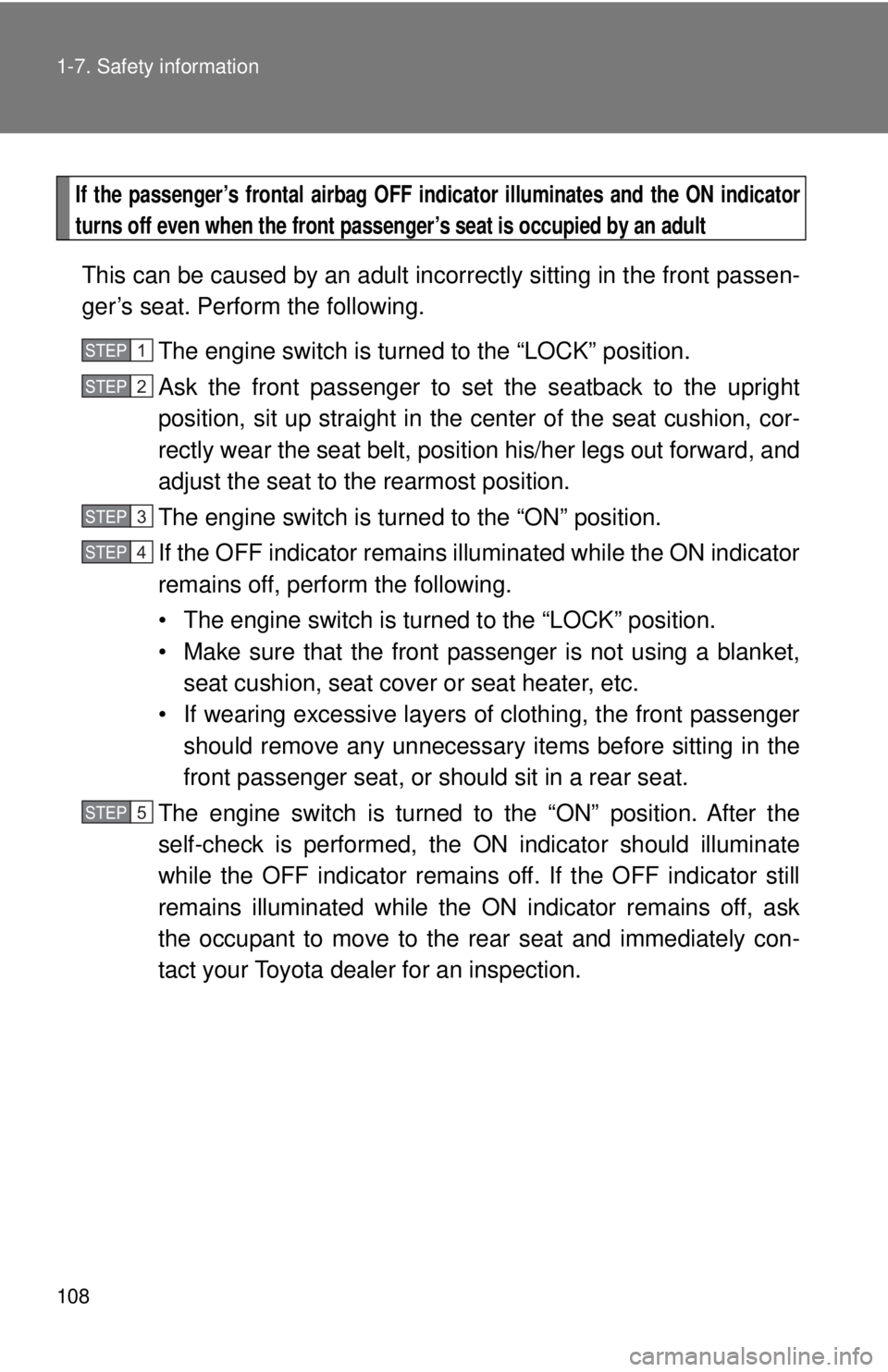
If the passenger’s frontal airbag OFF indicator illuminates and the ON indicator
turns off even when the front passenger’s seat is occupied by an adult
This can be caused by an adult in correctly sitting in the front passen-
ger’s seat. Perform the following.
The engine switch is turned to the “LOCK” position.
Ask the front passenger to set the seatback to the upright
position, sit up straight in the ce nter of the seat cushion, cor-
rectly wear the seat belt, posit ion his/her legs out forward, and
adjust the seat to the rearmost position.
The engine switch is turned to the “ON” position.
If the OFF indicator remains illuminated while the ON indicator
remains off, perform the following.
• The engine switch is turned to the “LOCK” position.
• Make sure that the front passenger is not using a blanket,
seat cushion, seat cover or seat heater, etc.
• If wearing excessive layers of clothing, the front passenger
should remove any unnecessary items before sitting in the
front passenger seat, or should sit in a rear seat.
The engine switch is turned to the “ON” position. After the
self-check is performed, the ON indicator should illuminate
while the OFF indicator remains off. If the OFF indicator still
remains illuminated while the ON indicator remains off, ask
the occupant to move to the rear seat and immediately con-
tact your Toyota dealer for an inspection.STEP 1
STEP 2
STEP 3
STEP 4
STEP 5
Page 110 of 428

1101-7. Safety information
WARNING■ Front passenger occupant classification system precautions
Observe the following precautions regarding front passenger occupant clas-
sification system.
Failure to do so may cause the occupant classification system to not function
correctly, resulting in death or serious injury.
● Wear the seat belt properly.
● Do not apply excessive force to the seat.
● Do not put sharp object(s) on the seat or pierce the seat upholstery.
● Do not put objects under the front passenger seat.
● Do not use a seat accessory, such as a cushion or seat cover, that covers
the seat cushion surface.
● Do not spill liquid on the front passenger seat. If liquid is spilled, wipe it off
immediately and dry the seat. If the airbag warning light illuminates, dry
the seat until the warning light turns off. If the airbag warning light stays on
even when the seat has dried, do not allow anyone to sit on the front pas-
senger seat and have the system checked by your Toyota dealer. If the air-
bag warning light does not illuminate, check that the airbag ON/OFF
indicator light works properly. If the indicator light does not work properly,
do not allow anyone to sit in the front passenger’s seat and have the sys-
tem inspected by your Toyota dealer.
● Do not remove or disassemble the front passenger seat. Also, do not
replace or modify the seat upholstery or foam inside the seat.
● Do not install any accessory (such as an audio amplifier) other than a gen-
uine Toyota accessory under the front passenger’s seat.
● Do not place a magnetized items near the seat belt buckle.
Page 111 of 428
1111-7. Safety information
1
Before driving WARNING■ Front passenger occupant classification system precautions
● Never install a rearward facing child seat in the front passenger’s seat
even if the front passenger’s SRS frontal airbag is deactivated. Be sure to
install it in the rear seat in a correct manner. Also, it is strongly recom-
mended that any forward facing child seat or booster seat be installed in
the rear seat, and that even children who have outgrown a child restraint
system be also seated in the rear seat. This is because children sitting in
the front passenger’s seat may be killed or severely injured should the
front passenger’s SRS frontal airbag deploy. Toyota believes that the rear
seats are the safest place for children
● If luggage or electronic devices are placed on the front passenger seat,
the OFF indicator may turn off and the ON indicator may illuminate. If this
occurs, the front passenger’s airbag may deploy during a collision. If this is
not desirable, remove the luggage or electronic devices from the front pas-
senger seat.
● Modifications for persons with disabilit ies that may affect the front passen-
ger occupant classification system. (U.S. only) Removing, replacing or
modifying any parts of the front seat s, seat belts, front bumper, front side
frame, instrument panel, combination meter, steering wheel, steering col-
umn, tires, suspension or floor panel can affect the operation of the Toyota
front passenger occupant classification system.
Page 112 of 428
1121-7. Safety information
Child restraint systems
Points to remember
Studies have shown that installing a child restraint on a rear seat is
much safer than installing one to the front passenger seat.
● Choose a child restraint system that suits your vehicle and is
appropriate to the age and size of the child.
● For installation details, follow the instructions provided with the
child restraint system.
General installation instructions are provided in this manual.
( → P. 116)
Types of child restraints
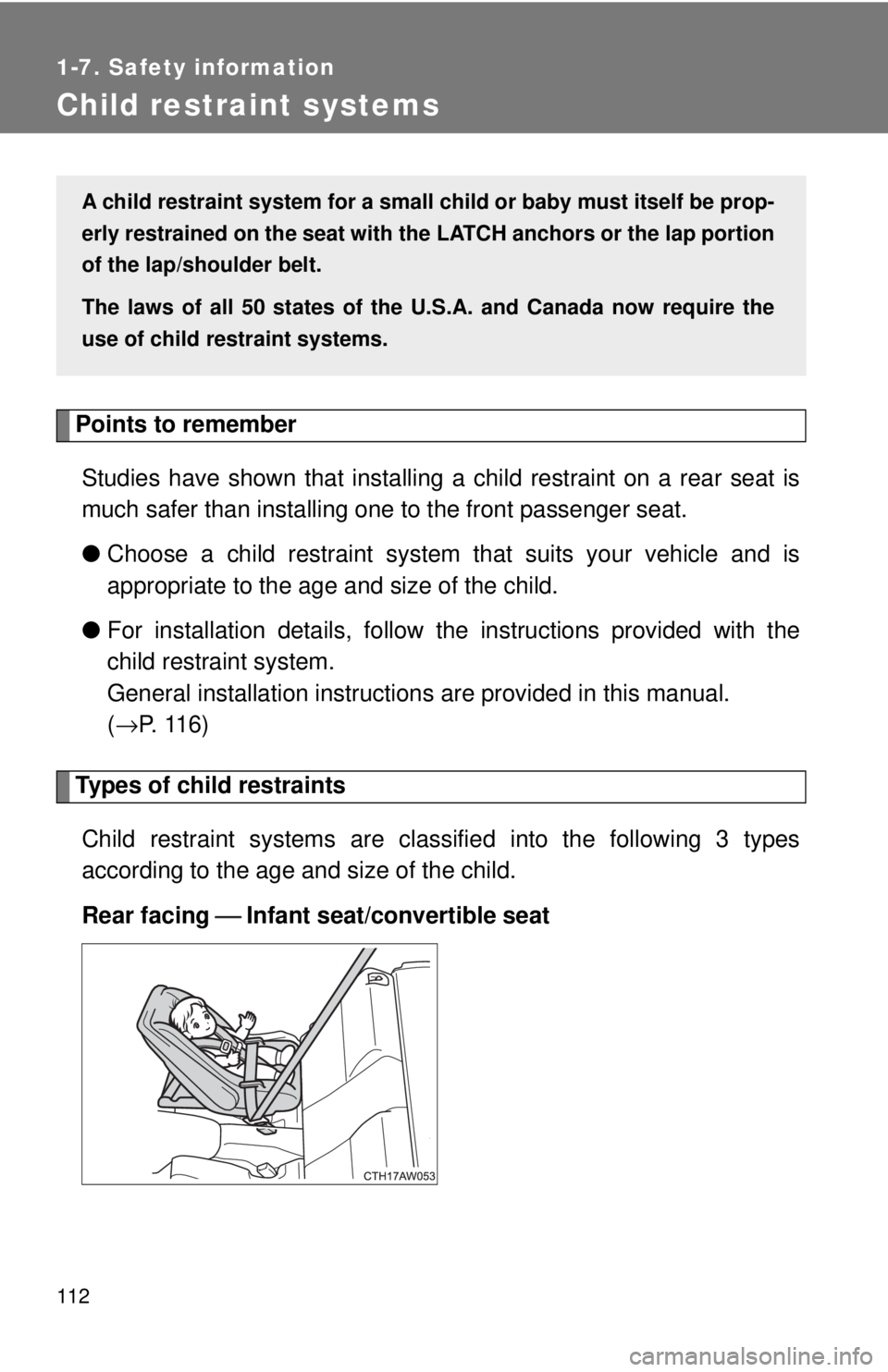
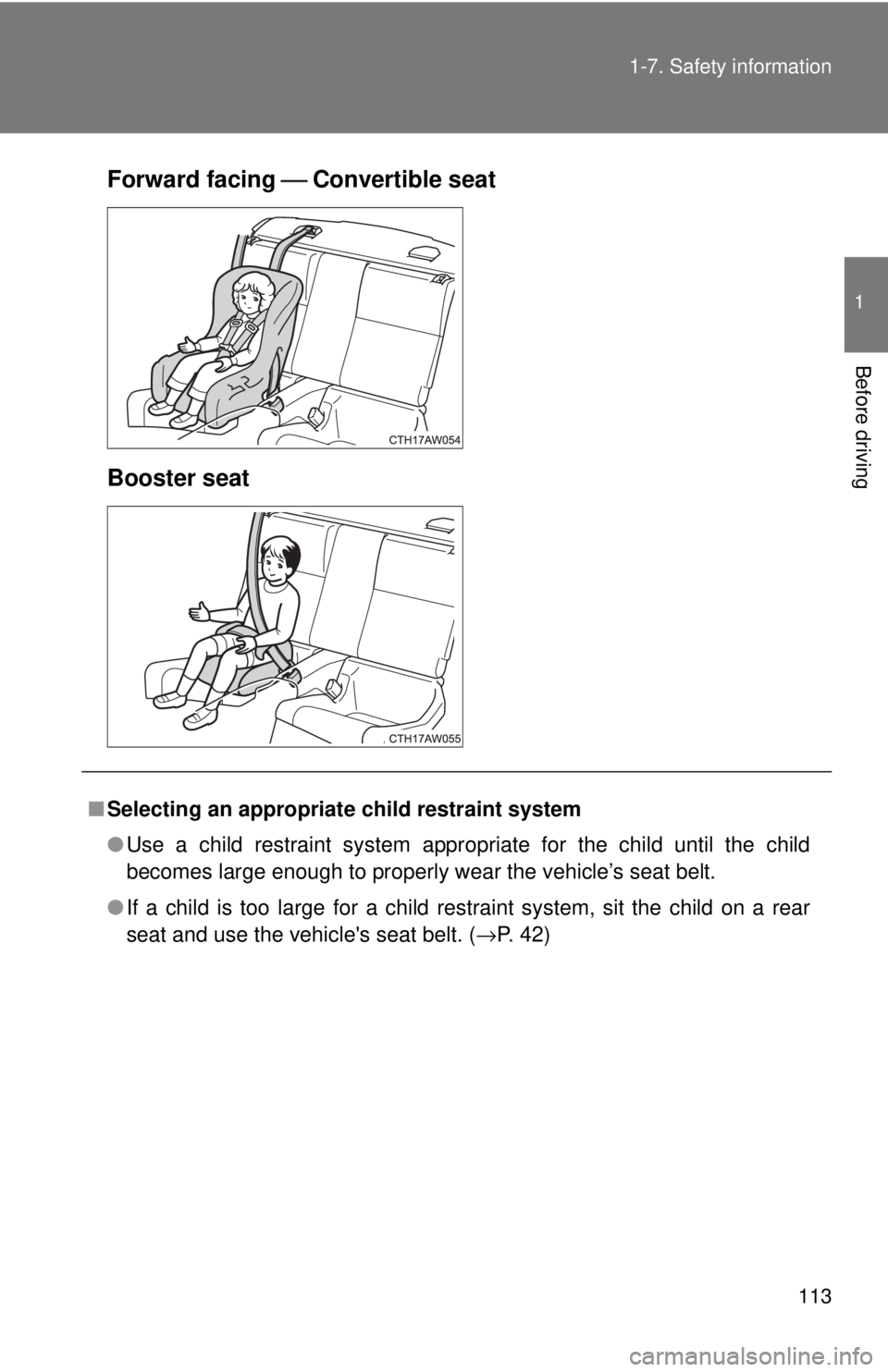
Child restraint systems are clas sified into the following 3 types
according to the age and size of the child.
Rear facing ⎯ Infant seat/convertible seatA child restraint system fo r a small child or baby must itself be prop-
erly restrained on the seat with th e LATCH anchors or the lap portion
of the lap/shoulder belt.
The laws of all 50 states of the U.S.A. and Canada now require the
use of child restraint systems.
Page 113 of 428
1131-7. Safety information
1
Before driving Forward facing ⎯ Convertible seat
Booster seat
■ Selecting an appropriat e child restraint system
● Use a child restraint system appropriate for the child until the child
becomes large enough to properly wear the vehicle’s seat belt.
● If a child is too large for a child restraint system, sit the child on a rear
seat and use the vehicle's seat belt. ( → P. 42)