fuel TOYOTA 86 2017 Owner's Guide
[x] Cancel search | Manufacturer: TOYOTA, Model Year: 2017, Model line: 86, Model: TOYOTA 86 2017Pages: 428, PDF Size: 5.25 MB
Page 320 of 428
3205-2. Steps to take in an emergency
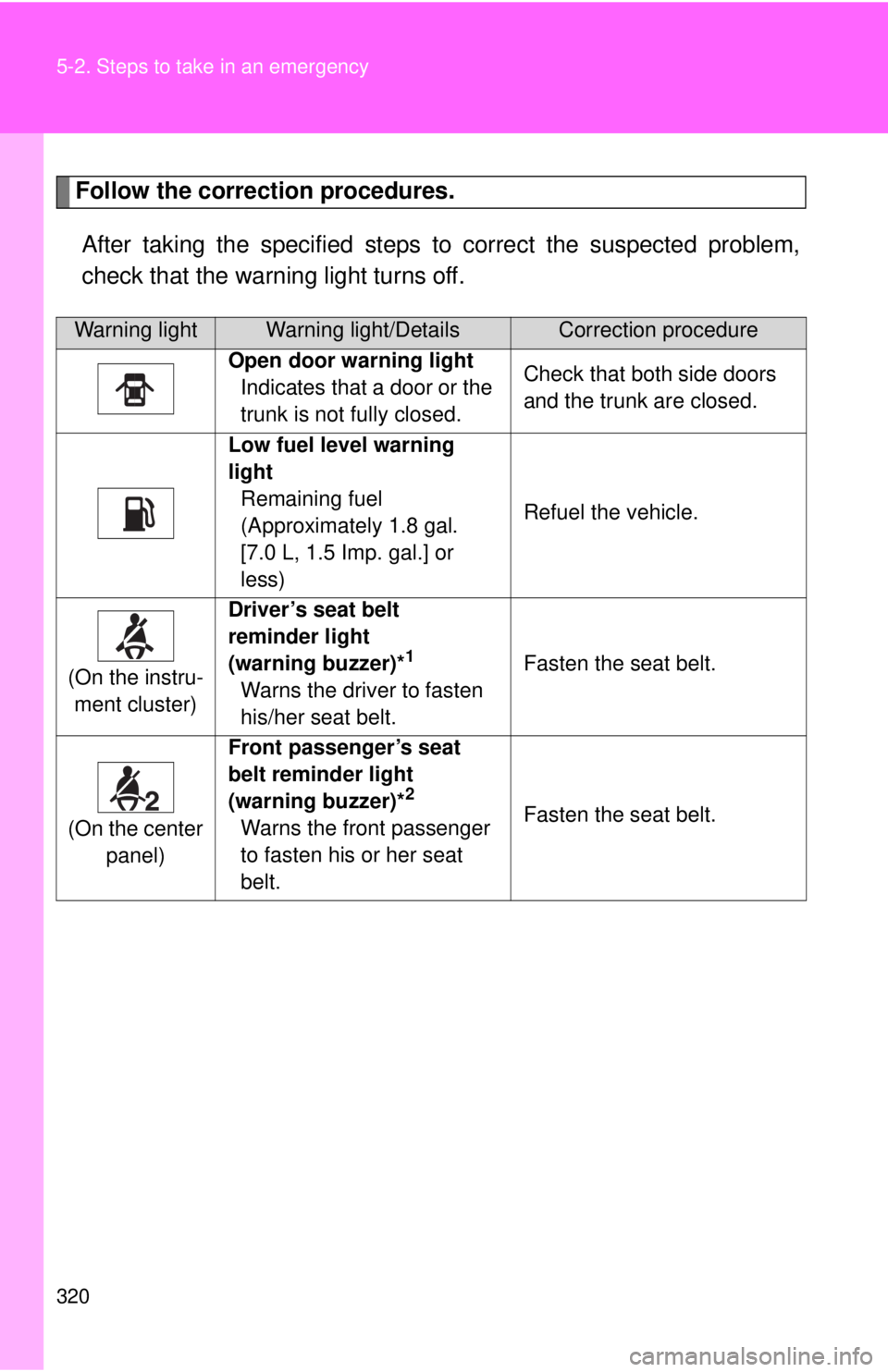
Follow the correction procedures.
After taking the specif ied steps to correct the suspected problem,
check that the warning light turns off. Warning light Warning light/Details Correction procedure
Open door warning light
Indicates that a door or the
trunk is not fully closed. Check that both side doors
and the trunk are closed.
Low fuel level warning
light
Remaining fuel
(Approximately 1.8 gal.
[7.0 L, 1.5 Imp. gal.] or
less) Refuel the vehicle.
(On the instru-
ment cluster) Driver’s seat belt
reminder light
(warning buzzer)* 1
Warns the driver to fasten
his/her seat belt. Fasten the seat belt.
(On the center
panel) Front passenger’s seat
belt reminder light
(warning buzzer)* 2
Warns the front passenger
to fasten his or her seat
belt. Fasten the seat belt.
Page 325 of 428
5
When trouble arises
3255-2. Steps to take in an emergency
WARNING■
Maintenance of the tires
Each tire, including the spare (if provided), should be checked monthly
when cold and inflated to the inflation pressure recommended by the
vehicle manufacturer on the vehicle placard or tire inflation pressure
label (tire and load information label). (If your vehicle has tires of a differ-
ent size than the size indicated on the vehicle placard or tire inflation
pressure label [tire and load information label], you should determine the
proper tire inflation pr essure for those tires.)
As an added safety feature, your vehicle has been equipped with a tire
pressure monitoring system (TPMS-ti re pressure warning system) that
illuminates a low tire pressure telltal e (tire pressure warning light) when
one or more of your tires is sign ificantly under-inflated. Accordingly,
when the low tire pressu re telltale (tire pressure warning light) illumi-
nates, you should stop and check your tires as soon as possible, and
inflate them to the proper pressure. Driving on a significantly under-
inflated tire causes the tire to overheat and can lead to tire failure.
Under-inflation also reduces fuel effi ciency and tire tread life, and may
affect the vehicle's handling and stopping ability.
Please note that the TPMS (tire pressure warning system) is not a sub-
stitute for proper ti re maintenance, an d it is the driver's responsibility to
maintain correct tire pressure, even if under-inflation has not reached the
level to trigger illumination of the TP MS low tire pressure telltale (tire
pressure warning light).
Your vehicle has also been equipped with a TPMS (tire pressure warning
system) malfunction indicator to indi cate when the system is not operat-
ing properly. The TPMS (tire pressure warning system) malfunction indi-
cator is combined with the low tire pressure telltale (tire pressure
warning light). When the system detects a malfunctio n, the telltale will
flash for approximately one minute an d then remain continuously illumi-
nated. This sequence will continue upon subsequent vehicle start-ups as
long as the malfunction exists. When the malfunction indicator is illumi-
nated, the system may not be able to detect or signal low tire pressure
as intended.
Page 338 of 428
3385-2. Steps to take in an emergency
If the engine will not start If the engine will not start even th ough correct star ting procedures
are being followed ( → P. 142), consider each of the following points.
■ The engine will not start even when the starter motor oper-
ates normally.
One of the following may be the cause of the problem.
● There may not be sufficient fuel in the vehicle’s tank.
Refuel the vehicle.
● The engine may be flooded.
Try to restart the engine once more following correct starting
procedures. ( → P. 142)
● There may be a malfunction in the engine immobilizer system.
( → P. 6 1 )
■ The starter motor turns over slowly, the interior lights and
headlights are dim, or the hor n does not sound or sounds at
a low volume.
One of the following may be the cause of the problem.
● The battery may be discharged. ( → P. 341)
● The battery terminal connec tions may be loose or corroded.
■ The starter motor does not turn over, the interior lights and
headlights do not turn on, or the horn does not sound.
One of the following may be the cause of the problem.
● One or both of the battery terminals may be disconnected.
● The battery may be discharged. ( → P. 341)
Contact your Toyota dealer if the problem cannot be repaired, or if
repair procedures are unknown.
Page 353 of 428
Vehicle specifications
6
3536-1. Specifications
Maintenance data
(fuel, oil level, etc.) ......... 354
Fuel information ............... 366
Tire information ................ 370
6-2. Customization
Customizable
features .......................... 383
Page 354 of 428
3546-1. Specifications
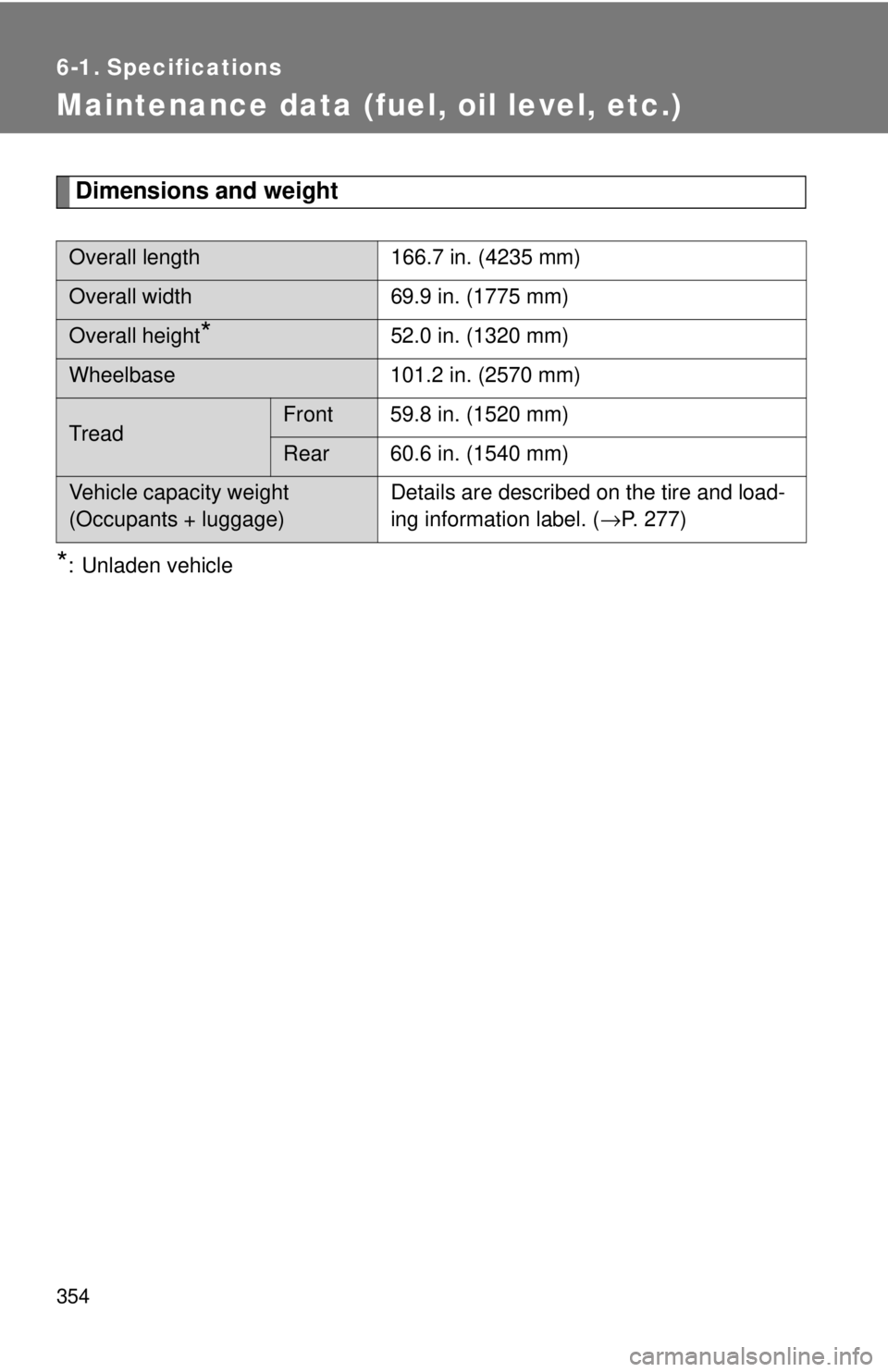
Maintenance data (fuel, oil level, etc.) Dimensions and weight
* : Unladen vehicle Overall length 166.7 in. (4235 mm)
Overall width 69.9 in. (1775 mm)
Overall height
* 52.0 in. (1320 mm)
Wheelbase 101.2 in. (2570 mm)
Tread Front 59.8 in. (1520 mm)
Rear 60.6 in. (1540 mm)
Vehicle capacity weight
(Occupants + luggage) Details are described on the tire and load-
ing information label. ( → P. 277)
Page 357 of 428
3576-1. Specifications
6
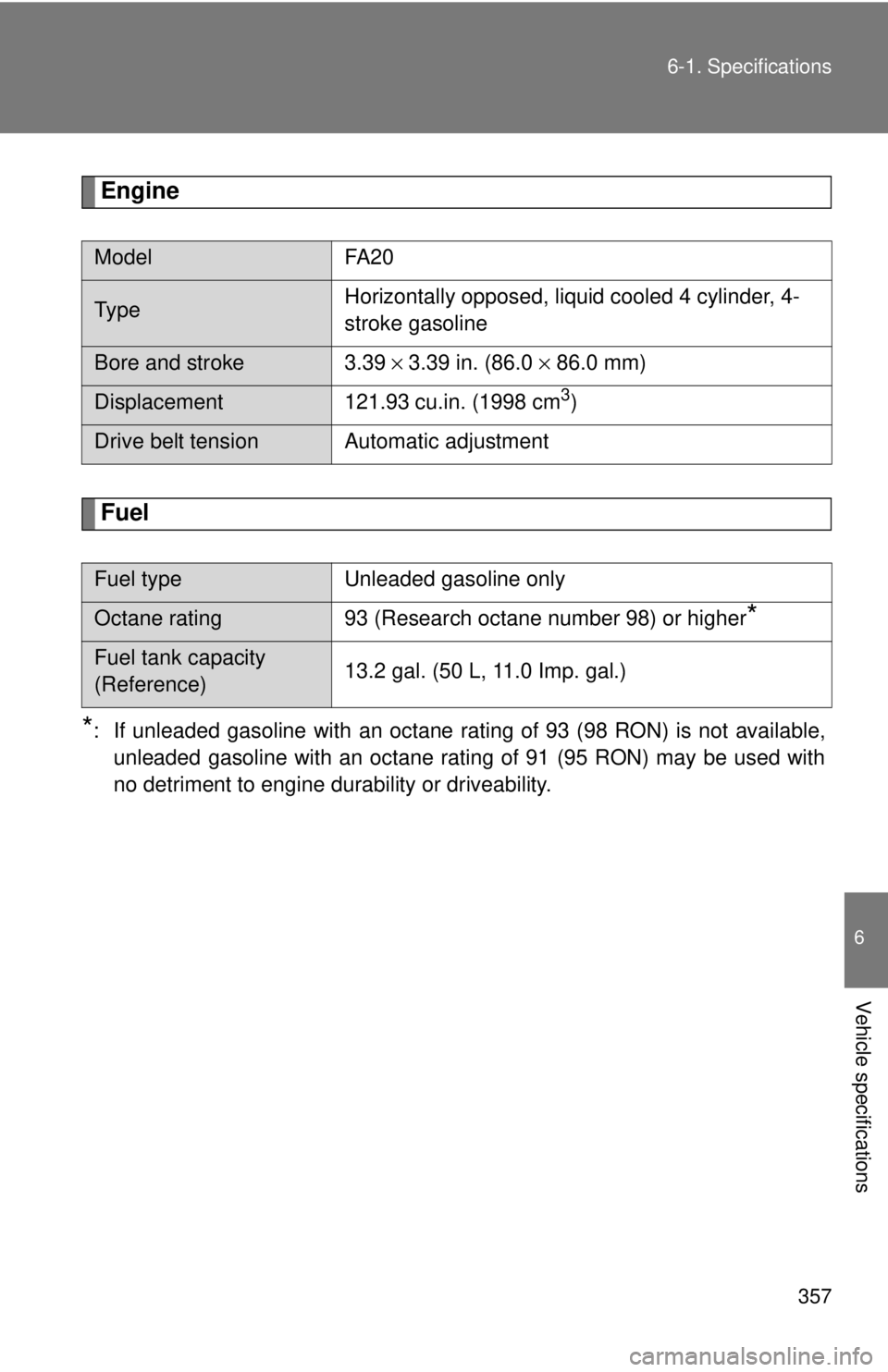
Vehicle specifications Engine
Fuel
* : If unleaded gasoline with an octane rating of 93 (98 RON) is not available,
unleaded gasoline with an octane rating of 91 (95 RON) may be used with
no detriment to engine durability or driveability.Model FA20
Ty p e Horizontally opposed, liquid cooled 4 cylinder, 4-
stroke gasoline
Bore and stroke 3.39 × 3.39 in. (86.0 × 86.0 mm)
Displacement 121.93 cu.in. (1998 cm 3
)
Drive belt tension Automatic adjustment
Fuel type Unleaded gasoline only
Octane rating 93 (Research octane number 98) or higher
*Fuel tank capacity
(Reference) 13.2 gal. (50 L, 11.0 Imp. gal.)
Page 358 of 428
3586-1. Specifications
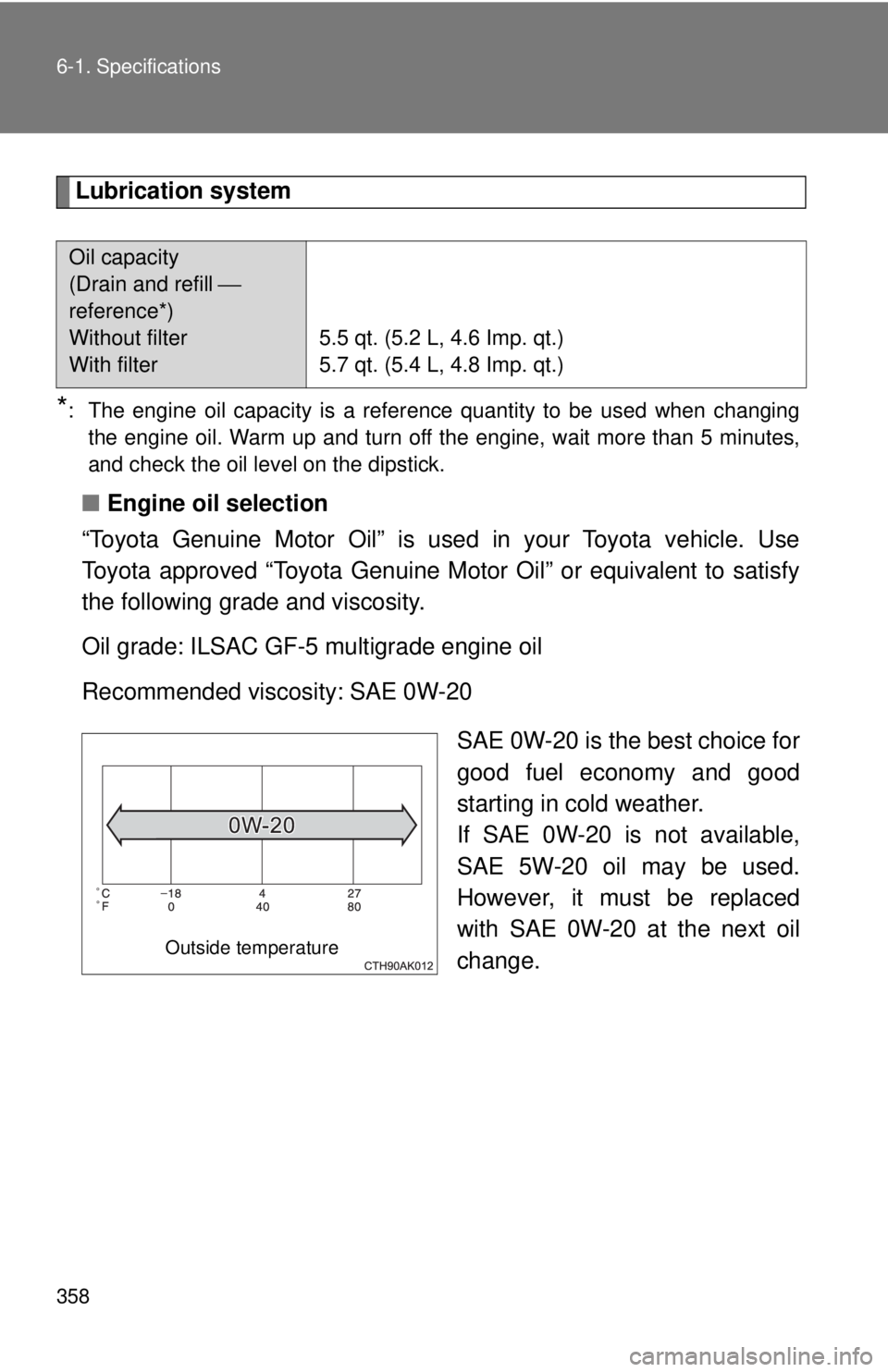
Lubrication system
* : The engine oil capacity is a reference quantity to be used when changing
the engine oil. Warm up and turn off the engine, wait more than 5 minutes,
and check the oil level on the dipstick.
■ Engine oil selection
“Toyota Genuine Motor Oil” is used in your Toyota vehicle. Use
Toyota approved “Toyota Genuine Motor Oil” or equivalent to satisfy
the following grade and viscosity.
Oil grade: ILSAC GF-5 multigrade engine oil
Recommended viscosity: SAE 0W-20
SAE 0W-20 is the best choice for
good fuel economy and good
starting in cold weather.
If SAE 0W-20 is not available,
SAE 5W-20 oil may be used.
However, it must be replaced
with SAE 0W-20 at the next oil
change.Oil capacity
(Drain and refill ⎯
reference*)
Without filter
With filter 5.5 qt. (5.2 L, 4.6 Imp. qt.)
5.7 qt. (5.4 L, 4.8 Imp. qt.)
Outside temperature
Page 361 of 428
3616-1. Specifications
6
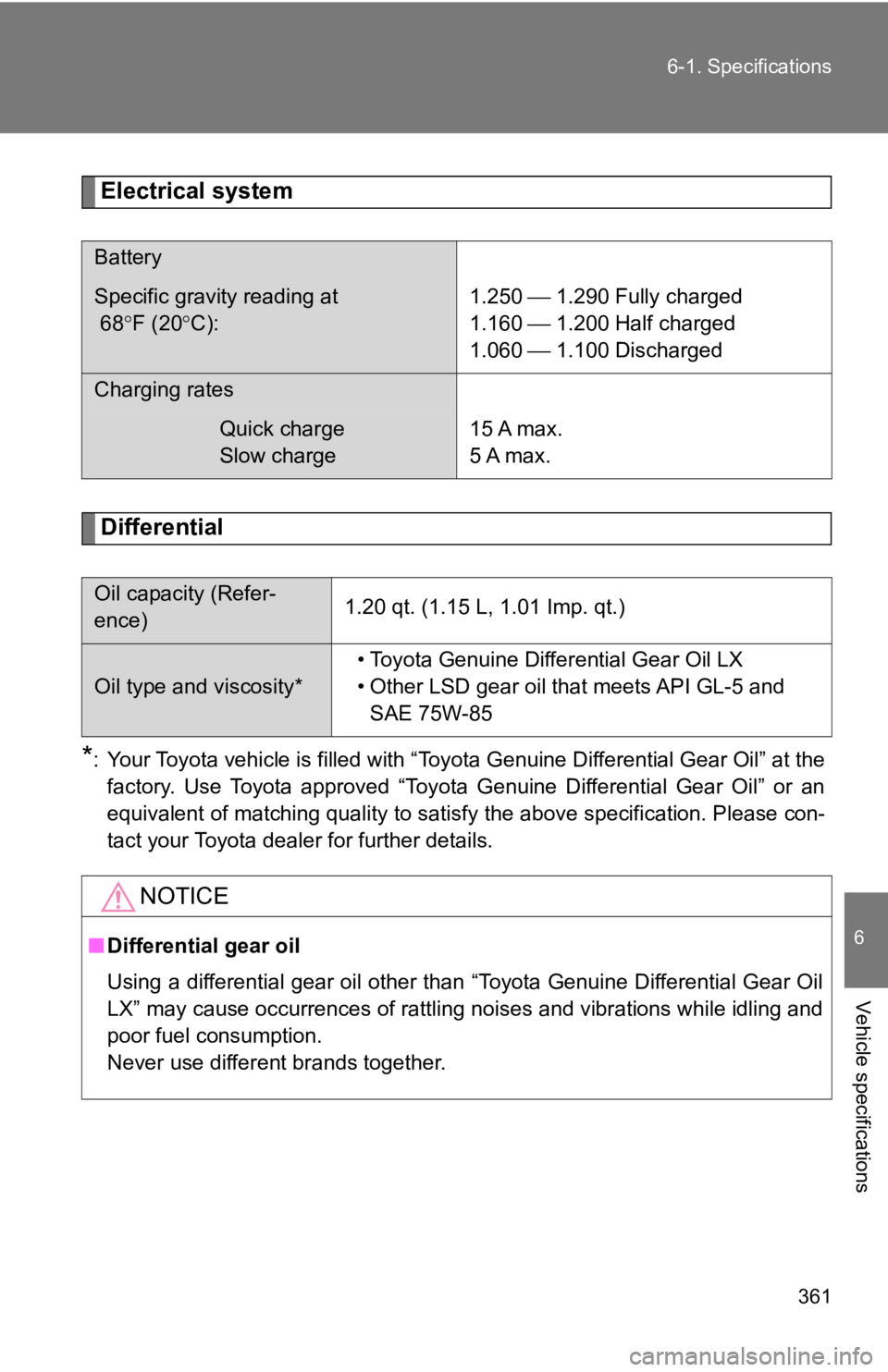
Vehicle specifications Electrical system
Differential
* : Your Toyota vehicle is filled with “Toyota Genuine Differential Gear Oil” at the
factory. Use Toyota approved “Toyota Genuine Differential Gear Oil” or an
equivalent of matching quality to satisfy the above specification. Please con-
tact your Toyota dealer for further details.Battery
Specific gravity reading at
68 ° F (20 ° C): 1.250 ⎯ 1.290 Fully charged
1.160 ⎯ 1.200 Half charged
1.060 ⎯ 1.100 Discharged
Charging rates
Quick charge
Slow charge 15 A max.
5 A max.
Oil capacity (Refer-
ence) 1.20 qt. (1.15 L, 1.01 Imp. qt.)
Oil type and viscosity* • Toyota Genuine Differential Gear Oil LX
• Other LSD gear oil that meets API GL-5 and
SAE 75W-85
NOTICE
■ Differential gear oil
Using a differential gear oil other than “Toyota Genuine Differential Gear Oil
LX” may cause occurrences of rattling noises and vibrations while idling and
poor fuel consumption.
Never use different brands together.
Page 362 of 428
3626-1. Specifications
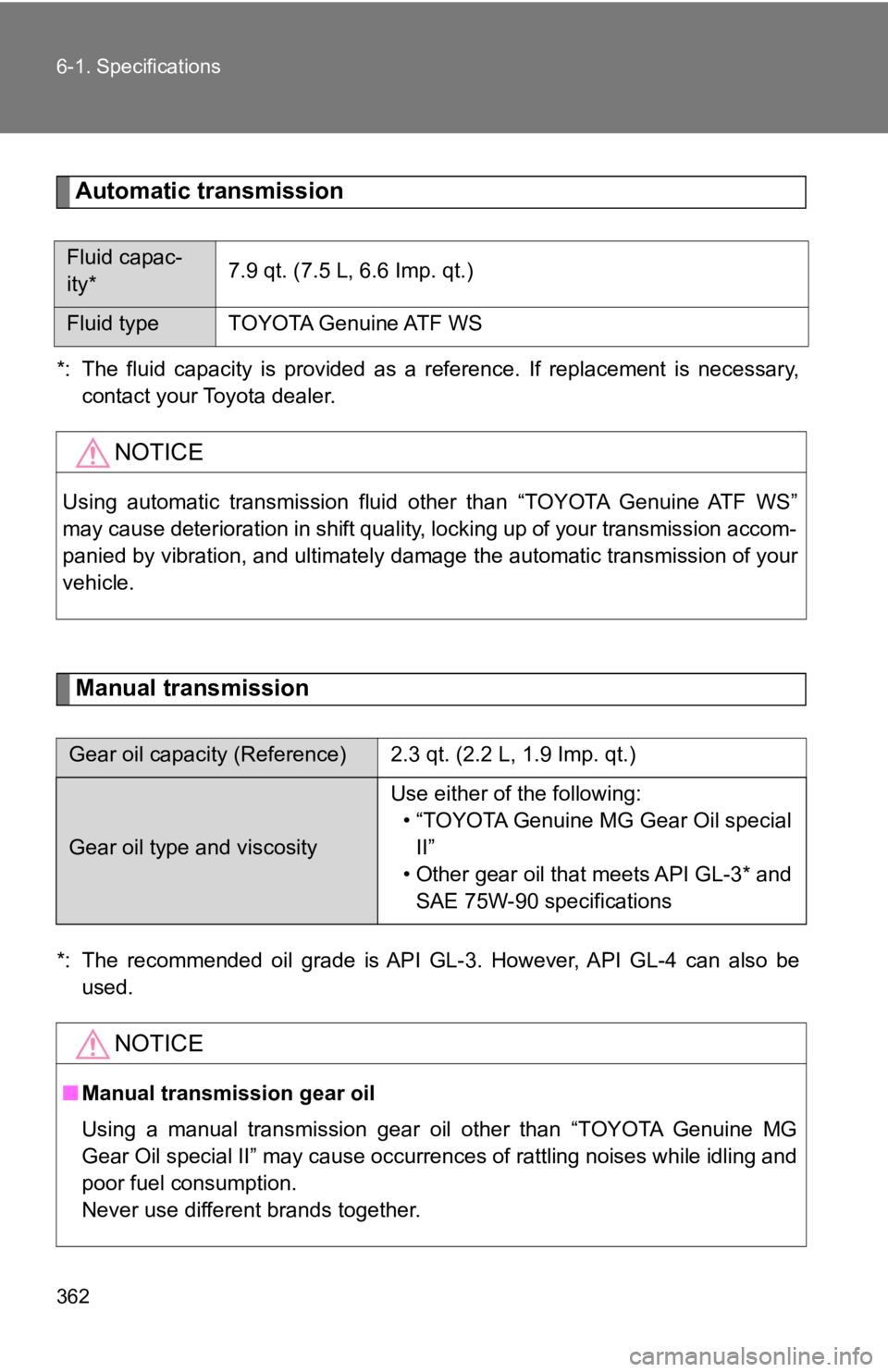
Automatic transmission
*: The fluid capacity is provided as a reference. If replacement is necessary,
contact your Toyota dealer.
Manual transmission
*: The recommended oil grade is API GL-3. However, API GL-4 can also be
used.Fluid capac-
ity* 7.9 qt. (7.5 L, 6.6 Imp. qt.)
Fluid type TOYOTA Genuine ATF WS
NOTICEUsing automatic transmission fluid other than “TOYOTA Genuine ATF WS”
may cause deterioration in shift quality, locking up of your transmission accom-
panied by vibration, and ultimately damage the automatic transmission of your
vehicle.
Gear oil capacity (Reference) 2.3 qt. (2.2 L, 1.9 Imp. qt.)
Gear oil type and viscosity Use either of the following:
• “TOYOTA Genuine MG Gear Oil special
II”
• Other gear oil that meets API GL-3* and
SAE 75W-90 specifications
NOTICE
■ Manual transmission gear oil
Using a manual transmission gear oil other than “TOYOTA Genuine MG
Gear Oil special II” may cause occurrences of rattling noises while idling and
poor fuel consumption.
Never use different brands together.
Page 366 of 428
3666-1. Specifications
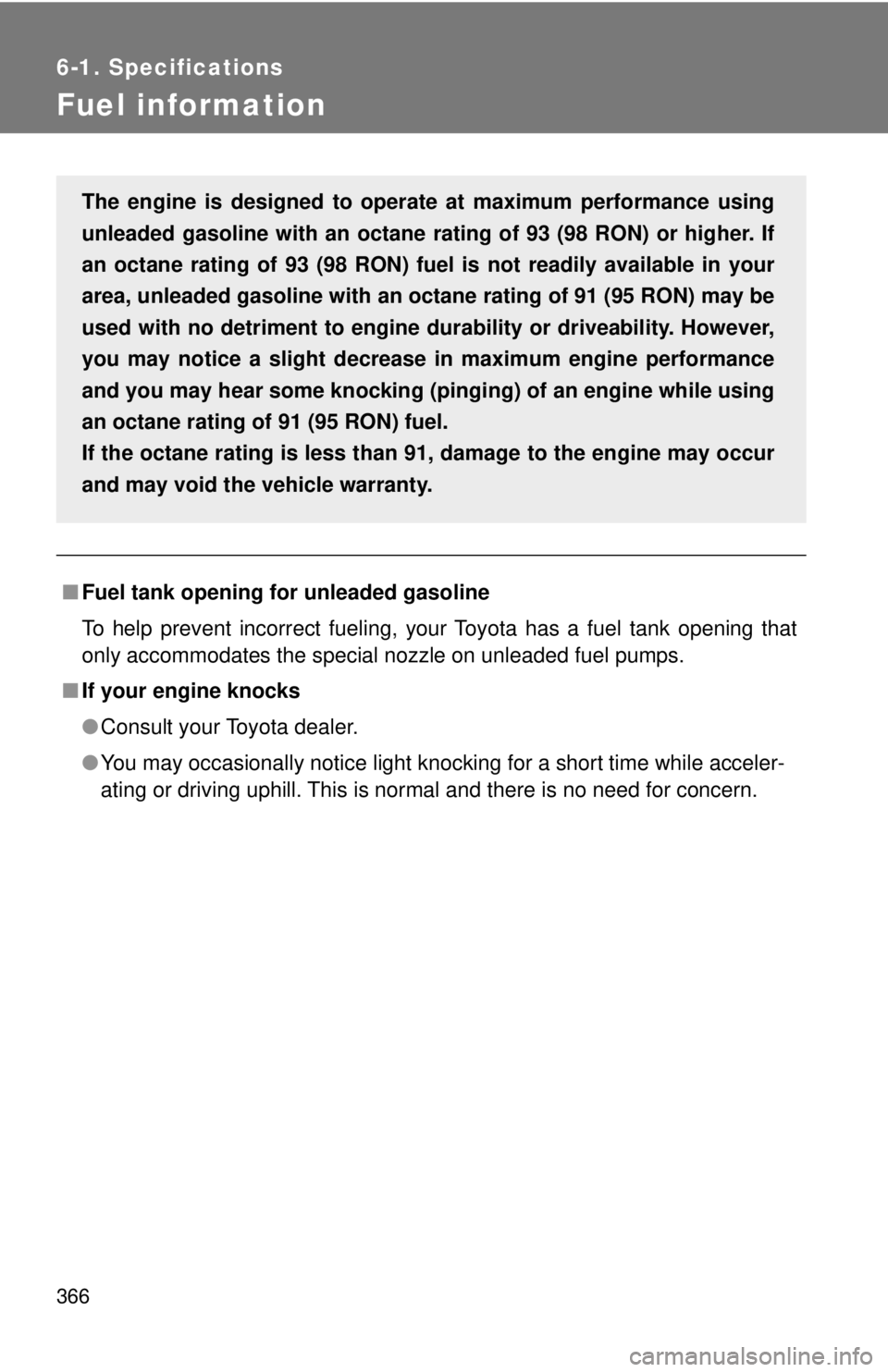
Fuel information
■ Fuel tank opening for unleaded gasoline
To help prevent incorrect fueling, your Toyota has a fuel tank opening that
only accommodates the special nozzle on unleaded fuel pumps.
■ If your engine knocks
● Consult your Toyota dealer.
● You may occasionally notice light knocking for a short time while acceler-
ating or driving uphill. This is normal and there is no need for concern.The engine is designed to operate at maximum performance using
unleaded gasoline with an octane ra ting of 93 (98 RON) or higher. If
an octane rating of 93 (98 RON) fuel is not readily available in your
area, unleaded gasoline with an octane rating of 91 (95 RON) may be
used with no detriment to engine dur ability or driveability. However,
you may notice a slight decrease in maximum engine performance
and you may hear some knocking (pin ging) of an engine while using
an octane rating of 91 (95 RON) fuel.
If the octane rating is less than 91, damage to the engine may occur
and may void the vehicle warranty.