brake TOYOTA 86 2017 Workshop Manual
[x] Cancel search | Manufacturer: TOYOTA, Model Year: 2017, Model line: 86, Model: TOYOTA 86 2017Pages: 428, PDF Size: 5.25 MB
Page 315 of 428
5
When trouble arises
3155-1. Essential information
If you think something is wrong If you notice any of the followin g symptoms, your vehicle probably
needs adjustment or repair. Contact your Toyota dealer as soon as
possible.
■ Visible symptoms
● Fluid leaks under the vehicle
(Water dripping from the air cond itioning after use is normal.)
● Flat-looking tires or uneven tire wear
● The engine coolant temperature gauge needle continually
points higher than normal
■ Audible symptoms
● Changes in exhaust sound
● Excessive tire squeal when cornering
● Strange noises related to the suspension system
● Pinging or other noises related to the engine
■ Operational symptoms
● Engine missing, stumbling or running rough
● Appreciable loss of power
● Vehicle pulls heavily to one side when braking
● Vehicle pulls heavily to one side when driving on a level road
● Loss of brake effectiveness, s pongy feeling, pedal almost
touches the floor
Page 317 of 428

5
When trouble arises
3175-2. Steps to take in an emergency
If a warning light turns on or a warning buzzer sounds... Stop the vehicle immediately. Continuing to drive the vehicle
may be dangerous.
The following warning indicates a possible problem in the brake sys-
tem. Immediately stop the vehicl e in a safe place and contact your
Toyota dealer.
Stop the vehicle immediately.
The following warning indicates the possibility of damage to the vehi-
cle that may lead to an accident. Immediately stop the vehicle in a
safe place and contact your Toyota dealer. Warning light Warning light/Details
(U.S.A.)
(Canada) Brake system warning light
• Low brake fluid
• Malfunction in the brake system
This light also comes on when the parking brake is not
released. If the light turns off after the parking brake is fully
released the system is operating normally.
Warning light Warning light/Details
Charging system warning light
Indicates a malfunction in the vehicle’s charging system.
Low engine oil pressure warning light
Indicates that the engine oil pressure is too low.Calmly perform the following actions if any of the warning lights turn
on or flash. If a light turns on or flashes, but then tu rns off, this does
not necessarily indicate a malfunction in the system.
Page 318 of 428
3185-2. Steps to take in an emergency
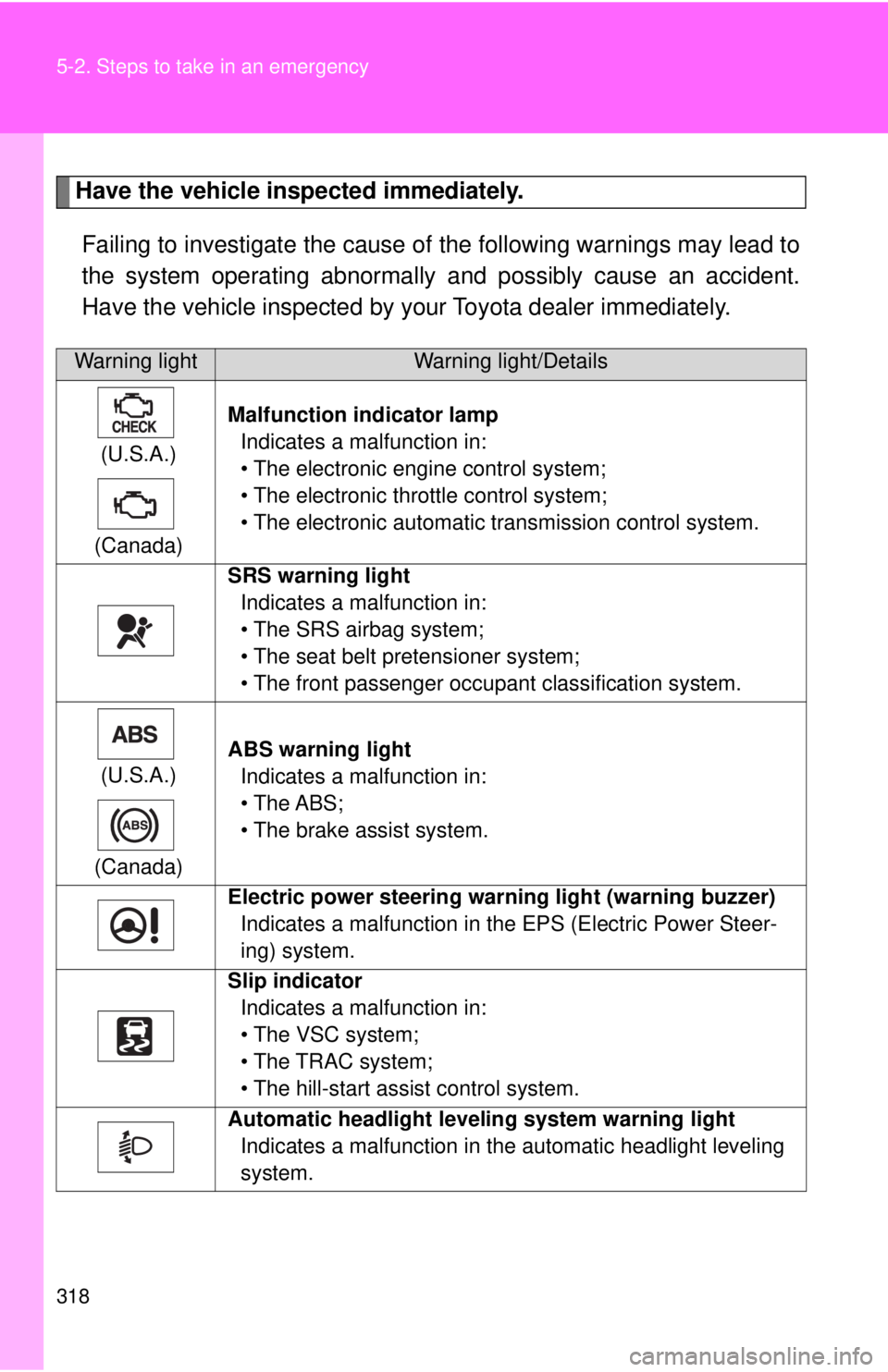
Have the vehicle inspected immediately.
Failing to investigate the cause of the following warnings may lead to
the system operating abnormally and possibly cause an accident.
Have the vehicle inspected by your Toyota dealer immediately. Warning light Warning light/Details
(U.S.A.)
(Canada) Malfunction indicator lamp
Indicates a malfunction in:
• The electronic engine control system;
• The electronic throttle control system;
• The electronic automatic transmission control system.
SRS warning light
Indicates a malfunction in:
• The SRS airbag system;
• The seat belt pretensioner system;
• The front passenger occupant classification system.
(U.S.A.)
(Canada) ABS warning light
Indicates a malfunction in:
• The ABS;
• The brake assist system.
Electric power steering warning light (warning buzzer)
Indicates a malfunction in the EPS (Electric Power Steer-
ing) system.
Slip indicator
Indicates a malfunction in:
• The VSC system;
• The TRAC system;
• The hill-start assist control system.
Automatic headlight level ing system warning light
Indicates a malfunction in the automatic headlight leveling
system.
Page 324 of 428

3245-2. Steps to take in an emergency
WARNING■
If the tire pressure warning light comes on
Be sure to observe the following precautions. Failure to do so could
cause loss of vehicle control and result in death or serious injury. ●
Stop your vehicle in a safe place as soon as possible. Adjust the tire
inflation pressure immediately.●
If the tire pressure warning light comes on even after tire inflation pres-
sure adjustment, it is pr obable that you have a flat tire. Check the tires.
If the tire is flat, change to the spar e tire and have the flat tire repaired
by the nearest Toyota dealer.●
Avoid abrupt maneuvering and braking. If the vehicle tires deteriorate,
you could lose control of the steering wheel or the brakes.■
If a blowout or sudden air leakage should occur
The tire pressure warning syste m may not activate immediately.
Page 327 of 428
5
When trouble arises
3275-2. Steps to take in an emergency
If you have a flat tire Your vehicle is equipped with a spare tire. The flat tire can be
replaced with the spare tire.
■ Before jacking up the vehicle
● Stop the vehicle in a safe place on a hard, flat surface.
● Set the parking brake.
● Shift the shift lever to P (vehic les with an automatic transmis-
sion) or R (vehicles with a manual transmission).
● Stop the engine.
● Turn on the emergency flashers. ( → P. 306)
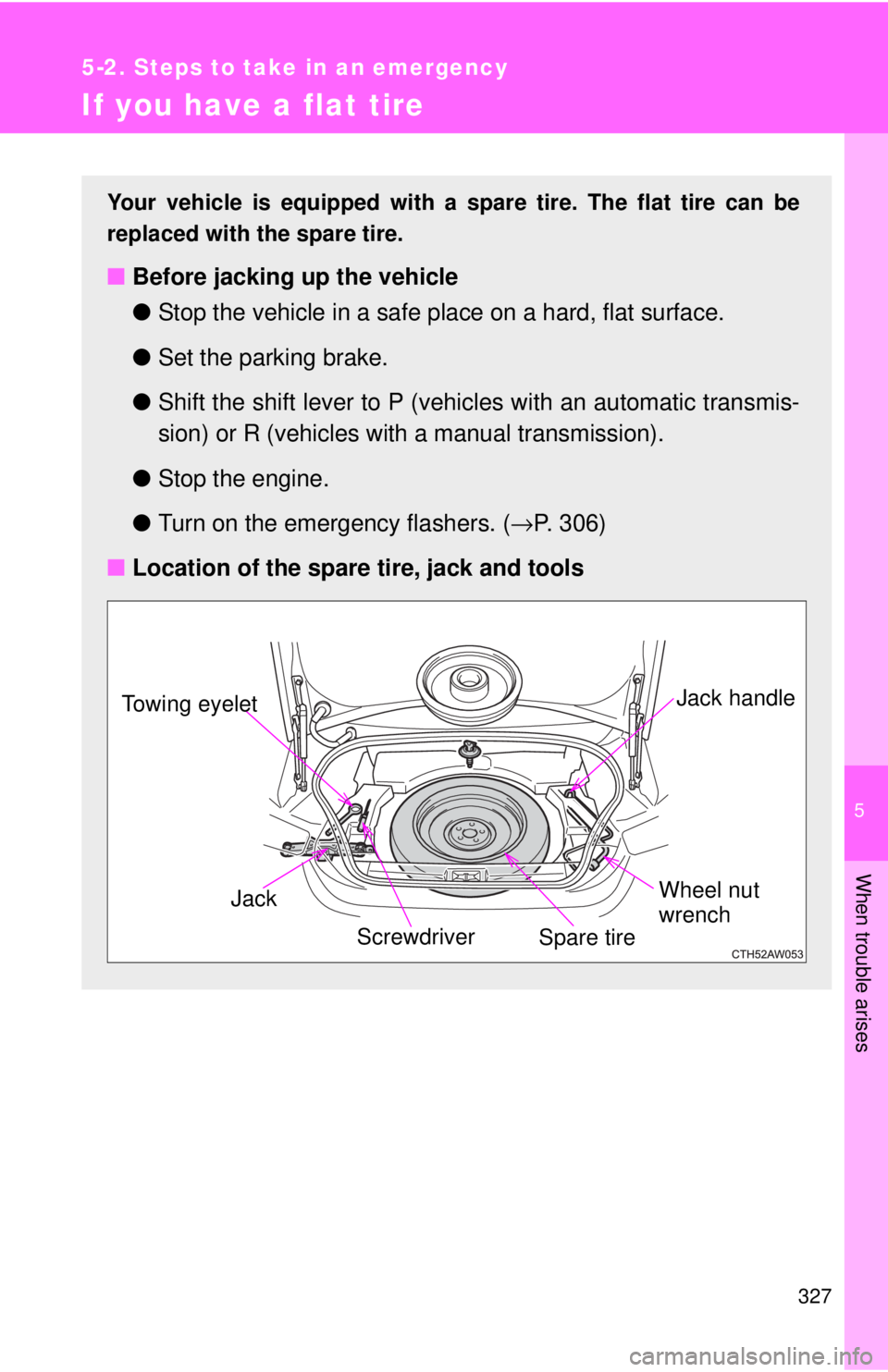
■ Location of the spare tire, jack and tools
Jack Jack handle
Spare tireTowing eyelet
Screwdriver Wheel nut
wrench
Page 335 of 428

5
When trouble arises
3355-2. Steps to take in an emergency
WARNING■
Replacing a flat tire ●
Do not touch the disc wheels or the area around the brakes immedi-
ately after the vehicle has been driven.
After the vehicle has been driven the disc wheels and the area around
the brakes will be extremely hot. To uching these areas with hands, feet
or other body parts while changing a tire, etc. may result in burns.●
Do not attach a heavily damaged wheel ornament, as it may fly off the
wheel while the ve hicle is moving.●
Failure to follow thes e precautions could ca use the wheel nuts to
loosen and the tire to fall off, resulting in death or serious injury.
• Have the wheel nuts tightened with a torque wrench to 89 ft•lbf (120
N•m, 12.2 kgf•m) as soon as po ssible after changing wheels.
• When installing a tire, only use wheel nuts that have been specifi-
cally designed for that wheel.
• If there are any cracks or deformations in the bolt screws, nut
threads or bolt holes of the wh eel, have the vehicle inspected by
your Toyota dealer.
• When installing the wheel nuts, be sure to insta ll them with the
tapered ends facing inward. ( → P. 282)
Page 336 of 428
3365-2. Steps to take in an emergency
WARNING■
When using the compact spare tire ●
Remember that your compact spare tire is specifically designed for
use with your vehicle. Do not use your compact spare tire on another
vehicle.●
Do not use two compact spare tires simultaneously.●
Replace the compact spare tire with a standard tire as soon as possi-
ble.●
Avoid sudden acceleration, abrupt steering, sudden braking and shift-
ing operations that cause sudden engine braking.●
Install the compact spare tire on a front wheel. ■
When storing the compact spare tire
Be careful not to catch fingers or other body parts between the compact
spare tire and the body of the vehicle.
■
Speed limit when using the compact spare tire
Do not drive at speeds in excess of 50 mph (80 km/h) when a compact
spare tire is installed on the vehicle.
The compact spare tire is not designed for drivin g at high speeds. Failing
to observe this precaution may lead to an accident causing death or seri-
ous injury.
■
When the spare tire is attached
The vehicle speed may not be correctly detected, and the following sys-
tems may not operate correctly:
●
ABS & brake assist
●
VSC
●
TRAC
●
EPS
●
Cruise control
●
LSD
Page 339 of 428
5
When trouble arises
3395-2. Steps to take in an emergency
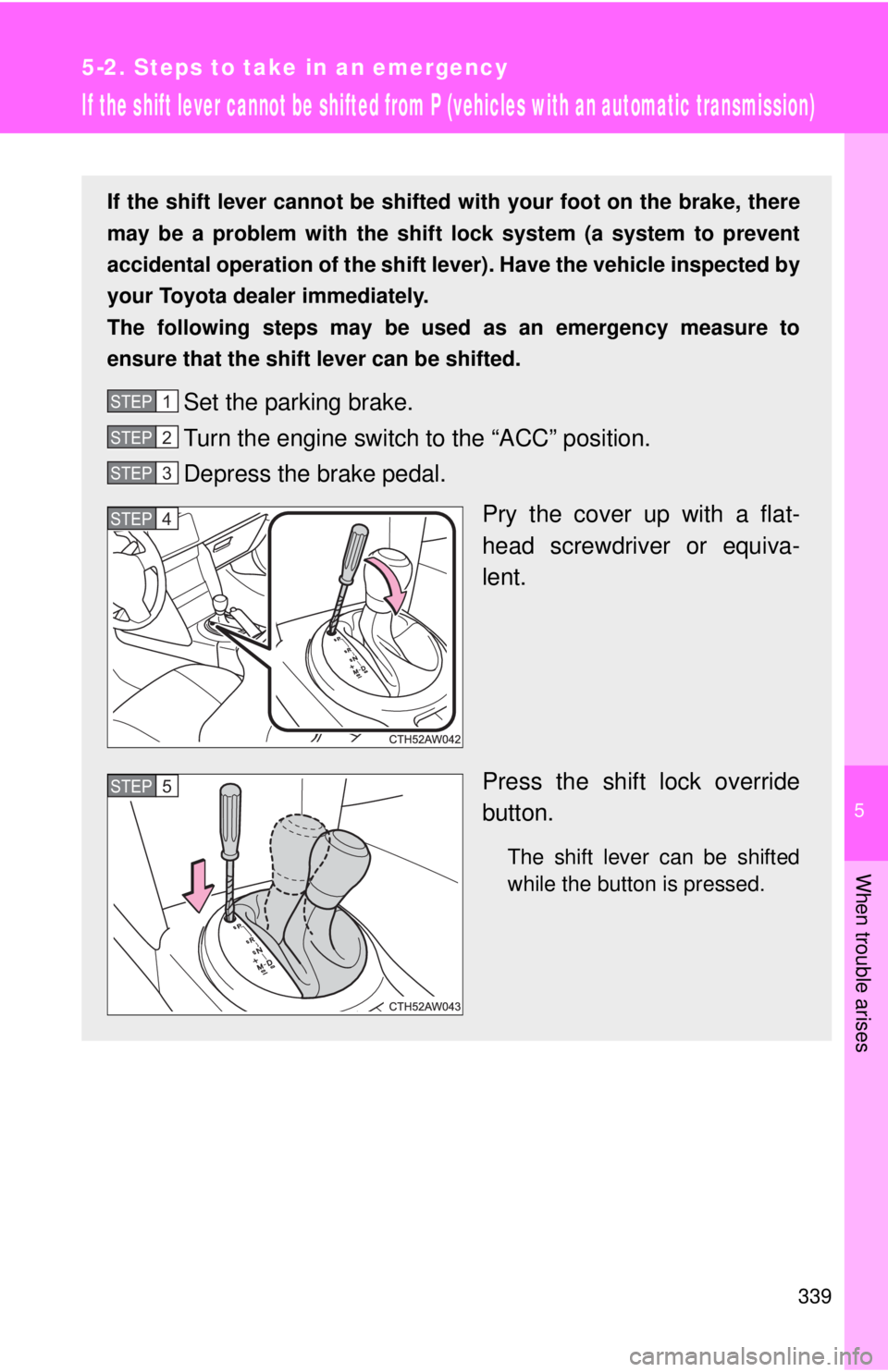
If the shift lever cannot be shifted from P (vehicles with an automatic transmission)If the shift lever cannot be shifted with your foot on the brake, there
may be a problem with the shift lock system (a system to prevent
accidental operation of the shift l ever). Have the vehicle inspected by
your Toyota dealer immediately.
The following steps may be used as an emergency measure to
ensure that the shift lever can be shifted.
Set the parking brake.
Turn the engine switch to the “ACC” position.
Depress the brake pedal.
Pry the cover up with a flat-
head screwdriver or equiva-
lent.
Press the shift lock override
button. The shift lever can be shifted
while the button is pressed.STEP 1
STEP 2
STEP 3
STEP 4
STEP 5
Page 348 of 428
3485-2. Steps to take in an emergency
If the vehicle becomes stuck
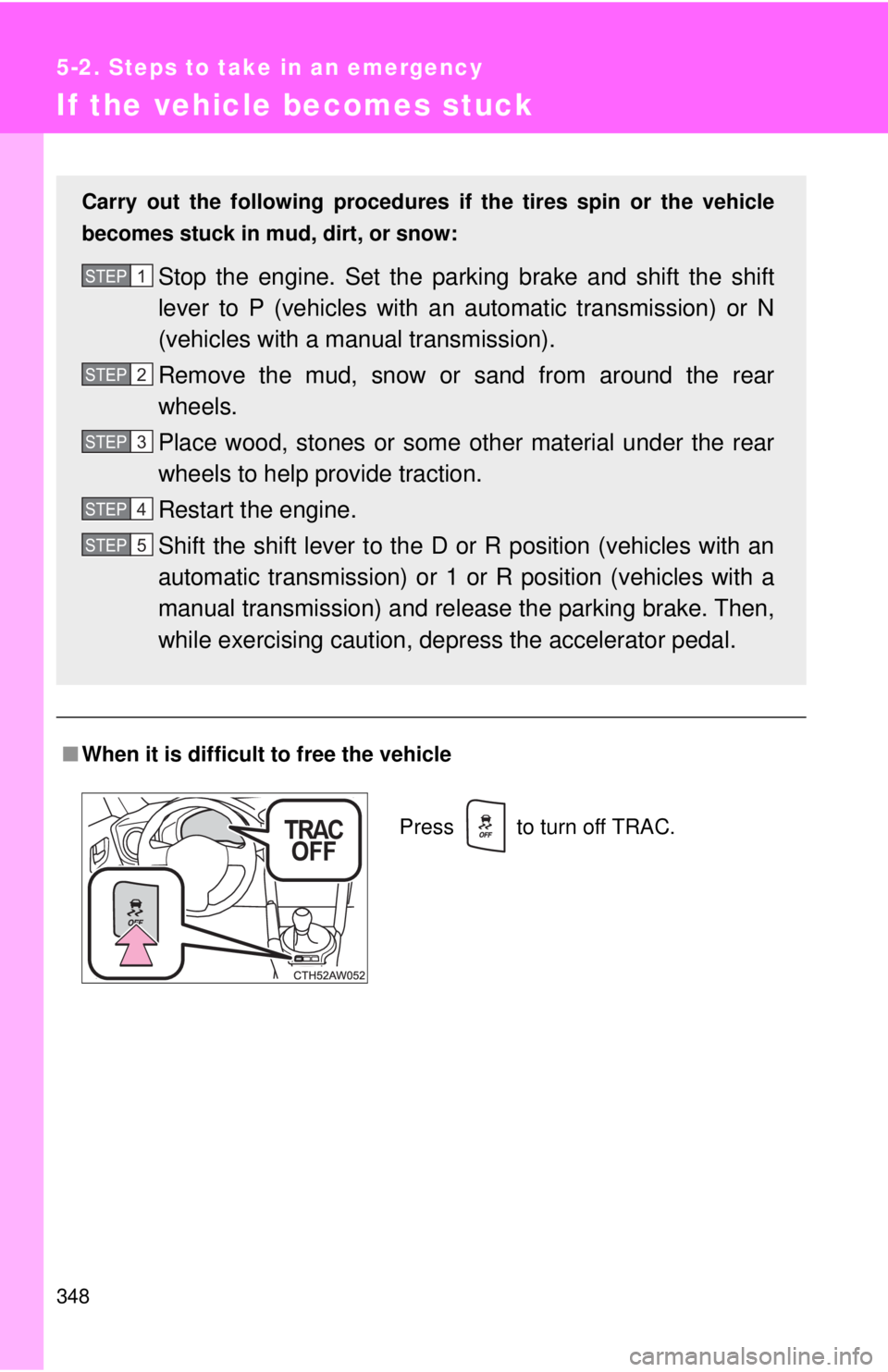
■ When it is difficult to free the vehicleCarry out the following procedures if the tires spin or the vehicle
becomes stuck in mud, dirt, or snow:
Stop the engine. Set the park ing brake and shift the shift
lever to P (vehicles with an automatic transmission) or N
(vehicles with a manual transmission).
Remove the mud, snow or sand from around the rear
wheels.
Place wood, stones or some other material under the rear
wheels to help provide traction.
Restart the engine.
Shift the shift lever to the D or R position (vehicles with an
automatic transmission) or 1 or R position (vehicles with a
manual transmission) and release the parking brake. Then,
while exercising caution, depress the accelerator pedal.STEP 1
STEP 2
STEP 3
STEP 4
STEP 5
Press to turn off TRAC.
Page 350 of 428
3505-2. Steps to take in an emergency
If your vehicle has to be stopped in an emergencyOnly in an emergency, such as if it becomes impossible to stop the
vehicle in the normal way, stop the vehicle using the following pro-
cedure:
Steadily step on the brake pedal with both feet and firmly
depress it. Do not pump the brake pedal repeatedly as this will increase the
effort required to slow the vehicle.
Shift the shift lever to N.
If the shift lever is shifted to N
After slowing down, stop the vehicle in a safe place by the
road.
Stop the engine.
If the shift lever cannot be shifted to N
Keep depressing the brake pedal with both feet to reduce
vehicle speed as much as possible.
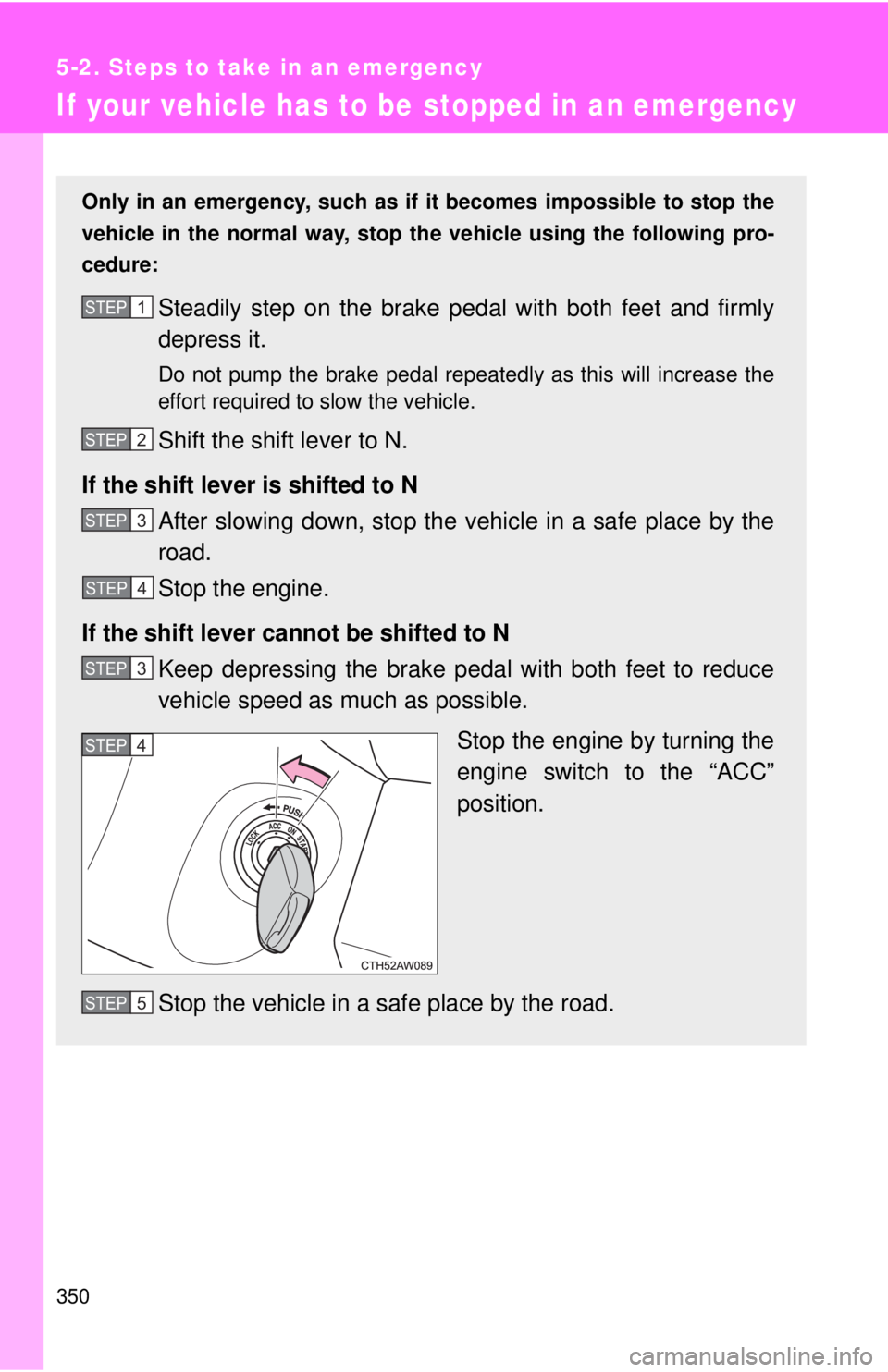
Stop the engine by turning the
engine switch to the “ACC”
position.
Stop the vehicle in a safe place by the road.STEP 1
STEP 2
STEP 3
STEP 4
STEP 3
STEP 4
STEP 5