XLE TOYOTA AVALON 2021 Owners Manual (in English)
[x] Cancel search | Manufacturer: TOYOTA, Model Year: 2021, Model line: AVALON, Model: TOYOTA AVALON 2021Pages: 548, PDF Size: 13.4 MB
Page 177 of 548

1774-1. Before driving
4
Driving
NOTICE
■When driving the vehicle
●Do not depress the accelerator and brake pedals at the same time during
driving, as this may restrain the engine output.
●Do not use the accelerator pedal or depress the accelerator and brake
pedals at the same time to hold the vehicle on a hill.
■When parking the vehicle
Always set the parking brake and shift the shift lever to P. Failure to do so
may cause the vehicle to move or the vehicle may accelerate suddenly if
the accelerator pedal is accidentally depressed.
■Avoiding damage to vehicle parts
●Do not turn the steering wheel fully in either direction and hold it there for
an extended period of time.
Doing so may damage the power steering motor.
●When driving over bumps in the road, drive as slowly as possible to avoid
damaging the wheels, underside of the vehicle, etc.
■If you get a flat tire while driving
A flat or damaged tire may cause the following situations. Hold the steering
wheel firmly and gradually depress the brake pedal to slow down the vehi-
cle.
●It may be difficult to control your vehicle.
●The vehicle will make abnormal sounds or vibrations.
●The vehicle will lean abnormally.
Information on what to do in case of a flat tire (P. 449)
■When encountering flooded roads
Do not drive on a road that has flooded after heavy rain etc. Doing so may
cause the following serious damage to the vehicle:
●Engine stalling
●Short in electrical components
●Engine damage caused by water immersion
In the event that you drive on a flooded road and the vehicle is flooded, be
sure to have your Toyota dealer check the following:
●Brake function
●Changes in quantity and quality of oil and fluid used for the engine, tran-
saxle, transfer (AWD models), rear differential (AWD models), etc.
●Lubricant condition for the propeller shaft (AWD models), bearings and
suspension joints (where possible), and the function of all joints, bearings,
etc.
Page 180 of 548

1804-1. Before driving
WARNING
■Things that must not be carried in the trunk
<0037004b0048000300490052004f004f0052005a004c0051004a00030057004b004c0051004a0056000300500044005c0003004600440058005600480003004400030049004c005500480003004c00490003004f005200440047004800470003004c005100
030057004b004800030057005500580051004e001d[
●Receptacles containing gasoline
●Aerosol cans
■Storage precautions
Observe the following precautions.
Failure to do so may prevent the pedals from being depressed properly,
may block the driver’s vision, or may result in items hitting the driver or pas-
sengers, possibly causing an accident.
●Stow cargo and luggage in the trunk whenever possible.
●To prevent cargo and luggage from sliding forward during braking, do not
stack anything in the enlarged trunk. Keep cargo and luggage low, a s
close to the floor as possible.
●Do not place cargo or luggage in or on the following locations.
• At the feet of the driver
• On the front passenger or rear seats (when stacking items)
• On the package tray
• On the instrument panel
• On the dashboard
• Tray that has no lid
●Secure all items in the occupant compartment.
●When you fold down the rear seats, long items should not be placed
directly behind the front seats.
●Never allow anyone to ride in the enlarged trunk. It is not designed for pas-
sengers. They should ride in their seats with their seat belts properly fas-
tened.
■Capacity and distribution
●Do not exceed the maximum axle weight rating or the total vehicle weight
rating.
●Even if the total load of occupant’s weight and the cargo load is less than
the total load capacity, do not apply the load unevenly. Improper loading
may cause deterioration of steering or braking control which may cause
death or serious injury.
Page 399 of 548

3996-3. Do-it-yourself maintenance
6
Maintenance and care
■When to replace your vehicle’s tires
Tires should be replaced if:
●The treadwear indicators are showing on a tire.
●You have tire damage such as cuts, splits, cracks deep enough to
expose the fabric, and bulges indicating internal damage
●A tire goes flat repeatedly or cannot be properly repaired due to the size
or location of a cut or other damage
If you are not sure, consult with your Toyota dealer.
■Replacing tires and wheels
If the ID codes of the tire pressure warning valve and transmitters are not
registered, the tire pressure warning system will not work properly. In this
case, after driving for about 20 minutes, the tire pressure warning light will
blink for approximately 1 minute and then illuminate to indicate a system
malfunction.
■Tire life
Any tire over 6 years old must be checked by a qualified technician even
if it has seldom or never been used or damage is not obvious.
■Routine tire inflation pressure checks
The tire pressure warning system does not replace routine tire inflation
pressure checks. Make sure to check tire inflation pressure as part of
your routine of daily vehicle checks.
■Low profile tires (vehicles with 18 or 19-inch wheels)
Generally, low profile tires will wear more rapidly and tire grip perfor-
mance will be reduced on snowy and/or icy roads when compared to
standard tires. Be sure to use snow tires on snowy and/or icy roads and
drive carefully at a speed appropriate for road and weather conditions.
■Maximum load of tire
Check that the maximum load of the replacement tire is greater than 1/2
of the Gross Axle Weight Ratings (GAWR) of either the front axle or the
rear axle, whichever is greater.
For the GAWR, see the Certification
Label. For the maximum load of the tire,
see the load limit at maximum cold tire
inflation pressure mentioned on the
sidewall of the tire. (P. 4 9 2 )
Page 427 of 548
427
7
When trouble arises
7-2. Steps to take in an emergency
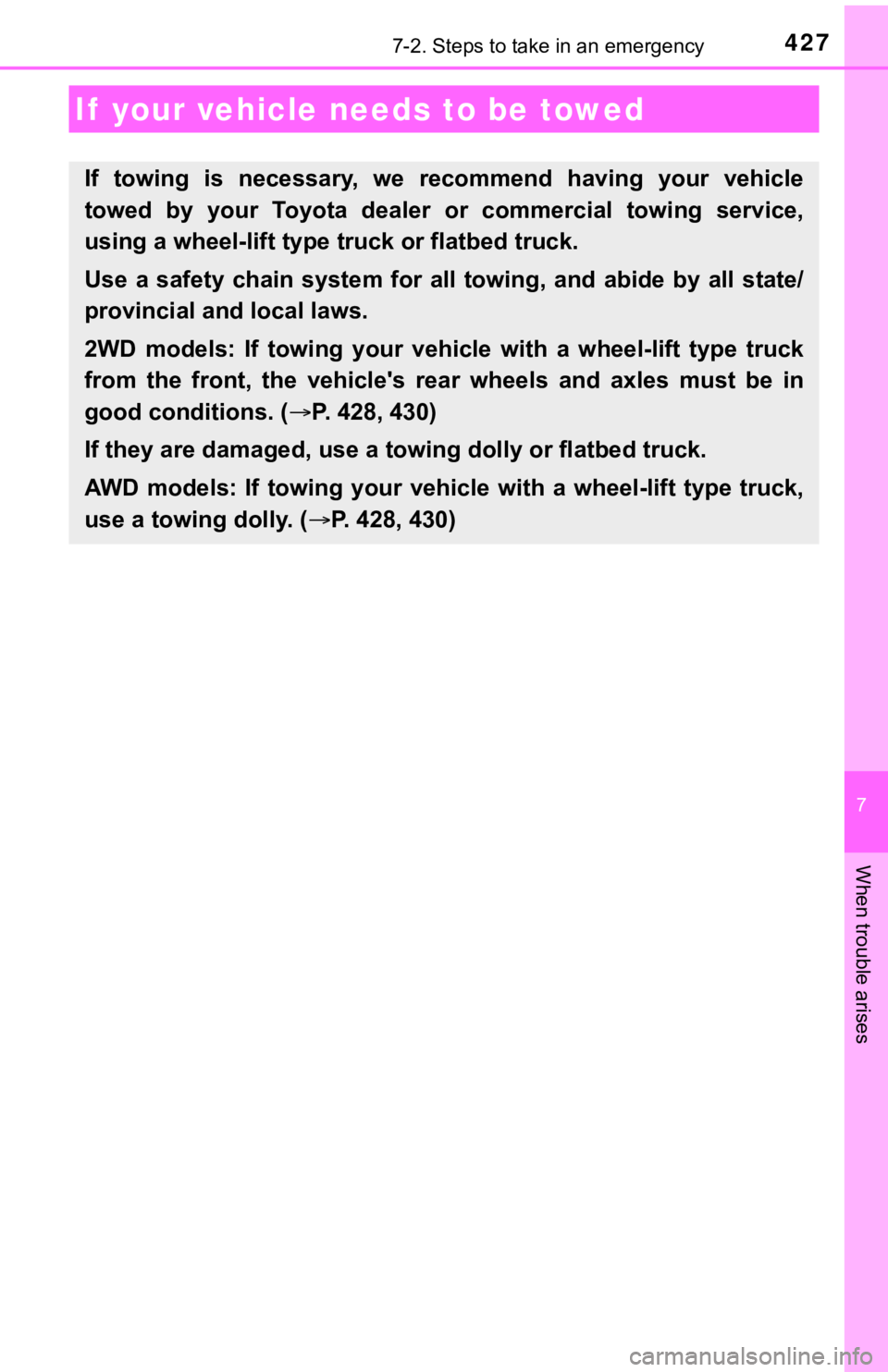
If your vehicle needs to be towed
If towing is necessary, we recommend having your vehicle
towed by your Toyota dealer or commercial towing service,
using a wheel-lift type truck or flatbed truck.
Use a safety chain system for all towing, and abide by all state/
provincial and local laws.
2WD models: If towing your vehicle with a wheel-lift type truck
from the front, the vehicle's rear wheels and axles must be in
good conditions. (P. 428, 430)
If they are damaged, use a towing dolly or flatbed truck.
AWD models: If towing your vehicle with a wheel-lift type truck,
use a towing dolly. (P. 428, 430)
Page 484 of 548
4848-1. Specifications
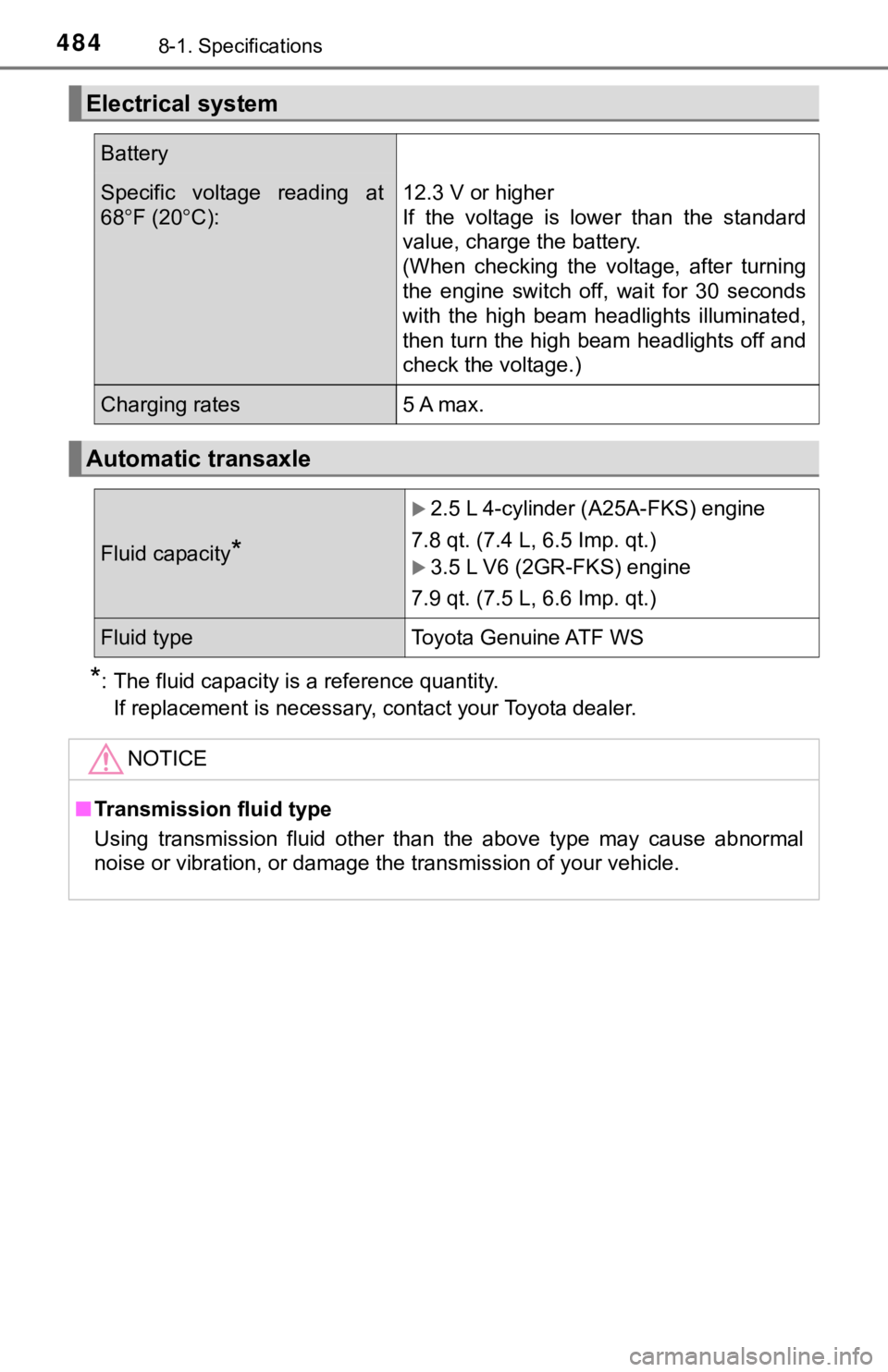
*: The fluid capacity is a reference quantity.
If replacement is necessary, contact your Toyota dealer.
Electrical system
Battery
Specific voltage reading at
68F (20C):12.3 V or higher
If the voltage is lower than the standard
value, charge the battery.
(When checking the voltage, after turning
the engine switch off, wait for 30 seconds
with the high beam headlights illuminated,
then turn the high beam headlights off and
check the voltage.)
Charging rates5 A max.
Automatic transaxle
Fluid capacity*
2.5 L 4-cylinder (A25A-FKS) engine
7.8 qt. (7.4 L, 6.5 Imp. qt.)
3.5 L V6 (2GR-FKS) engine
7.9 qt. (7.5 L, 6.6 Imp. qt.)
Fluid type Toyota Genuine ATF WS
NOTICE
■Transmission fluid type
Using transmission fluid other than the above type may cause abnormal
noise or vibration, or damage the transmission of your vehicle.
Page 500 of 548
5008-1. Specifications
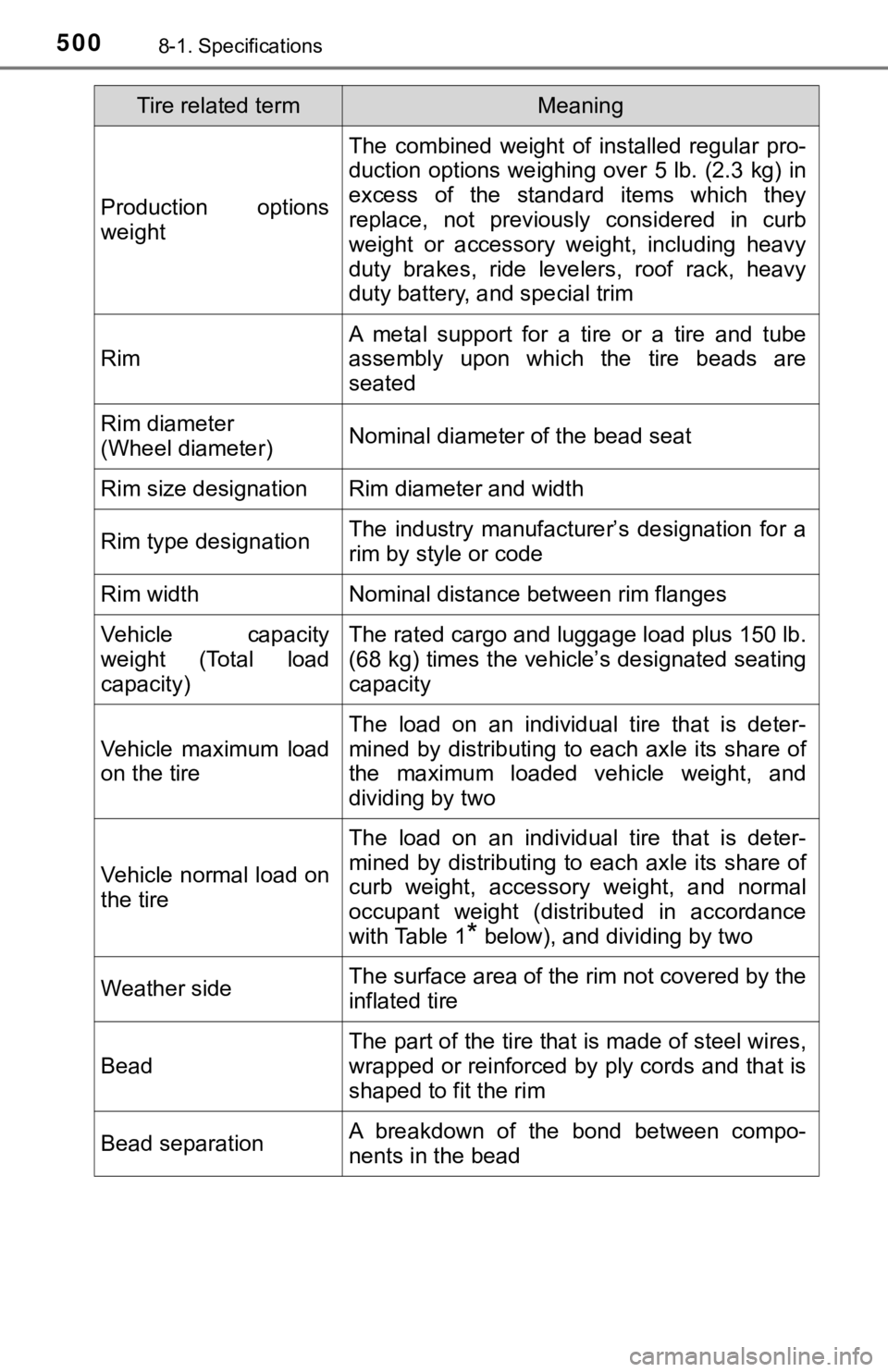
Production options
weight
The combined weight of installed regular pro-
duction options weighing over 5 lb. (2.3 kg) in
excess of the standard items which they
replace, not previously considered in curb
weight or accessory weight, including heavy
duty brakes, ride levelers, roof rack, heavy
duty battery, and special trim
Rim
A metal support for a tire or a tire and tube
assembly upon which the tire beads are
seated
Rim diameter
(Wheel diameter)Nominal diameter of the bead seat
Rim size designationRim diameter and width
Rim type designationThe industry manufacturer’s designation for a
rim by style or code
Rim widthNominal distance between rim flanges
Vehicle capacity
weight (Total load
capacity)The rated cargo and luggage load plus 150 lb.
(68 kg) times the vehicle’s designated seating
capacity
Vehicle maximum load
on the tire
The load on an individual tire that is deter-
mined by distributing to each axle its share of
the maximum loaded vehicle weight, and
dividing by two
Vehicle normal load on
the tire
The load on an individual tire that is deter-
mined by distributing to each axle its share of
curb weight, accessory weight, and normal
occupant weight (distributed in accordance
with Table 1
* below), and dividing by two
Weather sideThe surface area of the rim not covered by the
inflated tire
Bead
The part of the tire that is made of steel wires,
wrapped or reinforced by ply cords and that is
shaped to fit the rim
Bead separationA breakdown of the bond between compo-
nents in the bead
Tire related termMeaning
Page 537 of 548

537Alphabetical index
Engine coolant
Capacity ................................ 483
Checking ............................... 388
Preparing and checking
before winter....................... 317
Engine coolant temperature
gauge........................................ 90
Engine immobilizer system ...... 77
Engine oil
Capacity ................................ 481
Checking ............................... 385
Preparing and checking
before winter....................... 317
Engine switch .......................... 184
Enhanced VSC ......................... 309
EPS
(Electric Power Steering)...... 310
Warning light ......................... 436
Event data recorder
(EDR) ........................................ 11Flat tire ..................................... 449
Floor mats .................................. 26
Fluid
Automatic transaxle .............. 484
Brake .................................... 486
Washer ................................. 393
Front interior light ................... 333
Front passenger occupant
classification system .............. 50
Front passenger’s seat belt
reminder light ........................ 438
Front personal lights............... 333
Front seat heaters ................... 329
Front seats ............................... 142
Adjustment............................ 142
Cleaning ............................... 369
Correct driving posture ........... 28
Driving position memory ....... 146
Head restraints ..................... 151
Power easy access
system ................................ 146
Seat heaters ......................... 329
Seat ventilators ..................... 329
Front side marker lights
Light switch ........................... 202
Replacing light bulbs ............ 421F