warning TOYOTA AVENSIS 2015 Owners Manual
[x] Cancel search | Manufacturer: TOYOTA, Model Year: 2015, Model line: AVENSIS, Model: TOYOTA AVENSIS 2015Pages: 648, PDF Size: 39.64 MB
Page 466 of 648
4667-3. Do-it-yourself maintenance
AVENSIS_OM_OM20C20E_(EE)■
Situations in which the tire pressure warning system may not operate
properly (if equipped)
●In the following cases, the tire pressure warning system may not operate
properly.
• If non-genuine Toyota wheels are used.
• A tire has been replaced with a tire t hat is not an OE (Original Equipment)
tire.
• A tire has been replaced with a tire that is not of the specified size.
• Tire chains etc. are equipped.
• An auxiliary-supported run-flat tire is equipped.
• If a window tint that affects the radio wave signals is installed.
• If there is a lot of snow or ice on the vehicle, particularly around the
wheels or wheel housings.
• If the tire inflation pressure is extremely higher than the specified level.
• If tires not equipped with the tire pr essure warning valves and transmit-
ters are used.
• If the ID code on the tire pressure warning valves and transmitters is not
registered in the tire pressure warning computer.
• If the wheel set selected does not match the wheel set fitted to the vehi- cle, in case a second wheel set has been registered.
● Performance may be affected in the following situations.
• Near a TV tower, electric power plant, gas station, radio station, large dis-
play, airport or other facility that generates strong radio waves or electri-
cal noise
• When carrying a portable radio, cellular phone, cordless phone or other wireless communication device
● When the vehicle is parked, the time taken for the warning to start or go off
could be extended.
● When tire inflation pressure declines rapidly for example when a tire has
burst, the warning may not function.
■ The initialization operation (vehicles with the tire pressure warning sys-
tem)
●Make sure to carry out initialization after adjusting the tire inflation pressure.
Also, make sure the tires are cold before carrying out initialization or tire
inflation pressure adjustment.
● If you have accidentally turned the engine switch to the “LOCK” position
(vehicles without a smart entry & start system) or off (vehicles with a smart
entry & start system) during initialization, it is not necessary to restart the ini-
tialization again as initialization will restart automatically when the engine
switch has been turned to the “ON” position (vehicles without a smart entry
& start system) or IGNITION ON mode (vehicles with a smart entry & start
system) for the next time.
● If you accidentally start the initialization when initialization is not necessary,
adjust the tire inflation pressure to the specified level when the tires are
cold, and conduct initialization again.
AVENSIS_OM_OM20C20E_(EE).book Page 466 Thursday, January 29, 2015 1:47 PM
Page 467 of 648
4677-3. Do-it-yourself maintenance
AVENSIS_OM_OM20C20E_(EE)
7
Maintenance and care
■Warning performance of the tire pressure warning system (if equipped)
The warning of the tire pressure warning system will change in accordance
with the conditions under which it was initialized. For this reason, the system
may give a warning even if the tire pressure does not reach a low enough
level, or if the pressure is higher than the pressure that was adjusted to when
the system was initialized.
■ When initialization of the tire pressure warning system has failed (if
equipped)
Initialization can be completed in a few minutes. However, in the following
cases, the settings have not been recorded and the system will not operate
properly. If repeated attempts to record tire inflation pressure settings are
unsuccessful, have the vehicle inspected by any authorized Toyota dealer or
repairer, or another duly qualified and equipped professional.
●When operating the initialization of the system, the tire pressure warning
light does not blink 3 times.
● After driving for a certain period of time since the initialization has been
completed, the warning light comes on after blinking for 1 minute.
■ Low profile tires (225/45R18 tires)
Generally, low profile tires will wear more rapidly and tire grip performance
will be reduced on snowy and/or icy roads when compared to standard tires.
Be sure to use snow tires or tire chains on snowy and/or icy roads and drive
carefully at a speed appropriate for road and weather conditions.
AVENSIS_OM_OM20C20E_(EE).book Page 467 Thursday, January 29, 2015 1:47 PM
Page 468 of 648
4687-3. Do-it-yourself maintenance
AVENSIS_OM_OM20C20E_(EE)■
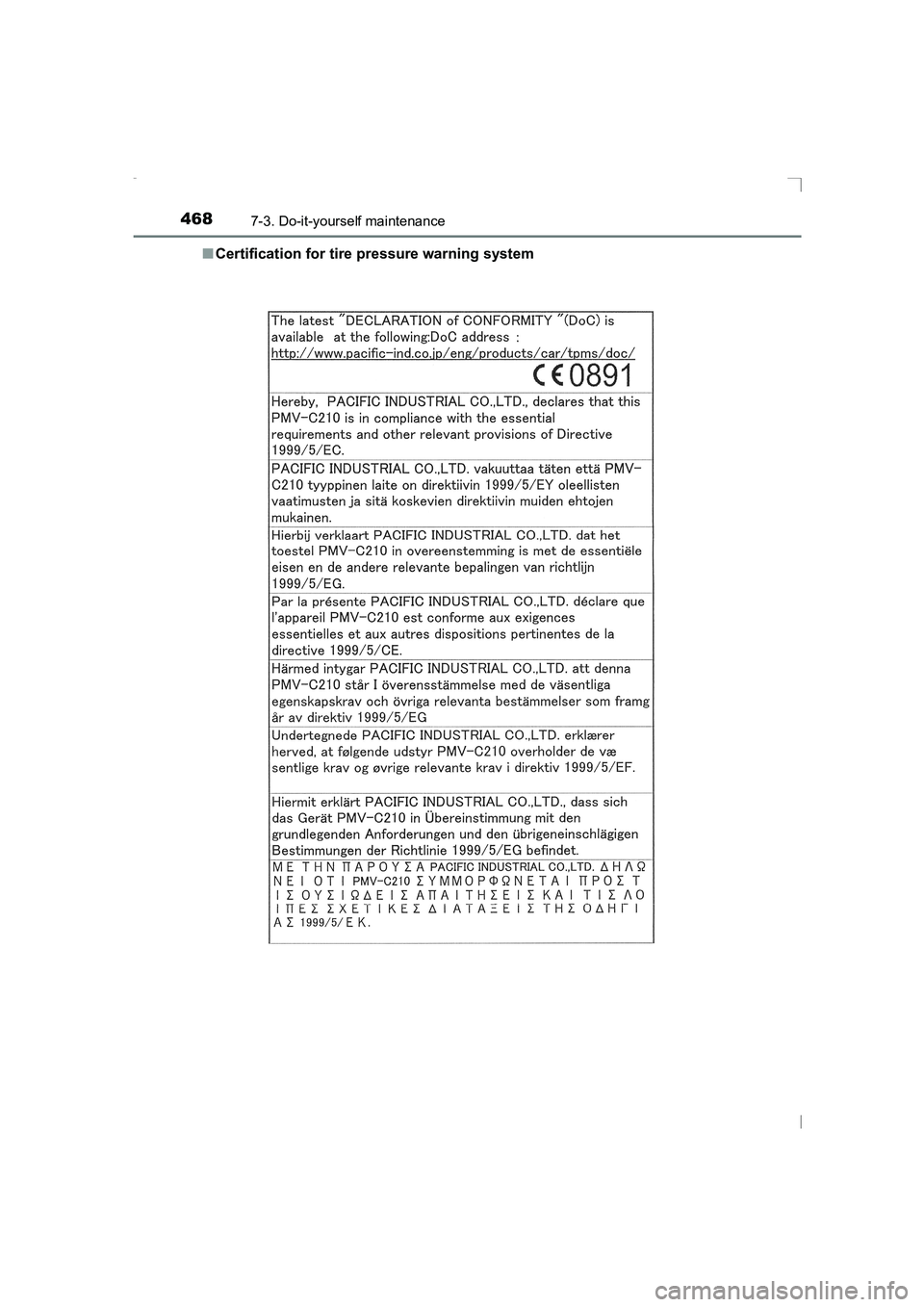
Certification for tire pressure warning system
AVENSIS_OM_OM20C20E_(EE).book Page 468 Thursday, January 29, 2015 1:47 PM
Page 473 of 648
4737-3. Do-it-yourself maintenance
AVENSIS_OM_OM20C20E_(EE)
7
Maintenance and care
WARNING
■ When inspecting or replacing tires
Observe the following precautions to prevent accidents.
Failure to do so may cause damage to parts of the drive train, as well as
dangerous handling characteristics, which may lead to an accident resulting
in death or serious injury.
●Do not mix tires of different makes, models or tread patterns.
Also, do not mix tires of remarkably different treadwear.
● Do not use tire sizes other than those recommended by Toyota.
● Do not mix differently constructed tires (radial, bias-belted or bias-ply
tires).
● Do not mix summer, all season and snow tires.
● Do not use tires that have been used on another vehicle.
Do not use tires if you do not know how they were used previously.
● Vehicles with a compact spare tire: Do not tow if your vehicle has a com-
pact spare tire installed.
■ When initializing the tire pressu re warning system (if equipped)
Do not initialize tire inflation pressure without first adjusting the tire inflation
pressure to the specified level. Otherwise, the tire pressure warning light
may not come on even if the tire inflation pressure is low, or it may come on
when the tire inflation pressure is actually normal.
NOTICE
■Repairing or replacing tires, wheels, tire pressure warning valves,
transmitters and tire valve caps (vehicles with the tire pressure warn-
ing system)
●When removing or fitting the wheels, ti res or the tire pressure warning
valves and transmitters, contact any authorized Toyota dealer or repairer,
or another duly qualified and equipped professional as the tire pressure
warning valves and transmitters may be damaged if not handled correctly.
● Make sure to install the tire valve caps. If the tire valve caps are not
installed, water could enter the tire pressure warning valves and the tire
pressure warning valves may seize.
● When replacing tire valve caps, do not use tire valve caps other than those
specified. The cap may become stuck.
AVENSIS_OM_OM20C20E_(EE).book Page 473 Thursday, January 29, 2015 1:47 PM
Page 474 of 648
4747-3. Do-it-yourself maintenance
AVENSIS_OM_OM20C20E_(EE)NOTICE
■
To avoid damage to the tire pressure warning valves and transmitters
(vehicles with the tire pressure warning system)
When a tire is repaired with liquid sealants, the tire pressure warning valve
and transmitter may not operate properly. If a liquid sealant is used, contact
any authorized Toyota dealer or repairer, or another duly qualified and
equipped professional or other qualified service shop as soon as possible.
After use of liquid sealant, make sure to replace the tire pressure warning
valve and transmitter when repairing or replacing the tire. ( →P. 460)
■ Driving on rough roads
Take particular care when driving on roads with loose surfaces or pot holes.
These conditions may cause losses in tire inflation pressure, reducing the
cushioning ability of the tires. In addition driving on rough roads may cause
damage to the tires themselves, as well as the vehicle’s wheels and body.
■ Low profile tires (225/45R18 tires)
Low profile tires may cause greater damage than usual to the wheel when
receiving impact from the road surface. Therefore pay attention to the fol-
lowing:
●Be sure to use proper tire inflation pressure. If tires are under-inflated, they
may be damaged more severely.
● Avoid pot holes, uneven pavement, curbs and other road hazards. Failure
to do so can lead to severe tire and wheel damage.
■ If tire inflation pressure of each tire becomes low while driving
Do not continue driving, or your tires and/or wheels may be ruined.
AVENSIS_OM_OM20C20E_(EE).book Page 474 Thursday, January 29, 2015 1:47 PM
Page 476 of 648
4767-3. Do-it-yourself maintenance
AVENSIS_OM_OM20C20E_(EE)
WARNING
■ Proper inflation is critical to save tire performance
Keep your tires properly inflated.
If the tires are not properly inflated, the following conditions may occur
which could lead to an accident resulting in death or serious injury:
●Excessive wear
● Uneven wear
● Poor handling
● Possibility of blowouts resulting from overheated tires
● Air leaking from between tire and wheel
● Wheel deformation and/or tire damage
● Greater possibility of tire damage while driving (due to road hazards,
expansion joints, sharp edges in the road, etc.)
NOTICE
■ When inspecting and adjusting tire inflation pressure
Be sure to put the tire valve caps back on.
If a valve cap is not installed, dirt or moisture may get into the valve and
cause an air leak, resulting in decreased tire inflation pressure.
AVENSIS_OM_OM20C20E_(EE).book Page 476 Thursday, January 29, 2015 1:47 PM
Page 478 of 648
4787-3. Do-it-yourself maintenance
AVENSIS_OM_OM20C20E_(EE)
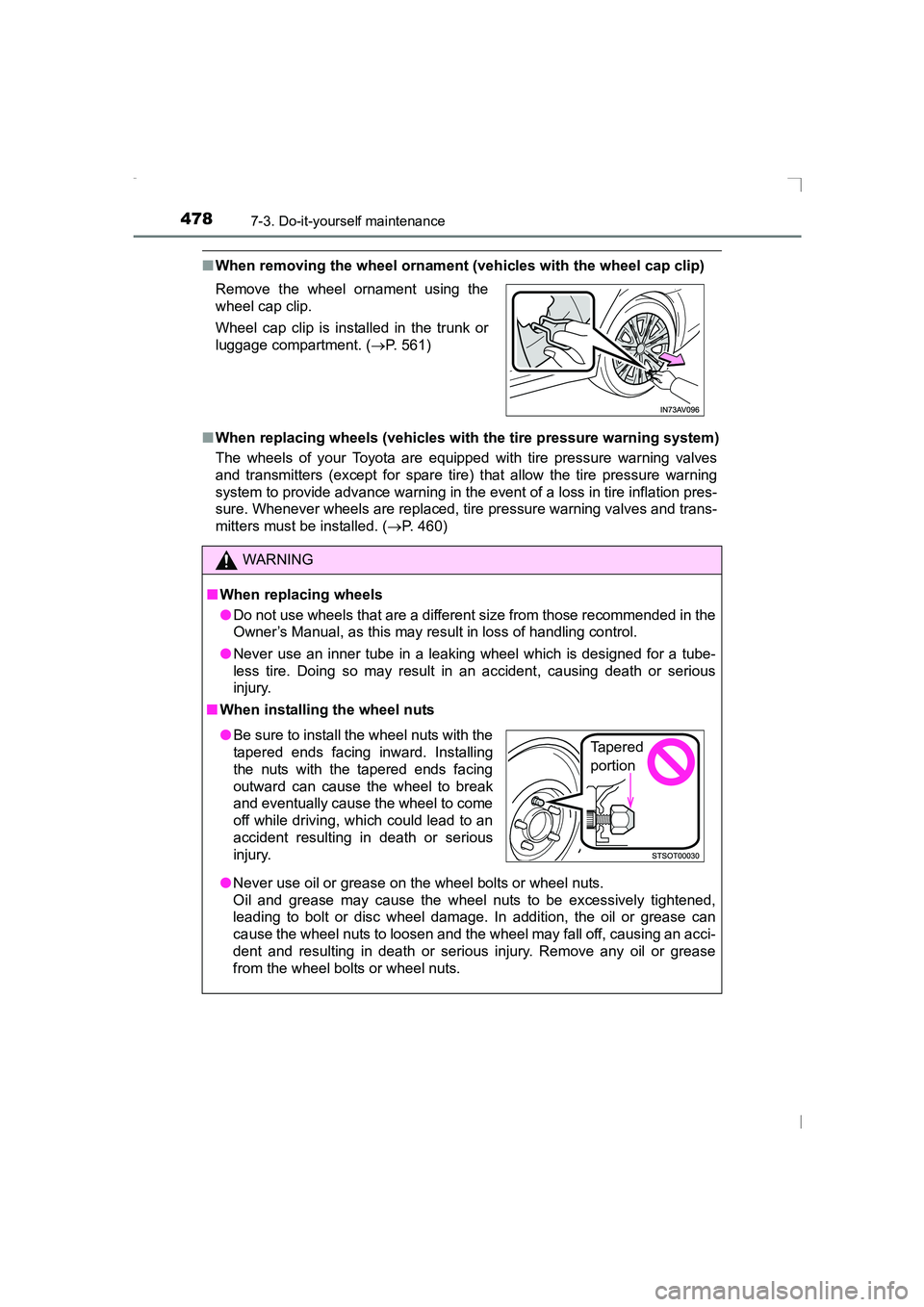
■When removing the wheel ornament (vehicles with the wheel cap clip)
■ When replacing wheels (vehicles with the tire pressure warning system)
The wheels of your Toyota are equipped with tire pressure warning valves
and transmitters (except for spare tire) t hat allow the tire pressure warning
system to provide advance warning in the event of a loss in tire inflation pres-
sure. Whenever wheels are replaced, tire pressure warning valves and trans-
mitters must be installed. ( →P. 460)
Remove the wheel ornament using the
wheel cap clip.
Wheel cap clip is installed in the trunk or
luggage compartment. (
→P. 561)
WARNING
■ When replacing wheels
●Do not use wheels that are a different size from those recommended in the
Owner’s Manual, as this may result in loss of handling control.
● Never use an inner tube in a leaking wheel which is designed for a tube-
less tire. Doing so may result in an accident, causing death or serious
injury.
■ When installing the wheel nuts
●Never use oil or grease on the wheel bolts or wheel nuts.
Oil and grease may cause the wheel nuts to be excessively tightened,
leading to bolt or disc wheel damage. In addition, the oil or grease can
cause the wheel nuts to loosen and the wheel may fall off, causing an acci-
dent and resulting in death or serious injury. Remove any oil or grease
from the wheel bolts or wheel nuts.
● Be sure to install the wheel nuts with the
tapered ends facing inward. Installing
the nuts with the tapered ends facing
outward can cause the wheel to break
and eventually cause the wheel to come
off while driving, which could lead to an
accident resulting in death or serious
injury.Tapered
portion
AVENSIS_OM_OM20C20E_(EE).book Page 478 Thursday, January 29, 2015 1:47 PM
Page 479 of 648
4797-3. Do-it-yourself maintenance
AVENSIS_OM_OM20C20E_(EE)
7
Maintenance and care
NOTICE
■Replacing tire pressure warning valves and transmitters (vehicles with
the tire pressure warning system)
●Because tire repair or replacement may affect the tire pressure warning
valves and transmitters, make sure to have tires serviced by any autho-
rized Toyota dealer or repairer, or another duly qualified and equipped pro-
fessional or other qualified service shop. In addition, make sure to
purchase your tire pressure warning valves and transmitters at any autho-
rized Toyota dealer or repairer, or another duly qualified and equipped pro-
fessional.
● Ensure that only genuine Toyota wheels are used on your vehicle.
Tire pressure warning valves and transmitters may not work properly with
non-genuine wheels.
AVENSIS_OM_OM20C20E_(EE).book Page 479 Thursday, January 29, 2015 1:47 PM
Page 484 of 648
4847-3. Do-it-yourself maintenance
AVENSIS_OM_OM20C20E_(EE)
■If the key battery is discharged
The following symptoms may occur.
●The smart entry & start system and wireless remote control will not function
properly.
● The operational range is reduced.
■ Use the following types of lithium battery
Vehicles without smart entry & start system: CR2016
Vehicles with smart entry & start system: CR1632
●Batteries can be purchased at any authorized Toyota dealer or repairer, or
another duly qualified and equipped professional, local electrical appliance
shops or camera stores.
● Replace only with the same or equivalent type recommended by the manu-
facturer.
● Dispose of used batteries according to the local laws.
WARNING
■ Removed battery and other parts
These parts are small and if swallowed by a child, they can cause choking.
Keep away from children. Failure to do so could result in death or serious
injury.
■ Certification for the smart entry & start system
CAUTION
RISK OF EXPLOSION IF BATTERY IS REPLACED BY AN INCORRECT
TYPE. DISPOSE OF USED BATTERIES ACCORDING TO THE INSTRUC-
TIONS
NOTICE
■For normal operation after replacing the battery
Observe the following precautions to prevent accidents.
●Always work with dry hands.
Moisture may cause the battery to rust.
● Do not touch or move any other components inside the remote control.
● Do not bend the battery terminals.
● Please perform this operation in a clean environment to avoid garbage, oil,
etc. insertion in the key.
AVENSIS_OM_OM20C20E_(EE).book Page 484 Thursday, January 29, 2015 1:47 PM
Page 489 of 648
4897-3. Do-it-yourself maintenance
AVENSIS_OM_OM20C20E_(EE)
7
Maintenance and care
■After a fuse is replaced
●If the lights do not turn on even after the fuse has been replaced, a bulb may
need replacement. ( →P. 490)
● If the replaced fuse blows again, have the vehicle inspected by any autho-
rized Toyota dealer or repairer, or another duly qualified and equipped pro-
fessional.
■ If there is an overload in the circuits
The fuses are designed to blow, protecting the wiring harness from damage.
WARNING
■ To prevent system breakdowns and vehicle fire
Observe the following precautions.
Failing to do so may cause damage to the vehicle, and possibly a fire or
injury.
●Never use a fuse of a higher amperage rating than indicated, or use any
other object in place of a fuse.
● Always use a genuine Toyota fuse or equivalent.
Never replace a fuse with a wire, even as a temporary fix.
● Do not modify the fuse or the fuse box.
NOTICE
■ Before replacing fuses
Have the cause of electrical overload determined and repaired by any
authorized Toyota dealer or repairer, or another duly qualified and equipped
professional, as soon as possible.
AVENSIS_OM_OM20C20E_(EE).book Page 489 Thursday, January 29, 2015 1:47 PM