ECU TOYOTA AYGO X 2022 (in English) User Guide
[x] Cancel search | Manufacturer: TOYOTA, Model Year: 2022, Model line: AYGO X, Model: TOYOTA AYGO X 2022Pages: 494, PDF Size: 92.53 MB
Page 45 of 494
43
1
Owner's Manual_Europe_M99V08_en
1-1. For safe use
For safety and security
WARNING
●If the areas where the SRS airbags are stored, such as the steering
wheel pad and front and rear pillar garnishes, are damaged or cracked, have them replaced by
any authorized Toyota retailer or Toyota authorized repairer, or any reliable repairer.
■Modification and disposal of SRS airbag system components
Do not dispose of your vehicle or per- form any of the following modifica-tions without consulting your Toyota
retailer or Toyota authorized repairer, or any reliable repairer. The SRS air-bags may malfunction or deploy
(inflate) accidentally, causing death or serious injury.
●Installation, removal, disassembly and repair of the SRS airbags
●Repairs, modifications, removal or replacement of the steering wheel, instrument panel, dashboard, seats
or seat upholstery, front, side and rear pillars, roof side rails, front door panels, front door trims or front
door speakers
●Modifications to the front door panel
(such as making a hole in it)
●Repairs or modifications of the front
fender, front bumper, or side of the occupant compartment
●Installation of a grille guard (bull bars, kangaroo bar, etc.), snow plows or winches
●Modifications to the vehicle’s sus-pension system
●Installation of electronic devices such as mobile two-way radios (RF-
transmitter) and CD players
Exhaust gas precautions
Harmful substance to the
human body is included in
exhaust gases if inhaled.
WARNING
Exhaust gases contain harmful car-
bon monoxide (CO), which is color- less and odorless. Observe the following precautions.
Failure to do so may cause exhaust gases to enter the vehicle and may lead to an accident caused by light-
headedness, or may lead to death or a serious health hazard.
■Important points while driving
●Keep the back door closed.
●If you smell exhaust gases in the vehicle even when the back door is closed, open the windows and have
the vehicle inspected at any autho- rized Toyota retailer or Toyota authorized repairer, or any reliable
repairer as soon as possible.
■When parking
●If the vehicle is in a poorly venti- lated area or a closed area, such as a garage, stop the engine.
●Do not leave the vehicle with the engine on for a long time.
If such a situation cannot be avoided, park the vehicle in an open space and ensure that
exhaust fumes do not enter the vehicle interior.
●Do not leave the engine running in an area with snow build-up, or where it is snowing. If snowbanks
build up around the vehicle while the engine is running, exhaust gases may collect and enter the
vehicle.
Page 47 of 494
45
1
Owner's Manual_Europe_M99V08_en
1-2. Child safety
For safety and security
1-2.Child sa fety
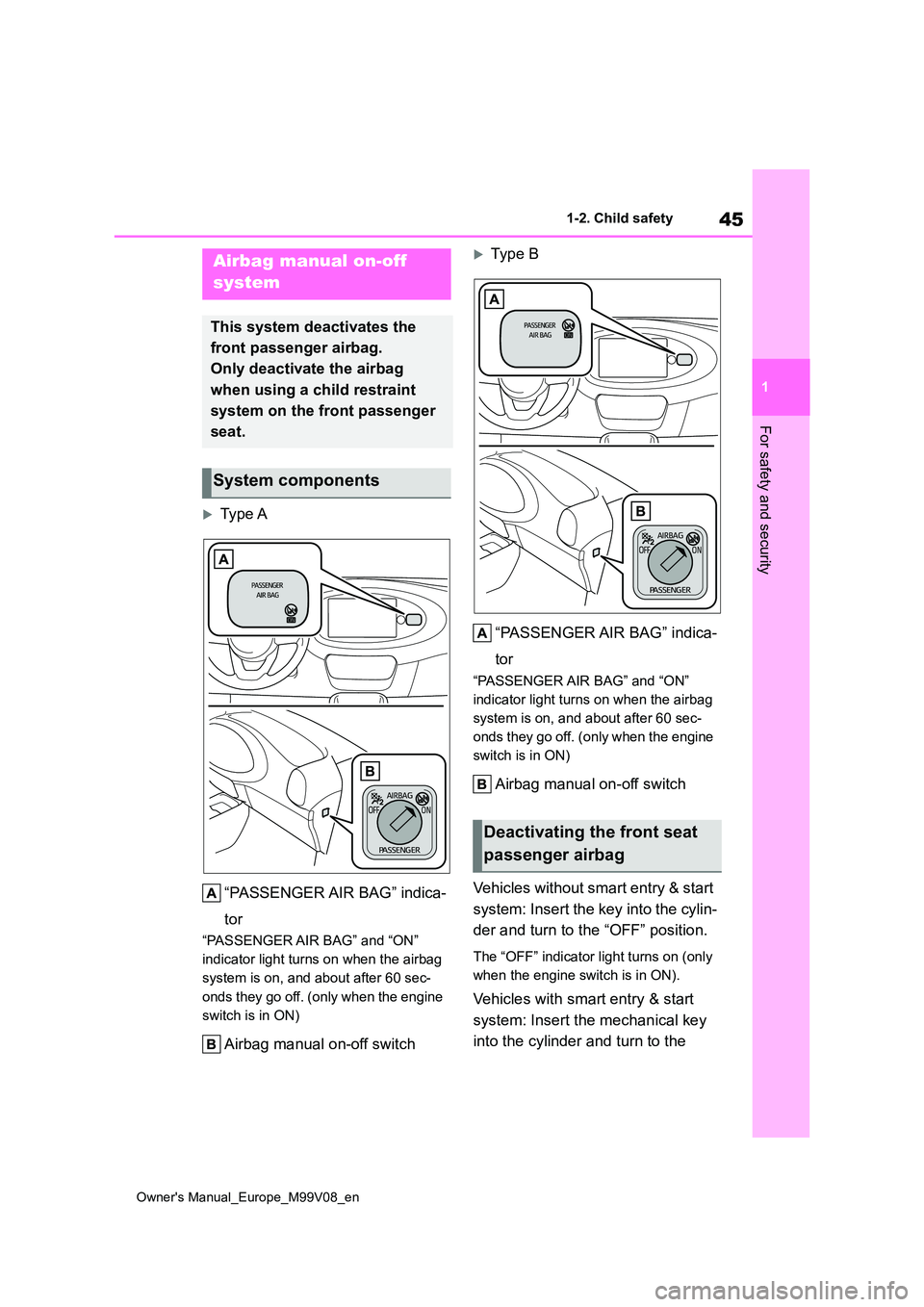
Type A
“PASSENGER AIR BAG” indica-
tor
“PASSENGER AIR BAG” and “ON”
indicator light turns on when the airbag
system is on, and about after 60 sec-
onds they go off. (only when the engine
switch is in ON)
Airbag manual on-off switch
Typ e B
“PASSENGER AIR BAG” indica-
tor
“PASSENGER AIR BAG” and “ON”
indicator light turns on when the airbag
system is on, and about after 60 sec-
onds they go off. (only when the engine
switch is in ON)
Airbag manual on-off switch
Vehicles without smart entry & start
system: Insert the key into the cylin-
der and turn to the “OFF” position.
The “OFF” indicator light turns on (only
when the engine switch is in ON).
Vehicles with smart entry & start
system: Insert the mechanical key
into the cylinder and turn to the
Airbag manual on-off
system
This system deactivates the
front passenger airbag.
Only deactivate the airbag
when using a child restraint
system on the front passenger
seat.
System components
Deactivating the front seat
passenger airbag
Page 49 of 494
47
1
Owner's Manual_Europe_M99V08_en
1-2. Child safety
For safety and security
Riding with children
Observe the following precau-
tions when children are in the
vehicle.
Use a child restraint system
appropriate for t he child, until
the child becomes large
enough to properly wear the
vehicle’s seat belt.
It is recommended that chil-
dren sit in the rear seats to
avoid accidental contact with
the shift lever, wiper switch,
etc.
Use the rear door child-protec-
tor lock or the window lock
switch to avoid children open-
ing the door while driving or
operating the power window
accidentally. ( P.99, 114)
Do not let small children oper-
ate equipment which may
catch or pinch body parts,
such as the power window,
hood, back door, seats, etc.
WARNING
■When children are in the vehicle
Never leave children unattended in
the vehicle, and never allow children to have or use the key.
Children may be able to start the vehi-
cle or shift the vehicle into neutral. There is also a danger that children may injure themselves by playing with
the windows, the canvas top, or other features of the vehicle. In addition, heat build-up or extremely cold tem-
peratures inside the vehicle can be fatal to children.
Page 51 of 494
49
1
Owner's Manual_Europe_M99V08_en
1-2. Child safety
For safety and security
■When installing a child
restraint system to a front pas-
senger seat
For the safety of a child, install a
child restraint system to a rear seat.
When installing a child restraint
system to a front passenger seat is
unavoidable, adjust the seat as fol-
lows and install the child restraint
system:
Move the front seat fully rear-
ward.
Adjust the seatback angle to the
most upright position.
When installing a forward-facing child
seat, if there is a gap between the child
seat and the seatback, adjust the seat-
back angle until good contact is
WARNING
●For effective protection in automo- bile accidents and sudden stops, a
child must be properly restrained, using a seat belt or child restraint system which is correctly installed.
For installation details, refer to the operation manual enclosed with the child restraint system. General
installation instruction is provided in this manual.
●Toyota strongly urges the use of a proper child restraint system that conforms to the weight and size of
the child, installed on the rear seat. According to accident statistics, the child is safer when properly
restrained in the rear seat than in the front seat.
●Holding a child in your or someone else’s arms is not a substitute for a child restraint system. In an acci-
dent, the child can be crushed against the windshield or between the holder and the interior of the
vehicle.
■Handling the child restraint sys-
tem
If the child restraint system is not properly fixed in place, the child or
other passengers may be seriously injured or even killed in the event of sudden braking, sudden swerving, or
an accident.
●If the vehicle were to receive a
strong impact from an accident, etc., it is possible that the child restraint system has damage that is
not readily visible. In such cases, do not reuse the restraint system.
●Depending on the child restraint system, installation may be difficult or impossible. In those cases,
check whether the child restraint system is suitable for installment in the vehicle. ( P.52) Be sure to
install and observe the usage rules after carefully reading the child restraint system fixing method in
this manual, as well as the opera- tion manual enclosed with the child restraint system.
●Keep the child restraint system properly secured on the seat even if
it is not in use. Do not store the child restraint system unsecured in the passenger compartment.
●If it is necessary to detach the child restraint system, remove it from the
vehicle or store it securely in the luggage compartment.
When using a child restraint
system
Page 53 of 494
51
1
Owner's Manual_Europe_M99V08_en
1-2. Child safety
For safety and security
WARNING
WARNING
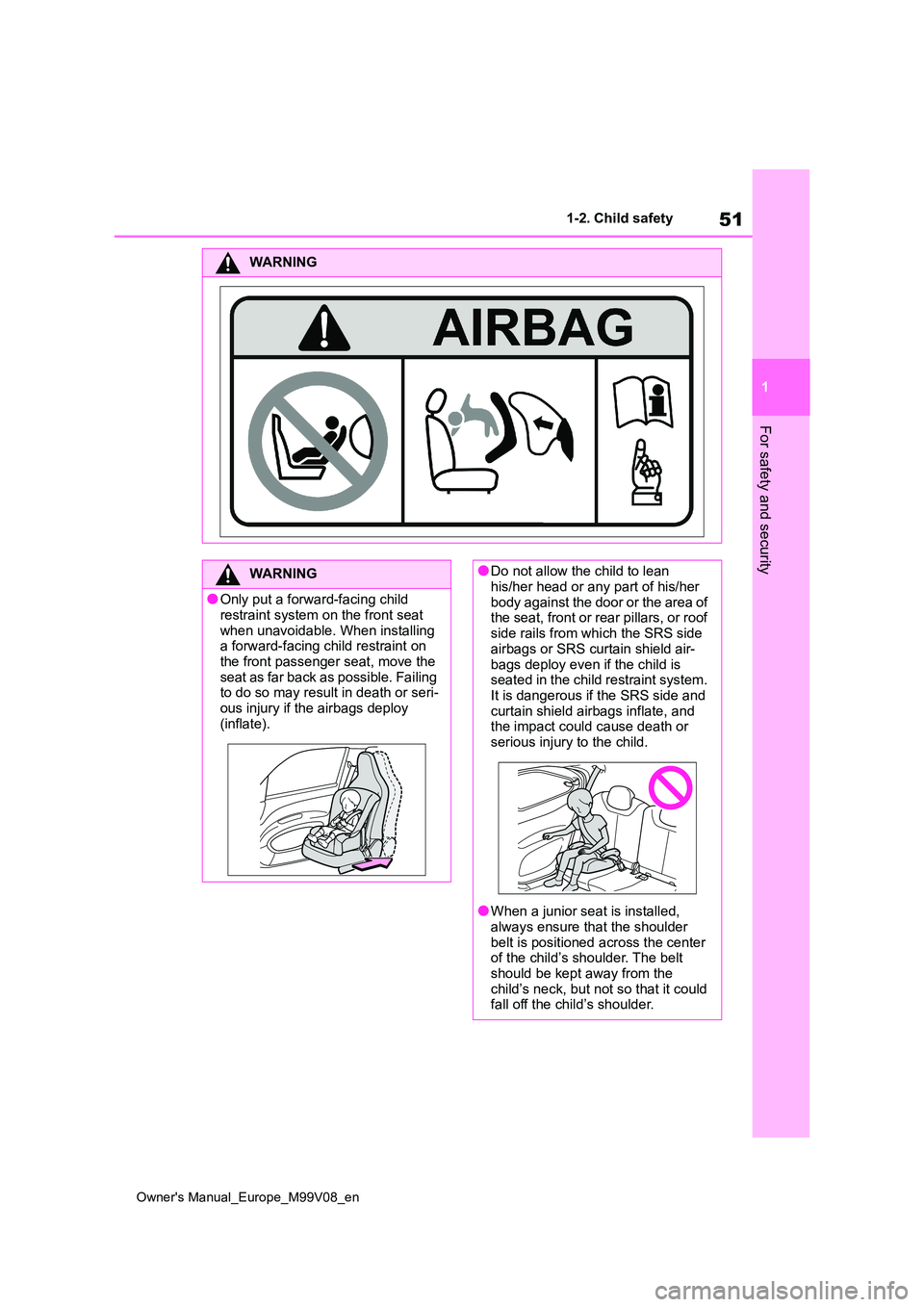
●Only put a forward-facing child restraint system on the front seat
when unavoidable. When installing a forward-facing child restraint on the front passenger seat, move the
seat as far back as possible. Failing to do so may result in death or seri-ous injury if the airbags deploy
(inflate).
●Do not allow the child to lean
his/her head or any part of his/her body against the door or the area of the seat, front or rear pillars, or roof
side rails from which the SRS side airbags or SRS curtain shield air-
bags deploy even if the child is seated in the child restraint system. It is dangerous if the SRS side and
curtain shield airbags inflate, and the impact could cause death or serious injury to the child.
●When a junior seat is installed, always ensure that the shoulder
belt is positioned across the center of the child’s shoulder. The belt should be kept away from the
child’s neck, but not so that it could fall off the child’s shoulder.
Page 55 of 494
53
1
Owner's Manual_Europe_M99V08_en
1-2. Child safety
For safety and security
indicated.
UN (ECE) R129 approval
mark*3
The height range of the child
who is applicable as well as
available weights for an UN
(ECE) R129 approval mark is
indicated.
2 Checking the category of the
child restraint system.
Check the approval mark of the
child restraint system for which
of the following categories the
child restraint system is suitable.
Also, if there are any uncertain-
ties, check the user’s guide
included with the child restraint
system or contact the retailer of
the child restraint system.
•“universal”
• “semi-universal”
• “restricted”
• “vehicle specific”
*1: UN (ECE) R44 and UN (ECE) R129
are U.N. regulations for child
restraint systems.
*2: The child restraint systems men-
tioned in the table may not be avail-
able outside of the EU area.
*3: The displayed mark may differ
depending on the product.
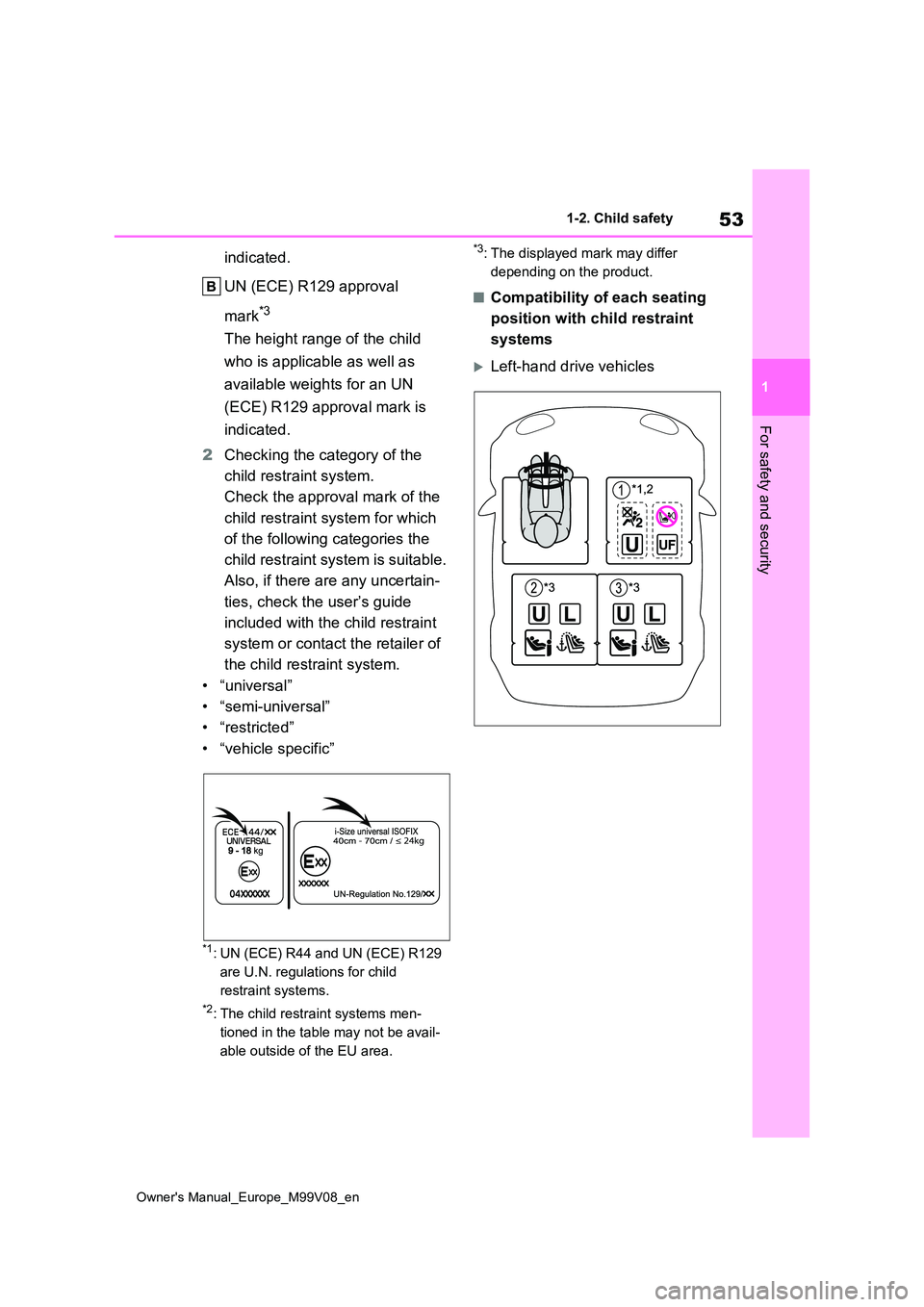
■Compatibility of each seating
position with child restraint
systems
Left-hand drive vehicles
Page 57 of 494
55
1
Owner's Manual_Europe_M99V08_en
1-2. Child safety
For safety and security
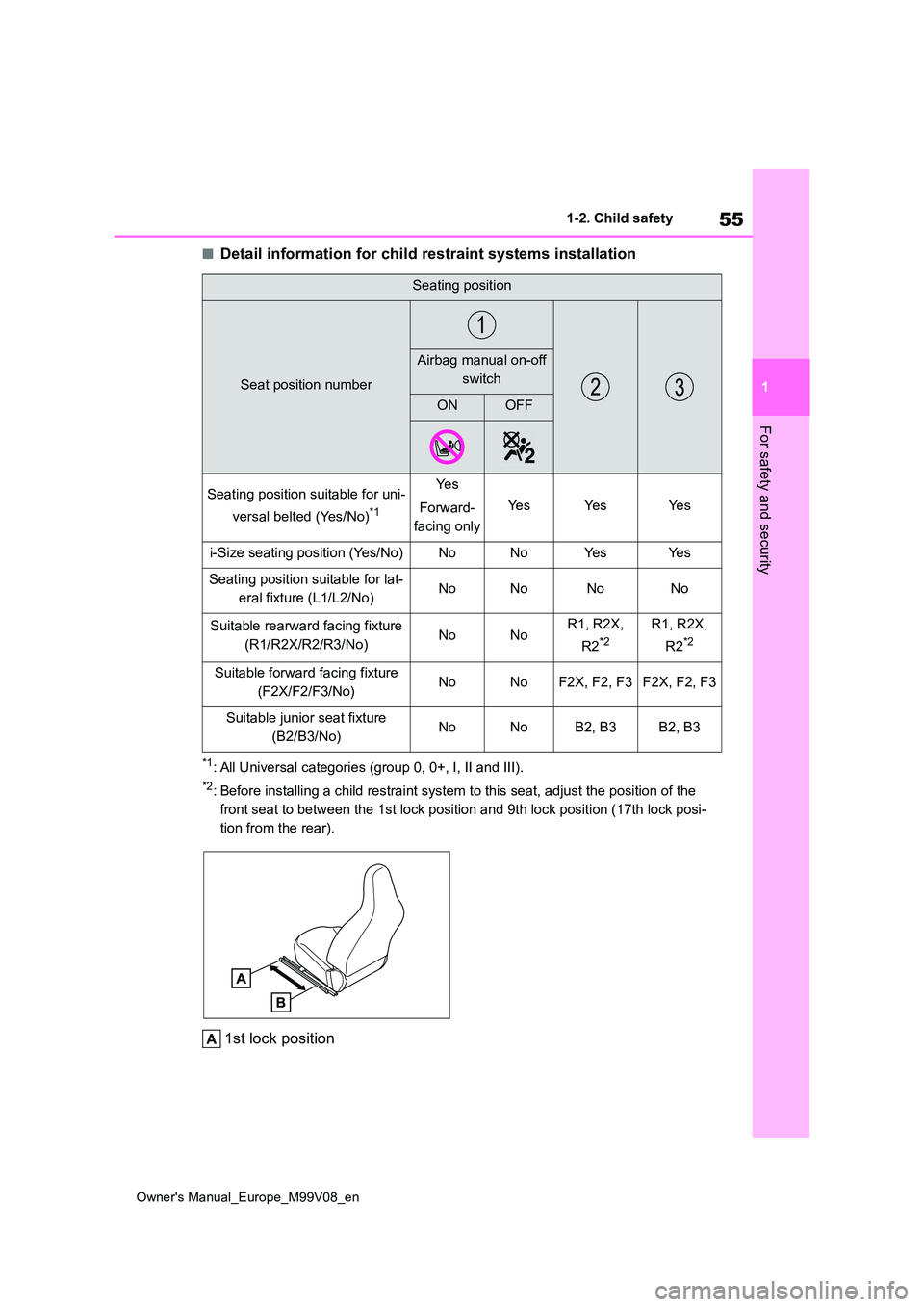
■Detail information for child restraint systems installation
*1: All Universal categories (group 0, 0+, I, II and III).
*2: Before installing a child restraint system to this seat, adjust the position of the
front seat to between the 1st lock position and 9th lock positi on (17th lock posi-
tion from the rear).
1st lock position
Seating position
Seat position number
Airbag manual on-off
switch
ONOFF
Seating position suitable for uni-
versal belted (Yes/No)*1
Ye s
Forward-
facing only
Ye sYe sYe s
i-Size seating position (Yes/No)NoNoYe sYe s
Seating position suitable for lat-
eral fixture (L1/L2/No)NoNoNoNo
Suitable rearward facing fixture
(R1/R2X/R2/R3/No)NoNoR1, R2X,
R2*2
R1, R2X,
R2*2
Suitable forward facing fixture
(F2X/F2/F3/No)NoNoF2X, F2, F3F2X, F2, F3
Suitable junior seat fixture
(B2/B3/No)NoNoB2, B3B2, B3
Page 59 of 494
57
1
Owner's Manual_Europe_M99V08_en
1-2. Child safety
For safety and security
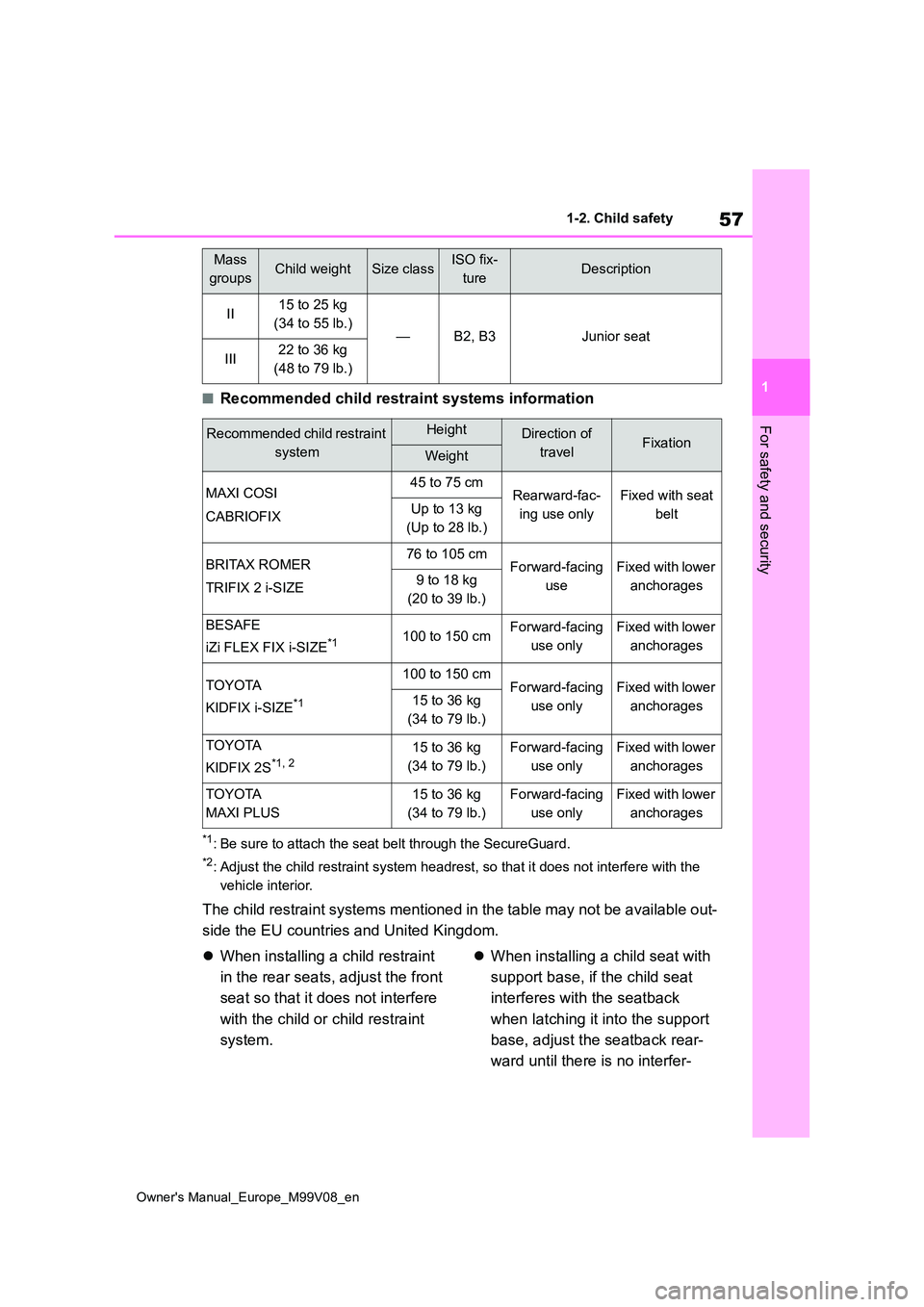
■Recommended child restraint systems information
*1: Be sure to attach the seat belt through the SecureGuard.
*2: Adjust the child restraint system headrest, so that it does not interfere with the
vehicle interior.
The child restraint systems mentioned in the table may not be a vailable out-
side the EU countries and United Kingdom.
When installing a child restraint
in the rear seats, adjust the front
seat so that it does not interfere
with the child or child restraint
system.
When installing a child seat with
support base, if the child seat
interferes with the seatback
when latching it into the support
base, adjust the seatback rear-
ward until there is no interfer-
II15 to 25 kg
(34 to 55 lb.)—B2, B3Junior seat
III22 to 36 kg
(48 to 79 lb.)
Recommended child restraint
system
HeightDirection of
travelFixationWeight
MAXI COSI
CABRIOFIX
45 to 75 cmRearward-fac-
ing use only
Fixed with seat
beltUp to 13 kg
(Up to 28 lb.)
BRITAX ROMER
TRIFIX 2 i-SIZE
76 to 105 cmForward-facing
use
Fixed with lower
anchorages9 to 18 kg
(20 to 39 lb.)
BESAFE
iZi FLEX FIX i-SIZE*1100 to 150 cmForward-facing
use only
Fixed with lower
anchorages
TOYOTA
KIDFIX i-SIZE*1
100 to 150 cmForward-facing
use only
Fixed with lower
anchorages15 to 36 kg
(34 to 79 lb.)
TOYOTA
KIDFIX 2S*1, 215 to 36 kg
(34 to 79 lb.)
Forward-facing
use only
Fixed with lower
anchorages
TOYOTA
MAXI PLUS
15 to 36 kg
(34 to 79 lb.)
Forward-facing
use only
Fixed with lower
anchorages
Mass
groupsChild weightSize classISO fix-
tureDescription
Page 60 of 494
58
Owner's Manual_Europe_M99V08_en
1-2. Child safety
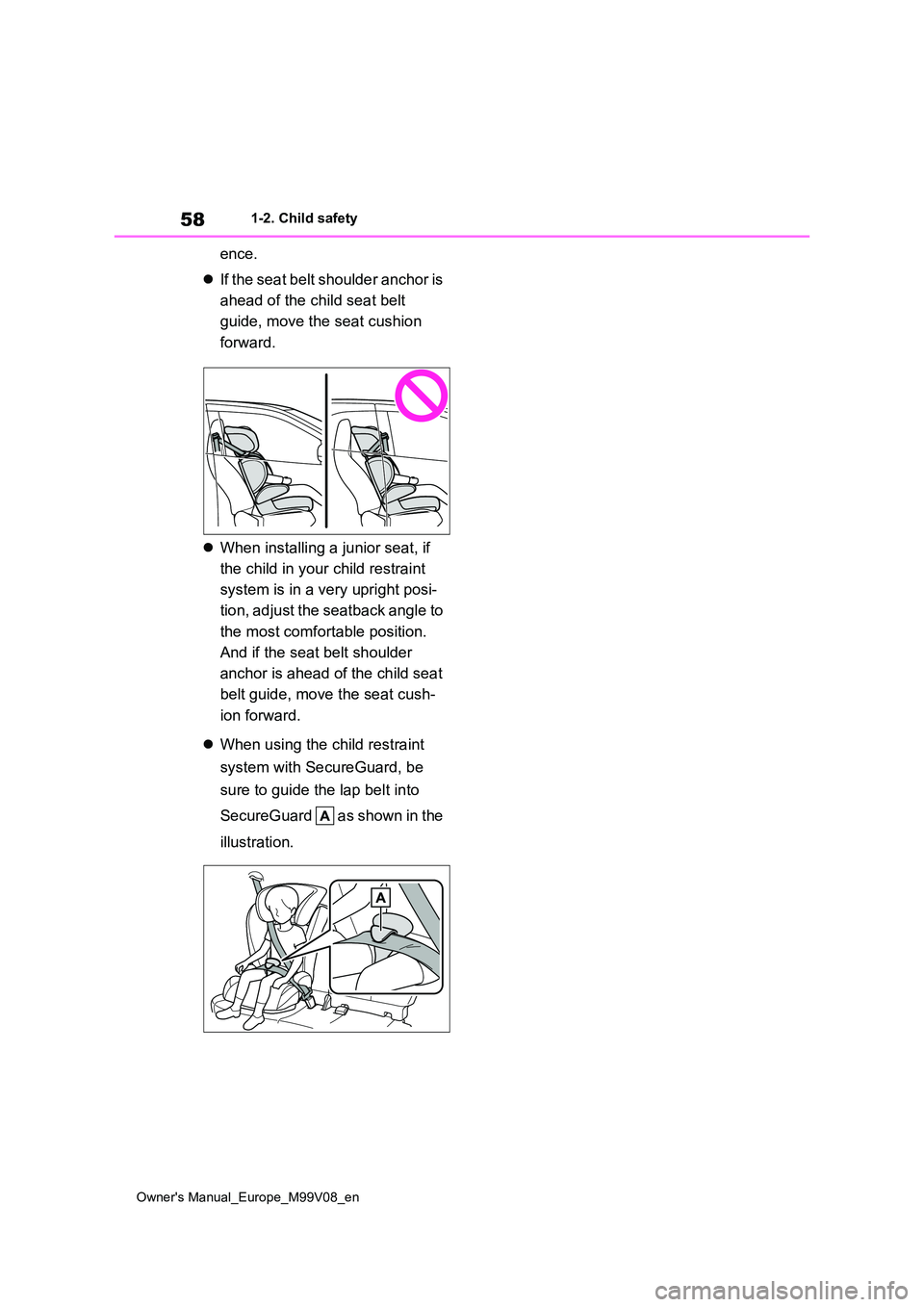
ence.
If the seat belt shoulder anchor is
ahead of the child seat belt
guide, move the seat cushion
forward.
When installing a junior seat, if
the child in your child restraint
system is in a very upright posi-
tion, adjust the seatback angle to
the most comfortable position.
And if the seat belt shoulder
anchor is ahead of the child seat
belt guide, move the seat cush-
ion forward.
When using the child restraint
system with SecureGuard, be
sure to guide the lap belt into
SecureGuard as shown in the
illustration.
Page 61 of 494
59
1
Owner's Manual_Europe_M99V08_en
1-2. Child safety
For safety and security
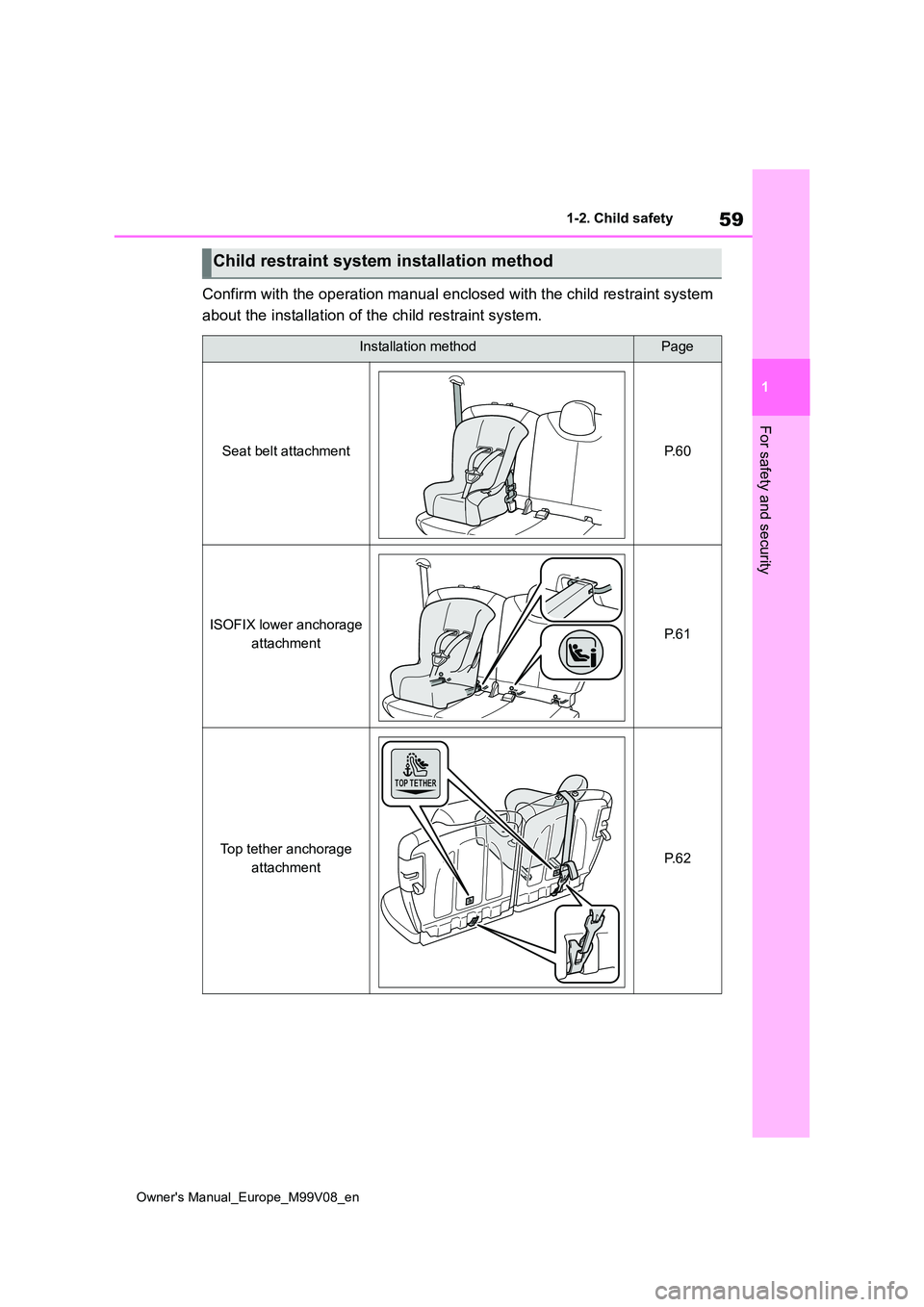
Confirm with the operation manual enclosed with the child restraint system
about the installation of the child restraint system.
Child restraint system installation method
Installation methodPage
Seat belt attachmentP. 6 0
ISOFIX lower anchorage
attachmentP. 6 1
Top tether anchorage
attachmentP. 6 2