ECU TOYOTA AYGO X 2022 (in English) Workshop Manual
[x] Cancel search | Manufacturer: TOYOTA, Model Year: 2022, Model line: AYGO X, Model: TOYOTA AYGO X 2022Pages: 494, PDF Size: 92.53 MB
Page 295 of 494
293
6
Owner's Manual_Europe_M99V08_en
6-3. Do-it-yourself maintenance
Maintenance and care
base.
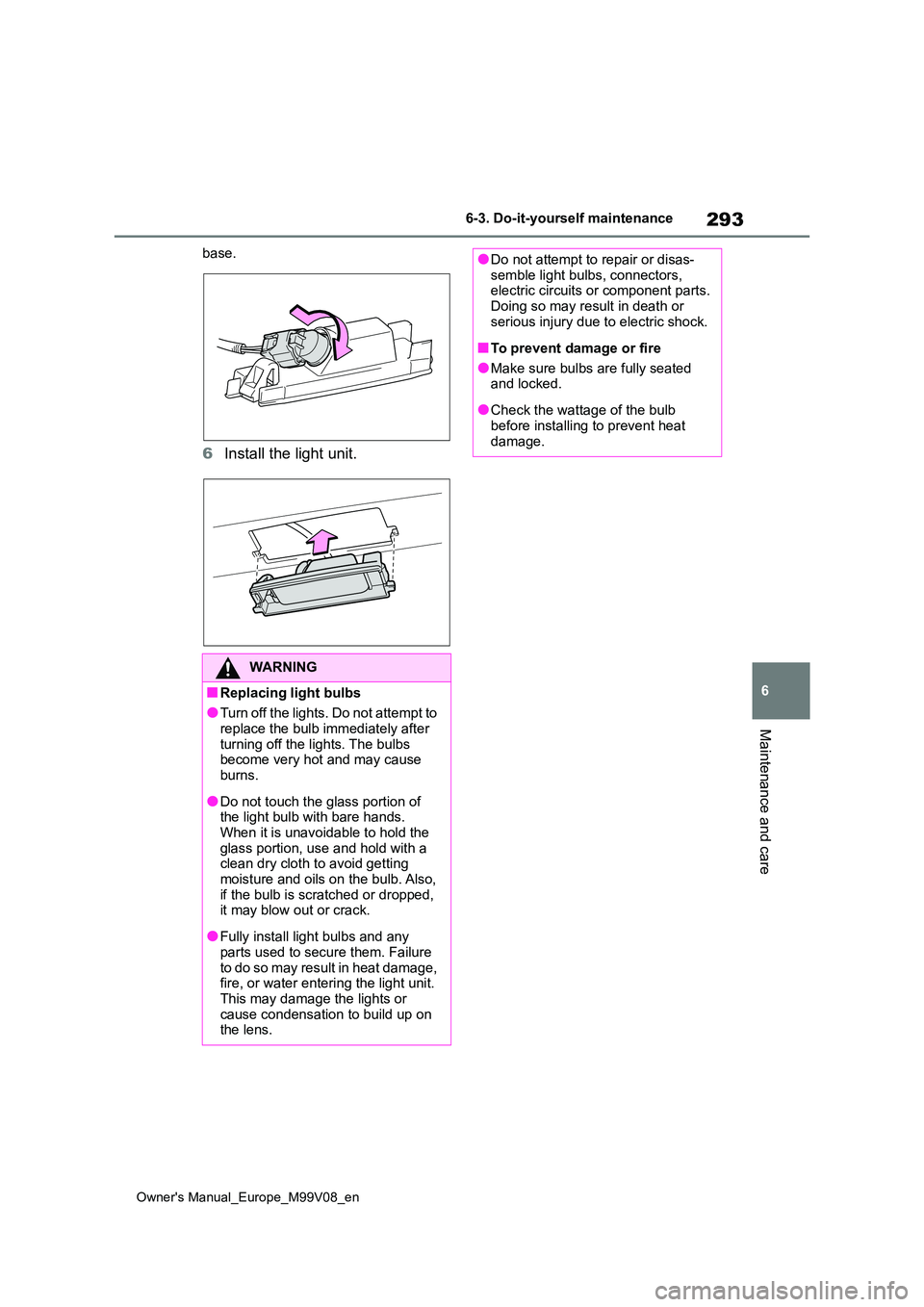
6Install the light unit.
WARNING
■Replacing light bulbs
●Tur n o ff t h e li g ht s. D o n o t at t e mp t t o replace the bulb immediately after
turning off the lights. The bulbs become very hot and may cause burns.
●Do not touch the glass portion of the light bulb with bare hands.
When it is unavoidable to hold the glass portion, use and hold with a clean dry cloth to avoid getting
moisture and oils on the bulb. Also, if the bulb is scratched or dropped, it may blow out or crack.
●Fully install light bulbs and any parts used to secure them. Failure
to do so may result in heat damage, fire, or water entering the light unit. This may damage the lights or
cause condensation to build up on the lens.
●Do not attempt to repair or disas-semble light bulbs, connectors, electric circuits or component parts.
Doing so may result in death or serious injury due to electric shock.
■To prevent damage or fire
●Make sure bulbs are fully seated and locked.
●Check the wattage of the bulb before installing to prevent heat
damage.
Page 299 of 494
297
7
Owner's Manual_Europe_M99V08_en
7-1. Essential information
When trouble arises
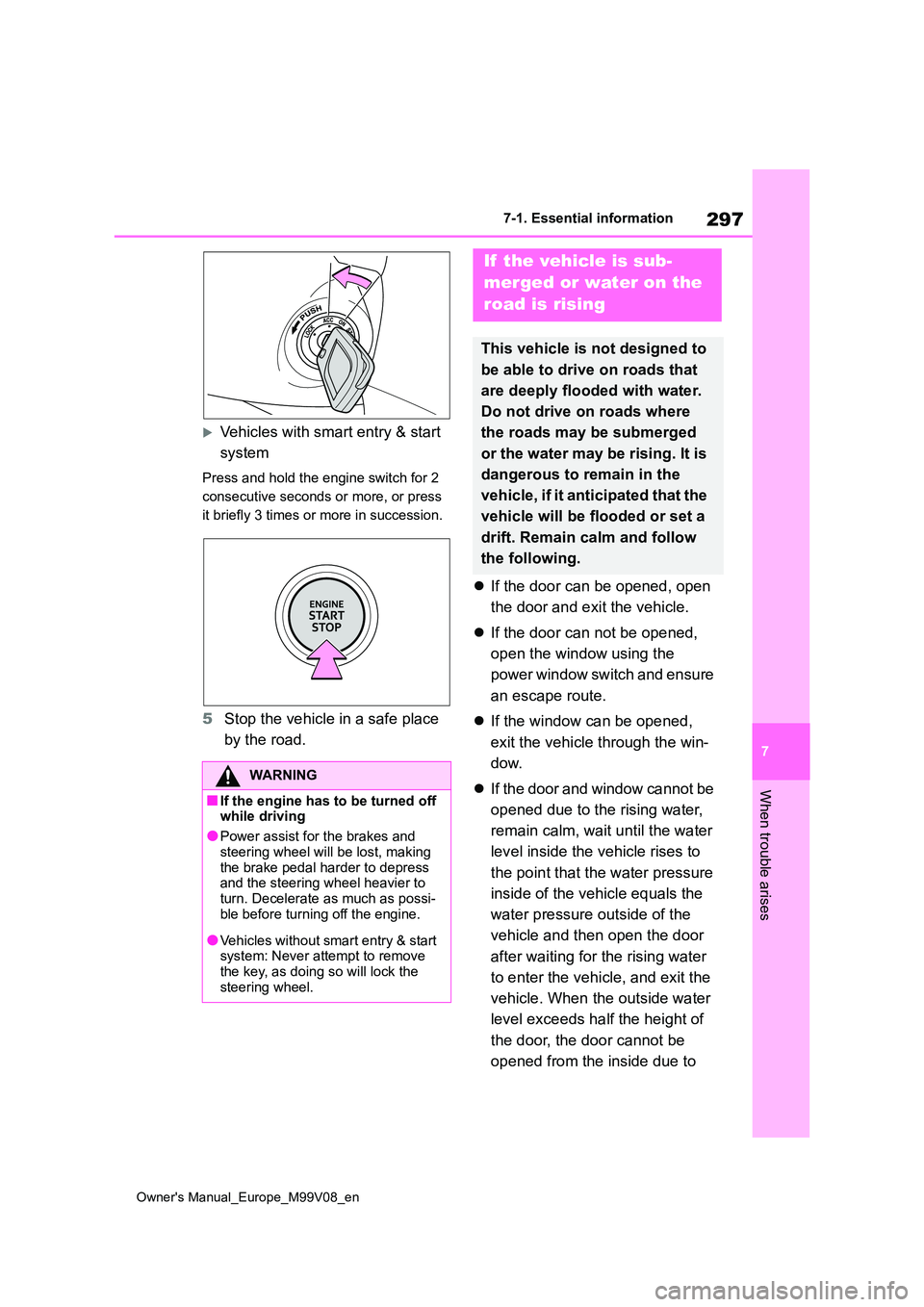
Vehicles with smart entry & start
system
Press and hold the engine switch for 2
consecutive seconds or more, or press
it briefly 3 times or more in succession.
5 Stop the vehicle in a safe place
by the road.
If the door can be opened, open
the door and exit the vehicle.
If the door can not be opened,
open the window using the
power window switch and ensure
an escape route.
If the window can be opened,
exit the vehicle through the win-
dow.
If the door and window cannot be
opened due to the rising water,
remain calm, wait until the water
level inside the vehicle rises to
the point that the water pressure
inside of the vehicle equals the
water pressure outside of the
vehicle and then open the door
after waiting for the rising water
to enter the vehicle, and exit the
vehicle. When the outside water
level exceeds half the height of
the door, the door cannot be
opened from the inside due to
WARNING
■If the engine has to be turned off while driving
●Power assist for the brakes and
steering wheel will be lost, making the brake pedal harder to depress and the steering wheel heavier to
turn. Decelerate as much as possi- ble before turning off the engine.
●Vehicles without smart entry & start system: Never attempt to remove the key, as doing so will lock the
steering wheel.
If the vehicle is sub-
merged or water on the
road is rising
This vehicle is not designed to
be able to drive on roads that
are deeply flooded with water.
Do not drive on roads where
the roads may be submerged
or the water may be rising. It is
dangerous to remain in the
vehicle, if it anticipated that the
vehicle will be flooded or set a
drift. Remain calm and follow
the following.
Page 302 of 494
300
Owner's Manual_Europe_M99V08_en
7-2. Steps to take in an emergency
When using a flat-bed truck to
transport the vehicle, use tire strap-
ping belts. Refer to the owner’s
manual of the flat-bed truck for the
tire strapping method.
In order to suppress vehicle move-
ment during transportation, set the
parking brake and turn the engine
switch off.
If a tow truck is not available in an
emergency, your vehicle may be
temporarily towed using cables or
chains secured to the emergency
towing eyelets. This should only be
attempted on hard surfaced roads
for at most 80 km (50 miles) at
under 30 km/h (18 mph).
A driver must be in the vehicle to
steer and operate the brakes. The
vehicle’s wheels, drivetrain, axles,
steering and brakes must be in
good condition.
For vehicles with Multidrive, only
the front towing eyelets may be
used.
To have your vehicle towed by
another vehicle, the towing eyelet
must be installed to your vehicle.
Install the towing eyelet using the
following procedure.
WARNING
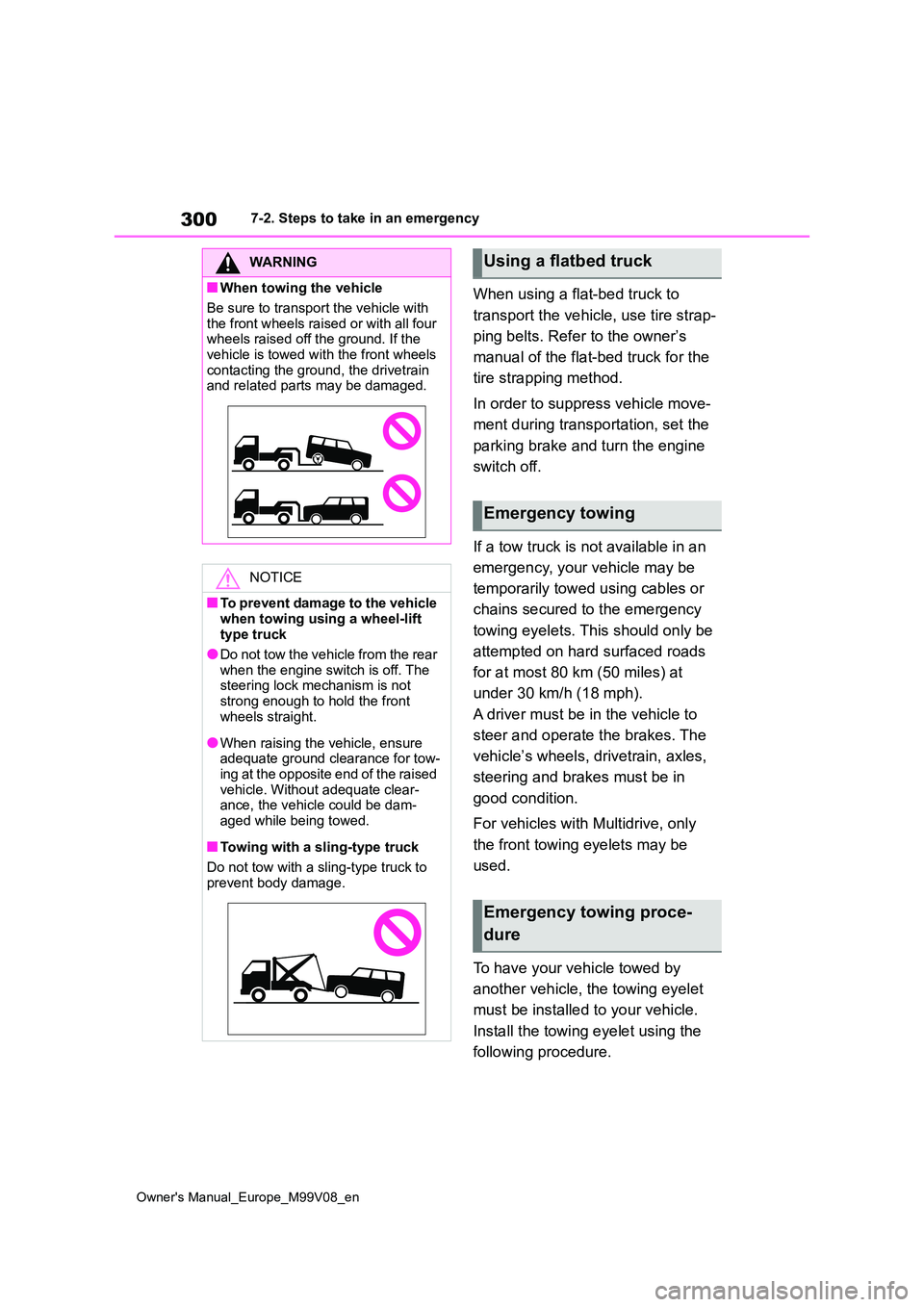
■When towing the vehicle
Be sure to transport the vehicle with
the front wheels raised or with all four wheels raised off the ground. If the vehicle is towed with the front wheels
contacting the ground, the drivetrain and related parts may be damaged.
NOTICE
■To prevent damage to the vehicle
when towing using a wheel-lift type truck
●Do not tow the vehicle from the rear
when the engine switch is off. The steering lock mechanism is not strong enough to hold the front
wheels straight.
●When raising the vehicle, ensure adequate ground clearance for tow-ing at the opposite end of the raised
vehicle. Without adequate clear- ance, the vehicle could be dam-aged while being towed.
■Towing with a sling-type truck
Do not tow with a sling-type truck to
prevent body damage.
Using a flatbed truck
Emergency towing
Emergency towing proce-
dure
Page 303 of 494
301
7
Owner's Manual_Europe_M99V08_en
7-2. Steps to take in an emergency
When trouble arises
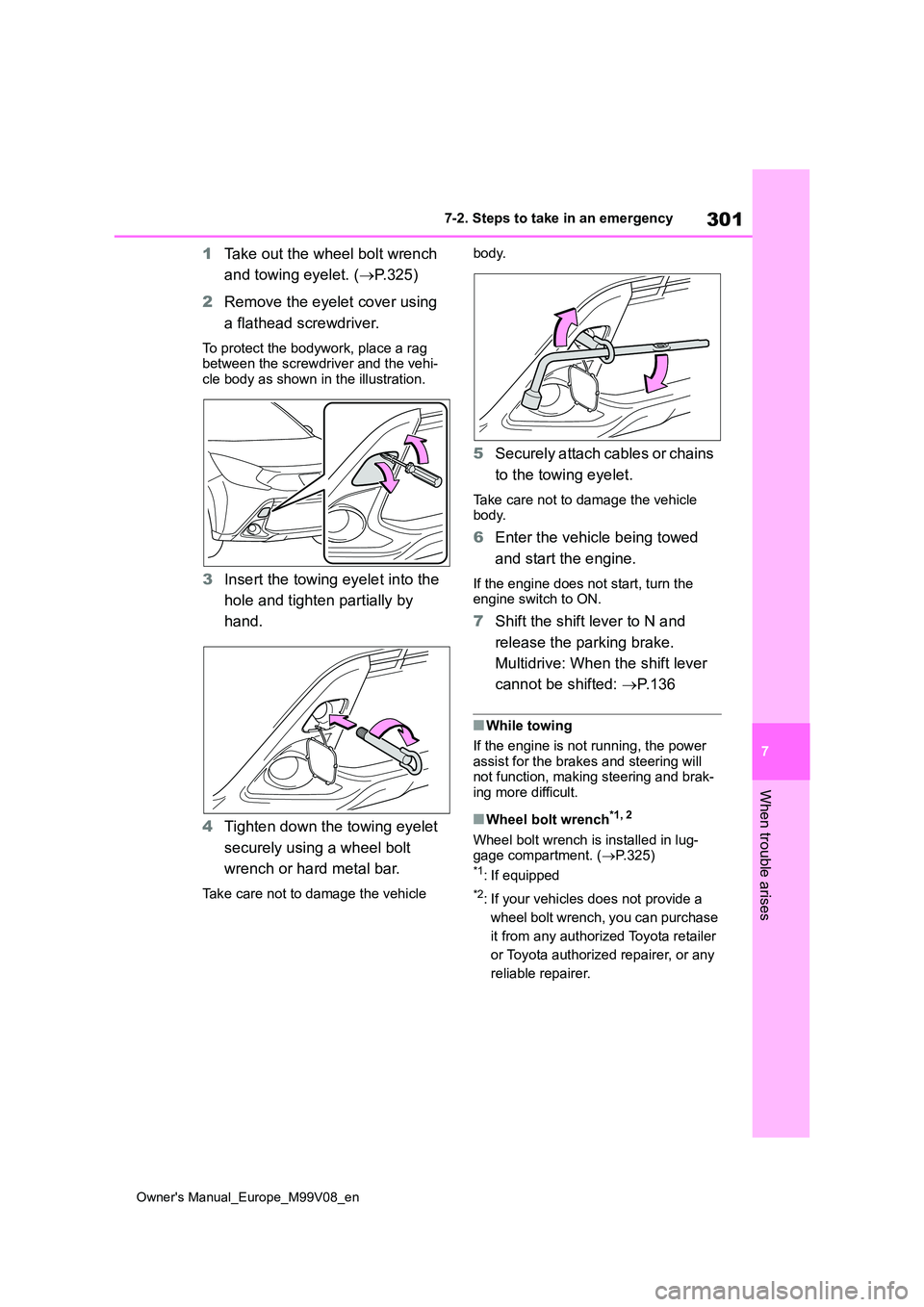
1Take out the wheel bolt wrench
and towing eyelet. ( P.325)
2 Remove the eyelet cover using
a flathead screwdriver.
To protect the bodywork, place a rag between the screwdriver and the vehi-cle body as shown in the illustration.
3 Insert the towing eyelet into the
hole and tighten partially by
hand.
4 Tighten down the towing eyelet
securely using a wheel bolt
wrench or hard metal bar.
Take care not to damage the vehicle
body.
5 Securely attach cables or chains
to the towing eyelet.
Take care not to damage the vehicle body.
6 Enter the vehicle being towed
and start the engine.
If the engine does not start, turn the engine switch to ON.
7 Shift the shift lever to N and
release the parking brake.
Multidrive: When the shift lever
cannot be shifted: P.136
■While towing
If the engine is not running, the power assist for the brakes and steering will not function, making steering and brak-
ing more difficult.
■Wheel bolt wrench*1, 2
Wheel bolt wrench is installed in lug- gage compartment. ( P.325)*1: If equipped
*2: If your vehicles does not provide a
wheel bolt wrench, you can purchase
it from any authorized Toyota retailer
or Toyota authorized repairer, or any
reliable repairer.
Page 304 of 494
302
Owner's Manual_Europe_M99V08_en
7-2. Steps to take in an emergency
Fluid leaks under the vehicle.
(Water dripping from the air con-
ditioning after use is normal.)
Flat-looking tires or uneven tire
wear
High engine coolant tempera-
ture warning light comes on
Changes in exhaust sound
Excessive tire squeal when cor-
nering
Strange noises related to the
suspension system
Pinging or other noises related to
the engine
Engine missing, stumbling or
running roughly
Appreciable loss of power
Vehicle pulls heavily to one side
WARNING
Observe the following precautions. Failure to do so may result in death or
serious injury.
■While towing
●When towing using cables or chains, avoid sudden starts, etc. which place excessive stress on the
towing eyelets, cables or chains. The towing eyelets, cables or chains may become damaged, bro-
ken debris may hit people, and cause serious damage.
●Do not turn the engine switch off.There is a possibility that the steer-ing wheel is locked and cannot be
operated.
■Installing towing eyelets to the
vehicle
Make sure that towing eyelets are installed securely.
If not securely installed, towing eye- lets may come loose during towing.
NOTICE
■To prevent damage to the vehicle during emergency towing
Do not secure cables or chains to the suspension components.
■When towing a vehicle equipped with the Stop & Start system
If it is necessary to tow the vehicle
with all four wheels on the ground, perform the following procedure before towing the vehicle in order to
protect the system. Turn the engine switch off and then start the engine or turn the engine switch to ON.
If you think something is
wrong
If you notice any of the follow-
ing symptoms, your vehicle
probably needs adjustment or
repair. Contact any authorized
Toyota retailer or Toyota autho-
rized repairer, or any reliable
repairer as soon as possible.
Visible symptoms
Audible symptoms
Operational symptoms
Page 324 of 494
322
Owner's Manual_Europe_M99V08_en
7-2. Steps to take in an emergency
replaced, make sure to tell any autho-
rized Toyota retailer or Toyota autho- rized repairer, or any reliable repairer that the sealant is injected.
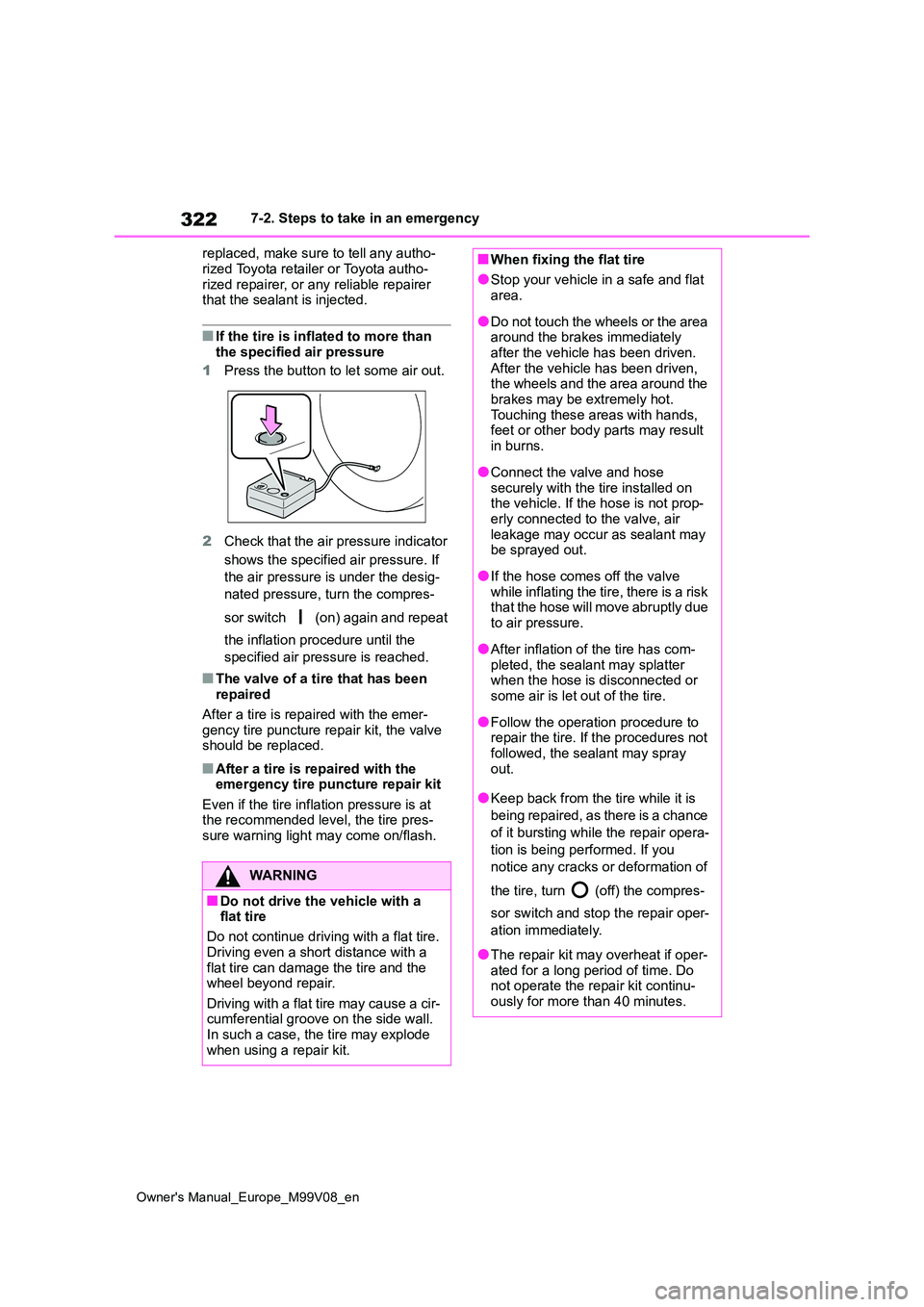
■If the tire is inflated to more than the specified air pressure
1 Press the button to let some air out.
2 Check that the air pressure indicator
shows the specified air pressure. If
the air pressure is under the desig-
nated pressure, turn the compres-
sor switch (on) again and repeat
the inflation procedure until the
specified air pressure is reached.
■The valve of a tire that has been repaired
After a tire is repaired with the emer-
gency tire puncture repair kit, the valve should be replaced.
■After a tire is repaired with the emergency tire puncture repair kit
Even if the tire inflation pressure is at the recommended level, the tire pres-sure warning light may come on/flash.
WARNING
■Do not drive the vehicle with a flat tire
Do not continue driving with a flat tire.
Driving even a short distance with a flat tire can damage the tire and the wheel beyond repair.
Driving with a flat tire may cause a cir- cumferential groove on the side wall. In such a case, the tire may explode
when using a repair kit.
■When fixing the flat tire
●Stop your vehicle in a safe and flat area.
●Do not touch the wheels or the area around the brakes immediately
after the vehicle has been driven. After the vehicle has been driven, the wheels and the area around the
brakes may be extremely hot. Touching these areas with hands, feet or other body parts may result
in burns.
●Connect the valve and hose
securely with the tire installed on the vehicle. If the hose is not prop-erly connected to the valve, air
leakage may occur as sealant may be sprayed out.
●If the hose comes off the valve while inflating the tire, there is a risk that the hose will move abruptly due
to air pressure.
●After inflation of the tire has com-
pleted, the sealant may splatter when the hose is disconnected or some air is let out of the tire.
●Follow the operation procedure to repair the tire. If the procedures not
followed, the sealant may spray out.
●Keep back from the tire while it is
being repaired, as there is a chance
of it bursting while the repair opera-
tion is being performed. If you
notice any cracks or deformation of
the tire, turn (off) the compres-
sor switch and stop the repair oper-
ation immediately.
●The repair kit may overheat if oper- ated for a long period of time. Do not operate the repair kit continu-
ously for more than 40 minutes.
Page 329 of 494
327
7
Owner's Manual_Europe_M99V08_en
7-2. Steps to take in an emergency
When trouble arises
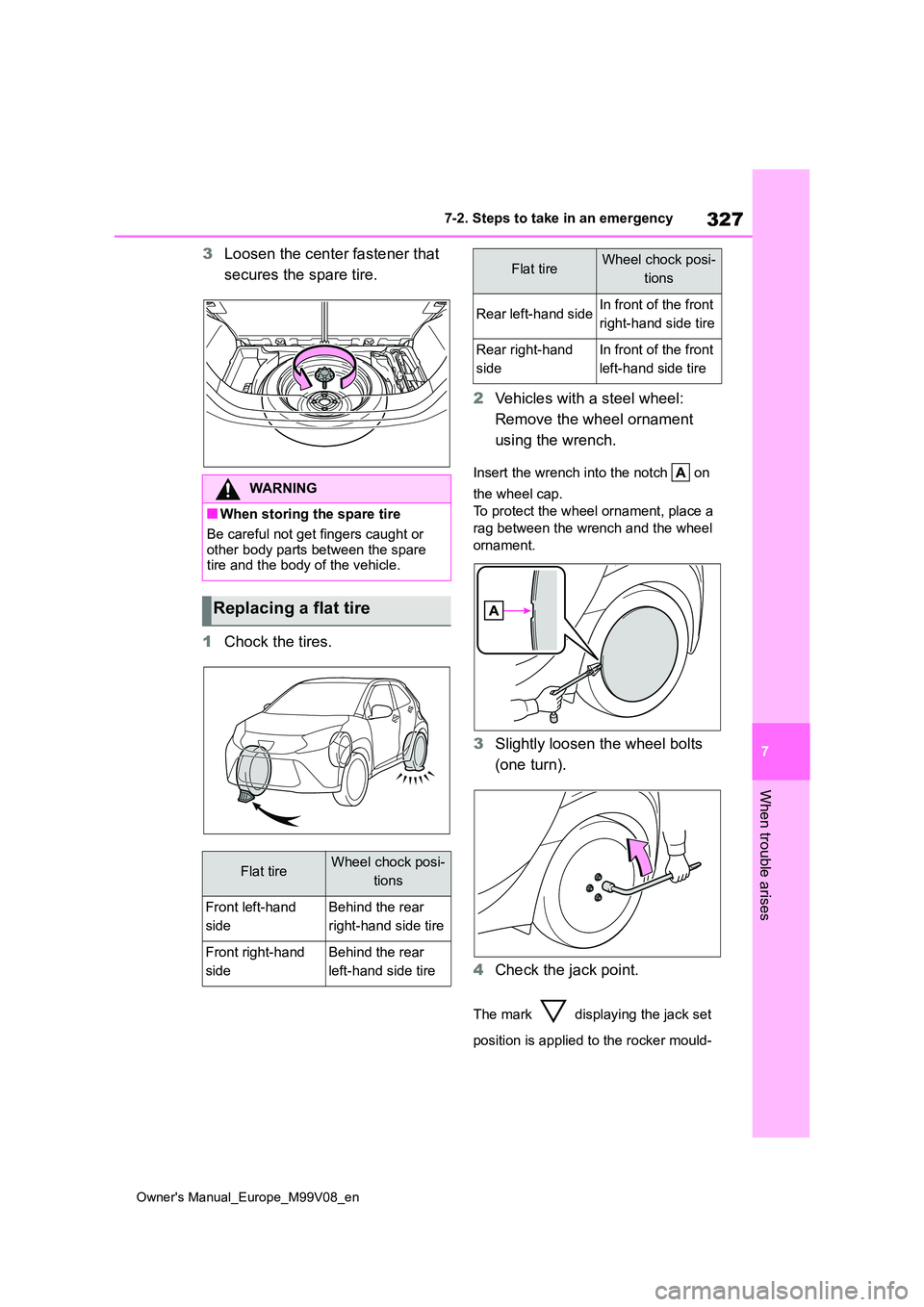
3Loosen the center fastener that
secures the spare tire.
1 Chock the tires.
2 Vehicles with a steel wheel:
Remove the wheel ornament
using the wrench.
Insert the wrench into the notch on
the wheel cap.
To protect the wheel ornament, place a
rag between the wrench and the wheel
ornament.
3 Slightly loosen the wheel bolts
(one turn).
4 Check the jack point.
The mark displaying the jack set
position is applied to the rocker mould-
WARNING
■When storing the spare tire
Be careful not get fingers caught or other body parts between the spare tire and the body of the vehicle.
Replacing a flat tire
Flat tireWheel chock posi-
tions
Front left-hand
side
Behind the rear
right-hand side tire
Front right-hand
side
Behind the rear
left-hand side tire
Rear left-hand sideIn front of the front
right-hand side tire
Rear right-hand
side
In front of the front
left-hand side tire
Flat tireWheel chock posi-
tions
Page 333 of 494
331
7
Owner's Manual_Europe_M99V08_en
7-2. Steps to take in an emergency
When trouble arises
WARNING
■When using the compact spare tire (if equipped)
●Remember that the compact spare tire provided is specifically designed for use with your vehicle.
Do not use your compact spare tire on another vehicle.
●Do not use more than one compact spare tires simultaneously.
●Replace the compact spare tire with a standard tire as soon as possible.
●Avoid sudden acceleration, abrupt steering, sudden braking and shift-ing operations that cause sudden
engine braking.
■When the compact spare tire (if
equipped) is attached
The vehicle speed may not be cor- rectly detected, and the following sys-
tems may not operate correctly:
• ABS & Brake assist
• VSC
•TRC
• Automatic High Beam (if equipped)
• Dynamic radar cruise control
• EPS
• PCS (Pre-Collision System)
• LTA (Lane Tracing Assist)
• Tire pressure warning system
• Toyota parking assist-sensor (if
equipped)
• Rear view monitor system (if
equipped)
• Navigation system (if equipped)
■Speed limit when using the com- pact spare tire (if equipped)
Do not drive at speeds in excess of 80
km/h (50 mph) when a compact spare tire is installed on the vehicle.
The compact spare tire is not designed for driving at high speeds. Failure to observe this precaution
may lead to an accident causing death or serious injury.
■After using the tools and jack
Before driving, make sure all the tools and jack are securely in place in their
storage location to reduce the possi- bility of personal injury during a colli-sion or sudden braking.
NOTICE
■Be careful when driving over bumps with the compact spare tire (if equipped) installed on the
vehicle.
The vehicle becomes lower when driving with the compact spare tire
compared to when driving with stan- dard tires. Be careful when driving over uneven road surfaces.
■Driving with tire chains and the compact spare tire (if equipped)
Do not fit tire chains to the compact spare tire. Tire chains may damage the vehicle body and adversely affect
driving performance.
■When replacing the tires
When removing or fitting the wheels, tires or the tire pressure warning valve and transmitter, contact any
authorized Toyota retailer or Toyota authorized repairer, or any reliable repairer as the tire pressure warning
valve and transmitter may be dam- aged if not handled correctly.
Page 339 of 494
337
7
Owner's Manual_Europe_M99V08_en
7-2. Steps to take in an emergency
When trouble arises
■Starting the engine when the bat- tery is discharged
The engine cannot be started by push- starting.
■To prevent battery discharge
●Turn off the headlights and the audio system while the engine is stopped.
●Turn off any unnecessary electrical components when the vehicle is run-ning at a low speed for an extended
period, such as in heavy traffic.
■When the battery is removed or dis- charged
●Information stored in the ECU is cleared. When the battery is depleted, have the vehicle inspected at any
authorized Toyota retailer or Toyota authorized repairer, or any reliable repairer.
●Some systems may require initializa-tion. ( P.361)
■When removing the battery termi-
nals
When the battery terminals are removed, the information stored in the
ECU is cleared. Before removing the battery terminals, contact any autho-rized Toyota retailer or Toyota autho-
rized repairer, or any reliable repairer.
■Charging the battery
The electricity stored in the battery will
discharge gradually even when the vehi- cle is not in use, due to natural dis-charge and the draining effects of
certain electrical appliances. If the vehi- cle is left for a long time, the battery may discharge, and the engine may be
unable to start. (The battery recharges automatically during driving.)
■When recharging or replacing the battery
●In some cases, it may not be possible to unlock the doors using the smart
entry & start system when the battery is discharged. Use the wireless remote control or the mechanical key
to lock or unlock the doors.
●The engine may not start on the first attempt after the battery has
recharged but will start normally after the second attempt. This is not a mal-function.
●The engine switch mode is memo-rized by the vehicle. When the battery
is reconnected, the system will return to the mode it was in before the bat-tery was discharged. Before discon-
necting the battery, turn the engine switch off.If you are unsure what mode the
engine switch was in before the bat- tery discharged, be especially careful when reconnecting the battery.
●The Stop & Start system may not automatically stop the engine for up to
an hour.
■When replacing the battery
●Use a genuine battery specifically
designed for use with the Stop & Start system or a battery with equivalent specifications to a genuine battery. If
an unsupported battery is used, Stop & Start system functions may be restricted to protect the battery. Also,
battery performance may decrease and the engine may not be able to restart. Contact any authorized Toyota
retailer or Toyota authorized repairer, or any reliable repairer for details.
●Use a battery that conforms to Euro-pean regulations.
●Use a battery that the case size is same as the previous one, 20 hour rate capacity (20HR) is equivalent or
greater, and performance rating (CCA) is equivalent or greater. Check the label on top of the battery for the
battery size and specifications (ex. LN2, 60Ah, 584A).• If the sizes differ, the battery cannot
be properly secured. • If the 20 hour rate capacity is low, even if the time period where the vehi-
cle is not used is a short time, the bat- tery may discharge and the engine may not be able to start.
Page 465 of 494
463
Owner's Manual_Europe_M99V08_en
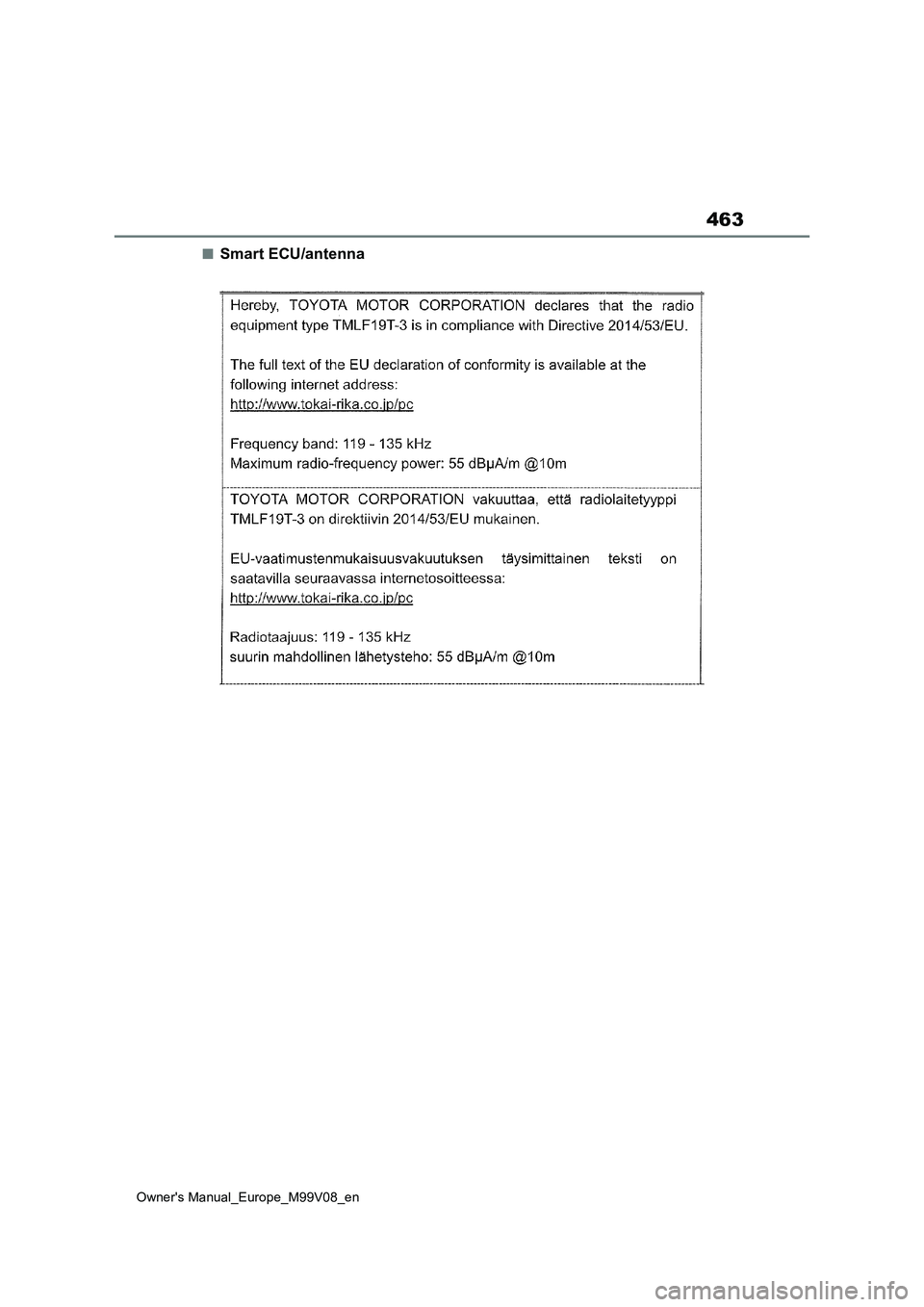
■Smart ECU/antenna