tire pressure TOYOTA BZ4X 2022 (in English) User Guide
[x] Cancel search | Manufacturer: TOYOTA, Model Year: 2022, Model line: BZ4X, Model: TOYOTA BZ4X 2022Pages: 674, PDF Size: 120.02 MB
Page 278 of 674
276
Owners Manual_Europe_M42D76_en
5-4. Using the driving support systems
■AHS (Adaptive High-beam
System) (if equipped)
P. 2 6 2
■AHB (Automatic High Beam)
(if equipped)
P. 2 6 5
■PCS (Pre-Collision System)
P. 2 8 3
■LTA (Lane Tracing Assist)
P. 2 9 4
■LDA (Lane Departure Alert)
P. 2 9 9
■RSA (Road Sign Assist)
P. 3 0 4
■Dynamic radar cruise control
P. 3 0 7
■Speed limiter (if equipped)
P. 3 1 8
■Emergency Driving Stop Sys-
tem
P. 3 2 1
Various sensors are used to obtain
the necessary information for sys-
tem operation.
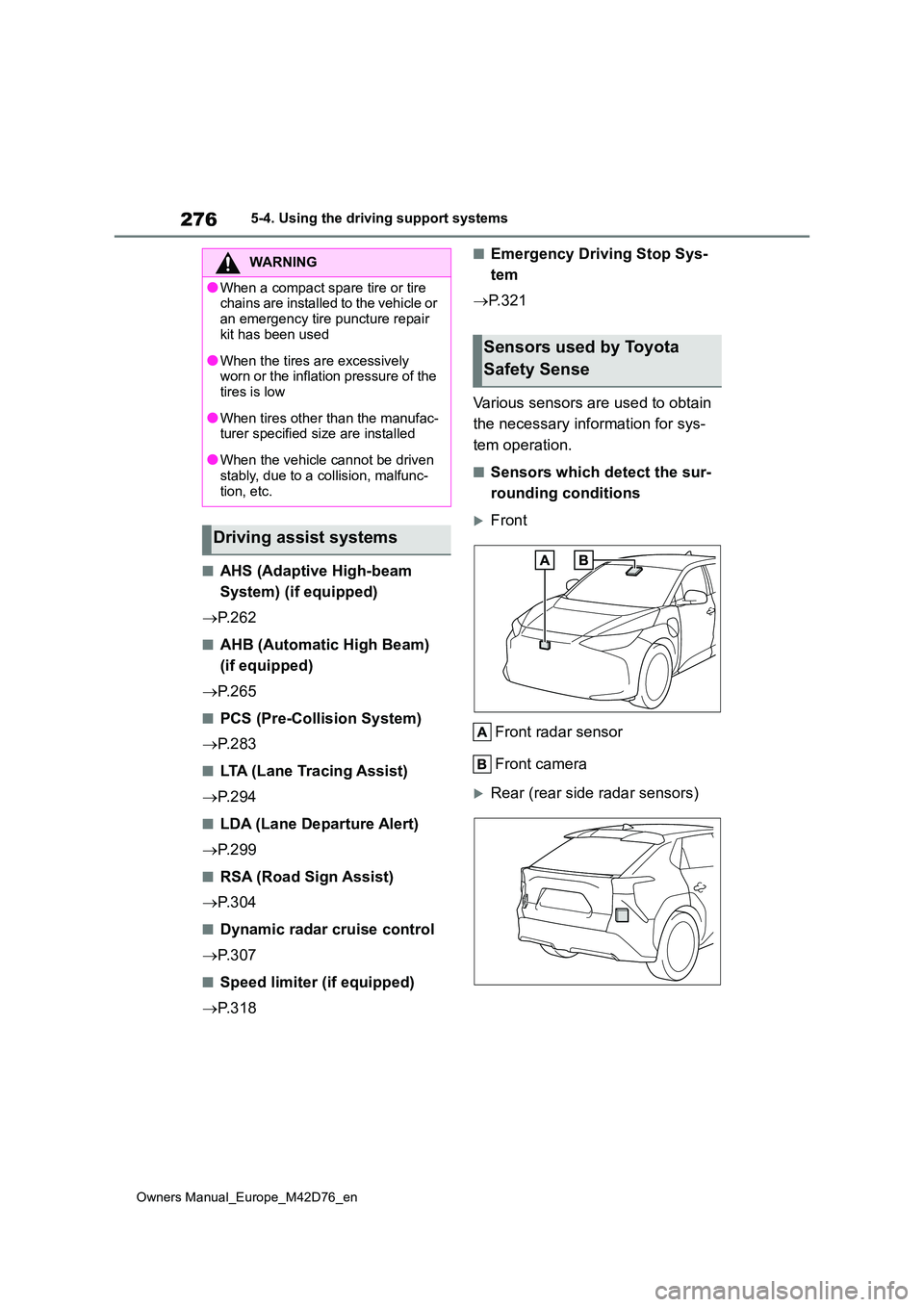
■Sensors which detect the sur-
rounding conditions
Front
Front radar sensor
Front camera
Rear (rear side radar sensors)
WARNING
●When a compact spare tire or tire chains are installed to the vehicle or
an emergency tire puncture repair kit has been used
●When the tires are excessively worn or the inflation pressure of the tires is low
●When tires other than the manufac-turer specified size are installed
●When the vehicle cannot be driven stably, due to a collision, malfunc-
tion, etc.
Driving assist systems
Sensors used by Toyota
Safety Sense
Page 336 of 674
334
Owners Manual_Europe_M42D76_en
5-4. Using the driving support systems
Use the meter control switches to
enable/disable the Toyota parking
assist-sensor. ( P. 1 7 6 )
1 Press or to select .
2 Press or to select
and then press .
When the Toyota parking assist-sensor
function is disabled, the Toyota parking
assist-sensor OFF indicator ( P.169)
illuminates.
To re-enable the system when it was
disabled, select on the multi-infor-
mation display, select and then
On. If disabled using this method, the
system will not be re-enabled by turning
the power switch off and then to ON.
Turning Toyota parking
assist-sensor on/off
WARNING
■Cautions regarding the use of
the system
There is a limit to the degree of recog- nition accuracy and control perfor-
mance that this system can provide, do not overly rely on this system. The driver is always responsible for paying
attention to the vehicle’s surroundings and driving safely.
■To ensure the system can oper-ate properly
Observe the following precautions.
Failing to do so may result in the vehi- cle being unable to be driven safely and possibly cause an accident.
●Do not damage the sensors, and always keep them clean.
●Do not attach a sticker or install an electronic component, such as a backlit license plate (especially fluo-
rescent type), fog lights, fender pole or wireless antenna near a radar sensor.
●Do not subject the surrounding area of the sensor to a strong impact. If
subjected to an impact, have the vehicle inspected by any authorized Toyota retailer or Toyota authorized
repairer, or any reliable repairer. If the front or rear bumper needs to be removed/installed or replaced,
contact any authorized Toyota retailer or Toyota authorized repairer, or any reliable repairer.
●Do n ot m od i fy, d is a sse mb l e o r p ai n t the sensors.
●Do not attach a license plate cover.
●Keep your tires properly inflated.
■When to disable the function
In the following situations, disable the function as it may operate even though there is no possibility of a colli-
sion.
●Failing to observe the warnings
above.
●A non-genuine Toyota suspension
(lowered suspension, etc.) is installed.
■Notes when washing the vehicle
Do not apply intensive bursts of water or steam to the sensor area.
Doing so may result in the sensor malfunctioning.
●When using a high pressure washer to wash the vehicle, do not spray the sensors directly, as doing
so may cause a sensor to malfunc- tion.
Page 351 of 674
349
5
Owners Manual_Europe_M42D76_en
5-4. Using the driving support systems
Driving
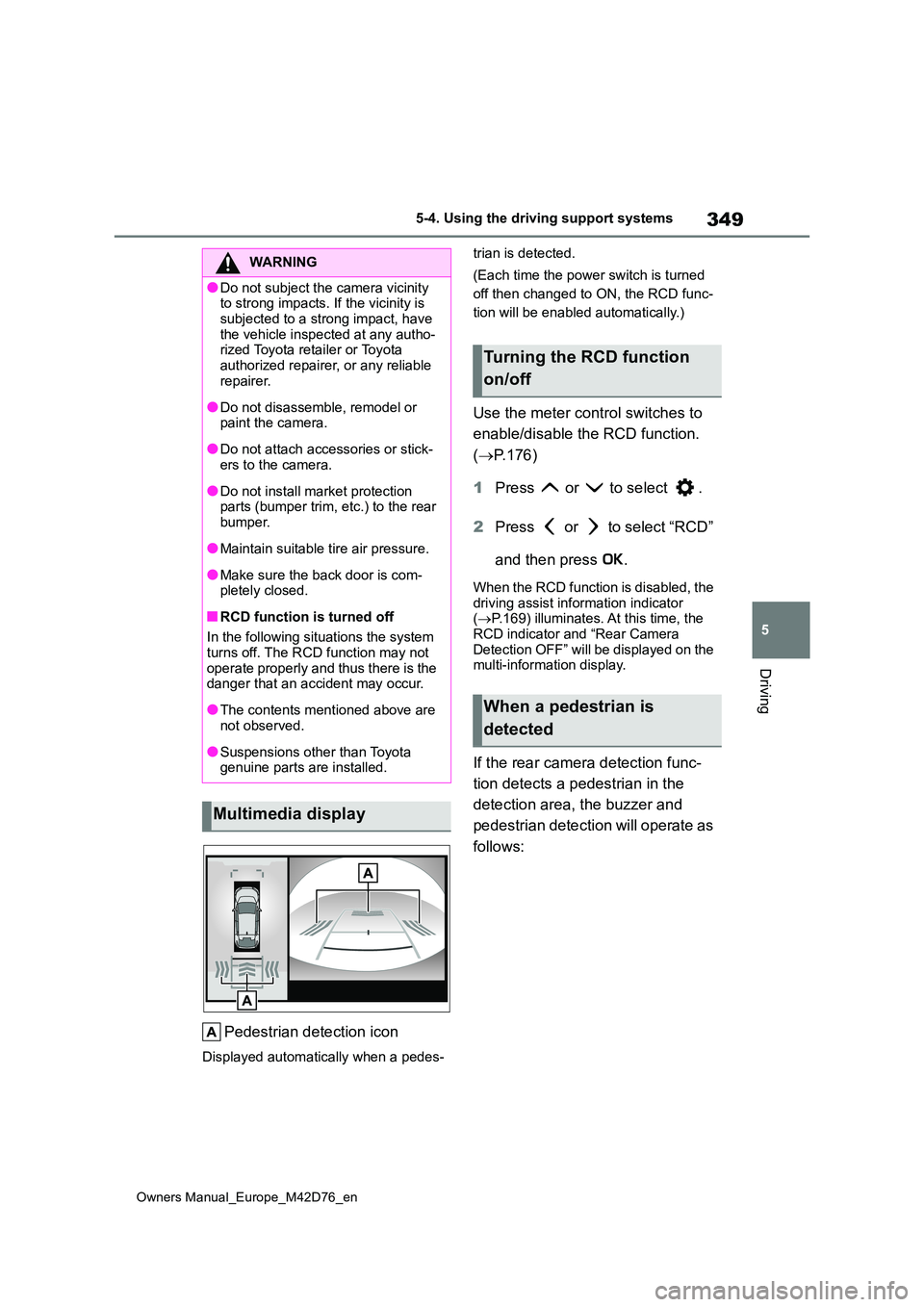
Pedestrian detection icon
Displayed automatically when a pedes-
trian is detected.
(Each time the power switch is turned
off then changed to ON, the RCD func-
tion will be enabled automatically.)
Use the meter control switches to
enable/disable the RCD function.
( P.176)
1 Press or to select .
2 Press or to select “RCD”
and then press .
When the RCD function is disabled, the driving assist information indicator ( P.169) illuminates. At this time, the
RCD indicator and “Rear Camera Detection OFF” will be displayed on the multi-information display.
If the rear camera detection func-
tion detects a pedestrian in the
detection area, the buzzer and
pedestrian detection will operate as
follows:
WARNING
●Do not subject the camera vicinity to strong impacts. If the vicinity is
subjected to a strong impact, have the vehicle inspected at any autho-rized Toyota retailer or Toyota
authorized repairer, or any reliable repairer.
●Do not disassemble, remodel or paint the camera.
●Do not attach accessories or stick-ers to the camera.
●Do not install market protection parts (bumper trim, etc.) to the rear bumper.
●Maintain suitable tire air pressure.
●Make sure the back door is com-pletely closed.
■RCD function is turned off
In the following situations the system turns off. The RCD function may not
operate properly and thus there is the danger that an accident may occur.
●The contents mentioned above are not observed.
●Suspensions other than Toyota genuine parts are installed.
Multimedia display
Turning the RCD function
on/off
When a pedestrian is
detected
Page 413 of 674
411
5
Owners Manual_Europe_M42D76_en
5-5. Driving tips
Driving
5-5.Driving tips
Use fluids that are appropriate to
the prevailing outside tempera-
tures.
• Power control unit coolant
• Heater coolant
• Washer fluid
Have a service technician
inspect the condition of the 12-
volt battery.
Have the vehicle fitted with four
snow tires or purchase a set of
tire chains for the front tires.
Ensure that all tires are the same size
and brand, and that chains match the
size of the tires.
Perform the following according to
Winter driving tips
Carry out the necessary prepa-
rations and inspections before
driving the vehicle in winter.
Always drive the vehicle in a
manner appropriate to the pre-
vailing weather conditions.
Preparation for winter
WARNING
■Driving with snow tires
Observe the following precautions to
reduce the risk of accidents. Failure to do so may result in a loss of vehicle control and cause death or
serious injury.
●Use tires of the specified size.
●Maintain the recommended level of air pressure.
●Do not drive at speeds in excess of the speed limit or the speed limit specified for the snow tires being
used.
●Use snow tires on all, not just some
wheels.
■Driving with tire chains
Observe the following precautions to reduce the risk of accidents.Failure to do so may result in the vehi-
cle being unable to be driven safely, and may cause death or serious injury.
●Do not drive in excess of the speed limit specified for the tire chains being used, or 50 km/h (30 mph),
whichever is lower.
●Avoid driving on bumpy road sur-
faces or over potholes.
●Avoid sudden acceleration, abrupt
steering, sudden braking and shift- ing operations that cause sudden regenerative braking.
●Slow down sufficiently before enter-ing a curve to ensure that vehicle
control is maintained.
●Do not use LTA (Lane Tracing
Assist).
NOTICE
■Repairing or replacing snow tires
Request repairs or replacement of
snow tires from any authorized Toyota retailer or Toyota authorized repairer, or any reliable repairer or legitimate
tire retailers. This is because the removal and attachment of snow tires affects the
operation of the tire pressure warning valves and transmitters.
Before driving the vehicle
Page 415 of 674
413
5
Owners Manual_Europe_M42D76_en
5-5. Driving tips
Driving
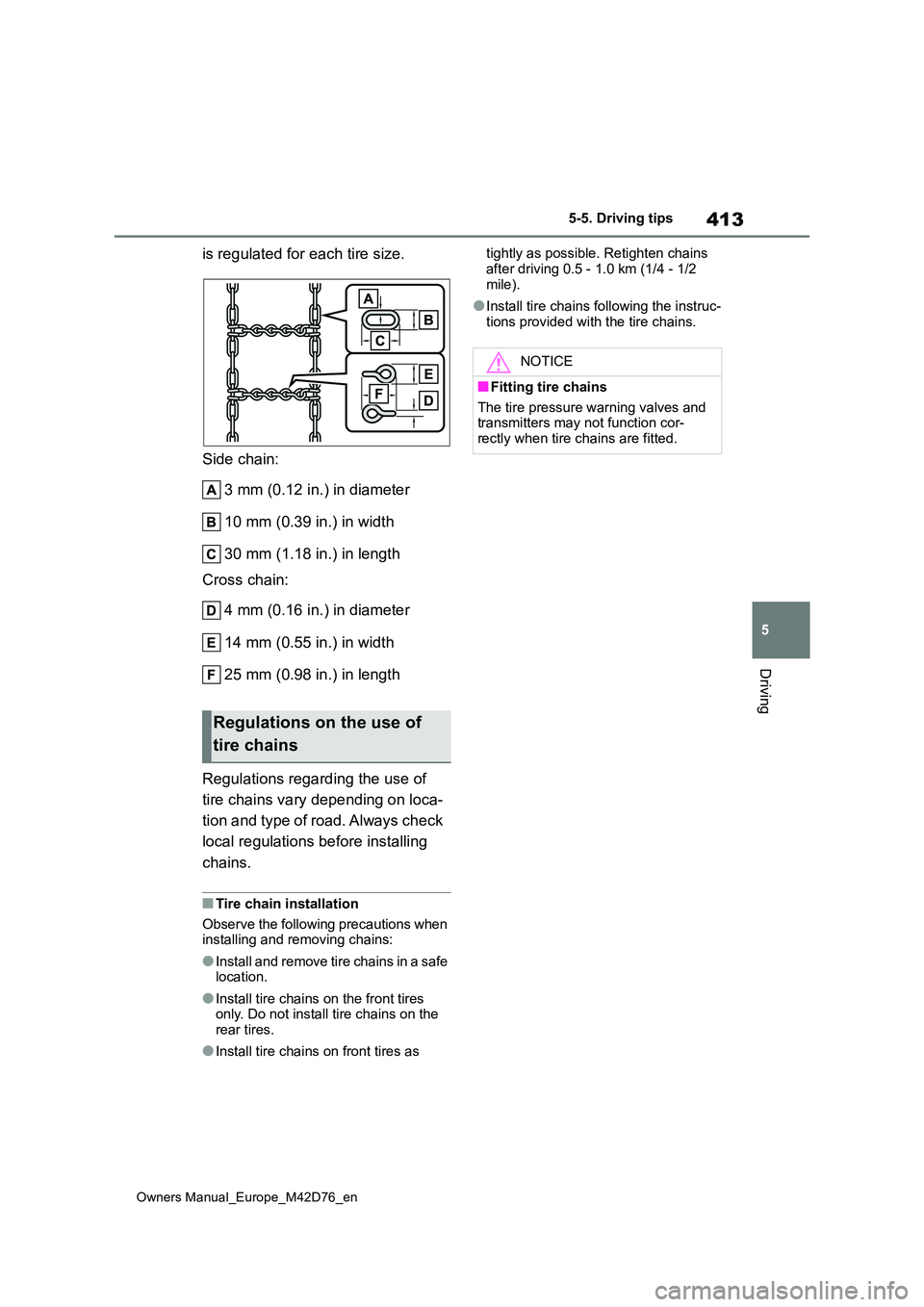
is regulated for each tire size.
Side chain:
3 mm (0.12 in.) in diameter
10 mm (0.39 in.) in width
30 mm (1.18 in.) in length
Cross chain:
4 mm (0.16 in.) in diameter
14 mm (0.55 in.) in width
25 mm (0.98 in.) in length
Regulations regarding the use of
tire chains vary depending on loca-
tion and type of road. Always check
local regulations before installing
chains.
■Tire chain installation
Observe the following precautions when installing and removing chains:
●Install and remove tire chains in a safe location.
●Install tire chains on the front tires only. Do not install tire chains on the rear tires.
●Install tire chains on front tires as
tightly as possible. Retighten chains
after driving 0.5 - 1.0 km (1/4 - 1/2 mile).
●Install tire chains following the instruc-tions provided with the tire chains.
Regulations on the use of
tire chains
NOTICE
■Fitting tire chains
The tire pressure warning valves and transmitters may not function cor-rectly when tire chains are fitted.
Page 457 of 674
7
455
Owners Manual_Europe_M42D76_en
7
Maintenance and care
Maintenance and care
7-1. Maintenance and care
Cleaning and protecting the
vehicle exterior ............... 456
Cleaning and protecting the
vehicle interior ................ 459
7-2. Maintenance
Maintenance requirements 463
7-3. Do-it-yourself maintenance
Do-it-yourself service precau-
tions ................................ 465
Hood ................................. 467
Positioning a floor jack...... 468
Motor compartment .......... 470
Tires .................................. 476
Replacing the tire.............. 488
Tire inflation pressure ....... 494
Wheels.............................. 495
Air conditioning filter ......... 496
Electronic key battery ....... 499
Checking and replacing fuses
....................................... 501
Light bulbs ........................ 504
Page 467 of 674
465
7
Owners Manual_Europe_M42D76_en
7-3. Do-it-yourself maintenance
Maintenance and care
7-3.Do-it-y ours elf main ten ance
Do-it-yourself ser vice
precautions
If you perform maintenance by
yourself, be sure to follow the
correct procedure as given in
these sections.
Maintenance
ItemsParts and tools
12-volt battery
condition
( P.473)
•Warm water
• Baking soda
•Grease
• Conventional
wrench (for terminal
clamp bolts)
• Distilled water
Heater coolant
level
( P.470, 472)
• “Toyota Super Long
Life Coolant” or a
similar high quality
ethylene glycol-
based non-silicate,
non-amine, non-
nitrite and non-
borate coolant with
long-life hybrid
organic acid technol-
ogy
“Toyota Super Long
Life Coolant” is pre-
mixed with 50%
coolant and 50%
deionized water.
• Funnel (used only
for adding coolant)
Power control
unit coolant
level
( P.472)
• In order to ensure
maximum perfor-
mance of the trac-
tion battery cooling
system and limit
risks of battery
short-circuit and
other damage to
your vehicle, Toyota
recommends using
“Toyota Genuine
Traction Battery
Coolant” or similar
high-quality ethylene
glycol-based, low
electric conductivity
coolant, non-amine
and non-borate cool-
ant with azole addi-
tives.
• Funnel (used only
for adding coolant)
Fuses
( P.501)
• Fuse with same
amperage rating as
original
Radiator and
condenser
( P.471)
−
Tire inflation
pressure
( P.494)
• Tire pressure gauge
• Compressed air
source
Washer fluid
( P.475)
• Water or washer
fluid containing anti-
freeze (for winter
use)
• Funnel (used only
for adding water or
washer fluid)
ItemsParts and tools
Page 479 of 674
477
7
Owners Manual_Europe_M42D76_en
7-3. Do-it-yourself maintenance
Maintenance and care
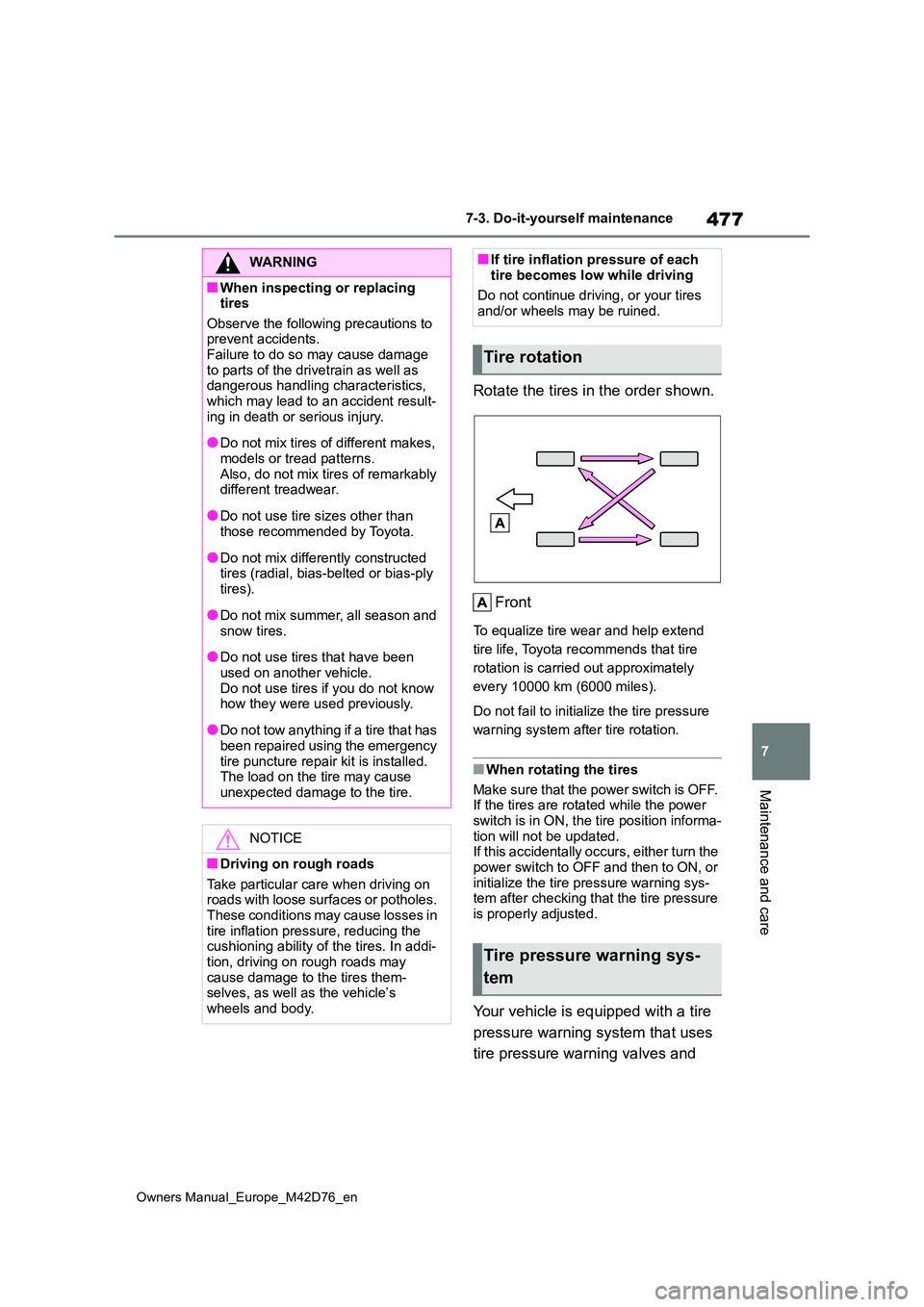
Rotate the tires in the order shown.
Front
To equalize tire wear and help extend
tire life, Toyota recommends that tire
rotation is carried out approximately
every 10000 km (6000 miles).
Do not fail to initialize the tire pressure
warning system after tire rotation.
■When rotating the tires
Make sure that the power switch is OFF. If the tires are rotated while the power
switch is in ON, the tire position informa- tion will not be updated. If this accidentally occurs, either turn the
power switch to OFF and then to ON, or initialize the tire pressure warning sys-tem after checking that the tire pressure
is properly adjusted.
Your vehicle is equipped with a tire
pressure warning system that uses
tire pressure warning valves and
WARNING
■When inspecting or replacing tires
Observe the following precautions to prevent accidents. Failure to do so may cause damage
to parts of the drivetrain as well as dangerous handling characteristics, which may lead to an accident result-
ing in death or serious injury.
●Do not mix tires of different makes,
models or tread patterns. Also, do not mix tires of remarkably different treadwear.
●Do not use tire sizes other than those recommended by Toyota.
●Do not mix differently constructed tires (radial, bias-belted or bias-ply
tires).
●Do not mix summer, all season and
snow tires.
●Do not use tires that have been
used on another vehicle. Do not use tires if you do not know how they were used previously.
●Do not tow anything if a tire that has been repaired using the emergency
tire puncture repair kit is installed. The load on the tire may cause unexpected damage to the tire.
NOTICE
■Driving on rough roads
Take particular care when driving on roads with loose surfaces or potholes. These conditions may cause losses in
tire inflation pressure, reducing the cushioning ability of the tires. In addi-tion, driving on rough roads may
cause damage to the tires them- selves, as well as the vehicle’s wheels and body.
■If tire inflation pressure of each tire becomes low while driving
Do not continue driving, or your tires
and/or wheels may be ruined.
Tire rotation
Tire pressure warning sys-
tem
Page 480 of 674
478
Owners Manual_Europe_M42D76_en
7-3. Do-it-yourself maintenance
transmitters to detect low tire infla-
tion pressure before serious prob-
lems arise.
The tire pressure warning system
of this vehicle adopts a 2-type
warning system.
When “Adjust Pressure” is dis-
played (Normal Warning)
A warning with the tire pressure warn-
ing light and warning buzzer when
there is an unknown level of low tire
pressure with the appearance of the tire
due to natural air leakage as well as the
pressure lowering due to changes in
the pressure according to the outside
temperature.
When “Immediately Check tyre
when Safe” is displayed (Emer-
gency Warning)
A warning with the tire pressure warn-
ing light and warning buzzer when
there is a known level of low tire pres-
sure with the appearance of the tire due
to pressure suddenly lowering.
However, the system may not be able
to detect sudden tire ruptures (bursting,
etc.).
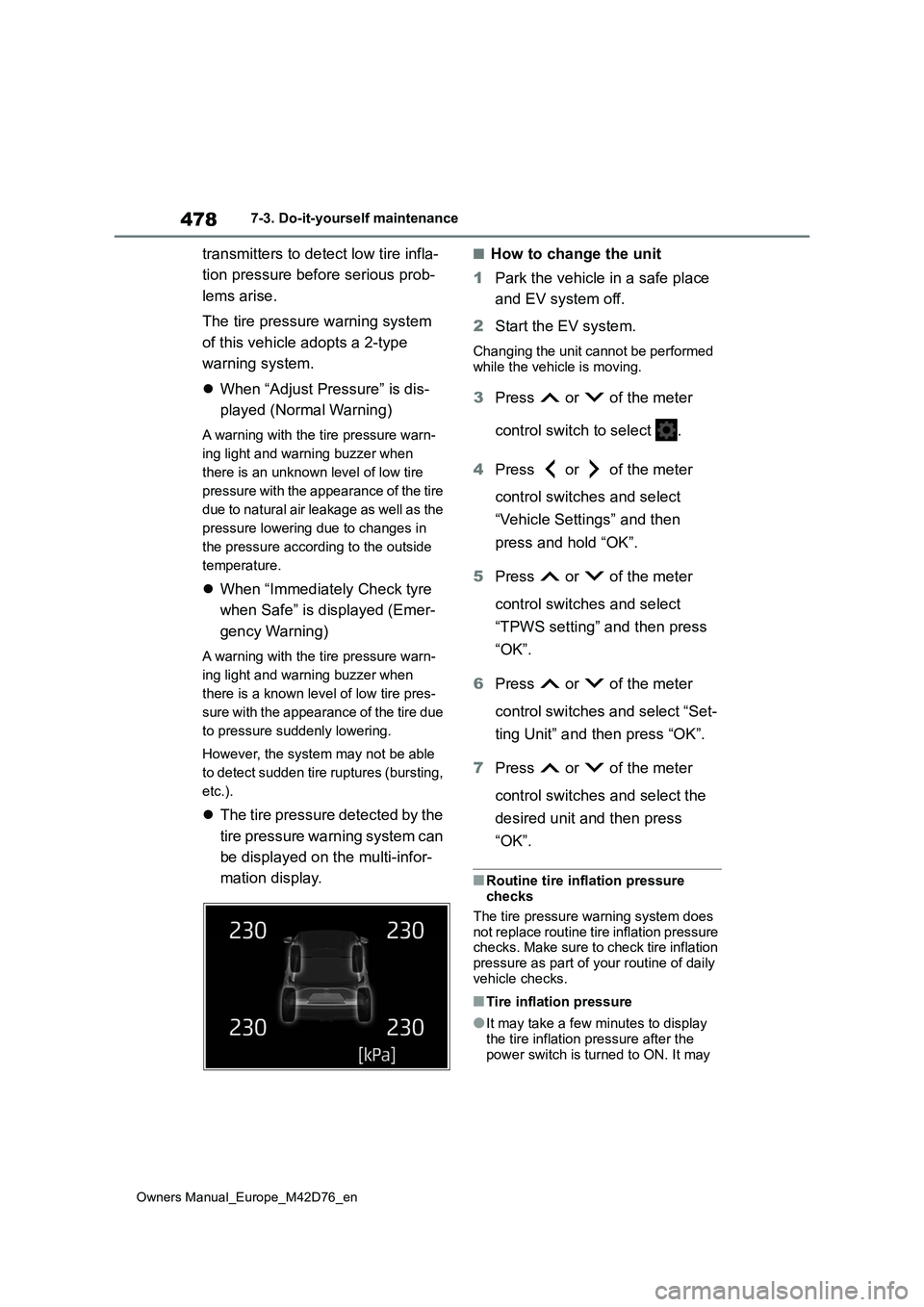
The tire pressure detected by the
tire pressure warning system can
be displayed on the multi-infor-
mation display.
■How to change the unit
1 Park the vehicle in a safe place
and EV system off.
2 Start the EV system.
Changing the unit cannot be performed
while the vehicle is moving.
3 Press or of the meter
control switch to select .
4 Press or of the meter
control switches and select
“Vehicle Settings” and then
press and hold “OK”.
5 Press or of the meter
control switches and select
“TPWS setting” and then press
“OK”.
6 Press or of the meter
control switches and select “Set-
ting Unit” and then press “OK”.
7 Press or of the meter
control switches and select the
desired unit and then press
“OK”.
■Routine tire inflation pressure checks
The tire pressure warning system does
not replace routine tire inflation pressure checks. Make sure to check tire inflation pressure as part of your routine of daily
vehicle checks.
■Tire inflation pressure
●It may take a few minutes to display
the tire inflation pressure after the power switch is turned to ON. It may
Page 481 of 674
479
7
Owners Manual_Europe_M42D76_en
7-3. Do-it-yourself maintenance
Maintenance and care
also take a few minutes to display the
tire inflation pressure after inflation pressure has been adjusted.
●Tire inflation pressure changes with temperature.The displayed values may also be dif-
ferent from the values measured using a tire pressure gauge.
■Situations in which the tire pres-sure warning system may not oper-
ate properly
●In the following cases, the tire pres-
sure warning system may not operate properly.• If non-genuine Toyota wheels are
used. • A tire has been replaced with a tire that is not an OE (Original Equipment)
tire. • A tire has been replaced with a tire that is not of the specified size.
• Tire chains etc. are equipped. • If a window tint that affects the radio wave signals is installed.
• If there is a lot of snow or ice on the vehicle, particularly around the wheels or wheel housings.
• If the tire inflation pressure is extremely higher than the specified level.
• If wheels without tire pressure warning valves and transmitters are used.• If the ID code on the tire pressure
warning valves and transmitters is not registered in the tire pressure warning computer.
●Performance may be affected in the following situations.
• Near a TV tower, electric power plant, gas station, radio station, large dis-play, airport or other facility that gen-
erates strong radio waves or electrical noise• When carrying a portable radio, cellu-
lar phone, cordless phone or other wireless communication device
If tire position information is not correctly
displayed due to the radio wave condi-
tions, the display may be corrected by
driving and changing the radio wave
conditions.
●When the vehicle is parked, the time taken for the warning to start or go off could be extended.
●When tire inflation pressure declines rapidly for example when a tire has
burst, the warning may not function.
When replacing tires or wheels, tire
pressure warning valves and trans-
mitters must also be installed.
When new tire pressure warning valves
and transmitters are installed, new ID
codes must be registered in the tire
pressure warning computer and the tire
pressure warning system must be ini-
tialized. ( P.484)
■When replacing the tires and wheels
If the ID code of the tire pressure warn-
ing valve and transmitter is not regis- tered, the tire pressure warning system will not work properly. After driving for
about 10 minutes, the tire pressure warning light blinks for 1 minute and
stays on to indicate a system malfunc- tion.
Installing tire pressure warn-
ing valves and transmitters