flat tire TOYOTA BZ4X 2022 (in English) Service Manual
[x] Cancel search | Manufacturer: TOYOTA, Model Year: 2022, Model line: BZ4X, Model: TOYOTA BZ4X 2022Pages: 674, PDF Size: 120.02 MB
Page 536 of 674
534
Owners Manual_Europe_M42D76_en
8-2. Steps to take in an emergency
Therefore keep it in a safe place.
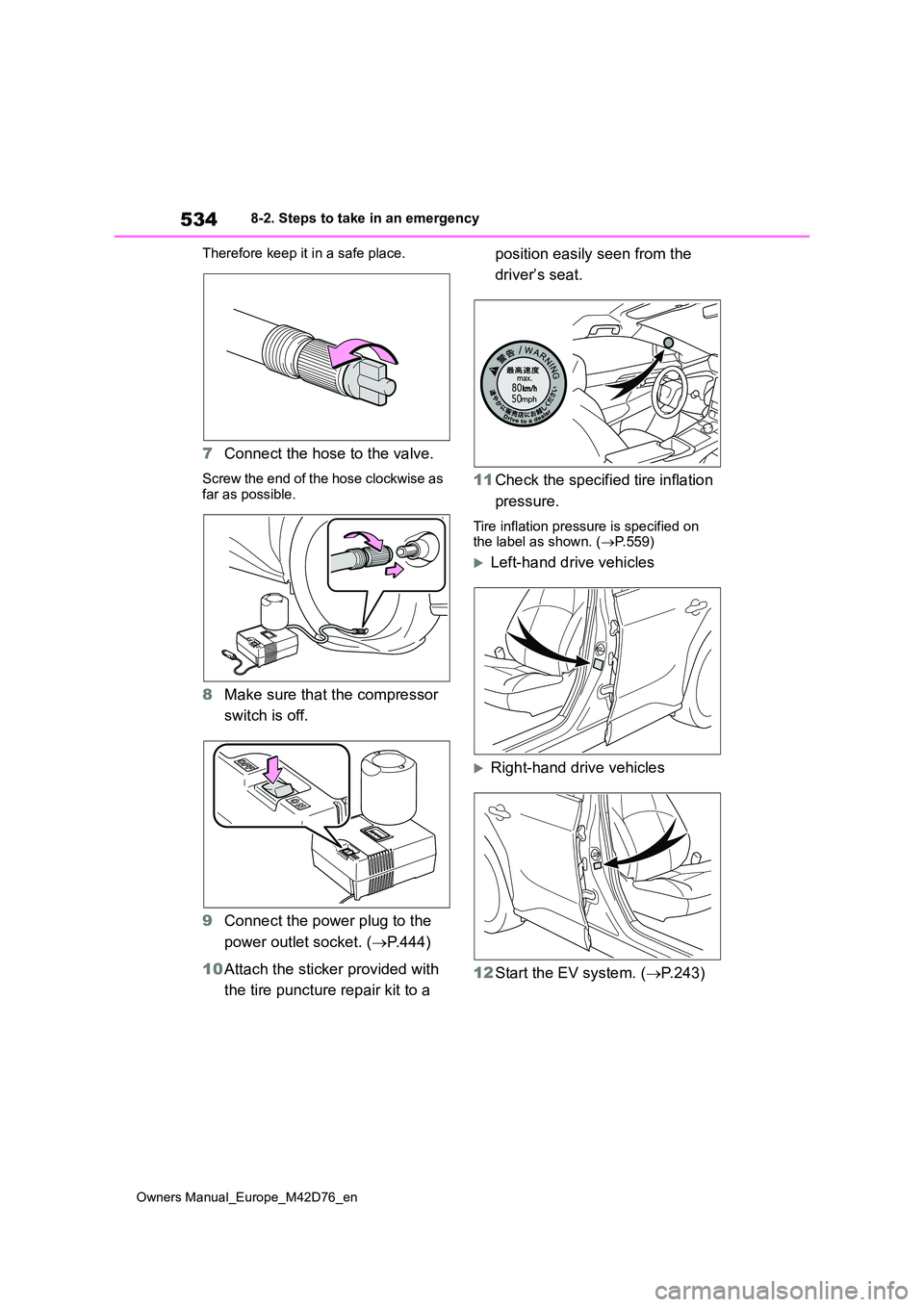
7 Connect the hose to the valve.
Screw the end of the hose clockwise as
far as possible.
8 Make sure that the compressor
switch is off.
9 Connect the power plug to the
power outlet socket. ( P.444)
10 Attach the sticker provided with
the tire puncture repair kit to a
position easily seen from the
driver’s seat.
11 Check the specified tire inflation
pressure.
Tire inflation pressure is specified on the label as shown. ( P.559)
Left-hand drive vehicles
Right-hand drive vehicles
12 Start the EV system. (P.243)
Page 537 of 674
535
8
Owners Manual_Europe_M42D76_en
8-2. Steps to take in an emergency
When trouble arises
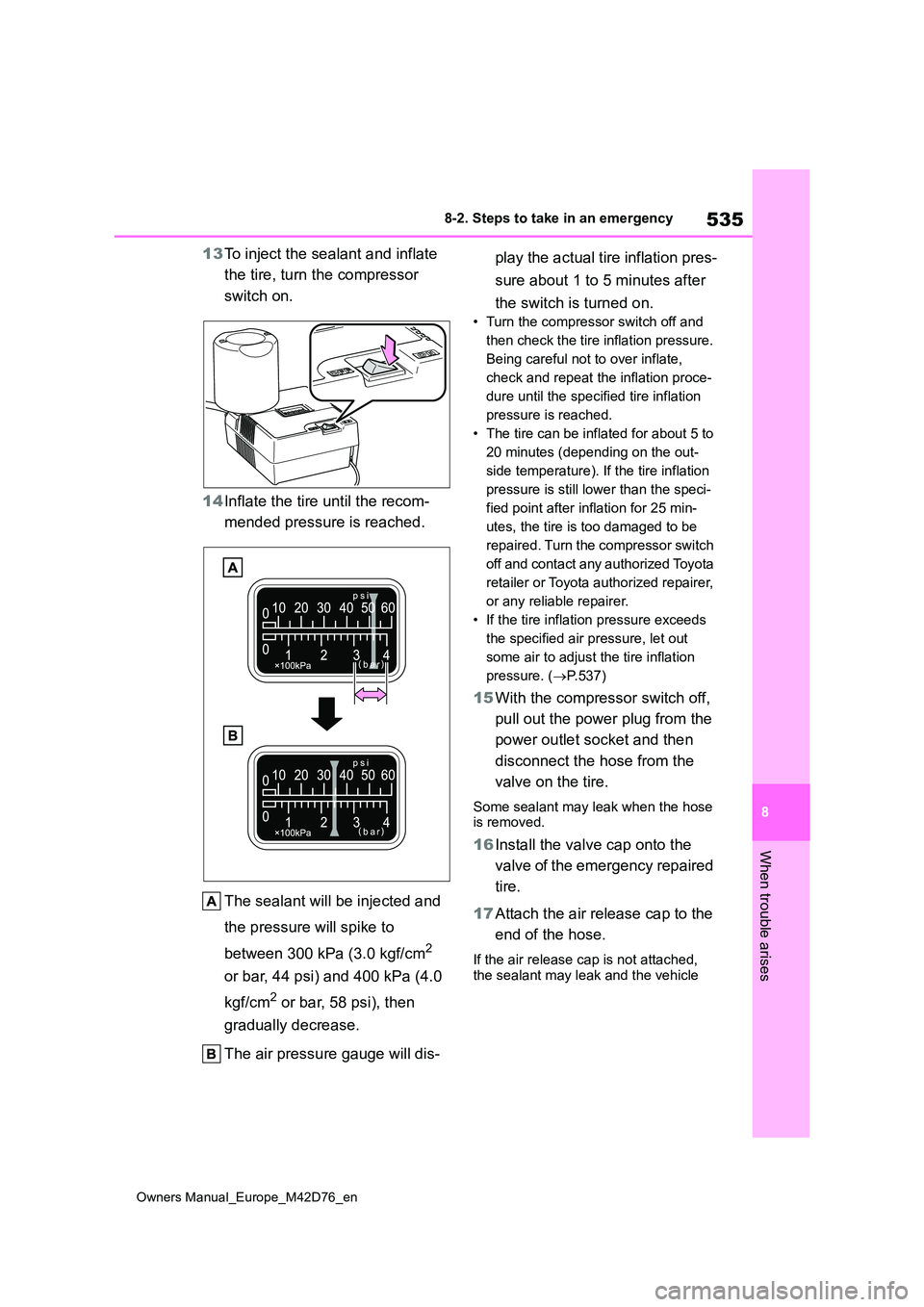
13To inject the sealant and inflate
the tire, turn the compressor
switch on.
14 Inflate the tire until the recom-
mended pressure is reached.
The sealant will be injected and
the pressure will spike to
between 300 kPa (3.0 kgf/cm2
or bar, 44 psi) and 400 kPa (4.0
kgf/cm2 or bar, 58 psi), then
gradually decrease.
The air pressure gauge will dis-
play the actual tire inflation pres-
sure about 1 to 5 minutes after
the switch is turned on.
• Turn the compressor switch off and
then check the tire inflation pressure.
Being careful not to over inflate,
check and repeat the inflation proce-
dure until the specified tire inflation
pressure is reached.
• The tire can be inflated for about 5 to
20 minutes (depending on the out-
side temperature). If the tire inflation
pressure is still lower than the speci-
fied point after inflation for 25 min-
utes, the tire is too damaged to be
repaired. Turn the compressor switch
off and contact any authorized Toyota
retailer or Toyota authorized repairer,
or any reliable repairer.
• If the tire inflation pressure exceeds
the specified air pressure, let out
some air to adjust the tire inflation
pressure. ( P.537)
15With the compressor switch off,
pull out the power plug from the
power outlet socket and then
disconnect the hose from the
valve on the tire.
Some sealant may leak when the hose is removed.
16 Install the valve cap onto the
valve of the emergency repaired
tire.
17 Attach the air release cap to the
end of the hose.
If the air release cap is not attached, the sealant may leak and the vehicle
Page 538 of 674
536
Owners Manual_Europe_M42D76_en
8-2. Steps to take in an emergency
may get dirty.
18 Temporarily store the bottle in
the luggage compartment while
it is connected to the compres-
sor.
19 To spread the liquid sealant
evenly within the tire, immedi-
ately drive safely for about 5 km
(3 miles) below 80 km/h (50
mph).
20 After driving, stop your vehicle in
a safe place on a hard, flat sur-
face and reconnect the repair
kit.
Remove the air release cap from the hose before reconnecting the hose.
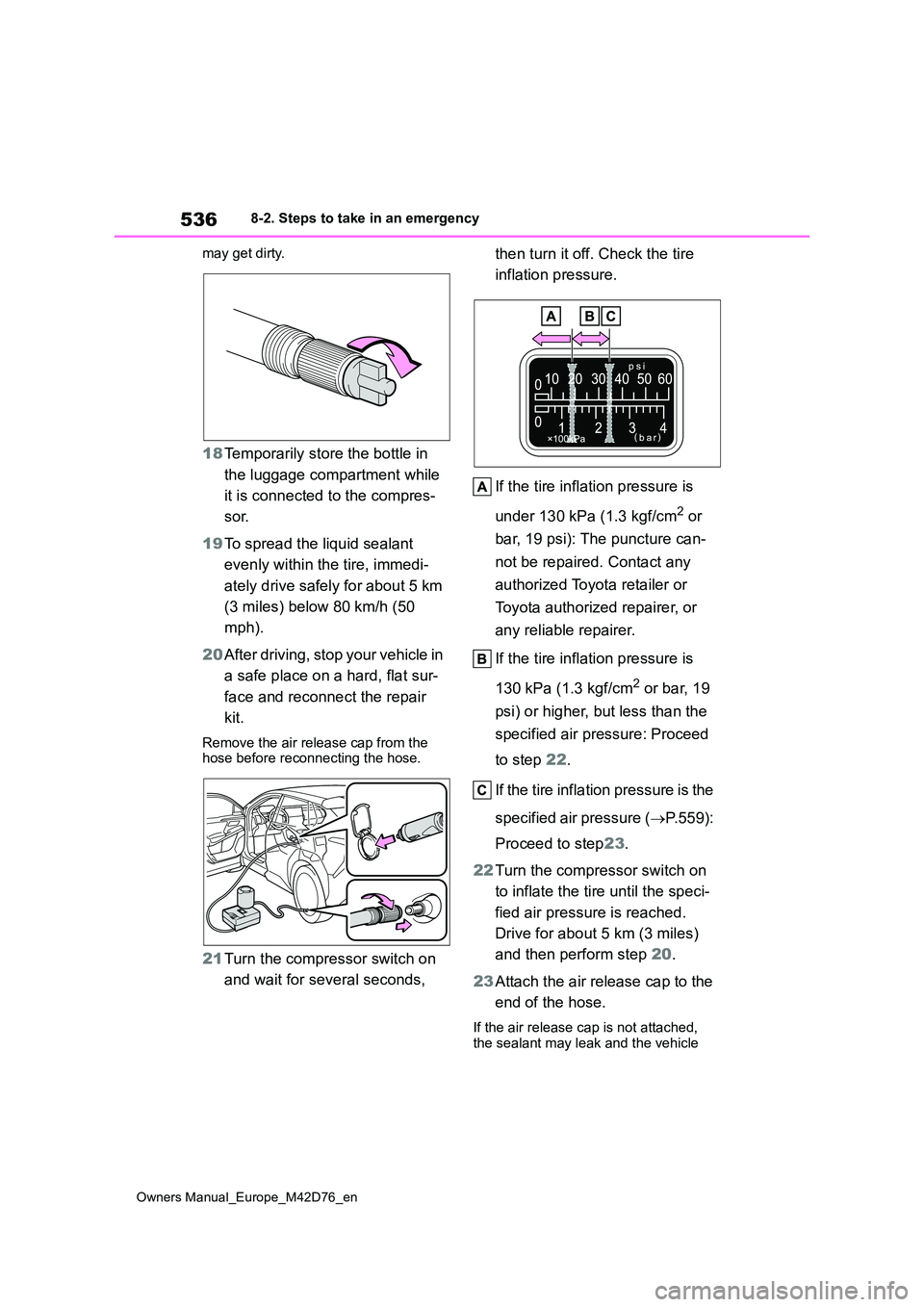
21 Turn the compressor switch on
and wait for several seconds,
then turn it off. Check the tire
inflation pressure.
If the tire inflation pressure is
under 130 kPa (1.3 kgf/cm2 or
bar, 19 psi): The puncture can-
not be repaired. Contact any
authorized Toyota retailer or
Toyota authorized repairer, or
any reliable repairer.
If the tire inflation pressure is
130 kPa (1.3 kgf/cm2 or bar, 19
psi) or higher, but less than the
specified air pressure: Proceed
to step 22.
If the tire inflation pressure is the
specified air pressure ( P.559):
Proceed to step 23.
22 Turn the compressor switch on
to inflate the tire until the speci-
fied air pressure is reached.
Drive for about 5 km (3 miles)
and then perform step 20.
23 Attach the air release cap to the
end of the hose.
If the air release cap is not attached, the sealant may leak and the vehicle
Page 539 of 674
537
8
Owners Manual_Europe_M42D76_en
8-2. Steps to take in an emergency
When trouble arises
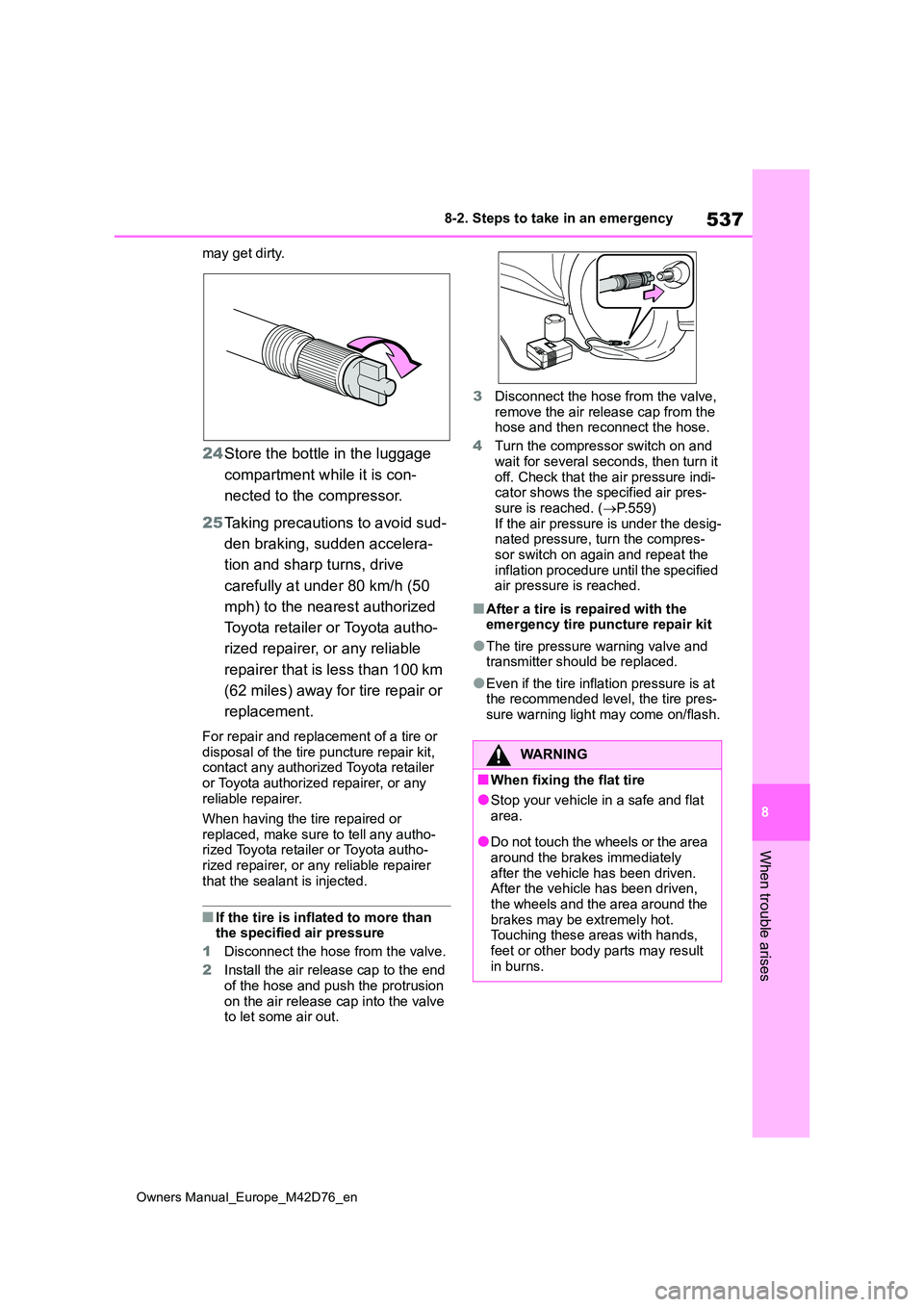
may get dirty.
24Store the bottle in the luggage
compartment while it is con-
nected to the compressor.
25 Taking precautions to avoid sud-
den braking, sudden accelera-
tion and sharp turns, drive
carefully at under 80 km/h (50
mph) to the nearest authorized
Toyota retailer or Toyota autho-
rized repairer, or any reliable
repairer that is less than 100 km
(62 miles) away for tire repair or
replacement.
For repair and replacement of a tire or disposal of the tire puncture repair kit, contact any authorized Toyota retailer
or Toyota authorized repairer, or any reliable repairer.
When having the tire repaired or
replaced, make sure to tell any autho- rized Toyota retailer or Toyota autho-rized repairer, or any reliable repairer
that the sealant is injected.
■If the tire is inflated to more than the specified air pressure
1 Disconnect the hose from the valve.
2 Install the air release cap to the end of the hose and push the protrusion
on the air release cap into the valve to let some air out.
3 Disconnect the hose from the valve,
remove the air release cap from the hose and then reconnect the hose.
4 Turn the compressor switch on and wait for several seconds, then turn it
off. Check that the air pressure indi- cator shows the specified air pres-sure is reached. ( P.559)
If the air pressure is under the desig- nated pressure, turn the compres-sor switch on again and repeat the
inflation procedure until the specified air pressure is reached.
■After a tire is repaired with the emergency tire puncture repair kit
●The tire pressure warning valve and transmitter should be replaced.
●Even if the tire inflation pressure is at the recommended level, the tire pres-
sure warning light may come on/flash.
WARNING
■When fixing the flat tire
●Stop your vehicle in a safe and flat
area.
●Do not touch the wheels or the area
around the brakes immediately after the vehicle has been driven. After the vehicle has been driven,
the wheels and the area around the brakes may be extremely hot. Touching these areas with hands,
feet or other body parts may result in burns.
Page 540 of 674
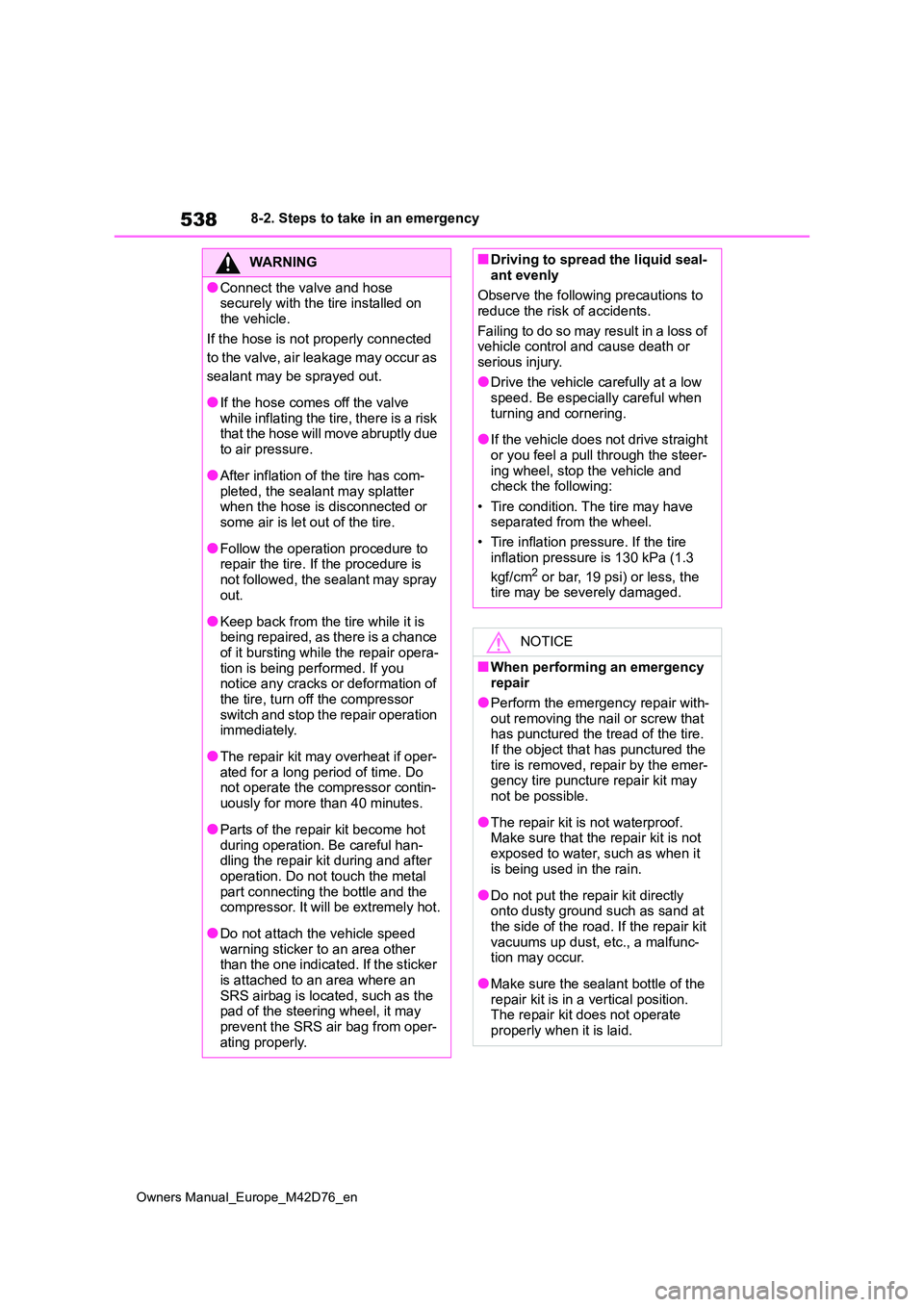
538
Owners Manual_Europe_M42D76_en
8-2. Steps to take in an emergency
WARNING
●Connect the valve and hose securely with the tire installed on
the vehicle.
If the hose is not properly connected
to the valve, air leakage may occur as
sealant may be sprayed out.
●If the hose comes off the valve while inflating the tire, there is a risk that the hose will move abruptly due
to air pressure.
●After inflation of the tire has com-
pleted, the sealant may splatter when the hose is disconnected or some air is let out of the tire.
●Follow the operation procedure to repair the tire. If the procedure is
not followed, the sealant may spray out.
●Keep back from the tire while it is being repaired, as there is a chance of it bursting while the repair opera-
tion is being performed. If you notice any cracks or deformation of the tire, turn off the compressor
switch and stop the repair operation immediately.
●The repair kit may overheat if oper-ated for a long period of time. Do not operate the compressor contin-
uously for more than 40 minutes.
●Parts of the repair kit become hot
during operation. Be careful han- dling the repair kit during and after operation. Do not touch the metal
part connecting the bottle and the compressor. It will be extremely hot.
●Do not attach the vehicle speed warning sticker to an area other than the one indicated. If the sticker
is attached to an area where an SRS airbag is located, such as the pad of the steering wheel, it may
prevent the SRS air bag from oper- ating properly.
■Driving to spread the liquid seal-ant evenly
Observe the following precautions to
reduce the risk of accidents.
Failing to do so may result in a loss of vehicle control and cause death or
serious injury.
●Drive the vehicle carefully at a low speed. Be especially careful when
turning and cornering.
●If the vehicle does not drive straight
or you feel a pull through the steer- ing wheel, stop the vehicle and check the following:
• Tire condition. The tire may have separated from the wheel.
• Tire inflation pressure. If the tire
inflation pressure is 130 kPa (1.3
kgf/cm2 or bar, 19 psi) or less, the tire may be severely damaged.
NOTICE
■When performing an emergency repair
●Perform the emergency repair with-
out removing the nail or screw that has punctured the tread of the tire. If the object that has punctured the
tire is removed, repair by the emer- gency tire puncture repair kit may not be possible.
●The repair kit is not waterproof. Make sure that the repair kit is not
exposed to water, such as when it is being used in the rain.
●Do not put the repair kit directly onto dusty ground such as sand at the side of the road. If the repair kit
vacuums up dust, etc., a malfunc- tion may occur.
●Make sure the sealant bottle of the repair kit is in a vertical position. The repair kit does not operate
properly when it is laid.
Page 561 of 674
559
9
Owners Manual_Europe_M42D76_en
9-1. Specifications
Vehicle specifications
*1: Minimum pedal clearance when depressed with a force of 300 N (31 kgf, 66 lbf)
while the EV system is operating.
*2: Make sure to confirm that the brake system warning light (yell ow) does not illumi-
nate. (If the brake system warning light illuminates, refer to P.515)
*3: Left-hand drive vehicles
*4: Right-hand drive vehicles
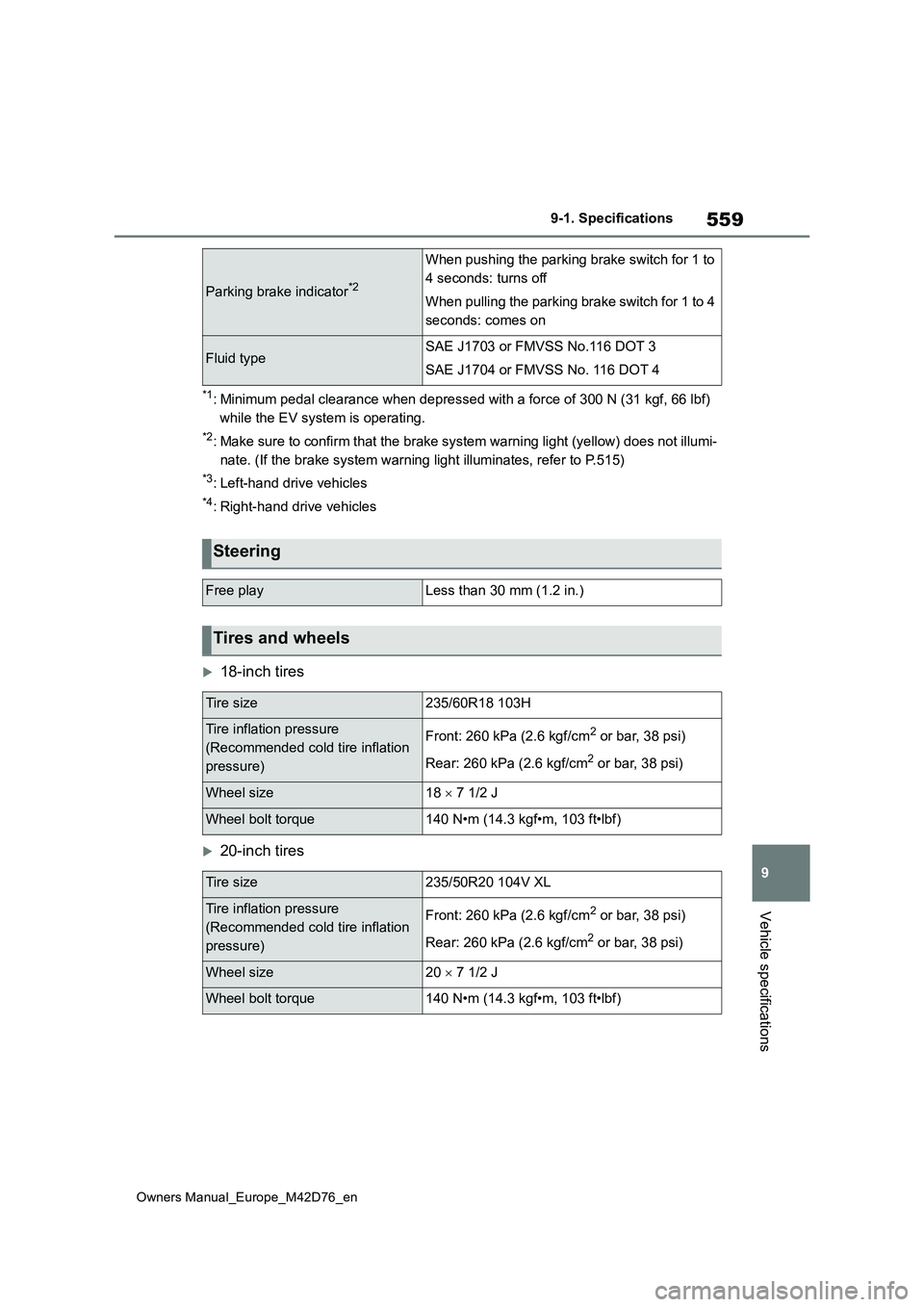
18-inch tires
20-inch tires
Parking brake indicator*2
When pushing the parking brake switch for 1 to
4 seconds: turns off
When pulling the parking brake switch for 1 to 4
seconds: comes on
Fluid typeSAE J1703 or FMVSS No.116 DOT 3
SAE J1704 or FMVSS No. 116 DOT 4
Steering
Free playLess than 30 mm (1.2 in.)
Tires and wheels
Tire size235/60R18 103H
Tire inflation pressure
(Recommended cold tire inflation
pressure)
Front: 260 kPa (2.6 kgf/cm2 or bar, 38 psi)
Rear: 260 kPa (2.6 kgf/cm2 or bar, 38 psi)
Wheel size18 7 1/2 J
Wheel bolt torque140 N•m (14.3 kgf•m, 103 ft•lbf)
Tire size235/50R20 104V XL
Tire inflation pressure
(Recommended cold tire inflation
pressure)
Front: 260 kPa (2.6 kgf/cm2 or bar, 38 psi)
Rear: 260 kPa (2.6 kgf/cm2 or bar, 38 psi)
Wheel size20 7 1/2 J
Wheel bolt torque140 N•m (14.3 kgf•m, 103 ft•lbf)
Page 562 of 674
560
Owners Manual_Europe_M42D76_en
9-1. Specifications
■When towing a trailer
Add 20.0 kPa (0.2 kgf/cm2 or bar, 3 psi) to the recommended tire inflation pressure
and drive at speeds below 100 km/h (62 mph).
Page 576 of 674
574
Owners Manual_Europe_M42D76_en
9-3. Initialization
9- 3. In it ia li za ti on
*: If equipped
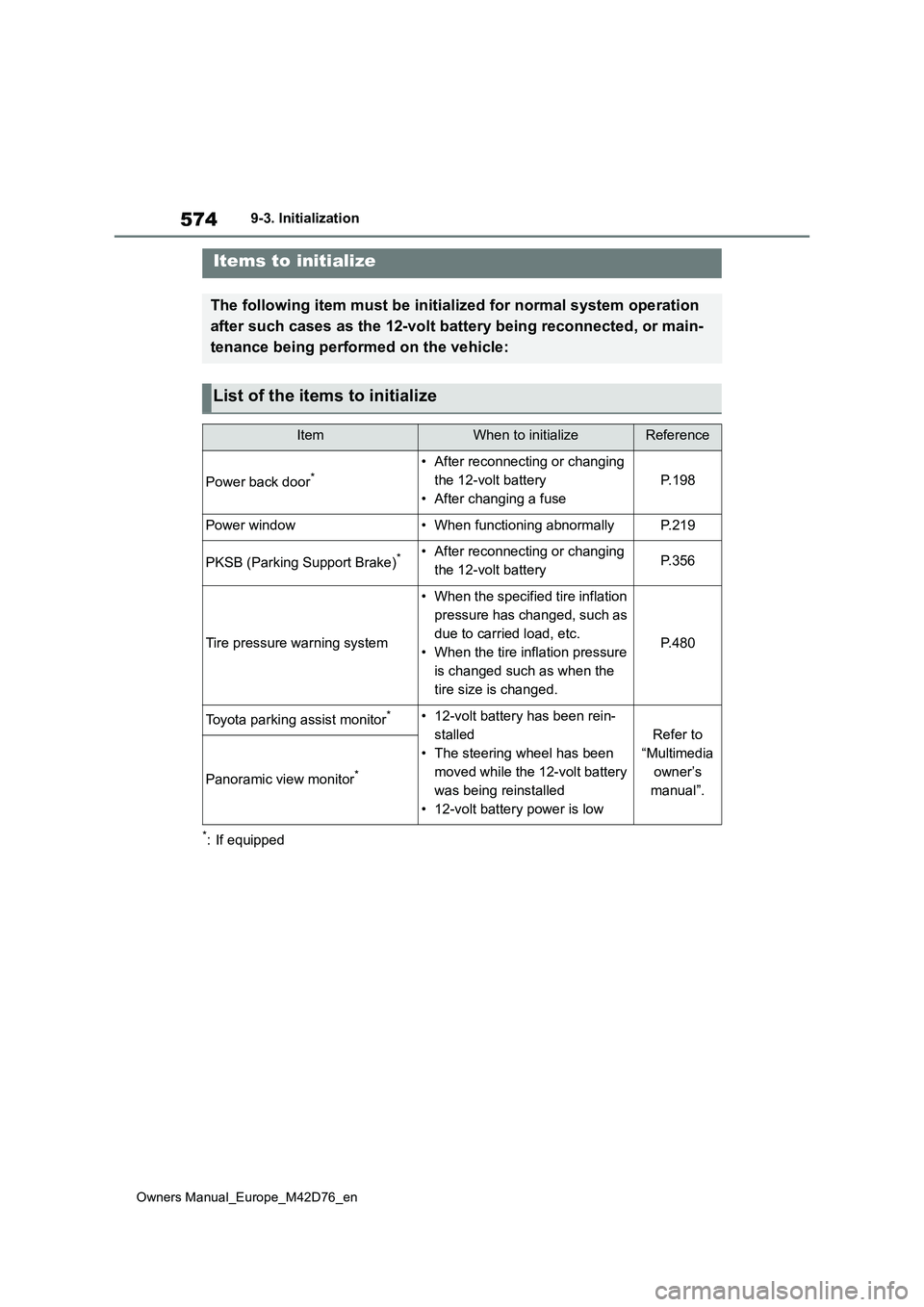
Items to initialize
The following item must be initialized for normal system operation
after such cases as the 12-volt battery being reconnected, or m ain-
tenance being performed on the vehicle:
List of the items to initialize
ItemWhen to initializeReference
Power back door*• After reconnecting or changing
the 12-volt battery
• After changing a fuse
P. 1 9 8
Power window• When functioning abnormallyP. 2 1 9
PKSB (Parking Support Brake)*• After reconnecting or changing
the 12-volt batteryP. 3 5 6
Tire pressure warning system
• When the specified tire inflation
pressure has changed, such as
due to carried load, etc.
• When the tire inflation pressure
is changed such as when the
tire size is changed.
P. 4 8 0
Toyota parking assist monitor*• 12-volt battery has been rein-
stalled
• The steering wheel has been
moved while the 12-volt battery
was being reinstalled
• 12-volt battery power is low
Refer to
“Multimedia
owner’s
manual”.Panoramic view monitor*
Page 579 of 674
577
Owners Manual_Europe_M42D76_en
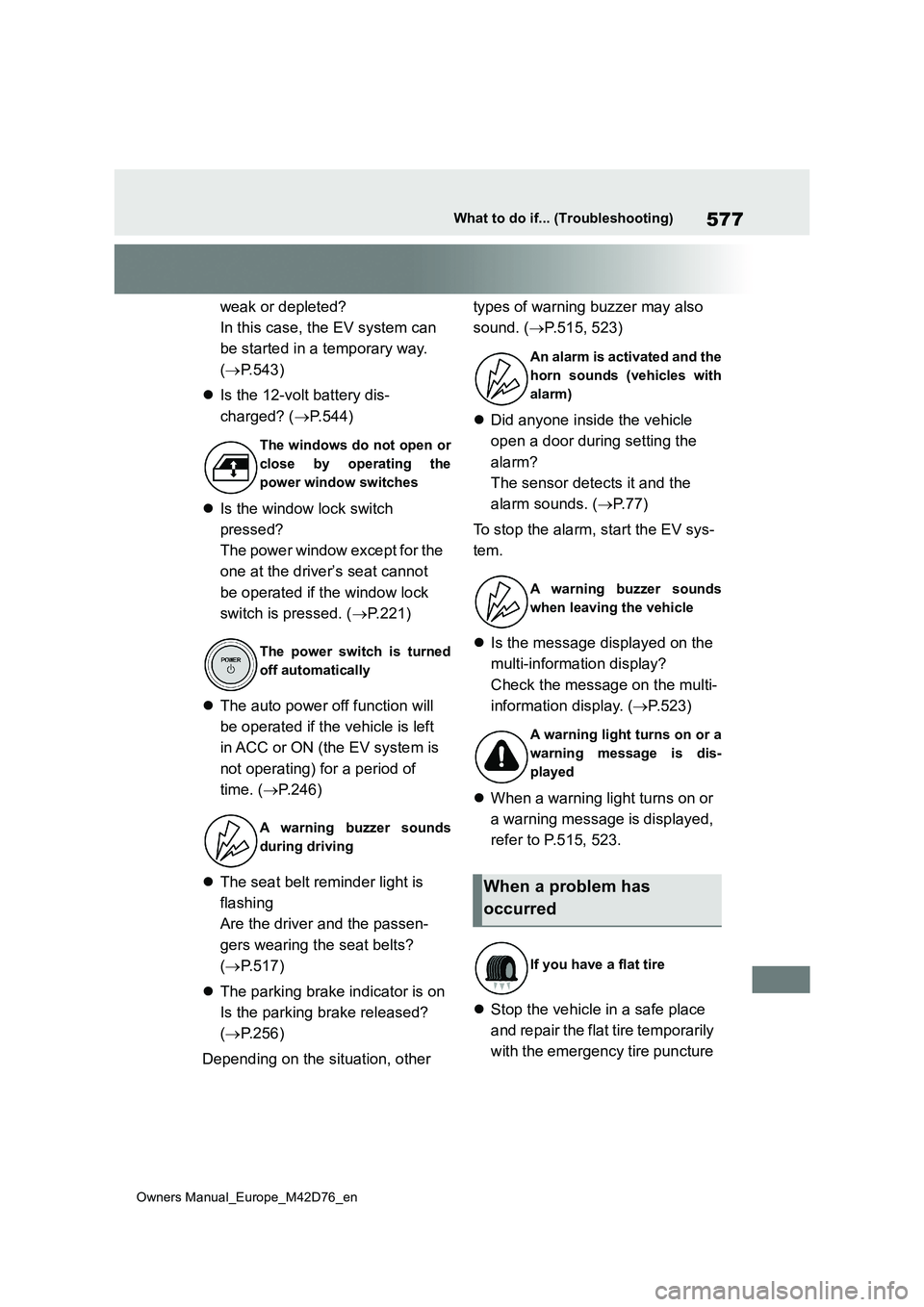
What to do if... (Troubleshooting)
weak or depleted?
In this case, the EV system can
be started in a temporary way.
( P.543)
Is the 12-volt battery dis-
charged? ( P.544)
Is the window lock switch
pressed?
The power window except for the
one at the driver’s seat cannot
be operated if the window lock
switch is pressed. ( P.221)
The auto power off function will
be operated if the vehicle is left
in ACC or ON (the EV system is
not operating) for a period of
time. ( P.246)
The seat belt reminder light is
flashing
Are the driver and the passen-
gers wearing the seat belts?
( P.517)
The parking brake indicator is on
Is the parking brake released?
( P.256)
Depending on the situation, other
types of warning buzzer may also
sound. ( P.515, 523)
Did anyone inside the vehicle
open a door during setting the
alarm?
The sensor detects it and the
alarm sounds. ( P.77)
To stop the alarm, start the EV sys-
tem.
Is the message displayed on the
multi-information display?
Check the message on the multi-
information display. ( P.523)
When a warning light turns on or
a warning message is displayed,
refer to P.515, 523.
Stop the vehicle in a safe place
and repair the flat tire temporarily
with the emergency tire puncture
The windows do not open or
close by operating the
power window switches
The power switch is turned
off automatically
A warning buzzer sounds
during driving
An alarm is activated and the
horn sounds (vehicles with
alarm)
A warning buzzer sounds
when leaving the vehicle
A warning light turns on or a
warning message is dis-
played
When a problem has
occurred
If you have a flat tire
Page 585 of 674
583
Owners Manual_Europe_M42D76_en
Alphabetical Index
Driving range ................................ 172
Driving support system information
display ......................................... 177
Dynamic radar cruise control .... 307,
316
Approach warning ...................... 313
Curve speed reduction function . 313
Road Sign Assist (RSA) ............. 314
Warning lights ............................ 520
E
eCall ................................................. 65
ECB (Electronically Controlled Brake
System) ....................................... 406
Warning light .............................. 515
Eco mode ...................................... 252
Elapsed time ................................. 178
Electric motor (traction motor)
Identification number.................. 555
Location ....................................... 82
Electric Power Steering (EPS)
Function ..................................... 406
Warning light .............................. 517
Electric Vehicle system features ... 82
Electric Vehicle system precautions
....................................................... 86
Electronic key
Battery-saving function .............. 204
If the electronic key does not operate
properly.................................... 542
Replacing the battery ................. 499
Electronic sunshade .................... 442
Operation ................................... 442
Electronically Controlled Brake Sys-
tem (ECB) .................................... 406
Warning light .............................. 515
Emergency brake signal .............. 406
Emergency Driving Stop System 321
Emergency flashers ..................... 506
Emergency tire puncture repair kit
..................................................... 528
Storage location ......................... 530
Emergency, in case of
If a warning buzzer sounds ........ 515
If a warning light turns on ........... 515
If a warning message is displayed
................................................. 523
If the 12-volt battery is discharged
................................................. 544
If the electronic key does not operate
properly .................................... 542
If the EV system will not start ..... 539
If the vehicle is submerged or water
on the road is rising..................507
If you have a flat tire ................... 528
If you lose your keys ..................541
If you think something is wrong .. 513
If your vehicle becomes stuck .... 551
If your vehicle has to be stopped in
an emergency .......................... 506
If your vehicle needs to be towed
................................................. 509
If your vehicle overheats ............549
EPS (Electric Power Steering)
Function ..................................... 406
Warning light .............................. 517
EV system........................................ 82
Acoustic Vehicle Alerting System . 84
Battery Electric Vehicle driving tips
................................................... 91
Brake Override System .............. 230
Drive-start control .......................234
Driving range ................................ 93
Electric Vehicle system precautions
................................................... 86
Emergency shut off system .......... 90
Features ....................................... 82
How to use AC charging............. 121
How to use DC charging ............129
If the EV system will not start ..... 539
If your vehicle has to be stopped in
an emergency .......................... 506